IMPROVING THE EFFFECTIVENESS OF THE GRAMEEN BANK OF UGANDA
Mahati Sridhar
An honors thesis submitted to the faculty of the Kenan-Flagler Business School at the University of North Carolina at Chapel Hill
Chapel Hill 2015
ABSTRACT Mahati Sridhar
Improving the Effectiveness of the Grameen Bank of Uganda (Under the direction of Dr. Larry Chavis)
Micro-finance is a lending solution for low-income and developing regions of the world. However, creating the most effective model for microfinance requires specific tailoring for each region and each target segment. One specific organization that is facing the challenges from the lack of an effective model is the Grameen Bank in Uganda. In comparison to some of its peer institutions, the Grameen Bank has much lower women outreach and rural penetration. Through my research, I provide qualitative and
TABLE OF CONTENTS
ABSTRACT ... ii
LIST OF TABLES ... v
LIST OF FIGURES ... vi
Chapter I. Introduction ... 1
A. Microfinance Definition ... 2
B. History of Microfinance ... 2
C. Microfinance in Africa ... 4
D. Types of Microfinance Institutions ... 4
E. Bank of Uganda Current Situation ... 6
II. Literature Review ... 7
A. How effectiveness has been quantified ... 8
1. Variables ... 8
2. Limitations ... 9
B. How the Grameen Bank model is structured ... 10
1. Grameen Model ... 11
2. Microfinance Studies ... 12
1. African MFIs ... 13
III. Research Methodology ... 18
A. Data Selection ... 18
B. Quantitative Analysis ... 21
C. Qualitative Research ... 24
D. Limitations ... 26
IV. Results ... 27
A. Urban vs Rural Programs ... 29
B. Central Institutions Analysis ... 31
C. Institution Type and Location Breakdown ... 32
D. Deposits and Loans Analysis ... 33
V. Discussion ... 34
A. Recommendations ... 36
LIST OF TABLES
Table 3.1 Initial Data Selection ... 25
Table 4.1 Regression Results ... 33
Table 4.2 Data Segmented Groups ... 34
Table 4.3 Segmented Group Data Averages ... 34
LIST OF FIGURES
Figure 3.1 Narrowing Data ... 25
Figure 4.1 Rural Penetration vs Women Outreach Graph ... 33
Figure 4.2 Four Central Institutions ... 36
I. INTRODUCTION
Microfinance is a popular lending solution for low-income and developing regions of the world. However, there are many different types of institutions with a variety of methods of reporting their success. My research will attempt to provide the Grameen Foundation of Uganda with recommendations for improving their programs based on a quantitative and qualitative analysis of other similar organizations.
My interest in microfinance stems from Muhammad Yunus’ Banker to the Poor (1999). Mohammad Yunus discussed his experiences with poverty and inequality in
many of the homes and villages across Southeast Asia. He implemented a micro-lending
program, called the Grameen Foundation, to stimulate the economies in these
impoverished centers through short-term investments in handicrafts, farm tools, and
small-scale manufacturing shops (Yunus, 1999). As a result, families gained additional
income to spend on food and education for their children. The Grameen Foundation is
extremely successful in Southeast Asia, but the same model is struggling in other geographic areas of the world—specifically in Africa. According to the Grameen
In this next section, I will give define more broadly what microfinance is and provide a brief overview of the history of microfinance, with a deeper look at
microfinance in Africa, the various types of microfinance institutions, and an understanding of the current situation at the Grameen Bank of Uganda.
Microfinance Definition
Microfinance is a term defined for the “formal and informal institutions offering financial services to the poor” (Brau & Woller, 2004). Microfinance aims at providing smaller (micro) loans with low interest to low-income individuals to help further their small businesses, agricultural practices, and other needs. Microfinance is practiced all around the world—extending financial inclusion universally.
History of Microfinance
Microfinance has been around for centuries in many informal manners in different cultures. For instance, “chit funds” in India, “tontines” in West Africa, “tandas” in
Mexico, and “susus” in Ghana are all names for informal microfinance lending practices deeply rooted in these cultures (Helms & Goodwin-Groen, 2006).
One of the earliest documented forms of a formal microfinance institution was the Irish Loan Fund, founded in the 1700s by Jonathan Swift (Helms & Goodwin-Groen, 2006). Swift created funds across Ireland to stimulate the growing agrarian economy (Helms & Goodwin-Groen, 2006). At one point, the Irish Loan Fund accounted for 20% of all Irish lending activity (Helms & Goodwin-Groen, 2006).
considered as customers at these formal lending institutions (Yunus, 1999). The number of microfinance programs remained stagnant as the demand grew.
The importance of microfinance resurfaced in the 20th
century with specific programs targeted at agricultural and craft markets in lesser-developed countries (LDCs). These rural programs initially failed because the rural development banks could not maintain their capital pool as a result of subsidized lending interest rates and low repayment rates. Additionally, much of this capital remained in the hands of a few fortunate farmers, while majority of the poor farmers could not gain access (Helms & Goodwin-Groen, 2006).
In the 1970s, Muhammad Yunus—the father of modern day microfinance— experimented with micro-lending in groups. By incorporating the social component, the loan repayments drastically increased and these programs brought much needed capital and credit opportunities to the poorest of communities. The social component involved creating small lending groups consisting of non-family members. These members held each other accountable for making loan repayments. If a single member did not make a payment, the entire group faced the repercussions.
Today, there are hundreds of thousands of microfinance banks and communities throughout the world. Some of the largest and most well-known institutions include:
• ACCION International
• Grameen Bank
• SEWA Bank
Microfinance in Africa
Microfinance in Africa has as deep of roots as the rest of the global community— with informal group lending practices popular all throughout the continent. However, formal lending institutions, particularly those with access to the poor, never gained traction in history up until recently. Through the early part of the 20th
century, the average financial inclusion rate for an African nation was a mere 25%--meaning majority of the population did not have access to a financial institution (Jarotschkin, 2013). As a result, introducing such practices has been difficult because the culture in many rural parts of Africa is not accustomed to an external party managing family and business financials (Maarse, 2014). However once more established organizations, such as the Grameen Bank and ACCION International, began to branch off with working microfinance institution (MFI) models, financial inclusion started to grow in Africa (Linthorst, 2013).
As of today, “Africa’s microfinance industry has been growing” (Jarotschkin, 2013). Since 2013, the number of microfinance institutions in Africa has increased by 5.3% (Cull, 2014). This growth is attributed to increased political stability throughout the region, and technological advances that have improved connectivity and communication from rural villages to urban settings (Basu & Blavy, 2004). This industry “weathered the financial crisis better than most industries, according to asset growth rates” and is poised to continue to grow rapidly over the next twenty years (Jarotschkin, 2013).
Types of Microfinance Institutions
• Microfinance Institutions (MFIs)
• Micro-depository Institutions (MDIs)
• Microfinance banks (MfBs)
• Savings and credit Cooperatives (SACCOs)
A microfinance institution is a more common term for a micro-lending institution. These organizations specialize in making loans. They do not have a depository function;
therefore, they cannot store money for clients. Micro-depository institutions are a step up and include the ability to receive deposits as well as make loans. In order to take deposits, these organizations must be registered with their respective countries in order to conduct business. MFIs do not have this requirement. Microfinance banks are capable of making loans and taking deposits. These institutions are usually subgroups from a government bank or local commercial bank. As a result, these programs are more stable but follow very traditional lending practices. Finally, SACCOs also have the ability to make loans and receive deposits. However, these organizations are completely government owned and receive their funding solely from the government budgets. These organizations are popular in many African nations, included Uganda and Kenya (Kariobangi, 2012). Grameen Bank of Uganda Current Situation
This program is based out of Kampala, the Ugandan capital. Most of the Grameen offices are located in the southern, more urban portion of the country. Their mission is to empower the rural through lending primarily to women (Cheston, 2002). Currently, the Grameen Bank program is popular with urban women—with over 20% women outreach. This number is much higher than other micro-lending institutions in the region. However, the Grameen Bank is suffering with its focus on improving rural villages and providing increased opportunities for these villagers.
II. LITERATURE REVIEW
The realm of microfinance is vast and well researched. The analyses range anywhere from historical comparisons of programs, to studies that quantify the effectiveness of these financial institutions. For this literature review, I will discuss:
• How effectiveness has been quantified
• How the Grameen Foundation model for microfinance is structured
• How other models in Africa compare
• How new innovations have stemmed in this field
This research will serve as a foundation and background for my thesis.
How effectiveness has been quantified
This section will discuss how the effectiveness of microfinance programs has been quantified with a focus on the variables measured and the limitations associated with these methods.
Variables
Multiple studies and reports have been created that quantify the effectiveness of microfinance institutions. I will group these studies and discuss their respective
contributions to this space based on the variables they have. The variables are:
• Rate of repayment
• Average loan sizes
• Percentage of rural clients
• Percentage of rural automated teller machines (ATMs) / points of sale (POS)
• Percentage of women borrowers
• Contraceptive use
• Children’s nutrition
The first two variables, number of depositors and rate of repayment, are the most common variables used to quantify the effectiveness of microfinance practices. These variables are used in Measuring the Impact of Microfinance by Odell (2010), From Financial Exclusion to Formal Inclusion: Empirical Evidence from the Microfinance and
Disability Project in Uganda by Maarse (2014), Financial Sector Development in Africa
by Jarotschkin (2013), and Microfinance in Ghana: an Overview by Asaima (2007). All of these articles cite number of depositors and rate of repayment as crucial indicators of the microfinance institution’s health.
If the number of depositors does not remain constant or positive, the MFI faces the danger of a shrinking lending population (Maarse, 2014). If the rate of repayment is not positive, then the MFI is not receiving enough of its principal back through monthly payments and cannot lend additional credit out to prospective new clientele (Maarse, 2014). Additionally, these variables are easy to measure given that each MFI carefully records each depositor in the books, as well as the monthly loan payments.
Financial Sector Development in Africa. These variables are used to paint a demographic
picture of the types of clients each MFI serves. The average loan size variable correlated strongly with the use of the loan. For instance, longer loans (36-60 months) typically involved agrarian based investments. While shorter loans (12-24 months) typically involved handicraft based investments (Jarotschkin, 2013). The percentage rural clients and the percentage of rural ATMs measured the financial inclusion of MFIs in rural African towns and villages. This metric is important because more than 70% of Africa’s population live in rural areas (Rural Poverty Portal, 2009). In the past twenty years, these variables have dramatically increased (Jarotschkin, 2013).
(2013) acknowledge the breadth of impact women in microfinance programs have on their families and therefore chose these variables accordingly.
Limitations
Though all these variables are popular for quantifying effectiveness, they present certain limitations when interpreting the data. First and foremost, the data collection process, especially for the noneconomic variables, is heavily reliant on self-reported data. In doing so, only certain populations that may be comfortable reporting or being
submitted to medical tests in order to determine their level of effectiveness (Maarse, 2014). Additionally, many women may not feel comfortable sharing this data because of certain social stigmas in their family structure—if they are found to be too “empowered,” they could be ostracized by their families and communities for overstepping cultural bounds (Odell, 2010; Maarse 2014).
How the Grameen Bank model is structured
For my analysis, I chose the Grameen Bank model in Uganda to analyze and compare to various other microfinance models in the African region. I selected this model because I have access to data and people working within this organization. In this section, I will discuss the Grameen model in depth and discuss some of the limitations of the model as discovered through various case studies.
Grameen Model
Muhammad Yunus in the 1970s to address the extreme poverty in Bangladesh. This organization has since gone international, with locations in many countries all across the globe (Yunus, 1999).
The Grameen Bank is a peer lending solution that relies on the idea of social capital (Yunus, 1999). Borrowers form groups of five or seven non-family members to receive a base loan amount. These individuals go through a brief training with the Grameen Bank to understand lending practices and basics of financial institutions. Following the training, the group receives a small base amount that anyone from the group, upon group consensus, may receive as a loan. Once a week, the group will meet and the member(s) with loans must repay. For every successfully repaid loan, the group receives additional principal to increase the base loan pool. For every default, the group is ineligible for a new loan (Yunus, 1999).
This model, though very successful, has been criticized by many on varying grounds. I will review several studies that analyze this specific model in Bangladesh as well as in other geographic locations.
Microfinance Studies
average, it takes the average client eight years to rise above the poverty line, with consistent participation and lending practices with the Grameen Bank (Magner, 2007). With all of these downfalls, Magner concludes that the Grameen Bank is an effective solution, but only to a specific niche market of poverty. The poverty group that lies in the top 50% of households below the poverty line tends to see more success with the
Grameen Bank model in comparison to those of extreme poverty (the bottom 50% of households below the poverty line) (Magner, 2007).
In another study, Morduch (1999) analyzes the role of subsidies in the success of the Grameen Bank. The subsidies allow the Bank to function despite low loan
repayments. As a result, these subsidies created the illusion that the Bank had very high repayment rates (>98% repayment). This was not the case; close to 10% of the portfolio defaulted, meaning that the clients did not meet their loan repayment. In the following years, as the volume of loans and clients grew, so did the percentage of portfolio defaults. In 1996, there was close to 24% default rate. However, because of the continual subsidies from private donors, government entities, and interest payments, these defaults were not issued the proper repercussions as they would if the client was lending from a standard commercial bank.
In Odell’s 2010 study, she poses the question: Does microfinance work? She analyzes this question based on a case study analysis of the Grameen Bank and a comparison of various studies on the topic. The conclusions were very similar to Magner’s conclusions. Odell concluded the Grameen Bank is an effective method to alleviate poverty for the “entrepreneurial poor” (Odell, 2010). For other population segments, the success rate is much lower and not as consistent.
Odell proposes that in order for microfinance to be a “tool to alleviate poverty,” a suite of programs and products must be offered. Similar to ACCION International and Kiva, institutions should provide lending and saving institutions. In doing so, these institutions are teaching their clients to be financially aware individuals (Odell, 2010).
The final study I looked at is Schreiner’s Cost-Effectiveness Analysis of the Grameen Bank of Bangladesh (2003). In this study, Schreiner conducts a cost-benefit
present value analysis of the Grameen Bank understand whether or not this industry is a lucrative investment. His findings state that this specific MFI, and more broadly, this industry, as a whole, is worth the investment.
encourages MFIs to reach out into the rural and financially excluded areas of the country through additional subsidies (Maarse, 2014).
How other African models compare
In this section, I will look at other models that are popular in Africa and what unique innovations they have implemented to increase their outreach and overall effectiveness.
African MFIs
Within Africa, there have been several successfully implemented MFIs with very different structures and offerings. A few studies have been conducted on specific MFI organizations, analyzing their journey and their effectiveness. In this section, I will highlight examples from: Kenya, Nigeria, and Uganda.
Kenya
The first example is the Sinapi Abi Trust in Kenya. This program is sponsored in collaboration with the commercial Bank of Kenya (Asaima, 2007). Historically, the Bank of Kenya had a branch focused solely on small and medium scale enterprises (SMSEs); this branch also solicited their equivalent of microloans. However, due to high default rates, this branch was quickly shut down. As a result, many of Kenya’s rural and urban poor did not have access to the much-needed funds.
group grew and the Bank of Kenya reached out for a partnership and offered a larger pool of capital to distribute loans from (Asaima, 2007).
Asaima (2007) analyzes this group’s history and its current synergy with the government and concludes that such integration is only possible with a stable political system and a strong subsidy base. Kenya’s government stabilized after the early 1980s and with the Bank of Kenya supporting the Sinapi Abi Trust, up to 20% of the defaults are backed (Asaima, 2007).
Nigeria
In Nigeria, Yahaya (2011) did a study to understand the effect of microfinance ventures in the Kwara State of Nigeria. His findings revealed that the microfinance institutions have the ability to “greatly impact the economy, for the better” (Yahaya, 2011). As a result, Yahaya recommends that the government partner with these entities to provide the proper infrastructure and transportation methods to most efficiently meet the populations in need of these financial services. Currently, 60% of all Nigerian MFIs are located in urban settings while 70% of the need for MFIs is in rural settings (Yahaya, 2011). However, Yahaya discusses how such partnership may not be possible for the near future given the political instability within Nigeria (Yahaya, 2011).
In both of these sources, Yahaya (2011) and Asaima (2007) highlight the importance of government interaction and government synergies in order to further the reach of microfinance institutions.
Uganda
Kirya’s overview of The State of Microfinance in Uganda (2013). Then, I will compare Jarotschkin’s (2013) specific examples from the space, as well as the Grameen Bank’s presence in Uganda.
Kagaba and Kirya (2013) present an overview of the financial sector of Uganda and discuss how microfinance plays a large role in the country’s financial activities. However, the Ugandan government poses unique requirements of such organizations within the country. These organizations must be recognized and registered with the government in order to serve as depository institution (MDIs) (Kagaba & Kirya, 2013). Without this government recognition, MFI organizations can only lend; they cannot hold the savings of individuals or accumulate interest from payments for an increased
principal base (Kagaba & Kirya, 2013).
Additionally, Kagaba and Kirya (2013) recognize the major problem within Uganda—majority of the microfinance need lies in the northern rural populations while most of the microfinance institutions are based in southern urban areas. This issue appears to be a consistent theme throughout the entire African region.
Jarotschkin (2013) discusses how certain microfinance institutions within Uganda have implemented interesting partner programs to grow their depositor rates. One
noteworthy initiative focused on women empowerment. Jarotschkin (2013) found that one MFI with 68% women borrowers had a much higher repayment rate in comparison to an MFI with a rate closer to 50% women borrowers.
with 27% of the growth in rural regions (Tortora, 2014). These devices increase access to rural Africa, regions that Basu and Blavy (2004) describe as “financial deserts” or regions with little to no access to financial institutions. Understanding that this was a problem, the Bill & Melinda Gates Foundation funded a mobile money initiative in Uganda
(Kendall, 2012). Mobile money has been a rapidly growing program all over the world to help increase access to financial services; this industry has predicted growth of 63% by 2017 (Kurkinen, 2012). This program utilizes virtual money to facilitate financial
obligations between various parties (Kendall, 2012). This program provides a secure and safe alternative to the typical brick and mortar lending facility while increasing ease of access through a secure wireless network.
Finally, Linthorst (2013) discusses why the Grameen Bank of Uganda is not as successful as many of its other global locations. The structure of the Grameen Bank MFI relies on social capital of non-family members and the interaction with a financial loan officer once a week (Yunus, 1999). Linthorst (2013) found that the family unit is very strong within Uganda and the base population prefers to lend within family than without. Additionally, given the political instability outside urban settings, the loan officer may not be able to travel to the various groups and centers for the weekly meetings. Though the Grameen Bank has made constant strides to reach out to the rural populations, the inconsistency has cast a negative light on the reputation of the Grameen Bank in Uganda (Linthorst, 2013).
After understanding all of the existing literature, I recognize that there is a need to fix the Grameen Bank’s model, specifically for Uganda. Many of the researchers
various microfinance institutions, but none of the researchers attempt to take a specific model and improve the institution within Uganda. Additionally, many of the researchers look solely at quantitative variables or qualitative variables. I hope to analyze the
III. RESEARCH METHODOLOGY
My research methodology will include both qualitative and quantitative analysis to determine how to best improve the Ugandan Grameen Bank model. A quantitative analysis will be conducted first to group together similar microfinance institutions to better compare the Grameen Foundation to others in its peer group. Once these groups are established, I will conduct a qualitative analysis to highlight the similarities and differences across the groups and institutions.
This section will discuss: data selection, quantitative analysis, qualitative analysis, and limitations.
Data Selection
My quantitative approach to my research involves comparing various
microfinance institutions, of the hundreds that exist, to the Grameen Bank of Uganda to gauge a sense of its effectiveness against similar organizations. I chose my microfinance institutions based on the following criteria:
1) Organizations that lie in the central and eastern regions of the African subcontinent
3) Organizations with data reported on the Microfinance Information Exchange (MIX, 2014a, b, c, d)
I am looking at the countries in this geographic location because the
demographics and geographic layout of the countries are fairly similar to Uganda—with a large percentage of the microfinance organizations located in urban settings and a large percentage of the need located in rural villages (Linthorst, 2013). The countries I chose are: Kenya, Nigeria, Tanzania, and Uganda because Linhorst (2013) used a similar set of countries in his comparison for his research on microfinance inclusion and policy.
I narrowed my scope to three specific types of organizations—MFIs, MDIs, and banks—because both the micro-depository and the bank-owned organizations seem to be gaining popularity in other countries and may present possible solutions for the Ugandan Grameen Bank. Please refer back to the literature review for more in depth explanation for the differences between these three types of organizations.
Finally, the selected organizations have some data present in the Microfinance Information Exchange (MIX, 2014a, b, c, d). There are more than 100 different
institutions that offer microfinance products in each of the four countries I am looking at. However, most of these organizations have outdated data and no updated profiles. After filtering the data, only 50 organizations have consistent published data from 2013. From there, I excluded organizations labeled as SACCOs (savings and credit cooperatives). These organizations are collaborated institutions that are typically partnered with
Figure 3.1: Narrowing Data
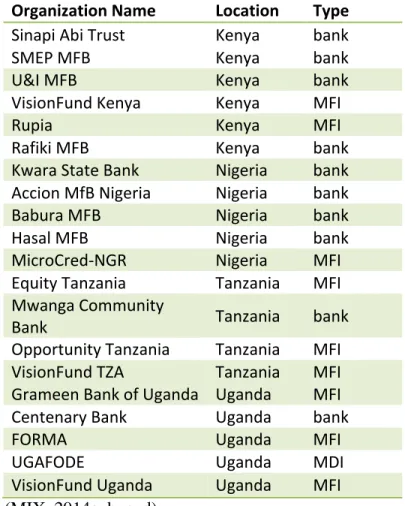
In the end, I have 20 selected organizations. Below is a table with my selected organizations, their location, and their type of microfinance organization.
Table 3.1: Initial Data Selection
Organization Name Location Type
Sinapi Abi Trust Kenya bank
SMEP MFB Kenya bank
U&I MFB Kenya bank
VisionFund Kenya Kenya MFI
Rupia Kenya MFI
Rafiki MFB Kenya bank
Kwara State Bank Nigeria bank
Accion MfB Nigeria Nigeria bank
Babura MFB Nigeria bank
Hasal MFB Nigeria bank
MicroCred-‐NGR Nigeria MFI
Equity Tanzania Tanzania MFI
Mwanga Community
Bank Tanzania bank
Opportunity Tanzania Tanzania MFI
VisionFund TZA Tanzania MFI
Grameen Bank of Uganda Uganda MFI
Centenary Bank Uganda bank
FORMA Uganda MFI
UGAFODE Uganda MDI
VisionFund Uganda Uganda MFI
(MIX, 2014a, b, c, d)
Of the 20 organizations, about 60% (12 out of 20) have full MIX-market profiles; including a comprehensive profile and metric information. About 50% (10 out of 20) publish annual reports separate from the MIX-market database. 75% (9 out of 12) of the
100 total organizations
50
organizations w/ current
data
organizations that publish data on MIX-market also have separate annual reports
available off the organizations’ websites. 20% (4 out of 20) of the organizations provide only basic metrics and do not have any form of reporting extensive financial data.
All of the data I will be analyzing is self-reported data from each of the institutions; therefore, the data may contain some bias in terms of what data each
institution chooses to report and withhold. Additionally, I understand that by limiting the types of organizations and the locations of these organizations, I may not be addressing all of the possible factors that contribute to successful MFIs.
Quantitative Analysis
My quantitative analysis serves as the first step for my research. I have used some commonly used financial ratios as well as a few variables I created to help quantify the effectiveness of my selected microfinance institutions. My goal is to find a relationship between any of these variables to help segment my data for my qualitative analysis of the programs offered by these institutions. I will run regressions to determine the correlations between the different variables to find out if there is any causal relationship between any two factors. In the end, I will compare the various segmented groups to the Grameen Foundation to best provide recommendations for how the Grameen Bank of Uganda can improve its operations and outreach.
The variables I will be using in my analysis are:
• Capital Asset Ratio
• Debt/Equity Ratio
• Deposits/Loans
• Cost/Depositor
• % Women Outreach
• % Rural Penetration
• % Technology Integration
The capital-asset ratio compares a financial institution’s risk by comparing the capital available to the risk weighted assets. This ratio is often represented as a
percentage to promote the “stability and efficiency of various financial systems and institutions” (“CAR”, 2013). This rate is calculated by:
𝑇𝑜𝑡𝑎𝑙 𝐶𝑎𝑝𝑖𝑡𝑎𝑙 𝑇𝑜𝑡𝑎𝑙 𝐴𝑠𝑠𝑒𝑡𝑠
Ultimately, this variable is assessing whether or not a financial institution or business has enough capital to support its assets. A higher capital-to-asset ratio indicates the
organization is more stable than a lower ratio.
The debt/equity ratio is another popular financial ratio. This ratio is used to assess what proportion of equity and debt the organization is using to finance its assets (“Debt Equity Ratio”, 2013). This metric assesses the microfinance organization’s internal efficiencies. This ratio is calculated by:
𝑇𝑜𝑡𝑎𝑙 𝑙𝑖𝑎𝑏𝑖𝑙𝑖𝑡𝑖𝑒𝑠 𝑆ℎ𝑎𝑟𝑒ℎ𝑜𝑙𝑑𝑒𝑟𝑠 𝑒𝑞𝑢𝑖𝑡𝑦
The deposits/loans variable compares the volume of deposits to the volume of loans held by each institution. This metric describes the lending practices of each
education is increasing the amounts of deposits and depository institutions, particularly in Africa (Basu & Blavy, 2004). This ratio is calculated by:
𝑇𝑜𝑡𝑎𝑙 𝑉𝑜𝑙𝑢𝑚𝑒 𝑜𝑓 𝐷𝑒𝑝𝑜𝑠𝑖𝑡𝑠 𝑇𝑜𝑡𝑎𝑙 𝑉𝑜𝑙𝑢𝑚𝑒 𝑜𝑓 𝐿𝑜𝑎𝑛𝑠
The next two variables are cost per borrower and cost per depositor. These ratios describe how much each institution invests in their depository and loan practices.
Typically, larger and more established institutions have lower costs. These ratios are calculated by:
𝑇𝑜𝑡𝑎𝑙 𝐶𝑜𝑠𝑡 𝑜𝑓 𝑃𝑟𝑜𝑣𝑖𝑑𝑖𝑛𝑔 𝐷𝑒𝑝𝑜𝑠𝑖𝑡𝑠 𝑇𝑜𝑡𝑎𝑙 𝑁𝑢𝑚𝑏𝑒𝑟 𝑜𝑓 𝐷𝑒𝑝𝑜𝑠𝑖𝑡𝑜𝑟𝑠
𝑇𝑜𝑡𝑎𝑙 𝐶𝑜𝑠𝑡 𝑜𝑓 𝑃𝑟𝑜𝑣𝑖𝑑𝑖𝑛𝑔 𝐿𝑜𝑎𝑛𝑠 𝑇𝑜𝑡𝑎𝑙 𝑁𝑢𝑚𝑏𝑒𝑟 𝑜𝑓 𝐵𝑜𝑟𝑟𝑜𝑤𝑒𝑟𝑠
The next three metrics are measure the social and demographic impact of the institutions; the first is % women outreach. This metric measures how many outreach programs each institution offers specifically targeted towards women. This variable is calculated by dividing the number of programs for women by the total programs offered by each institution:
𝑁𝑢𝑚𝑏𝑒𝑟 𝑜𝑓 𝑝𝑟𝑜𝑔𝑟𝑎𝑚𝑠 𝑓𝑜𝑟 𝑊𝑜𝑚𝑒𝑛 𝑁𝑢𝑚𝑏𝑒𝑟 𝑜𝑓 𝑡𝑜𝑡𝑎𝑙 𝑝𝑟𝑜𝑔𝑟𝑎𝑚𝑠 𝑜𝑓𝑓𝑒𝑟𝑒𝑑
𝑁𝑢𝑚𝑏𝑒𝑟 𝑜𝑓 𝑅𝑢𝑟𝑎𝑙 𝑂𝑓𝑓𝑖𝑐𝑒 𝐿𝑜𝑐𝑎𝑡𝑖𝑜𝑛𝑠 𝑁𝑢𝑚𝑏𝑒𝑟 𝑜𝑓 𝑇𝑜𝑡𝑎𝑙 𝑂𝑓𝑓𝑖𝑐𝑒𝑠
Rural penetration describes the amount of offices that are located outside the main populated regions within each nation. For many of the countries in Africa, the need for financial inclusion is strongest in rural settings (Jarotschkin, 2013). It is important for MFIs to have a presence in these regions in order to bring about the most change for these populations.
The final variable is % technology integration. This variable describes the amount of new technologies that have been integrated into the programs of these institutions to better reach and serve their clientele. Such technologies include utilizing mobile banking and mobile money; this is a growing field of access, especially in Africa, because as of 2013, nearly 65% of all African households owned at least one mobile device (Tortora, 2014). This variable is calculated by:
𝑁𝑢𝑚𝑏𝑒𝑟 𝑜𝑓 𝑝𝑟𝑜𝑔𝑟𝑎𝑚𝑠 𝑤𝑖𝑡ℎ 𝑡𝑒𝑐ℎ𝑛𝑜𝑙𝑜𝑔𝑦 𝑖𝑛𝑡𝑒𝑔𝑟𝑎𝑡𝑖𝑜𝑛 𝑁𝑢𝑚𝑏𝑒𝑟 𝑜𝑓 𝑡𝑜𝑡𝑎𝑙 𝑝𝑟𝑜𝑔𝑟𝑎𝑚𝑠 𝑜𝑓𝑓𝑒𝑟𝑒𝑑
After analyzing all these variables, I will run correlations to see what variables have the strongest relationships and use those variables to classify my data into two groups to compare and contrast with the rest of the variables.
Qualitative Research
Once the two groups have been formed, I will compare them based on other quantitative factors, but I will also dive deeper into the various facets and differentiating factors of these institutions based on their programs and product offerings. The specific types of offerings I will be looking into include:
• Technology integrated programs
• Programs for student education
• Programs for improving personal finance skills
Financial programs for women are targeted initiatives that many microfinance organizations implement in order to reach out to women entrepreneurs. Women in microfinance tend to have higher loan repayment rates and tend to bring more income home to the family (Basu & Blavy, 2004). As a result, many microfinance organizations want to focus on women in order to bring about a greater impact in rural African
communities (Basu & Blavy, 2004).
Mobile banking and mobile money are technology-integrated programs that provide a banking platform synced through mobile devices with “virtual money.” These types of programs are more readily available and secure than other banking
infrastructures in rural Africa (Kendall, 2012). Given the increasing amount of mobile devices found in Africa, many microfinance and mobile phone providers have been jumping to meet the demand in this market (Tortora, 2014).
Another popular program offering is for student education. Some MFIs believe that one of the top ways to improve a nation’s economy is to provide more opportunity and education for the youth (Asaima, 2007). Therefore, investing in the youth early on may reap benefits in years to come. These programs sponsor and assist with student loans and schooling fees for families that want to educate their children.
African nations is not keen on allowing an external party to handle financial matters; therefore, these sorts of programs have not done very well in these regions (Maarse, 2014).
In addition to comparing and contrasting the program-based data, I will also compare using averages and medians of the variables previously mentioned to understand how the two groups are differentiated and see if there are any overlaying trends in the data. Finally, I will use this data analysis to discuss how my data relates to the pre-existing literature in this space. I will also make some recommendations for the Ugandan Grameen Bank for how they can best improve their operations to match the success of their peer group.
Limitations
One of the biggest limitations of my research is the potential bias present in all the raw data I am analyzing. Because there is no standardized manner or need for
microfinance institutions to report data, every institution only reports what they feel is necessary, or what they may excel in. These institutions can very easily hide any flaws in their programs and cover up any shortcomings their programs may face.
V. RESULTS
The first step in conducting my research is to run a regression analysis between
different combinations of the variables I have data for to see if any strong relationships
materialize. These regressions helped determine whether or not there is an actual causal
relationship between any of these given variables. For this exercise, I analyzed the
following relationships:
• Rural penetration vs Loan size
• Rural penetration vs Deposits/Loans
• Rural penetration vs Women outreach
• Technology involvement vs Rural penetration
• Volume of deposits vs Technology involvement
• Cost/Borrower vs Rural penetration
• Cost/Loan vs Rural penetration
I chose to look at these relationships because they have been cited as important
and related factors in some of the literature including Jarotschkin’s Financial Sector
Development in Africa (2013), Basu and Blavy’s Microfinance in Africa: Experience and
Lessons from Selected African Countries (2004), and Odell’s Measuring the Impact of
empowerment and rural outreach. Therefore, I chose to look more closely at these two
variables and their relationships with other factors. I ultimately selected Rural penetration
vs Women outreach as the variables to define the two groups for my research because
this relationship had the strongest correlation.
Below is the data table generated from the regression of these variables as well as
a scatter plot representing with my institution data.
Table 4.1: Regression Results
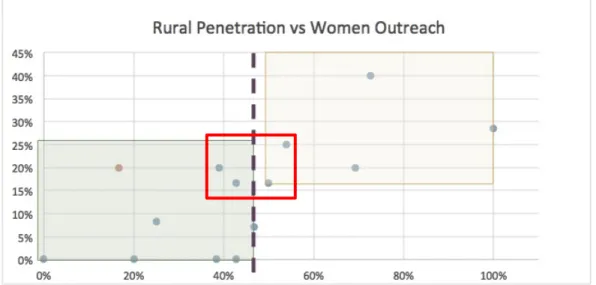
Figure 4.1: Rural Penetration vs Women Outreach Graph
After running the regression of rural penetration vs women outreach, it becomes
somewhat apparent that this set of institutions is segmented into two groups—low women
outreach with low rural penetration (group A), and high women outreach with high rural 0%
5% 10% 15% 20% 25% 30% 35% 40% 45%
0% 20% 40% 60% 80% 100%
penetration (group B). Group A is to the left of the line in the scatterplot above and
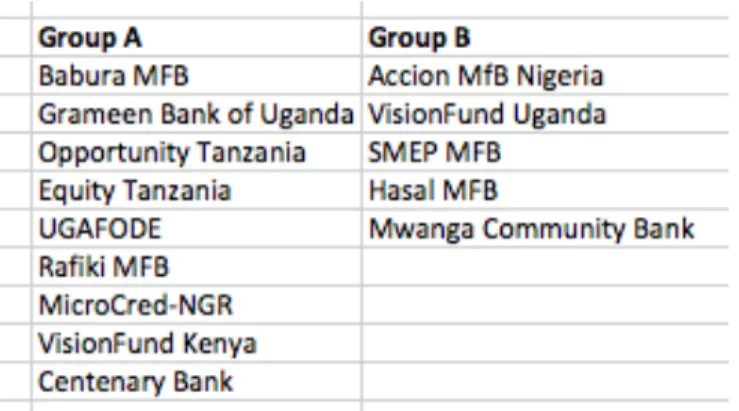
Group B is to the right. The Grameen Foundation of Uganda is in Group A. The dividing
line is marked at 45% rural penetration.
Table 4.2: Data Segmented Groups
Now, I juxtapose these groups with certain key variables discussed earlier that
have been commonly used to measure the effectiveness of microfinance institutions.
These data points are averages of each institution’s data point for the measure. The table
below summarizes some of these comparisons, including the Grameen Foundation’s
metrics separately in the rightmost column.
Table 4.3: Segmented Group Data Averages
Urban vs Rural Programs
Based off this data, it is clear that Group A contains smaller and more urban MFI institutions that do not stress the importance of women outreach through their program
Group A tends to have more programs focused on youth education and schooling than
Group B. For instance, Opportunity Tanzania offers an education finance program that
includes school fees loans and school improvement loans and VisionFund Kenya offers
their Mkopo Sokomi loan program with youth empowerment loans (Opportunity
Tanzania, 2014; KADET, 2013). These programs are heavily promoted by these MFIs
through their community outreach tactics and internet presence (Interview data, 2015).
Group B institutions offer primarily agriculture based finance loan programs,
small business programs, and personal finance programs. Many of the women outreach
programs fall under the small business programs umbrella, with programs encouraging
women to sell/trade their “womencrafts” to bring more money to their households
(Cheston, 2002). Additionally, four of the five MFIs with a strong rural presence are
classified as banks; these institutions not only offer microfinance products, but also
function as a community bank. As a result, these entities are more stable, with higher
volumes of loans and a greater ability to branch into rural areas.
Looking at the Grameen Bank relative to these two groups, the Grameen
foundation lies in Group A and follows similar trend in this group. The Grameen Bank
has similar women outreach, but much lower rural penetration than other institutions in
Group A. In contrast to the Grameen’s well known model of empowering rural women,
this specific group has been heavily involved in educational programs and technological
integration programs. Currently, this Grameen Bank is working with the Bill and Melinda
Gates Foundation to conduct a new initiative that teaches the importance of personal
finance and banking with collaborations with regional mobile money providers. This new
much emphasis on this new program with not enough attention on other ventures
(interview data, 2015).
Central Institutions Analysis
Figure 4.2: Four Central Institutions
Another point of interest from these results are the four institutions right around
the dividing line separating Groups A and B. These points are highlighted in the red box
above. These four institutions are MicroCred-NGR, Rafiki MFB, Accion MfB Nigeria,
and SMEP MFB. The first two are in Group A and the latter two are in Group B. I
selected to look at these institutions more closely because they all are very similar in
terms of their performance in rural penetration and women outreach. Interestingly, all
four of these institutions are located in either Nigeria or Kenya. Three out of four of them
are classified as MFBs or microfinance banks—with synergies and partnerships with
national banks and government entities.
This next graph highlights each of the plotted institutions by what type of
institution they are (MFI, MDI, or MFB) and where they are located (Nigeria, Kenya,
Tanzania, or Uganda).
Figure 4.3: Data Graph Broken down with Bank Type and Location
Key:
The different countries are spread pretty evenly across the different rates of rural
penetration and women outreach. The most successful and unsuccessful institutions are
all classified as MFBs; these institutions are found in the top right corner and bottom left
corner of the graph. Most of the MFIs and MDIs are found just left of center in the graph;
all but one are classified in Group A.
One cause for the MFBs’ levels of success could be their age. These organizations
have been around much longer than the MDIs and MFIs because they are government
sponsored (Jarotschkin, 2013). As a result, these institutions are more stable and have a
MFI MDI Bank Nigeria Kenya
Uganda Tanzania
0% 10% 20% 30% 40% 50%
0% 20% 40% 60% 80% 100%
better reputation in these nations. The MFBs that are not doing so well are primarily
based out of urban settings; their mission is not to spread into rural areas (Babura, 2013).
Deposits and Loans Analysis
The last finding involves data surrounding the deposits and loans made by these various institutions. Below are the group averages for deposits, loans, and the
deposits/loans ratio for Group A, Group B, and the Grameen Bank of Uganda. Table 4.4: Borrower and Depositor Group Averages
Group A has just over $4 million in loans and $6.6 million in deposits, while Group B has $11 million in loans and $7.6 million in deposits. It is interesting to note that Group A has a higher volume in deposits while Group B has a higher volume in loans. Both groups also have their loans and deposits averages within one standard deviation of each other. The Grameen Foundation, though categorized into Group A, follows a similar pattern with the deposit and loan volumes as Group B. However for both groups, the deposits/loans percentage is within ~4% of each other.
VI. DISCUSSION
In this section, I will discuss the implications of my results, their relation to existing literature for microfinance research, and my recommendations for the Grameen Foundation of Uganda.
My results support the overall idea that women outreach is closely related with rural penetration. Both Jarotschkin (2013) and Basu & Blavy (2004) found similar findings with their research. Jarotschkin (2013) discussed how women in rural situations find “house money” harder to come by. This house money helps provide clothing and assistance for women and the children of the family. Yunus (1999) reaffirms this finding in his book. As a result, Yunus (1999) founded the Grameen Bank’s model to aid
primarily women in these settings because the greatest change for the family can be felt through the mother figure.
more prone to participate such programs despite what the men in their family say with hopes for a better future for their offspring (Jarotschkin, 2013).
The higher loan amounts in rural areas also reflects the shift in culture and the growing trust rural individuals have with financial institutions. For the institutions with higher rural penetration (categorized as Group B in my research), the loan volume is higher than the deposits volume. The rural population is more comfortable receiving loans from an external party than letting the external party hold their money safe through deposits. Maarse (2014) supported this finding and expanded on the hesitatation of rural populations to work with financial institutions by looking specficially at another
disadvantaged population—the handicapped and disabled individuals of rural Africa. This minority faced the same oppression as many of the rural women and therefore were also early adapters of new programs promising a better quality of life (Maarse, 2014).
Looking at institution popularity, my research differed from some of the research in this field—namely pertaining to the types of microfinance institutions that are popular in comparison to the less successful ventures. Morduch (1999) and Linhorst (2013) discuss the role that government subsidies play and the popularity of
institutions. As a result, governments often shut down these programs and these programs have short lives (Morduch, 1999).
However, my research supports MFBs as the more popular and successful entities, particularly within rural populations of my select nations. Four of the main institutions in Group B are classified as MFBs. These institutions had the highest women outreach, highest rural penetration, and larger average loans and deposits. These
institutions have also been in existence longer than most of the organizations in Group A. The Group B institutions average ten years old while Group A averages around five years old. Their age and government link may be a reason for their success and presence in more rural parts of these African nations.
Recommendations
Taking all my research and findings into consideration, I have a few
recommendations for the Grameen Bank of Uganda in order to improve efficiencies and outreach. The biggest place for improvement for this institution would be their rural penetration. This institution needs to focus on manners through which they can reach the villages of Uganda. Recently, the Bill and Melinda Gates Foundation have partnered with this institution to help bring mobile money to the region and help reach more individuals.
members and employees in order to facillitate growth and longevity of programs in new areas.
VI. REFERENCES
Asaima, J. (2007). Microfinance in Ghana: An Overview. Retrieved from Bank of Ghana, Economics Web Institute:
http://www.economicswebinstitute.org/essays/microfinanceghana.htm
Basu, A., & Blavy, R. (2004). Microfinance in Africa: Experience and Lessons from Selected African Countries. Retrieved from The International Monetary Fund: https://www.imf.org/external/pubs/cat/longres.aspx?sk=17710.0
Brau, J., & Woller, G. (2004). Microfinance: A comprehensive review of existing literature. Journal of Entrepreneurial Finance, 9 (1), 1-27.
Cheston, S. (2002). Empowering Women through Microfinance. Retrieved from GlobalCitizen.net:
http://storage.globalcitizen.net/data/topic/knowledge/uploads/201101311419705.pdf
Cull, R. (2014). Benchmarking the Performance, Growth, and Outreach of Microfinance Institutions in SubSaharan Africa. Retrieved from The Microfinance Gateway:
http://www-wds.worldbank.org/external/default/WDSContentServer/WDSP/IB/2014/09/15/00015834 9_20140915084416/Rendered/PDF/WPS7029.pdf
Helms, B. & Goodwin-Groen, R. (2006). The History of Microfinance. Retrieved from Global Envision: https://www.globalenvision.org/library/4/1051
Jarotschkin, A. (2013). Microfinance of Africa. In T. Beck & S Maimbo (Eds.), Financial Sector Development in Africa (pp. 7-38). Retrieved from
https://openknowledge.worldbank.com/bitstream/handle/10986/11881/9780821396285.p df?sequence=2#page=29
Kagaba, S. & Kirya, J. (2013). Country & Financial Sector Overview. The State of Microfinance in Uganda (pgs 4-25). Retrieved from
http://www.amfiu.org.ug/images/docs/Studies/State%20of%20Microfinance%20in%20U ganda.pdf
Kariobangi, M. (2012). Differences between SACCOS, MFIS, and Banks. Retrieved from Kariobangi Finance: http://kariobangi.com/2012/11/26/differences-between-saccos-mfis-and-banks/
Kendall, J. (2012). Mobile Money in Uganda. Retrieved from The Microfinance
Gateway: http://www.microfinancegateway.org/sites/default/files/mfg-en-paper-mobile-money-in-uganda-use-barriers-and-opportunities-oct-2012.pdf
Linthorst, A. (2013). Uganda Map of Financial Inclusion: Analysing datasets for better policy decision-making. Retrieved from The Microfinance Information Exchange: http://www.themix.org/publications/mix-microfinance-world/2013/07/uganda-map-financial-inclusion-analyzing-datasets-better-policy-decision-making
Maarse, A. (2014). From Financial Exclusion to Formal Inclusion: Empirical Evidence from the Microfinance and Disability Project in Uganda. Retrieved from:
http://www.light-for-the-world.org/uploads/media/financial_exclusion_formal_inclusion.pdf
Magner, M. (2007). Microfinance: A Platform for Social Change. Retrieved from Grameen Foundation Publication Series:
http://www.promujer.org/publications/our_publications_2_Pdf_EN_Marge%20Magner% 20Paper-Grameen-2007.pdf
Morduch, J. (1999). The role of subsidies in microfinance: evidence from the Grameen Bank. Journal of Development Ecoomics, 60 (1), 229-248.
Odell, K. (2010). Measuring the Impact of Microfinance. Retrieved from Grameen Foundation Publication Series:
http://ww.w.bankerswithoutborders.com/sites/default/files/Updated2_Measuring%20the %20Impact%20of%20Microfinance%20-%20Taking%20Another%20Look.pdf
Schreiner, M. (2003). A Cost-Effectiveness Analysis of the Grameen Bank of Bangladesh. Development Policy Review, 21 (3), 357-382.
Scott, C. (2014). Grameen Foundation Annual Report 2013-2014. Retrieved from Grameen Foundation:
http://www.grameenfoundation.org/sites/grameenfoundation.org/files/Grameen_Foundati on_2014_Annual-Report_web.pdf
Tortora, B. (2014). Africa Continues Going Mobile. Retrieved from Gallup: http://www.gallup.com/poll/168797/africa-continues-going-mobile.aspx
Yahaya, A. A. (2011). Effectiveness of Microfinance banks in Alleviating Poverty in Kwara State Nigeria. Global Journal of Management and Business Research , 11 (4), 13-20.