Effect of Naltrexone-Bupropion on Major Adverse
Cardiovascular Events in Overweight and Obese Patients
With Cardiovascular Risk Factors
A Randomized Clinical Trial
Steven E. Nissen, MD; Kathy E. Wolski, MPH; Lisa Prcela, RN; Thomas Wadden, PhD; John B. Buse, MD, PhD; George Bakris, MD; Alfonso Perez, MD; Steven R. Smith, MD
IMPORTANCEFew cardiovascular outcomes trials have been conducted for obesity treatments. Withdrawal of 2 marketed drugs has resulted in controversy about the cardiovascular safety of obesity agents.
OBJECTIVETo determine whether the combination of naltrexone and bupropion increases major adverse cardiovascular events (MACE, defined as cardiovascular death, nonfatal stroke, or nonfatal myocardial infarction) compared with placebo in overweight and obese patients.
DESIGN, SETTING, AND PARTICIPANTS Randomized, multicenter, placebo-controlled, double-blind noninferiority trial enrolling 8910 overweight or obese patients at increased cardiovascular risk from June 13, 2012, to January 21, 2013, at 266 US centers. After public release of confidential interim data by the sponsor, the academic leadership of the study recommended termination of the trial and the sponsor agreed.
INTERVENTIONSAn Internet-based weight management program was provided to all participants. Participants were randomized to receive placebo (n=4454) or naltrexone, 32 mg/d, and bupropion, 360 mg/d (n=4456).
MAIN OUTCOMES AND MEASURES Time from randomization to first confirmed occurrence of a MACE. The primary analysis planned to assess a noninferiority hazard ratio (HR) of 1.4 after 378 expected events, with a confidential interim analysis after approximately 87 events (25% interim analysis) to assess a noninferiority HR of 2.0 for consideration of regulatory approval.
RESULTS Among the 8910 participants randomized, mean age was 61.0 years (SD, 7.3 years), 54.5% were female, 32.1% had a history of cardiovascular disease, and 85.2% had diabetes, with a median body mass index of 36.6 (interquartile range, 33.1-40.9). For the 25% interim analysis, MACE occurred in 59 placebo-treated patients (1.3%) and 35 naltrexone-bupropion– treated patients (0.8%; HR, 0.59; 95% CI, 0.39-0.90). After 50% of planned events, MACE occurred in 102 patients (2.3%) in the placebo group and 90 patients (2.0%) in the naltrexone-bupropion group (HR, 0.88; adjusted 99.7% CI, 0.57-1.34). Adverse effects were more common in the naltrexone-bupropion group, including gastrointestinal events in 14.2% vs 1.9% (P< .001) and central nervous system symptoms in 5.1% vs 1.2% (P< .001).
CONCLUSIONS AND RELEVANCEAmong overweight or obese patients at increased
cardiovascular risk, based on the interim analyses performed after 25% and 50% of planned events, the upper limit of the 95% CI of the HR for MACE for naltrexone-bupropion treatment, compared with placebo, did not exceed 2.0. However, because of the
unanticipated early termination of the trial, it is not possible to assess noninferiority for the prespecified upper limit of 1.4. Accordingly, the cardiovascular safety of this treatment remains uncertain and will require evaluation in a new adequately powered outcome trial.
TRIAL REGISTRATIONclinicaltrials.gov Identifier:NCT01601704
JAMA. 2016;315(10):990-1004. doi:10.1001/jama.2016.1558
Editorialpage 984
Related articlepage 1046
Supplemental contentat jama.com
CME Quizat jamanetworkcme.com
Author Affiliations:Cleveland Clinic Center for Cardiovascular Research, Cleveland, Ohio (Nissen, Wolski, Prcela); Center for Weight and Eating Disorders Department of Psychiatry, University of Pennsylvania Perelman School of Medicine, Philadelphia (Wadden); University of North Carolina School of Medicine, Chapel Hill (Buse); ASH Comprehensive Hypertension Center, University of Chicago Medicine, Chicago, Illinois (Bakris); Takeda Pharmaceuticals, Deerfield, Illinois (Perez); Translational Research Institute for Metabolism and Diabetes, Florida Hospital, Sanford-Burnham Medical Research Institute, Orlando (Smith).
Corresponding Author:Steven E. Nissen, MD, Cleveland Clinic, 8500 Euclid Ave, Cleveland, OH 44195 ([email protected]).
T
he prevalence of obesity has increased steadily in the United States and globally over the last several de-cades, and this disorder is now considered one of the most serious contemporary threats to cardiovascular health.1 The current obesity epidemic has resulted in a substantial in-crease in the incidence of diabetes mellitus and related complications.2Lifestyle modification has long been consid-ered a mainstay of therapy for obesity, but this intervention has produced only modest weight loss and no reduction in ma-jor adverse cardiovascular events (MACE).3Accordingly, treat-ment strategies have centered on pharmacological and surgi-cal approaches to weight reduction. Drug treatments for obesity have yielded mixed results, with pharmacological agents achieving modest weight loss but without demonstrating a re-duction in cardiovascular events. Two therapies, fenflur-amine and sibutrfenflur-amine, were removed from the market after evidence of cardiovascular harm emerged.4,5Accordingly, the medical community and regulatory authorities have ex-pressed concerned about the cardiovascular safety of new drugs to treat obesity.The combination of naltrexone and bupropion reduced weight during phase 3 clinical trials,6but the US Food and Drug Administration (FDA) deferred approval based on safety con-cerns related to small increases in blood pressure and heart rate in these trials.7The FDA mandated a placebo-controlled, non-inferiority cardiovascular outcomes trial, specifying that an in-terim analysis after 25% of expected events had accrued would need to rule out an upper 95% confidence interval of the haz-ard ratio (HR) of 2.0 prior to approval and a HR of 1.4 at study completion (potentially postapproval).8Both the sponsor and the FDA agreed to not disclose the 25% interim analysis until completion of the study. While the trial was ongoing, the spon-sor publicly released the confidential 25% interim results via a patent publication.9The study’s academic leadership rec-ommended termination of the trial due to the breach of con-fidentiality and the sponsor agreed. The current report pro-vides results for the 50% interim data, which was the last prespecified analysis performed by the data monitoring com-mittee prior to public disclosure. We also include the 25% in-terim analysis and a sensitivity analysis based on the final data available at last patient contact.
Methods
Study Design
The study was a phase 3b, multicenter, randomized, double-blind, placebo-controlled trial to assess the occurrence of MACE in overweight or obese patients at increased risk of adverse car-diovascular outcomes treated with an extended-release, fixed-dose formulation containing a total daily fixed-dose of 32 mg of naltrexone and 360 mg of bupropion. Interim monitoring boundaries allowed for early termination for either superior efficacy or established harm but not based on noninferiority considerations.
The study enrolled patients into a double-blind lead-in pe-riod to identify patients who did not tolerate treatment with low-dose naltrexone-bupropion or who exhibited poor
adher-ence. During the lead-in period, participants were randomly assigned in a 1:1 ratio to 1 of 2 treatment sequences: 1 week of active study medication followed by 1 week of placebo or 1 week of placebo followed by 1 week of active study medication. Eli-gible patients were subsequently randomized to treatment with either naltrexone-bupropion or placebo in a 1:1 ratio (Figure 1). Randomization occurred via an interactive voice recognition system using a permuted block size of 4 with no stratification factors. To achieve the requisite number of events, the dura-tion of randomized treatment was estimated to be between 2 and 4 years.
The trial required discontinuation from study medica-tion at week 16 in a blinded manner for patients who did not lose 2% or more of their initial body weight or experienced a sustained (at ≥2 visits) increase in blood pressure (systolic or diastolic) of 10 mm Hg or greater. The approach was selected in consultation with the FDA to avoid administration of naltrexone-bupropion to patients who did not lose weight or who experienced clinically unacceptable increases in blood pressure as suggested in the labeling for bupropion.
Study Population
The study was approved by an institutional review board for all study sites, and all enrolled patients provided written in-formed consent. Overweight or obese patients at increased risk of adverse cardiovascular outcomes were eligible to partici-pate in the trial. The study required eligible patients to be aged 50 years or older (women) or 45 years or older (men), have a body mass index between 27 and 50 (calculated as weight in kilograms divided by height in meters squared), and have a waist circumference of 88 cm or more (women) or 102 cm or more (men). Enrollment was restricted to patients with char-acteristics associated with an increased risk of adverse car-diovascular outcomes.
Several categories of increased risk were prespecified, including documented preexisting cardiovascular disease. Patients could also be enrolled if they demonstrated angina with an abnormal graded exercise test result or exercise car-diac imaging study (echocardiography or nuclear scintigra-phy); an ankle brachial index of less than 0.9; or documented 50% or greater stenosis of a coronary, carotid, or lower extremity artery. Patients with type 2 diabetes mellitus were eligible if they had 2 or more of the following: hypertension, dyslipidemia requiring pharmacotherapy, low high-density lipoprotein cholesterol (<50 mg/dL [1.30 mmol/L] in women or <40 mg/dL [1.04 mmol/L] in men), or current tobacco smoking. Patients were required to have consistent access to broadband Internet.
Figure 1. Flow of Participants Through the Trial
2678Excluded
1728Did not meet eligibility criteria
201History of tachyarrhythmia 656Blood pressure ≥145/95 mm Hg
266Not at increased risk of adverse cardiovascular outcomes 107Body mass index ≤27 or ≥50
94Long-term use or positive screen for opioids 404Other reasons
95Lost to follow-up 351Did not give consent
2Missing 418Other reasons
78Investigator decision 6Study closed or terminated
1499Did not complete lead-in period 543Adverse events
425Did not meet eligibility criteria
85Recent drug/alcohol abuse or dependence within 6 mo prior to screening or positive drug screen for cocaine, methamphetamine, opiates, phencyclidine, or other prohibited drugs
187Long-term use or positive screen for opioids
153Other reasons 216Withdrew consent
29Sponsor decision 3Missing 92Other reasons 109Protocol deviation
82Lost to follow-up
105Withdrew consent after completing lead-in period but prior to randomization 13 192Patients screened
10 514Entered lead-in period
9015Completed lead-in period
8910Randomized
4454Randomized to receive placebo 4450Received placebo as randomized
4Did not receive placebo
4456Randomized to receive naltrexone-bupropion 4455Received naltrexone-bupropion as randomized
1Did not receive naltrexone-bupropion
433Discontinued from study 241Lost to follow-up
192Patient revoked contact with primary care physician or designated contact
410Discontinued from study 217Lost to follow-up
193Patient revoked contact with primary care physician or designated contact
4450Included in final efficacy analysis 4455Included in final efficacy analysis 2124Discontinued study drug during first 16 wk
1130Did not meet wk 16 treatment continuation criteria 971Weight change <2%
495Patient decision to no longer receive study medication 259Adverse events
128 Lost to follow-up 19Protocol deviation 14Sponsor decision
4Not treated 75Other reasons
3Blood pressure change >10 mm Hg 12Other reasons
144Weight change <2% and blood pressure change >10 mm Hg
1903Discontinued study drug during first 16 wk 993Adverse events
367Patient decision to no longer receive study medication
20Blood pressure change >10 mm Hg 6Other reasons
125Lost to follow-up 4Protocol deviation 2Sponsor decision 2Unknown 1Not treated 64Other reasons
267Weight change <2%
52Weight change <2% and blood pressure change >10 mm Hg 345Did not meet wk 16 treatment continuation criteria
1618Discontinued study drug during subsequent follow-up 678Did not meet wk 16 treatment continuation criteria
586Weight change <2%
602Patient decision to no longer receive study medication 146Adverse events
86Lost to follow-up 15Protocol deviation 14Sponsor decision
1Unknown 76Other reasons
14Blood pressure change >10 mm Hg 9Other reasons
69Weight change <2% and blood pressure change >10 mm Hg
1437Discontinued study drug during subsequent follow-up 577Patient decision to no longer receive study medication
38Blood pressure change >10 mm Hg 4Other reasons
106Lost to follow-up 18Protocol deviation 17Sponsor decision
3Unknown 111Other reasons
203Weight change <2%
44Weight change <2% and blood pressure change >10 mm Hg 316Adverse events
upper limit of normal, long-term opioid use, history of sei-zures or cranial trauma, mania, bulimia, anorexia nervosa, acute depressive illness, or suicidality. Patients taking mono-amine oxidase inhibitors within 14 days prior to screening were excluded. Race/ethnicity was assessed by the investiga-tor; this information was collected to determine if there were differences in outcomes for patients with different racial or ethnic backgrounds.
Treatments
All patients were encouraged to participate in an Internet-based weight management program that included educa-tional resources on healthy eating, exercise, and behavioral modifications. Program information was presented in the form of weekly lessons that the study participants could access on-line, and they also received weekly emails with healthy life-style tips and reminders. Patients also had access to a per-sonal weight loss coach; programs to track weight, meals, and physical activity; and a low-fat, low-calorie meal plan.
Patients who discontinued study medication prema-turely were encouraged to continue the weight management program. The study medication (naltrexone-bupropion or pla-cebo) was provided in tablet form. Each active tablet con-tained an extended-release formulation of 8 mg of naltrex-one and 90 mg of bupropion or placebo. All tablets were identical in appearance. Dose escalation occurred during the first 4 weeks of treatment, beginning with 1 tablet daily dur-ing the first week, increasdur-ing to 2 tablets durdur-ing week 2, 3 tab-lets during week 3, and 4 tabtab-lets daily during week 4 and there-after. Dosage levels requiring more than 1 tablet daily were administered twice per day (morning and evening).
Outcome Measures
A blinded independent clinical events committee at the Cleveland Clinic Center for Clinical Research adjudicated clinical outcomes, including cardiovascular death, nonfatal myocardial infarction, nonfatal stroke, hospitalization for unstable angina, and all-cause mortality. The prespecified primary outcome measure was time from treatment random-ization to the first confirmed occurrence of a MACE, defined as cardiovascular death, nonfatal stroke, or nonfatal myocar-dial infarction. The prespecified secondary outcomes were times to first occurrence of MACE or hospitalization for unstable angina, fatal or nonfatal stroke, and fatal or nonfatal myocardial infarction. The incidence of coronary revascular-ization was collected but not adjudicated. Additional out-come measures included changes in body weight, body mass index, and waist circumference. Although not prespecified in the protocol, time-weighted changes in blood pressure and heart rate over the course of the trial were assessed. Changes were also determined after 16 weeks of treatment, when adherence was relatively high, to assess the peak effects of naltrexone-bupropion on these vital signs.
Statistical Analysis
The protocol specified enrollment of approximately 9880 pa-tients into the double-blind lead-in period, with the anticipa-tion that 8900 would be randomized into the double-blind
treatment period. The primary analyses were performed for the intention-to-treat (ITT) population, defined as patients who underwent randomization into the treatment period and were dispensed study medication. No imputation was performed for missing data. Analyses were also performed for an “on-treatment” population, defined as ITT patients who took at least 1 dose of study medication, with censoring of events oc-curring more than 30 days after a patient’s last confirmed dose of study medication.
For the primary end point, 3 null hypotheses were pre-specified: (1) that the HR for naltrexone-bupropion relative to placebo is 2.0 or greater; (2) that the HR for naltrexone-bupropion relative to placebo is 1.4 or greater; and (3) that the HR for naltrexone-bupropion relative to placebo is 1.0 or greater (test for superiority). Estimates of the HRs and associated con-fidence intervals comparing naltrexone-bupropion with pla-cebo were obtained using the Cox proportional hazards model, with randomized treatment as a covariate and the Kaplan-Meier method used for time-to-event plots. Continuous mea-surements of body weight and blood pressure over time were analyzed using a general linear model with treatment, cardio-vascular risk group, race, and sex as factors and with age and baseline values as covariates. Categorical data were assessed using the χ2test.
An initial noninferiority analysis was planned after ac-crual of approximately 87 events (25% interim analysis) to de-termine whether a 2-tailed upper bound of the 95% confi-dence interval of the HR would rule out 2.0 (testing null hypothesis 1), in which 1.31 was the least favorable HR point estimate consistent with this noninferiority boundary. The study design mandated that the 25% interim analysis be pro-vided exclusively to a core team from the sponsor to enable regulatory filing for approval, but all personnel involved in the ongoing trial would remain blinded to these results. The FDA agreed to keep the interim results confidential until the trial was completed.
Sequential monitoring for superior efficacy or harm (test-ing null hypothesis 3) was performed by the data monitor(test-ing committee using O’Brien-Fleming group sequential boundar-ies, implemented using a Lan-DeMets α spending function with planned interim analyses at 50% and 75% of event accrual.10 The primary analysis of the study would be formally ad-dressed only after accrual of 378 events (at study completion) to determine whether an upper bound of the 95.6% confi-dence interval of the HR would rule out 1.4 (testing null hy-pothesis 2), in which the least favorable HR point estimate con-sistent with noninferiority was 1.14.
noninferiority are reported because these cannot be appro-priately adjusted for data derived from interim analyses not intended to serve as evidence for achievement of the prespeci-fied criterion for noninferiority. All statistical analyses were per-formed using SAS software, version 9.3 (SAS Institute Inc).
Sample Size Determination
The trial was designed to provide 90% power to rule out the 1.4 margin (ie, the upper limit of the confidence interval would not exceed 1.4) when the true HR is 1.0, which required 378 primary events. The early preapproval analysis to rule out the 2.0 margin required 87 primary events to provide 90% power when the true HR is 1.0. In both settings, a 1-sided type I error (α) of 2.5% was used. To obtain sample sizes, an annualized rate of primary events of 1.5% in the placebo group was as-sumed. The recruitment was assumed to take 1.5 years, with maximum patient follow-up of 4 years. It was assumed that 7% of the study population would discontinue during the lead-in period, with a loss–to–follow-up rate of 1.2% annu-ally. Under these assumptions, the trial required 3448 partici-pants per treatment group. However, the study planned to re-cruit 4450 per treatment group to compensate for any deviations from the anticipated event rate or recruitment or retention rates.
Early Data Release and Study Termination
The study’s academic executive steering committee, data monitoring committee, and sponsor at the time (Orexigen Therapeutics) developed a data access plan specifying strict confidentiality of interim data to be used in a regulatory filing for drug approval. The data monitoring committee released interim data to the sponsor after approximately 25% of planned events had accrued in November 2013, and the blinded trial continued as planned. On September 10, 2014, the FDA approved naltrexone-bupropion for marketing but publicly stated that the number of individuals who had received knowledge of the interim results, both inside and outside the company, was far greater than the agency consid-ered essential to facilitate the regulatory submission for approval.11The FDA also stated that due to the breach of con-fidentiality, the trial could not be used to meet the postap-proval requirement to rule out a noninferiority margin of 1.4.11Nonetheless, the FDA encouraged the sponsor to con-tinue the trial as originally planned.
In March 2015, while the trial was still ongoing (after sponsorship was transferred to Takeda Pharmaceuticals), Orexigen publicly released the 25% interim results via a pat-ent publication and submission to the Securities and Ex-change Commission.9The published patent claimed a method for reducing cardiovascular risk and included the 25% in-terim data for MACE showing an estimated HR of 0.59, which was reported in the media as evidence of a cardiovascular ben-efit for naltrexone-bupropion.12
The executive steering committee concluded that the pre-mature release of interim data had compromised the scien-tific integrity of the ongoing study, precluding successful completion. The executive steering committee recom-mended trial termination on May 12, 2015, and the original
sponsor (Orexigen Therapeutics) and the current holder of the Investigational New Drug application (Takeda Pharmaceuti-cals) agreed. The executive steering committee also decided to unblind and partially release outcome data from a recently completed, preplanned 50% interim analysis to correct the im-pression of benefit created by release of potentially unreli-able 25% interim data.13The executive steering committee ex-pressed concern that the breach of confidentiality through release of preliminary data could result in inappropriate use of naltrexone-bupropion with an expectation of cardiovascu-lar benefit.
The 50% interim analysis was completed on March 3, 2015, based on 192 adjudicated MACE (from a database lock on Feb-ruary 3, 2015). As a result of the termination of the study, the preplanned 50% interim analysis was considered the most ap-propriate analysis to generate the primary results. Additional outcomes accumulated after the February 2015 database lock are included in a sensitivity analysis, which reports results af-ter 64% of planned events. The 25% inaf-terim analysis used in the regulatory approval of naltrexone-bupropion is also reported.
Results
Patients
The disposition of patients is shown in Figure 1. From June 13, 2012, until January 21, 2013, the trial screened 13 192 patients and randomized 10 514 into the lead-in period, and 10 505 were included in the enrolled population (9 patients did not re-ceive study medication), with 9015 patients (85.8%) success-fully completing this phase. The most common reason for non-completion during the lead-in was an adverse event, which occurred in 543 patients (5.2%). Ultimately, 8910 patients were randomized into the ongoing study, with 8905 included in the ITT population (5 did not receive study medication).
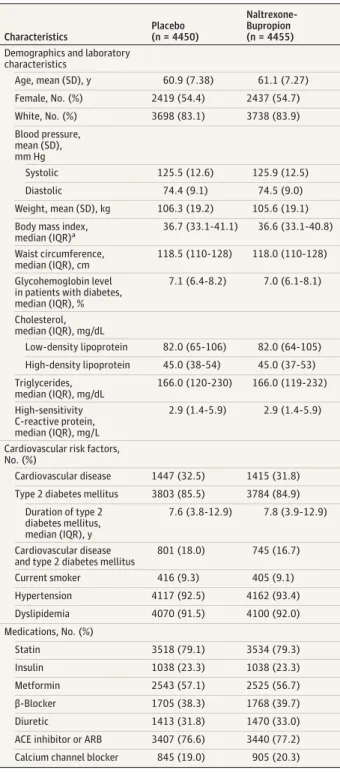
The baseline characteristics of the patients are shown in Table 1. The mean age of randomized patients was 61.0 years (SD, 7.3 years), with a slight predominance of women (54.5%), and 83.5% patients were described as white. The median body mass index was 36.6 (interquartile range [IQR], 33.1-40.9), with a median body weight of 104.1 kg (IQR, 92.1-118.1 kg) and a me-dian waist circumference of 118.1 cm (IQR, 110-128 cm). Type 2 diabetes was present in 85.2% of patients, established car-diovascular disease in 32.1%, and both disorders in 17.4%. Car-diovascular risk factors were well controlled, with a mean sys-tolic blood pressure of 125.7 mm Hg (SD, 12.5 mm Hg), a median low-density lipoprotein cholesterol level of 82.0 mg/dL (2.12 mmol/L) (IQR, 65-106 mg/dL [1.68-2.75 mmol/L]), and a median high-density lipoprotein cholesterol level of 45.0 mg/dL (1.17 mmol/L) (IQR, 38-53 mg/dL [0.98-1.37 mmol/L]). Concomitant medications included statins in 79.2% of pa-tients, antihypertensive medications in 92.0%, and glucose-lowering agents in 75.1%.
Efficacy Outcomes
Primary End Point
primary prespecified outcome measure, time to first MACE, occurred in 192 patients, 102 (2.3%) in the placebo group and 90 (2.0%) in the naltrexone-bupropion group (HR, 0.88; 99.7% CI, 0.57-1.34). The components of the primary composite out-come included cardiovascular death in 34 placebo-treated pa-tients (0.8%) and 17 naltrexone-bupropion–treated papa-tients (0.4%; HR, 0.50; 99.7% CI, 0.21-1.19). Nonfatal stroke oc-curred in 19 patients (0.4%) in the placebo group and 21 (0.5%) in the naltrexone-bupropion group (HR, 1.10; 99.7% CI, 0.44-2.78). Nonfatal myocardial infarction occurred in 54 patients (1.2%) in the placebo group and 54 (1.2%) in the naltrexone-bupropion group (HR, 1.00; 99.7% CI, 0.57-1.75).Figure 2A shows the Kaplan-Meier plot of time to first MACE for the 50% interim analysis.
Table 3shows results of the sensitivity analysis based on the final end-of-study assessment for the primary and sec-ondary cardiovascular outcomes in the ITT population. The primary outcome measure, time to first MACE, occurred in 124 patients (2.8%) in the placebo treatment group and 119 pa-tients (2.7%) in the naltrexone-bupropion group (HR, 0.95; 99.7% CI, 0.65-1.38). The components of the primary compos-ite outcome showed cardiovascular death in 42 placebo-treated patients (0.9%) and 26 naltrexone-bupropion– treated patients (0.6%; HR, 0.61; 99.7% CI, 0.30-1.27). Nonfatal stroke occurred in 21 patients (0.5%) in the placebo group and 28 (0.6%) in the naltrexone-bupropion group (HR, 1.32; 99.7% CI, 0.57-3.08). Nonfatal myocardial infarction occurred in 67 patients (1.5%) in the placebo group and 68 (1.5%) in the nal-trexone-bupropion group (HR, 1.01; 99.7% CI, 0.61-1.66). Figure 2B shows the Kaplan-Meier plot of time to first MACE for the final end-of-study analysis.
Table 4shows the results from the 25% interim analysis used in the regulatory approval of naltrexone-bupropion and subsequently released by the original sponsor (Orexigen) in a patent filing. The primary outcome, time to first MACE, oc-curred in 59 patients (1.3%) in the placebo group and 35 pa-tients (0.8%) in the naltrexone-bupropion group (HR, 0.59; 95% CI, 0.39-0.90). Table 4 also shows events rates and HRs with 95% confidence intervals for components of the primary out-come and secondary outout-comes for the 25% interim analysis. The 25% interim analysis shows 95% confidence intervals rather than 99.7% confidence intervals because this analysis tested only whether the trial ruled out a noninferiority mar-gin of 2.0 and did not test for the marmar-gin of 1.4. Table 4 also shows the primary end point and its components for the on-treatment analysis. For the on-on-treatment analyses, the HRs are less favorable than the ITT analyses and show wider confi-dence intervals.
Secondary Outcomes
Table 2 shows the secondary outcome measures for the ITT population at the 50% interim analysis. The composite of MACE plus hospitalization for unstable angina occurred in 142 pla-cebo patients (3.2%) and 133 naltrexone-bupropion–treated pa-tients (3.0%; HR, 0.93; 99.7% CI, 0.66-1.33). Table 3 shows these same outcomes at study completion and Table 4 shows these outcomes for the 25% interim analysis. Results at study comple-tion (64% of planned events) were less favorable than
ob-served at the 50% interim analysis (HR, 0.95; 99.7% CI, 0.95-1.38). The 25% interim analysis showed more favorable HRs than subsequent analyses, with very wide confidence inter-vals due to the low number of events. Table 2, Table 3, and Table 1. Demographics and Baseline Characteristics of the
Intention-to-Treat Population
Characteristics
Placebo (n = 4450)
Naltrexone-Bupropion (n = 4455)
Demographics and laboratory characteristics
Age, mean (SD), y 60.9 (7.38) 61.1 (7.27)
Female, No. (%) 2419 (54.4) 2437 (54.7)
White, No. (%) 3698 (83.1) 3738 (83.9)
Blood pressure, mean (SD), mm Hg
Systolic 125.5 (12.6) 125.9 (12.5)
Diastolic 74.4 (9.1) 74.5 (9.0)
Weight, mean (SD), kg 106.3 (19.2) 105.6 (19.1)
Body mass index,
median (IQR)a 36.7 (33.1-41.1) 36.6 (33.1-40.8)
Waist circumference, median (IQR), cm
118.5 (110-128) 118.0 (110-128)
Glycohemoglobin level in patients with diabetes, median (IQR), %
7.1 (6.4-8.2) 7.0 (6.1-8.1)
Cholesterol, median (IQR), mg/dL
Low-density lipoprotein 82.0 (65-106) 82.0 (64-105)
High-density lipoprotein 45.0 (38-54) 45.0 (37-53)
Triglycerides, median (IQR), mg/dL
166.0 (120-230) 166.0 (119-232)
High-sensitivity C-reactive protein, median (IQR), mg/L
2.9 (1.4-5.9) 2.9 (1.4-5.9)
Cardiovascular risk factors, No. (%)
Cardiovascular disease 1447 (32.5) 1415 (31.8)
Type 2 diabetes mellitus 3803 (85.5) 3784 (84.9)
Duration of type 2 diabetes mellitus, median (IQR), y
7.6 (3.8-12.9) 7.8 (3.9-12.9)
Cardiovascular disease and type 2 diabetes mellitus
801 (18.0) 745 (16.7)
Current smoker 416 (9.3) 405 (9.1)
Hypertension 4117 (92.5) 4162 (93.4)
Dyslipidemia 4070 (91.5) 4100 (92.0)
Medications, No. (%)
Statin 3518 (79.1) 3534 (79.3)
Insulin 1038 (23.3) 1038 (23.3)
Metformin 2543 (57.1) 2525 (56.7)
β-Blocker 1705 (38.3) 1768 (39.7)
Diuretic 1413 (31.8) 1470 (33.0)
ACE inhibitor or ARB 3407 (76.6) 3440 (77.2)
Calcium channel blocker 845 (19.0) 905 (20.3)
Abbreviations: ACE, angiotensin-converting enzyme; ARB, angiotensin receptor blocker; IQR, interquartile range.
SI conversions: To convert low- and high-density lipoprotein cholesterol to millimoles per liter, multiply by 0.0259. To convert triglycerides to millimoles per liter, multiply by 0.0113.
Table 4 also show the additional secondary outcomes of fatal or nonfatal stroke and fatal or nonfatal myocardial infarction for the 50% interim analysis, end-of-study analysis, and 25% interim analysis, respectively.
Other Cardiovascular Outcomes
Table 2 and Table 3 show other cardiovascular outcomes including all-cause mortality, coronary revascularization, hospitalization for unstable angina, and additional composite Figure 2. Time to MACE in the 50% Interim Analysis and the Final End-of-Study Analysis
2.5
2.0
1.5
1.0
0.5
0
4455 4450
26
4322 4298
52
4235 4196
78
4110 4088
104
4015 3979
130
864 858
Cumulativ
e Incidence of MA
CE, %
Weeks Following Randomization
No. at risk Placebo
Placebo
Naltrexone-bupropion
Naltrexone-bupropion Time to MACE in 50% interim analysis
A
Hazard ratio, 0.88 (99.7% CI, 0.57-1.34)
4
3
2
1
0 0
4455 4450
26
4317 4289
52
4228 4183
78
4092 4053
130
3403 3333 104
3951 3886
156
102 90
Cumulativ
e Incidence of MA
CE, %
Weeks Following Randomization
No. at risk Placebo
Placebo
Naltrexone-bupropion
Naltrexone-bupropion Time to MACE in final end-of-study analysis
B
Hazard ratio, 0.95 (99.7% CI, 0.65-1.38) 0
MACE indicates major adverse cardiovascular events. Segment of y-axes shown in blue is the range of 0% to 2.5%. Table 2. Primary and Secondary Efficacy Outcomes (50% Interim Analysis)
End Points
Placebo, No. (%) (n = 4450)
Naltrexone-Bupropion, No. (%)
(n = 4455)
Hazard Ratio (99.7% CI)a
Intention-to-treat analysis
Primary outcome
Major adverse cardiovascular events 102 (2.3) 90 (2.0) 0.88 (0.57-1.34)
Components of the primary outcome
Cardiovascular death 34 (0.8) 17 (0.4) 0.50 (0.21-1.19)
Nonfatal stroke 19 (0.4) 21 (0.5) 1.10 (0.44-2.78)
Nonfatal myocardial infarction 54 (1.2) 54 (1.2) 1.00 (0.57-1.75)
Secondary outcomes
Major adverse cardiovascular events + hospitalization for unstable angina
142 (3.2) 133 (3.0) 0.93 (0.66-1.33)
Fatal or nonfatal stroke 21 (0.5) 22 (0.5) 1.04 (0.43-2.55)
Fatal or nonfatal myocardial infarction 57 (1.3) 55 (1.2) 0.96 (0.55-1.67)
Other outcomes
All-cause mortality 51 (1.1) 43 (1.0) 0.84 (0.46-1.54)
Hospitalization for unstable angina 43 (1.0) 47 (1.1) 1.09 (0.59-2.02)
Coronary revascularization 145 (3.3) 132 (3.0) 0.91 (0.64-1.29)
All-cause mortality plus nonfatal myocardial infarction + nonfatal stroke
119 (2.7) 114 (2.6) 0.95 (0.65-1.40)
Major adverse cardiovascular events + hospitalization for unstable angina + coronary revascularization
205 (4.6) 188 (4.2) 0.91 (0.68-1.23)
On-treatment analysis
Major adverse cardiovascular events 37 (0.8) 43 (1.0) 0.97 (0.50-1.88)
Components of the primary outcome
Cardiovascular death 10 (0.2) 8 (0.2) 0.67 (0.17-2.72)
Nonfatal stroke 7 (0.2) 11 (0.2) 1.25 (0.30-5.18)
Nonfatal myocardial infarction 21 (0.5) 24 (0.5) 0.96 (0.40-2.3)
a
end points at the 50% interim and final end-of-study analy-sis. At the 50% interim analysis, all-cause mortality occurred in 51 placebo patients (1.1%) and 43 naltrexone-bupropion patients (1.0%; HR, 0.84; 99.7% CI, 0.46-1.54). Hospitaliza-tion for unstable angina occurred in 43 (1.0%) of placebo-treated patients and 47 (1.1%) of naltrexone-bupropion– treated patients (HR, 1.09; 99.7% CI, 0.59-2.02). Coronary revascularization occurred in 145 (3.3%) of placebo patients and 132 (3.0%) of naltrexone-bupropion patients (HR, 0.91; 99.7% CI, 0.64-1.29).
Table 2 and Table 3 also include the post hoc composite outcome of all-cause mortality, nonfatal myocardial infarc-tion, and nonfatal stroke, which showed less favorable HRs than the primary outcome because the fewer cardiovascular deaths were counterbalanced by an excess of noncardiovas-cular mortality. The broadest measure of cardiovasnoncardiovas-cular out-come, MACE plus hospitalization for unstable angina or coro-nary revascularization, occurred in 205 placebo patients (4.6%) and 188 naltrexone-bupropion patients (4.2%; HR, 0.91; 99.7% CI, 0.68-1.23). Table 2, Table 3, and Table 4 also show the pri-mary end point and components of the pripri-mary end point for the on-treatment analysis. Because of the low adherence rates, these analyses have fewer patient-years of follow-up, result-ing in wider confidence intervals, and consistently show less favorable HRs than the ITT population.
Adherence and Retention
Figure 3shows time to permanent study drug discontinua-tion for any reason. Adherence to study drug, as expected, was relatively low and showed a different pattern between the 2 treatment groups. After the first 2 weeks of treatment, 95.1% of patients treated with naltrexone-bupropion and (97.6%) of placebo patients were taking study medication. At 16 weeks, 72.1% of placebo-treated patients and 64.0% of naltrexone-bupropion–treated patients were still taking study drug (P< .001). One year after randomization, 26.3% of placebo patients and 37.5% of naltrexone-bupropion patients were still taking study drug (P< .001). Two years after ran-domization, only 17.3% of placebo patients and 27.0% of naltrexone-bupropion patients were still taking study drug (P< .001). The median duration of treatment was 16.3 weeks for placebo (IQR, 15.6-53.1 weeks) and 18.4 weeks for naltrexone-bupropion (IQR, 8.1-109.3 weeks).
A large decrease in the number of patients receiving study drug occurred after the 16-week assessment, with 44% of pla-cebo patients and 17.8% of naltrexone-bupropion patients dis-continued by investigators. Most discontinuations were due to a failure to lose 2% of body weight, but 230 placebo pa-tients and 154 naltrexone-bupropion papa-tients discontinued treatment because of a greater than 10–mm Hg increase in blood pressure (Figure 1). A high percentage of patients who discon-Table 3. Primary and Secondary Efficacy Outcomes (Final End-of-Study Analysis)
End Points
Placebo, No. (%) (n = 4450)
Naltrexone-Bupropion, No. (%)
(n = 4455)
Hazard Ratio (99.7% CI)a
Intention-to-treat analysis
Primary outcome
Major adverse cardiovascular events 124 (2.8) 119 (2.7) 0.95 (0.65-1.38)
Components of the primary outcome
Cardiovascular death 42 (0.9) 26 (0.6) 0.61 (0.30-1.27)
Nonfatal stroke 21 (0.5) 28 (0.6) 1.32 (0.57-3.08)
Nonfatal myocardial infarction 67 (1.5) 68 (1.5) 1.01 (0.61-1.66)
Secondary outcomes
Major adverse cardiovascular events + hospitalization for unstable angina
171 (3.8) 164 (3.7) 0.95 (0.69-1.31)
Fatal or nonfatal stroke 23 (0.5) 31 (0.7) 1.34 (0.60-2.99)
Fatal or nonfatal myocardial infarction 71 (1.6) 69 (1.5) 0.96 (0.59-1.58)
Other outcomes
All-cause mortality 71 (1.6) 65 (1.5) 0.91 (0.55-1.50)
Hospitalization for unstable angina 50 (1.1) 51 (1.1) 1.01 (0.57-1.82)
Coronary revascularization 170 (3.8) 152 (3.4) 0.89 (0.64-1.23)
All-cause mortality + nonfatal myocardial infarction + nonfatal stroke
151 (3.4) 156 (3.5) 1.02 (0.73-1.43)
Major adverse cardiovascular events + hospitalization for unstable angina + coronary revascularization
244 (5.5) 226 (5.1) 0.92 (0.70-1.20)
On-treatment analysis
Major adverse cardiovascular events 39 (0.9) 47 (1.1) 0.99 (0.52-1.87)
Components of the primary outcome
Cardiovascular death 11 (0.2) 9 (0.2) 0.67 (0.18-2.54)
Nonfatal stroke 7 (0.2) 12 (0.3) 1.35 (0.33-5.47)
Nonfatal myocardial infarction 22 (0.5) 26 (0.6) 0.98 (0.42-2.30)
a
tinued treatment remained in follow-up for MACE and con-tributed to the ITT analysis. Discontinuation of follow-up oc-curred in 9.7% of placebo patients and 9.2% of naltrexone-bupropion patients. The median duration of follow-up was 121 weeks (IQR, 114-128 weeks) for placebo and 121 weeks (IQR, 114-128 weeks) for naltrexone-bupropion.
Other Outcome Measures
At trial completion, body weight decreased a mean of 3.9 kg (95% CI, −4.1 to −3.7 kg) in the naltrexone-bupropion group and 1.2 kg (95% CI, −1.3 to −1.0 kg) in the placebo group, cor-responding to reductions of 3.6% and 1.1%, respectively (P< .001). The between-group mean difference was 2.7 kg (95% CI, −2.9 to −2.5 kg;P< .001), representing a 2.5% reduc-tion (95% CI, −2.8% to −2.3%) in body weight. At trial completion, waist circumference decreased 2.1 cm (95% CI, −2.4 to −1.8 cm) in the naltrexone-bupropion group and 0.8 cm (95% CI, −1.0 to −0.5 cm) in the placebo group (P< .001). In post hoc analysis of data at 16 weeks, time-weighted systolic blood pressure increased a mean of 1.4 mm Hg (95% CI, 1.0-1.7 mm Hg) in the naltrexone-bupropion group and 0.5 mm Hg (95% CI, 0.4-0.6 mm Hg) in the placebo group (P< .001). Time-weighted average heart rate increased 0.7/min (95% CI, 0.5/min to 0.9/min) in the naltrexone-bupropion group and 0.6/min (95% CI, 0.3/min to 0.8/min) in the placebo group. The increase in blood pressure and heart rate at approximately 16 weeks, when adherence to treatment was still relatively high, showed a mean difference in blood pressure between treatment groups of 0.46 mm Hg (95% CI, 0.01-0.92 mm Hg) and a mean difference in heart rate of 0.45/min (95% CI, 0.11/min to 0.78/min). Plots of change over time in body weight, systolic blood pressure, and heart rate are shown inFigure 4, andFigure 5.
Figure 3. Time From Randomization to Permanent Study Drug Discontinuation
100
80
60
40
20
0
4455 4450
26
2052 1465 16
2752 2914
52
1661 1163
78
1394 942
104
1196 765
130
231 130
Study Drug Discontinuation, %
Weeks Following Randomization
No. at risk Placebo
Placebo
Naltrexone-bupropion
Naltrexone-bupropion
0
Table 4. Efficacy Outcomes (25% Interim Analysis)
End Points
Placebo, No. (%) (n = 4450)
Naltrexone-Bupropion, No. (%)
(n = 4455)
Hazard Ratio (95% CI)a
Intention-to-treat analysis
Primary outcome
Major adverse cardiovascular events 59 (1.3) 35 (0.8) 0.59 (0.39-0.90)
Components of the primary outcome
Cardiovascular death 19 (0.4) 5 (0.1) 0.26 (0.10-0.70)
Nonfatal stroke 10 (0.2) 7 (0.2) 0.70 (0.27-1.83)
Nonfatal myocardial infarction 33 (0.7) 23 (0.5) 0.70 (0.41-1.18)
Secondary outcomes
Major adverse cardiovascular events + hospitalization for unstable angina
79 (1.8) 63 (1.4) 0.80 (0.57-1.11)
Fatal or nonfatal stroke 11 (0.2) 7 (0.2) 0.63 (0.25-1.64)
Fatal or nonfatal myocardial infarction 34 (0.8) 24 (0.5) 0.70 (0.42-1.19)
Other outcomes
All-cause mortality 22 (0.5) 10 (0.2) 0.45 (0.22-0.96)
Hospitalization for unstable angina 23 (0.5) 29 (0.7) 1.26 (0.73-2.18)
Coronary revascularization 65 (1.5) 65 (1.5) 1.00 (0.71-1.41)
All-cause mortality + nonfatal myocardial infarction + nonfatal stroke
62 (1.4) 40 (0.9) 0.64 (0.43-0.96)
Major adverse cardiovascular events + hospitalization for unstable angina + coronary revascularization
105 (2.4) 91 (2.0) 0.87 (0.65-1.15)
On-treatment analysis
Major adverse cardiovascular events 30 (0.7) 23 (0.5) 0.71 (0.41-1.22)
Components of the primary outcome
Cardiovascular death 7 (0.2) 4 (0.1) 0.57 (0.16-1.94)
Nonfatal stroke 7 (0.2) 6 (0.1) 0.72 (0.24-2.16)
Nonfatal myocardial infarction 16 (0.4) 13 (0.3) 0.77 (0.37-1.60)
aBased on Cox proportional hazards
Adverse Events
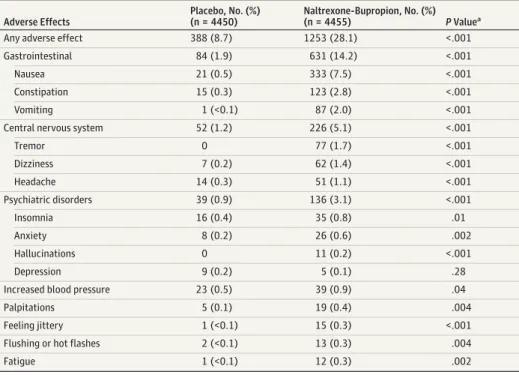
The most common adverse events leading to the discontinu-ation of study drug are shown inTable 5. These included gas-trointestinal adverse effects, which occurred in 14.2% of naltrexone-bupropion–treated patients and 1.9% of placebo-treated participants (P< .001), and central nervous system symptoms, which occurred in 5.1% of naltrexone-bupropion patients and 1.2% of placebo patients (P< .001). Psychiatric symptoms resulted in study drug discontinuation in 3.1% of naltrexone-bupropion patients and 0.9% of placebo patients (P< .001).
Discussion
The cardiovascular safety of obesity drugs has received con-siderable attention after the withdrawal of sibutramine and fen-fluramine by the FDA for cardiovascular harm.4,5Some drugs that reduce appetite are sympathomimetic agents that can in-crease blood pressure and heart rate. Bupropion, a drug widely used to treat depression, has anorexigenic properties result-ing in modest weight loss.14The effectiveness of bupropion is increased when combined with the opioid antagonist naltrexone.15A combination product was considered by the FDA for approval, but the agency initially rejected this new drug application because of elevation of blood pressure and heart rate, requiring a preapproval cardiovascular safety study.
Our study was designed to provide an assessment of car-diovascular outcomes for extended-release naltrexone, 32 mg/d, and bupropion, 360 mg/d. However, the study was terminated prematurely after the unplanned release of an interim analysis after 25% of planned events with MACE oc-curring in 59 placebo-treated patients (1.3%) and 35 naltrexone-bupropion–treated patients (0.8%; HR, 0.59; 95% CI, 0.39-0.90). After 50% of planned events, outcomes were less favorable, with MACE occurring in 102 patients (2.3%) in the placebo group and 90 patients (2.0%) in the
naltrexone-bupropion group (HR, 0.88; adjusted 99.7% CI, 0.57-1.34). Given the unplanned early termination of the trial, which di-rectly resulted from the inappropriate release of the highly fa-vorable 25% interim data, these findings do not establish non-inferiority for the prespecified margin of 1.4.
Recently, the FDA has adopted a 2-stage approach to drug approval with the intent of ruling out a high degree of hazard prior to approval based on an interim analysis of preliminary clinical trial results. These trials then continue to potentially rule out a more stringent noninferiority margin in the postap-proval setting.16The approach of a 2-stage safety trial was origi-nally developed to facilitate safety assessment of diabetes drugs.16For naltrexone-bupropion, the FDA required that the sponsor conduct a noninferiority cardiovascular outcomes trial, specifying that an interim analysis would need to rule out a noninferiority margin of 2.0 prior to approval and a margin of 1.4 at study completion (potentially postapproval).
Figure 4. Change in Body Weight During the Trial
0
–1
–2
–3
–4
–5
0
4455 4450
16
3677 3738 8
3977 4042
26
3404 3297
52
2995 2848
78
2690 2507
104
2408 2264
Mean Change in B
o
dy W
eight
, k
g
Weeks Following Randomization
No. of patients Placebo
Placebo
Naltrexone-bupropion
Naltrexone-bupropion
–6
Error bars indicate 95% confidence intervals.
Figure 5. Changes in Systolic Blood Pressure and Heart Rate During the Trial
3.5
1.5 2.0 3.0
2.5
1.0
0.5
0
–0.5
0
4455 4450
16
3871 3854 8
3977 4042
26
3404 3297
52
2997 2850
78
2690 2506
104
2409 2267
Mean Change in S
ystolic
Blood Pressure, mm Hg
Weeks Following Randomization
No. of patients Placebo
Placebo
Naltrexone-bupropion
Naltrexone-bupropion
–1.0
Change in systolic blood pressure A
1.6
0.6 0.8 1.4
1.2
1.0
0.4
0.2
0
0
4455 4450
16
3871 3854 8
3977 4042
26
3404 3297
52
2997 2850
78
2690 2506
104
2409 2267
Mean Change in Hear
t Rate, /
m
in
Weeks Following Randomization
No. of patients Placebo
Placebo
Naltrexone-bupropion
Naltrexone-bupropion
–0.2 Change in heart rate B
The success of the 2-stage approach to drug develop-ment relies on the maintenance of strict confidentiality dur-ing the time from submission of the initial interim results un-til completion of the definitive safety study. In practice, a defined team from the trial sponsor is provided with the in-terim results and submits the drug for approval but has no on-going involvement with the study. The company business lead-ership, the study’s academic leadlead-ership, and all other study personnel remain blinded until the definitive study is com-pleted. The FDA also agreed to maintain confidentiality for the 25% interim data until the trial was completed.
During our trial, publication of a patent submitted by Orexigen, along with a subsequent submission by the com-pany to the Securities and Exchange Commission,9resulted in public release of the 25% interim results of the trial. The published patent claimed a method of reducing cardiovascu-lar risk based on a 41% reduction in cardiovascucardiovascu-lar risk with naltrexone-bupropion, which were interpreted in the media as showing cardiovascular benefit. The study academic lead-ership subsequently recommended and the sponsors agreed to terminate the trial.
As a result of these events, interpretation of the results of the trial involves complex statistical issues. Noninferiority testing to rule out a doubling of cardiovascular risk (an upper 95% confidence limit of the HR not exceeding 2.0) was suc-cessfully completed after accrual of 94 (25%) of the planned 378 events (Table 4). Accordingly, it is possible to conclude that naltrexone-bupropion does not double cardiovascular risk based on the preplanned 25% interim analysis, but it is not possible to draw any conclusions related to the noninferi-ority margin of 1.4. A new cardiovascular outcome trial will be required to address the regulatory mandate to rule out a noninferiority margin of 1.4 but will not be available for a minimum of 3 to 4 years.
Per the study design, the data monitoring committee could consider stopping the trial for overwhelming evidence of efficacy or harm based on interim analyses at 50% and 75% of trial completion with statistical adjustments using O’Brien-Fleming boundaries. The study design did not allow early termination for demonstration of noninferiority. The primary outcome data reported in this manuscript were determined using the 50% interim analysis (192 events), the last preplanned analysis performed prior to termination of the trial. The HRs along with the 99.7% confidence intervals reflect the appropriate statistical adjustments for the 50% interim analysis. NoPvalues for either superiority or nonin-feriority are reported because the results of the prematurely terminated trial cannot be used to rigorously address either superiority or the prespecified noninferiority margin of 1.4. An additional sensitivity analysis was performed using the final data available at the time of last patient contact and showed less favorable findings than the primary analysis. The final data include 243 primary composite end points, approximately 64% of the intended 378 events.
In clinical trials, an ITT analysis is preferred because it is the only analysis that preserves the integrity of randomiza-tion and represents a conservative approach to assessment of efficacy. However, in a safety study, particularly one with a low adherence rate, the on-treatment analysis can provide addi-tional insight because it reflects outcomes in patients while they were actually taking the medication under study. In a safety study, when adherence rates are low, the ITT analysis can re-sult in a false-positive declaration of noninferiority. Accord-ingly, an on-treatment analysis is essential to confirm find-ings derived from the ITT analysis.
In our trial, the on-treatment analysis shows HRs that are less favorable (higher) than the ITT analysis for naltrexone-bupropion. This finding is particularly evident for the 25% Table 5. Most Common Adverse Effects Leading to Discontinuation of Study Drug
Adverse Effects
Placebo, No. (%) (n = 4450)
Naltrexone-Bupropion, No. (%) (n = 4455) PValuea
Any adverse effect 388 (8.7) 1253 (28.1) <.001
Gastrointestinal 84 (1.9) 631 (14.2) <.001
Nausea 21 (0.5) 333 (7.5) <.001
Constipation 15 (0.3) 123 (2.8) <.001
Vomiting 1 (<0.1) 87 (2.0) <.001
Central nervous system 52 (1.2) 226 (5.1) <.001
Tremor 0 77 (1.7) <.001
Dizziness 7 (0.2) 62 (1.4) <.001
Headache 14 (0.3) 51 (1.1) <.001
Psychiatric disorders 39 (0.9) 136 (3.1) <.001
Insomnia 16 (0.4) 35 (0.8) .01
Anxiety 8 (0.2) 26 (0.6) .002
Hallucinations 0 11 (0.2) <.001
Depression 9 (0.2) 5 (0.1) .28
Increased blood pressure 23 (0.5) 39 (0.9) .04
Palpitations 5 (0.1) 19 (0.4) .004
Feeling jittery 1 (<0.1) 15 (0.3) <.001
Flushing or hot flashes 2 (<0.1) 13 (0.3) .004
interim analysis showing 24 more primary events for the pla-cebo vs naltrexone-bupropion treatment group in the ITT analysis (59 vs 35) but only 7 excess events in the placebo group for the on-treatment analysis (30 vs 23) (Table 4). The most favorable component of the primary end point at the 25% interim analysis, cardiovascular death, 19 events for placebo vs 5 for naltrexone-bupropion, was driven almost exclusively by a 12-to-1 imbalance in death favoring naltrexone-bupropion among patients who were no longer taking study drug. These observations suggest that any infer-ence regarding noninferiority must be viewed cautiously pending completion of an adequately powered new clinical trial, preferably with greater adherence to treatment.
The trial offers some useful findings with respect to the effectiveness of naltrexone-bupropion as a treatment for obe-sity and provides insights about the conduct of future trials of obesity treatments. For the ITT population, at trial comple-tion, the observed weight loss with naltrexone-bupropion was modest, with a mean reduction of 3.9 kg (95% CI, −4.1 to −3.7 kg), 3.6% of initial body weight, compared with 1.2 kg (95% CI, −1.3 to −1.0 kg) in the placebo group (Figure 4). Com-pared with placebo, the incremental weight loss was approxi-mately 2.7 kg (95% CI, −2.9 to −2.5 kg), or 2.5% of body weight. The modest weight loss efficacy was likely related to low ad-herence to treatment, with approximately 63% of naltrexone-bupropion patients and 74% of placebo patients no longer taking study drug after 12 months.
A relatively low adherence rate was anticipated in the design of the trial. Patients were discontinued from treat-ment at 16 weeks (but remained in the ITT population) if they lost less than 2% of initial body weight, an approach selected by the FDA, sponsor, and academic leadership to reflect the use of antiobesity agents in clinical practice. Patients and physicians do not persist with an obesity treatment in the absence of weight loss. Patients with obesity are often dispir-ited and easily frustrated by their inability to lose weight per-manently after years of trying.17,18These experiences may contribute to suboptimal adherence to treatment recommen-dations and poor study retention. Despite maximal efforts, poor adherence and modest retention represent challenges to the conduct of such trials. Because cardiovascular outcomes trials typically require many patient-years of exposure, suc-cessfully completing such trials will require intensive efforts to promote adherence to study drugs and retention of patients in the trial. The low adherence rate and early termi-nation of our trial does not allow any reliable conclusions about the long-term safety of naltrexone-bupropion.
Because blood pressure and heart rate increases repre-sented the major reasons for concern about the cardiovascu-lar safety of naltrexone-bupropion, we collected these vital sign measurements throughout the trial. Post hoc analysis of blood pressure and heart rate after 16 weeks of treatment, when adherence was still relatively high, showed a mean increase in blood pressure for naltrexone-bupropion com-pared with placebo averaging only 0.46 mm Hg (95% CI, 0.01-0.92 mm Hg) and mean increase in heart rate of 0.45/min (95% CI, 0.11/min to 0.78/min). These changes are similar to those observed during previous studies of
naltrexone-bupropion. Adverse effects leading to study drug discontinuation were relatively common, occurring in 28.1% of naltrexone-bupropion–treated patients and 8.7% of placebo-treated patients (P< .001). The most common adverse effects were gastrointestinal and central nervous sys-tem symptoms (Table 4).
The events leading to the termination of the study serve as a valuable reminder of the importance of maintaining con-fidentiality during ongoing trials. Premature release of interim data can result in inappropriate prejudgment about the benefits or risks of the studied therapy and make comple-tion of the trial highly problematic. An FDA guidance for industry explicitly states that interim data from an ongoing clinical trial should remain confidential and warns that “such knowledge can bias the outcome of the study by inappropri-ately influencing its continuing conduct or the plan of analyses.”19Prior to public release of the 25% interim data, the FDA had already appropriately concluded that the knowl-edge of the results by business interests within the sponsor constituted an unacceptable breach of confidentiality that precluded use of the trial to meet the postapproval regulatory requirement.11
The findings of this study illustrate the importance of con-fidentiality for early interim data. In this case, the 25% in-terim data (Table 4) showed a point estimate for the HR for the primary end point of 0.59, although with wide confidence in-tervals (95% CI, 0.39-0.90). However, after an additional 25% of data were collected, the HR increased to 0.88 (99.7% CI, 0.58-1.34). For the final end-of-study analysis, the HR in-creased further to 0.95 (99.7% CI, 0.65-1.38), such that any po-tential benefit suggested in the earlier analysis was no longer apparent.
Our study has both strengths and weaknesses. It repre-sents one of the few cardiovascular outcomes trials of phar-macological agents used to treat obesity and, despite early ter-mination, collected data on a large number of cardiovascular events. The unplanned early termination represents an im-portant weakness that prevented the trial from achieving its full potential. The poor adherence rate was also a weakness but may represent the typical pattern observed with antiobe-sity pharmacological therapies in clinical practice. The obser-vations derived from this study provide useful insights for other investigators designing future outcomes trials for other obe-sity treatments.
Conclusions
ARTICLE INFORMATION
Author Contributions:Dr Nissen had full access to all of the data in the study and takes responsibility for the integrity of the data and the accuracy of the data analysis.
Study concept and design:Nissen, Wadden, Buse, Bakris, Smith.
Acquisition, analysis, or interpretation of data: Nissen, Wolski, Prcela, Buse, Perez, Smith. Drafting of the manuscript:Nissen, Wolski, Prcela, Bakris, Perez.
Critical revision of the manuscript for important intellectual content:Nissen, Wadden, Buse, Bakris, Perez, Smith.
Statistical analysis:Nissen, Wolski. Obtained funding:Nissen, Perez.
Administrative, technical, or material support: Nissen, Prcela, Bakris, Perez.
Study supervision:Nissen, Wadden, Buse, Perez, Smith.
Conflict of Interest Disclosures:All authors have completed and submitted the ICMJE Form for Disclosure of Potential Conflicts of Interest. Dr Nissen reports grants from the Medicines Company, Amgen, Pfizer, AstraZeneca, Esperion Therapeutics, Eli Lilly, and Cerenis. He consults with many pharmaceutical companies but requires any honoraria or consulting fees be paid directly to charity so that he receives neither income nor a tax deduction. Dr Wadden reports receipt of personal fees for serving on the executive steering committee for the current study. Dr Buse reports fees for consultation to the University of North Carolina under contract and travel/meals/lodging for contracted activities from a variety of companies; grants from GlaxoSmithKline, Astellas, MacroGenics, and Intarcia Therapeutics; and membership on a variety of nonprofit boards (eg, American Diabetes Association,
DiabetesSisters, Taking Control of Your Diabetes, AstraZeneca Healthcare Foundation, Bristol-Myers Squibb Together on Diabetes Foundation, the National Diabetes Education Program). Dr Bakris reports consultancy for AbbVie, Takeda, Medtronic, Relypsa, Boehringer-Ingelheim, Janssen, AstraZeneca, Bayer, and Merck. Dr Perez was previously an employee of Takeda. Dr Smith reports grants/personal fees from Takeda. No other disclosures were reported.
Funding/Support:The study was sponsored by Orexigen Therapeutics Inc, La Jolla, California, and Takeda Pharmaceuticals International, Deerfield, Illinois.
Role of the Funders/Sponsor:The sponsors were involved in the design and conduct of the study and collection and management of the data. Both the Cleveland Clinic Center for Clinical Research and the sponsors had access to the full trial database for analysis. The sponsors had the right to comment on the manuscript, but final decisions on content rested with the academic authors.
Group Information:Executive steering committee: Steven S. Nissen, MD (executive steering committee chairman and study co–principal investigator), Cleveland Clinic, Department of Cardiovascular Medicine, Cleveland, Ohio, George L. Bakris, MD, University of Chicago Medicine, director, ASH Comprehensive Hypertension Center, Chicago, IL, John B. Buse, MD, PhD, University of North Carolina School of Medicine, Chapel Hill, NC;
Thomas A. Wadden, PhD, University of
Pennsylvania Perelman School of Medicine, Center for Weight and Eating Disorders Department of Psychiatry, Philadelphia, PA, Steven R. Smith, MD, Translational Research Institute for Metabolism and Diabetes, Florida Hospital, Sanford-Burnham Medical Research Institute, Orlando, FL.Data monitoring committee:Thomas R. Fleming (data monitoring committee chair and biostatistician); Paul W. Armstrong; Darren K. McGuire; Domenica M. Rubino; Ihsan M. Salloum; Arya M. Sharma. Independent statistical center supporting the data monitoring committee:Axio Research, Seattle, WA. Academic research organization:C5Research– Cleveland Clinic Coordinating Center for Clinical Research (Cleveland, OH): A. Michael Lincoff, MD (director), Lisa Prcela, Dianna Bash, Elizabeth Fabry, Denise Mason, Mingyan Shao, Michelle Strzelecki, Kathy E. Wolski.Contract research organization: PRA Health Sciences (Blue Bell, PA): Maria C. Harrison (vice president), Dana McCarthy, Kathryn Cheatle, Chris Meussner, Erica Rohrbach, Matt Zimmerman.Clinical events committee: C5Research–Cleveland Clinic Coordinating Center for Clinical Research (Cleveland, OH): Michael Faulx, MD (clinical events committee chairperson), Venu Menon, MD (clinical events committee director), Mary Jo Heckman RN, Michael Chenier, MD, Paul Cremer, MD, Irene Katzan, MD, Jason Lappe, MD, David Newton, MD, Lee Pierson, MD, Andrew Russman, MD, Daniel Sedehi, MD, Jitendra Sharma, MD, Ken Uchino, MD.Takeda Pharmaceuticals International(Deerfield, IL): Study leadership: Penny Fleck, Stuart Kupfer, MD, Orlando Bueno, MD, Jay Liu, Kraig Keeter, Jason Gans, Diane Balma, Ming Jing, John Marcinak, MD, Cong Han, Hung Lam, Yinzhong Chen, Nina Barcha, Alison Handley. Orexigen Therapeutics Inc(La Jolla, CA): Study leadership: Toni Foster, Amy Halseth, Dan Cooper, Daun Bahr, Kevin Shan, Dawn Viveash, Kristin Taylor, Ann Ashinger, Colleen Burns.Light Investigators (Number of Enrolled Patients):Laura Akright, NECRSA, LLC, Schertz, TX (142); Kevin D. Cannon, PMG Research of Wilmington LLC, Wilmington, NC (136); Douglas R. Schumacher, Radiant Research Inc, Columbus, OH (119); Lars H. Runquist, PMG Research of Charleston, Mount Pleasant, SC (112); William P. Jennings, Radiant Research Inc, San Antonio, TX (112); Harry I. Geisberg, Radiant Research Inc, Anderson, SC (112); Margaret Rhee and Hassan Malik, Radiant Research Inc, Akron, OH (110); Larry Kotek and Tami Helmer, Radiant Research Inc, Edina, MN (109); Leslie Tharenos, Radiant Research Inc., St Louis, MO (106); Adnan A. Aslam, Northwest Houston Heart Center, Tomball, TX (104); John Rubino, PMG Research of Raleigh, Raleigh, NC (104); Muna Abuerreish and Mary Cotharp, Radiant Research, Overland Park, KS (103); Michael R. Adams, Radiant Research Inc, Murray, UT (100); Michele D. Reynolds, Radiant Research Inc, Dallas, TX (100); William T. Ellison, Radiant Research, Greer, Greer, SC (95); George L. Raad, PMG Research of Charlotte, Charlotte, NC (94); Michael Glenn Winnie, Corpus Christi Family Wellness Center, Corpus Christi, TX (94); Jonathan Paul Wilson, PMG Research of Winston Salem, Winston Salem, NC (92); Linda Murray, Radiant Research Inc, Pinellas Park, FL (91); Robert E. McNeill, PMG Research of Salisbury, LLC, Salisbury, NC (86); Martin L. Throne, Radiant Research Inc., Atlanta, GA (83); Debra L. Weinstein, ZASA Clinical Research, Boynton, FL
Phoenix Medical Clinic, LLC, Phoenix, AZ (44); Nathan Segall, Clinical Research Atlanta, Stockbridge, GA (44); Harold E. Bays, L-MARC Research Center, Louisville, KY (43); Joseph L. Lillo, Elite Clinical Studies LLC, Phoenix, AZ (43); Albert Q. Tejada, Radiant Research Inc., Scottsdale, AZ (43); Eli M. Roth and Matthew D. Wenker, Sterling Research Group, Ltd, Cincinnati, OH (42); Steven A. Geller, Centennial Medical Group, Elkridge, MD (41); Ronald I. Harris, Geisinger Specialty Clinic, Wilkes Barre, PA (41); Jon O. Ebbert, Mayo Clinic, Rochester, MN (41); Seth H. Baker, Indian River Medical Associates–Cardiology, Vero Beach, FL (41); Warren Shu and Gary L. Sutter, HealthCare Partners Medical Group, Pasadena, CA (40); Holly Dushkin, Alan E. Kravitz, Nancy J. Tresser and Alan C. Wine, Rapid Medical Research Inc, Cleveland, OH (40); Robert J. Buynak, Buynak Clinical Research, Valparaiso, IN (39); David R. Allen, Clinical Research Advantage Inc/Internal Medicine Physicians, Omaha, NE (39); Peter Rives and Gary Elkin, Southeast Regional Research Group, Savannah, GA (39); Rajesh J. Patel, Lycoming Internal Medicine Inc, Jersey Shore, PA (38); Paul D. Rosenblit, Diabetes/Lipid Management and Research Center, Huntington Beach, CA (38); William L. Abraham, Radiant Research Inc, Tucson, AZ (38); Robert A. Strzinek, Protenium Clinical Research, LLC, Hurst, TX (37); Timothy R. Smith, Mercy Health Research, Saint Louis, MO (37); Sanford N. Plevin, Suncoast Clinical Research Inc, New Port Richey, FL (36); Robinson Koilpillai and Richard Giusti, Clinical Research of Central Florida, Winter Haven, FL (36); Mark Heiman, Cardiology Associates of Fairfield County, PC, Stamford, CT (36); Adeniyi O. Odugbesan, Physicians Research Associates LLC, Lawrenceville, GA (36); Isaac Dor, Clinical Investigations Specialists Inc, Gurnee, IL (36); Zulfiquar Bhatti, Columbus Regional Research Institute, Columbus, GA (36); William R. Felten, MidMichigan Medical Center Midland, Midland, MI (35); Brenda C. Peart, Southwest Heart Group, Tucson, AZ (34); Rao V. C. Gudipati, Michigan Cardiovascular Institute, Saginaw, MI (33); Mark A. Stich, Westside Center for Clinical Research, Jacksonville, FL (33); Damodhar P. Suresh, Saint Elizabeth Healthcare, Crestview Hills, KY (33); Michael R. Seidner and Jack C. Rosenfeld, Green and Seidner Family Practice Associates, Lansdale, PA (33); Samer Nakhle, Palm Research Center, Las Vegas, NV (32); Barry C. Lubin, National Clinical Research-Norfolk Inc, Norfolk, VA (32); Alfred N. Poindexter III, Advances In Health Inc, Houston, TX (32); Donald P. Hurley, Medical Research South LLC, Charleston, SC (32); E. Clark Cullen, Sunstone Medical Research LLC, Medford, OR (32); Mark A. Turner, Advanced Clinical Research, Meridian, ID (32); Gerald R. Shockey, Clinical Research Advantage Inc./Desert Clinical Reseach, LLC, Mesa, AZ (32); Roddy P. Canosa Frank W. Corbally, Northern Lancaster County Medical Group affiliate of Wellspan Health Medical Group, Ephrata, PA (32); Lisa M. Cohen, Suncoast Clinical Research Inc, New Port Richey, FL (32); Sabrina A. Benjamin, Universal Research Group, Tacoma, WA (32); David Fitz-Patrick, East-West Medical Research Institute, Honolulu, HI (32); Kenneth M. Maynard, Investigator’s Research Group, LLC, Brownsburg, IN (31); Robert J. Weiss, Maine Research Associates, Auburn, ME (31); Dale C. Allison, Hillcrest Family Health Center, Waco, TX (31); Douglas Young, Northern California Research, Sacramento, CA (31); Ralph David Wade, Wade Family Medicine Inc,
Bountiful, UT (30); Raymond E. Jackson, QUEST Research Institute, Bingham Farms, MI (30); Miguel E. Trevino, Innovative Research of West Florida Inc, Clearwater, FL (29); Murray A. Kimmel,
Accelovance, Melbourne, FL (29); Matthew D. Acampora, The Center For Nutrition and Preventive Medicine, Charlotte, NC (29); Gigi C. Lefebvre, Meridien Research, St Petersburg, FL (29); Louis M. Stephens Jr, Palmetto Clinical Trials Services LLC, Fountain Inn, SC (28); Jennifer S. Kay, Clinical Research Advantage Inc/ Ridge Family Practice, Council Bluffs, IA (28); Kenneth Cohen, New West Physicians, PC, Golden, CO (27); Jay C. Anderson, Internal Medical Associates of Grand Island PC, Grand Island, NE (27); Robert Lipetz, Encompass Clinical Research, Spring Valley, CA (27); Bindu Lal and Armen H. Arslanian, Beacon Clinical Research, LLC, Brockton, MA (27); Bhola Rama, Rama Research, LLC, Marion, OH (27); Ravi S. Bhagwat, Cardiovascular Research of Northwest Indiana LLC, Munster, IN (27); Jack D. Wahlen, Advanced Research Institute, Ogden, UT (26); Jeffrey G. Shanes, Consultants in Cardiovascular Medicine, Melrose Park, IL (26); Michelle Welch, Cosano Clinical Research, San Antonio, TX (26); Ronald Blonder, UCH-MHS, Colorado Springs, CO (26); Michael Jacobs, Clinical Research Consortium, Las Vegas, NV (25); Irving K. Loh, Westlake Medical Research, Thousand Oaks, CA (25); William Saway, Columbia Medical Practice, Columbia, MD (25); David Radin, Stamford Therapeutics Consortium, Stamford, CT (25); Anthony Alfieri, Alfieri Cardiology, Newark, DE (25); Judith L. Kirstein, Advanced Clinical Research, West Jordan, UT (25); William Gonte, American Center for Clinical Trials, Southfield, MI (24); Jeffrey Rothman, University Physicians Group Research Division, Staten Island, NY (24); O. Michael Obiekwe, Atlanta Ropheka Medical Center/APSMO, Riverdale, GA (24); Donna M. DeSantis, Clinical Research Advantage Inc/ East Valley Family Physicians, PLC, Chandler, AZ (23); Robert Lamar Parker, Lyndhurst Clinical Research, Omaha, NE (23); Eric M. Ball, Walla Walla Clinic, Walla Walla, WA (23); Caroline M. Apovian, Boston University Medical Center, Boston, MA (23); Rene Casanova, SouthEast Medical Centre, Oakland Park, FL (23); Cezar Staniloae, Gotham Cardiovascular Research, PC, New York, NY (23); John J. Champlin, Med Center, Carmichael, CA (23); Kari T. Uusinarkaus, Clinical Research Advantage Inc/ Colorado Springs Health Partners, PC, Colorado Springs, CO (22); Daniel Weiss, Your Diabetes Endocrine Nutrition Group Inc, Mentor, OH (22); Anthony J. Bartkowiak Jr, Blair Medical Associates, Inc, Altoona, PA (22); Paul C. Norwood, Valley Research, Fresno, CA (22); David M. Barker, Chattanooga Medical Research LLC, Chattanooga, TN (22); John Buse, UNC Diabetes Care Center, Chapel Hill, NC (22); Daniel F. Sousa, Genesis Clinical Research and Consulting LLC, Fall River, MA (22); Andrea L. Phillips, Phillips Medical Services PLLC, Jackson, MS (22); Dean J. Kereiakes, The Carl and Edyth Lindner Center for Research and Education at The Christ Hospital, Cincinnati, OH (22); John Agaiby, Clinical Investigation Specialists Inc, Kenosha, WI (22); Scott Sulman, Geisinger Clinic/Geisinger Medical Group-Scenery Park, State College, PA (22); Mark L. Warren, Physician’s East PA Endocrinology, Greenville, NC (21); John Hoekstra and John K. Scott, National Clinical Research-Richmond Inc, Richmond, VA (21); Oliver T. Willard and William E. Fowler, Advanced Research Associates–Self Medical Group, Hodges, SC (20);