Industries & Sprawl
Measuring the Effect of Labor Demand Structure
on Urban Form Using Landscape Metrics
Travis Maverick Green
MCRP Candidate 2012
Department of City and Regional Planning
University of North Carolina—Chapel Hill
T. William Lester, Advisor and First Reader
Nikhil Kaza, Second Reader
Abstract
1.
Introduction
Apple and the City of Cupertino began holding public meetings to discuss the environmental impact study for a new headquarters for the corporation. The tech company has outgrown its existing office park, and the company hopes to build a new facility to house 13,000 employees while also staying close to the institutions that helped catalyze its creation. The proposed facility will require demolition of 2.6 million square feet of outdated office space. Apple prefers to stay inside the city and has elected not to build at a greenfield site at the city’s periphery…
In an attempt to attract and retain high tech jobs, central North Carolina’s governments established Research Triangle Park in 1959 on a vacant 7,000-acre strip of land between Raleigh-Durham and Chapel Hill. The Park has become an epicenter of high tech growth as the area’s tobacco and furniture industries decline. The Park now hosts 38,000 full time employees in 22.5 million square feet of office space. Wake County’s core has shifted to the West as new employment opportunities grow up around this park…
Between 2001 and 2006 Las Vegas housing construction boomed as the market for vacation properties and investment properties shot up during the housing bubble. Ten percent of all jobs in the city were dedicated to construction--70% higher employment than the national average. Suburban subdivisions sprawled across the desert. Total urbanized area in Clark County, the principal county for Las Vegas, grew by 55 square miles in just five years…
* * *
These three examples—Cupertino, Raleigh-Durham, and Las Vegas—suggest a link between urban growth and the structure of labor demand. But how are they linked exactly? Are the kinds and quality of jobs related to how a city grows? Can employment in one industry create one form of growth while employment in another industry produces an entirely different form?
furniture and tobacco manufacturing employment to university-based research employment changed the location of workplaces, commuting patterns, average household incomes, average employees per workplace, and the educational qualifications of a substantial portion of the region’s population. The new growth characteristic emerging in Raleigh-Durham may be that of a hub and spoke system emanating from key centers needed to drive employment in these sectors. In Las Vegas, the construction industry was fundamental to the built environment of city. Here, the growth is itself the product of a dominant industry in the community. Cities with larger residential construction industries may see sprawling urban growth.
The purpose of this paper is to empirically test the role of industries, or more precisely, the role of selected “industrial attributes” in shaping two characteristics of urban expansion: rate of growth and fragmentation. Do different industries encourage more rapid urban expansion? And can certain industries, as characterized by various “industrial attributes”, lead to fragmented growth as opposed to contiguous urban growth? To foreshadow my conclusion, industries can impact urban form through income, number of establishments, income inequality and relative use of college-educated workers. As counties move towards employment in industries with lower mean incomes, total urbanized area in a county grows more rapidly. The development also becomes more contiguous. As number of workplaces in a county increase, so does total urbanized area. As counties shift towards industries with flatter income distributions and low rates of college education, total urbanized area also grows but it also remains more fractured.
In this introductory section, I will expand on my definitions of urban growth and local economies by discussing some of the literature. I will also wrestle with the important question of causality and offer an argument for why one can see form of growth as a product of economy and not the other way around. Finally, I will conclude this section with an outline of the paper’s subsequent chapters.
Urban Growth and City Form
the techniques. The key attributes of urban form and growth that can be understood using landscape metrics include size, complexity of shape, fragmentation and overall density. These attributes say very little about what is happening at the core of cities; the technique favors analysis of what is happening at the periphery of urban areas. Therefore, for the purposes of this paper, “city form” will primarily be reduced to understanding if various industries produce growth and if the growth is contiguous or fractured.
Sprawl, a form of growth, is a complicated term that will appear throughout this analysis. Scholars have not settled on a common definition of sprawl. Squires, in a volume he edited in 2002, argues that urban sprawl, or uneven growth, is characterized by “low-density, automobile-dependent, exclusionary new development on the fringe of settled areas often surrounding a deteriorating city.” Squires’s work focuses on sprawl as a U.S. phenomenon produced by decades of federal housing and transportation policies favoring suburbs over older, denser cities. In adopting such a definition, Squires connects growth at the fringe with decline in the center; it connects new development with racially charged disinvestment at the core. By comparison, Galster, in a 2001 article, promotes separating sprawl and its causes from its consequences and advocates for a more
technical definition. He favors using measurements in eight distinct dimensions of land use patterns—density, continuity, concentration, clustering, centrality, nuclearity mixed uses, and proximity—to quantitatively asses whether a community is sprawling. For Galster, sprawl is something that is simply measured.
There are also many conflicting understandings of the causes of sprawl. While Squires favors the theory that sprawling development has been spurred on by federal policies, Beauregard (2001), counters the claim with empirical evidence and says that scholars should look elsewhere to explain the phenomenon. In a land cover study, Burcheld (2006) found that “ground water availability, temperate climate, rugged terrain, decentralized employment, early public transport infrastructure, uncertainty about metropolitan growth, and unincorporated land in the urban fringe” increase sprawl. Brueckner (2000) argues that sprawl has been primarily caused by population growth, rising incomes and falling transportation costs. Wu (2001) explains sprawl as a product of household consumption preferences favoring various environmental and social amenities more available in suburbs. Finally, Mieszkowski (1993) explains sprawl as a product of the natural evolution of urban form downplaying the role of any one historical event.
For the purposes of this paper, the term “sprawl” will be used without the socio-economic associations proposed by Squires. Instead, like Galster, it will be used to describe a collection of attributes of development at a city’s edge. Although some may disagree about whether simple residential expansion at a city’s periphery constitutes sprawl, most scholars have agreed that “leapfrog” development constitutes sprawl (see Figure 1). Leapfrogging occurs when developers skip over vacant land adjacent to existing urban areas and develop a disconnected urban area. Sprawl, in this analysis, will be used to describe counties experiencing leapfrog development. Spatially, this will be described as (1) rapid growth and (2) low rates of defragmentation. While urban development consumes more land in almost every county from year to year, sprawling counties do so more quickly. Similarly, urban development tends to become more contiguous as urban areas merge into each other. Sprawling development, by this paper’s definition, does so less rapidly. It remains or becomes more fragmented.
Local Economies and Spatial Economics
testing. Economists have predominately written about firm decisions. Alfred Weber described firm locational decisions as a product of two inputs: transaction costs and labor costs. Weber’s Least Cost Theory predicts that firms locate to minimize both labor and transaction costs. Walter Christaller and, later, August Losch described Central Place Theory recognizing that firms are spatially distributed to capture markets. Because of travel costs for consumers, firms appreciate a locational monopoly when they are a certain distance from their nearest competitor. More recently, Fujita (1999) summarized decades of economic thought on spatial economies, a work for which Krugman won the Nobel Prize in economics in 2008. Collectively, these works of urban economics explain how firms locate to reduce transaction costs, capture spillover effects, and share labor pools.
These theories, in turn, have shaped economic development practice. Michael Porter writes about clusters and encourages cities to recruit businesses by capitalizing on economic advantages of agglomeration economies. Richard Florida discusses the locational preferences of the “creative class,” suggesting that city form is itself a commodity sought by this new techno-elite, the most important resource in the new economy.
Other scholars have taken an alternative approach arguing that space is not just a variable to which firms respond, but a product of firms themselves. Storper and Walker (1983) pioneered this rethinking of the orthodox approach to spatial economics using labor. They argue that it is an oversimplification to say that firms simply minimize costs through locational decisions. Businesses generate unique labor markets so as to capitalize on a “spatial division of labor.” (33) This paper will build on the assumptions of Storper and Walker arguing that firms co-produce their environments.
Finally, I must address a second spatial question. To what area should one ascribe the impacts of an industry? It may be obvious how jobs in a given sector in Houston impact Houston and not Portland. But how do you draw distinctions between San Diego and Los Angeles? Minneapolis and St. Paul? Do the Federal agencies in Washington have spatial consequences for Baltimore?
the significant exclusion of major sectors like agriculture and mining, two sectors that may have large impacts on urban form. Second, this study is principally concerned with the impacts of industries not housing and therefore prioritizes the location of workplaces over residences. The data sources for this study report employment based on the county of the workplace and not the employee’s home. Recognizing that this geography is problematic, I have selected to use county data.
Causality
Do industries produce city form, does city form attract firms, or is there no relation between industries and city form? As mentioned above, most spatial economics literature presumes that firms view their locational decision as a maximization problem suggesting that industries respond to form instead of producing it. In this paper I will argue the opposite. In the vignettes discussed above—Cupertino, Raleigh-Durham, and Las Vegas—we saw how industries may be seen as producing space. In Cupertino, the success of a major corporation in concert with regional spillover economies have led to plans to restructure the city’s center. In Raleigh-Durham, the creation of a suburban industrial park grew the high tech sector that changed the fundamental shape and commute patterns of the region. Las Vegas’s leisure economy led to a vacation home boom that sent the city sprawling in all directions.
Of course, the argument that cities can be a product of their economies is not new. Adam Smith argued that the formation of towns and cities was primarily an economic activity driven by the need for specialized labor. “The scattered families that live at eight or ten miles distance from the nearest of them must learn to perform themselves a great number of little pieces of work, for which, in more populous countries, they would call in the assistance of those workmen.” As the nature of work changed, so did cities.
The Work Ahead
In this section I have presented a research question: does industrial change influence city form? I have clarified that city form will be characterized using quantitative landscape metrics measuring rate of growth and degree of fragmentation. Rapid growth and lack of substantial defragmentation will be described as “sprawl”. I will use counties as the unit of analysis. The remaining sections of this paper will be divided as follows: In the methodology section I will define and discuss the six landscape metrics used for this analysis: total patch area, number of patches, patch size, standard deviation of patch size, mean shape index, and fractal dimensional index. I will also explain the independent variables including categorization of employment, which will describe “industry” in the model. In the data section I will detail the sample and how it was selected. In the results section I will share the results of various regressions. In the discussion and conclusion sections I will expand on the results of the regressions and look closely at the three counties introduced at the beginning of this paper. Also in the conclusion, I will expand on my hypothesis that industries produce distinct forms and discuss which industries may be producing sprawl based on those attributes.
2.
Methodology
To measure industry’s impact on urban form I will measure form and industry changes from 2001 to 2006. I will then conduct a basic employment analysis on counties that are sprawling to determine how they may differ from the entire sample. Then, using linear regression I will measure the statistical relationships between industrial characteristics and urban form. Finally, I will use logistic regression to measure the likelihood of various industrial characteristics producing sprawl.
In my analysis, I will measure forms of growth using landscape metrics. I will use levels of employment in various sectors to describe industrial character. The models will then be tested using various statistical techniques as well as by comparing the difference between industry inferred economic characteristics and observed characteristics.
Landscape Metrics
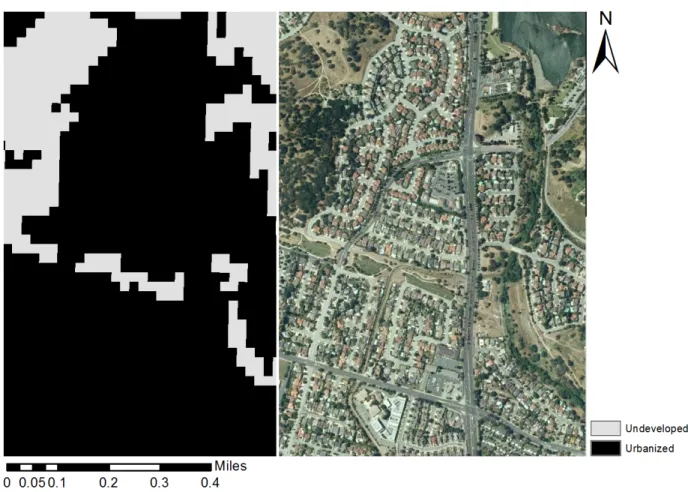
Landscape metrics are created by first classifying predetermined units of area into various categories of interest. This land cover map usually starts as a satellite image that is then broken into a grid of pixels (see Figure 2). Adjacent pixels with the same value are called a “patch”. In an urbanized area map, land that has been urbanized is given one value, “1” or “black”, and land that is un-urbanized is given another, “0” or “white”. A contiguous urbanized area in then called an “urbanized patch”. These maps then can be run through a geospatial statistical software program that generates descriptive landscape metric values for a given area.
Evelin Uuemaa (2009) conducted a review of landscape metrics and their various uses in geo-spatial research. The study found that from 1994 to 2008, scholars published 331 articles using landscape metric techniques. A significant number of these articles were dedicated to studies of biodiversity and habitat. Landscape metrics have also been used for estimating water quality and measuring landscape pattern responses to natural disasters. More recently, landscape metrics have been used to study urbanization patterns mostly as it relates to impacts on ecosystems. For instance, papers have tried to measure how infrastructure has resulted in habitat fragmentation.
packages to aid researchers in producing metrics has created a fragmented assortment of metrics many of which communicate the same thing. To test the value of individual metrics, Hargis (1998) created artificial landscapes with various controls representing different fragmentation processes. Hargis found that different landscape measures were highly correlated and linearly associated. She also documented some blind spots in the technique, i.e. none of the measures were able to distinguish between dispersed and aggregated patches. Such statistical relationships, the risk for autocorrelation and simultaneously the risk for blind spots in data analysis, must be taken into account when selecting appropriate metrics to describe space.
The second key issue identified by Uuemaa is the modifiable areal unit problem which covers “how the grain size, zoning and areal extent of investigation influence results and how to determine their optimal values for each particular case.” (7) For the most part, this second problem will go unaddressed by this research project. Two things can be said however in defense of the selected scale of the study. First, I have
not selected boundaries or a resolution to achieve preferred results; the boundaries and resolution were selected because of data availability. I will be using the 2001 and 2006 data files from the National Land Cover Database that divides the United States into 30-meter classified pixels. I have broken this map by current county boundaries, a unit for which employment data is readily available. Second, it is hard to imagine circumstances under which the chosen metrics for this study would vary greatly at smaller resolutions of study. The modifiable unit problem has great consequences for habitat where contiguity of territory has very real impacts on the survivability of creatures. Understanding how the species of study interacts with the environment should guide the decision regarding units. In this case, the relevant level of study is more subjective and should reflect the ways humans interact with the built environment. The provided data set with 30-meter resolution passes the gut test of appropriate resolution for study: smaller units would be prone to more errors and would provide unneeded detail; larger units would conceal processes of interest to regional decision makers.
Finally, another criticism of the technique comes from Li (2004) who points out that there were high expectations for spatial analysis, but that it has done little to “improve our understanding and prediction of ecological processes”. Li concludes that statistical description of space is just that. It must be paired with meaningful analysis of how such characterizations of form relate to underlying ecological or urban forms. In other words, studies with metrics should be paired with additional analyses of form. The metrics used in this paper are two-dimensional and binary: urban or not-urban. A 30-meter urbanized patch in Manhattan is likely very different from a 30-meter urbanized patch Harrisburg. For this paper I will have limited opportunities to go beyond the statistics, but I will briefly discuss how urbanization trends are impacting the three counties detailed in the introduction.
Landscape Metrics Describing Urban Growth
edge density, and mean fractal dimensional index of urbanized patches. I use similar metrics.
These six metrics can be divided into three categories: measures of absolute size, measures of relative size and complexity of urban form. Measures of absolute size, number of patches and total area, increase with increased urbanization. Seto writes, “As urban growth occurs, total urban area continually increases due to the highly non-reversible nature of urbanization. The number of urban patches metric is a measure of discrete urban areas in the landscape and is expected to increase during period of rapid urban nuclei development, but may decrease if urban areas expand and merge into continuous urban fabric.” (877)
The measures of relative size are mean urban patch area and standard deviation of patch area. “Decreasing values of mean urban patch size implies that new urban centers are growing faster than existing urban areas. That is, urban growth occurs more as a process of new and multiple urban nuclei formation than of envelopment or annexation.” (877) Standard deviation of patch area measures the breadth or diversity of sizes of urbanized patches. Decreasing values indicate that patches are becoming more uniform in size.
The third set of metrics measure complexity of urban form. Mean urbanized patch fractal dimension “describes the degree to which the shape of an urban area is irregular or complex. The more irregular the shape of the urban area, the higher the fractal dimension”. (878) The second measure of complexity is mean shape index, a slight revision from Seto’s preferred edge density. Mean shape index measures a patch’s likeness to a shape with a very simple and low edge to area ratio. “In this index low values reflect the compactness of individual developments.” (Kaza, 7)
How can these six metrics describe specific forms of growth? As mentioned in the introduction, this study is limited to describing two principal characteristics of growth: rate of urbanization and rate of defragmentation. I have labeled a community that is both growing rapidly and experiencing little defragmentation as “sprawling”. I will measure rate of growth as the percent total urban area increase and fragmentation as the percent change in number of urbanized patches.
Measuring Industrial Character
the Bureau of Labor Statistics. This data is collected at the establishment level. Each establishment is categorized into one of nineteen sectors, or NAICS codes, based on its primary product. The Bureau of Labor Statistics collects this data from the states and then distributes the data publically at the county level.
One option would be to characterize industrial character in regression models by employment data alone. I suspected and later confirmed that this would be problematic because of high levels of autocorrelation between levels of employment in some industries. Including 19 separate employment values in a regression can be difficult to interpret. Instead of using raw employment data, I chose to re categorize employment in various industries into five “industry attributes” that I hypothesized, based on previous sprawl literature and based on intuition, may be impacting urban form. The five variables are:
Mean Income Percent Change – Using industry employment totals for each county, I generated a weighted average of “mean industrial incomes” in 2001 and 2006. I inflated the 2001 income and measured the percent change. Profiling the dominant theoretical frameworks for suburbanization, Mieszkowski and Mills (1993) argue that historically incomes have been a cause of sprawl. “As new housing is built at the periphery, high income groups who can afford larger and more modern housing settle there.” (136) As employment shifts to industries with higher mean incomes, we might expect total urbanized area to increase.
Portion of Population with College Degrees Percent Change – Like income inequality, industries have different arrangements of occupations requiring different skill levels. I summed the occupations in each industry to predict a percentage of jobs requiring college education. I then calculated the percent change from 2001 to 2006. Predicting the impacts of labor skill on urban growth is a little more difficult. Like with income inequality, educational attainment may produce more pressure at the urban periphery. “Homogenous groupings enhance the quality of education, as there is evidence that peer-group effects are important in the production of educational achievement.” (Mieszkowski and Mills, 137) I find this argument not all that compelling. Instead, I prefer looking at education as an indicator of high value labor inputs. Higher value inputs, using a Weber analysis, creates a tighter network of firms around those inputs. I predict that increasing percent of college-educated employees will discourage sprawl and urban growth. Others, like Florida (2002), have argued that “the creative class”, a more educated group of workers, now prefers denser center city living.
Number of Establishments Percent Change – Industries may be predisposed to certain size establishments. Using industry averages, I calculated the number of establishments in a county using employment data. I then measured the percent change from 2006 to 2001. Like changes in numbers of housing units, I predict that an increase in the percent of establishments will result in sprawling urban form.
Ratio of Super Establishments Percent Change – Some industries have higher ratios of super establishments, or establishments with 100+ employees. Using employment data, I calculated the ratio of super establishments to non-super establishments in each county. I then measured the percent change from 2006 to 2001. Super establishments will likely favor more compact urban development as they tether employees to more compact employment centers.
For a summary of hypotheses on how these variables impact sprawl, see Table 2.
In addition to the five industry metrics, three control variables will complete my models for sprawl. Index of Relative Rurality (detailed for 2000) measures a county’s degree of rurality on a scale of 0 to 1 with 1 representing a perfectly rural county and 0 representing a perfectly urban county (Isserman 2005). I included average July temperature to control for the Sun Belt effect, or the population and employment shift of the country from the Northeast towards the Southwest. Finally, I included percent change in number of housing units as a stand-in for change in population. I selected change in housing units because it more accurately represents the spatial consequences of an additional household, but it also allows for a more direct analysis of the impacts of housing versus the impacts of employment.
Comparing Observed Variables and Industry Implied Variables
The industry implied variables described above capture how employment shifts between industries impact expected labor force and workplace attributes. A 1% increase in mean income, for example, describes a shift in employment from industries that pay lower national mean incomes to industries that pay higher national mean incomes. It does not mean that local incomes actually increase.
Statistical Analysis
3.
Data
Two-hundred fifty-six counties in the lower-48 possessed all the data required to be a part of the study. These counties constituted 44.6% of the total population of the lower-48, and included a variety of urban area types from older mature population cores to actively developing urban areas. These 256 counties possessed full employment data for the 19 sectors of interest in both 2001 and 2006, the single most limiting factor on the sample size. The 256 counties also had complete land area calculations, housing unit data from 2000 and 2005, and complete temperature data. Several parishes in Louisiana were excluded because of the catastrophic impacts of Katrina.
A majority of these counties, 223, are part of metropolitan areas. By Census classification, the most (133) are classified as “mixed rural”. Sixty six are classified as urban, 56 are mixed urban and only 1 is completely rural. At least one county is included from 45 of the 48 contiguous states. No counties are included from Delaware, Vermont, the District of Columbia or Virginia. In terms of 2006 population, 74 counties had populations over 500,000. Eighty-two have populations between 200,000 and 500,000, and 100 have populations below 200,000.
Another interesting measure of the data set is the relative “developmental age” of the counties. One can draw some conclusions about the form of a county based on when it went through rapid development. Kaza (2011) introduced such a measure in his paper regarding landscape metrics. Kaza’s technique divided counties into four categories based on when they achieved 75% of their 2000 population. If it was achieved prior to 1950, counties were labeled “very mature”. Counties reaching the 75% threshold between 1950 and 1970 were labeled “mature”, between 1970 and 1990 were labeled “developed” and counties that have not reached 75% of current population by 1990 were labeled “developing”. Kaza found this variable to be well correlated with the total area, number of patches, average size and standard deviation of area of urbanized patches. In my dataset, 29 counties are “developing”, 112 are “developed”, 42 are “mature” and 48 are “very mature”. The developmental age of 25 counties cannot be determined because of limitations of Census data and changing county boundaries.
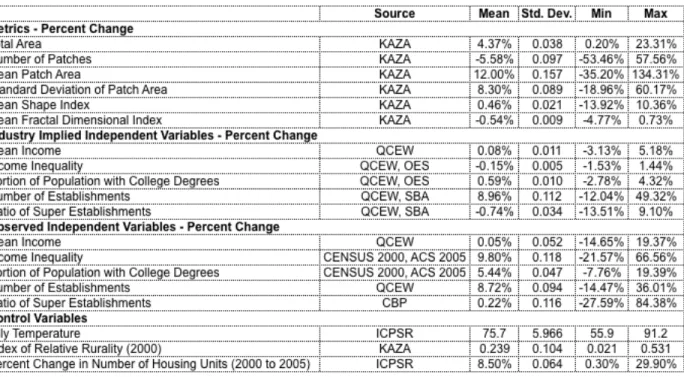
urbanized area was an increase of 23.3% (Jackson, MS). San Juan County, NM, (Farmington) by comparison had the smallest increase of 0.2%
The change in number of patches has a mean of -5.6% indicating that counties, for the most part, have a decreasing number of urbanized patches. The majority of urbanized areas in the sample are becoming more contiguous. This however varied from 53% decrease in Salt Lake County, UT to a 57.6% increase in Taylor County, TX. Mean urbanized patch area typically increased (the mean was 12%), although this too varied from large decreases, 35.2%, in Taylor County, to a 134% increase in Salt Lake County, UT where the large change in number of patches merged into one large patch. The mean county had a slight increase, 8.3%, in standard deviation of urbanized patch area.
Counties typically had a slight increase, 0.5%, in urbanized mean shape index, meaning form was becoming more irregular. The largest increase was Salt Lake County, UT, 10.4%, where the new emerging urban shapes were much more irregular. Taylor County, TX, had the largest drop of 13.9% where new urbanized areas were relatively square-like.
Finally, fractal dimensional index of urbanized patches tended to decrease meaning counties were becoming more regular and grid-like in urbanized form. The largest decrease, 4.8%, occurred in Webb County, TX. The largest increase, just 0.7%, occurred in Fort Bend County, TX in Houston where the form became more complex.
4.
Results
The results of my data analysis are divided into four sections. First, I conducted some initial data analysis to determine how the economies of sprawling counties were changing relative to the entire sample. Generally, employment grew more rapidly in sprawling counties. Declining industries declined less rapidly and growing sectors grew more rapidly. Health care, retail trade and accommodation and food services were the biggest job gainers, and manufacturing jobs were better preserved in sprawling counties. Second, I conducted regressions to evaluate how individual landscape metrics were impacted by the independent industry variables. From 2001-2006, decreasing industry incomes increased urban growth and encouraged urban defragmentation. Decreasing industry income inequality both increased urbanized area and increased urban fragmentation. Third, I conducted a logistic regression to determine how independent industry variables collectively impacted landscape metrics to specifically produce sprawling form. Decreasing industry income inequality and decreasing industry college education attainment rates had a higher likelihood of producing sprawl. Finally, I reviewed how the landscape metrics and employment changes in the three counties mentioned in the introduction.
Which counties are sprawling, and how is their employment changing?
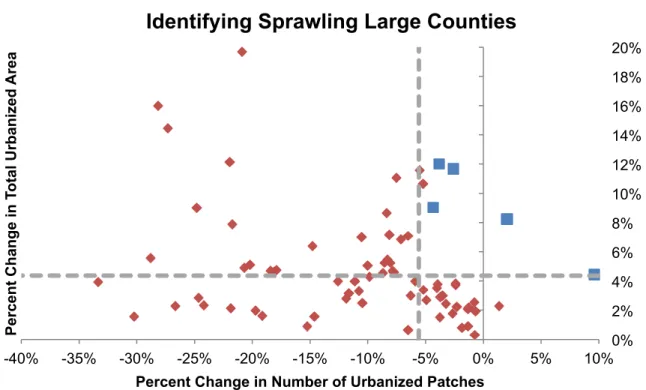
I identified five counties with populations over 500,000 (2005 population) that were rapidly urbanizing but not defragmenting, our selected indicator for sprawl (see Table 4 for a complete list). Arapahoe (part of Denver) and El Paso (Colorado Springs) counties in Colorado, Hidalgo (McAllen) and Travis (Austin) counties in Texas, and Wake County (Raleigh) in North Carolina went through substantial fragmented urbanization from 2001-2006. In addition to these larger counties, I identified 20 counties with populations between 200,000 and 500,000 and 29 counties with populations between 50,000 and 200,000 that showed similar growth patterns.
Table 4: Sprawling counties
0% 2% 4% 6% 8% 10% 12% 14% 16% 18% 20%
-40% -35% -30% -25% -20% -15% -10% -5% 0% 5% 10%
Pe
rc
en
t
C
h
an
g
e
in
T
o
ta
l U
rb
an
ize
d
A
re
a
Percent Change in Number of Urbanized Patches
Identifying Sprawling Large Counties
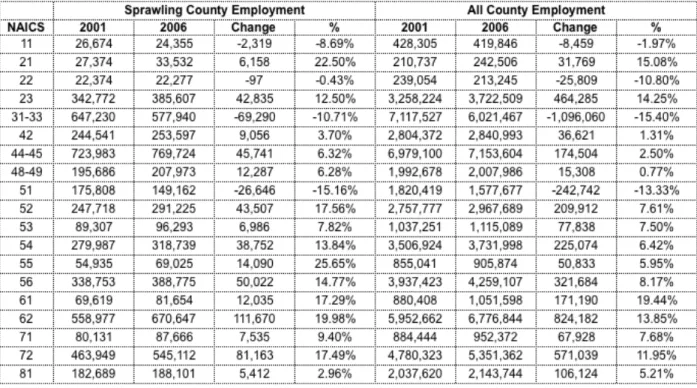
The fragmented-growth counties saw a rather unique employment change pattern from 2001 to 2006 (see Table 5). Although agriculture was already underrepresented in the sprawling counties, it declined much faster (-8.7% versus -2.0%). Management of companies grew much faster at 25.7% versus 6.0% in the entire sample. Most employment losses in utilities were prevented in sprawling counties. They only declined at -0.4% rather than at -10.8% in all counties. Accommodation and food services (17.5%), health care (20.0%), administrative and support (14.8%), mining (22.5%), and finance and insurance (17.6%), grew between 5 and 10% faster than all other counties.
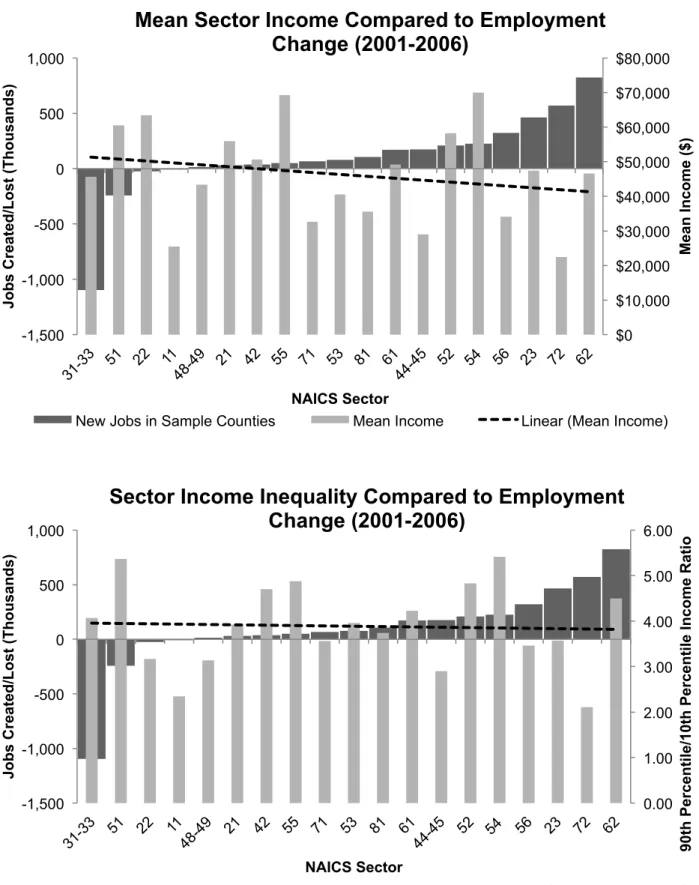
The most consequential employment changes can be revealed by predicting how a county’s employment should change if it followed the trends in the entire sample. I found that sprawling counties do not follow the employment changes in the rest of the sample. Sprawling counties were better at preserving manufacturing jobs, saving 30,380 more jobs than expected. Health care added 34,276 more jobs than expected. Retail trade added 27,639 more jobs and accommodation and food services added 25,741 more jobs than expected. These employment shifts have interesting socio-economic consequences for these counties that might be impacting their urbanization. The additional growth in retail trade and accommodation services, for instance, may be dropping countywide mean incomes (see Figure 4).
These two sectors are the lowest and third lowest, respectively, in terms of sector mean income. Health care, by comparison, is roughly average. We might also be observing a shift to sectors with more “super establishments”, or workplaces with more than 100+ employees. Retail trade ranks 5th, accommodation and food services ranks 6th and finance and insurance ranks 4th for number of super establishments, and all four sectors added disproportionately more jobs in sprawling counties.
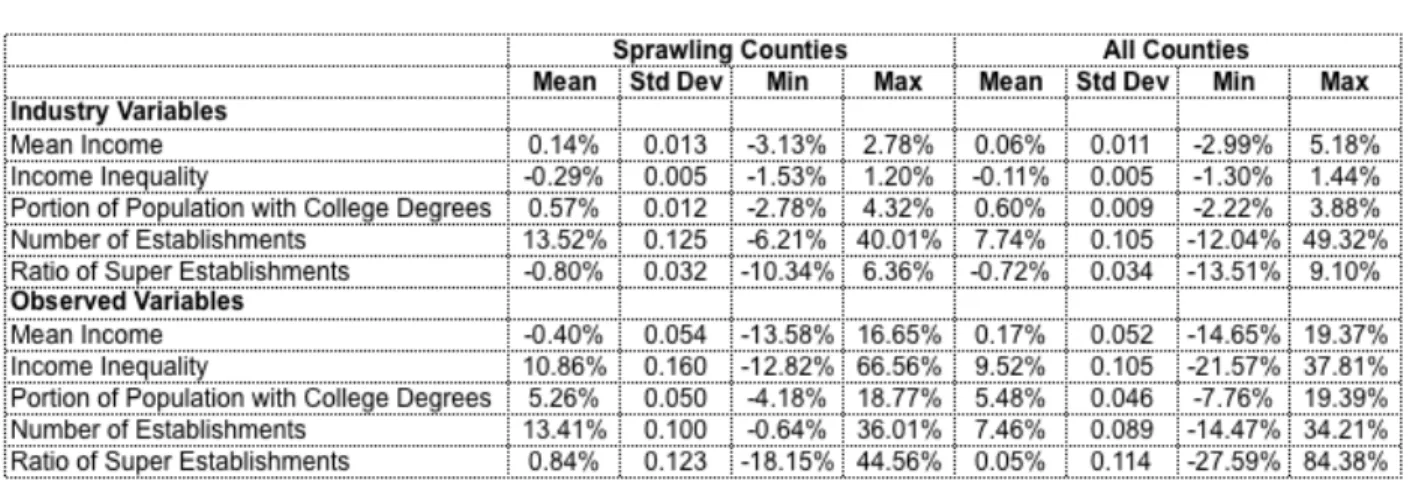
More in-depth data analysis, however, complicates these preliminary observations of how industrial composition may be impacting these counties and thereby impacting their spatial growth patterns. Just looking at averages suggests that based on the dominant sectors of employment, fragmented growth counties will have large increases in incomes, have greater decreases in income inequality, have smaller increases in number of college educated employees, have significantly greater increases in number of establishments and have slightly greater decreases in the ratio of large to small establishments (see Table 6). These differences in averages should be seen skeptically because in all instances, the standard deviations of the observations significantly overlap. The industrial differences of these counties may be intriguing, but more statistical rigor must be employed to really demonstrate a connection between changes in employment and sprawl.
$0 $10,000 $20,000 $30,000 $40,000 $50,000 $60,000 $70,000 $80,000 -1,500 -1,000 -500 0 500 1,000 Me an In co m e ($ ) Jo b s C re ate d /L o st (T h o u sa n d s) NAICS Sector
Mean Sector Income Compared to Employment
Change (2001-2006)
New Jobs in Sample Counties Mean Income Linear (Mean Income)
0.00 1.00 2.00 3.00 4.00 5.00 6.00 -1,500 -1,000 -500 0 500 1,000 90 th Pe rc en ti le /1 0th Pe rc en ti le In co m e R ati o Jo b s C re ate d /L o st (T h o u sa n d s) NAICS Sector
Sector Income Inequality Compared to Employment
Change (2001-2006)
New Jobs in Sample Counties 90-10 Income Ratio Linear (90-10 Income Ratio)
0% 10% 20% 30% 40% 50% 60% 70% 80% 90% -1,500 -1,000 -500 0 500 1,000 Pe rc en t o f Jo b s R eq u ir in g C o lle g e D eg re es Jo b s C re ate d /L o st (T h o u sa n d s) NAICS Sector
Sector Educational Attainment
Compared to Employment Change (2001-2006)
New Jobs in Sample Counties Percent College Educated Linear (Percent College Educated )
0.0 0.5 1.0 1.5 2.0 2.5 3.0 3.5 -1,500 -1,000 -500 0 500 1,000 R ati o o f L ar g e (1 00 + em p lo ye es ) to Sm al l Es ta b lis h m en ts Jo b s C re ate d /L o st (T h o u sa n d s) NAICS Sector
Ratio of Large-to-Small Establishments
Compared to Employment Change (2001-2006)
New Jobs in Sample Counties Ratio of Large-to-Small Establishments
Are landscape metrics tied to changes in employment?
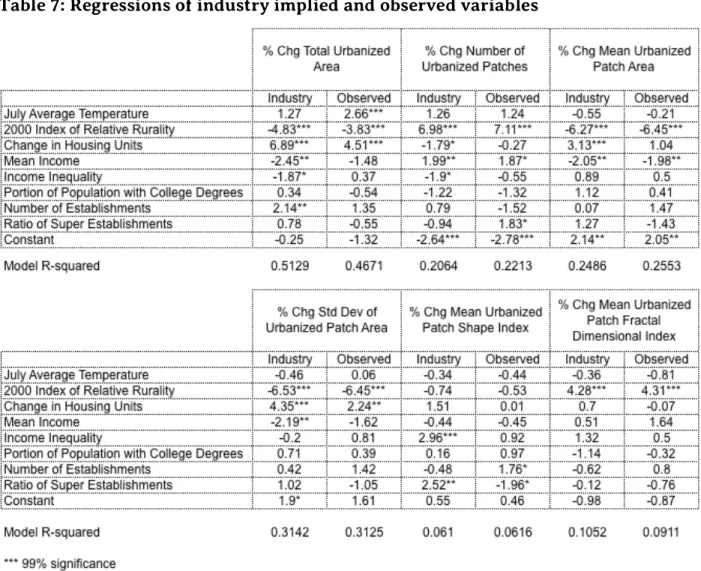
Sprawling counties appear to have some economic differences from other counties, but can we measure a statistically significant relationship? To test this question, I conducted six regressions measuring the relationship between the five industry constructed variables and the six landscape metrics, both discussed in the methodology section (see Table 7). These regressions were meant to test how employment shifts, as measured by characteristics of various sectors, change urbanization.
I then conducted a second set of regressions that replaced the “industry implied” attributes such as “industry implied number of establishments” and with observed economic characteristics. As mentioned in my methodology section, one concern with using simply observed values for these attributes is that many factors—beyond industrial character—may be impacting income, income inequality, etc. etc. However, the industry implied model depicted above can and should be compared to the actually observed variables. If the coefficients in the models change sign or are no longer statistically significant, further study may be require to validate the models.
0 10 20 30 40 50 60 70 -1,500 -1,000 -500 0 500 1,000 A ve ra g e Em p lo ye es Pe r Es ta b lis h m en t Jo b s C re ate d /L o st (T h o u sa n d s) NAICS Sector
Average Employees Per Establishment
Compared to Employment Change (2001-2006)
Of the industry related independent variables, change in mean income was the most significant in the most models. The coefficient was statistically significant in models of change of total urbanized area, change of number of urbanized patches, change in mean urbanized patch area and change in standard deviation of urbanized patch area. This change in mean income coefficient implies that as local employment composition shifts towards industries paying higher mean incomes, urbanized area grows less rapidly, number of urbanized patches increase, mean urbanized patch area falls and standard deviation of urbanized patch area falls. The models measuring observed change in mean incomes confirmed these results. The coefficients had similar signs and in all cases, except for change in total urbanized area, were also statistically significant.
Three landscape metrics had statistically significant coefficients for industry implied changes in income distribution. As county structure of labor demand shifted towards industries with larger income gaps, change in urbanized area decreased relatively, number of urbanized patches decreased, and mean urbanized patch shape index increased. This last model, however, had very low explanatory value. In all three cases, observed shifts in income gaps did not confirm the industry-implied results. This may be an artifact of the discrepancy in how the income inequality variables were constructed, an issue I will discuss later.
Number of college-educated employees, industry implied and observed, appears to have little or no impact on the six landscape metrics I measured. This may be because the major components of educational attainment are already captured by income.
An increase in industry implied number of establishments positively impacted change in total area. The coefficient was not statistically significant in any other model, and the observed change in number of establishments was not statistically significant in any model, except for change of mean urbanized patch shape index, a low explanatory value model.
Finally, the industry implied presence of super employers appears to only have an impact on mean shape index, again a low explanatory value model. The sign on the coefficient flipped in the observed model. The observed presence of super employers also appears to have had a positive impact on the number of urbanized patches.
The control variables, 2000 Index of Relative Rurality and percent change in housing units, both appear to be highly significant in most models. July average temperature, an attempt to control for the “sunbelt factor”, appears to have only been significant in the observed change of total urbanized area.
Can we predict sprawl using employment data?
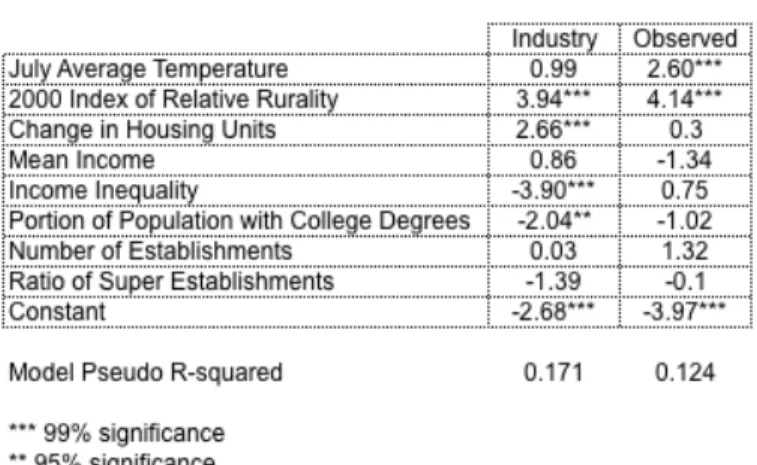
The model had limited explanatory power (a pseudo R2 of 0.171, the sample had 256 observations). More rural counties (having a higher IRR in 2000) had an increased likelihood of sprawling. A one percent increase in housing units produced a 2.66% increase in likelihood of sprawling, falling within the 99% confidence interval. A 1% increase in income equality increased the likelihood of sprawling by 3.90%. This coefficient was significant at the 99% level. Also, a 1% increase in the industry implied percentage of college educated employees decreased the likelihood of sprawling by 2.04%. This final variable was significant at the 95% level. None of the other industry variables had statistically significant coefficients. It should also be noted that the logistic model, when replicated with observed variables, did not produce statistically significant coefficients for any of the industry variables.
Cupertino, Raleigh, and Las Vegas
In the introduction I profiled three counties that I believed helped make the case the economies were instrumental in shaping urban form. Before we look at the wider data set, it may be worthwhile to look at what happened in these three counties.
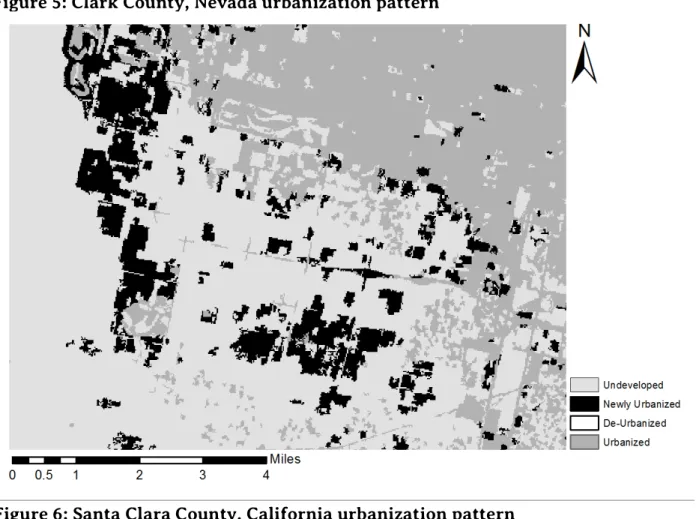
Clark County’s (part of Las Vegas, Nevada) urbanized area grew the most, 16.0%. Wake County (Raleigh, North Carolina) grew by 11.7%, and Santa Clara’s (San Jose, California) urbanized area only grew by 0.3%. With respect to mean urbanized shape index, all counties, taking into account area variations, saw increases in mean edge to interior ratios. In other words, shapes became less square like. Santa Clara became more fractal-like, while both Clark and Wake counties became less fractal-like. Mean urbanized patch area and mean standard deviation of urbanized patch area increased
Figure 5: Clark County, Nevada urbanization pattern
in all three counties. This suggests that larger, older patches are the focus of most growth rather than new nuclei. The main difference between the three counties, however, is what is happening to the number of urbanized patches in each. Santa Clara County is seeing a small reduction in number of patches, roughly 0.7%, which is consistent with its relatively low level of new development. Clark County has seen a precipitous drop in number of urbanized patches: number of patches in the county decreased by 28.1% in five years. This is consistent with growth connecting these patches. Wake County, by comparison, has seen only a 2.6% reduction in urbanized patches despite its remarkable growth. This difference is what led me label the county as a sprawling county.
accommodation and food services, and professional, scientific, technical services. The three largest job growth industries in Clark County were construction, accommodation and food services, and retail-trade. Santa Clara grew the most in health care, other services, and finance and insurance.
For Further Investigation
5.
Discussion and Conclusion
The models used in my analysis of urban form point to several important results. First, increasing industry income is associated with less rapid, fragmented, urbanized growth, not sprawl. This result goes against the findings in literature up to this point. An alternative way of stating this finding is that decreasing mean incomes creates rapidly expanding, contiguous urban growth. There are several theories that may explain why this may be. First, traditional models of cities presume the most affordable housing can be found at a city’s periphery where land is most affordable and where residents are willing to substitute longer commute times for housing costs. This theory is called the bid-rent model. Decreasing mean income in a county is likely to generate outward growth pressures. In this scenario, industrial character influences urban form through housing choices.
A second hypothesis is that outward development is cyclical, and that as cities experience massive development pressures, they first go through increased perimeter expansion. The observation that incomes are causing this change may be caused by the fact that the fastest growing industries, at this time, have lower incomes than other sectors. In other words, the observation is a coincidence and is not causal. Had the 2000s been defined by marked job growth in industries with higher mean incomes, we may have found that higher mean incomes are associated with expanding development.
Another key finding of my analysis is that as number of workplaces increases, total urban area increases. Increases in both the number of housing units and workplaces create urban growth in counties.
The most curious finding, however, is the relationship between income inequality and sprawl. In the employment derived model, decreasing income inequality produces increased urban growth and increasing urbanized patches. This suggests that decreased income inequality may produce sprawl. This result is confirmed with the logistic regression.
development. Greater understanding of the causal mechanisms would be required to more confidently state this conclusion. It is also important to point out that while the industry employment shifts were significant (i.e. shifts towards industries with greater income equality), counties with greater observed income equality were themselves not statistically more likely to be undergoing leapfrogging development. Again, this may be caused by how these two variables were constructed, but again further analysis is required to explain that difference.
Finally, growth in industries with lower rates of educational attainment is associated with sprawl. I had originally hypothesized that those industries with specialized labor inputs would form tighter networks based on the Weber theory of firm location. In other words, the increasing value of the labor inputs would draw urban forms closer. These results are consistent with that observation.
Based on the income inequality and college attainment findings, it is possible to highlight a set of industries that might be producing sprawl. The most likely sprawl causing industries will have 1) large employment changes, 2) low levels of income inequality, and 3) low levels of college attainment. Based on these three standards, four industries are likely to be associated with sprawl (see Table 9):
• accommodation and food services • construction
• retail trade
• administrative, support, waste management
Using the same results, one can hypothesize which industries may prevent sprawl:
• health care • information
• finance and insurance
• educational services, and professional, scientific, technical service
These industries have 1) large employment changes, 2) high levels of income inequality, and 3) high levels of college attainment (see Table 9)
Final Thoughts
In early sprawl literature, sprawling growth was primarily attributed to housing decisions, federal policies and desires for socio-economic homogeneity, not industry labor demand. This paper suggests there are some industries that are impacting urban form primarily through their labor force demand. As counties shift in employment towards industries with lower mean incomes, total urbanized area in a county grows more rapidly. The urbanized area also becomes more contiguous. Just as with housing, as number of workplaces in a county increase, so does total urbanized area.
In counties with industries with flatter income distributions, total urbanized area grows but also remains more fractured. The same leapfrogging-sprawl is associated with industries with lower levels of college attainment.
Based on these industry attributes, counties with particularly large ratios of their workforces in accommodation and food services, construction, retail trade, and administrative, support, waste management are at increased risk of sprawl.
6.
Bibliography
Beauregard, R. A. 2001. Federal policy and postwar urban decline: A case of government complicity? Housing Policy Debate 12 (1): 129-51.
Brueckner, J. K. 2000. Urban sprawl: Diagnosis and remedies. International Regional Science Review 23 (2): 160-71.
Burcheld, M., H. G. Overman, D. Puga, and M. A. Turner (2006). Causes of sprawl: A portrait from space. Quarterly Journal of Economics 121 (2), 587{633.
Buyantuyev, A., J. Wu, and C. Gries (2010). Multiscale analysis of the urbanization pattern of the phoenix metropolitan landscape of USA: time, space and thematic resolution. Landscape and Urban Planning 94 (3-4), 206{217.
Fujita, Masahisa, Paul R. Krugman, and Anthony Venables. 1999. The spatial economy: Cities, regions, and international trade. Cambridge, Mass.: MIT Press.
Florida, R. L. 2002. The rise of the creative class: And how it's transforming work, leisure, community and everyday life. New York:Basic Civitas Books.
Galster, G., R. Hanson, M.R. Ratcliffe, H. Wolman, S. Coleman, and J. Freihage. 2001. Wrestling sprawl to the ground: defining and measuring an elusive concept.
Housing Policy Debate, 12(4): 681-718
Gordon, P., and H. W. Richardson. 2000. Critiquing Sprawl’s critics. Cato Policy Analysis No. 365.
Hargis, C. D., J. A. Bissonette, and J. L. David (1998). The behavior of landscape metrics commonly used in the study of habitat fragmentation. Landscape Ecology 13 (3), 167{186.
Hietel, E., R. Waldhardt, and A. Otte. 2005. Linking socio-economic factors,
environment and land cover in the German highlands, 1945-1999. Journal of Environmental Management 75 (2): 133-43.
Irwin, E. and N. Bockstael (2007). The evolution of urban sprawl: evidence of spatial heterogeneity and increasing land fragmentation. Proceedings of the National Academy of Sciences 104 (52), 20672.
Isserman, A. (2005). In the national interest: Dening rural and urban correctly in research and public policy. International Regional Science Review 28 (4), 465{499.
Kaza, N. 2011. The Changing Urban Landscape of the United States. Unpublished.
Li, H. and J. Wu (2004). Use and misuse of landscape indices. Landscape Ecology 19, 389{399.
Mieszkowski, P., and E. S. Mills. 1993. The causes of metropolitan
Seto, K. C. and M. Fragkias (2005). Quantifying spatiotemporal patterns of urban land-use change in four cities of China with time series landscape metrics.
Landscape Ecology 20 (7), 871{888.
Squires, G. D. 2002. Urban sprawl: Causes, consequences, and policy responses.
Washington, D.C.: Urban Inst Pr.
Storper, M., and R. Walker. 1983. The theory of labour and the theory of location. International Journal of Urban and Regional Research 7 (1): 1-43.
Uuemaa, E., M. Antrop, J. Roosaare, R. Marja, and U. Mander (2009). Landscape metrics and indices: An overview of their use in landscape research. Living Reviews in Landscape Research 3 (1).