Zika Virus Infection
Amy Lina, Weigang Huanga, Qisheng Zhanga.
aDivision of Chemical Biology and Medicinal Chemistry, Eshelman School of Pharmacy, The
Abstract Introduction
Zika virus (ZIKV) is a mosquito borne flavivirus that can trigger Guillian-Barre syndrome and cause congenital brain defects in pregnancy due to its infection and persistence in both adult and fetal neural cells. Currently there is no treatment available for ZIKV. Through a chemical screen, we have identified hippeastrine as a drug candidate that can block and clear ZIKV infection in vitro in human cortical neural progenitor cells (hNPCs) and in adult mouse brains. However, hippeastrine only exhibits moderate potency and its mechanism of action is unknown. Therefore, we aim to enhance hippeastrine’s anti-ZIKV activity through medicinal chemistry and better understand its mechanism against ZIKV.
Methods
To enhance the potency, we modified specific functional groups on hippeastrine through synthetic chemistry. The reactions utilized included the esterification of the alcohol, saturation of the alkene, opening of the cyclic acetal and changing the lactone to a lactam. These
hippeastrine derivates were then tested for their activity in hNPCs. Results
We have synthesized ten analogues and preliminary testing has shown that
modifications at the alcohol have significantly increased activity. In contrast, reduction of the double bond in hippeastrine completely abolishes its anti-ZIKV activity. Based on this structure activity relationship, a photoaffinity labeling group was attached at the alcohol to the saturated or unsaturated hippeastrine for use in cellular pulldown assays to identify hippeastrine’s tinteracting proteins.
Conclusions
Based on the results we have shown that it is possible to modify the anti-ZIKV activity of hippeastrine. The best improvement was a 5-fold increase in potency. These results along with the synthesis of photoaffinity labelled hippeastrine derivatives will allow for further enhancement of potency and elucidation of hippeastrine’s role in blockade and clearance of ZIKV infection.
1. Introduction
Zika virus (ZIKV) is an Aedes mosquito borne flavivirus first discovered in Uganda in 19471-2. Human infection with ZIKV was identified as early as 1952 and the virus spread throughout Africa and Asia, with the infection associated with mild disease. The first major outbreak of ZIKV occurred in the Island of Yap in 2007. In most of these cases, over 80% of the infected patients were asymptomatic.3 However, the ZIKV associated neurological complications such as onset of Guillian-Barre syndrome in adults and microcephaly in newborns, weren’t realized until the 2015 outbreak in Brazil.1-2 Specifically, there was 20-fold increase in microcephaly reported during the outbreak compared to pre-ZIKV prevalence.1 Case-control studies further confirmed this correlation.4 Due to these findings and increased transmission, by February 2016 the World Health Organization (WHO) had declared the outbreak as a Public Health Emergency of International Concern.1
The neurological complications are the result of the predominance and persistence of ZIKV infection in neural cells. ZIKV also demonstrates the ability to undergo intrauterine transfer into the placental and fetal brain cells from an infected mother, which can lead to the
to continued replication and ultimately neuronal cell death. Despite this knowledge, there is no current treatment to block ZIKV infection.
With no approved medications to treat ZIKV infection, current treatment strategies are directed towards symptom management.3 Further emphasis has been placed on infection transmission prevention measures1, especially in light of the ability of ZIKV to persist in bodily fluids.7 This prevention, however, cannot prevent the ZIKV-induced adult and fetal neurological complications, and all treatment measures are supportive.6
With the pressing need for a therapeutic option, Xu et al. performed a high-throughput screen of 6000 currently approved drugs and drug candidates to measures their ability to either suppress ZIKV infection or prevent further replication.8 The initial compounds were chosen for their ability to inhibit caspase-3, based on the finding that caspase-3 activity increased after ZIKV infection. Their screen provided two classes of drugs that protected against cell death and inhibited ZIKV replication: neuroprotective and antiviral agents, respectively. Furthermore, when the two types of agents were combined, they showed synergistic effects by preventing cell death while allowing cells to recover from ZIKV infection by stalling replication.8 However, while the drugs were effective in reducing viral load, they did not demonstrate the ability to clear the infection from host cells.8 This result is problematic because ZIKV persistence could still lead to neural complications and future transmission.6 Specifically, it has been reported that even if ZIKV was limited to 1% of the initial viral load, it could replicate and induce cell death later.9
In order to identify a possible drug that can block and clear ZIKV infection, Zhou et al screened over 1000 drug candidates in ZIKV infected hNPCs.9 This screen led to the discovery that hippeastrine, a naturally occurring compound derived from the amaryllidacease family plant Lycoris radiata, could block and eliminate ZIKV infection at an EC50 of 5.5 µM, a promising measure of its potency in vitro. Hippeastrine was also studied in vivo in adult mouse brains and in human fetal forebrain organoids, showing similar results. In the latter, hippeastrine showed the ability to “rescue” the infected organoids, both preventing ZIKV activity and restoring ZIKV induced structural defects that are associated with microcephaly pathologies.9 These findings demonstrate the promise of hippeastrine as a drug candidate for ZIKV treatment, given its ability to treat ZIKV infection during multiple stages of its pathogenicity.
2. Methods
2.1 Synthesis of Derivatives of Hippeastrine to Increase its Anti-ZIKV Activity The hippeastrine derivatives to synthesize
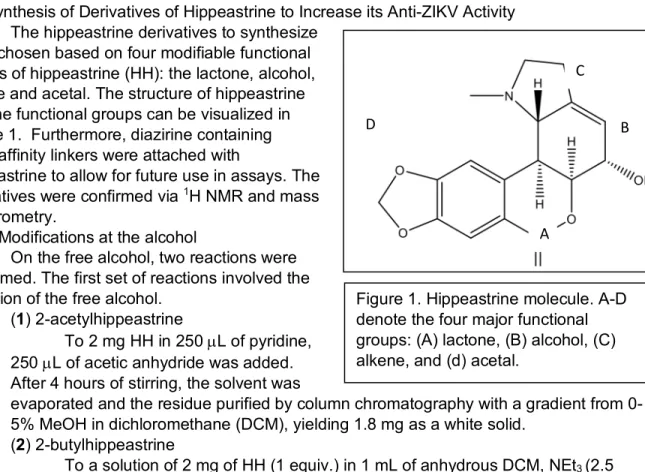
were chosen based on four modifiable functional groups of hippeastrine (HH): the lactone, alcohol, alkene and acetal. The structure of hippeastrine and the functional groups can be visualized in Figure 1. Furthermore, diazirine containing photoaffinity linkers were attached with
hippeastrine to allow for future use in assays. The derivatives were confirmed via 1H NMR and mass spectrometry.
2.1.1 Modifications at the alcohol
On the free alcohol, two reactions were performed. The first set of reactions involved the acylation of the free alcohol.
(1) 2-acetylhippeastrine
To 2 mg HH in 250 µL of pyridine, 250 µL of acetic anhydride was added. After 4 hours of stirring, the solvent was
evaporated and the residue purified by column chromatography with a gradient from 0-5% MeOH in dichloromethane (DCM), yielding 1.8 mg as a white solid.
(2) 2-butylhippeastrine
To a solution of 2 mg of HH (1 equiv.) in 1 mL of anhydrous DCM, NEt3 (2.5 equiv.) and butyl chloride (1.5 equiv.) were added. The reaction was allowed to stir for 12 hours, before the solvent was evaporated and the residue purified by column chromatography with a gradient from 0-5% MeOH in DCM, yielding 1.6 mg as a white solid.
(3) 2-heptanoate-hippeastrine
Heptanoic acid (1.5 equiv.), N,N’-Dicyclohexylcarbodiimide (DCC) (1.5 equiv.) and 4-dimethylaminopyridine (DMAP) (0.1 equiv.) were stirred in DCM at room
temperature for 30 minutes. To this solution, 2 mg HH dissolved in 0.5 mL of DCM was added and allowed to stir for 12 hours. The reaction mixture was then evaporated and purified by column chromatography with a gradient from 0-5% MeOH in DCM, yielding 1.1 mg as a white solid.
(4) 2-benzoate-hippeastrine
To a solution of 2 mg of HH in anhydrous DCM, trimethylamine NEt3 (2.5 equiv.) and benzoyl chloride (1.5 equiv.) were added. The reaction was allowed to stir for 12 hours, before the solvent was evaporated and the residue purified by column
chromatography with a gradient from 0-5% MeOH in DCM, yielding 1.3 mg as a white solid.
(5) 2-(2-(3-(But-3-yn-1-yl)-3H-diazirin-3-yl)acetyl hippeastrine
2-(3-(But-3-yn-1-yl)-3H-diazirin-3-yl)acetic acid was prepared based on the reference by Kleiner et al5. 2-(3-(But-3-yn-1-yl)-3H-diazirin-3-yl)acetic acid(1.5 equiv.), DCC (1.5 equiv.) and DMAP (0.1 equiv.) were stirred in DCM at room temperature for 30 minutes. To this solution, 2 mg HH dissolved in 0.5 mL of DCM was added and allowed to stir for 12 hours in the dark. The reaction mixture was then evaporated and purified by
Figure 1. Hippeastrine molecule. A-D denote the four major functional groups: (A) lactone, (B) alcohol, (C) alkene, and (d) acetal.
B C
white solid.
(6) 2-methyl hippeastrine
To a solution of NaH (1.1 equiv.) in dry THF at 0 °C, 2 mg of HH was added and stirred for 30 minutes. Methyl iodide (1.5 equiv.) was added and the reaction was heated and refluxed for 12 hours. The mixture was then cooled and the solvent removed by evaporation. The crude product was purified by column chromatography with gradient from 0-5% MeOH in DCM, yielding 1.3 mg as a white solid.
2.1.2 Modification at the acetal (7) 8,9-Norhippeastrine
To a solution of 2 mg HH in dry DCM, at 0 °C, 1 M BBr3 in DCM (1.5 equiv.) was added dropwise. The reaction mixture was stirred for five hours and then the solvent removed by evaporation. The crude product was purified by column chromatography with a gradient from 0-5% MeOH in DCM, yielding 1.1 mg as a brown oil.
2.1.3 Modifications at the alkene (8) 3,4R-Dihydrohippeastrine
To a solution of 2 mg of HH in 1 ml of methanol, a catalytic amount of Pd/C was added. Air was evacuated from the reaction flask and cycled with hydrogen gas three times before remaining under hydrogen gas for 12 hours. The resulting solution was filtered through Celite and washed five times before the solvent was evaporated resulting in 2 mg of white solid.
(9) 2-acetyl-(3,4R-Dihydrohippeastrine)
To 2 mg of 8 in 250 µL of pyridine, 250 µL of acetic anhydride was added. After 4 hours of stirring, the solvent was evaporated and the residue purified by column
chromatography with a gradient from 0-5% MeOH in DCM, yielding 1.6 mg as a white solid.
(10) ) 2-(2-(3-(But-3-yn-1-yl)-3H-diazirin-3-yl)acetyl-(3,4R-Dihydrohippeastrine) 2-(3-(But-3-yn-1-yl)-3H-diazirin-3-yl)acetic acid was prepared based on the reference by Kleiner et al5. 2-(3-(But-3-yn-1-yl)-3H-diazirin-3-yl)acetic acid(1.5 equiv.), DCC (1.5 equiv.) and DMAP (0.1 equiv.) were stirred in DCM at room temperature for 30 minutes. To this solution, 2 mg of 8 was dissolved in 0.5 mL of DCM was added and allowed to stir for 12 hours in the dark. The reaction mixture was then evaporated and purified by column chromatography with a gradient from 0-5% MeOH in DCM, yielding 0.9 mg as a white solid.
2.2 Determination of Hippeastrine Derivatives Anti-ZIKV Activity in hNPCs
3. Results
3.1 Synthesis of Hippeastrine Derivatives to Increase Anti-ZIKV Activity
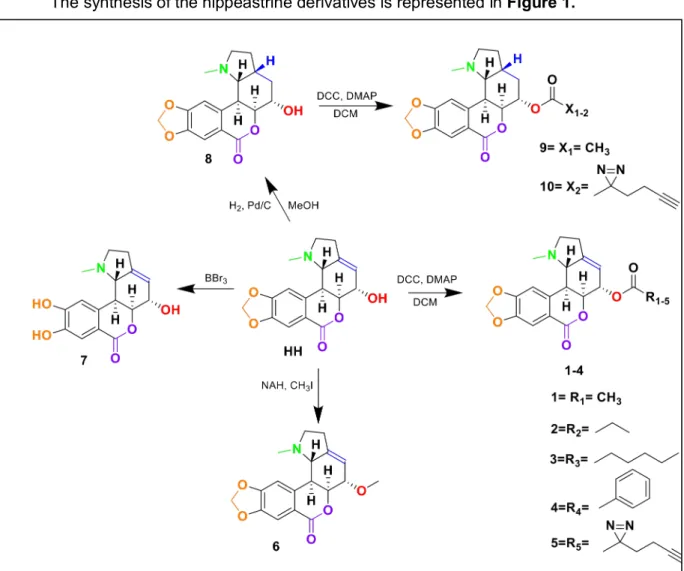
The synthesis of the hippeastrine derivatives is represented in Figure 1.
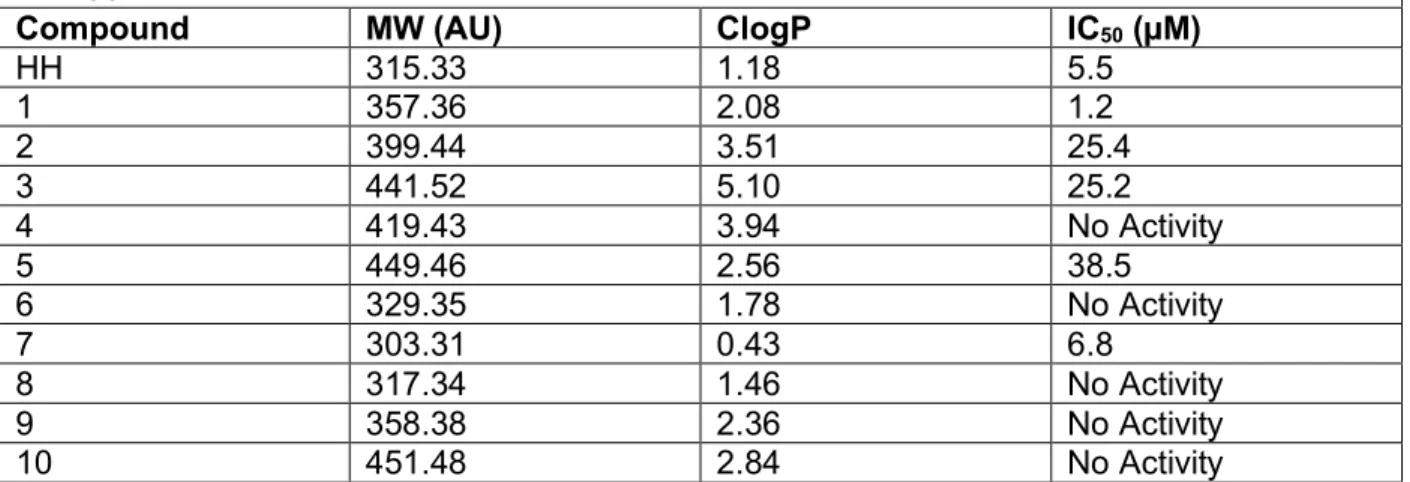
For the ten synthesized derivatives, the IC50 was determined along with their calculated ClogP and molecular weight as shown in Table 1.
Table 1. Physiochemical descriptors and in vitro anti-ZIKV activity as denoted by IC50 in hNPCs.
Compound MW (AU) ClogP IC50 (µM)
HH 315.33 1.18 5.5
1 357.36 2.08 1.2
2 399.44 3.51 25.4
3 441.52 5.10 25.2
4 419.43 3.94 No Activity
5 449.46 2.56 38.5
6 329.35 1.78 No Activity
7 303.31 0.43 6.8
8 317.34 1.46 No Activity
9 358.38 2.36 No Activity
10 451.48 2.84 No Activity
From this data, one hippeastrine derivative, the product of the acylation of the free alcohol with an acetate, 1, was found to have increased anti-ZIKV activity. There was a five-fold increase in potency compared to hippeastrine. However, further acylation reactions with longer acyl chains of four or seven carbons, 2 and 3 respectively, or a phenyl functional group, 4, had detrimental effects on the anti-ZIKV activity.
Modifications on the other functional groups on hippeastrine also altered its anti-ZIKV activity. The methylation of the free alcohol ,6, saturation of the double bond, 8, and subsequent modification on the saturated hippeastrine, 9 and 10, rendered the molecule inactive. The deprotection of the acetal group, 7, resulted in a minimal decrease in potency.
The synthesis of 5 and 10, represent the hippeastrine with photoaffinity linkers to be utilized when determining interacting proteins. The hippeastrine with photoaffinity linker demonstrated anti-ZIKV activity, though with diminished potency. On the other hand, 10, the saturated hippeastine with photoaffinity linker, did not exhibit anti-ZIKV activity. Because of the small modification compared to HH, analog 10 works as an ideal control compound to study HH’s biological functions.
4. Discussion
From the results, we have demonstrated the ability to modify the anti-ZIKV activity of hippeastrine. These initial modifications have shed some light on the structure activity
relationship of hippeastrine. The increase in potency with the addition of the acetate on the free alcohol could be associated with cellular permeability based on the increased lipophilicity and labile nature of the bond. However, while the addition of longer carbon chains should contribute to increased cellular permeability, this was not seen in the activity data. This finding could be attributed to a binding site or channel that is limited sterically. Also, the loss of activity
associated with the saturation of the alkene also alludes to the importance of the conformation of hippeastrine.
identified, which is a limitation of this study. However, both an active and inactive photoaffinity labeled hippeastrine were synthesized and tested in this study to utilize in future cellular pull-down assays to determine the interacting proteins.
This study has shown the ability to enhance the anti-ZIKV activity of hippeastrine. With other modifications, such as the conversion of the lactone to lactam, and cellular pull-down assays yet to be completed, there is promise for the site directed determination of a
hippeastrine derivative with further enhanced potency.
References
1. Kindhauser MK, Allen T, Frank V, Santhana R, Dye C. Zika: the origin and spread of a mosquito-borne virus [Internet]. Bulletin of the World Health Organization, 2016 [cited 2017 Feb 13]. Available from: http://www.who.int/bulletin/online_first/16-171082/en/. 2. Barzon L, Trevisan M, Sinigaglia A, et al. Zika virus: from pathogenesis to disease
control. FEMS Microbiology Letters. 2016; 363(18):1-17.
3. Shazaad SYA, Tejal NA, and Ustianowski A, et al. Zika virus: management of infection and risk. BMJ. 2016;352:i1062-1068.
4. de Araujo TVBD, de Alencar Ximenes RA, de Barros Miranda-Filho D, et al. Association between microcephaly, Zika virus infection and other risk factors in Brazil: final report of a case-control study. Lancet Infect Dis. 2018; 18:328-36.
5. Bhatnagar J, Rabeneck DB, Martines RB, Reagan-Steiner S, Ermias Y, Estetter LBC, et al. Zika Virus RNA Replication and Persistence in Brain and Placental Tissue. Emerging Infectious Diseases. 2017;23(3):405-14.
6. Hanners NW, Eitson JL, Usui N, Richardson B, Wexler EM, Konopka G, Schoggins JW. Western Zika Virus in Human Fetal Neural Progenitors Persists Long Term with Parital Cytopathic and Limited Immunogenic Effects. Cell Reports. 2016;15:2315-2322.
7. Paz-Bailey G, Rosenberg ES, Doyle K, et al. Persistence of Zika Virus in Bodily Fluids – Final Report. NEJM. 2018;379:1234-1243.
8. Xu M, Lee EM, Wen Z, Cheng Y, Huang W, Qian X, et al. Identification of small-molecule inhibitors of Zika virus infection and induced neural cell death via a drug repurposing screen. Nature Medicine. 2016; 22(10):1101-07.
9. Zhou T, Tan L, Cederquist GY, Fan Y, Hartley B, Robinson CL, et al. High-Content Screening in hPSC-Neural Progenitors Identifies Drug Candidates that Inhibit Zika Virus Infection in Fetal-like Organoids and Adult Brains. Cell Stem Cell. 2017; 21:274-283. 10. Kleiner P, Heydenreuter W, Stahl M, Korotkov VS, Sieber SA. A Whole Proteome
Inventory of Background Photocrosslinker Binding. Angewandte Chemie. 2016;56(5):1396-1401.
Acknowledgements
American Foundation for Pharmaceutical Education
Funding Support
American Foundation for Pharmaceutical Education Daedalus Fund for Innovation
Conflicts of Interest
The hope is to both present and publish the research. However, a couple steps need to completed before meetings and journals for publication are considered. First, the cellular pull-down assays to determine interacting proteins must be completed. Second, the synthesis of the lactone to lactam hippeastrine derivative will demonstrate a significant alteration of
hippeastrine’s structure and should be completed to determine its effect on anti-ZIKV activity. Therefore, the focus of the hopeful publication will have a much broader focus on the alterations and MOA of hippeastrine and their implications in the treatment of ZIKV.
Challenges Encountered