FACULTY AND STUDENT PERCEPTIONS ON THE EFFECTIVENESS OF ONLINE COURSE MODULES: ARE MODULES A HINDRANCE OR HELP?
by Clista Clanton
A Master's paper submitted to the faculty of the School of Information and Library Science of the University of North Carolina at Chapel Hill
in partial fulfillment of the requirements for the degree of Master of Science in
Library Science.
Chapel Hill, North Carolina April, 2001
Approved by:
Clista Clanton. Faculty and student perceptions on the effectiveness of online course modules: Are modules a hindrance or help? A Master’s paper for the Master of Science in Library Science degree. April 2001, 56 pages. Advisor: Claudia Gollop.
The Health Sciences Library at the University of North Carolina-Chapel Hill currently develops online course modules in conjunction with the School of Pharmacy. These modules are used to help in the teaching of course offerings, and there is a trend in several programs of developing online course content. Since there is a growing emphasis on online course modules within these curriculums, there should also be an evaluation of the perceived effectiveness of these teaching aids by both the faculty who administer them and the students who complete them. A study of these perceptions will support the development and future direction of online teaching aids in meeting both curriculum development within these programs, and the educational needs of the students. Major findings of the study include the majority of students (86%) preferred using online modules, while those who did not (14%) cited computer illiteracy as one reason.
Headings:
Computer-assisted instruction Bibliographic instruction
Internet – College and university libraries Surveys – Information needs
Table of Contents:
Abstract ... i
Table of contents ... ii
Introduction ... 2
Literature review ... 3
Methodology ... 14
Background of online modules at the HSL ... 16
Evaluation of online modules by faculty... 18
Evaluation of online modules by students... 22
Future directions for online modules at the HSL ... 25
Recommendations ... 26
Limitations of this study... 28
Conclusions and future research ... 29
References ... 31
Tables: Table 1: Literature review research emphases and methods used ... 11
Table 2: Online survey questions and results of completed Pharmacy modules... 24
Appendices: Appendix A: Results from student evaluations, September 2000... 33
Appendix B: Module used by the School of Pharmacy, April 2001 ... 34
Appendix C: Summary of answers to question 4 ... 36
Appendix D: Summary of answers to question 6: Preference indicated for online modules... 37
Appendix E: Summary of answers to question 6: Preference indicated for written assignments... 42
Appendix F: Summary of answers to question 8 ... 43
Appendix G: Summary of answers to question 15 ... 48
Appendix H: Consent form for interviews... 51
Appendix I: Interview questions for instructor ... 53
Introduction
The Health Sciences Library (HSL) at the University of North Carolina-Chapel Hill (UNC-CH) currently develops online course modules in conjunction with several of the health sciences programs, including the Schools of Pharmacy, Nursing and Public Health. These online modules are used to help in the teaching of several course offerings (HSL Courses http://www.hsl.unc.edu/hsl/es/courses.htm) and there is a growing trend among these programs of developing online course content. According to Julia Shaw-Kokot, the Education Programs Coordinator at the Health Sciences Library, the Library is devoting both personnel and resources towards these efforts, with anticipation that the emphasis on these types of online teaching aids will continue to increase (personal communication, Oct. 18, 2000).
Literature Review
A “module” has been defined as a short-segment program that can be interspersed between other forms of instruction to cover limited, specific units rather than an entire course (Lumsdaine, 1964). They are compatible with B.F. Skinner’s definition of the term “program”, as applied to a sequence of instruction presented by a teaching machine. Skinner’s 1954 and 1958 papers, directly or indirectly, guided the development of
programmed instruction during the later 1950’s and 1960’s. “Teaching Machines” (Skinner, 1958) proposed many of the ideas that have actually come to fruition in online and distance education. Skinner believed that education must become more efficient and that curricula must be revised and simplified, and textbooks and classroom techniques improved. Any other field would have demanded increased production, which would have led at once to the invention of labor saving capital equipment. Yet Skinner also believed that any machine used in the classroom should do more than just present material, as he also believed that students were in danger of become mere passive receptors of instruction. Skinner proposed a machine along the lines of Pressey’s
teaching machine, which encouraged the student to take an active role in learning, due to the programmable capabilities of the machine. Pressey seems to have been the first to emphasize the importance of immediate feedback in education and to propose a system in which each student could move at his own pace. He conceived of a machine that (in contrast with the audio-visual aids which were beginning to be developed at that time) permitted the student to play an active role in his or her education.
that these machines would be capital equipment used by teachers to save time and labor. In assigning certain mechanizable functions to machines, the teacher would emerge in his proper role as an indispensable human being. The teacher could then teach more students than before in fewer hours and with fewer burdensome chores. In return for this greater productivity the teacher could then ask society to improve his or her economic condition.
Skinner’s article accurately describes what has happened with the advent of desktop computing and network capabilities in higher education facilities throughout the world. With the exception of predicting that teachers would be able to demand more money for their services, his description of the direction that higher education would need to take seems to be remarkably on track.
Given the fact that adjunct faculty were actively recruited to teach these courses, perhaps the full time faculty’s perceptions regarding being replaced were more on target than was portrayed.
These ongoing questions are very relevant to the development of course modules offered at the University of North Carolina-Chapel Hill, as the perceptions of faculty towards online course modules used in their classes are very important. If the faculty is not supportive of the development of such modules, then much time and effort on both the part of the instructor and the library staff who create the modules is wasted.
Granted, many of the issues faced in distance education are different than those arising from course modules that are utilized in conjunction with a traditional classroom setting. However, the lines do blur, as attitudes towards technology and its usage in education throughout much of the twentieth century indicate (Cuban, 1986). The
classroom has become home to a succession of technologies (textbook, chalkboard, radio, film, television, and computer) that have been tailored to the dimensions of classroom practice. Each successive wave of technology has had implied promises of
individualized instruction, relief of the tedium of repetitive activities, and presentation of content beyond what was available to a classroom teacher. Cuban describes a “fickle romance” between professionals and these technologies – the attempts to capture the paradox of stability and change in classrooms. He maintains that what has been written about motion pictures, radio, and television (and most recently, computers) has
cycle starts with an initial wave of enthusiasm for each new technology, followed by academic studies to demonstrate the effectiveness of the technology, then complaints from teachers about the logistics of use, technical imperfections, etc., and then criticism towards administrators who under utilize the technology.
While use of computers in the classroom has been around for many years now, distance education is currently riding that initial wave of enthusiasm (U.S. Department of Education, 1997). Thirty-three percent of higher education institutions offered distance education in the fall of 1995, with another twenty-five percent planning to offer courses in the next three years. There have also been studies documenting the effectiveness, and lack of effectiveness, of online and distance education (Peterman, 2000; Grineski, 1999). Whether or not teacher dissatisfaction with the technology is evident is not as clear at this point, although other issues have been highlighted. Some factors that were keeping institutions from starting or expanding their distance education courses included concerns about faculty workload, lack of faculty interest, and lack of faculty rewards or incentives (U.S. Department of Education, 1997).
Another important issue relating to online education and faculty revolves around the ownership of online course material (Twigg, 2000). This issue is a hot topic due to the fact that committing to writing the course content (e.g. lectures, exercises) and digitizing course materials makes it possible, if not potentially lucrative, to package courses in such a way that they can become mobile and can be delivered by people other than the original author. Courses have become “commoditized” and sought as
opportunities and challenges. These issues will only continue to become increasingly important as online instruction becomes more of a driving force in education. Most institutions do not have clear-cut policy regarding the ownership of online course material, partly due to different variables that can affect each scenario. However, the Pew Symposia in Learning and Technology, convened to discuss intellectual property issues relating to online technology and instruction, recommended a default policy position for all institutions that the faculty member own the course materials he or she has created.
While online and distance education may be riding the crest of enthusiasm right now, some are asking hard questions regarding its role in higher education (Grineski, 1999). Grineski investigates the phenomenon of “memes”, which are behaviors and ideas copied from person to person by imitation. One meme Grineski is interested in is the use of technology in the classroom and the belief that computer instructional technology is
the necessary ingredient for academic success, future employment, a fulfilling life and therefore deserves to be highly valued and not questioned. According to Grineski, a powerful application of the meme that promotes online instruction in higher education was evident when UCLA implemented the Instructional Enhancement Initiative, which mandated that all arts and science faculty members had to develop and use course Web sites.
pressure exist among faculty to incorporate instructional computer technology into lessons?
Grineski conjectures that technological products seem to be driving, rather than supporting instructional decisions, but gives no hard data to back this up. His article is important, however, in that it raises valid questions regarding the use of technology in the classroom.
Along with faculty perceptions and input regarding online instruction, the
perceptions of students using the online modules are also important. Some initial online course offerings have indicated high student satisfaction (Hanson & Lombardo, 1997). In 1995, librarians from ten colleges and universities throughout Utah collaborated to
develop Internet Navigator, a one credit-hour introductory course intended to emphasize information literacy rather than Internet mechanics. Conclusions from this study
indicated that Web-based instruction is not only feasible, but also popular with both traditional (students between the ages of 18-23 who are not married or parents) and non-traditional students (older students who have previously attend college or who are attending college for the first time). This particular case study was a collaboration between the library and faculty of ten higher education institutions in Utah, and was designed so that instructors can assign modules, or sections of modules, for sessions on specific topics. The modules developed by the Health Sciences Library at UNC-CH are also structured this way and are a result of the collaboration of library staff and faculty.
five of the features of a webware package, investigated how this affected the participants’ learning outcomes. Borrás, in implementing this strategy redundancy technique, viewed the qualitative sources of the data in her study as generating interesting variables through the implication of participants in the interpretation of the results. This reflects the
researcher-shared view with Borg and Gall (1989) that “Quantitative researchers with behavioristic orientations often overlook the fact that much can be learned from human subjects by asking for their perceptions” (p. 267). Educators and policy makers may need to add student voices as an important element in thinking about users of technology (Watson, 1998). This study relates no theory or hypothesis because what the students say about their experiences with technology varies with the purpose, context, or setting of the technology use. Watson admits that his findings may not be relevant to other situations, as he relied on a convenience sample, but he believes that transferability or identification may occur. Therefore, the reader of the study can then question, “How does this story connect with my own experiences as a learner, teacher, and user of technology?”
While the existing literature does address many of the issues facing higher education institutions in their use of online and distance education and instructional technology, more research needs to be conducted. Specifically, the perceptions of both faculty and students regarding the use of these types of educational methods should be further investigated, as they are the two groups that are most affected by their use.
Hopefully, the present research will add to the body of knowledge that is currently available by providing a snapshot of a current scenario that involves the use of online education modules with students in a university setting.
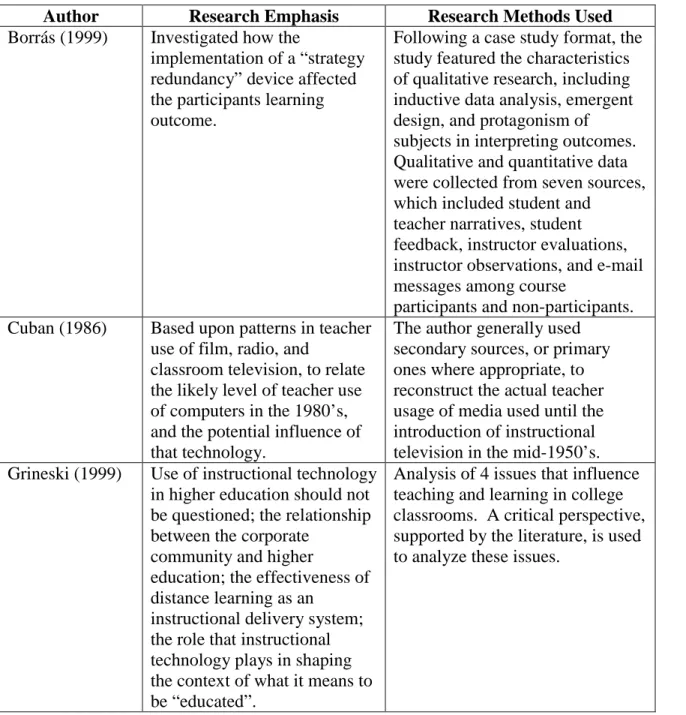
Table 1: Literature review research emphases and methods used
Author Research Emphasis Research Methods Used Borrás (1999) Investigated how the
implementation of a “strategy redundancy” device affected the participants learning outcome.
Following a case study format, the study featured the characteristics of qualitative research, including inductive data analysis, emergent design, and protagonism of
subjects in interpreting outcomes. Qualitative and quantitative data were collected from seven sources, which included student and
teacher narratives, student feedback, instructor evaluations, instructor observations, and e-mail messages among course
participants and non-participants. Cuban (1986) Based upon patterns in teacher
use of film, radio, and
classroom television, to relate the likely level of teacher use of computers in the 1980’s, and the potential influence of that technology.
The author generally used secondary sources, or primary ones where appropriate, to reconstruct the actual teacher usage of media used until the introduction of instructional television in the mid-1950’s. Grineski (1999) Use of instructional technology
in higher education should not be questioned; the relationship between the corporate
community and higher
education; the effectiveness of distance learning as an
instructional delivery system; the role that instructional technology plays in shaping the context of what it means to be “educated”.
Table 1 (cont.):
Author Research Emphasis Research Methods Used Hansen &
Lombardo (1997)
Development, purpose, and content of online course Internet Navigator. Addresses student and faculty responses to the course, as well as issues encountered in collaborative implementation. Addresses future prospects for Web-based courses.
Case study. In 1995 librarians from ten colleges and universities throughout Utah collaborated to develop Internet Navigator, a one credit-hour introductory course intended to emphasize information literacy. Since Jan. 1996 this self-paced, independent study course has been offered simultaneously at all ten institutions, via the WWW. 171 students completed it during the first 6 months.
Lumsdaine (1964)
Instructional technology: how technological advances in society pose new requirements for education, as well as offer new resources.
Review and synthesis of research literature in the field of
instructional technology.
Peterman (2000) The steps that Park University went through to develop their distance education program, and where it is now headed.
Case study of Park University, which has developed an online distance-learning program that serves more than 1,700 students per term worldwide.
Skinner (1958) Education within the framework of behavioral science, and the implications of “teaching machines” in education.
Review of research in the areas of education and behavioral science.
Twigg (2000) 14 higher education leaders were part of this invitational symposium on the topic of “Who owns online courses and course material? Intellectual property policies for a new learning environment”. This was the second of the recently created Pew Symposia in Learning and Technology, whose purpose is to conduct an ongoing national conversation about issues related to the intersection of learning and technology.
The participants at the symposium discussed four different case studies, each chosen to raise awareness of the issues and to stimulate discussion.
Table 1 (cont.):
Author Research Emphasis Research Methods Used U.S. Department
of Education (1997)
Distance education in higher education institutions.
Survey, conducted in 1995 by the National Center for Education Studies using the Postsecondary Education Quick Information System (PEQIS).
Survey was mailed to 1,276 2-year and 4-year higher education institutions. Unweighted survey response was 94% (weighted was 96%). Data were adjusted for questionnaire nonresponse and weighted to provide national estimates.
Watson (1998) Students’ perceptions about their experience with
technology, especially the use of the World Wide Web.
A qualitative study that looks at a sample of eighth-grade students’ perceptions (5 males, 4 females) about their experiences with technology that employs a
phenomenological methodology of both examining a single student story and analyzing a collection of student voices. The study,
therefore, provides qualitative data for others to read first-person voices from the schools, and one professional’s response to them. The study is embedded in a
Methodology
The present research is a case study that has utilized a hybrid strategy of both interviews and an online survey. One Pharmacy class was surveyed that completed an online module developed by the Health Sciences Library at the University of North Carolina-Chapel Hill and the School of Pharmacy. This class was composed of first year pharmacy students for the year 2000-2001, and numbered 118. Because surveys typically seek to describe or analyze a certain phenomenon and/or tend to include the thoughts or perceptions of research participants, the survey method was appropriate. This researcher wished to find out what the perceptions of the students are towards the online modules, and so a survey was employed to accomplish this. One of the advantages of conducting a survey include providing the library staff and faculty who develop the modules with a reliable and quantifiable tool with which to evaluate the online modules. A disadvantage of conducting this survey could include dubious internal validity, in that the author would be relying on the students to answer truthfully about what they were thinking or feeling regarding the modules. Another potential disadvantage was the possibility of a low response rate to the survey. A strategy used to increase participation in the survey was to have the instructor explain it’s purpose and importance prior to the students' completion of the modules, and by making it easily accessible to the students by providing several hyperlinks to the survey. One hyperlink to the survey was on the same Web page as the modules, and another was placed in the confirmation message that the students received when they completed the module.
final due date being midnight of the fifth day. The survey answer form generated included only the time of submission, with no other identifying features on the survey answer forms. The survey itself was composed of 15 questions, and include a
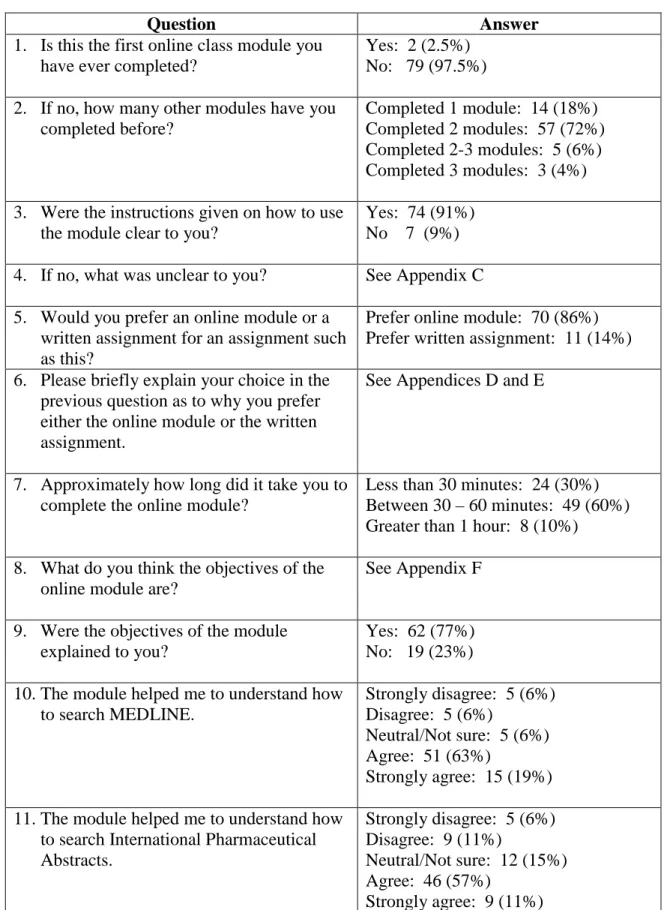
combination of multiple choice and open-ended questions. The software used to construct the online survey was ColdFusion, which uses a tag-based, server-scripting language that is good for programming Web applications. For survey questions and results, see in Table 2.
Also conducted were interviews with two library staff members and the instructor of the class that used the online modules. The library staff that were interviewed have worked closely with the instructor in developing previous online modules used by this Pharmacy class, or have been instrumental in creating the education services that are offered at the Library. They were able to relate information on previous methods used in the training that the online modules currently provide, including past student evaluations. By interviewing the instructor of the class, the author was able to investigate the
Finally, this study was evaluative in nature, as it was an attempt to discover student and faculty views of the worth or value of the online modules in their course curriculum. The desire was to not only provide a representative sampling of these views, but also to provide insight and suggestions on how to improve the modules. Previously, there had been only one brief evaluation from September 2000 of the online modules developed by the HSL in conjunction with the School of Pharmacy. The results of that evaluation are included in Appendix A. This current research will provide additional and more comprehensive data to the Library which, hopefully, will assist in making decisions regarding the future development and utilization of these online modules.
Background of Online Modules at the HSL
In fall 1996, the Chancellor at the University of North Carolina at Chapel Hill (UNC-CH), convened a special task force on instructional technology, one of whose goals was to develop a request for grant proposals for instructional technology projects to be undertaken by UNC-CH faculty and staff that would support the Chancellor’s goal of transforming education through the application of information technology. The
Education Services department at the Health Sciences Library (HSL) submitted a proposal for one of the grants to develop Web-based tutorials designed to teach
information skills. The Library was notified that they received the grant in January 1997, with projects to be completed by June 30, 1997 (Loven, 1998).
The rationale behind the Web-based modules was to create tutorials that could be used when and where the information was needed. The modules would introduce
effective strategies to access, evaluate, and apply that information, and support the learning process through electronic communication. Since the course was to be designed in modules, the sessions would be a toolkit for instruction that could be used in a variety of settings and courses. The development of the various modules began in Spring 1997, and the Library developed 6 stand alone online modules: Bibliographic Formatting Software, Finding Health Law and Legislative History, Searching Databases, Using the Internet to Find Health Information, Evaluating Online Information, and Finding Health Related Statistics.
Later, there was an evolution from the stand alone modules created by the HSL to modules used for bibliographic instruction (BI). Prior to using the online modules for BI, library staff would conduct a demonstration in class, then bring the students into the SOP computer lab and present the assignment. Sometimes the class instruction took place in the library lab as opposed to the course classroom, with the 1st hour being instruction on the resources, and the 2nd hour devoted to the lab assignment.
The School of Pharmacy began using modules developed by the HSL in 1999. Currently, modules are being utilized by only one class, which is serving as a pilot. The goal is to refine the process before using modules on a more widespread basis. The modules used by the School of Pharmacy are primarily meant to provide the students’ with practice in searching and retrieving relevant citations in various databases such as MEDLINE, International Pharmaceutical Abstracts, Infotrac, and the library’s online catalog, as well as various health and drug related Web sites. Each module contains questions that revolve around a specific topic and ask the student to perform searches to answer the questions. The students are completing three modules for the year, two in the first semester, and one in the second semester. An example of a module used in spring semester 2001 in the School of Pharmacy can be found in Appendix B.
RESULTS
Evaluation of Online Modules by Faculty
of the pharmacist’s role, and literature searching is an important part of the patient education process.
The instructor’s objectives for the modules include teaching students how to not only retrieve drug and health related information, but to also enable them to identify credible information resources, to evaluate the literature they retrieve for relevance and communication to the patient. The modules also provide opportunities for continuing education, in that they expose the students to online retrieval methods that will develop their skills for future use as they continue in the curriculum.
The instructor participating in this research indicated that there is an increasing emphasis in online instruction in the School of Pharmacy. In fact, one instructor has developed an online course in Pharmaceutics. The University administration is currently offering assistance in putting course content online via the popular instructional
technology software Blackboard, which the School of Pharmacy is utilizing to put course material online. Some faculty have indicated opposition to this approach to teaching and learning, voicing concerns about the possible impact online information will have on student attendance in classes. Putting information online can also make the faculty more accountable regarding the dates for assignments and exams, which has caused hesitancy on the part of some faculty.
A review of the literature indicated some ambivalence on the part of faculty regarding the use of online instructional technology in higher education. Some of the ambivalence apparently stemmed from inequitable reward systems for the authorship and use of online instruction and publishing, as opposed to traditional publishing. As
become evident that there is a need to develop processes and standards for online scholarship, and an accompanying reward structure.
In July of 2000, the second annual Syllabus Institute was held at Stanford University. The purpose of the Institute is to create opportunities for exchange and reflection among leading educators, practitioners of educational computing and advanced interactive technologies, with a goal of influencing the course of information technology in higher education. The Institute hosted five sessions, two of which addressed issues related to “Curricular Change and Development” and “Faculty Rewards and Evolving Roles.” Four areas emerged as having direct bearing on curricular change and faculty rewards in digital instructional environments: defining rewards, institutional cultures, collaborative commercial and peer support, and tenure and promotion review procedures (Culp, 2001).
When the instructor participating in this study was asked what her thoughts or concerns are regarding ownership of online course material, she indicated that she would like clear authorship and ownership on any course material that she develops. The University culture at UNC-CH is that competition among faculty is strong because of faculty rewards for research and for securing grants, but not as much for teaching. The instructor would like more credit for teaching and the authorship of course content and related course information she creates.
even censorship increases dramatically. At the same time, the use of the technology entails an inevitable extension of working time and an intensification of work as faculty struggle to stay on top of the technology (Noble, 1998).
Currently, the instructor reported time involved in developing the online modules for each semester is about 3 hours. She would like to be able to devote more time to building online course content, but just does not have it. Mainly, she provides input on topics for the questions and then reviews the completed modules before they are given to the students. She also facilitates the learning process by making the modules a course requirement and by assigning points to the modules. Staff within the Education Services department at the Health Sciences Library does the actual construction of the modules, including the content. Initial development of the module is about 40 hours spread among 3 people at the HSL who work on content and Web development. The HSL also tests the questions to make sure they are appropriate for the students’ academic level. Upon completion of the assignment, the Library develops standardized answers to the questions that the students have access to. In the past the library has provided individual feedback to the students, which required about 40 hours spread between 2 people. Feedback now with the standardized answer sheets requires 10 hours spread between 2 people. In this instance, the use of instructional technology via the online modules has allowed library staff to provide more efficient and timely feedback to students regarding their
Evaluation of Online Modules by Students
Of the 109 students who submitted modules by the due date, 81 also submitted surveys, for a return rate of 74%. Of these students who filled out a survey, 86% indicated a preference for online assignments of this nature and 14% indicated a
preference for written assignments. Students who preferred online assignments listed a variety of reasons why, but a common thread among the answers were ease of use, convenience, quicker to complete, online submission capability, and the modernity of using computers. A full listing of reasons that students preferred online assignments can be found in Appendix D. Of the students who preferred written assignments, common reasons included uneasiness with computers, computer illiteracy, technical problems with the modules or computers, and a desire for more tangible information. A complete listing of reasons that students preferred written assignments can be found in Appendix E.
while 33% were neutral/not sure, disagreed, or strongly disagreed. 90% of the students felt that the difficulty level of the modules were just right, with 7% indicating it was too difficult, and 1% that it was too easy. See Table 2 for the complete survey and
Table 2: Online survey questions and results of completed Pharmacy modules – Total number of student participants: 81 (74%)
Question Answer 1. Is this the first online class module you
have ever completed?
Yes: 2 (2.5%) No: 79 (97.5%) 2. If no, how many other modules have you
completed before?
Completed 1 module: 14 (18%) Completed 2 modules: 57 (72%) Completed 2-3 modules: 5 (6%) Completed 3 modules: 3 (4%) 3. Were the instructions given on how to use
the module clear to you?
Yes: 74 (91%) No 7 (9%) 4. If no, what was unclear to you? See Appendix C 5. Would you prefer an online module or a
written assignment for an assignment such as this?
Prefer online module: 70 (86%) Prefer written assignment: 11 (14%) 6. Please briefly explain your choice in the
previous question as to why you prefer either the online module or the written assignment.
See Appendices D and E
7. Approximately how long did it take you to complete the online module?
Less than 30 minutes: 24 (30%) Between 30 – 60 minutes: 49 (60%) Greater than 1 hour: 8 (10%)
8. What do you think the objectives of the online module are?
See Appendix F
9. Were the objectives of the module explained to you?
Yes: 62 (77%) No: 19 (23%)
10. The module helped me to understand how to search MEDLINE.
Strongly disagree: 5 (6%) Disagree: 5 (6%)
Neutral/Not sure: 5 (6%) Agree: 51 (63%)
Strongly agree: 15 (19%)
11. The module helped me to understand how to search International Pharmaceutical Abstracts.
Strongly disagree: 5 (6%) Disagree: 9 (11%)
Neutral/Not sure: 12 (15%) Agree: 46 (57%)
Table 2 (cont.):
Question Answer 12. Do you feel like you even needed
instruction on how to search these databases?
Yes: 52 (64%) No: 29 (36%)
13. The module helped me to understand how to search the online catalog.
Strongly disagree: 6 (7%) Disagree: 7 (9%)
Neutral/Not sure: 14 (17%) Agree: 40 (50%)
Strongly agree: 14 (17%) 14. Do you think the difficulty level of the
module was about right, too difficult, or too easy?
About right: 73 (90%) Too difficult: 7 (9%) Too easy: 1 (1%) 15. Please indicate any other comments you
may have regarding the modules.
See Appendix G
Future Directions for Online Modules at the HSL
Other changes regarding the modules that management within the Library can foresee include building more interactivity and self-assessment features into the modules, such as feedback to students and instructors to indicate how the students are grasping the content. This will require building greater security measures into the modules, as it will be
important to protect faculty and student confidentiality and grades. The Library would like to keep track of the students who complete the modules and their grades via a database now that students are taking multiple modules throughout the year. Also, the Library would like to have a basic core set of modules that cover the fundamental information competencies that could be used by faculty and students, with additional modules that cover more specialized subjects. At a limited level, the Library could act as a “school” by having a curriculum that is easily incorporated into and used with the curriculums of different schools at the University. Lastly, there is also a need to identify new modules for use in various schools based on their curriculums. Additionally, there is also potential for using modules for staff training.
Recommendations
This study has indicated that the majority of students (86%) prefer using the online modules and find them beneficial in learning how to use the electronic resources highlighted in the modules. However, there is still a small segment of students (14%) that find the modules very frustrating to use. Reasons for this include feeling
received in using the electronic resources was rushed and did not fully cover what they needed to know in order to successfully complete the assignments. Having a librarian who provides initial instruction regarding the sources selected, available to answer
questions, and to demonstrate searching techniques is vital to the success of the modules. Handouts describing the databases covered and how to search these databases would provide reinforcement of what was covered in the classroom instruction. For the student who still does not feel adequately prepared, there could also be the option of one-on-one consultations with a librarian. Despite the fact that the students have now completed 3 modules, there are several who indicated unfamiliarity with International Pharmaceutical Abstracts, which has been offered and demonstrated each time. Interestingly enough, many of the students (20%) indicated in the survey that they had taken the modules 1 or less times before, indicating a lack of carry over in both memory and skill from previous modules completed.
following may prove useful: “this module is intended to not only help you to retrieve relevant citations, but to evaluate the literature you retrieve in order to assist in the selection of the best articles”. Each module could build upon the previous one and become progressively more difficult.
Obviously, continued use of the modules will require increased commitment of resources on the part of the library. The modules are both labor and time intensive, and the proposed changes envisioned by the Library for the modules will require even more time and effort. Management within the Library recognizes this, and the current thinking is that the time and resources devoted to them are worth it. They also recognize that the Library may have to develop a different mentality concerning the role it plays in
instruction and begin to see itself as a production shop. Skills will probably be required that increase productivity in less time. There is also a need to be able to measure the costs and benefits based on educational outcomes. As expected, there is a learning curve for new staff who will have the job of creating modules. Currently there are only a few staff members who have experience in creating the modules.
Limitations of this Study
affect student and instructor support for them. 34 students (24%) did not respond to the survey, which could have provided greater insight into their preferences about the content and format used for the modules.
Conclusion and Future Research
If online modules are to be a viable teaching tool that will benefit all students, it will be important to construct future modules with the differences in learning styles taken into account. How can different features be built into the modules for students who are auditorily oriented? Technology does currently exist that allows sound files to be incorporated into modules, and as the technology continues to advance, even more options will become available. Will it be beneficial to have different modules geared towards different learning styles, so that students can chose modules that are most suitable to their needs?
Even though some students have indicated a low comfortability level with computers and instructional technology, will this change as students are increasingly exposed to the technology and become more computer literate? A follow-up study five years from now would be able to benchmark the changes that have occurred in student attitudes towards instructional technology.
References
Borrás, I. (1999). “Strategy redundancy” and its impact on the effectiveness of technology-enhanced instruction: a case study. The Internet and Higher Education 1(4), 263-280.
Cuban, L. (1986). Teachers and machines: The classroom use of technology since 1920.
New York: Teachers College Press.
Culp, G., Riffee, W., Starrett, D., Sarin, S., & Abrahamsen, H (2001). Faculty rewards in digital instructional environments. Syllabus Jan. 2001, 11-14.
Grineski, S. (1999). Questioning the role of technology in higher education: Why is this the road less traveled? The Internet and Higher Education2(1), 45-54.
Hansen, C., & Lombardo, N. (1997). Toward the virtual university: Collaborative development of a web-based course. Research Strategies, 15(2), 68-79. Loven, B., Morgan, K., Shaw-Kokot J., & Eades, L. (1998). Information skills for
distance learning. Medical Reference Services Quarterly 17(3), 71-75. Lumsdaine, A.A. (1964). Educational technology, programmed learning, and
instructional science. In D.P. Ely & T. Plomp(Eds.) Classic writings on
instructional technology, (pp. 65-90). Englewood, CO: Libraries Unlimited, Inc. Noble, D. (1998). Digital diploma mills, part I: The automation of higher education.
Peterman, T.W. (2000). Elements of success at a traditional/virtual university: lessons learned from three years of growth in cyberspace. The Journal of Academic Librarianship, 26(1), 27-32.
Skinner, B.F. (1958). Teaching machines. In D.P. Ely & T. Plomp(Eds.) Classic writings on instructional technology, (pp. 211-227). Englewood, CO: Libraries Unlimited, Inc.
Twigg, Carol A. (2000). Who owns online courses and course materials? Intellectual property policies for a new learning environment [145 paragraphs]. The Pew Learning and Technology Program [online article]. Available:
http://www.center.rpi.edu/PewSym/mono2.html [2000, Oct. 23]. U.S. Department of Education (1997). Distance education in higher education
institutions, [NCES 98-062]. U.S. Department of Education, Office of Education Research & Improvement.
Appendix A: Results from Student Evaluations, September 2000 (99 evaluations submitted)
Question Strongly disagree
Disagree Neutral/Not sure
Agree Strongly agree
Lab activities were relevant to the practice of pharmacy.
0 3 9 48 39
I received clear instruction.
3 3 10 49 34
I completed all self-instructional and preparatory activities before coming to lab today.
0 5 15 30 48
I enjoyed today’s lab activities.
Appendix B: Module used by School of Pharmacy, April 2001
Click here for instructions on how to complete this module.
(Please note: DO NOT close your screen down before you have completed the questions and submitted them, or you will lose your answers and will have to start again!)
Clozapine, an atypical antipsychotic drug used in the treatment of
schizophrenia, carries a significant risk of serious blood disorders. There are
more recently FDA approved atypical antipsychotic drugs that might be good
substitutes for clozapine.
1) Find an article that compares clozapine with the newer atypical antipsychotic medications available for the treatment of schizophrenia.
Search MEDLINE and International Pharmaceutical Abstracts (from UNCLE). Limit your search to English language.
Select the one (1) best article from each database and copy the information to the appropriate text box. Include the search history and some comment on the process. (Please do not select letters or meeting abstracts.)
MEDLINE Citation
International Pharmaceutical Abstracts Citation
2) You have heard that the FDA recently approved a new drug by Pfizer for the treatment of schizophrenia, and you want to learn more about it but can't remember the name of the drug.
Search General BusinessFile Internat'l (from the InfoTrac databases in the Online Catalog). Use the Advanced mode.
What is the name of the recently approved drug manufactured by Pfizer for the treatment of schizophrenia?
Appendix B (cont.):
3) Find a book on drug therapy for schizophrenia in the Online Catalog.
Title:
Date: Available at HSL? yes no
4) Does HSL have the 1998, vol. 52 issue of Biomedicine & Pharmacotherapy? yes no
Is it currently received? yes no
Is electronic access to full text available? yes no 5) What was the FDA approval date for Ziprasodine?
(Please use the FDA web site for this question.) Please enter your name and e-mail address.
Name: E-mail:
Submit Answ ers
Appendix C: Summary of Answers to Question 4
Question Answers 4. If no, what was unclear
to you (about the instructions)?
• “I think that for the last question the instructions should have been placed above the text answer box, because I wasted about 5 minutes before I saw that.”
• “Some of the search engines were not straight forward in locating.”
• “This entire process was explained to us very quickly in one class. I have found everyone of these exercises VERY frustrating and do not find it helpful.”
• “The individual explaining what to do from the library was rushed for time, and she was not able to explain the details to a class of 20 students.”
• "It seemed like the presenter went through how to use the different search engines so quickly, that it was hard to follow what she was saying and remember everything. I think this whole process is kind of confusing, and I usually do not use the UNCLE system when doing research for class projects or papers. It would be helpful if we had a set of written directions about how to use the various search engines and how to find relevant information on a topic."
• "How to copy citations to the answer box."
• "What database exactly was to be used, and how to get there."
Appendix D: Summary of Answers to Question 6 – Preference Indicated for Online
Modules (86%)
Question Answers 6. Please briefly explain
your choice in the previous question as to why you prefer either the online module or the written assignment.
• “Online modules are much simpler to do and
understand because the instructions are right there for you.”
• “Online module allows simultaneous searching and answering of questions and rapid submission.”
• “I like the online version because it(s) quicker especially with a fast computer. I’m sorry, I have never done a written assignment of this before so I can’t really compare the two. However, I think online module would be more convenient.”
• “It is easy to just copy and paste rather than having to type out the entire assignment.”
• “It is more applicable to everyday life because it teaches you skills you need in today’s computer-friendly world.”
• “The online module is more convenient.”
• “It is pretty easy to manage the online sites.”
• “More relevant to online practice.”
• “Online is a more modern approach.”
• “It is faster to find information and submit.”
• “The online module is easier to use than a written one would be.”
• “It is much more convenient to be able to copy the desired information into the form than having to write it down.”
• “It is much easier to turn in and if you live on campus you can do it from your own computer.”
• “It allows for faster and more accurate information, less time is involved.”
• “Easier than writing and good practice for research.”
• “More convenient and good practice with the
computer since the module is designed to improve not only your research skills but also familiarity with computer programs.”
• “It’s much easier and faster online.”
• “It is more convenient in submitting your answers. We don’t have to write anything. Most of the work can be done by copying and editing.”
Appendix D (cont.):
Question Answers 6. Please briefly explain
your choice in the previous question as to why you prefer either the online module or the written assignment.
• “I prefer the online module because it was easier and it also helped me to learn how to use the online catalogs to look up articles.”
• “No writing.”
• “Can copy and past with online module.”
• “Since the research involves using online resources, it makes sense to have the assignment online as well.”
• “The access to the databases is nice on the online module. There is always a link that will take you to the correct database instead of spending more time trying to find the database in addition to finding the relevant material.”
• “Online takes less time.”
• “You can gather all your information and hand it in all in one step.”
• “More convenient.”
• “Much quicker and more simple to do online than take the time to write something out and turn it in later.”
• “It is more convenient.”
• “Online is best because I can complete it whenever it is convenient. It is nice, too since I am already at the computer finding the information.”
• “It facilitates the use of online resources needed to answer the questions.”
• “It is easy to find the information while still getting practice using the different databases at the library. Also I am able to do them at my own convenience and in the comfort of my own room. I don’t have to go to the library to get it done.
• “I prefer to complete an assignment that resembles something that I would actually do. After completing the assignment last time, it made it much easier to go to the library and complete searches for papers and presentations.”
Appendix D (cont.):
Question Answers 6. Please briefly explain
your choice in the previous question as to why you prefer either the online module or the written assignment.
• “Online modules make it a lot easier in that everything is there in front of you. You can open up several windows if needed and still have the instructions handy. Also people seem to spend more time on computers and if more assignments were made on computers, I think people would be more apt to do them.”
• “You must use resources online to answer the
questions anyway so it’s easier to just do it all on the computer.”
• “Doing it directly on the computer is easier than writing it out.”
• "The online model allows me to store it in my email mailbox and complete it at my convenience without having to shuffle through papers to find the
assignment."
• "I think it's faster to do it online."
• "I find online work much easier than written work."
• "I'd rather type something than hand write it."
• "The online module is very easy to use, and I feel the directions are easy to follow and the process is fairly quick."
• "The online module is much more efficient and since most people are moving towards online things I think it is very good to have it online."
• "I think that it is important to do exercises on the computer because of the importance in being able to work well online."
• "Because it is easier to search, and then turn in your answers to the questions. After you turn in your answers you can view the correct answers as well as have your answers emailed to you."
• "The online module is much faster and the information is right in front of you. I think with written we have to look for information and then decide on whether it is appropriate. This format allows us to view the abstracts."
• "An online module gives you more flexibility and allows you to submit your answers directly from your home. It's much easier to not have to walk to a
Appendix D (cont.):
Question Answers 6. Please briefly explain
your choice in the previous question as to why you prefer either the online module or the written assignment.
• "Easier to learn on the net."
• "Easy access to online from anywhere."
• "It's much more convenient and I feel that it will be more useful."
• "The online module is much easier and quicker, since a written assignment would require more writing and responsibility to turn that copy in."
• "It's easier to connect to resources within the library if you are already online."
• "It is much easier to copy and paste the information from the web rather than write it on a piece of paper. This is where it turns into busy work. I also like doing the assignment at my convenience."
• "I do lots of work online. It's easier to type and submit the answers instead of having to keep up with paper. Also, not as much paper has to be used in order for an assignment to be completed."
• "It is easier and faster to use. Also you get a copy of your answers."
• "The online link is so much easier and more convenient."
• "Because online modules are easier and less time consuming."
• "Online is more contemporary."
• “It’s easier to access and can be done on your own time.”
• “Online is easier to work through and submit. It can be done from any computer that has Internet access. A written assignment would have to be done in the library to access information and then turned in in class.”
• “The online module allows you to just click on the website without having to know the actual websites. I think the written assignment would require you to do more research.”
• “It takes a lot less time that is very valuable to the students.”
Appendix D (cont.):
Question Answers 6. Please briefly explain
your choice in the previous question as to why you prefer either the online module or the written assignment.
• “It is easier to use. It provides us with links that take us straight to the website.”
• “It is easier and less time consuming.”
• “Definitely easier and less time consuming. Also, we write enough in class already.”
• “Online is more convenient...you can copy/paste answers instead of handwriting them.”
• “Saves time.”
Appendix E: Summary of Answers to Question 6 – Preference Indicated for
Written Assignment (14%)
Question Answers 6. Please briefly explain
your choice in the previous question as to why you prefer either the online module or the written assignment.
• “The online is very confusing and aggravating and sometimes the sites are too crowded and cannot be accessed.”
• “I like written assignments better because I can do them on my own time and at night.”
• “Last time I completed an online module, one of my professors said that she had not received my work. I did not have to redo it, but there was that possibility. With online work, there is that chance that the
completed work will get lost somewhere in cyberspace. But with written work, there is a physical proof.”
• “I’d prefer to do a written assignment – I’m not computer literate.”
• “Sometimes certain sites are tied up and you are unable to proceed.”
• "I would prefer a written assignment because I think online modules are confusing for people who are not very good with computers. I feel like I have mediocre skills on the computer and Internet, yet this exercise always takes me a long time. However, I can easily find information on topics that I am researching by going to the HSL and finding the appropriate books and journals that I need."
• "There is no way to save your answers, I accidentally kept exiting the program and ending up with a blank sheet. I had to start over 2 times…this was very annoying."
• "I think that using the online module is very beneficial, but I have a hard time actually finding good sources. I think I need more assistance."
• “I think the written assignment is better because sometimes the computers are not available. Also, I am more used to written format of things than online. I feel more comfortable because you are kind of unsure whether the modules one is sending online actually gets there or not due to computer problems.”
Appendix F: Summary of Answers to Question 8
Question Answers 8. What do you think the
objectives of the online module are?
• “The objectives include becoming familiar with the electronic databases that the HSL offers and how to perform advanced searches with the databases.”
• “To learn how to use the different search engines for literature searches.”
• “Help student take advantage of the technologies available and save time and maintain data retrieving skill.”
• “To help us to learn how to use the many resources that are available.”
• “To learn how to use these resources.”
• “To get you familiar with using the computer system in the library for further independent research papers.”
• “To get me familiar with the system.”
• “Learn and understand the methods by which information can be retrieved via the HSL system.”
• “To familiarize the students with the online search possibilities that are available to them.”
• “To help us find relevant articles without having to run to the library.”
• “Learn how to research better online.”
• “Make me more comfortable and educate me on how to use these services.”
• “Increase students’ awareness of the realm of
information that can be found using these technological resources.”
• “To better train us to use the tools that will be most available in the future.”
• “To keep us aware of how to locate information.”
• “To see if students can successfully retrieve correct information from various online sites available to us.”
• “To make sure we are knowledgeable of sites we can do research with that may be helpful for projects or just our general information.”
• “To make me familiar with the various sources that could provide me with valuable information once I am out on the practice site.”
• “Learn how to do research using Medline and other sources.”
Appendix F (cont.):
Question Answers 8. What do you think the
objectives of the online module are?
• “To be able to obtain information on various databases.”
• “To make us familiar with UNCLE and how to find the information we need.”
• “Researching skills.”
• “To help you become familiar with how to search for items online.”
• “Get used to using the HSL online.”
• “Learning the use the resources online.”
• “To practice using the online resources.”
• “To refamiliarize ourselves with the databases that we have access to. Many times we forget the vast majority of the resources that are made available to us.”
• “To learn how to perform searches.”
• “To allow the students to become familiar with the library.”
• “To facilitate the use of the online catalogs so we won’t have trouble researching topics.”
• “To get familiar with ways of finding database through online.”
• “Test student proficiency in online information retrieval which is an important skill when trying to find
information we may need for school or in professional practice.”
• “To teach us to be more proficient in our research techniques.”
• “To help me get comfortable with the resources so I can use them efficiently when I am finding research
information.”
• “To help with our online research skills.”
• “To educate students of the different resources available to familiarize students with methods of researching.”
• “I think that the objectives of this module are to get practice using the different databases that are available for use at the library.”
• “To provide practice on how to complete searches when you need them.”
• “To familiarize me with the different ways in which I can access information using UNCLE.”
Appendix F (cont.):
Question Answers 8. What do you think the
objectives of the online module are?
• “To get used to what resources are available out there for health professionals to take advantage of.”
• “To learn more about how to find drug and healthcare information using a variety of sources.”
• "To improve skills on finding research/references."
• "I think exposure to different online search sites and learning by trial and error to streamline the search process."
• "To learn how to research efficiently."
• "Learn how to do research using a variety of tools."
• "To practice using the search capabilities in UNCLE. By doing so research in the library is easy."
• "To ensure that students do not lose in the information they learn about the system."
• "To learn how to search for information better."
• "To better familiarize yourself with the online databases and searches."
• "I think the objectives is to familiarize us with online databases, such as UNCLE so we can use such search engines for research. However, I never use most of these catalogs because I find it difficult to find what I am looking for and the information never seems that relevant."
• "I think it was to prepare us for the future, when we have to do research on specific drugs. Also, to make us more aware of how the systems work and what are all the resources that area available to find the information. Also, showed us that we should start out with bigger topic then narrow so we will not miss important literature."
• "To make sure you know how to optimize your searching capabilities."
• "To make sure one can find articles with this program."
• "Teach how to access information from online."
• "To be able to search accurately for a particular subject that is of interest or that is needed for class research. Without these, I would be lost attempting to search on my own."
Appendix F (cont.):
Question Answers 8. What do you think the
objectives of the online module are?
• "Become more familiar with how to use UNCLE and access resources within the library."
• "To give me the opportunity to look up specific information using different programs such as UNCLE and Infotrac. Therefore, in future assignments I will not be uncomfortable with data retrieval."
• "To make sure the student knows how to research. Although, I personally feel like one module would be sufficient enough instead of completing three."
• "Make sure students are able to use and search for any topics of interest with ease and efficiency."
• "To make sure we are able to retrieve the information we needed to help us in projects, papers, and
presentations."
• "To be able to search for articles quickly using all possible resources."
• "To help students become familiar and comfortable in searching the HSL so in the future, gathering
researching will be less intimidating."
• "Refining student research tools on the internet."
• "Help students and professionals to be better at finding the many sources that are available."
• “To teach students how to use the databases online so that in the future they may more easily and efficiently research information for upcoming projects, papers, etc.”
• “To become more familiar with the tools available through UNCLE. To practice finding the information we will need to find when on clerkships and in
practice.”
• “To allow students to get familiar with online resources and the different databases that offer lots of helpful information.”
• “To get us familiar with the UNCLE system.”
• “To be able to find information online because you will not always have written format.”
• “Keep familiarization with library services.”
• “To allow us to become familiar with using online modules.”
• “To be able to effectively do research and to be familiar with online technology.”
Appendix F (cont.):
Question Answers 8. What do you think the
objectives of the online module are?
• “Simply to show that there is comprehension of how to use the system and not actually compiling the
information that would be needed.”
• “To learn how to look up information using the online databases.”
• “To understand how to gather information by narrowing searches.”
• “To learn how to find strange things. Trying to find exactly what YOU want is never racking. In real life would find many sources and use the ones that were best. Can never KNOW if source is REALLY right/good for you until you obtain it. Find in lib or online and read for yourself.”
Appendix G: Summary of Answers to Question 15
Question Answers 15. Please indicate any
other comments you may have regarding the modules.
• “I think the modules are too easy, the way the question is asked is directly guiding the search. Something more difficult will be more fun and challenging.”
• “Directions to the different sites would be more time efficient.”
• “Finding the International Pharmaceutical Abstracts was not easy or self-evident. I had to ask a librarian. Medline is easier to access, but the IPA is somewhat hidden and the instructions on the problem set page were not too clear.”
• “I did not like the IPA search engine but everything else was good.”
• “The IPA was too hard to find.”
• “I don’t think enough information is given to complete the module in a timely manner!!”
• “Good exercise to reinforce the skills we thought we had forgotten how to use.”
• “I don’t know how to access Medline without the link, I don’t think I have a password.”
• “It is a great idea. When I wrote my Biochemistry paper, I had to research information that just isn’t the easiest to find. Doing the first module helped me to get familiar when it came down to me having to use UNCLE and these other resources.”
• “It is good to do them every semester to keep skills fresh.”
• “I think they are helpful and a good learning tool.”
• “I feel that we have done this exercise about 3 times too many – once was enough!”
• “I wish we were given more instructions.”
• "To be honest, I tried two previous sets of questions before finding a set that I could complete. This week's sets on antipsychotic drugs and mad cow disease were too difficult for me to complete. I had to quit and try another subject. The Vitamin C/E set was appropriate."
• "I think this exercise would be better if we had to find information on a certain topic, but could find the
Appendix G (cont.):
Question Answers 15. Please indicate any
other comments you may have regarding the modules.
• "Very good practice, but somewhat repetitious when you have already completed the same type of exercise two other times."
• "There should not be questions that require you to access the system from campus, ex. Infotrac."
• "I felt like the module was a practice exercise for me."
• "None…except that I don't like the International Pharmaceutical Abstract."
• "I don't feel like recurrent module assignments are necessary. If a person wants to sharpen their researching skills, they'll do it on their own. It has become more of an aggravation than a learning experience at this point (after 3 assignments)."
• "Very straight forward."
• "The module was a little on the hard side; make easier at first and then make progressively harder."
• “Very effective exercise in teaching me how to manipulate the databases and learn how to maneuver throughout each site.”
• “By now we have done several searches on Medline, the Online Catalog and other search engines through specific assignments or for research for other projects. We had not used International Pharmaceutical Abstracts and I did not find it as easy to use as the others.”
• “The question using INFOTRAC did not direct me to any kind of catalog and the link showed no signs of a catalog so I have no idea if I was searching the right area or not. I found a correct answer but have no idea if I was using the correct source. Think this should be better clarified or the link should take you directly there. The same thing for IPA.”
• “The modules were fun but it was sometimes hard to find the needed information online because there is just so much information that it was kind of hard to narrow it down to the specifics needed for the modules.”
• “It is very time-efficient. It definitely helps that it can be accessed from any computer.”
Appendix G (cont.):
Question Answers 15. Please indicate any
other comments you may have regarding the modules.
• “As I said before, only learn with time and many efforts. The finding of certain things with only (one) 1 answer is not the way to go. Feel pressure to figure out what YOU are asking for instead of learning to use systems. Could always use help on Medline and the system that lets you find all current papers that ref a certain older paper, I used it once and found it to be a great tool.”