A FASHION COLOUR COMBINATION VISUALIZATION
MODEL USING GENETIC ALGORITHM
*1O. S. SALAKO, 2C. O. OLORUNTOBA, 3O. V. SANUSI AND 4A. A.
MARUF-SOGEYINBO
1, 2,3Department of Computer Science, Federal University of Agriculture, Abeokuta, Nigeria 4Department of Computer Science Education, Federal College of Education, Abeokuta,
Nigeria
*Corresponding author: [email protected] Tel: +447551917352, 2348066296776
not efficient in terms of cost and time. A computer-aided system may provide visuali-zation for fashion/textile colour combina-tions giving suggescombina-tions until the taste of the user is suited.
In this paper, we developed a fashion colour combination aid system for ladies using do-main specific knowledge from fashion ex-perts. We have classified women’s dress into two parts and provided colour combinations from these. Through interaction with a user, our system could effectively suggest a colour combination the user would prefer.
This paper is organized as follows: Section 2
ABSTRACT
Selecting appropriate colours poses great challenge for expert fashion designers and users. At times, different coloured fabrics and textiles have to be manually placed side by side to see how well they combine. In this paper, a model was developed for fashion colour combination visualization for ladies using concepts in genetic algorithm to achieve a display of colour variations. This research involved 26 users to suggest rules that guide choosing fashion colour combination for ladies in the initial stage. Analysis of the questionnaire was carried out in an online survey site. Two of the suggestions made by the users were considered. These are light colours on dark colours and stripped colours on plain col-ours. The system was implemented using C# programming language and XAML. It was found to be a useful tool to users and fashion designers for the visualization of fashion colour combination for ladies.
Keywords: Colour Combination, C# programming, Fashion Design, Genetic Algorithm, Visualization,
User Satisfaction
INTRODUCTION
Expert fashion designers and even consum-ers spend time in trying to figure out what colours match or combine well. This also applies to textile and fabric designers. At times, differently coloured fabrics and tex-tiles have to be manually placed side by side to see how well they combine.
As most consumers are not professional at fashion design with respect to combining colours for fashion, a computer aided sys-tem might be helpful to choose what they like. It can be a solution that fashion design-ers produce designs after which they visual-ize what the outcome looks like, but this is
Journal of Natural Science, Engineering
and Technology
ISSN:
Print - 2277 - 0593 Online - 2315 - 7461
examines some related literature about fash-ion design, conventfash-ional fashfash-ion design aid systems and visualization. Section 3 de-scribes our system design. Sections 4 and 5 give the system implementation using C# programming in Visual Studio and XAML and also show our experimental results.
LITERATURE REVIEW
Fashion Design
Fashion design means to make a choice within various styles that clothes can take (Sharon, 1984). Fashion design consists of
three shape parts: Silhouette, detail and trim-ming. Silhouette refers to outline or outlook shape that expresses the whole characteristic of a cloth. Detail is composed of subdivided parts of Silhouette. Trimming is a generic term of all finishing ornaments. The general details of a female’s dress as shown in Figure 1 below include detail elements like necklace, collar, sleeve, cuffs, waistline, etc. (Lee and Park, 1998; Lee, 1998; Mckelvey, 1996). This paper is focused on detail elements with two subdivisions: Blouse and Skirt.
Blouse
Figure 1: General details of females’ dress (Kim and Cho, 2000)
Fashion Design Aid Systems
When designers design clothes, they sketch first and later detail it into an illustration. With clippings from magazines, journals and photographs of similar designs from fashion shows, they then make these con-cepts into some sample piece (Kim and Cho, 2000). There are many systems that aid fashion designing. Examples include AutoCAD from Autodesk, ApparelCAD, an apparel design software/plug-in designed to work with AutoCAD (Miller, 2004). Oth-ers include Photoshop and Illustrator from
Adobe (Kim and Sul, 1998; Lee, 1999). Also, some design-aid systems have been developed using evolutionary computations (EC). A fashion design aid system using ge-netic programming (GP) was developed in 1996 (Nikanishi, 1996a, 1996b). He encoded a number of dress lengths into chromo-somes. The system evolved each dress ac-cording to the user’s selection.
Kim and Cho (2000) performed research to enhance women’s dress design. They
devel-oped an encoding scheme that describes a dress with three parts: body and neck, sleeve and skirt. They then used interactive genetic algorithm to produce various dress designs for women implementing their sys-tem with OpenGl and VRML to enhance the system interface.
Volino et al. (2005) also in their research used a framework of virtual garment design and prototyping with details on interactive design, simulation and visualization fea-tures. This involved the use of algorithms from the field of mechanical simulation, animation and rendering.
Current researches like Paul et al. (2015) and Zhou et al. (2015) give insight into the bene-fits of design and visualizations in solving problems in other domains like Urban Sys-tems and environment. However, these re-searches have not been able to look into fashion and particularly colour combination visualization for ladies.
This research aims to develop an interactive computer aided visualization tool that would help ladies and fashion designers vis-ualize colour combinations in order to make suitable choices in dressing and fashion de-sign.
MATERIALS AND METHODS
This section covers the detailed explanation of the system design of our computer-aided tool for colour combination in fashion de-sign for ladies.User-Centric Approach
This research involved 26 users in the initial stage of the creation of our computer-aided tool for fashion colour combination. They were asked to suggest rules that guide choosing fashion colour combinations for
ladies. We designed an online questionnaire using an online survey at www.goo.gl/ Z6SLsR. The analysis of the questionnaire was also carried out on the online survey site. Some of the suggestions made by the users that guide fashion colour combination include light colours on dark colours (96% agreed to this), stripped colours on plain col-ours (68% agreed to this), skin colour deter-mines colour of dress put on (72% agreed to this), weather of the environment determines the type of clothing etc. This project there-fore considers two of the suggestions made by the users for ladies. These are light col-ours on dark colcol-ours and stripped colcol-ours on plain colours.
Colour Database
A colour database consisting of 173 stand-ard colour names and their RGB values was used. This was read by our program on ini-tialization using file streaming IO namespac-es provided by C#. The RGB was used to determine the contrast of the colours used in the selection process. The colour database was used in the implementation to calculate the contrast level of the colours. This was done using the formula given below.
Z =
Dark Contrast = Light Contrast = 1
-The RGB values were also used during our prototype display. The RGB values for the colours stored in the data file were also tem-porarily stored in the program on initialisa-tion and these values were called when the colours were about to be displayed (when the users clicked “View” as illustrated in the
implementation section of this research). Some concepts in Genetic Algorithm (GA) were borrowed to implement our colour combination system. These include encod-ing, fitness value, selection, cross-over and mutation. These were implemented with the aim of obtaining varied colour combina-tions and not for optimisation as most GA systems do. How the GA concepts were utilized in this project is further explained in the following sections.
Encoding of colours
The RGB values are being read from a “.dat” file. The chromosomes that make up the colour selection are being guided by these values e.g. RED has RGB of 255, 0, 0
and these values can be used to get the dark-ness and lightdark-ness fraction used in the selec-tion process. The Chromosomes (individual colours) that guide the crossover and selec-tion act as a form of memory for our algo-rithm to make selections from.
Selection of colours
Selection of colours is based on the contrast difference. As contrast is a deciding factor in dressing as suggested earlier by fashion ex-perts (i.e. light colours on dark colours, stripped on plain colours), our system based its analysis on this. Fitness range was used for the selection. Based on this fact, our sys-tem selected a changeable fitness range and once a colour fits into this range, it is select-ed for the cross over process.
LIGHT is selected when Light fraction >= lowerFitnessValue and <= UpperFitnessValue DARK is selected when Dark fraction >= lowerFitnessValue and <=UpperFitnessvalue Lower fitness value for both selection set is the same but the upper fitness value of the dark Selection is 0.1 higher than Light Selection
The LowerFitnessValue for DARK and LIGHT was set at 0.6 The UpperFitnessValue for LIGHT was set at 0.7
The UpperFitnessValue for DARK was set at 0.8
The main reason for this difference in range is due to the fact that during Light on Dark colour selection, dark cloths look better when they have really dark colours, while light cloths really don’t need to be extremely light to look good on a slightly above average dark cloth.
Stripped on plain colours
In this research, the stripped part of a ladies blouse consists of two colours. The beauty of a stripped cloth we believe is when there is a large contrast difference between the two col-ours that forms the strips. Stripped clothes having both colcol-ours as dark colcol-ours give a really dull dress. Our system therefore considers a stripped coloured blouse and a plain coloured skirt.
The plain part of the skirt is left extremely dark coloured. For the stripped blouse, the two colours are being selected within the range of two extreme light and dark colours while the plain colour for the skirt is being selected from extreme dark colours.
Stripped Colours
frac-tion>= Lower fitness value and <=Upperfitness value
Second colour (let’s call it the unstripped part of the stripped blouse) is selected when Light fraction >= Lowerfitness value and <= Upperfitness value
PlainColours
Colour is selected when Dark fraction>= Lowerfitness value and <=upper fitness value
Fitness values of colours
The Lower fitness value for first colour and second colour was set at 0.6 The Upper fitness value for first and second colour was set at 0.8 The Lower fitness value for plain was set at 0.7
The Upper fitness value for plain was set at 0.8
Cross Over
After Specific colours are being selected (in the case of Light on Dark combination), Light and dark colours selected during the selection process are being crossed over randomly and three of those random crossovers are being displayed.
The main reason for performing random crossover is to largely ensure that all possible col-our combinations within the colcol-our selections can be made
Mutation
After displaying the colours to the user, the user is asked if she is satisfied with the colours she is visualizing. If she is not, the application changes its selection criterion, that is, the fitness values change.
Light and ark mutation
The Upper fitness value for Light cloth increases by 0.08 The Upper fitness value for Dark cloth increases by 0.01
The Lower fitness value for both Light and Dark cloth increases by 0.08
This mutation gives off a new offspring based on the change in the fitness value, and the crossover of the offspring brings up a new combination of Mutated offspring that has been adopted to fit the user’s need. The reasons for mutating in the incrementing direction are:
i. The user probably does not want the kind of combinations she has seen so far and increase in the contrast level could bring the user closer to her search.
ii. The user is not satisfied with the colour offspring. This could be because the colour combination is too dull and mutating incrementally could offer a solution to that situation.
iii. An acceptable combination of Light on Dark is an extremely Light cloth and an extremely dark cloth such as white and black so starting from a slightly above average contrast level and mutating incrementally means a better colour combination in both cases
Stripped on plain mutation
Lower fitness value for first colour and second colour on stripped cloth is increased by 0.01 Upper fitness value for first and second colour on stripped cloth is increased by 0.02 Lower fitness value for plain is increased by 0.01
Upper fitness value for plain is increased by 0.05
This mutation produces new offspring based on the change in the fitness value as shown above. Our reasons for incremental mutation are:
i. In a stripped cloth with two colours, one colour has to be really bright and the other colour has to be dark (e.g. black). The bright colour brings out the dark colour to form an almost perfect standard of colours to present to the user so the higher the incrementing contrast the better it would look.
ii. Plain clothes in this case are usually dark so increasing the fitness range gives us a darker colour.
Creation of new colour combinations
This is done after cross over. In this application, the results of the cross over produces oth-er colour combinations. The Light on Dark and the Stripped on Plain outputs are displayed in a result text in a string pattern on the screen and the user can choose to see the colour visualization of the selection made.
Figure 2 below shows the flowchart for the colour combination visualization model de-scribed in this paper.
START PROGRAMME Storing internally EXTERNAL A.I MEMORY RGB Colour store x INTRO MES-SAGE
1. Light on Dark 2. Stripped on Unstripped on
plain 3. Exit
if x= 1
NO YE S if YES N O TERMI-NATE S t or e d A . I M E M O R Y USER FITNESS RANGE INIT MAKE SELECTIONS CROSSOVER SELECTIONS
DISPLAY 3 RESULTS AND ASK FOR
SATISFAC-TION if x=yes MUTATION Changing fitness range for new selections N O FIT-RAN GE MAKE SELECTION S CROSSOVE R SE-S DISPLAY 3 RESULTS AND ASK FOR
SATISFAC-TION if x=yes MUTATION Chang-fitness for selec-N
Figure 2: Flowchart for the Colour combination visualization model
RESULTS AND DISCUSSION
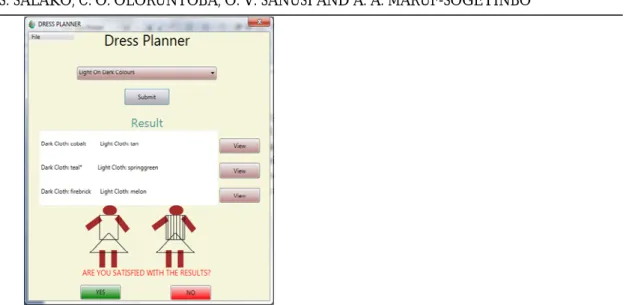
The system was implemented using C# programming language in Visual Studio andIn Figure 4, one of the view buttons is pressed. Pressing the “View” button makes the RGB values of those selected, crossed over and probably mutated colours show in the human image model in the program. The human model was implemented using
XAML.
The human figure (on the left) in the Figure 5 above shows a Dark blouse being visual-ized on a light skirt (dark blouse: Cobalt, Light Skirt: Tan).
Figure 3: Start Interface for colour combination visualization
When light on dark is selected and submit-ted, the view buttons are being enabled and usable and it goes into the encoded data and makes selections and does crossover and displays the result. Once the “submit”
but-ton is pressed, selection and crossover is be-ing done. So if one desires more crossovers within the fitness range, he button can be clicked over and over again.
The human figure in Figure 5 (on the right) shows a stripped blouse being visualized on a plain coloured skirt (Stripped blouse: blue-violet and gold, Plain Skirt: Brown)
During system testing, a questionnaire was designed to obtain people’s views about the dress planner application created. The ques-tionnaire was evaluated based on the 7 re-sponses given by female lecturers and ladies dealing with clothing and textile in the de-partment of Home Science Management at Federal University of Agriculture, Abeoku-ta. One of the respondents commented that our application enabled them make a right colour combination for the colours to wear. Another thought it was a good idea to view what ones outfit would look like before wearing it. However, one user commented that our representation of the female figure in the application was not realistic enough.
CONCLUSION
Users found our computer aided application for visualizing fashion colour combinations useful for suggesting colour combinations that could suit female users. Our application
therefore would serve as a tool for enhanc-ing colour combination visualization for fashion and textile designing.
There could be some extensions/ improvements on this project. The represen-tation of the female figure (the human mod-el) could be made to look more realistic as suggested by the users. Further issues that affect fashion colour combination as earlier mentioned by the users like skin colour, weather, etc., should be considered. In addi-tion, this project has looked into visualizing colour combinations for women’s dressing. Future work could incorporate that for men.
REFERENCES
Kim, H. S., & Cho, S. B. 2000. Application of interactive genetic algorithm to fashion design. Engineering applications of artificial
intelli-gence, 13(6), 635-644.
Kim, S.-K., Sul, J.-H., 1998. Computer Graphics for Fashion Design Using Adobe Illustrator and Photoshop. Shinjiseowon (in Korean).
Lee, H.-S., Park, H.-S., 1998. Fashion Design. Kyungchunsa (in Korean), Seoul, Korea.
Lee, S.-J., 1999. Computer-Aided Fashion and Fabric design. Hyung-Sul Publishers Inc. (in Korean), Seoul, Korea.
Lee, S.-R., 1998. Details and Fashion De-sign Collection. Munyemadang (in Korean), Seoul, Korea.
Nikanishi Y. 1996a. Applying evolutionary systems to design aid system. Proceedings from Artificial Life V (Poster Presentation). pp. 147-154.
Nikanishi Y. 1996b. Capturing preference into a function using interactions with a manual evolutionary design aid system. Ge-netic Programming 1996 Late-Breaking
Pa-pers, pp. 133-138.
Paul, C. L., Rohrer, R., Nebesh, B. 2015. A “Design First” Approach to Visualization Innovation. IEEE computer graphics and
appli-cations, (1), 12-18.
Sharon, L. T. 1984. Inside Fashion Design. Harper & Row, New York.
Volino, P., Cordier, F., Magnenat-Thalmann, N. 2005. From early virtual gar-ment simulation to interactive fashion de-sign. Computer-Aided Design, 37(6), 593-60. Zhou, Y., Dao, T. H. D., Thill, J. C., Delmelle, E. 2015. Enhanced 3D visualiza-tion techniques in support of indoor locavisualiza-tion planning. Computers, Environment and Urban
Systems, 50, 15-29.