Sharif University of Technology
Scientia IranicaTransactions A: Civil Engineering www.scientiairanica.com
Charged system search and particle swarm optimization
hybridized for optimal design of engineering structures
A. Kaveh
and A. Nasrollahi
Centre of Excellence for Fundamental Studies in Structural Engineering, Iran University of Science and Technology, Tehran, P.O. Box 16846-13114, Iran.
Received 25 February 2013; received in revised form 4 September 2013; accepted 24 September 2013
KEYWORDS Hybrid metaheuristic algorithm;
Charged system search;
Particle swarm optimization; Optimal design; Engineering structures.
Abstract. In this paper, a new Hybrid Charged System Search and Particle Swarm Optimization, HCSSPSO, is presented. Although Particle Swarm Optimization (PSO) has many advantages, including directional search, it has also some disadvantages resulting in slow convergence rate and low performance. On the other hand, the Charged System Search (CSS) is a robust optimization algorithm which has been successfully utilized in many structural optimization problems. In this study, the goal is to incorporate the positive features of the PSO in CSS and make it more capable of solving optimization problems. The hybrid CSS and PSO is named HCSSPRO, and it uses the positive features of the PSO to further improve the CSS. In order to show the higher performance of the HCSSPSO, it is implemented and applied to some engineering problems. These structures are benchmark examples which are optimized by many other methods and are suitable for comparison. Results of the present algorithm show its better performance and higher convergence rate for the problem studied.
c
2014 Sharif University of Technology. All rights reserved.
1. Introduction
In recent years, many meta-heuristic optimization al-gorithms have been developed and employed in the optimal design of engineering structures. Nowadays, there is considerable eort made towards designing engineering structures and machines using the least possible amount of materials and resources. For this purpose, many mathematical programming and meta-heuristic methods of optimization based on natural events, the social behavior of animals and insects, and physics laws, are applied to engineering design. Due to the simplicity and versatility of the meta-heuristic methods compared to mathematical programming ap-proaches, these algorithms have become the focus of attention among many researchers.
*. Corresponding author. Tel.: +98 21 77240104; Fax: +98 21 77240398
E-mail address: [email protected] (A. Kaveh)
In general, gradient-based methods converge faster and can obtain solutions with higher accuracy compared to stochastic approaches in fullling the local search task. However, for eective implementation of these methods, the variables and cost function of the generators should be continuous. Also, a good starting point is vital for these methods to be executed successfully. In many optimization problems, prohib-ited zones, side limits, and non-smooth or non-convex cost functions need to be considered. As a result, non-convex optimization problems cannot be solved by the traditional mathematical programming methods. Although dynamic programming or mixed integer non-linear programming and their modications oer some facility in solving non-convex problems, these methods, in general, require considerable computational eort.
Particle Swarm Optimization is a multi-agent meta-heuristic optimization algorithm which was intro-duced by Eberhart and Kennedy [1]. This algorithm is inspired by social interaction among animals and
insects that are living in swarms and ocks, having social behavior. In this algorithm, each member (particle) of the society (swarm) tends to follow the member which has a better position and this directs the exploration of the search space. Some advantages of the PSO consist of the ease of its implementation and directional search, resulting in its popularity. However, a lack of balance between exploration and exploitation reduces its performance and convergence rate. Another problem with PSO is not having an ecient method for dealing with violated particles from the feasible search space. Kaveh and Nasrollahi [2] used a linear varying inertia weight for balancing exploration and exploitation, as well as a Harmony Search Based approach for reproducing violated par-ticles.
On the other hand, the CSS is another multi-agent meta-heuristic optimization algorithm which was developed by Kaveh and Talatahari [3]. This algorithm is based on the laws of Coulomb and Gauss from electrostatics and the Newtonian laws of mechanics. The CSS was successfully applied to many structural optimization problems by Kaveh and Talatahari [4-8], Kaveh and Ahmadi [9], and Kaveh and Behnam [10]. Results from the above research show that CSS has a fast convergence rate and there is a suitable balance between exploration and exploitation. However, the main problem with CSS is the direction of movement of each Charged Particle (CP), since all CPs which can exert forces onto a CP, have the same inuence, i.e. the best CPs have the same inuence as other CPs. Previously, Kaveh and Laknejadi [11] introduced a hybrid CSS and PSO for multi-objective optimization. Kaveh et al. [12] also presented a new version of CSS by introducing magnetic, as well as electrostatic, forces.
In this paper, the directional search characteristic of the PSO is added to the CSS to master the inuence of the best CP and the best position history of CP itself. This modication improves the capability of the CSS in nding the minimum of an objective function. The new algorithm is applied to four benchmark structural design problems and the higher performance of the HCSSPSO is shown compared to other methods. The obtained improvements correspond to both the design output and the convergence rate of the algorithm.
2. Particle swarm optimization
The PSO makes use of a velocity vector to update the current position of each particle in the swarm. The position of each particle in the swarm, which adapts to its environment by ying in the direction of the best position of all particles and the best position of the particle itself, provides the search process of the PSO. The position of the ith particle at iteration k + 1 is
calculated using the following relationship: xi
k+1= xik+ vk+1i :t; (1)
where, xi
k+1 is the new position; xik is the position at
the kth iteration; vi
k+1 is the updated velocity vector
of the ith particle; and t is the time step which is considered as unity. The velocity vector of each particle is determined by:
vi
k+1= w:vik+ c1:r1: p i k xik
t + c2:r2
pgk xi k
t ;(2) where, vi
kis the velocity vector at iteration k; r1and r2
are two random numbers between 0 and 1; pi
krepresents
the best ever position of particle i, local best; pk g is the
global best position in the swarm up to iteration k; c1
is the cognitive parameter; c2 is the social parameter;
and w is the inertia weight.
With the above description of the PSO, the algorithm can be summarized as follows.
The initial position, xi
0, and the velocities, v0i,
of the particles are distributed randomly in a feasible search space:
xi
0= xmin+ r: (xmax xmin) ; (3)
vi
0=xmin+ r: (xtmax xmin); (4)
where, r is a random number uniformly distributed between 0 and 1, and xmin and xmax are minimum
and maximum possible variables for the ith particle, respectively.
3. Charged system search
The Charged System Search (CSS) algorithm is an optimizer based on the Coulomb and Gauss electro-statics laws and the Newtonian Mechanics laws. A brief explanation of the CSS is as follows: This algorithm is a multi-agent approach, where each agent is a Charged Particle (CP). A CP is considered as a charged sphere with radius a, having a uniform volume charge density of magnitude:
qi =tbest tworstt(i) tworst ; i = 1; : : : ; N; (5)
where tbest and tworst are the best tness and the worst tness of all the particles, t(i) represents the tness of the agent, i, and N is the total number of CPs. CPs can impose electric forces on the others. The forces are considered as attractive and their magnitude for a CP located inside the sphere is proportional to the separation distance, rij, between the CPs. For a CP
located outside the sphere, it is inversely proportional to the square of the separation distance between the particles. In continuous problems, it is sucient to
consider all the forces as attractive. Therefore, the forces can be obtained as follows:
Fj= qj N
X
i;i6=j
qi
a3rij:i1+
qi
r2 ij:i2
!
:pij(Xi Xj) ; (6)
where Fj is the resultant force acting on the jth CP,
and rij is the separation distance between two charged
particles, which is dened as: rij= k(X kXi Xjk
i+ Xj)=2 Xbestk + "; (7)
where Xi and Xj are the positions of the ith CP and
jth CP, respectively; Xbest is the position of the best
current CP, and " is a small positive number. The initial positions of the CPs are determined randomly in the search space, and the initial velocities of charged particles are assumed to be zero.
pij determines the probability of moving each CP
towards the others, as:
pij =
(
1 t(i) tbestt(j) t(i) > rand _ t(j) < t(i) 0 otherwise (8) The resultant forces and motion laws determine the new location of the CPs. At this stage, each CP moves toward its new position under the action of the resultant forces and its previous velocity as:
Xj;new=randj1:ka:mFj j:t
2+ rand
j2:kv:Vj;old:t
+ Xj;old; (9)
where ka is the acceleration coecient; kv is the
velocity coecient to control the inuence of the pre-vious velocity; and randj1 and randj2 are two random
numbers uniformly distributed in the range of (0,1): Vj;new= Xj;newtXj;old: (10)
To save the best design, a memory (Charged Memory or CM) is considered in the CSS. If a CP moves out of the allowable search space, its position is corrected using the Harmony Search handling method. Accord-ing to this mechanism, any component of the solution vector violating boundaries can be regenerated from CM as:
xi;j =
8 > > > > > > > > < > > > > > > > > : w.p. CMCR
) select a value for a variable from CM ) w.p. (1-PAR) do nothing
) w.p. PAR choose a neighboring value w.p. (1-CMCR)
) select a new variable randomly
(11)
where xi;j is the ith component of the CP, j. The
Charged Memory Considering Rate (CMCR), varying between 0 and 1, sets the rate of choosing a value in the new vector from the historic values stored in the CM, and (1-CMCR) sets the rate of choosing one random value from the possible range of values. The pitch adjusting process is performed only after a value is chosen from the CM. The value (1-PAR) sets the rate of doing nothing. Here, \w.p." stands for \with probability".
4. Hybrid charged system search and particle swarm optimization
In this section, a new hybrid Charged System Search and Particle Swarm Optimization is presented. For this purpose, some of the PSO parameters which provide good search for the PSO are added to the CSS. These modications include:
1. Initial velocities of CPs are not considered as 0, but it is assumed to be dened by Eq. (4). This is necessary for the next stages.
2. For providing a balance between exploration and exploitation in the PSO, Fourie and Groenwold [13] have considered a dynamic varying of the inertia weight. In this approach, the inertia weight is not considered as constant. It varies by the progress of the algorithm and, in iteration k + 1, the inertia weight is dened as:
wk+1= kw:wk; (12)
where wk and wk+1 are the inertia weights in
iteration k and k + 1, respectively; and kw is a
constant multiplier.
However, in the CSS, the linear varying of force eect and velocity eect is considered as:
ka= 0:5
1 + itermaxiter
; (13)
kv= 0:5
1 itermaxiter
: (14)
In this study, by inspiration of the dynamic varying of inertia weight, a new dynamically varying of the force eect and the velocity eect are introduced as follows:
ka= (k1)
iter
itermax; (15)
kv= (k2)
iter
itermax ; (16)
where, k1 and k2 are two constants. Since, at
the initial stages of the optimization there must be a focus on exploration, the velocity must have
more signicant eect and, in the latest iterations exploitation, must be performed by an algorithm, it is recommended to consider the values of k1
and k2 as 2.0 and 1:0E 5, respectively. These
values ensure a good balance between exploration and exploitation in the algorithm. By using a dynamically varying concept, the convergence rate of the CSS can be increased.
3. Since, in the CSS, the velocity vectors of particles depend on the amount of force, and, on the other hand, the forces exerted on a CP depend on the distances of other particles and the amount of the cost function corresponding to each CP, it is not ensured that the best particle has the most eect. This may cause reduction of the convergence rate and exploration. Thus, if we can master the eect of the best CP, the performance of the CSS will be improved. The key of this problem exists in the denition of the velocity in the PSO. If we consider the velocity of CPs by Eq. (17), the eect of the best CP will be raised, and the eect of the best position of CP up to the current iteration will be added to the CSS:
vi
k+1= w:vki +c1:r1: pik xik
+c2:r2: pgk xik
: (17) However, in this approach, it is necessary to add a memory to the CSS for each particle in order to save the best position of the CP up to the current iteration. With these modications, the performance of the CSS improves in such a way that by dening the dynamical variance, it is expected to raise the convergence rate, and by the use of the velocity denition of the PSO in the CSS, a better search will be performed. The stages of implementation of the HCSSPSO are similar to that of the CSS and only these modications are applied. With the above denitions, the steps of optimization by the HCSSPSO are shown in the owchart of Figure 1.
5. Numerical examples
To illustrate the eectiveness of the mentioned modi-cations, several benchmark examples that have previ-ously been optimized by other researchers, are consid-ered. These examples have been studied before using a variety of methods and are suitable for measuring the capability of an algorithm compared to existing ones. In these examples, the number of CPs is considered to be 20, and 20 independent runs are performed for each example. After some trial and error processes for nding suitable values for constants, w, c1, and c2, the
best value for these parameters is found to be 1.0. In order to deal with the constraints, a penalty function approach is utilized.
Figure 1. Flowchart of the HCSSPSO.
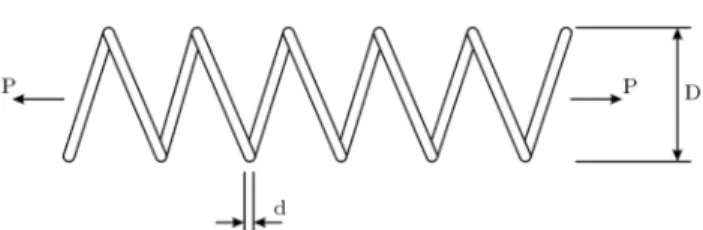
Figure 2. Geometry and the parameters of the tension/compression spring design.
5.1. A tension/compression spring design problem
This problem is described by Belegundu [14] and Arora [15]. It consists of minimizing the weight of a tension/compression spring subjected to constraints on shear stress, surge frequency, and minimum deection, as shown in Figure 2.
The design variables are the mean coil diameter, D (= x1), the wire diameter, d (= x2), and the number
of active coils, N (= x3). The problem can be expressed
with the following cost function:
fcost(X) = (x3+ 2) x2x21; (18)
constraints:
g1(X) = 1 x 3 2x3
71; 785x4
1 0; (19)
g2(X) = 4x 2 2 x1x2
12; 566 (x2x31 x41)+
1 5; 108x2
1 1 0;(20)
g3(X) = 1 140:45xx2 1
2x3 0; (21)
g4(X) = x11:5+ x2 1 0: (22)
The variables are selected from the following regions: 0:1 x1 2; (23)
0:25 x2 1:3; (24)
2 x3 15: (25)
This problem has been solved by Belegundu [14] using eight dierent mathematical optimization techniques (only the best results are shown). Arora [15] has also solved this problem using a numerical optimization technique, called constraint correction, at a constant cost. Coello [16], and Coello and Montes [17] solved this problem using a GA-based method. Additionally, He and Wang [18] utilized a Co-evolutionary Particle Swarm Optimization (CPSO). Recently, Montes and Coello [19], and Coelho [20] used evolution strategies to solve this problem. Table 1 presents the best solution of this problem obtained using the HCSSPSO algorithm and compares the HCSSPSO results to the solutions reported by other researchers. From Table 1, it can be seen that the best feasible solution obtained by the HCSSPSO is better than those previously reported. This issue is in both obtained cost function and standard deviation or the number of runs required for nding a reliable minimum by the algorithm. As can
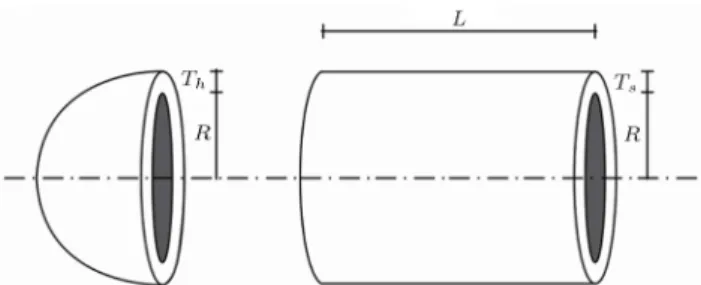
Figure 3. Geometry and parameters of the pressure vessel.
be seen, the results of the present algorithm compared to those of the CSS are better, and one can state that the advantages of the PSO are successfully added to the CSS.
5.2. A pressure vessel design problem
A cylindrical vessel clapped at both ends by semispher-ical heads, as shown in Figure 3, is considered as the second design example. The objective is to minimize the total cost, including the cost of material, forming and welding [21]:
fcost(X) =0:6224x1x3x4+ 1:7781x2x23
+ 3:1661x2
1x4+ 19:84x21x3; (26)
where x1 is the thickness of the shell (Ts), x2 is the
thickness of the head (Th), x3 is the inner radius (R),
and x4 is the length of the cylindrical section of the
vessel (L), not including the head. Tsand Thare integer
multiples of 0.0625 inches, the available thickness of the rolled steel plates, and R and L are continuous.
The constraint can be expressed as:
g1(X) = x1+ 0:0193x3 0; (27)
g2(X) = x2+ 0:00954x3 0; (28)
g3(X) = x23x4 43x33+ 1; 296; 000 0; (29)
g4(X) = x4 240 0: (30)
Table 1. Optimal results of the tension/compression spring design.
Method x1(d) x2(D) x3(N) Best
result
Mean of the results
Worst
results SD
Belegudu [14] 0.050000 0.315900 14.250000 0.012833 N/A N/A N/A
Arora [15] 0.053396 0.399180 9.185400 0.012730 N/A N/A N/A
Coello [16] 0.051480 0.351661 11.632201 0.012705 0.012769 0.012822 3.939E-05 Coello and Montes [17] 0.051989 0.363965 10.890522 0.012681 0.012742 0.012973 5.900E-05 He and Wang [18] 0.051728 0.357644 11.244543 0.012675 0.012730 0.012924 5.199E-05 Montes and Coello [19] 0.051643 0.355360 11.397926 0.012698 0.013461 0.164850 9.660E-04 Coelho [20] 0.051515 0.352529 11.538862 0.012665 0.013524 0.017759 1.268E-3 CSS (present work) 0.052952 0.387880 9.671307 0.012694 0.013518 0.015435 1.088E-03 HCSSPSO (present work) 0.051799 0.359380 11.134561 0.012665 0.013142 0.015134 8.893E-04
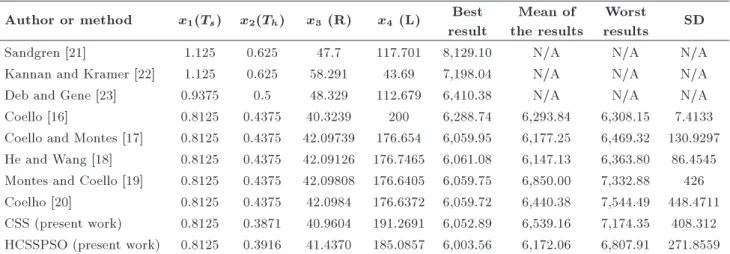
Table 2. Result of the optimal design of pressure vessel. Author or method x1(Ts) x2(Th) x3 (R) x4 (L) Best
result
Mean of the results
Worst
results SD
Sandgren [21] 1.125 0.625 47.7 117.701 8,129.10 N/A N/A N/A
Kannan and Kramer [22] 1.125 0.625 58.291 43.69 7,198.04 N/A N/A N/A
Deb and Gene [23] 0.9375 0.5 48.329 112.679 6,410.38 N/A N/A N/A
Coello [16] 0.8125 0.4375 40.3239 200 6,288.74 6,293.84 6,308.15 7.4133 Coello and Montes [17] 0.8125 0.4375 42.09739 176.654 6,059.95 6,177.25 6,469.32 130.9297 He and Wang [18] 0.8125 0.4375 42.09126 176.7465 6,061.08 6,147.13 6,363.80 86.4545 Montes and Coello [19] 0.8125 0.4375 42.09808 176.6405 6,059.75 6,850.00 7,332.88 426 Coelho [20] 0.8125 0.4375 42.0984 176.6372 6,059.72 6,440.38 7,544.49 448.4711 CSS (present work) 0.8125 0.3871 40.9604 191.2691 6,052.89 6,539.16 7,174.35 408.312 HCSSPSO (present work) 0.8125 0.3916 41.4370 185.0857 6,003.56 6,172.06 6,807.91 271.8559
The design space is as follows:
0 x1 99; (31)
0 x2 99; (32)
10 x3 200; (33)
10 x4 200: (34)
The approaches applied to this problem include a branch and bound technique [21], an augmented La-grangian multiplier approach [22], genetic adaptive search [23], a GA-based co-evolution model [16], a feasibility-based tournament selection scheme [17], a co-evolutionary particle swarm optimization [18], an evolution strategy [19], and a Gaussian quantum-behaved PSO approach [20]. The best solutions ob-tained by the above mentioned approaches and their statistical simulation results are listed in Table 2. From Table 2, it can be seen that the best solution found by the HCSSPSO is better than the best solutions found by other techniques. Also, from this table, it can be seen that the average searching quality of the HCSSPSO is better than that of other methods. 5.3. A 25-bar element space truss
As the third example, a 25-bar space truss, as a transmission tower, is considered, as described by Schmit and Fleury [24], and shown in Figure 4. The design variables are the cross sectional areas of the members, which are categorized into eight groups, as shown in Table 3. The loading of the structure is shown in Table 4. Constraints are imposed to cross-sectional areas of the members between 0.01 in2 to 3.4
in2, and to the allowable stresses, which are included in
Table 5. Another considered constraint is the allowable displacement, which is taken as 0:35 in for every direction.
Table 3. Truss member grouping of the 25-bar truss members.
Group Truss members
1 1
2 2 5
3 6 9
4 10 11
5 12 13
6 14 17
7 18 21
8 22 25
Table 4. Nodal load of the 25-bar truss. Node Fx (lb) Fy (lb) Fz (lb)
1 10,000 10; 000 10; 000
2 0 10; 000 10; 000
3 500 0 0
6 600 0 0
Table 5. Allowable stresses for the 25-bar truss members. Element
group
Allowable compressive stress
ksi (MPa)
Allowable tensile stress
ksi (MPa) 1 35.092 (241.96) 40.0 (275.80) 2 11.590 (79.913) 40.0 (275.80) 3 17.305 (119.31) 40.0 (275.80) 4 35.092 (241.96) 40.0 (275.80) 5 35.092 (241.96) 40.0 (275.80) 6 6.759 (46.603) 40.0 (275.80) 7 6.959 (47.982) 40.0 (275.80) 8 11.082 (76.410) 40.0 (275.80)
Figure 4. Geometry and element grouping of the 25-bar element space truss. Table 6. Results of the optimal design of the 25-bar truss structure. Element
group
Wu and Chow [25]
Zhu [26]
Haftka and Grudal [27]
Zhou and Rozvany
[28]
Erbatur et al.
[29]
Perez and Behdinan
[30]
CSS (present
work)
HCSSPSO (present
work)
1 0.1 0.1 0.01 0.01 0.1 0.1 0.104 0.1
2 0.5 1.9 1.987 1.987 1.2 1.0227 0.3475 0.4438
3 3.4 2.6 2.991 2.994 3.2 3.4 3.3667 3.3946
4 0.1 0.1 0.01 0.01 0.1 0.1 0.1 0.1
5 1.5 0.1 0.012 0.01 1.1 0.1 1.845 1.7925
6 0.9 0.8 0.683 0.684 0.9 0.6399 0.9538 0.9497
7 0.6 2.1 1.679 1.677 0.4 2.0424 0.5993 0.51
8 3.4 2.6 2.664 2.662 3.4 3.4 3.3921 3.3969
Best result
(kips) 486.29 562.93 545.22 545.16 493.8 485.33 485.54 484.43
Mean of results
(kips) N/A N/A N/A N/A N/A N/A 487. 90 485.04
Worst result
(kips) N/A N/A N/A N/A N/A 534.84 489.37 486.364
SD N/A N/A N/A N/A N/A N/A 1.732174 0.60718
Table 6 shows the chronic solution of this example and, also, results of the CSS and HCSSPSO are in-cluded. From this table, it can be seen that HCSSPSO has a better solution for this example. It is also obvious that the CSS has better results compared to other methods except HCSSPSO, and by the use of the HCSSPSO, a better solution than CSS is obtained. A smaller standard deviation indicates that the obtained
weights from dierent runs are nearer than those of a higher standard deviation and this can be regarded as an additional capability of the algorithm. As shown in Table 6, the HCSSPSO has a smaller standard deviation compared to the CSS results. Thus, it can be stated that the HCSSPSO is more reliable and, in a few runs, we can be sure that a nearly optimum weight is obtained. The HCSSPSO and CSS progression curves
Figure 5. Convergence history of the 25-bar space truss.
have been shown in Figure 5. From this gure, it can be observed that the convergence rate of the HCSSPSO is higher than that of CSS and PSO.
5.4. 120-bar dome space truss
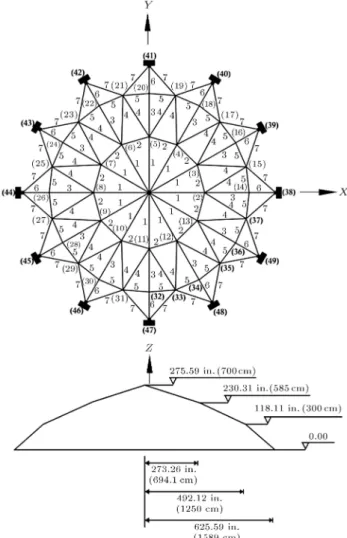
The design of a 120-bar dome truss, shown in Figure 5, is considered the last example to compare the practical capability of the HCSSPSO algorithm. This dome is utilized in literature to nd a size design using metaheuristic algorithms. The modulus of elasticity is 30,450 ksi (210,000 MPa), and the material density is 0.288 lb/in3 (7971.810 kg/m3). The yield stress of
steel is taken as 58.0 ksi (400 MPa). The dome is considered to be subjected to vertical loading at all the unsupported joints. These loads are taken as 13:49 kips ( 60 kN) at node 1, 6:744 kips ( 30 kN) at nodes 2 through 14, and 2:248 kips ( 10 kN) at the remaining nodes. The minimum cross sectional area of all members is 0.775 in2 (2 cm2) and the
maxi-mum cross-sectional area is taken as 20.0 in2 (129.03
cm2). The stress constraints of the structural members
are calculated as per AISC (1989) specications, as illustrated in Eqs. (34) and (35). Also, displacement limitations of 0.1969 in ( 5 mm) are imposed on all nodes in x; y and z directions. The 120-bar truss members are categorized into 7 groups, as shown in Figure 6.
( +
i = 0:6Fy for i 0
i for i < 0 (35)
where, i is calculated according to the slenderness ratio using:
i = 8 < :
h 1 2i
2C2 c
Fy
i =5
3+8C3ic
3 i
8C3 c
for i<Cc 122E
232
i for iCc (36)
where, E is the modulus of elasticity; Fy is the
yield strength of steel; Cc is the slenderness ratio
which divides the elastic and inelastic buckling regions,
Cc =p22E=Fy
; and i is the slenderness ratio.
Figure 6. Geometry and element grouping of the 120-bar dome space truss.
Figure 7. Convergence history of the 120-bar dome truss.
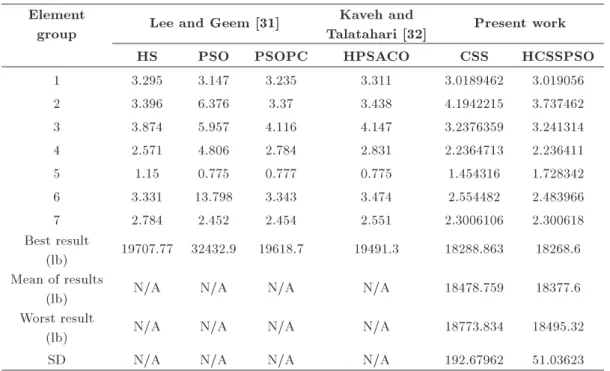
Figure 7 shows the convergence history of the CSS, HCSSPSO, and PSO. As can be seen, the conver-gence rate of the HCSSPSO is nearly the same as that of the CSS and higher than PSO. Also, results of the HCSSPSO are included in Table 7 for comparison. As shown, similar to other examples, HCSSPSO performs
Table 7. Results of the optimal design of the 120-bar truss dome. Element
group Lee and Geem [31]
Kaveh and
Talatahari [32] Present work
HS PSO PSOPC HPSACO CSS HCSSPSO
1 3.295 3.147 3.235 3.311 3.0189462 3.019056
2 3.396 6.376 3.37 3.438 4.1942215 3.737462
3 3.874 5.957 4.116 4.147 3.2376359 3.241314
4 2.571 4.806 2.784 2.831 2.2364713 2.236411
5 1.15 0.775 0.777 0.775 1.454316 1.728342
6 3.331 13.798 3.343 3.474 2.554482 2.483966
7 2.784 2.452 2.454 2.551 2.3006106 2.300618
Best result
(lb) 19707.77 32432.9 19618.7 19491.3 18288.863 18268.6 Mean of results
(lb) N/A N/A N/A N/A 18478.759 18377.6
Worst result
(lb) N/A N/A N/A N/A 18773.834 18495.32
SD N/A N/A N/A N/A 192.67962 51.03623
much better, and the results obtained by the use of the present algorithm are better, in terms of both standard deviation and weight. These results also indicate the improvement of the CSS when the advantages of the PSO are added to it. However, as seen from Table 7, the CSS results are better than other methods for the design of this dome.
6. Mechanism of exploration and exploitation in the present algorithm
In order to show how the particles follow the global best and local best of the swarm, a 3-variable exponential function (two independent variables and one dependent variable) with a 2-dimensional search space is exam-ined. This function is chosen because the search space can be visualized in a plane coordinate and thus, one can follow the search mechanism. The aforementioned function is in the following form:
fcost(X) = exp 0:5 x21+ x22
; X 2 [ 1; 1]2: (37) This function is visible in Figure 8 in the assumed search space and, from gradient based methods of nding the global minimum, it is evident that this function has a minimum of 1 at the point (0,0).
The search phase of the algorithms is shown in Figure 9. This gure shows two distinguished phases of search. The rst phase takes place during the iterations 1 to 30 and is a global search or exploration. In this phase, the displacements of the particles are considerable and particles move from one side to
Figure 8. Graph of exponential function.
Figure 9. Exploration and exploitation mechanism of the HCSSPSO.
another with a direction towards the global minimum. The second phase starts from iteration 30, which is an exploitation involving the movement of the particles in a more contracted search space. This is a local search phase, which causes the correction of the particles positions and nally nds the correct point of the minimum value. From this gure, one can see that both exploration and exploitation of the HCSSPSO are performed accurately and properly and this mechanism makes the HCSSPSO a robust algorithm. This is obvious, since most of the particles are gathered at point (0,0).
7. Concluding remarks
In this paper, a new hybrid algorithm called HC-SSPSO is presented. This algorithm consists of the hybridization of the CSS and PSO algorithms and can be considered an enhanced CSS with some advantages of the PSO. Since the denition of the velocity in CSS is aected by all the CPs exerting forces on each CP and is dependent, all the CPs have the same inuence and the best CP does not, necessarily, have the most eect. This problem may cause a reduction in the search eciency of the algorithm. On the other hand, the denition of the velocity in the PSO is dependent on the position of the best particle and the best position of the particle up to the current iteration. If the denition of velocity in the PSO is used in the CSS, it can work better. Another enhancement of the CSS, based on the PSO concept, is using a dynamic varying approach for the parameters, ka and kv, of the CSS. This modication has been
previously implemented in inertia weight denition in the PSO, resulting in a higher convergence rate. These modications are also added in the CSS. To prove positive modication of the HCSSPSO compared to CSS, four numerical examples extensively proposed by researchers are considered. Results illustrate the higher capability of the HCSSPSO compared to other methods of optimization and also CSS. Thus, it can be concluded that these improvements promote the performance of the CSS, and HCSSPSO can successfully be utilized in engineering design optimization problems.
Acknowledgement
The rst author is grateful to the Iran National Science Foundation for its support.
References
1. Eberhart, R.C. and Kennedy, J. \A new optimizer using particle swarm theory", Proceedings of the Sixth International Symposium on Micro Machine and Human Science, Nagoya, Japan (1995).
2. Kaveh, A. and Nasrollahi, A. \Engineering design optimization using a hybrid PSO and HS algorithm", Asian Journal of Civil Engineering (BHRC), 14(2), pp. 201-223 (2013).
3. Kaveh, A. and Talatahari, S. \A novel heuristic optimization method: Charged system search", Acta Mechanica, 213(3-4), pp. 267-289 (2009).
4. Kaveh, A. and Talatahari, S. \A charged system search with a y to boundary method for discrete optimum design of truss structures", Asian Journal of Civil Engineering, 11(3), pp. 277-293 (2010).
5. Kaveh, A. and Talatahari, S. \Charged system search for optimum grillage system design using the LRFD-AISC code", Journal of Constructional Steel Research, 66(6), pp. 767-771 (2010).
6. Kaveh, A. and Talatahari, S. \Optimal design of skeletal structures via the charged system search algo-rithm", Structural and Multidisciplinary Optimization, 41(6), pp. 893-911 (2010).
7. Kaveh, A. and Talatahari, S. \An enhanced charged system search for conguration optimization using the concept of elds of forces", Structural and Multidisci-plinary Optimization, 43(3), pp. 339-351 (2010).
8. Kaveh, A. and Talatahari, S. \Geometry and topology optimization of geodesic domes using charged system search", Structural and Multidisciplinary Optimiza-tion, 43(2), pp. 215-229 (2011).
9. Kaveh, A. and Ahmadi, B. \Simultaneous analysis, de-sign and optimization of structures using force method and supervised CSS algorithm", Scientia Iranica, 20, pp. 65-76 (2013).
10. Kaveh, A. and Behnam, A.F. \Cost optimization of a composite oor system, one-way wae slab, and concrete slab formwork using charged system search algorithm", Scientia Iranica, 19, pp. 410-416 (2012).
11. Kaveh, A. and Laknejadi, K. \A novel hybrid charge system search and particle swarm optimization method for multi-objective optimization", Expert Systems with Applications, 38(12), pp. 15475-15488 (2011).
12. Kaveh, A., Motie Share, M.A. and Moslehi, M. \Mag-netic charged system search: A new meta-heuristic algorithm for optimization", Acta Mechanica, 224(1), pp. 85-107 (2013).
13. Fourie, P. and Geroenwold, A. \The particle swarm op-timization algorithm in size and shape opop-timization", Structural and Multidisciplinary Optimization, 23(4), pp. 259-267 (2002).
14. Belegundu, A.D. \A study of mathematical program-ming methods for structural optimization", PhD the-sis, Department of Civil and Environmental Engineer-ing, University of Iowa, Iowa (1982).
15. Arora, J.S., Introduction to Optimum Design, McGraw-Hill, New York (1989).
16. Coello, C.A.C. \Use of a self-adaptive penalty ap-proach for engineering optimization problems", Com-puters in Industry, 41, pp. 113-127 (2000).
17. Coello, C.A.C. and Montes, E.M. \Constraint-handling in genetic algorithms through the use of dominance-based tournament selection", Advanced Engineering Informatics, 16, pp. 193-203 (2002).
18. He, Q. and Wang, L. \An eective co-evolutionary particle swarm optimization for constrained engineer-ing design problems", Engineerengineer-ing Applications of Articial Intelligence, 20, pp. 89-99 (2007).
19. Montes, E.M. and Coello, C.A.C. \An empirical study about the usefulness of evolution strategies to solve constrained optimization problems", Interna-tional Journal of General Systems, 37(4), pp. 443-473 (2008).
20. Coelho, L.S. \Gaussian quantum-behaved particle swarm optimization approaches for constrained engi-neering design problems", Expert Systems with Appli-cations, 37, pp. 1676-1683 (2010).
21. Sandgren, E. \Nonlinear integer and discrete program-ming in mechanical design", In Proceedings of the ASME Design Technology Conference, Kissimine, FL, pp. 95-105 (1988).
22. Kannan, B.K. and Kramer, S.N. \An augmented Lagrange multiplier based method for mixed integer discrete continuous optimization and its applications to mechanical design", Transactions of ASME Journal of Mechanical Design, 116, pp. 318-320 (1994).
23. Deb, K. and Gene, A.S. \A robust optimal design tech-nique for mechanical component design", In Dasgupta, D., Michalewicz Z., Eds., Evolutionary Algorithms in Engineering Applications, Springer, Berlin, pp. 497-514 (1997).
24. Schmit, L. and Fleury, C. \Discrete-continuous vari-able structural synthesis using dual methods", AIAA Journal, 18, pp. 1515-1524 (1980).
25. Wu, S. and Chow, P. \Steady-state genetic algorithm for discrete optimization of trusses", Computers and Structures, 56(6), pp. 979-991 (1971).
26. Zhu, D. \An improved templemans algorithm for optimum design of trusses with discrete member size", Engineering Optimization, 9, pp. 303-312 (1986).
27. Haftka, R. and Grudal, Z., Elements of Structural Optimization, 3rd Ed., Dordrecht: Kluwer Academic Publishers (1992).
28. Zhou, M. and Rozvany, G. \An optimality criteria method for large systems. Part II: Algorithm",
Struc-tural and Multidisciplinary Optimization, 6, pp. 250-262 (1993).
29. Erbatur, F., Hasancebi, O., Tntnncn, I., and Kilt, H. \Optimal design of planar and space structures with genetic algorithms", Computers and Structures, 75, pp. 209-224 (2000).
30. Perez, R.E. and Behdinan, K. \Particle swarm ap-proach for structural design optimization", Computers and Structures, 85(19-20), pp. 1579-1588 (2007).
31. Lee, K.S. and Geem, Z.W. \A new structural opti-mization method based on the harmony search algo-rithm", Computers and Structures, 82(9-10), pp. 781-798 (2004).
32. Kaveh, A. and Talatahari, S. \Particle swarm opti-mizer, ant colony strategy and harmony search scheme hybridized for optimization of truss structures", Com-puters and Structures, 87(5-6), pp. 267-283 (2009).
Biographies
Ali Kaveh was born in 1948 in Tabriz, Iran. He obtained a BS degree from the Department of Civil Engineering at the University of Tabriz in 1969, and MS, DIC and PhD degrees in 1970 and 1974, respec-tively, on Structures, from Imperial College of Science and Technology, London, UK. He is currently Professor of Structural Engineering at Iran University of Science and Technology, Tehran, Iran. Professor Kaveh is the author of 280 papers published in international journals and 135 papers presented at international conferences. He has authored 23 books in Farsi and 6 books in English published by Wiley, the American Mechanical Society, Research Studies Press, and Springer.
Amir Nasrollahi was born in 1985 in Borujerd, Iran. He obtained his BS degree in Civil Engineering from the Islamic Azad University, Kashan, Iran, in 2009, and his MS degree in Earthquake Engineering from the Building and Housing Research Center in 2011. At present, he is a PhD degree student of Earthquake Engineering at Iran University of Science and Tech-nology, Tehran, Iran, and is working on development and application of meta-heuristic methods in structural analysis and design.