ISSN 1479-4403 111 ©Academic Conferences Ltd
Reference this paper as:
Alsultanny Y, (2006) “e-Learning System Overview based on Semantic Web” The Electronic Journal of e-Learning Volume 4 Issue 2, pp 111 - 118, available online at www.ejel.org
e-Learning System Overview based on Semantic Web
Yas A. Alsultanny
Graduate College of Computing Studies, Amman, Jordan
[email protected]
Abstract: The challenge of the semantic web is the provision of distributed information with well-defined meaning, understandable for different parties. e-Learning is efficient task relevant and just-in-time learning grown from the learning requirements of the new dynamically changing, distributed business world. In this paper we design an e-Learning system by using a semantic web and show how the semantic web resource description formats can be utilised for automatic generation of hypertext structures from distributed metadata. It is primarily based on ontology-based descriptions of content, context and structure of the learning materials and thus provides flexible and personalised access to these learning materials.
Keywords: e-Learning, semantic web, ontology, education hypermedia.
1. Introduction
"e-Learning is just-in-time education integrated with high velocity value chains. It is the delivery of individualised, comprehensive, dynamic learning content in real time, aiding the development of communities of knowledge, linking learners and practitioners with experts" Drucker 2005).
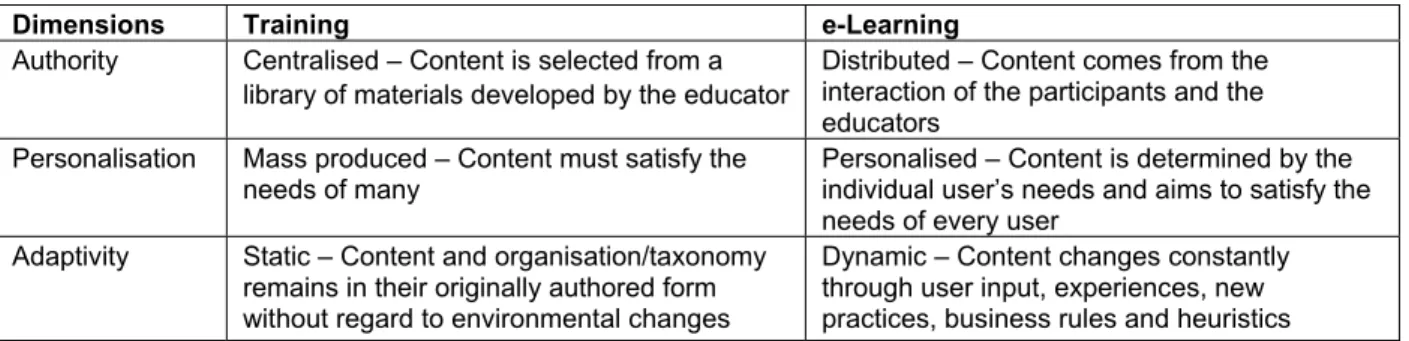
E-Learning aims at replacing old-fashioned time/place/content predetermined learning with a just-in-time/artwork- place/customised/on-demand process of learning. It builds on several pillars, vis. management, culture and IT (Maurer and Sapper, 2001). e-Learning needs management support in order to define a vision and plan for learning and to integrate learning into daily work. It requires changes in organisational behaviour establishing a culture of "learn in the morning, do in the afternoon". Thus, an IT platform, which enables efficient implementation of such a learning infrastructure, is also needed. Our focus here lies in IT (Web) technology that enables efficient, just-in-time and relevant learning. Table 1 shows the characteristics of the standard training and the improvements achieved using the e-Learning approach (Maurer and Sapper, 2001). e-Learning has its origins in computer-based training (CBT), which was an attempt to automate education,
replace a paid instructor, and develop self-paced learning. But the focus of e-Learning is to extend and improve the users and business' needs (Barker, 2000). Key to success is the ability to reduce the cycle time for learning and to adapt “content, size and style” of learning to the respective user and their business environment. Technologies have been enhancing education all the time and new technologies have always been utilised firstly by education, especially with the emerging of computer related information technology (Devedzic, 2000). Network education (including distance education, distance learning), or e-Learning with the growth of computer networking. Wireless and mobile computing have resulted in mobile education or m-Learning. With wireless and mobile technologies, it is possible to realise anytime, anywhere, anyway, any device for learning and educating. Implementation of the m-Learning involves adding mobile computing technologies into the old e-Learning system. Modifying old systems needs a lot of work: redesigning architecture and re-implementing the m-Learning system. In the meantime, a large number of universities will update their systems and many more educational resources will be ported to new systems.
Table (1): Differences between training and e-Learning (Maurer and Sapper, 2001)
Dimensions Training e-Learning
Delivery Push – Instructor determines agenda Pull – Student determines agenda
Responsiveness Anticipatory – Assumes to know the problem Reactionary– Responds to problem at hand Access Linear – Has defined progression of
knowledge
Non-linear – Allows direct access to knowledge in whatever sequence makes sense to the situation at hand
Symmetry Asymmetric – Training occurs as a separate activity
Symmetric – Learning occurs as an integrated activity
Modality Discrete – Training takes place in dedicated chunks with defined starts and stops
Continuous – Learning runs in the parallel to business tasks and never stops
Dimensions Training e-Learning Authority Centralised – Content is selected from a
library of materials developed by the educator
Distributed – Content comes from the interaction of the participants and the educators
Personalisation Mass produced – Content must satisfy the needs of many
Personalised – Content is determined by the individual user’s needs and aims to satisfy the needs of every user
Adaptivity Static – Content and organisation/taxonomy remains in their originally authored form without regard to environmental changes
Dynamic – Content changes constantly through user input, experiences, new practices, business rules and heuristics
2. e-Learning benefits
“The biggest growth in the internet, and the area that will prove to be one of the biggest agents of change, will be in e-Learning.” By:John Chambers, CEO, Cisco Systems
Many of the benefits of e-Learning derive directly from the drivers themselves, e.g., global reach consistency of message and ability to learn anytime, anywhere. But e-Learning in the corporate environments offers other benefits as well. First, e-Learning enables companies to update materials and information across the entire enterprise, keeping content fresh and relevant. This is especially important as product-development cycles continue to diminish, product modifications become more frequent, and company organisations and policies become more volatile. Second, online training also creates a personalised learning experience. Instead of daylong or weeklong programmers, the typical e-Learning course can be broken into one-hour
modules, offering flexibility around training. Employees can adapt training to their own lives and learning styles, accessing material whenever it is convenient to review course material.
Third, e-Learning is ideal for global corporations with people in multiple time zones, there is no need to coordinate travel and delivery schedules. Global companies, however, do need to address language and localisation issues. Fourth, Internet-based training can reduce costs, with housing and travel costs accounting for the majority of the savings. Lost productivity and revenue from classroom training can actually be higher if one considers time spent away from the office. Finally, there is evidence that e-Learning benefits corporate operation. e-Learning on the whole, appears to offer many improvements, both in the tangible as well as the intangible world. Some of the other benefits can be summarised as shown in Table 2 (Rosenberg, 2001).
Table 2: Benefits of e-Learning
Benefits of e-Learning Information is consistent or
customised, depending on need
Everyone gets the same content, presented in the same way. Yet the programs can also be customised for different learning needs or different groups of people
Content is more timely and dependable
Because it is web-enabled, e-Learning can be updated
instantaneously, making the information more accurate and useful for a longer period of time. The ability to upgrade e-Learning content easily and quickly, and then immediately distribute the new information to users is extremely time efficient.
Learning is 24/7 Students can access e-Learning anywhere and at any time of the day. It’s “just in time – any time’ approach makes the learning process ubiquitous.
Universality e-Learning is web-enabled and takes advantage of the universal Internet protocols and browsers. Concern over differences in platforms and operating systems is rapidly fading. Everyone on the Web can receive virtually the same material in virtually the same time.
Scalability e-Learning solutions are highly scalable. Programs can move 10 participants to 100 or even more participants with little effort or incremental cost (as long as the infrastructure is in place). Builds communities The Web enables students to build enduring communities of
practice where they can come together to share knowledge and insight. This can be a tremendous motivator for learning. e-Learning lowers costs Despite outward appearances, e-Learning is often the most cost
effective way to deliver instruction or information. It cuts travel expenses; it can also reduce teaching time, and significantly reduces the need for a classroom/teacher infrastructure.
Yas A. Alsultanny
www.ejel.org 113 ISSN 1479-4403
3. Learning theory
e-Learning associated with any learning that incorporated any form of technology. E-Learning used synonymously in dialogue concerning flexible distance learning. However with the recent surge to incorporate more computer technology into classrooms, at all levels.
e-Learning can be defined as all that activity utilising information transfer and knowledge utilisation during the learning process with particular attention to computer-based technology involving learning activities in relation to primary school classroom environment. Research on flexible learning has been driven by what many are calling the "information revolution”. Research on Flexible learning is becoming increasingly more visible as a part of the higher education family. But the research and literature reviewed for this study indicate that the higher education community has a lot to learn regarding how and in what ways technology can enhance the teaching/learning process. The recent work on social cognition . . . has shown clearly that information is processed in wondrous ways, few of which are replicate of the original information . . . the gist of this more recent work is roughly that individuals, alone or in organisations, transform and use research in highly selective and strategic ways (Huberman,1987).
The perspectives on knowledge use described by Huberman draw from a learning theory known as constructivism, which has moved to the forefront of educational theory in recent years (Huberman, 1987). A learning environment begins now to look more like a mix between the teaching strategies based in a critical inquiry and the teaching conditions, which are thought to support the goals, which these strategies hope to achieve. While no learning environment is ever complete, therefore the sense of its completion must derive less from a necessity to deliver all that learners need and more from its ability to allow learners to integrate various models of reality in ways that enable their meaningful management (Checkland, 1991).
4. Information technology and
knowledge
Knowledge cannot be stored in computers; it can only be stored in the human brain (Davenport and Prusak, 2000; Lytras, et al, 2002), knowledge is what a knower knows; there is no knowledge without someone knowing it. Knowledge is information combined with experience, context, interpretation, reflection, intuition and creativity. Information, which can be stored in computers, becomes knowledge once it is processed in the mind of an individual. This knowledge then becomes information again once it is articulated or
communicated to others in the form of text, computer output, spoken words, or written words or other means. Six characteristics of knowledge that distinguish it from information:
1. Knowledge is a human act
2. Knowledge is the residue of thinking
3. Knowledge is created in the present moment 4. Knowledge belongs to communities
5. Knowledge circulates through communities in many ways
6. And new knowledge is created at the boundaries of old.
Knowledge acquisition must be viewed as a cyclic process where old information is taken on board, combined with new information and the user’s experiences to create newer updated knowledge. This then in turn reduces the old knowledge to the information level, and the previously utilised information could eventually be even further rescinded - to the data level (Colbeck, 2003). Information technology can play an important role in successful knowledge management initiatives. However, the concept of coding and transmitting knowledge in educational organisations is not new: training and employee development programs, organisational policies, routines, procedures, reports, and manuals have served this function for many years. What is innovative in the knowledge management area is the potential for using modern information technology (e.g. the internet, intranets, extranets, browsers, data warehouses, data filters, software agents, expert systems) to support knowledge creation, sharing and exchange in an organisation and between organisations. Modern information technology can collect, systematise structure, store, combine, distribute and present information of value to knowledge workers (Nahapiet and Ghoshal, 1998).
The successful information technology can be integrated by the following four stages;
1. General Support; the first stage is general IT support for knowledge workers. This includes word processing, spreadsheets, and email. End-user tools are made available to knowledge workers. At the simplest stage, this means a capable networked PC on every desk or in every briefcase, with standardised personal productivity tools (word processing, presentation software) so that documents can be exchanged easily throughout an organisation.
2. Expand Accessible Information Sources; an information system stores information on who knows what in the organisation and outside the organisation. The system does not store what they actually know. A typical example is the company intranet. Information about who
knows what is made available to all people in the organisation and to select outside partners.
3. Advanced Information Sources; the system stores what knowledge workers know in terms of information. A typical example is databases such as Lotus Notes.
4. Expert Systems; information system uses information to simulate expert opinions. A typical example is the expert system: ‘Knowledger’. Artificial intelligence is applied in these systems. For example, neural networks are statistically oriented tools that excel at using data to classify cases into one category or another.
5. e-Learning and semantic web
The great success of the current WWW leads to a new challenge: a huge amount of data is interpretable by humans only; machine support is limited. Berners-Lee suggests enriching the Web by machine-processable information, which supports the user in his tasks. For instance, today’s search engines are already quite powerful, but still return too often too large or inadequate lists of hits. Machine-processable information can
point the search engine to the relevant pages and can thus improve both precision and recall. To reach this goal the semantic web will be built up in different levels: Unicode/Unified Resource Identifiers, XML, RDF, ontologies, logic, proof, trust
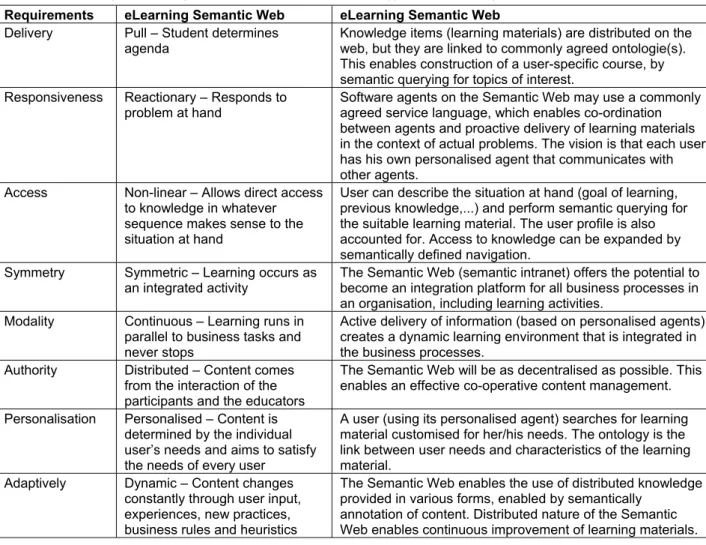
(http://www.w3.org/DesignIssues/Semantic.html). The important property of the Semantic Web architecture i.e. (common-shared-meaning and machine-processable metadata), enabled by a set of suitable agents, establishes a powerful approach to satisfy the e-Learning requirements. The process is based on semantic querying and navigation through learning materials, enabled by the ontological background. In Semantic Web can be exploited as a very suitable platform for implementing an e-Learning system, because it provides all means for (e-Learning): ontology development, ontology-based annotation of learning materials, their composition in learning courses and (pro) active delivery of the learning materials through e-Learning portals. Table 3 shows the suggested advantages to the possibility of using the Semantic Web for realising the e-Learning requirements.
Table 3: advantages of using Semantic Web as a technology for e-Learning Requirements eLearning Semantic Web eLearning Semantic Web Delivery Pull – Student determines
agenda
Knowledge items (learning materials) are distributed on the web, but they are linked to commonly agreed ontologie(s). This enables construction of a user-specific course, by semantic querying for topics of interest.
Responsiveness Reactionary – Responds to problem at hand
Software agents on the Semantic Web may use a commonly agreed service language, which enables co-ordination between agents and proactive delivery of learning materials in the context of actual problems. The vision is that each user has his own personalised agent that communicates with other agents.
Access Non-linear – Allows direct access to knowledge in whatever sequence makes sense to the situation at hand
User can describe the situation at hand (goal of learning, previous knowledge,...) and perform semantic querying for the suitable learning material. The user profile is also accounted for. Access to knowledge can be expanded by semantically defined navigation.
Symmetry Symmetric – Learning occurs as an integrated activity
The Semantic Web (semantic intranet) offers the potential to become an integration platform for all business processes in an organisation, including learning activities.
Modality Continuous – Learning runs in parallel to business tasks and never stops
Active delivery of information (based on personalised agents) creates a dynamic learning environment that is integrated in the business processes.
Authority Distributed – Content comes from the interaction of the participants and the educators
The Semantic Web will be as decentralised as possible. This enables an effective co-operative content management.
Personalisation Personalised – Content is determined by the individual user’s needs and aims to satisfy the needs of every user
A user (using its personalised agent) searches for learning material customised for her/his needs. The ontology is the link between user needs and characteristics of the learning material.
Adaptively Dynamic – Content changes constantly through user input, experiences, new practices, business rules and heuristics
The Semantic Web enables the use of distributed knowledge provided in various forms, enabled by semantically
annotation of content. Distributed nature of the Semantic Web enables continuous improvement of learning materials.
Yas A. Alsultanny
www.ejel.org 115 ISSN 1479-4403
Learning Material
Ontology
An interesting clarification of the philosophical term ontology is provided by Guarino and Gitareta (1995). They summarised several common definitions of ontology is a specification of a conceptualisation, as depicted in figure 1.
An informal conceptual system
A formal semantic account
A specification of a conceptualisation A representation of a conceptual system via a logical theory
The vocabulary used by a logical theory
(Meta-level) specification of a logical theory Figure 1: A basic classification of ontology ̇ An informal conceptual system
̇ A formal semantic account
̇ A specification of a “conceptualisation”
̇ As a representation of a conceptual system via a logical theory
o Characterised by specific formal properties
o Characterised only by its specific purposes
̇ As the vocabulary used by a logic theory ̇ As a (meta-level) specification of a logical
theory
The ontology is to formally describe shared meaning of the used vocabulary (set of symbols) (Stojanovic, 2004; Noy and Klein, 2003). In fact, ontology constrains the set of possible mapping between symbols and their meanings. But the shared understanding problem in e-Learning occurs on several orthogonal levels, which describe several aspects of document usage, as sketched in figure 2. From the student point of view the most important criterions for searching learning materials are: what the learning material is about (content) and in which form this topic is presented (context). However, while learning material does not appear in isolation, another dimension (structure) is needed to encompass a set of learning materials in a learning course. The shared-understanding problem in e-Learning occurs when one tries to define the content of a learning document in the process of providing learning materials as well as in the process of accessing to (searching for) particular learning material.
Figure 2 Metadata for describing the content of learning materials
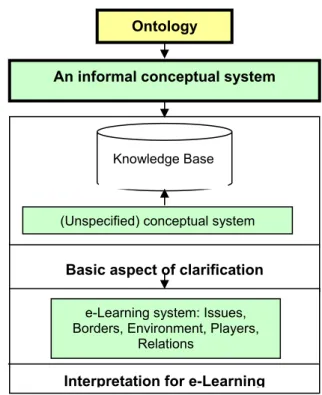
Ontology as an informal conceptual system, figure 3 in the context of e-Learning means that we admit the presence of an (unspecified) conceptual system, which we may assume to underlie a particular knowledge base.
Figure 3: Ontology as an informal conceptual system
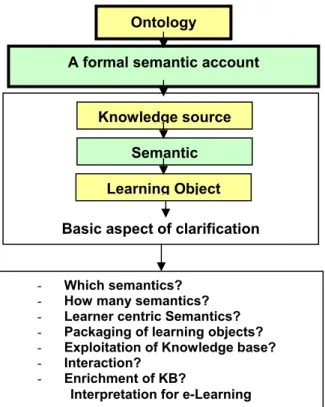
This is the common hypothesis in e-Learning implementations. An ontology as a formal semantic account, see figure 4, means that we analysed the phenomenon of e-Learning and we have concluded several semantic that formulate a value layer capable of exploiting knowledge sources semantically. The major problem concerning this interpretation of ontology is the complexity of e-Learning.
Content Context
Ontologies
Ontology
An informal conceptual system
Basic aspect of clarification (Unspecified) conceptual system
Knowledge Base
Interpretation for e-Learning e-Learning system: Issues, Borders, Environment, Players,
Figure 4: Ontology as a formal semantic account
6. Metadata
Metadata is structured information system describing resources, created to help in the task of discovering, managing and using them without the need to be read, viewed or explored in some way. Metadata is the total sum of what one can say about any information object at any level of aggregation, considering that an information object is anything that can be addressed and manipulated by a human or a system as a discrete entity (Gilliland-Swetland, 2005). Metadata enable effective search of resources across multiple repositories, since dealing with descriptive surrogates of resources is easier than dealing with the resources themselves. The use of a certain object by different communities can be facilitated by the existence of different metadata records describing it according to metadata schemes tailored to the needs of each community. The e-Learning Hypermedia System envisaged to achieve adaptability needs to have not only the Hypermedia repository, also called Hyperspace, containing the HTML and XML, pages of e-Learning content, but also a repository containing knowledge about the domain to be taught, i.e., the Knowledge Spacecomposed of the description of each elementary subject that conforms the knowledge space to be covered by the e-Learning content. The Content Knowledge Ontology is a structure of knowledge concerning the actual pieces of e-Learning content, capable of providing
composition rules represented in a principled way to enable the configuration of complex learning objects tailored to the student’s structure is based on standard metadata to enable interoperability and is encoded in a formal Web ontology capable of supporting reasoning services. The system must have a Student Model representing the knowledge concerning the profile of each individual learner which will be used at run time to decide which goals and preferences must be covered by the e-Learning content that the system provides to the learner. Such a student profile is also object to changes over time because of the student’s activities. The student model was modelled and implemented as application ontology.
7. e-Learning system implementation
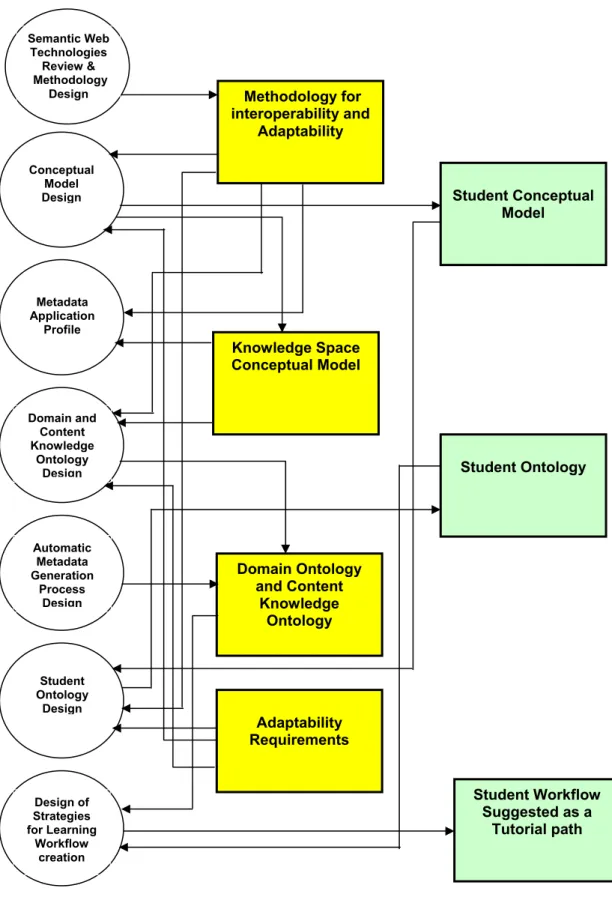
Figure 5 shows the block diagram of the e-Learning system implemented. Circles indicate activities while rectangles indicate obtained results. Arrows indicate the input or output results of activities. The Conceptual Model containing both the Student Model and the Knowledge Space Model was designed. Based on the Student Conceptual Model, the Student Ontology was designed in order to maintain a machine understandable repository with the student’s profile. Based on both the Knowledge Space Conceptual Model and the Metadata Standard Specification, a Metadata Application Profile was designed intended to address the metadata needs for the e-Learning context of the particular project. Based on the identified Adaptability Requirements, the Content Knowledge Ontology was created to maintain the knowledge of each piece of the e-Learning content of the system. Also, the Domain Ontology was created based on the defined application profile and the scope and structure of the domain to be taught. Lastly, the process that automatically generates metadata instances describing the hypermedia repository elements in terms of the Knowledge Space Model was implemented and a procedure to augment the system’s metadata by edition was also proposed and used.8. Conclusion
Making content machine-understandable is a popular paraphrase of the fundamental prerequisite for the semantic web. In this paper we have presented an e-Learning system that exploits it in three ways, for describing the semantic (content) of the learning materials (this is the domain dependent ontology), for defining the learning context of the learning material and for structuring the learning materials in the courses.
Ontology
A formal semantic account
Basic aspect of clarification Semantic
Knowledge source
Learning Object
- Which semantics? - How many semantics? - Learner centric Semantics? - Packaging of learning objects? - Exploitation of Knowledge base? - Interaction?
- Enrichment of KB?
ISSN 1479-4403 111 ©Academic Conferences Ltd
Reference this paper as:
Alsultanny Y, (2006) “e-Learning System Overview based on Semantic Web” The Electronic Journal of e-Learning Volume 4 Issue 2, pp 111 - 118, available online at www.ejel.org
Figure 5: block diagram of the e-Learning system The three dimensional, semantically structured spaces enable easier and more comfortable search and navigation through the learning material. Semantic Web is the backbone for e-Learning; a Semantic Web-based learning
process could be a relevant (problem-dependent), a personalised (user customised) and an active (context-sensitive) process. These are prerequisites for realising efficient learning. Semantic Web
Technologies Review & Methodology
Design Methodology for
interoperability and Adaptability Conceptual
Model Design
Student Ontology
Design Domain and
Content Knowledge
Ontology Design
Automatic Metadata Generation
Process Design Metadata Application
Profile
Design of Strategies for Learning
Workflow creation
Knowledge Space Conceptual Model
Domain Ontology and Content
Knowledge Ontology
Adaptability Requirements
Student Conceptual Model
Student Ontology
Student Workflow Suggested as a
References
Barker, Ph. (2000),”Designing Teaching Webs: Advantages, Problems and Pitfalls. Educational Multimedia, Hypermedia and Telecommunication, Association for the Advancement of Computing in Education”, pp. 54-59.
Checkland, P. (1991), “In Information Systems Research: Contemporary Approaches and Emergent Traditions”, (Eds, Nissen, H.-E., Klein, H. K. and Hirschheim, R. A.) North-Holland, Amsterdam, pp. 397-403.
Colbeck, D. F., (2003), “Review of Topics of Interest within - Davenport and Prusak University of Tasmania, Launceston”. Davenport, T. H. and Prusak, L., (2000), “Working Knowledge - How Organisations Manage What They Know”, Harvard
Business School Press, Boston, Massachusetts.
Devedzic, Vladan (2002) “What Does Current Web-Based Education Lack?” , Proceedings of the IASTED International Conference APPLIED INFORMATICS, Austria, pp. 351-607.
Drucker, P. (2005), “Need to Know: Integrating e-Learning with High Velocity Value Chains”, A Delphi Group White Paper, http://www.delphigroup.com/pubs/whitepapers/20001213-e-learning-wp.pdf .
Gilliland-Swetland, A. (2005), “Introduction to Metadata: Setting the Stage, Pathways to Digital Information”, Getty Information Institute Available at http://www.getty.edu/research/institute/ standards/intrometadata/.
Guarino N. and P. Giareta (1995), “Ontologies and Knowledge bases: Towards a Terminolgical Clarification”, In Mars, N., Editor, IOS Press, pp. 25-32.
http://www.w3.org/DesignIssues/Semantic.html.
Huberman, A. M., (1987), “Steps Toward an Integrated Model of Research Utilisation, Knowledge”, pp. 586-611.
Lytras, M. D., A. Pouloudi and A. Poulymenakou (2002), “ Dynamic eLearning settings through advanced semantics. The value Justification of a knowledge management oriented metadata schema”, International Journal on eLearning, vol. 1, no 4, pp.50-61.
Maurer, H., and Sapper, M. (2001), “E-Learning Has to be Seen as Part of General Knowledge Management”, In Proc. of ED-MEDIA 2001 World Conference on Educational Multimedia, Hypermedia and Telecommunications, pp. 1249-1253.
Nahapiet, J. and Ghoshal, S., (1998), “Social Capital, Intellectual Capital, and the Organisational Advantage, Academy of Management Review”, 23, pp. 242-266.
Noy, N and Klein, M (2003) “Ontology Evolution: Not the same as schema evolution”, Knowledge and Information Systems, 5.
Rosenberg, M., (2001), “eLearning: Strategies for Delivering Knowledge in the Digital Age”, McGraw-Hill, U.S.A. Stojanovic, L, (2004) “Methods and Tools for Ontology Evolution”, PhD thesis, Universitat Karlsruhe.
ISSN 1479-4403 119 ©Academic Conferences Ltd Reference this paper as:
Evans R and Bellett E (2006) “Establishing Effective e-Learning Communities within the Teaching Profession: Comparing Two Projects to Discover the Necessary Ingredients.” The Electronic Journal of e-Learning Volume 4 Issue 2, pp 119 -126, available online at www.ejel.org
Establishing Effective e-Learning Communities within the
Teaching Profession: Comparing Two Projects to Discover the
Necessary Ingredients.
Ros Evans
1and Eileen Bellett
21
York St John University, UK
2RE consultancy
[email protected]
[email protected]
Abstract: This article sets out to compare and contrast two different projects, aimed to get primary teachers collaborating online, with respect to advice from research on how to engage participants. The first project tried to encourage teachers in small rural schools to share ideas for the implementation of the National Numeracy Strategy. The second was intended to provide a platform for teachers to develop materials for the teaching of religious education in the classroom. There appears to be four ‘necessary ingredients’ for the successful establishment of e-learning communities within practising teachers. These include: face-to-face meetings; high quality IT support; outcomes, which are of real benefit to participants; adequate funding. The outcome of the comparison is felt to add to the knowledge of how to encourage participation in online forums within a context outside those normally researched. As such it should help those trying to design similar projects in the future.
Keywords: Online collaboration, online forums, face to face meetings, project ownership, Religious Education, National Numeracy Strategy, mixed age classes
1. Introduction
Online collaboration between schoolteachers has the potential to improve practice by providing peer support, facilitating the sharing of expertise and reducing the planning workload of those involved. A number of governmental, local education authority (LEA) and commercial websites are available which provide resources for hard pressed teachers to access. However, whilst extremely useful, these do not always provide materials which are tailor-made for particular contexts. Two projects, which set out to encourage online collaboration between primary teachers in the north of England, aimed to do just that. The first focused on the sharing of ideas to enable teachers in small rural primary schools to better cater for the wide range of needs within their mixed age classes during the daily mathematics lessons prescribed by the National Numeracy Strategy (NNS), a teaching framework introduced in 1999 which advocated the increased use of whole class teaching and differentiation of work at three levels. The second project brought together a group of primary teachers, who were subject co-ordinators for religious education (RE) within their schools, with the aim of preparing teaching materials, which could be used by themselves and others. In both projects the intention was for communication to be through the medium of online discussion boards, yet the outcomes were very different.
This paper outlines the research that was carried out to investigate the outcomes of these two
projects in order to find out what conditions are needed to encourage teachers to participate in online collaboration. Much time and effort was invested in both projects with very different results and it was felt that if the reasons for the differing levels of success could be uncovered, and a list of ‘dos’ and ‘don’ts’ be built up, then this would provide useful advice to those who might be considering embarking on similar ventures in the future. Consequently the question that needed addressing by the researchers was: What are the necessary steps that need to be taken to encourage online collaboration between busy primary teachers?
The paper first discusses some of the general issues that need to be taken into consideration when setting up systems for online collaboration within the teaching profession. It then outlines the methodology of the research undertaken before moving on to comparing and contrasting the outcomes of the two projects and discussing the possible reasons for any differences. The paper concludes by making some suggestions to facilitate successful outcomes of such projects in the future.
2. Encouraging online collaboration
between practising teachers
Much research (McConnell 2000; Annison, J. 2002; Vrasidas and McIsaac1999) has been carried out on the levels of participation of students in online discussion boards as part of
their further or higher education courses. Although such research can provide us with some useful information it may not be possible to directly transfer this to such a different context as practising teachers. The majority of students engage in courses in order to gain further qualifications and, if online collaboration is a requirement, there is some incentive to participate. Although recent advice (DfES 2003:78) encourages teachers to collaborate, sharing ideas and jointly preparing materials with colleagues from other schools is not a requirement. They could carry out their job without the added complication of having to collaborate.In the experience of the researchers few teachers seem to implement a collaborative approach. Where there is collaboration this tends to be within, and not across, schools. In this section only the advice from research, which seems most pertinent to the setting up of an e-learning community of full time practising teachers will be discussed.
There are a number of studies providing reasons for people meant to be engaging in online forums not wanting to become involved. Clouder and Deepwell (2004) found that many in their study of student participation in online forums were hesitant in starting off a discussion for fear of being thought to be too keen, and Latch and Zimring reported ‘evaluation apprehension’ arising from students thinking ‘…that others in the group know more than they do or that the group is being judged’ (2000:4). Wegerif argues that failures in online courses develop where students are not able to ‘cross the threshold from feeling like outsiders to feeling like insiders’ (1998:34). Cramphorn suggests that to overcome this sort of problem the instructor must develop an environment that is ‘democratic, respectful, open to challenges, prepared to give grounds for statements and seeking critically grounded consensus’ (2004:48). The sending in of encouraging ‘seed’ messages to get the forums started could be one way of ensuring participants do not feel that they look pushy or are having to break the ice, something advocated by Tenby (2003). Salmon (2000) listed training participants in the use of the technologies that were to be used as being of particular importance and, later (2002), that the purposes and benefits of the tasks to be carried out online should be made clear in order to motivate participants to carry them out. This would appear to be sound advice for anyone intent upon organizing an online learning community. Likewise Insung Jung et al (2002), The Open University (2002) and Moore and Kearsley (1996) all highlighted the importance of providing feedback to participants in online forums in order to motivate them, the OU suggesting that
there should at least be a response to all first postings (2002:112). Vonderwell (2003) reported negative student feedback in a project where the moderator was not consistent in timing when responding to postings. It appears then that speedy feedback is important.
Tolmie and Boyle (2000:122-3) list a number of factors associated with successful computer mediated communication (CMC), which appear directly relevant to the projects under discussion. The first of these is the need to keep the size of the participating group small to allow for a more balanced use of a forum. This advice was followed by the instructor in Vonderwell’s study in order to ‘prevent information overload and to ensure that students read each other’s responses and engaged in interaction’ (2003:80). Tolmie and Boyle also advocate participants knowing each other, something that Vonderwell agrees with having found that some of the students in her study were reluctant to get involved, seemingly ‘uncomfortable about interacting with the students who they did not know beforehand’ (2003:82). Tolmie and Boyle (2000) also suggest that participants in online forums need to have had some experience in CMC in order for the venture to be successful. This would appear to be a ‘catch 22’ situation unless ‘experience in CMC’ can mean as little as being able to use email. Their suggestions for participants to have ownership of the task and an understanding that there is a clear need for the communication to be computer mediated appear to be far more straightforward. The two projects under review appeared to follow some of the above advice with varying degrees of success. The following section outlines the methodology used to compare the two in order to ascertain what the necessary ingredients for successful online collaboration between practising teachers might be.
3. Methodology
The first step in answering the research question set was for the researchers to look at each of the projects in turn and understand the different contexts. Next those pieces of advice discussed above which each of the projects appeared to follow were listed to allow a comparison to be made. In order to judge whether or not the projects were successful a set of criteria were devised and applied to each project in turn. It was decided that two possible measures of success would be the number of teachers agreeing to participate and the number of postings they sent into the discussion boards; whilst recognising that quantity does not necessarily mean quality this would provide a simple way of judging the degree to which online communication took place. A third
Ros Evansand Eileen Bellett
www.ejel.org 121 ISSN 1479-4403
measure of success was identified as being the number of prompts needed from the project leaders to maintain the impetus of the projects; the fewer the prompts the more motivated the participants were likely to be. Finally the end results needed to be looked at to find out exactly what the projects achieved. The production of teaching resources, which could be utilised by others, would be seen as a successful outcome. So too would online interactions which showed that an idea from one individual was being utilised in some way to improve practice by another. Ideally both projects would have been fully evaluated by the participants themselves and the results of these evaluations would have provided a rich source of data. Whilst this was done with one of the projects, due to the lack of participation within the other it was not possible to carry out such an evaluation. The results of the comparison of the two projects will now be outlined and analysed within the next section of the paper.
4. Results
4.1 Overviews of each project
4.1.1 Project 1 - The ‘mathematics in small
schools’ project
This project was an extension of a previous investigation into the implementation of the NNS in small rural schools. Two questions raised in the original study (Evans 2001:73) as being of particular significance in such a context were: a) How can very young reception children in a
mixed age Foundation Stage / Key Stage 1 (F/KS1 or 4-7) class be given an appropriate mathematical experience?
b) How can particularly able mathematicians be appropriately challenged in whole KS classes if teachers follow NNS guidance that advocates differentiation at only three levels? The project involved setting up a web-based discussion board, for invited colleagues in small schools within an Initial Teacher Training (ITT) provider/schools partnership, to share and discuss strategies used to deal with these two groups of children. The aim was two-fold. In particular the hope was that the discussions would provide planning advice for students working within such contexts during their school experience placements. However, it was also the intention that by engaging in this type of discussion the teachers would be able to improve their own practice when implementing NNS style daily mathematics lessons in the context of a mixed age class. The project leader set up the discussion board in November 2001 on the
JISCmail site and sent out a circular to all 100 small schools within the partnership informing them of the newly set-up forum and inviting them to join and send in a response to the initial discussion prompts within the circular.
4.1.2 Project 2 - The ‘Culham Trust’ project
This project was set up to allow an RE adviser and an Information Technology (IT) consultant to work with a group of primary school RE co-ordinators to develop learning materials for the primary age phase in which ICT was an integral and authentic part of the learning process. This type of initiative, according to Sutherland (2005) will help teachers ‘…start to embed ICT into classroom practices’ something that, according to OfSTED (2004) is still needed across the curriculum. Most of the communication between participants was done through the medium of an online php discussion board.The project ran over the academic year 2004-05 and consisted of three phases. During the first of these (autumn term 2004) the project team was established – the group included representatives from a range of dioceses, LEAs and schools. The emphasis in phase one was on planning and development, consideration being given to the feasibility of identifying existing appropriate units of work either from LEA/Diocesan syllabuses or Qualification and Curriculum Authority (QCA) guidelines or the developing National Framework for RE and the enhancement of these through ICT and /or the creation of new units of work with an integrated ICT element. An initial face-to-face (F2F) meeting allowed for planning and training in the use of an online php discussion board. Further planning was facilitated through the discussion board hosted by the online RE centre of a local ITT provider. During phase two (spring term 2005) materials developed in phase 1 were trialed by members of the project group within their own school contexts. On line professional exchange/ discussion and evaluation continued on the discussion board. The group also met on 2 occasions for F2F discussion and ongoing evaluation. Phase three (summer term 2005) involved reflection on their experiences and revision of the materials produced.
4.2 Comparing the projects against the
advice from research and the
success criteria
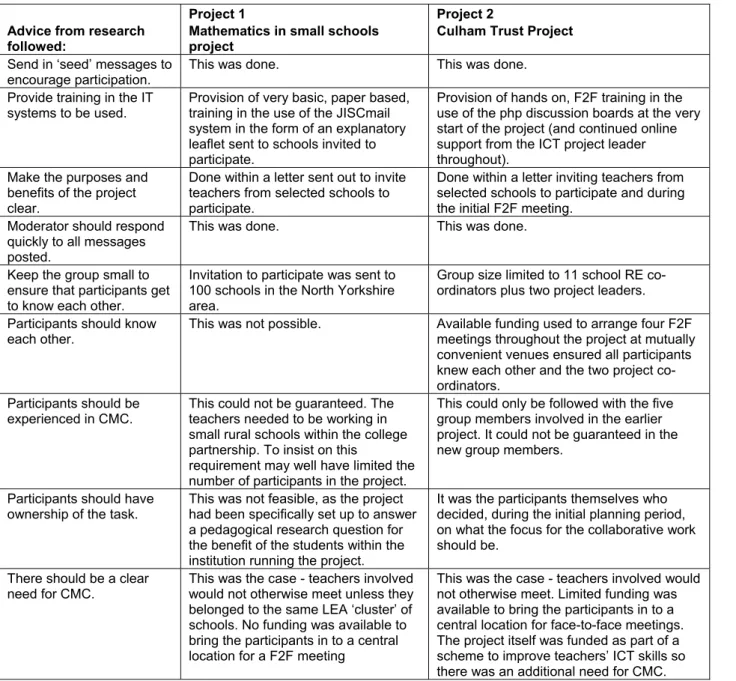
In order to make the comparison of the two projects easier, the advice arising from research has been tabulated in table 1 below.
Table 1: Advice from research followed when setting up the projects.
Advice from research followed:
Project 1
Mathematics in small schools project
Project 2
Culham Trust Project
Send in ‘seed’ messages to encourage participation.
This was done. This was done. Provide training in the IT
systems to be used.
Provision of very basic, paper based, training in the use of the JISCmail system in the form of an explanatory leaflet sent to schools invited to participate.
Provision of hands on, F2F training in the use of the php discussion boards at the very start of the project (and continued online support from the ICT project leader throughout).
Make the purposes and benefits of the project clear.
Done within a letter sent out to invite teachers from selected schools to participate.
Done within a letter inviting teachers from selected schools to participate and during the initial F2F meeting.
Moderator should respond quickly to all messages posted.
This was done. This was done.
Keep the group small to ensure that participants get to know each other.
Invitation to participate was sent to 100 schools in the North Yorkshire area.
Group size limited to 11 school RE co-ordinators plus two project leaders. Participants should know
each other.
This was not possible. Available funding used to arrange four F2F meetings throughout the project at mutually convenient venues ensured all participants knew each other and the two project co-ordinators.
Participants should be experienced in CMC.
This could not be guaranteed. The teachers needed to be working in small rural schools within the college partnership. To insist on this
requirement may well have limited the number of participants in the project.
This could only be followed with the five group members involved in the earlier project. It could not be guaranteed in the new group members.
Participants should have ownership of the task.
This was not feasible, as the project had been specifically set up to answer a pedagogical research question for the benefit of the students within the institution running the project.
It was the participants themselves who decided, during the initial planning period, on what the focus for the collaborative work should be.
There should be a clear need for CMC.
This was the case - teachers involved would not otherwise meet unless they belonged to the same LEA ‘cluster’ of schools. No funding was available to bring the participants in to a central location for a F2F meeting
This was the case - teachers involved would not otherwise meet. Limited funding was available to bring the participants in to a central location for face-to-face meetings. The project itself was funded as part of a scheme to improve teachers’ ICT skills so there was an additional need for CMC.
Table 2: Comparison of the two projects against the success criteria
Success criteria
Project 1
Mathematics in small schools project
Project 2
Culham Trust Project
Number of active participants
The response to the initial invitation to participate was poor, with only 3 colleagues asking to join the forum by the end of January 2002. A second mail-shot was sent out to the same schools in February 2002 in an attempt to boost both the membership and discussion participation. This had limited success – a further 2 colleagues requested to join the list giving a total of 5 in all.
All of the teachers contacted by the project leaders agreed to participate. These consisted of a core group of five RE subject leaders from a previous project and six new members giving an overall group size of 11 excluding the two project leaders.
Number of postings
Those that did agree to participate engaged minimally. None sent in any response to the initial discussion suggestions within the welcome message.
A second prompt eventually initiated posting of two messages by two participants. It is important to note that both messages were sent directly to the moderator not to the board which meant that
530 postings were made about 119 topics by all involved. About one third of these were from moderators but this left a sizable number of messages posted by participants, seven of who were particularly prolific posting well over 20 messages each (one or two over three times that many). The other participants took a lesser part, posting fewer than 10 messages.
Ros Evansand Eileen Bellett
www.ejel.org 123 ISSN 1479-4403
Success criteria
Project 1
Mathematics in small schools project
Project 2
Culham Trust Project
they then had to be posted under the moderator’s name.
Number of prompts needed
An initial prompt was sent to the original members of the list asking them for some thoughts on the discussion issues at the time of the second mail shot (February 2002).
Two weeks later a second prompt had to be sent out as there was still no activity on the forum.
The discussions maintained their own
momentum with very few gentle reminders from moderators.
End result The outcome of the project was a very limited number of single postings briefly outlining how the teachers involved ran their daily mathematics lessons. There was no further interaction after the moderator answered each post.
During the first two phases there was evidence of some innovative practice and a developing ability, on the part of participants, to engage in increasingly analytical and reflective self-evaluation, using the discussion board to promote professional interchange and enhance professional development.
Postings (and the end of project evaluation) evidenced an increasing confidence in planning work in RE with ICT as an integral part of the planning process. Teachers were able to provide training support for each other in the use of power point, interactive white boards and digital photography.
Learning materials were then launched as web based materials through an ITT provider’s RE centre web site and, where possible, linked to other appropriate sites.
See also the outcomes of the evaluation process listed separately below.
Some additional information is available from the outcomes of the evaluation of project two by participants where a questionnaire of open questions was distributed during the final F2F evaluation meeting (see appendix 1). Eight of the eleven participants were able to attend and complete the form. Responses to the questions often highlighted the benefits of using the discussion board and show just how useful this type of project can be when it is planned and implemented well. Comments, which exemplify this, included views such as:
̇ Liasing with other teachers using the forum was very beneficial (3*).
̇ It allowed me to share resources (1), work with colleagues who share a passion for RE (1), are more knowledgeable (1) and were able to increase awareness of RE websites (1).
̇ Dialogue and interaction with other participants and the project leaders was helpful and encouraging (5).
̇ Reading others’ lesson evaluations on the forum allowed me to amend my own plans (2).
̇ Being accountable to other colleagues made me persevere (1).
* Numbers in brackets indicate the numbers of respondents voicing this opinion.
5. Analysis of the results
With regard to following advice from research figure 1 shows that the two projects had some common ground. However, in spite of this the outcomes, listed in figure 2, were very different and by looking at the differences, rather than the similarities lessons can be learned. There were three main areas where the two projects differed a good deal; these were to do with the inclusion of F2F sessions, the provision of IT support and establishing ownership of the project. Each of these will now be looked at in turn.
5.1 Inclusion of F2F sessions
It appears that the introduction of some F2F sessions may well have had the big impact on the success of the ‘Culham Trust’ project. Through these the participants were able to meet the two project leaders and get to know them on a personal level. Both were the kinds of people who were very likeable, would instil confidence and motivate participants to become involved. Because of this any ‘seed messages’ were being sown to good effect, unlike the ‘Maths in Small Schools’ project where the project leader was unknown to the teachers and, therefore, likely to be of little importance to those being invited to participate. Here the ‘seed’ messages were of little use in encouraging participation. Likewise any responses to postings by the moderator did
little to encourage further debate, unlike similar responses within the ‘Culham Trust’ project. The teachers involved in the ‘Culham Trust’ project enjoyed their days out of school, meeting colleagues and getting to know the project leaders well. This gave them motivation to make sure that the project succeeded, as they did not want to let their colleagues down. The postings on the forum tended to be very friendly and it was apparent that the participants were enjoying the experience. The two messages to the ‘Maths in Small Schools’ forum tended to be far more formal and definite ‘one offs’. There was no cause for them to be otherwise; although the number of eventual participants was half that of the ‘Culham Trust’ project there was no way that the teachers could get to know who else was involved and this could well have affected their level of participation. This echoes Vonderwell’s findings (2003) mentioned earlier.
5.2 Provision of IT support
The F2F training session which allowed participants to register for and find out how to use the discussion board contributed to the success of the ‘Culham Trust’ project as only one reported having difficulties with this. The session also allowed the original project members to share their expertise and personal experiences of online communication much more meaningfully with newer participants. Once participants were aware of who they could ask when they ran into problems a mutual support system developed naturally. This type of mutual support was not available in the ‘Maths in Small Schools’ project as the participants did not know each other at all. The paper-based information leaflets, although simple and explicit, did not appear to be sufficient to help teachers overcome their difficulties in the ‘Maths in Small Schools’ project as evidenced in their emailing the postings directly to the moderator. According to OfSTED (2004) the training provided for teachers by the Government funded programme in recent years (New Opportunities Fund training in the use of ICT for teaching and learning) has been variable and it could well be that those invited to participate in the ‘Maths in Small Schools’ project were lacking in ICT skills. Although paper based information leaflets are useful as ‘aide memoirs’ once someone is conversant with a system, they are not sufficient to provide the support needed to get started.
5.3 Establishing ownership of the project
This was the second area where the two projects differed completely. In the ‘Culham Trust’ project it was the participants themselves who decided what the project should involve. This was a
deliberate decision by the project leaders as not having a sense of ownership of the task was something that had caused the initial ‘Culham Trust’ project to be less than successful. Previously the project leaders had imposed materials. The reason for this was that project leaders had identified reluctance within undergraduate students to criticise the work of peers online, something also found by Light and Light (1999 cited in Williams (2000)). They thought that if the participants were given material to critique then they would be more likely to do so as they were not commenting on their colleagues’ ideas. However, evaluation of the first project had shown them that, unlike students, the teachers would have preferred to have had ownership of the materials, and would have been willing to be constructively critical so, for this second project the leaders made sure that this was the case. Task ownership within the ‘Culham Trust’ project meant that all participants ended the project with a set of useful resources, relevant and specific to their context, which could be utilised in future years. In the ‘Maths in Small Schools’ project this was not the case. The project leader decided on the purpose of the discussions i.e. to be able to gather advice for students on placement and the few short messages that were posted were unlikely to have added much to the knowledge of maths planning of the participants. The benefits to the teachers were few – namely that the students who might eventually arrive in their particular classrooms would be better prepared for their teaching placements. This was rather too long term and not necessarily seen as important, after all some on the spot advice could be given as it was needed.
In addition to the above, the ‘Culham Trust’ project participants were working to a tight timescale in order to produce the materials in time for a particular religious festival and were taking part in something, which was immediately relevant, as it would help them in their planning. In the ‘Maths in Small Schools’ project, although the aim of the project was made clear and the advantages of having better informed students on placements in the schools highlighted, there were no deadlines and participation was probably seen as a nuisance – something over and above what would normally have to be done.
6. Conclusion
Whilst much of the advice given by previous research has been followed in both of the projects discussed it would appear that there are some ‘necessary ingredients’ for the successful establishment of online learning communities.
Ros Evansand Eileen Bellett
www.ejel.org 125 ISSN 1479-4403
The real key to success appears in F2F meetings, which allow the participants to get to know each other on a personal level. Whilst other online communities within the teaching profession (the Times Educational Supplement forums being a prime example) may well function successfully without this it has certainly helped in the ‘Culham Trust’ project. The group gelled from the start and felt a sense of obligation to each other and to the project leaders. These meetings also allowed a good level of initial ‘hands on’ training to be given from which the benefits were reaped throughout the project. The provision of high quality support in the areas being developed would also seem to be an important issue. In the ‘Culham Trust’ project the two project leaders were accessible experts in RE and ICT and were able to give a great deal of advice. More experienced colleagues within the group were also able to provide support. In the ‘Maths in Small Schools’ project the leader was not an expert in the implementation of the NNS in small rural schools. This was made clear in the initial letter. The aim was simply to facilitate communication on the participants’ and students’ behalf.
Ensuring that the project arises from the participants themselves and is of real practical benefit to them is a third important aspect. The ‘Culham Trust’ project not only aimed to help participants in their normal RE planning process but also to improve their ICT skills. It was clearly worth getting involved. In contrast, the ‘Maths in Small Schools’ project was less enticingas it was
not providing any immediate benefits to participants. The first two of these ‘ingredients’ do not come cheap so a reasonably substantial budget could also be said to be necessary. Access to funding to pay for meeting venues, lunches, travel costs, supply cover, administration costs and the time of the project leaders enabled the ‘Culham Trust’ project to gain the benefits of F2F meetings, the ‘Maths in Small Schools’ project only had sufficient funding to cover administration costs and time out of teaching for the project leader so was at a disadvantage from the start. It is hoped that the sharing of the outcomes of these projects can add to the body of knowledge other prospective e-learning community project leaders can draw on when designing online communication systems. Having enthusiasm for the project is important but if full-time practising teachers are to be encouraged to participate then good design and financial support is vital if the venture is to succeed within a profession where time is a precious commodity.
7. Acknowledgements
The authors would like to acknowledge the teachers involved in the ‘Culham Trust’ project for agreeing to give up time to participate in this venture and the Culham Trustees for their funding support. They would also like to give special thanks to the late Dave Evans whose understanding of technology and how people collaborate online ensured the success of the ‘Culham Trust’ project.
References
Annison, J. (2002) “Action Research: Reviewing the Implementation of a Distance Learning Degree Programme Utilising Communication and Information Technologies”, Innovations in Education and Teaching International 39, 2 pp95 – 105
Clouder, L. & Deepwell, F. (2004) “Reflections on Unexpected Outcomes: Learning From Student Collaboration in an Online Discussion Forum?” Paper presented to the Networked Learning 2004 Conference pp 429-435
Cramphorn, C. (2004) “An Evaluation of Formal and Underlying Factors Influencing Student Participation within E-Learning Web Discussion Forums ?” Paper presented to the Networked Learning 2004 Conference p. 417-423 Insung Jung, Seonghee Choi, Cheolil Lim and Junghoon Leem (2002) “Effects of different types of interaction on
learning achievement, satisfaction and participation in web-based instruction”, Innovations in Education and Teaching International 39, 2 pp153 – 162
DfES (2003) Excellence and Enjoyment [online]
http://www.standards.dfes.gov.uk/primary/publications/literacy/63553/pns_excell_enjoy_037703v2.pdf (accessed 25/11/05)
Evans, R. (2001) “Implementing the NNS in Small Rural Schools”
,
Mathematics Education Review 13 pp55-74. Latch C, D. and Zimring, C (2000) “Supporting Collaborative Design Groups as Design Communities” [online]http://coweb.cc.gatech.edu:8888/csl/uploads/des_studies.1.pdf (accessed 12/3/06)
McConnell, D. (2000) Implementing Computer Supported Cooperative Learning Kogan Page: London Moore, M.G. & Kearsley, G. (1996) Distance Education: a systems view Belmont, CA Wadsworth OfSTED (2004) ICT in schools – the impact of government initiatives: Primary schools HMI Salmon, G. (2000) E-moderating: The Key to Teaching and Learning Online Kogan Page: London Salmon, G. (2002) etivities: The Key to Active Online Learning KoganPage: London
Sutherland, R. (2005) “Teachers are wary about using IT in the classroom”, Bristol UniversityNews Archive, 13th September 2005 [online] http://www.bris.ac.uk/news/2005/794 (accessed 19/10/05)
[online] http://www.techsoup.org/learningcenter/webbuilding/page5106.cfm (accessed 16/10/06) The Open University (2002) Supporting Open Learners: Reader OUP
Tolmie, A. and Boyle, J. (2000) “Factors influencing the success of computer mediated communication (CMC) environments in university teaching: A review and case study”, Computers and Education 34 pp.119-140
Vonderwell, S. (2003) “An examination of asynchronous communication experiences and perspectives of students in an online course: a case study”, Internet and Higher Education6 pp.77–90
Vrasidas, C. & McIsaac, M. S. (1999) “Factors influencing interaction in an online course”, The American Journal of Distance education 13 (3) pp22 –36
Wegerif, R. (1998) “The social dimension of asynchronous learning networks”, Journal of Asynchronous Learning Networks, 2 (1) [online]
http://www.aln.org/alnweb/journal/vol2_issue1/wegerif.htm(accessed 21/12/04)
Williams, C. (2000) “Learning on-line: a review of recent literature in a rapidly expanding field”, Journal of Further and Higher Education, 26 (3) pp263-272.
Appendix 1
The ‘Culham Trust’ Project Evaluation Questionnaire
a) From the point of view of RE, what did you do during the course of the project b) that you wouldn’t have done had you not been involved?
c) What parts were successful and which were not?
d) From the point of view of ICT what did you do during the course of the project? e) that you wouldn’t have done had you not been involved?
f) What parts were successful and which were not?
g) What have you done since the Easter period as a result of being involved in the h) project?
i) What plans do you have for the future arising out of your involvement in the project? j) Is your confidence in RE teaching diminished/ the same / increased as a result of k) being involved? In what ways?
l) Is your confidence in your use of ICT diminished/ the same / increased as a result of being involved? In what ways?
ISSN 1479-4403 127 ©Academic Conferences Ltd Reference this paper as:
Graff M(2006) “The Importance of Online Community in Student Academic Performance” The Electronic Journal of e-Learning Volume 4 Issue 2, pp 127 - 132, available online at www.ejel.org
The Importance of Online Community in Student Academic
Performance
Martin Graff
Department of Psychology and Education, University of Glamorgan. UK
[email protected]
Abstract: This study sought to investigate four separate issues regarding student performance in a blended learning environment in the delivery of a Psychology course to 140 University undergraduates. Firstly, to investigate the relationship between student performance on three different coursework assignments and their performance on interim online assessments. Secondly, to investigate the relationship between student performance on coursework assignments and their perceptions of online community. Thirdly, to investigate the relationship between students’ online community scores and their engagement with an online assessment. Finally, to look at the relationship between students’ cognitive information processing style and coursework performance. The findings revealed that student coursework performance was positively related to their engagement with the online assessments. Furthermore, student online community scores were related to their coursework performance as was cognitive style. The results are discussed in terms of a consideration of these three factors in course design within a blended learning framework.
Keywords: Community, cognitive style, interim assessment
1. Introduction
The initial rationale underpinning the use of an interim online assessment system is to monitor and identify, early on in a course, those students who appear to not understand the course material. The most expedient way to achieve this is through the use of online multiple-choice tests (MCQs). Students obtaining low scores here can then be offered additional help and instruction. Furthermore, such a system could also be useful as a way of identifying students who are failing to attend classes, or students who are attending classes less regularly than other students.
One further possible reason for student success or failure on a particular course is the degree to which these students engage with that course and with the other students on the course. This sense of engagement between learners is referred to as sense of classroom community. Rovai (2002) offers an explanation of sense of classroom community as being mutual interdependence and a sense of trust and interaction among community members. This means that the members of the community have shared goals and values. Online community needs to be thought of in terms of the activities people perform together in their group and not physically where they perform such activities. There are four components of classroom community outlined by Rovai (2001) and these are described as follows. Firstly, ‘spirit’ which is the feeling of belonging to and acceptance of a group identity. This refers to the recognition of membership of a community and the feelings of cohesion that develop amongst learners in a group as a result of this. Secondly, ‘trust’ is simply the feeling that the group can be trusted and the group members will give feedback
to each other. Once this is established, members of the group or community can speak with confidence to other members of the group. Thirdly, ‘interaction’ is the feeling that community members have that they may benefit by interacting with other members of the community. Finally, ‘learning’ is the sense that community members have that learning can come about due to the community discussing information, that is, the community can construct knowledge. In a typical online environment group members may engage in interactive behaviour such as discussion, exchange of ideas and seeking advice.
1.1 Community
There is a body of evidence that would argue in favour of the importance of a sense of community in learning. For example, Wang (2001) argues that community can also result from shared knowledge among learners in an online environment, and the evidence suggests that interaction between learners in online courses could be of great importance to learner success (e.g. Shale and Garrison, 1990). Indeed, Citera (1998), suggests that online discussions encourage more reticent individuals to participate to a greater extent, while Warschauer (1997) advocates interaction in online environments, where there is less opportunity for intimidation between individuals and, in asynchronous settings, less time pressure than in face-to-face interactions. However, the lack of a sense of close interaction between learners in an online environment may have adverse consequences, which may be because learners experience feelings of isolation. Haythornthwaite, Kazmer, Robbins and Shoemaker (2000), suggested that