Int. J. Food System Dynamics 9 (5), 2018, 409-418
DOI: http://dx.doi.org/10.18461/ijfsd.v9i5.953System Dynamics Modelling and System Analysis Applied in
Complex Research Projects - the Case of VALUMICS
Anna Hulda Olafsdottir, Ingunn Gudbrandsdottir, Harald U. Sverdrup,
Sigurdur G. Bogason, Gudrun Olafsdottir, and Gunnar Stefansson
Icelandic System Dynamic Centre, (ISDC), Faculty of Industrial Engineering, Mechanical Engineering and Computer Science, University of Iceland, VR-II, Hjardarhagi 6, IS-107 Reykjavik, Iceland
[email protected]; [email protected]; [email protected]; [email protected]; [email protected]; [email protected] Received March 2018, accepted September 2018, available online October 2018
ABSTRACT
VALUMICS is a Horizon 2020 project funded by the European Commission (2017-2021). The project structure is highly integrated and transdisciplinary, building on the expertise of over 30 specialists in various fields of research including knowledge integration through systems analysis and system dynamics modelling, food science, supply chain management, life cycle assessment, logistics, economics and social science. The aim of the project is to analyze the dynamics of food supply- and value chain systems using a structural analysis including system analysis and perform system simulations using system dynamics. The VALUMICS research approach and the project design are explained and it is justified why system analysis is needed to obtain an understanding of the complex connections and interactions of the distinct parts of food systems. Patterns will be recognized and thus causes and effects of complex relations within the selected food supply system and networks will be identified. This understanding of the functioning of the system can in turn be used to identify policy interventions.
Keywords: food system network, value chains, supply chains, dynamic modelling, system dynamics
1
Introduction
In this paper we describe how the VALUMICS project group approaches the analysis of food system dynamics based on an innovative theoretical basis. The project is driven by iterative group model building sessions, thus drawing on the transdisciplinary expertise of the project partners and other stakeholders. The aim is to put more focus than traditionally on the conceptualization phase of the model building to ensure the relevance of the model for the issues to be addressed. We believe that the approach presented can add value to further development within the food system dynamics modelling domain. Contemporary food supply chains tend to be complex, include many stakeholders, and stretch across countries or even continents (Hearnshaw and Wilson, 2013; Utomo et al., 2018). In addition to producers and final consumers, stakeholders such as governments, monitoring and control organizations, insurance companies, financial institutes, and various service providers, to name some, are involved in the food supply chain (Grimm et al., 2014). Descriptions and analysis of supply chains have often a somewhat limited scope of single upstream or downstream processes. This includes flows of materials such as raw materials, components or finished goods, and information flow in addition to financial flow between stakeholders.
Typical units of analysis are efficiency and economic performance, time aspects of processes, quality of products, environmental impacts together with societal impacts of each undertaken supply chain (Schoenfuss and Lillemo, 2014).
Commonly, only one or maybe two of the above units of analysis are being embraced in many research designs, often due to the complexity resulting from involving more units or simply due to time or financial constraints. Hence, the output of such research tends to be an analysis of simplified supply chains missing many of the important interactions between important components and stakeholders of the system being analyzed. This simplification may also be necessary due to the fact that the analytical frameworks and tools being applied cannot consider too many or too complex relations as is the fact with many simulation tools and visualizations tools available and used by researchers (Trienekens et al., 2012).
System analysis (SA) and system dynamics (SD) focus on understanding the nonlinear and dynamic behavior of complex systems through stocks and flows, feedback loops and time delays, and are therefore valuable tools when studying complex supply chains or networks. Dynamic relationships of supply-, value- and decision chains can be explained by introducing market dynamics and the laws of supply and demand as previously reported for system dynamics models of commodity productions cycles (Meadows, 1971). Sterman (2000) further demonstrated the usefulness of system dynamics modelling for studying changes over time in complex supply systems with the aim to build both the understanding of complexity needed to find effective policies and the confidence to use that understanding to take action. Several system dynamics studies have focused on food supply chains (Georgiadis, Vlachos, and Iakovou, 2005), non-perishable products (Kumar and Nigmatullin, 2011), and the dynamics of agricultural systems (Conrad, 2004). Minegishi and Thiel (2000) used system dynamics modeling and simulation to improve the knowledge of the complex logistic behavior of an integrated food industry. Stave and Kopainsky (2015) used system dynamics to frame questions about food system vulnerability in industrialized food systems and defined food system resilience as the ability of the food system to withstand disturbances that could lead to disruption of the food supply. Furthermore, a systemic analysis of food supply and distribution systems in the context of city-region systems provided insights to policy interventions to motivate transition to resilient agri-food systems (Armendariz, Armenia and Atzoru, 2016). In recent research on metal commodities in the field of natural resources, system dynamics models have been developed that incorporate economic factors, market dynamics and decision chains, into integrated models of supply systems (H. Sverdrup, 2016; H. Sverdrup and Ragnarsdottir, 2016; H. U. Sverdrup, Ragnarsdottir, and Koca, 2017). The Valumics research builds on the research efforts mentioned above. We draw on earlier work on supply chain modeling using system dynamics, with a specific focus on those that incorporate market dynamics and decision linkage between physical and monetary flows (Meadows, 1971; Conrad, 2004; H. Sverdrup, 2016; H. Sverdrup and Ragnarsdottir, 2016; H. U. Sverdrup et al., 2017).
From the early start of designing the VALUMICS project, the ambition was to go beyond traditional research design and try to understand and describe the complexity of contemporary food supply chains and value chains. Henceforth, a methodology applying system analysis and system dynamics was selected to further understand these complex chains and generate models that can be used to analyse and visualise the causal links in the system and the effect of changing one or more factors, such as market price, lead times, availability or scarcity, etc. The benefits of such an approach are miscellaneous as various issues can be addressed, such as how to increase resilience of the undertaken supply chain, how integrity can be increased as many modern consumers insist on knowing more about the products such as their origin (David et al., 2017), the manufacturer and the exact ingredients (Lemke and Luzio, 2014). Furthermore, despite positive advances in public health and quality of life, modern lifestyles can have negative and unsustainable aspects, particularly in relation to overproduction and overconsumption (Backhaus et al., 2011). Additionally, food production has large environmental impacts where e.g. meat and dairy consumption account for almost one quarter of all final consumption impacts – by far the largest share in the food and drink sector (Weidema et al. 2008). Supply-side efficiencies are essential to mitigate these impacts, but will not be enough without addressing the consumption behaviors and lifestyle patterns that lie at their source (see e.g. UNEP, 2015; Ranganathan, 2016). This implies that the interpretation of sustainability, social responsibility, integrity and resilience has to be considered within the food sector, in a way that is relevant and meaningful. The VALUMICS system dynamics team has experience of working with long term sustainability of food supply systems in many variations (Haraldsson 2004, Sverdrup and Svensson, 2004, Haraldsson and Sverdrup, 2005, Öborn et al., 2005, Modin-Edman et al., 2007, Missimer et al., 2010, Sverdrup et al., 2017a,b), and environmental life cycle assessment of food products (Ramos et al., 2015).
Recently, FAO published a report where the definition of sustainable Food Value Chain is presented as: “the full range of farms and firms and their successive coordinated value-adding activities that produce particular raw agricultural materials and transform them into particular products that are sold to final
consumers and disposed of after use, in a manner that is profitable throughout, has broad-based benefits
for society and does not permanently deplete natural resources”
In the quotation, the definition of the “full range of farms and firms” refers to both value chain actors who take direct ownership of the product, and various business service providers (e.g. banks, transporters, extension agents, input dealers and processors who charge a fee) (FAO, 2014). From the FAO report, the complex framework described in the literature has been drawn up into a systems presentation that the VALUMICS project will adapt as a useful concept for developing the project’s approach. Further to this, the following definitions influence the work:
The food value chain is comprised of the stages of the path of the food products starting with inputs, primary production, manufacturing, logistics and transportation, grocery and retail sectors until consumers. Further, consumers generate waste which can be partially recycled, closing the loop. The viewpoint of economic value addition is emphasised.
Food system comprises the food value chains/networks and in addition, waste management and all the supporting and interacting activities such as administration and policies (governance), education and research, financing activities etc. The food system can be viewed as a social-ecological system.
This background confirms the need to employ dynamic systems analysis to capture within the food systems under study both value chain complexities and the supply chain system and decision structures to progress from the current state of art. System analysis involves identifying the components of a system, building a mental model of how they relate to one another and presenting it as a causal loop diagram (CLD) (Sterman 2000). Once a mental model has been constructed, the dynamics of the system can be recreated using mathematical simulation models. Such models can then be used to explain past behavior of the system and predict and influence future outcomes.
2
Methods
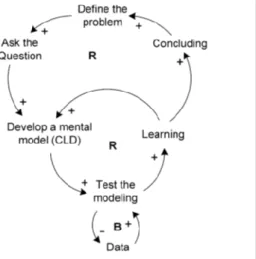
For any modelling, three basic steps are required for the modelling to be successful. These are illustrated as follows from Figure 1. In VALUMICS project the system thinking methodology, carried out through iterations of the learning loop, is the key driver of the project and its application is essential for successful execution and for meeting its ambitious goals (Figure 2).
Figure 1. The formal steps of any modelling
Figure 2.The learning loop (R=reinforcing loop; B= balancing loop)
In the VALUMICS project the benefits of system thinking are exploited to the fullest extent. This includes the inherent learning mechanism of the CLD building process which is described as the learning loop (Figure 2). Building a CLD involves identifying, sorting and drawing the relevant variables into a CLD. The CLD is the foundation on which a mathematical simulation model is built. The model is tested using actual
historical data and conclusions made based on the current knowledge and understanding. New insights can then be developed based on these conclusions which calls for a redefinition of the problem and the question starting a new iteration of the learning loop
The initial mapping of food systems is driven by a combination of the project’s internal and external stakeholder workshops, where the transdisciplinary expertise of the various participants is used to analyze the system in terms of its causal relationships and feedback structure. All of the consortium members will initially attend the workshops to provide expert input. They have broad and in-depth experience from earlier projects with various food systems and scientific merits to analyze gaps and develop further the additional relevant research questions needed to ensure the scientific and innovative approach of the VALUMICS activities during all phases of work.
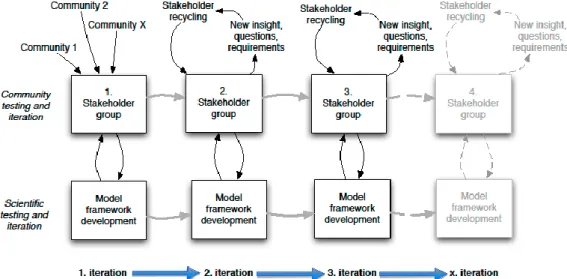
Figure 3. Workshop format used in VALUMICS. The work alternaties between model framework and system dynamics development and workshops with stakeholder, being a broad collection of stakeholders or a narrow collection of concerned
scientists working in the project.
Furthermore, external stakeholders will be involved in the workshops to provide specific inputs to ensure the relevance of the approaches and provide complementary expertise and background information linked to case studies. After each workshop, new insights and questions are formed and addressed which adds to the overall understanding. Figure 3 demonstrates the dynamics and iterative nature of the project approach reflecting the learning loop process. The VALUMICS systems method is successfully tested in earlier projects in Scandinavia like the large Swedish Research programmes SUFOR I+II, ASTA I+II or Food21 I+II, and in EU Research Projects like CONVERGE (2013).
3
Results
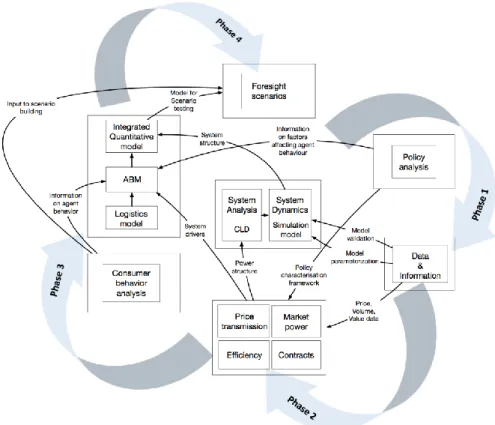
The VALUMICS project will implement a holistic approach and causality based system framework, supported by new advances in theory, modelling and data gathering, which is required to capture and understand the dynamics and interactions in food systems from providers of farm inputs to consumers, including the waste managers and policy makers. The overall objective of the VALUMICS project is to provide decision makers throughout food value chains with a comprehensive suite of approaches and tools that will enable them to evaluate the impact of strategic and operational policies to enhance the resilience, integrity and sustainability of food value chains for European countries. This overall objective is divided into specific aims, which are associated with the four operational phases of the project where key activities have been defined (see Figure 4).
Figure 4.Conceptual diagram of the VALUMICS model building, showing the four project phases, and the flow of information and analysis across the project (ABM: agent based modelling; CLD: causal loop diagrams
)
Phase 1: Development phase – Fundamental groundwork:1. Develop approaches and tools to analyse the structure, dynamics, resilience and impact of food chains on food security, economic development and the environment:
Develop an overarching causality based conceptual model framework to analyse the structure, dynamics and governance of selected food value chains,
Prioritise relevant key indicators/determinants and metrics based on their capacity to explain influences on resilience, and impacts on governance, food security and sustainable development, including economic, environmental and social dimensions,
Apply specific tools to analyse quantitatively and qualitatively the functioning of food value chains and assess their impact.
Phase 2: Integration phase – Case studies, data gathering, primary and secondary analysis
2. Analyse further the suitability of selected indicators to capture the evolution of resilience, the sustainability and the integrity of a set of major food value chains across Europe, and their transformative capacity:
Explore relationships, value and risk distribution, power asymmetries including perceptions of fairness and information exchange along food chains and examples of best practice in actor relationships leading to greater equity,
Map dynamics of material and energy flows, environmental impacts, cost structures and price transmission,
Assess collaborative governance forms and consumer relations, drawing on innovative good practice. Phase 3: Exploration phase – Integrated quantitative model leading to future studies
3. Develop an integrated modelling approach and use for the analysis of external and internal drivers influencing the performance of food value chains and demonstrate options for improved business strategies. Explore also the impact of public regulations (quotas, subsidies, public procurement policies etc.) and private initiatives (certification, Corporate Social Responsibility, marketing, retailer standards, fair trade etc.), which have shaped these food chains to assess the conditions under which these interventions enhance or not resilience, integrity and sustainability.
Phase 4: Policy and use phase – Fit for purpose tests and scenarios
4. Build foresight scenarios to reflect on the possible evolution of those food chains and on the kind of public, private and civil society instruments that would enable enhancing their desirable outcomes or counteract their negative impacts.
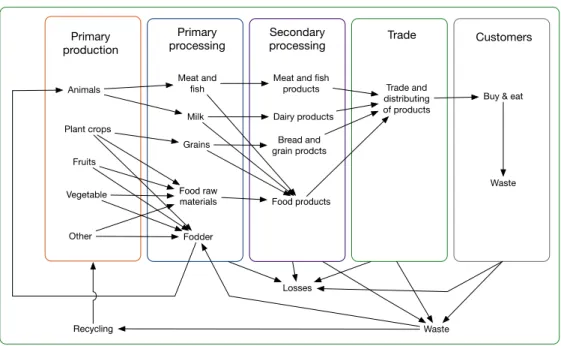
Figure 5. The case studies will grasp larger or smaller parts of the value chains and combine many aspects at systems level, and cover specific food product cases interactions, and governance systems.
Drivers that influence chains' sustainability performance will be analysed and mapping performed of a wide range of value chains. The selected chains will cover various sectors and represent short and local food chains in regions across Europe as well as global chains, to give a thorough insight in upstream and downstream chain flows and interactions between chains (examples in Figure 5).
The work on the case studies are designed around the modelling process. To ensure adherence to the systematic approach the case studies are implemented using common guidelines. The case studies are selected based on their potential to support the goals of the VALUMICS project to explore resilience, sustainability and integrity of food supply chains and systems. The case study process is divided into the following five steps:
1. Problem articulation involves describing the food systems to be addressed, including e.g product functional unit, spatial scale, temporal scale, key mechanisms and transformations inside the system, system boundaries and timeframes and identification of key stakeholders in the systems. Goals are defined and problems to be addressed identified based on historical behavior and potential future behavior
2. System conceptualization starts with mapping product flow using EPC (Event-based Process Chains) (Davis and Brabänder, 2007) methodology. The EPC will be used to integrate key value chain indicators including product, process and sustainability data. Each key indicator will be linked to a specific supply chain resource and event (e.g. raw material acquisition, processing, transport, storage, distribution, etc.). Then the system is mapped using CLD‘s and flow charts where the mapping is based on the idea of an integrated supply-, value- and decision chain and include the flow of physical food products, money and the decision linkage. The information on causal relationships and flow are based on information gathered in the EPC model, literature review and interviews with stakeholders. The drivers of change in terms of the problematic system behavior (e.g. resilience, sustainability, integrity issues) will be identified. The data is identified for the simulation model (for parametrization and validation). This is sorted into data for starting conditions, boundary conditions, parameter settings for different processes and mechnisms, and data on system state. The system states are not used to initialize the model, but rather to evaluate the performance of the model and identify scenarios for testing and potential policy implementations
3. Simulation model formulation is based on collecting the relevant data and formulate simulation (system dynamics) model based on the CLD created in the case studies. The model is built using a simulation program, e.g. Stella (isee systems, 2018), and the model parameterized using the data collected (e.g. price and demand curves).
4. Model evaluation includes checking if the model can reproduce the historical behavior using part of
the data collected and sensitivity analysis
5. Model implementation will focus on testing scenarios identified for policy implementations with relevance to resilience, sustainability and integrity of food supply chains and systems.
In addition to the central dynamic analysis modelling, VALUMICS will compare this output with several traditionally used modelling methods, e.g., for econometric analysis, to validate advances made in new theories in dynamic quantitative modelling. Stakeholders will be consulted at appropriate points in the work, both to involve them in co-creation activities, and to prime them for take up of information disseminated and communicated by the project. The systems will be tested for sustainability in all aspects, in terms of physical sustainability and resilience, economic sustainability and stability and in terms of social sustainability. Social sustainability represents challenges, but can in no serious integrated assessment study be omitted (Sverdrup and Svensson, 2004; Missimer et al., 2010). Validating the model outputs on historical data is important to do when this is possible. If the model is capable of reconstruction the observed history, then we have a very strong case for getting useful predictions about the future. If the model turns out to not be able to reconstruct the past sufficiently well, then the model will lack explanatory power and should not be used for future planning or policy development.
4
Discussion
One of the benefits of mapping the system in a causality loop form from the beginning is that the data gathering will be much more efficient. As a result of the workshops only the data needed will be gathered. The work will collate existing information on the VALUMICS challenges, drawing on theory and literature, other projects, clusters, and existing information channels, and use these for:
Building a conceptual model on dynamics of food value chains and networks to capture their resilience, integrity, sustainability and efficiency, and further guide data collection and for quantitative modelling work.
Mapping food value chains to determine critical points where key indicators must be recorded, and confirm the indicators identified through stakeholder interactions, at the various nodes in the often complex value chains. This includes the value-adding activities of the various steps of the chain. The product at the beginning of the chain is transformed along the chain and becomes a different product. This increase in value leads to higher price. The increase in value is the result of the various steps of the chain that can be described as a flow of products with each step providing an added value to the product which ends with the consumer as a transformed product.
Establishing parameters (metrics) to identify and measure/quantify the structure, dynamics and governance in selected food value chains, including local vs. global drivers, networks for resilience (including adaptability and transformability), integrity, sustainability, efficiency, food security, taking into account economic, social and environmental impacts.
Analysis of the food supply-, value- and decision chains to include the primary production, processing, production of consumer products, trade with logistics, commercialization, consumption stages and the production of waste. These stages include six functions placed in a sequential order: farming inputs, farming/breeding, food processors, food manufacturing, services, and traders/retailers. Then consumer analysis will be added to provide a comprehensive perspective of the food chain functioning and dynamics.
From the analytical point of view, the proposed approach includes: i) main actors who operate in order to add value to the food they “produce” and then sell (farmers, processors, traders/retailers); ii) supplier actors who provide inputs and services such as farming inputs, food industry machinery and services; iii) consumers for their role as final recipients of the food chain outputs.
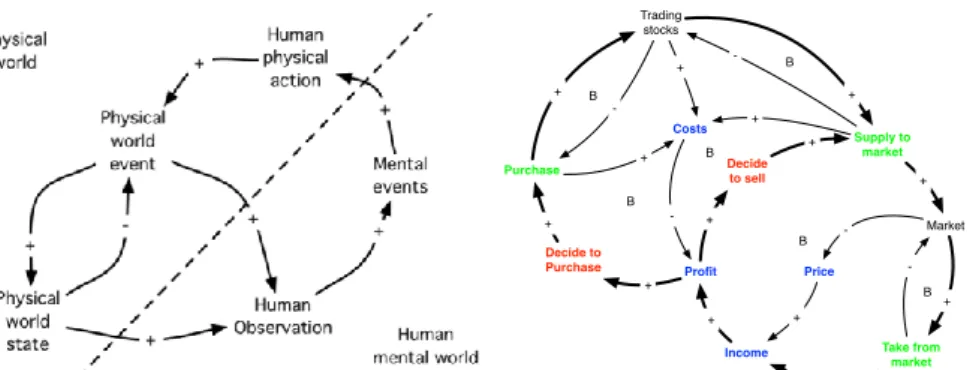
Figure 6. Integrating physical supply systems (black) and the value flows (Green), with decisions made that govern the system (Red). All have to be properly analyzed to constitute a proper system.
Many classical engineering approaches have an overemphasis on the physical parts with flows and stocks, and seem to forget or hide the human interaction (Haraldsson and Sverdrup 2005, see also Figure 6). The connections are often under the excuse that it is “too difficult” or “too uncertain”. Likewise, the economics of the system is done with statistical or linear approaches under similar excuses. If the human interaction or decisions are important or required for realistic representations, then such excuses are invalid. If the physical flows are not exactly represented by the economic flows, then the system representation will be flawed. We put emphasis on integrating physical supply systems and the value flows they create with the decisions made that govern the system in the VALUMICS project, in order to overcome such short-comings. All necessary and required components will have to be included and their interactions properly mapped and analyzed to constitute a proper system.
5
Conclusion
The system approach in the VALUMICS project is designed to obtain an understanding of the complex connections and interactions of the distinct parts of food systems. The project is currently in the conceptualization phase of the system dynamic modelling where flow diagrams and causal loop diagrams are being created to explore the behavior of the system. The work includes an in-depth analysis of economic, social and environmental indicators for selected food supply chains. The objective is to obtain parameters for the model validation and identify system drivers with the aim to operationalize the concepts of e.g. fairness, integrity, and resilience of food value chains. The vision is to develop an overarching integrated model to answer questions on e.g. fairness with respect to value distribution in the supply chain. It is foreseen that specific behaviors of the system will be captured by using a hybrid of system dynamic and agent-based models. The VALUMICS project will provide an understanding of the functioning of the food systems which in turn can then be used to identify policy interventions. This will be achieved by the following:
i. Model assessments through policy development of the physical, social and economic domains. Policy is developed in a recursive manner, where a policy proposal is always followed by an assessment of the outcome from that policy with respect to the goal, as well as being investigated for side effects and goal conflicts. The process will incorporate the conflicts, political contexts, and the power relationships and asymmetries, to provide optimal potential policy and governance recommendations based in real life value chain scenario.
ii. Mapping of advanced market mechanisms and causalities. An aggregated first draft of causality loop diagram to grasp those issues will be developed. Price transmission will be studied in selected food value and supply chains, which implies coupling such models along the chains and studying price transmission dynamics. The transmission of a price signal along a chain depends on transaction speeds, signal delays, supply chain delays, degree of transparency, extraction of costs and rents, and a number of other factors that needs to be explored and researched.
Acknowledgements
The VALUMICS project “Understanding Food Value Chain and Network Dynamics” has received funding from the European Union’s Horizon 2020 research and innovation programme under grant agreement No 727243, webpag www.valumics.eu.
References
Armendáriz, V., Armenia, S., and Atzori, A.S. (2016). Systemic Analysis of Food Supply and Distribution Systems in City-Region Systems—An Examination of FAO’s Policy Guidelines towards Sustainable Agri-Food Systems. Agriculture, 6 (4): 65. doi:10.3390/agriculture6040065
Backhaus, J. Backhaus, J., Breukers, S., Mont, O., Paukovic, M., and Mourik, R., (2011). Sustainable lifestyles: today’s facts and tomorrow’s trends. D1.1. Sustainable lifestyles baseline report. SPREAD Sustainable Lifestyles 2050 project, 2011. Available at: http://www.sustainable-lifestyles.eu/fileadmin/images/-content/D1.1_Baseline_Report.pdf
Conrad, S. H. (2004). The dynamics of agricultural commodities and their responses to disruptions of considerable magnitude. Paper presented at the Proceedings of the International Conference of the System Dynamics Society. Available at: https://www.systemdynamics.org/assets/conferences/2004/-SDS_2004/PAPERS/352CONRA.pdf
CONVERGE (2013). Rethinking Globalisation in the light of Contraction and CONVERGEnce. Project ID: 227030 CORDIS, FP7 Environment. Available at: https://cordis.europa.eu/project/rcn/92442_en.html
David C. W., Ashok, C. Wang,D. and Van Fleet, D. ( 2017). Food integrity : A market-based solution. British Food Journal, 119 (1): 7-19.
Davis, R., Brabänder, E. (2007). The Event-driven Process Chain ARIS Design Platform. Springer, London (pp. 105-125). London: Springer.
FAO (2014). Developing sustainable food value chains – Guiding principles. Rome; Accessed by Internet 15.01.2018.
Grimm J.H., Hofstetter J.S., and Sarkis J. (2014). Critical factors for sub-supplier management: A sustainable food supply chains perspective. International Journal of Production Economics, 152: 159-173
Georgiadis, P., Vlachos, D., and Iakovou, E. (2005). A system dynamics modeling framework for the strategic supply chain management of food chains. Journal of Food Engineering, 70(3): 351-364. doi:10.1016/j.jfoodeng.2004.06.030
Haraldsson, H. V. (2004). Introduction to systems thinking and causal loop diagrams. Technical report, Lund University, Department of Chemical Engineering. Reports in Ecology and Environmental Engineering, 1: 1– 49.
Haraldsson H. Sverdrup, H. (2005). On aspects of systems analysis and dynamics workflow. Proceedings of the systems dynamics society, July 17-21, 2005 International Conference on systems dynamics, Boston, United States of America. 1-10 pages. http://www.systemdynamics.org/conferences/2005/proceed/-papers/HARAL310.pdf
Hearnshaw E.J.S., Wilson M.M.J., (2013). A complex network approach to supply chain network theory.
International Journal of Operations and Production Management, 33 (4): 442-469.
Isee systems (2018). Stella professional. Retrieved from https://www.iseesystems.com/store/products/stella-professional.aspx
Kumar, S., Nigmatullin, A. (2011). A system dynamics analysis of food supply chains - Case study with non-perishable products. Simulation Modelling Practice and Theory, 19(10): 2151-2168. doi:10.1016/j.simpat.2011.06.006
Lemke, F., Luzio, J.P.P. (2014). Exploring Green Consumers’ Mind-Set Towards Green Product Design and Life Cycle Assessment: The Case of Sceptical Brazilian and Portuguese Green Consumers. Journal of Industrial Ecology, 18: 619-630.
Meadows, D. L. (1971). Dynamics of commodity production cycles. Dynamics of commodity production cycles. Wright-Allen Press, Cambridge, Mass, 104p
Minegishi, S., Thiel, D. (2000). System dynamics modeling and simulation of a particular food supply chain.
Simulation Practice and Theory, 8(5): 321-339. doi:10.1016/s0928-4869(00)00026-4
Missimer, M., Robert, K.-H., Broman, G., and Sverdrup, H. (2010). Exploring the possibility of a systematic and generic approach to social sustainability. Journal of Cleaner Production, 18:1107-1112
Modin-Edman, A.K., Öborn, I., and Sverdrup, H. (2007) FARMFLOW–A Dynamic Model for Phosphorus Mass Flow, Simulating Conventional and Organic Management of a Swedish Dairy Farm Agricultural Systems. Agricultural systems, 94:431-444.
Ramos, S., Larrinaga, L., Albinarrarte, U., Jungbluth, N., Doublet, G., Ingolfsdottir, G.M., Yngvadottir, E., Lanquist, B., Aronsson, A.K.S., Olafsdottir, G., Esturo, A., and Perez-Villareal, B., (2015). SENSE tool: Easy-to-use web-based tool to calculate food product environmental impact. Int. J. Life Cycle Assess. 21, (5), 710-721. https://doi.org/10.1007/s11367-015-0980-x Ranganathan, J. et al. (2016). Shifting Diets for a Sustainable Food Future. Creating a Sustainable Food Future, Installment Eleven. World Resources Institute, April 2016, Available at:
http://www.wri.org/sites/default/files/Shifting_Diets_-for_a_Sustainable_Food_Future_0.pdf.
Schoenfuss T.C., Lillemo J.H., (2014), Food safety and quality assurance S. Clark, S. Jung, B. Lasmal (Eds.), Food Processing: Principles and applications, Jon Wiley and Sons, Ltd: 233-247.
Stave, K. A., Kopainsky, B. (2015). A system dynamics approach for examining mechanisms and pathways of food supply vulnerability. Journal of Environmental Studies and Sciences, 5(3): 321-336. http://dx.doi.org/10.1007/s13412-015-0289-x
Sterman, J. (2000). Business Dynamics: Systems Thinking and Modeling for a Complex World: Irwin/McGraw-Hill.
Sverdrup, H. (2016). Modelling global extraction, supply, price and depletion of the extractable geological resources with the LITHIUM model. Resources, Conservation and Recycling, 114: 112-129. https://doi.org/10.1016/j.resconrec.2016.07.002
Sverdrup, H., Ragnarsdottir, K. V. (2016). A system dynamics model for platinum group metal supply, market price, depletion of extractable amounts, ore grade, recycling and stocks-in-use. Resources, Conservation and Recycling, 114: 130-152. https://doi.org/10.1016/j.resconrec.2016.07.011
Sverdrup, H. U., Ragnarsdottir, K. V., and Koca, D. (2017). Integrated Modelling of the Global Cobalt Extraction, Supply, Price and Depletion of Extractable Resources Using the WORLD6 Model. BioPhysical Economics and Resource Quality, 2(1): 4. doi:10.1007/s41247-017-0017-0
Sverdrup, H., Koca, D., and Ragnarsdottir K.V. (2017a). Defining a free market: Drivers of unsustainability as illustrated with an example of shrimp farming in the mangrove forest in South East Asia. Journal of Cleaner Production, 140: 299-311, DOI: 10.1016/j.jclepro.2015.06.087.
Sverdrup, H. U., Olafsdottir, A.H., and Ragnarsdottir, K.V., (2017b). Modelling Global Wolfram Mining, Secondary Extraction, Supply, Stocks-in-Society, Recycling, Market Price and Resources, Using the WORLD6 System Dynamics Model. Biophysical Economics and Resource Quality,3: 4-22. DOI 10.1007/s41247-017-0028-x.
Sverdrup, H., Svensson, M. (2004). Defining the concept of sustainability, a matter of systems analysis. In: M. Olsson; G. Sjöstedt (Eds.); Revealing Complex Structures -- Challenges for Swedish Systems Analysis: 122-142. Kluwer Academic Publishers.
Trienekens J.H., Wognum P.M., Beulens A.J.M, and van der Vorst J.G.A.J., (2012). Transparency in complex dynamic food supply chains. Advanced Engineering Informatics, 26 (1): 55-65.
UNEP (2015). Post 2015 Note #2: Sustainable Consumption and Production and the SDGs. Available at: https://www.cbd.int/financial/monterreytradetech/unep-scp.pdf.
Utomo, D.S., Onggo, B. S., and Eldridge, S. (2018). Applications of agent-based modelling and simulation in the agri-food supply chains. European Journal of Operational Research, 269: 794-805. https://doi.org/10.1016/j.ejor.2017.10.041
Weidema, B. P., Wesnæs, M., Hermansen, J., Kristensen, T. and Halberg, N. (2008). Environmental Improvement Potentials of Meat and Dairy Products, P. Eder and L. Delgado (Eds.), JRC/IPTS. DOI 10.2791/38863
Öborn, I., Modin-Edman, A. K., Bengtsson, H., Gustafson, G., Salomon, E., Nilsson, S. I., Holmqvist, J., Jonsson, S., and Sverdrup, H. (2005). A Systems Approach to Assess Farm-Scale Nutrient and Trace Element Dynamics: A Case Study at the Öjebyn Dairy Farm. Ambio 34,4,301-310. https://doi.org/10.1579/0044-7447-34.4.301