w w w . i a j p s . c o m
Page 275
ISSN 2349-7750
I
IN
ND
DO
O
A
AM
ME
ER
RI
IC
CA
AN
N
J
JO
OU
UR
RN
NA
AL
L
O
OF
F
P
P
H
H
A
A
R
R
M
M
A
A
C
C
E
E
U
U
T
T
I
I
C
C
A
A
L
L
S
S
C
C
I
I
E
E
N
N
C
C
E
E
S
S
Available online at
: http://www.iajps.com
Research Article
FORMULATION AND INVITRO EVALUATION OF
LORATIDINE FAST DISSOLVING FILMS
K. Rama Krishna*
Department of Pharmaceutics, Pulipati Prasad College of Pharmaceutical
sciences,
Affiliated to Kakatiya University, Warangal, Telangana state.
Abstract:
Fast dissolving films have been playing one of the important role in the current pharmaceutical research because of their convenience and ease of use over other dosage forms such as orally disintegrating tablets and immediate release tablets. In the current research, rapidly dissolving films of Loratidine were developed using low viscosity grades of HPMC and pullulan gum as film forming polymers. HPMC is a synthetic polymer which is water soluble. It is used as film former from many years. Solvent casting method is employed for the preparation of the films of Loratidine using di-chloromethane and methanol as solvents. The prepared films were evaluated for drug content, weight variation, thickness and in vitro in vivo disintegration time. Loratidine is moderately bitter drug. The taste masking was achieved by use of sweeteners and flavours. The in vitro disintegration time of the prepared formulation was found to be in the range of 18 to 50 seconds respectively. The prepared films exhibit good integrity and thickness. In vitro dissolution studies were performed as per the FDA dissolution guidelines for about 30 minutes. The optimum formulation release complete drug within 15 minutes. DSC and FTIR studies showed no drug polymer interaction.
Key words: Fast dissolving films, HPMC, Loratidine, Solvent casting method,
Address for Correspondence:
K. Rama Krishna*
Department of Pharmaceutics,
Pulipati Prasad College of Pharmaceutical sciences,
Affiliated to Kakatiya University,
w w w . i a j p s . c o m
Page 276
INTRODUCTION
Due to their unique properties and advantages, Fast
dissolving films or rapidly dissolving dosage forms
have great importance in the pharmaceutical
industry [1, 2]. In less than a minute they undergo
rapid disintegration in the salivary fluids of the oral
cavity, where they release the drug. Most of the
drug is swallowed orally with the saliva and the
absorption of drug takes place in the
gastro-intestinal [3.4] tract. Quick disintegrating, orally
disintegrating, rapidly disintegrating, mouth
dissolve or melt in mouth dosage forms are the
various names referred to this fast dissolving
dosage forms by researchers. [1, 3, 4]
The specific advantages for the rapidly
disintegrating formulations include no water
required for taking the dosage form, accuracy,
immediate availability of drug at the site of
absorption, rapid onset of action, ease of handling
and transporting, acceptable pleasant taste and
improved patient compliance. The dosage forms
were first introduced in 1970's as an alternative to
the conventional immediate release tablet and
capsule which [3-5] require swallowing of the
dosage form. The lyophilized dosage forms such as
wafers, thin strips and films are sophisticated
technologies for the rapidly dissolving dosage
forms. These dosage forms can be manufactured
using a variety of technologies, including freeze
drying, vacuum drying, spray drying [1, 2] by using
different super disintegrants and molding methods
Fast disintegration dosage forms are available in
the market for a variety of drugs. Orally
disintegrating films were introduced in the market
as breath fresheners and personal care products
such as dental care strips and soap strips. To
achieve better therapeutic benefits these dosage
forms were introduced in the United States and
European pharmaceutical markets [2, 5-7]. The oral
disintegrating films are prepared using water
soluble and/or water swellable film forming
polymer due to which the film dissolves rapidly
when placed on the tongue in the oral cavity. The
first oral strips were developed by the Pfizer who
named it as Listerine® and were used for mouth
freshening. Chloraseptic® relief strips were the
first oral thin films which contained [7] benzocaine
and were used for the treatment of sore throat.
At low viscosity hydroxy propyl methyl cellulose is
the water soluble swellable polymer which is used
as a film forming agent. The most preferred grades
of HPMC film formers are HPMC E 3, HPMC E6
[8, 9]. These polymers were easily soluble in the
water and gives viscous clear solution. Pullulan
gum was also used in the present research work.
Loratidine is a second-generation histamine H1
receptor antagonist and derivative of azatadine
which is used in the treatment of allergic rhinitis
and urticaria. It lacks central nervous system
depressing effects such as drowsiness. Loratidine
competes with free histamine and exhibits specific,
selective peripheral H1 antagonistic activity. This
block the action of endogenous histamine, which
subsequently leads to temporary relief of the
negative symptoms brought on by histamine.
Loratidine has low affinity for cholinergic
receptors. In vitro it does not exhibit any
appreciable alpha-adrenergic blocking activity. It
also suppresses the release of histamine and
leukotrienes from animal mast cells, and the
leukotrienes from human lung fragments [9-18].
MATERIALS:
Loratidine was received as a gift sample from
Strides acrolabs Banglore, India. HPMC grades
were received as a gift sample from Colorcon asia
PVT Ltd, Goa, India., polyethylene glycol 400
(PEG 400) were purchased from S.D. Fine Chem
w w w . i a j p s . c o m
Page 277
from Himedia Lab Pvt Ltd., Mumbai, India.Banana flavor was received as gift samples from
Pentagon trading company, Ahmedabad, India. All
other chemicals used were of analytical grade and
were used without further purification.
METHODS:
Preparation of ODF:
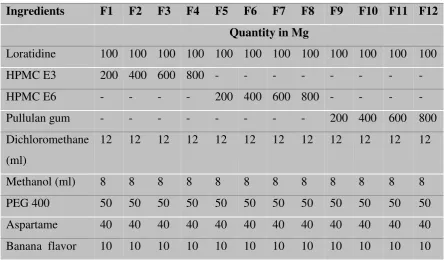
The FDF of Loratidine was prepared using HPMC
E3, HPMC E6 and PULLULAN GUM with
different ratios of 1:3, 1:6 and 1:9. The polymeric
solution of HPMC was prepared by using
dichloromethane and methanol in the ratio of 1:1
and kept aside for about 5 to 6 hrs for swelling of
polymer shown in table-1. Loratidine was dissolved
in 4 ml of dichloromethane and this drug solution
was added to the above polymeric solution. This
step was followed by the addition of plasticizers
such as PEG 400, sweetener, flavor and color was
added. Uniformity of drug content is achieved by
mixing in cyclo mixer for 10 minutes. The solution
was cast on a petri dish and dried at 450C in hot air
oven for 45 minutes. The film was carefully
removed from the petri dish, then checked for
imperfections and cut to the required size to deliver
the equivalent dose (2.5 × 2.5 cm2) per strip. Film
samples with air bubbles, cuts or imperfections
were excluded from the study .
EVALUATION OF FILMS
The weights of the films formed were determined
by using electronic balance [19]. The thickness of
the films was evaluated by using digital Vernier
calipers [20]. The folding endurance for the
prepared films was done manually. A strip of film
was cut and folded repeatedly at the same place
until it broke. The number of times the film could
be folded at the same place without breaking is
taken as the value of folding endurance [21].
Drug content:
Out of 5 films one film was randomly selected,
weighed and added to 100ml of 0.01N HCl in a
volumetric flask. The solution was sonicated for 30
mins. The solution was diluted suitably and
absorbance of the resulted solution were measured
using UV-Visible spectrophotometer against 0.01N
HCl as blank at max 244 nm [20]. In vitro disintegration time:
Disintegration time gives an indication about the
disintegration characteristics and dissolution
characteristics of the film. Time required for the
film to break was noted as in vitro disintegration
time In vitro disintegration time of the films was
determined visually in a petri glass dish with 25ml
0.01N HCl and swirling was done at every 10 sec
[22].
In vitro dissolution study: [23-25]
In-vitro dissolution study of the prepared FDF
formulations was carried out by the method
suggested by USFDA dissolution methods for
Loratidine. The method was USP type I (basket) by
using Electro lab dissolution rate test apparatus.
FDFs of desired formulation were taken and placed
in the wire mesh of 700 m and then it was placed
in the vessels of dissolution apparatus. Samples
were collected from the vessels at 2, 4, 6, and 10
minutes, replaced with same volume of the blank
solution. The solutions were filtered through
Millipore 0.45 µm syringe filter and analyzed using
UV – Vis spectrophotometer. Drug concentration was calculated from the standard graph and
expressed as % of drug dissolved. The release
studies were performed in 6 replicates and mean
values were taken.
Fourier transforms infrared spectroscopy (FT-IR): [26]
The FT-IR spectrum of pure drug and prepared
FDF formulation were determined. FTIR (Thermo
nicolet 670 spectrometer) was used for the analysis
in the frequency range between 4000 and 400cm-1
and 4cm-1 resolution. A quality equivalent to 2 mg
w w w . i a j p s . c o m
Page 278
Differrentential scanning colorymetry (DSC): [27]
Thermal properties of pure drug and the
formulation were evaluated by Differrentential
scanning colorimetry (DSC) using a diamod (DSC)
(Mettler star sw8.10).The analysis were performed
at a rate 50C min-1 to 200oC temperature range
under nitrogen flow of 25ml min-1.
RESULTS AND DISCUSSION
Loratidine oral disintegrating films were prepared
using HPMC E3, E6 and pullulan gum as film
forming polymer and PEG 400 is used as
plasticizer. The prepared films showed in figure-4
uniform distribution of the drug without uneven
shape and air entrapments as shown in figure 2.
The prepared films were evaluated for various
evaluation parameters like weight variation, folding
endurance, thickness, drug content etc. The results
showed that all the films have a smooth surface
texture. The weight variations of the films were
found to be uniform within all batches. The
thickness of the films was found to be in the range
of 0.19 mm to 0.12 mm. The folding endurance
was found to be above 300 which indicate that the
plasticizer concentration was adequate. % Drug
content uniformity evaluation results were found in
between 98.6 ± 1.3 to 99.8 ± 1.5, thus drug was
uniformly distributed in the films. The
disintegration time of the films was evaluated using
0.01 N HCl buffer. The disintegration time of films
in formulations F1 to F4 was in the range of 23 sec
to 40 sec, in F5 to F8 it was in the range of 29 sec
to 50 sec, in F9 to F12 it was in the range of 18 sec
to 37sec. It was observed that the disintegrating
time was increased as the concentration of polymer
was increased.
Invitro drug release study Loratidine oral disintegrating films:
Invitro drug release of the oral disintegrating films
prepared with HPMC E3, was faster at initial 5
minutes ranging from 75 to 65% in the formulation
and the dissolution rate were slower as the polymer
concentration was increased. However all the
formulations released 99% within 30 mins. Invitro
drug release of the oral disintegrating films
prepared with HPMC E6, the formulation F5
showed complete drug release in 25 mins. The
formulation showed only 96 to 89 % of drug
release at the end of 30 mins. Invitro drug release
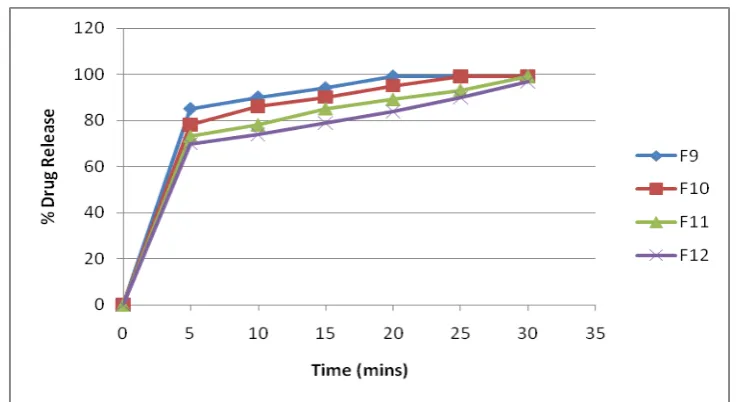
of the films prepared with pullulan gum, the
formulation F9 showed 95 % of drug release in 15
mins and complete drug release within in 20 mins.
Formulation F10 to F12 extended the drug release
up to 30 mins. This clearly indicated the drug
release from FDF was mainly depends on the
polymer viscosity and the concentration of the
polymer used in the formulation. Plots for the
cumulative drug released vs. time were showed in
Figures1-3.
DRUG AND EXCIPIENT COMPATIBILITY: Differential Scanning Calorimetric (DSC) study:
The prepared formulations were evaluated for DSC
studies. Results of the DSC study of pure drug
showed sharp endothermic peak at 134.8OC.
Similar endothermic peaks were obtained in the
formulations at 134.4OC clearly indicated that there
was no drug polymer interaction. Results of DSC
thermograms were showed in the figure 5.
Fourier Transform Infrared Spectroscopy (FT-IR) study:
The physicochemical compatibility between the
pure drug and polymers was established through
FTIR studies. The FTIR spectrum of pure
Loratidine showed 1703cm−1 (C=O of ester), 1560
w w w . i a j p s . c o m
Page 279
shown in the FTIR spectrum further conformed thatthere is no drug polymer interaction. The FTIR
spectrum of pure drug and the prepared ODF were
given in figure 6.
CONCLUSION:
The results of the present study indicated that
HPMC based fast disintegrating films of Loratidine
were showed good physico chemical properties and
the method solvent casting can be successfully
adopted for the preparation of films. Taste masking
was achieved with the use of aspartame and banana
flavor. The prepared formulations were shown
good mechanical properties. It was found that the
polymers HPMC E3, E6 and pullulan gum has
good film forming properties. The formed films
were smooth in texture and have good folding
endurance. The drug release was faster in the films
formulated with pullulan gum than when
formulated with HPMC E3, E6. The best
formulation was selected from the film forming
capacity and the invitro dissolution profile.
Table 1 Formulation and physico chemical characteristics of the prepared fast
disintegrating films of Loratidine
Ingredients
F1
F2
F3
F4
F5
F6
F7
F8
F9
F10 F11 F12
Quantity in Mg
Loratidine
100 100 100 100 100 100 100 100 100 100 100 100
HPMC E3
200 400 600 800 -
-
-
-
-
-
-
-
HPMC E6
-
-
-
-
200 400 600 800 -
-
-
-
Pullulan gum
-
-
-
-
-
-
-
-
200 400 600 800
Dichloromethane
(ml)
12
12
12
12
12
12
12
12
12
12
12
12
Methanol (ml)
8
8
8
8
8
8
8
8
8
8
8
8
PEG 400
50
50
50
50
50
50
50
50
50
50
50
50
Aspartame
40
40
40
40
40
40
40
40
40
40
40
40
w w w . i a j p s . c o m
Page 280
Figure 1: Invitro drug release study Loratidine oral disintegrating films prepared with
HPMC E3
Figure 2: Invitro drug release study Loratidine oral disintegrating films prepared with
HPMC E6
Figure 3: Invitro drug release study Loratidine oral disintegrating films prepared with
w w w . i a j p s . c o m
Page 281
Figure 4: Photographs showing the prepared fast dissolving films of Loratidine.
w w w . i a j p s . c o m
Page 282
Figure 6 FTIR Spectrum of pure drug and Loratidine Fast disintegrating films
REFERENCES:
1. Liang AC, Chen LH, 2001, Fast Dissolving
Intraoral Drug Delivery Systems, Exp. Opin. Ther.
Patents., 11,981.
2. Borsadia S, Halloran DO, Osborne JL, 2003,.
Quick Dissolving Films-A Novel Approach to
Drug Delivery, Drug Delivery Technology; 3, 63.
3. Klancke J, 2003, Dissolution Testing of Orally
Disintegrating Tablets, Dissolution technologies;
10, 6.
4. Parakh SR, Gothoskar AV, 2003, Review of
Mouth Dissolving Tablet Technologies, Pharm
Tech; 27, 92.
5. Vondrak B, Barnhart S 2008, Dissolvable films
for flexible product format in drug delivery. Pharm
Tech; S, 20.
6. Arnum PV. 2006, Outsourcing Solid Dosage
Manufacturing, Pharm Tech. 30, 44.
7. Ghosh T, Pfister W. Drug Delivery to the Oral
Cavity: Molecules to Market. Florida: CRC Press,
Taylor & Francis; 2005.
8. Raymond CR, Paul J S, Sian C , , Hand book of
Pharmaceutical excipients ., 4th Ed., 297; 2003.
9. Corniello CM., 2006, Drug Delivery
Technology., 6, 68.
10. Chen X, Ji ZL, Chen YZ: TTD: Therapeutic
Target Database. Nucleic Acids Res. 2002 Jan
1;30(1):412-5. Pubmed
11. Cieslewicz G, Gondorowicz K,
Grzelewska-Rzymowska I, Rozniecki J, Wojciechowska B:
[Effect of loratadine—selective antagonist of histamine (H1) receptor—on allergen-induced bronchoconstriction in atopic asthmatics]
Pneumonol Alergol Pol. 1992;60(11-12):11-5.
Pubmed
12. Cieslewicz G, Gondorowicz K,
Grzelewska-Rzymowska I, Rozniecki J: [Effect of loratadine,
selective antagonist of histamine H1 receptors, on
histamine-induced bronchoconstriction]
Pneumonol Alergol Pol. 1995;63(5-6):281-5.
Pubmed
13. Letari O, Miozzo A, Folco G, Belloni PA, Sala
w w w . i a j p s . c o m
Page 283
cytosolic Ca2+ levels and leukotriene release:novel mechanisms of action independent of the
anti-histamine activity. Eur J Pharmacol. 1994 Feb
15;266(3):219-27. Pubmed
14. Cavero I, Mestre M, Guillon JM, Heuillet E,
Roach AG: Preclinical in vitro cardiac
electrophysiology: a method of predicting
arrhythmogenic potential of antihistamines in
humans? Drug Saf. 1999;21 Suppl 1:19-31;
discussion 81-7. Pubmed
15. Tamura T, Masaki S, Ohmori K, Karasawa A:
Effect of olopatadine and other histamine H1
receptor antagonists on the skin inflammation
induced by repeated topical application of
oxazolone in mice. Pharmacology. 2005
Dec;75(1):45-52. Epub 2005 Jun 7. Pubmed
16. Grzelewska-Rzymowska I, Gondorowicz K,
Cieslewicz G, Rozniecki J, Wojciechowska B:
[Effect of loratadine (LO), a selective H1
antagonist, on histamine-induced
bronchoconstriction] Pneumonol Alergol Pol.
1992;60(11-12):16-21. Pubmed
17. Menardo JL, Horak F, Danzig MR, Czarlewski
W: A review of loratadine in the treatment of
patients with allergic bronchial asthma. Clin Ther.
1997 Nov-Dec;19(6):1278-93; discussion 1523-4.
Pubmed
18. Howarth PH: Histamine and asthma: an
appraisal based on specific H1-receptor
antagonism. Clin Exp Allergy. 1990 Aug;20 Suppl
2:31-41. Pubmed
19. Raghavendra Rao NG, Suryakar VB.
Formulation and evaluation of Montelukast sodium
mucoadhesive buccal patches for chronic asthma
attacks. International Journal of Pharma and Bio
Sciences 2010; 1(2): 1-14.
20. Patel R, Shardul N, Patel J, Baria A.
Formulation, development & evaluation of oral fast
dissolving anti-allergic film of levocetrizine
dihydrochloride Arch Pharm Sci & Res 2009;
1(2):212 – 217.
21. Mahesh A, Shastri N, Sadanandam M.
Development of taste masked fast disintegrating
films of levocetirizine dihydrochloride for oral use.
Curr Drug Deliv 2010; 7:21–7.
22. Arya A, Chandra A, Sharma V, Pathak K. Fast
dissolving strips: A novel approach for the delivery
of verapamil. Int J ChemTech Res 2010; 2(1).
23. Patel R, Naik S, Patel J, Baria A. Formulation
development and evaluation of mouth melting film
of ondansetron. Arch Pharm Sci Res 2009; 1:212– 7.
24. Mohammed A, Harish N, Charyulu R, Prabhu
P. Formulation of chitosan-based ciprofloxacin and
diclofenac film for periodontitis therapy. Trop J
Pharm Res 2009; 8:33–41.
25. Siewert M, Dressman J, Brown CK, Shah VP.
FIP; AAPS. FIP/AAPS guidelines for
dissolution/in vitro release testing of novel/special
dosage forms. AAPS PharmSciTech 2003; 4:E7.
26. Vidyadhara S, Balakrishna T, Sasidhar RLC,
Showri Babu CH, Lakshmi Harika D. Formulation
and evaluation of zolmitriptan fast dissolving
buccal films. Scholars Research Library Der
Pharmacia Lettre 2013; 5 (4):145-152.
27. Patil A, Shaik M, Gulam I. Floating tablets of
nimodipine and its inclusion complex with β -cyclodextrin for controlled release. Int J Pharm