
Syllidian miscellany
14
0
0
Full text
(2) 642. YO K. OKADA.. 0. I. FIG. 1.-Autolytu8. r08eu8?. from Plymouth. district..
(3) SYLLIDIAN. 643. MISCELLANY.. 5% formalin, its colour in the living condition is not exactly known, although a red Ime is still abundantly retained; the colour is due to numerous microscopic patches of red pigment disposed in two transverse bands on the dorsal surface of each segment and its dorsal cirri. On the head the appendages are strongly contracted, coiled in spirals and massed up almost together. Their condition naturally makes the small appendages in question very difficult to examine. At any rate, I shall first sketch out the general appearance of the specimen here (Fig. 1). As the figure shows, the Sacconereis closely resembles Autolytus roseus of Claparede, except in the number of unmodified segments in the first region. Here we count 14 segments as opposed to 8 in that case, and this difference deserves a little consideration before proceeding to the main problem of the present enquiry. With regard to the sexual metamorphosis of the segments for swimming, the stolons of the Autolytinre among Syllids may be divided into two categories, the first including those stolons of short length and possessing a smaller number of segments. In these forms the body is generally made up of the anteriorly unmodified and the posteriorly modified segments. The stolons of the second category consist of three regions having modified segments between the anterior and posterior unmodified ones. To the first category belong the stolons of Myrianida (Milne-Edwards) and Autolytus (Grube), and to the second those of Procer(J3a(Ehlers), Procemstea (Langerhans) and Virchowia (Langerhans). In the stolons of the first category the anterior unmodified region consists of only two (female) or three (male) segments, but in those of the second category there are, as a rule, 6 segment~ in this region, whether in the male or the female. The sexual individuals of Procer(J3a(Autolytus) longeferiens(SaintJoseph) described under the title of Autolytus alexandri by Malmgren are, however, excepted from the general rule, since the first region of this Sacconereis contains 14 unmodified segments (see Okada, 1929, Fig. 30). In Autolytus roseus, as mentioned above, 8 segments are assigned to the first region. Therefore, if the original count be not mistaken, we have another exception to the general constitution of the Autolytan stolons of the second category. Now in connection with this number of unmodified segments in the first region the question arises whether it is truly specific to this stolon or whether it is rather due to a chance variation in the only specimen observed. Since the material at my disposal is also single, the problem cannot be settled by the method of simple comparison. Therefore turning to the other side, I examined a large number of stolons of different species, so far as I have been able to capture them by towing; and finally found some stolons of Procerastea having 3 segments in the first unmodified region instead of the usual 6. Hence, a hypomeric variation is possible at least in the case of Procerastea. On the other hand, no single instance NEW. SERIES.-VOL.. XVIII.. No.2.. JANUARY, 1933.. 0.
(4) 644. yo K. OKADA.. of hypermeric variation was detected during the whole of my examination. Generalising from this result I may conclude that 8 unmodified. segmentsin the first region of Autolytus roseus would be due to a hypomeric change of the original 14 segments. I continued my examination of other Sacconereis belonging to the second category, hoping to find some other forms possessing a pair of problematical appendages in front of the head, and at length found them in. 0 FIG. 2.-Anterior. I m/ '0..5 /m. part of female individual of Proeerceapieta.. female individuals of Procer03apicta Ehlers and of Procer03aaurantiaca Olaparede. A pair of small appendages does exist in the head besides the median and lateral tentacles of the prostomium and the tentacular cirri of the peristomium. The general constitution of the head of the first species is sketched out in Figure 2. The appendages in question are, however, not exactly in front but slightly posterior to the anterior end o~the head, and placed on each side beneath the position of the dorsal eyes. They are, of course, not the lateral tentacles, since the latter, which are highly developed, are found anterior to.
(5) SYLLIDIAN. MISCELLANY.. 645,. them at each frontal edge of the head. Also they do not represent the ventral cirri of the peristomial segment, since there is a pair of cirri, dorsally long and ventrally short, on each side of the posterior boundary of the head. I do not hesitate therefore in comparing this pair of short appendages with the problematical frontal ones of Autolytus roseus and to say that they are homologous with the palpi of the asexual animal. * Hence the constitution of the head of Autolytus roseus described by Claparede is probably not due to a teratological formation, while the absence of the appendages in the head of other stolons closely allied to it shown in the figures of previous authors is probably incorrect. II.. ApPEARANCE OF AUTOLYTUS CORNUTUS A. AGASSIZ IN EUROPE.. My second visit to the Plymouth Laboratory was in June, 1929. This time I obtained a tiny Syllid abundantly on Laminaria covered by Obelia always in close association with Autolytus edwarsi Saint-Joseph. It differs, however, from the latter not only in size but distinctly also in colour, which is rather pale green, and in the fact that the dorsal surface of the segments is fringed with more or less dark pigment. It produces a single stolon, either male or female, and does not carry a chain of stolons, the posterior segments separating from the anterior with a new formation of the head always on the anterior boundary of the 14th setigerous segment (Fig. 3). The female individual consists of three distinct regions, the first containing 6 unmodified segments, the second 12 modified, and the third again 8-13 unmodified ones. * In the Autolytinro the palpi are generally reduced in size and fused into a lip-like structure in front of the mouth opening.. FIG. 3.-Autolytus cornu/us. from Plymouth district..
(6) 646. YOK. OKADA.. This constitution would make the stolon belong to the type of Procerrea or the second category of my classification. The male individual, however, has only two regions. The anterior unmodified region is made up of 6 segments as in the other sex, while in the following region of the body all the segments except the anal one are metamorphosed for swimming. According to my classification, stolons having more than 6 segments in the first region must belong to the second category, although the Polybostricus of the present species represents the type of the first category. In connection with the number of segments in the first unmodified. /. Qo~ Qo.:;0 -?;; FIG. 4.-Trepan. of Atttolytu8. cornutu8.. region, A. Agassiz (1862, p. 394) has mentioned that" the number of rings which are not provided with long setre, and have short dorsal cirri, are five, instead of six as in the female." But judging from the subsequent statement that" the spermatozoa (PI. XI, Fig. 8, 0) are found on the sides of these six rings only, and extend also into the cirri, but never into the posterior rings, as is the case with the eggs of the female," Agassiz seems to have mistakenly counted the most anterior segment as being in the head, since the spermatozoa are only produced in the original segments, i.e. from the 14th to the 20th setigerous segment of the asexual stage, and never in the new head. Agassiz did not give the dentation of the pharynx, so it may be rather risky to identify the present species with the American only by its external resemblance. Nevertheless, the following two reasons would make this identification not improbable: first, the species was not found before during my stay from June, 1927, to April of the next year, in spite of its being so common in the summer of 1929. Secondly, this district of.
(7) SYLLIDIAN. 647. MISCELLANY.. England is the first port of Europe touched by steamers coming from America. It is possible that its appearance in Plymouth Sound was due to its being carried by a steamer from its native country. Of course, it is probably not simply carried by adhering to the bottom of a ship, but the latter would first be covered by some hydroids including Obelia, to which the Syllid attaches itself secondarily. III.. PROOERLEAPlOTA EHLERS AND. STEPHANOSYLLIS. SOAPULARIS. CLAPAREDE.. This Syllid described by E. Ehlers (1864, p. 587) under the title of " Procerrea picta " is most easily distinguished from other forms of the same type of animal by its characteristic pigmentation. The dorsal surface is covered with a deep deposit of black or dark brown pigment, with the exception of a mid-dorsal longitudinal line, which is free of pigment and hence appears white, and a series of transverse bands free of pigment and hence also appearing white. The white bands are especially well marked after the 7th setigerous segment, developing between the following segments: 7 & 8, 9 & 10, 11 & 12, 13 & 14, 19 & 20, 22 & 23, 26 & 27, 30 & 31, 34 & 35, 42 & 43, 45 & 46, 48 & 49, 52 & 53, 56 & 57, 60 & 61, 64 & 65, 68 & 69, 72 & 73; they become gradually obscure towards the caudal extremity. The pigmentation is further complicated on each segment. By the white line in the middle, the coloured area is divided into left and right halves, which are further subdivided into several narrow bands. This part of the centre is fringed by a longitudinal stripe of especially deep pigment. The latter is restricted to narrow limits on each side of the segments but stretches continuously from just behind the head to the tail end, without being interrupted by the transverse white bands mentioned above. Anteriorly at the level of the 3rd setigerous segment the peripheral fringes of deep pigment come from each side to the middle and meet together between a pair of nuchal organs, which are also deeply pigmented. Sometimes, especially in large individuals, the pigmentation in front of the 14th setigerous segment is more or less different from that of the posterior part of the body, the former part being always much more intense than the latter. This fact is easily understood when the method of stolonisation of this Syllid is considered; those segments posterior to the critical position are separated at each time of stolonisation and the missing part is replaced by new segments. P. Langerhans (1879, p. 578) state that" bei jungeren lndividuen ist die Farbung einfacher, nur die beiden braunen Langsstreifen sind zu erkennen. Das bestimmt mich zwei junge Thiere von 1 cm. und 50 Segmenten, die ich in Funchal am Strande gefangen habe, hierher zu stellen. Sie hatte nur zwei dunkelbraune dorsale Langsstreifen, die sich tiber das.
(8) 648. YO K. OKADA.. ganze Thier bis zum Analsegment erstreckten. Aber sie stimmten sonst ganz mit der picta iiberein. Namentlich hatte der Pharynx wie bei dieser 20 Zahne, 10 grossere abwechselnd mit 10 kleineren. Analcirren kurz." Unfortunately this statement cannot be applied to all small individuals of the so-called" Autolytus pictus " in the Plymouth district. There are plenty of specimens which measure even less than 1 cm. and consist of less than 60 segments, yet showing the special pattern of pigmentation detailed above, while on the other hand there are also nearly as many specimens whose pigmentation is indeed" einfach," without the transverse white bands. These worms are, however, by no means always :smaller than those of the other type. On the contrary, they are some-times as big as the largest worms of the other type, and have even been ,observed in the act of producing the stolon. It is almost certain, therefore, that we are d~aling here with two different species or varieties at least and not two developmental stages of one and the same species. Ehlers (1864,p. 257)has mentioned the existence of some variations among :his" ProcenBa picta ": "Ein dritte Form ist diejenige, wo die gleichIDassig gelb gefarbte Riickenflache an den Kanten von einem braunen Langsstreifen eingefasst wird, wobei die Stirnfiihler und Cirren des zweiten Segmentes braun, die das ersten und dritten Segmenten nur an der Spitze braun, sonst weiss.waren." Such pigmentation may be well applicable to " Stephanosyllis scapularis " described by Claparede in the same year from Port-Vendres (Pyrenees Orientales). The stolon of the so-called Autolytus pictus was first shown by SaintJoseph (1886, Figs. 102-105). It represents the male individual of the type" picta," while as to the other sex Saint-Joseph states, " Je ne vois jamais de Sacconereis se detacher; je constate seulement que la tete en est semblable It celIe figuree par moi pour la Sacconereis de l'Autolytus ornatus." In his monograph on "The British Annelids" McIntosh (1908, PI. XLVII, Fig. 1) has figured a young Polybostricus of the same type. Now it might be asked whether this banded type of the Autolytus in question is not the male producing animal, and the other non-banded .simply pigmented type the female producing one. Actually among Mrs. E. W. Sexton's sketches of the Plymouth Polychretes (unpublished and preserved in the Laboratory) there is a Sacconereis certainly belonging to the latter type. This consists of 28 setigerous segments in addition to the head and tail ones, differentiated into 6 unmodified, 13 modified, and 9 unmodified. However, there is also a female stolon of the banded type in the same collection of sketches. Therefore, sexual dimorphism cannot be .applied here to explain the colour differences of the Autolytus in question. At any rate, to settle the problem definitely I cultivated the banded and non-banded animals separately to see what kind of stolons come out. As a result each type was found to produce both male and female stolons.
(9) SYLLIDIAN. MISCELLANY.. 649. independently, and those stolons well preserve their original pattern of pigmentation even after being separated from the anterior part. Stolonisation, either in the banded or in the non-banded type, takes place quite easily even when the animals are confined in a finger-bowl filled with sea-water during the warmer season from June to August, while the stolons are most abundant in the plankton from April to June. A quite astonishing fact is that after September, in spite of its being still quite warm in Plymouth, the animals cultivated in vitro never produce any more stolons, although some of them are full of green eggs or milkywhite spermatozoa. Apparently stolonisation in nature also stops after the summer season, just as in culture experiments. At about the same time we find no more stolons in the plankton, although there are still plenty of asexual individuals among the dredgings. Among the latter there are also specimens whose body segments are filled with sexual products. Olaparede (l.c., p. 108) observed in his" Stephanosyllis scapularis " the eggs contained up to the 10th setigerous segment, without, however, any sign of stolonisation. Langerhans (l.c., p. 579) has also mentioned a similar case of sexual maturity in Procera3aaurantiaca: " Ich habe nur einmal bei dem grossten meiner Exemplare im December vom 16 Segment an Ei gefunden, ohne Anzeigen einer Knospenbildung." Since such specimens are obtained mostly in the winter season, it may be supposed that the stolonisation of Procerrea and its allied species would depend upon the temperature of the sea-water. However, examining Mrs. Sexton's drawings of Plymouth Polychretes again I find an example of Autolytus prolifer, which is full of ripe eggs and yet without any indication of forming a stolon. It was captured, according to a note attached, at Millbay pit on July 1st, 1914. In July the sea-water at Plymouth is by no means cold. As has been mentioned already, stolonisation in both Procera3apieta and scapularis stops nearly at the same time, about the end of August, while sexual individuals are quite abundant in the plankton in April. The temperature of the sea-water at Plymouth in September is never lower than in April, so that stolonisation of these Autolytids at least could not be simply due to the temperature of the external medium, but must be inherent and due to some other factors. The regeneration of Procera3apicta is most interesting to study. As I have already shown in a former publication (1929, p. 560) if we cut the anterior segments, the posterior piece almost invariably regenerates the head up to about the level of the 42nd setigerous segment. But the regenerative power is not the same throughout the body. From the head to the end of the 5th setigerous segment the number of new segments almost always corresponds to that of the missing ones. Behind this level the number of regenerated segments is more or less smaller than the original number, the maximum number being still, however, the same as.
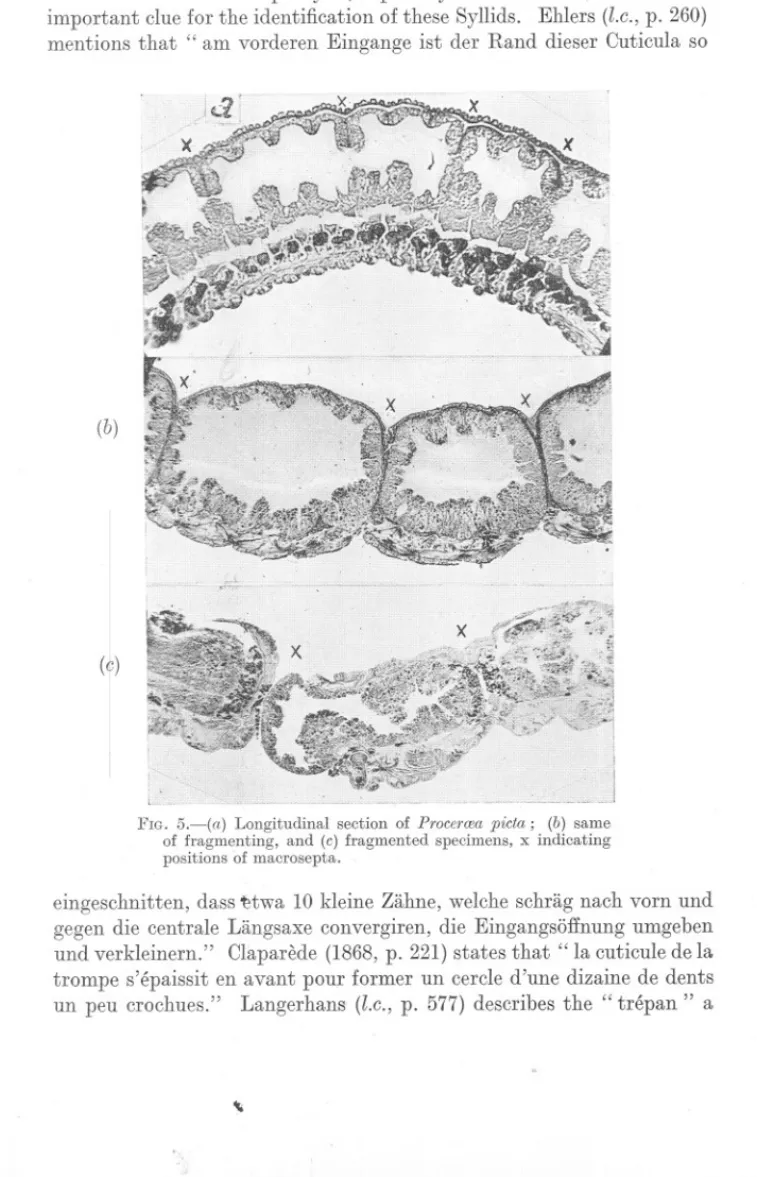
(10) 650. yo K. OKADA.. the missing. Posterior to this level but up to the end of the 7th segment, the same maximum regeneration cannot as a rule exceed 4 setigerous segments in addition to the head; and this 6-segmental recovery holds to the end of the 13th segment. Between the 14th and the 42nd setigerous segment, the regeneration is quite isopotential, only the head plus one setigerous segment being produced before sexual maturity, and only the head part in the sexually matured animal. Moreover, beyond the level of the 13th setigerous segment there is absolutely no stomodeal invagination in regenerated segments, and the cut end of the intestine opens directly to the exterior as a mouth. However, as I have mentioned before, "this interesting result that there is so distinctly regional difference in regeneration, cannot be extended and applied to the body of other Syllids, even within the bounds of the same genus." So far as myexperiments are concerned only Proeerma seapularis presents the same regional difference in regeneration according to the point at which the cut is made. Fragmentation is not a characteristic phenomenon in these species of Autolytids, but it has been well investigated in them. There are two methods of provoking artificial fragmentation, viz. dilution of sea-water with fresh or distilled water (Allen's dilution method) and employing a solution of KOL As has been explained, the fragmentation due to KOI solution depends upon a muscular action, while the same phenomenon in diluted sea-water is due to the osmotic changes in the intestine. According to my former experiment almost no effect is produced by dilution until the deg:r;eeof 60% (not 6% as printed in the former publication, Okada, 1929, p. 586) of distilled water in sea-water is reached. Procerrea can live quite normally in such a medium. Nevertheless, if we cut or injure any part of the body with the exception of the extreme anterior or posterior portion, fragmentation takes place even in such a low degree of dilution. In Proeermapieta two consecutive united groups of segments at each white band separate first on the dorsal surface, a transverse crack appearing in the middle of the white band. Procerma seapularis has no transverse bands, but fragmentation of segments takes place exactly in the same manner as in the preceding case. The external and internal changes of the segments, which are observed in this case of fragmentation, have been described in the former paper. They are also illustrated here by the three microphotographs in Figure 5. It was stated that" the swollen intestine is generally coloured brown, while in its normal condition it is almost without colour or at the most pale yellow." This change of colour in the intestine is found to be closely related to the change in the chemical nature of the granules contained in the intestinal cells. The granules in the normal specimens are slightly stained by eosin or other acid dyes, but not at all by Heidenhain's iron..
(11) SYLLIDIAN. MISCELLANY.. 651. hrematoxylin, while the same granules in the fragmenting or fragmented specimens are highly stainable by the last-mentioned stain. The structure of the pharynx, especially the dentation, is the most important clue for the identification of these Syllids. Ehlers (l.c., p. 260) mentions that" am vorderen Eingange ist der Rand dieser Cuticula so. (b). (c). FIG. 5.-(a) Longitudinal section of Proeercea pieta; (b) same of fragmenting, and (e) fragmented specimens, x indicating positions of macrosepta.. eingeschnitten, dass ttwa 10 kleine Zahne, welche schrag nach vorn und gegen die centrale Langsaxe convergiren, die Eingangsoffnung umgeben und verkleinern." Claparede (1868, p. 221) states that" la cuticule de la trompe s'epaissit en avant pour former un cercle d'une dizaine de dents un peu crochues." Langerhans (l.c., p. 577) describes the" trepan" a. '".
(12) 652. yo K. OKADA.. little more precisely: "Pharynx mit 20 Zahne, 10 grossere, 10 kleine Zahne." This number of 20 of two kinds of larger and smaller teeth disposed alternately is also given by Saint-Joseph (1886, Fig. 101, also P. Fauvel, 1923, p. 316, Fig. 121b). However, it is doubtful whether these authors really counted all the teeth carefully or whether they counted only one side of the trepan and doubled the number. There are just 5 larger and 5 smaller teeth on one side of each trepan when we count them without moving the screw of . the microscope. But if we count all. .. d. 0 FIG. 6.-Trepan. of Proeerrea pieta (a), and scapztlaris (b).. the teeth with a little more patience, we find the number is 18 instead of 20; 9 larger teeth are disposed alternately with 9 smaller teeth forming a circle (Fig. 6). In Procermapicta the difference in size between the larger and smaller teeth is great. They are, however, of the same size and shape aIllong those of the same category. On the other hand, the smaller teeth are much developed in Procerma scapularis, and the difference in size between them and the larger teeth is accordingly reduced. Moreover, in the latter species the larger teeth are not uniformly shaped, some being broader tl1,anothers, while the latter are more sharply pointed and longer than the former. Although this character is not very constant, yet it.
(13) SYLLIDIANMISCELLANY.. 653. is never found in the trepan of Procermapicta. It cannot be considered teratological, since the structure is met with in too many cases. On account of the different dentation, as well as the difference in the colour pattern, I propose to revive the name Procerma scupularis to be applied to the so-called" Autolytus pictus " with non-banded simple pigmentation and purple tentacles and cirri.. REFERENCES. AGASSIZ,A. 1862. On alternate generation of Annelids and the embryology of Autolytus cornutus. Boston J. Nat. Rist., 7, p. 392. ALLEN,E. J. 1927. Fragmentation in the genus Autolytus and in other Syllids. Journ. Mar. BioI. Assoc., N.S., 14, p. 869. CLAPAREDE,E. 1864. Glanures zootomiques parmi les Annelides de Port-Vendres. Mem. Soc. Phys. de Geneve, 17. CLAPAREDE, EDOUARD. 1868. Les Annelides Chetopodes du Golfe de Naples. Geneva. EHLERS,E. 1964-'68. Die Borstenwiirmer. Leipzig. FAUVEL,P. 1923. Faune de France. 5. Polychetes Errantes.. Paris.. LANGERHANS, P. 1879. Die Wurm-fauna von Madeira 1. Z. ZooI., 32, p.513. McINTOSH,W. C. 1908. The British Annelida, II, pt. 1. London. OKADA,Y. K. 1929. Regeneration and Fragmentation in the Syllidian Polychffites. Roux' Arch., 115, p. 542.. .. SAINT-JOSEPH(Baron de). 1886. Annelides Polychetes des Cotes de Dinard, 1. Famille des Syllidiens Gr. Ann. Sc. Nat. ZooI., 7e Ser. I, p.134..
(14) '~. -~.
(15)
Figure



Related documents
National Conference on Technical Vocational Education, Training and Skills Development: A Roadmap for Empowerment (Dec. 2008): Ministry of Human Resource Development, Department
Considering a range of tax and benefit systems, particularly those having benefit taper rates whereby some benefits are received by income groups other than those at the bottom of
In the simplest scheme based on the boolean model for retrieval, we retrieve the documents that have occurrences of both good and teacher.. Such
The corona radiata consists of one or more layers of follicular cells that surround the zona pellucida, the polar body, and the secondary oocyte.. The corona radiata is dispersed
4.1 The Select Committee is asked to consider the proposed development of the Customer Service Function, the recommended service delivery option and the investment required8. It
Currently, National Instruments leads the 5G Test & Measurement market, being “responsible for making the hardware and software for testing and measuring … 5G, … carrier
Using text mining of first-opinion electronic medical records from seven veterinary practices around the UK, Kaplan-Meier and Cox proportional hazard modelling, we were able to
• Follow up with your employer each reporting period to ensure your hours are reported on a regular basis?. • Discuss your progress with
