Dr. M. Venkatanarayana, GITAM University,
Dr. M. Venkatanarayana, GITAM University,
Dr. M. Venkatanarayana, GITAM University,
Dr. M. Venkatanarayana, GITAM University,
Dept. of. Chemistry, HTP Cam pus
Dept. of. Chemistry, HTP Cam pus
Dept. of. Chemistry, HTP Cam pus
Dept. of. Chemistry, HTP Cam pus
Unit-IV-Liquid Fuels
The importance of liquid fuels is the fact that almost all combustion engines run on them.
The largest source of liquid fuels is petroleum. The calorific value of petroleum is about 40000 kJ/kg.
There are other supplements of liquid fuels such as coal tar, crude benzol, syntheic liquid fuel made from coal etc.
Petroleum: The term petroleum means rock oil. It is also called mineral oil.
Petroleum is a complex mixture of paraffinic, olefinic and aromatic hydrocarbons with small quantities of organic compounds containing oxygen, nitrogen and sulphur.
Chemical composition of Petroleum
Carbon- 80-87%; Hydrogen- 11.1-15%; Sulphur- 0.1-3.5; Oxygen- 0.1-0.9; Nitrogen-
0.4-0.9.
The ash of the crude oil is 0.1%.Metals e.g., Silicon, iron, aluminium, calcium, magnesium, nickel and sodium.
Crude oil is a mixture of straight chain paraffins and aromatic hydrocarbons e.g., benzene, toluene, naphthalenes etc.
Sulphur is present in the form of derivatives of hydrocarbons such as alkylsulphides, aromatic sulphides etc. Nitrogen is present in the form of pyridine, quinoline derivatives, pyrrole etc. Combined oxygen is present as carboxylic acids, ketones and phenols.
The objectionable odor of crude petroleum is due to the presence of sulphur compounds in it.
Processing of Crude Petroleum:
Petroleum is found deep below the earth crust. The oil is found floating over salt water or brine. Generally, accumulation of natural gas occurs above the oil.
Refining of Petroleum
Crude oil reaching the surface, generally consists of a mixture of solid, liquid and gaseous hydrocarbons containing sand and water.
After the removal of dirt, water and much of the associated natural gas, the crude oil is separated into a no of useful fractions by fractional distillation.
The resultant fractions are then subjected to purification known as refining of petroleum.
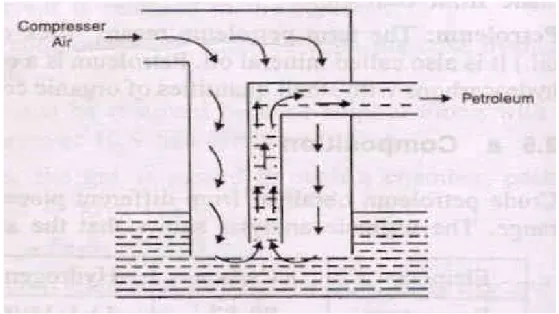
Fig: Pumping of oil
(i) Demulsification:
The crude oil coming out from the well is in the form of stable emulsion of oil and salt water, which is yellow to dark brown in colour.
The demulsification is achieved by Cottrell’s process, in which the water is removed from the oil by electrical process. The crude oil is subjected to an electrical field, when droplets of colloidal water coalesce to form large drops which separate out from the oil.
(ii) Removal of harmful impurities: Excessive salt content such as NaCl and MgCl2 can
corrode the refining equipment. These are removed by washing with water.
The objectionable sulphur compounds are removed by treating the oil with copper oxide. The copper sulphide so formed is separated by filtration.
CuO + S CuS
(iii) Fractional Distillation: It is done in tall fractionating tower or column made up of steel.
Fig. 10: Fractional distillation of crude petroleum
The hot vapours from the crude are passed through a tall fractionating column, called bubble tower.
Bubble tower consists of horizontal trays provided with a no of small chimneys, through which vapours rise.
These chimneys are covered with loose caps, known as bubble caps. These bubble caps help to provide an intimate contact between the escaping vapours and down coming liquid.
The temperature in the fractionating tower decreases gradually on moving upwards.
Fractions by distillation of crude
Name of fraction Boiling range Composition Uses
1. Uncondensed gas
Below 30OC C1-C4 (such as a
ethane, propane, isobutene)
As domestic or industrial fuel under the name L.P.G
2. Petroleum ether 30-70°C C5-C7 As a solvent
3. Gasoline or petrol
40-120°C C5-C9 As motor fuel,
solvent and dry cleaning
4. Naphtha 120-180°C C9-C10 As solvent and in dry
cleaning.
5. Kerosene oil 180-250°C C10-C16 Jet engine fuel and
for preparing laboratory gas.
6. Diesel 250-320°C C10-C18 Diesel engine fuel.
7. Heavy oil 320-400°C C17-C30 For getting gaso-line
by cracking process
A brief description of three most important liquid fuels derived from petroleum is given on below:
a) Gasoline or petrol: Is a obtained between 40-120°C and is a mixture of hydrocarbons such
as C5H12 (pentane) to C8H18 (octane). Its approximate composition is C= 84%; H=15%;
N+S+O=1%. Its calorific value is about 11,250 Kcal/kg. It is highly volatile, inflammable and used as fuel for internal combustion engine of automobiles and aeroplanes.
b) Kerosene oil: Is a fraction obtained between 180-250°C and is a mixture of hydrocarbon
such as C10H22 (decane) to C16H34 (hexadecane). Its approximate composition is C=84% H=
16% with less than 0.1%S. Its specific gravity is 0.75-0.85. Its calorific value is 11,100 Kcal/kg. Due to high boiling point range, kerosene does not vaporize easily. It is used as domestic fuel in stoves, as jet engine fuel and for making oil gas.
c) Diesel oil: Is a fraction obtained between 250-320°C and is a mixture C15H32 to C18H38
hydrocarbons. Its density is 0.86 to 0.95. Its calorific value is about 11,000 kcal/kg. Its is used as a diesel engine fuel.
Synthetic Petrol
1). Fischer-Tropsch method: Water gas (CO+H2) produced by passing steam over heated
coke, is mixed with hydrogen. The gas is purified by passing through Fe2CO3 to remove H2S
The purified gas is compressed to 5 to 25 atm and then led through a convertor containing a catalyst, consisting of a mixture of 100 parts cobalt, 5 parts thoria, 8 parts magnesia and 200 parts keiselguhar earth.
Maimed about 200-300°C. A mixture of saturated and unsaturated hydrocarbons results: nCO + 2n H2 CnH2n + nH2O
nCO +( 2n+1) H2 CnH2n+2 + nH2O
The reaction is exothermic, so outcoming hot gaseous mixture is led a cooler, where a liquid resembling crude oil is obtained.
The crude oil thus obtained is then fractionated to yield: (i) gasoline, and (ii) high-boiling heavy oil.
The heavy oil is reused for cracking to get more gasoline.
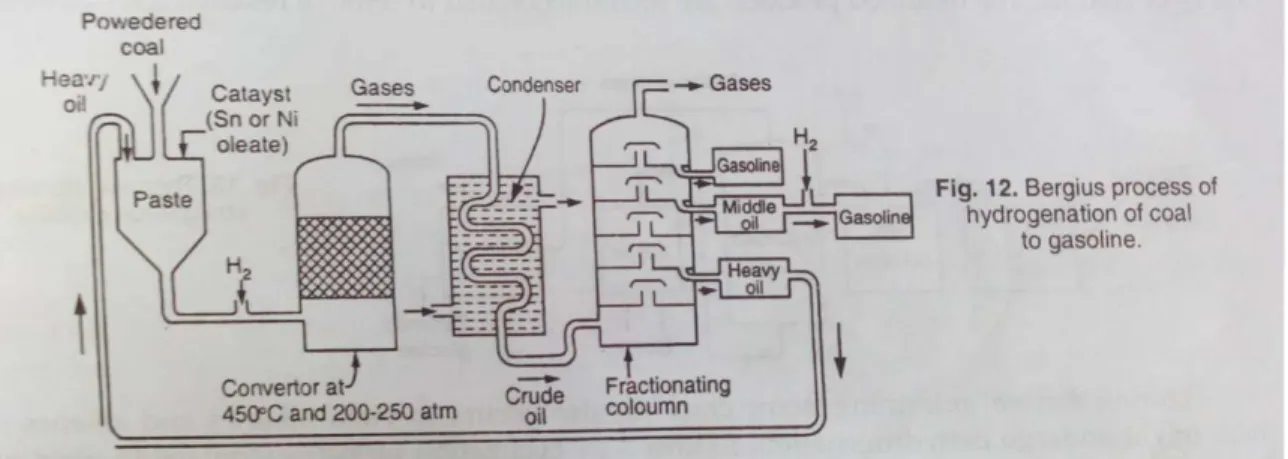
(2). Bergius process: The low ash coal is finely powdered and made into a paste with
heavy oil and then a catalyst (composed of tin or nickel) is incorporated.
The hole is heated at 450°C and under a pressure 200-250 atm for about 1.5 hours, during which hydrogen combines with coal to form saturated hydrocarbons.
The issuing gases are led to condenser, where a liquid resembling crude oil is obtained, which is then fractionated to get (i) gasoline, (ii) middle oil, (iii) heavy oil.
Fig: Bergius Process
Knocking and antiknocking
In an internal combustion engine a mixture of gasoline vapour and air is used as a fuel. After the reaction is initiated by a spark, a flame should spread rapidly and smoothly through the gas mixture and the expanding gas drives the piston down the cylinder. In certain circumstances the rate of oxidation is so high that the last portion of the mixture detonates, producing an explosive sound called knocking.
Fig: fuel undergoes compression and
gets fire by the help of spark plug Fig: Piston is going down in cylinder due to flame spread rapidly and
Compression ratio: The ratio of the gaseous volume in the cylinder at the end of the suction-stroke to the volume at the end of compression-stroke of the piston, is know the compression ratio. The efficiency of an internal combustion engine increases with the increase in compression ratio, which is dependent on the nature of the constituents present in the gasoline used.
Anti Knocking agents
The tendency of fuel constituent to knock is in the following order
Straight chain>branched>olefins>cycloparaffins>aromatics
An antiknocking agent is used to increase the octane number of a fuel.
TEL ( Tetra ethyl lead)
Methyl cyclopentadienyl Manganese tricarbonyl
Ferrocene , iron pentacarbonyl
Importance of TEL:
The mechanism is that TEL dissociates to give radicals which convert some of the straight chain hydrocarbons to branched chain hydrocarbons.
In this case the lead converted into PbO is harmful to engine life. Consequently, in order to help the simultaneous elimination of PbO formed from the engine, a small amount of ethylene di bromide is also added to petrol.
Ethylene di bromide removes lead oxide as volatile lead bromide along with exhaust gases.
Octane number:
is defined as the percentage of is octane present in a mixture of iso-octane and n-heptane, which has the same knocking characteristics as that of fuel under examination, under same set of conditions.
Thus a gasoline with an octane no of 80, would give the same knocking as a mixture of isooctane and n-heptane containing 80% of isooctane by volume. Greater the octane number, greater is the antiknock property of the fuel.
It has been found that n-heptane knocks very badly and hence, its anti-knock value has arbitrarily been given zero. On the other hand, isooctane (2:2:4-trimethyl pentane), gives very little knocking, so its anti-knock value has been given as 100.
H3C CH3
n-heptane
H3C CH3
CH3 CH3
CH3 CH3
Cetane number:
The cetane number of a diesel oil is defined as the percentage of cetane in a mixture of n-hexadecane and 2-methyl naphthalene which will have the same ignition characteristics as the fuel under test, under same set of conditions.
CH3
2-Methyl naphthalene (Cetane No. 0)
H3C
CH3
hexadecane Cetane No. 100)
The cetane rating of a fuel depends upon the nature and composition of hydrocarbon. The straight chain hydrocarbons ignite quite readily while aromatics do not ignite easily. Ignition quality order among the constituents of diesel engine fuels in order of decreasing cetane no is as follows:
n-alkanes> naphthenes > alkenes > aromatics
Thus, hydro carbons which are poor gasoline fuels are quite good diesel fuels.
High-speed and low-speed diesels:
In a high-speed engine, the time lag in getting the diesel droplets heated to ignition point is very brief, about 1/500th of a second. Such diesel engines require diesel with cetane numbers in excess of 45 (up to 60). On the other hand, low speed diesel requires cetane number of about 25. Cetane number of medium speed is about 35.
Power Alcohol:
Ethyl alcohol is an important liquid fuel and when it is used in an internal combustion engines, it is called power alcohol.
Generally gasoline and alcohol are present in the ratio of 4:1. Its octane no is 90.
Manufacture of Power Alcohol: Ethyl alcohol can be manufactured from hydrocarbons,
carbohydrates, starches and molasses, waste sulphite liquor from paper and pulp mills. Ethyl alcohol is mainly manufactured from molasses.
The formation of alcohol involves the following steps:
(i) Dilution: High concentration of sugars in molasses
(ii) (ii) Addition of dilute sulphuric acid: For fermentation the pH of the solution
should be kept between 4 to 5.
(iii) (iii) Addition of ammonium salts: When molasses contain insufficient yeast
(iv) (iv) Addition of yeast: This is the main step in the formation of alcohol from
mollases. To the solution a selected strain of yeast is added. The mixture s kept at a temperature of 30 oC for 2-3 days (36 to 38h.).
(v) Azeotropic distillation: The fermentated liquid contains about 18-20% alcohol
obtained. The wash is then fractionally distilled to get rectified spirit, which contains 90-95% alcohol. For getting absolute alcohol (i.e. 100% alcohol), the rectified spirit is digested with lime for 2 days and then distilled.
Advantages of Alcohol blended gasoline:
1. The octane no of alcohol is quite high. Hence on blending with gasoline, it increases the octane no of gasoline.
2. There is no decrease in power output or increase in specific fuel consumption on blending alcohol with gasoline.
3. Alcohol-petrol blend has a tendency to absorb any traces of moisture present.
Disadvantages of Alcohol blended Gasoline:
1. The calorific value of alcohol is low and hence the alcohol lowers the calorific value of petrol.
2. Since the air required for complete combustion of blend is less than the air required for petrol.
3. The ratio of flow of blend is to be increased to 1.56 times to that of pure petrol by altering the size of carburetor jet.
4. Because of its considerable surface tension alcohol is difficult to atomize, particularly at low temp. Hence specific arrangement for starting alcohol-petrol blends in carburetor is to be provided.
5. Alcohol is easily oxidized to acids. Hence alcohol may cause corrosion.
LPG:
Varieties of LPG bought and sold include mixes that are primarily propane (C3H8),
primarily butane (C4H10) and, most commonly, mixes including both propane and butane
and isobutane depending on the season — in winter more propane, in summer more butane[. Propylene and butylenes are usually also present in small concentration. A powerful odorant, ethanethiol, is added so that leaks can be detected easily
Applications of LPG:
Liquefied petroleum gas (also called LPG, GPL, LP Gas, or liquid propane gas) is a flammable mixture of hydrocarbon gases used as a fuel in cooking, heating appliances and vehicles.
It is used as a feedstock for the manufacture of various chemicals and olefins by pyrolysis.
Other industrial application includes its use in portable blow lamps, soldering, welding, annealing hardening, brazing, steel cutting etc.
It is increasingly used as an aerosol propellant and a refrigerant, replacing chlorofluorocarbons in an effort to reduce damage to the ozone layer.
When specifically used as a vehicle fuel it is often referred to as autogas.
Disadvantages of LPG:
Due to its faint odour, leakage cannot be easily detected.
Handling has to be done under pressure
Its octane number is very low and the load sensitivity is very high