The Politics of Effective
Foreign Aid
Joseph Wright
1and Matthew Winters
21Department of Political Science, The Pennsylvania State University, University Park, Pennsylvania 16802; email: [email protected]
2Department of Political Science, University of Illinois at Urbana-Champaign, Champaign, Illinois 61820; email: [email protected]
Annu. Rev. Polit. Sci. 2010. 13:61–80
First published online as a Review in Advance on February 16, 2010
TheAnnual Review of Political Scienceis online at polisci.annualreviews.org
This article’s doi:
10.1146/annurev.polisci.032708.143524 Copyright c2010 by Annual Reviews. All rights reserved
1094-2939/10/0615-0061$20.00
Key Words
growth, political institutions, exogeneity
Abstract
There is little consensus on whether foreign aid can reliably increase economic growth in recipient countries. We review the literature on aid allocation and provide new evidence suggesting that since 1990 aid donors reward political contestation but not political inclusiveness. Then we examine some challenges in analyzing cross-national data on the aid/growth relationship. Finally, we discuss the causal mechanisms through which foreign aid might affect growth and argue that politics can be viewed as both (a) an exogenous constraint that conditions the causal process linking aid to growth and (b) an endogenous factor that is affected by foreign aid and in turn impacts economic growth.
Annu. Rev. Polit. Sci. 2010.13:61-80. Downloaded from arjournals.annualreviews.org by University of Illinois - Urbana Champaign on 07/28/10. For personal use only.
Click here for quick links to Annual Reviews content online, including:
• Other articles in this volume • Top cited articles • Top downloaded articles • Our comprehensive search
Further
INTRODUCTION
Twelve years ago, the World Bank’s report As-sessing Aid: What Works, What Doesn’t, and Why (1998) inaugurated a line of research that tries to determine the conditions under which for-eign aid leads to economic growth. That study and the main research behind it (Burnside & Dollar 2000) emphasized that foreign aid spurs growth when recipient countries pursue “good” economic policies such as low inflation, low budget deficits, and high trade volume. This intuitive and appealing finding was initially highly influential, but it also generated a se-ries of critical studies that argued foreign aid either led unconditionally to economic growth, did not lead at all to economic growth, or led to economic growth conditional on other fac-tors (Hansen & Tarp 2000; Hansen & Tarp 2001; Lensik & White 2001; Clemens et al. 2004; Dalgaard et al. 2004; Easterly et al. 2004; Roodman 2007, 2008b; Rajan & Subramanian 2008). This research agenda has in many ways stalled amid criticism related to poor iden-tification, self-inflicted endogeneity, and the general limitations of cross-country growth regressions.
Nonetheless, a very public debate has emerged between “aid optimists” such as Sachs (2004), who believe that substantial increases in foreign aid—the so-called “big push”—are nec-essary to lift the world’s poor out of poverty, and “aid pessimists,” such as Easterly (2006), who argue that piecemeal aid projects with narrow, easily measurable goals are the only effective use of foreign aid. To a certain extent, both sides ignore the politics of foreign aid. Optimists ap-pear to assume that a massive scale-up in aid will be used as economic theories predict, ignor-ing the possibility that governments have incen-tives to divert aid funds for their own purposes. The pessimists, meanwhile, argue that donors should bypass recipient governments and give aid directly to the poor (Easterly 2006, p. 368), ignoring the political and technical difficul-ties of doing this. Neither perspective directly addresses the governance question, and many of the economists involved in the aid/growth
debate ignore the messy world of political institutions and political decision making ex-cept to underscore that, historically, much aid has been distributed to corrupt and badly gov-erned regimes.
To understand how aid can promote growth, we need to think through the political processes that shape how aid is used in recipient countries and examine how foreign aid shapes recipient leaders’ incentives to pursue growth-promoting policies and develop growth-promoting po-litical institutions. Popo-litical leaders (and even nongovernmental organizations) who receive aid are located in different types of institu-tional settings that place different sets of con-straints on their behavior. Understanding how aid is likely to be used in these different types of institutional settings will offer insight into whether and how aid promotes growth and development.
At the moment, there is no simple conclu-sion on the relationship between foreign aid and economic growth. There are basic reasons to believe that foreign aid—through the simple mechanism of injecting additional resources into an economy—should foment economic growth. There are also reasons to believe, however, that foreign aid—through indirect channels—can provide cover for governments undertaking poor economic policies, facili-tate the persistence of political institutions that hinder economic growth, interfere with technocratic planning processes, or displace domestic business and investment. Therefore, in this review, we emphasize the importance of assessing exactly how foreign aid affects economic growth and clearly tracing the causal pathway(s) through which aid might positively or negatively lead to economic growth. We begin by briefly reviewing the literature on aid allocation and presenting some new evidence on donors’ responsiveness to the political characteristics of aid recipients. Then we look at remaining challenges to identifying the true relationship between foreign aid and growth and suggest some possible directions in which this research program can evolve. Finally, we discuss the pathways through which aid might
affect growth and review how well empirical papers have done at identifying the pathways through which aid operates.
THE POLITICS OF AID ALLOCATION
Critics of foreign aid frequently begin their ar-gument by citing the abysmal historical record of foreign aid (Easterly 2001, Easterly 2006, Moyo 2009). Aid has failed to spur economic growth in the places where it could perhaps do the most good—the poorest countries in the world, particularly those of sub-Saharan Africa. A recent article, for example, begins by tabulating a cumulative $2.3 trillion in for-eign aid over the past 50 years, noting that there has not been much economic growth to show for it (Easterly & Pfutze 2008). To crit-ics, this money is not only a colossal waste, but perhaps worse: a pernicious force that breeds corruption, deters democracy and good governance, and ultimately impedes economic growth.
One difficulty in assessing the effectiveness of foreign aid in fostering economic growth is that we know significant amounts of aid were never intended to bring about economic growth but rather were given to governments for geopolitical reasons. The literature on aid allocation shows that recipient-country need is only one factor among many strate-gic interests for donor countries (Frey & Schneider 1986, Schraeder et al. 1998, Alesina & Dollar 2000, Neumayer 2003a, Andersen et al. 2006, Easterly & Pfutze 2008, Dreher et al. 2009). With a few notable exceptions (Alesina & Weder 2003), research showing that donors rarely give aid nonstrategically conforms nicely with the pessimistic view of some of the aid literature (Easterly 2006, Moyo 2009).
Recent research examining how the deter-minants of aid allocation vary over time, how-ever, suggests that this picture is a simplifi-cation. While Easterly & Pfutze (2008) state that the proportion of aid distributed to cor-rupt countries has not changed over time and
Neumayer (2003b) finds little evidence that donors respond in a consistent way to the gov-ernance characteristics of recipient countries, Dollar & Levin (2006) argue that some donors are quite good at giving aid to countries with sound policies and good governance, although only in the post–Cold War period. Hyde & Boulding (2008) find evidence suggesting that, at least in the 1990s, bilateral donors systemati-cally punished undemocratic behavior by with-drawing aid to recipient countries failing to hold free and fair elections. Claessens et al. (2009) argue that the influence of strategic (or nondevelopmental) factors in aid allocation has faded over time.
Alternatively, donors could allocate differ-ent types of aid to differdiffer-ent types of countries. Bermeo (2008) shows that the type of aid donors distribute varies by whether or not the recipi-ent country is relatively well-governed. Well-governed countries are more likely to receive development aid (e.g., for economic infrastruc-ture), whereas poorly governed countries are more likely to get only emergency relief aid. This pattern, however, only holds for data from 2000–2005 and not for data from the 1980s, suggesting some change in donors over time. Similarly, Neumayer (2005) finds that food aid in the 1990s is largely driven by recipients’ need and not by donors’ strategic interests, and Winters (2009) shows that the World Bank varies the types of projects that countries re-ceive according to their governance character-istics. Breaking down foreign aid into differ-ent compondiffer-ents provides some evidence that donors have become “smarter” over time, either by responding to the governance characteristics of recipient countries when determining their overall aid allocations or by distributing differ-ent types of aid in response to governance prob-lems, corruption, or antidemocratic behavior in those countries.
We add to this recent evidence here by look-ing at how changes in political institutions in re-cipient countries have been rewarded (or not) by OECD donors over time. We measure the outcome variable aid using the constant dol-lar figure from Roodman’s (2008a) Net Aid
Transfers (NAT) data set, which improves on the net Overseas Development Assistance (ODA) measures used in most existing research (Roodman 2007). The NAT measure is aid net of payments on loan principle or interest, whereas net ODA is only net of payments on the principle. NAT also does not count the cancelation of foreign debt as an aid transfer, whereas the net ODA measure does. As Rood-man describes, in 2003 wealthy donor countries canceled nearly $5 billion of non-ODA debt owed by the Democratic Republic of Congo (DRC), which implied $5 billion of net ODA but is excluded in the calculation of NAT be-cause no new aid money was transferred to the government of the DRC. We take the logarithm of NAT to ensure that outliers do not drive the analysis and to allow us to interpret the results as elasticities.
To capture changes in political institutions, we use Coppedge et al.’s (2007) variables, con-testationandinclusion. These variables are de-rived from common factor analysis of 11 mea-sures of democracy and are meant to comprise the two dimensions of Dahl’s (1971) definition of democracy. We create variables that indicate an increase or decrease incontestationand inclu-sionof more than 0.5:MoreContest, LessContest, MoreInclusion, LessInclusion. (The within-sample
−.15
−.1
−.05
0
.05
.1
P
ercentage change in aid
1960 1970 1980 1990 2000
Year
Inclusiveness Contestation
Figure 1
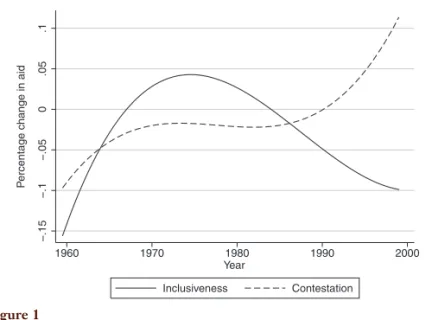
Foreign aid and improvement incontestationandinclusiveness. The graph shows
time trends of the percentage change in aid resulting from an improvement in contestationandinclusivenessin the past two years.
standard deviation is 0.91 forcontestation and 1.05 for inclusion.) The data cover the years 1960–2000 but exclude countries with popula-tions less than one million in 1980. To capture time trends we use a cubic function, and we interact the indicators for changes in political institutions with the time trend. This results in the following specification forcontestation:
log(Aid)=log(Aid)t−1+MoreContest
+LessContest+MoreContest∗T
+LessContest∗T+T+log(GNPpercapita)
+log(population)+ζi+ε
where T is the vector of time trends: T =
(Time,Time2,Time3),ζ
i is a vector of
coun-try fixed-effects, andεis an error term. We use a similar equation forinclusion.
Figure 1shows how foreign aid allocation has responded to increases incontestation and inclusiveness over time. The aid reward for increased contestation is increasing over the sample period, to the 5%–10% range by the mid-1990s. Donors’ response to increases in contestationappears to be slightly negative for the 20 years preceding 1990 and strongly nega-tive in the 1960s—suggesting that donors actu-ally punished recipient countries for increased contestationduring this decade. Overall, though, the reward for improvedcontestationappears to be increasing over time. The pattern for inclu-siveness is less promising. The results suggest that donors actually punished increased inclu-sivenesswith less aid in the 1960s and again in the 1990s. Although the patterns during the Cold War may not be too surprising, the responses of donors to improvements incontestationand inclusivenessappear to work at cross-purposes during the 1990s, rewarding increased contes-tation but punishing increased inclusiveness.
We take these patterns as a starting point from which to enter the debate about aid effec-tiveness, drawing two preliminary conclusions. First, we might only expect aid to have a positive effect on growth and development in the post– Cold War world, in which donors could at least plausibly be viewed as being less influenced by alliance politics (Bearce & Tirone 2009). This
calls into question the conclusions of empiri-cal studies of foreign aid effectiveness that rely heavily on data from before 1990. Put another way, is it fair to judge the current state of foreign aid by looking at historical data, when we know that aid was distributed and used under condi-tions very different from those we face today?
A second, albeit very tentative, conclusion from this descriptive analysis suggests that any improvements over time in the way donors distribute foreign aid may be the result of an increased focus on political contestation— essentially more elections and/or perhaps more competitive elections. If increased political competition is indeed the best way to ensure that aid money is well spent, then these results suggest a genuine improvement over time. However, recent work calls into question the helpfulness of donor-induced elections in countries with weak states and little social cohesion (Collier 2009). Some find that democracy actually increases the risk of political violence in poor (and hence heavily aid-dependent) countries (Collier & Rohner 2008), and the violence following the most recent Kenyan election is a sobering reminder of the need for caution (Ksoll et al. 2009). The singular focus on contestation may miss an important avenue through which aid can foster growth: inclusion. Theories that stress the re-distributive implications of democracy suggest that democratic institutions credibly lock-in power for poorer voters who prefer more government redistribution—and presumably prefer more propoor government policy. If the mechanism through which aid promotes growth runs through government policies that better reflect the interests of the poor, and if inclusive political institutions are necessary to guarantee propoor policies, then the post–Cold War changes to aid allocation patterns may not actually change the aid/growth relationship. Nonetheless, the possibility that foreign aid distribution follows very different patterns before and after 1990 should lead us to think theoretically about what has changed in the modalities of foreign aid since the end of the Cold War.
We again emphasize that this is an area where the causal mechanisms that link aid to growth matter crucially. Is aid conditionality now credible to the extent that foreign aid can more forcefully encourage countries to pur-sue progrowth policies? If so, giving condi-tional aid to even poorly governed states (that have an incentive to trade reform for aid) may spur growth. Or does the allocation pattern instead reflect the fact that donors now have the freedom and know-how to target the right kind of aid to each kind of recipient, for ex-ample, forsaking direct transfers to govern-ments in poorly governed countries and instead only sending disaster relief that bypasses the government?1
In the next section, we discuss the chal-lenges of establishing exogeneity in aid/growth regressions. This is a challenge in many types of empirical studies, but it poses particular dif-ficulties for those studying the effect of aid on economic growth, in part because donors may be likely to give aid precisely to those countries with poor growth records. The final section ex-amines the causal mechanisms through which foreign aid might affect economic growth: Can aid improve growth-promoting capital spending? Can aid buy growth-promoting reform? This discussion helps us pinpoint how political institutions fit into the aid/growth nexus by positing that politics can be viewed as both an exogenous constraint that conditions the causal process linking aid to growth and an endogenous factor that is affected by foreign aid, which in turn impacts economic growth.
1This modality of aid-giving is fraught with its own prob-lems. Donors must find appropriate nongovernmental part-ners to distribute aid. Operating outside of official channels makes coordination of relief efforts more difficult, and, at an extreme, external financing may displace efforts that govern-ments would have made. For example, some observers blame international relief aid distributed directly to refugees in east-ern Congo after the Rwandan genocide for strengthening the Hutu militias and genocidaires (Wrong 2001). On the other hand, a review of relief aid in Aceh following the December 2004 tsunami credits some of the humanitarian success to the Indonesian government’s prominent role in organizing external funds (Masyrafah & McKeon 2008).
THE CHALLENGES OF
ESTABLISHING EXOGENEITY IN AID/GROWTH REGRESSIONS
A perpetual challenge of cross-country growth regressions is to establish the exogeneity of aid to ensure that the equation does not simply pick up the extent to which growth outcomes affect the allocation of aid. The most common way to address this concern is to use instruments for aid, which in turn requires that the variables employed as instruments are correlated with aid but not causally related to growth. For exam-ple, the seminal Burnside & Dollar (2000) paper uses a set of instruments that includes indica-tors for some plausibly exogenous facindica-tors such as known strategic aid relationships, but it also includes interactions between their macroeco-nomic policy index and population and GDP per capita. It is not entirely clear why these pol-icy interactions would be exogenous to growth, which may mean that their first-stage regres-sions violate one of the key criteria for instru-ment validity (Clark et al. 2006). Further, the instruments cannot be correlated with factors other than aid that are also causally linked to growth (Bazzi & Clemens 2009, Deaton 2009). Another variable frequently used as an instru-ment is arms imports. However, this variable is likely to be correlated with things such as civil conflict and coups that also affect growth, calling into question its usefulness as an instru-ment even before we consider the fact that aid might be causally related to military spending, coups, and conflict (Grossman 1992; Collier & Hoeffler 2002, 2007).
In addition, many aid/growth regressions use geographic or regional indicator variables as instruments. For example, dummy variables for Egypt or the franc currency zone are sometimes employed as instruments because they represent strategic aid allocation that is unlikely to be causally related to growth outcomes. However, these instruments have no temporal variation, which limits inferences about how aid affects growth over time. Werker et al. (2009) use oil-price fluctuations as an
instrument for aid from OPEC countries, in part because variation in oil prices over time circumvents this issue. They find that aid has no effect on growth but depresses domestic sav-ings and increases consumption of noncapital imports.
Some scholars suggest that the political and strategic determinants of aid, such as rotating membership on the U.N. Security Council or colonial relationship with a donor, may provide useful instruments for aid because these factors are causally unrelated to growth (e.g., Powell & Bobba 2007, Rajan & Subramanian 2008). However, if we believe that strategic aid should have little effect (or even a negative effect) on growth, but that nonstrategic aid can increase growth, then using strategic variables as instru-ments for aid will only pick up the causal effect of the type of aid that is unlikely to be correlated (or negatively correlated) with growth (Bearce & Tirone 2009). If there is causal heterogeneity among the different types of aid (strategic and nonstrategic), then strategic instruments may be of little use in modeling the impact of the most potentially effective type of aid (Dunning 2008).
Finally, Roodman (2008b) points out that much of the empirical aid/growth literature uses a dependent variable that is endogenous by construction. Foreign aid is often standard-ized by GDP (Aid/GDP). Because the depen-dent variable is economic growth, or change in GDP, an increase in GDP may entail a decrease in Aid/GDP. Thus, by construction, the causal arrow points from growth to aid. To circum-vent this problem, it may be better to standard-ize aid by population or simply to lag the aid variable. Bearce (2009) and Bearce & Tirone (2009) follow this latter strategy, in part because lagging aid also captures their causal mecha-nism; they argue that aid takes some years to cause economic reform, which in turn takes some time to affect growth. Rajan & Subra-manian (2008) also experiment with different lags of aid, but they find no consistent effect on growth.
HOW POLITICS ENTERS THE AID/GROWTH NEXUS
Researchers commonly cite two basic causal mechanisms through which foreign aid can af-fect growth. The first explanation, and the one most often used historically to justify large aid donations, argues that aid can increase capital spending in the recipient country (Rosenstein-Rodan 1943, Chenery & Strout 1966). Begin-ning with an early generation of development economists, implemented by the big-push the-orists in the immediate postcolonial period, and finding favor most recently with Sachs (2004) and his colleagues at the United Nations, this mechanism suggests that aid will translate into capital spending and that this capital spending will in turn lead to growth. Poor countries in tropical Africa face a dearth of domestic savings and thus do not have the necessary capital to jump-start sustained growth. According to this argument, massive infusions of well-targeted aid will push these countries past the capital threshold and toward sustained growth. Sachs’ study makes the bold claim that in tropical Africa more aid is precisely what is needed.
This causal mechanism has two steps—both of which entail assumptions about the role of politics. First, politics might condition the re-lationship of aid to capital. Corrupt politicians in recipient governments may pocket aid well before it makes its way from the treasury to the budget. As Collier (2009) notes, politicians in poor countries often use their positions in of-fice to amass personal fortunes. Political science is rife with studies linking political institutions to corruption (Persson et al. 2003, Chang 2005, Chang & Golden 2007), and scholars have long noted a strong correlation between corruption and arrested economic growth (Mauro 1995, Ades & di Tella 1999, Treisman 2000). Com-bining these insights suggests that political in-stitutions that breed corruption may affect the relationship between aid and growth. Also, even when aid makes its way into the budget, gov-ernments often spend the resources on con-sumption goods rather than investment (Boone 1996), which may explain why aid increases
spending even when government revenue declines (Remmer 2004).
Second, capital spending must promote growth. However, not all capital spending is equal. While development economists have been relatively successful in identifying types of capital spendingoutcomesthat promote eco-nomic growth (e.g., Papageorgiou 2003), polit-ical scientists have constructed many theories to suggest when and why politicians spend on pro-grams that are more likely to reach larger seg-ments of society (Bueno de Mesquita et al. 2003) and promote growth (e.g., Stasavage 2005 and Hicken & Simmons 2008) and not simply re-sult in inefficient patronage spending ( Jackson & Rosberg 1984; van de Walle 2001, 2003; Golden 2003).
If capital spending were the only mechanism through which foreign aid affected economic growth, it would be relatively straightforward to use the insights from political science to un-derstand how politics conditions the aid/growth relationship. The political institutions in a country—institutions that facilitate rent seek-ing or not, that facilitate corruption or not, that facilitate accountability or not—determine how aid resources get spent. In this scenario, how-ever, institutions remain exogenous: They con-dition the relationship between aid and growth, but the effect of aid on growth does not flow endogenously through aid’s effect on the insti-tutions themselves.
Treating institutions as a conditional but exogenous factor follows the lead of Burnside & Dollar (2000), who posited that the correct
macroeconomic policy environment was
sufficient for aid to spur growth. Instead of pinpointing economic policies, the research linking political institutions to corruption and patronage spending suggests that giving aid to recipients with a good political or governance environment means aid will promote growth. Conversely, giving aid to a country with a bad environment simply wastes aid (Dollar & Burnside 2004). According to this logic, the worst-case scenario merely entails aid being wasted; that is, if political institutions are
exogenous, aid is not “perverse,” “pernicious,” or a “curse.”
The second mechanism through which for-eign aid can affect growth is by changing the political or economic institutions of an aid-receiving country. Many foreign-aid critics im-plicitly finger this mechanism when offering theories and evidence to suggest that aid is “pernicious” or a “curse” similar to a natural resource curse (Friedman 1958, Bauer 1971, Djankov et al. 2008, Moyo 2009). The relation-ship runs both directly through the impact of external resources on the domestic institutions handling those resources and also through the use of foreign aid as a tool by which donors can “buy” economic or political reforms.
The direct link between aid and institu-tions is seen in theories suggesting that aid creates incentives for increased rent-seeking behavior (Svensson 2000a, Hodler 2007). Un-der this scenario, foreign aid increases the size of the revenues available for rent-seeking, and more (nontax) revenue increases rent-seeking behavior (Torvik 2002), which in turn stunts growth by introducing economic and bureau-cratic inefficiencies (Krueger 1974, Murphy et al. 1993). The other link between aid and in-stitutions suggests that donors can threaten to withhold foreign aid unless the recipient coun-try pursues economic reforms or improves gov-ernance (Svensson 2000b). This aid condition-ality should result in national institutions and policies that improve economic growth.
We proceed by reviewing the evidence of the conditional impact of foreign aid depending on the quality of governing institutions; then we return to the question of whether or not aid af-fects the quality of institutions. We also discuss how conditionality has changed over time and how the composition of aid flows has changed.
Do Political Institutions Condition the Aid/Growth Relationship?
Burnside & Dollar (2000) confirmed much of the conventional wisdom in the economic-development community at the time: Eco-nomic policy matters, and inducing orthodox
neoclassical economic policy reform is not only good for growth but also makes foreign aid more effective. [Some scholars have criticized the paper for being politically motivated, with the goal of endorsing neoclassical economic orthodoxy (Stein 2008).] This avenue of the research on aid effectiveness has since been dissected to the point where scholars, far from finding consensus on the relationship between aid and growth, can describe the state of the empirical literature as “anarchy” (Roodman 2007). In the most comprehensive set of panel and cross-section tests to date, Rajan & Subramanian (2008) find little consistent evidence that aid affects growth—one way or another. They analyze different time periods, various time horizons and lags, many types of assistance, distinct types of donors, and whether aid effectiveness is conditioned by geography or macroeconomic policy.
This literature, though, has only fleetingly looked at how the political or governance en-vironment might condition aid effectiveness. Some of the first attempts to examine whether aid was more effective in more democratic or more free regimes found either null results (Boone 1996) or some mildly positive results (Svensson 1999). Both of these studies, though intriguing, only included data up to 1989. Us-ing the same data set as many previous stud-ies (Easterly et al. 2004), Wright (2007) found largely null results for three different measures of democracy (Polity, Freedom House, and a binary indicator), suggesting that democracy, at least as we frequently measure it, does not con-dition the relationship between foreign aid and economic growth.
However, others have found that some political environments are more conducive to effective aid. In a follow-up to their original article, Dollar & Burnside (2004) replace their macroeconomic policy index with a measure of institutional quality to show that foreign aid led to economic growth during the 1990s in coun-tries with good institutions. Looking beyond economic growth, Kosack (2003) demonstrates a conditional relationship where foreign aid has a negative effect on changes in a country’s
level of human development unless there is a sufficiently high level of democracy in the country. Kosack & Tobin (2006) similarly show that aid to countries with high human capital endowments is positively correlated with both economic growth and improvement in human development indices. Their argument emphasizes the role of government preferences in using aid to boost human development: Governments that already promote human capital are likely to use aid to promote further human development. Mosley et al. (2004) and Gomanee et al. (2005) show that aid can positively affect economic growth and human development once they account for the spending priorities of recipient governments, and Baliamoune-Lutz & Mavrotas (2010) find that social capital, measured as ethnolinguistic fractionalization, and institutional quality condition the aid/growth relationship.
At the level of individual aid projects, Isham et al. (1997) find that World Bank projects per-form better (in terms of their economic rate of return) in countries with better civil liber-ties. They provide evidence suggesting that the ability of citizens to engage in protest makes projects more effective. Similarly, Dollar & Levin (2005) show that World Bank projects are rated more satisfactory in countries that have higher-quality institutions (measured in several different ways). These papers support the con-tention that foreign aid will be more effective in the context of good institutions.
Some recent work looks even more specif-ically at the characteristics of particular governments and regimes. Wright (2008, 2010) separates aid-recipient nondemocracies and democracies to examine variation within regime type. In authoritarian regimes, Wright (2008) finds that a dictator’s time horizon conditions the relationship between aid and growth: Dictators who expect to remain in power for a long time appear better able to make use of foreign aid for economic growth. Building on research on the consequences of personalist electoral institutions (Carey & Shugart 1995, Hicken & Simmons 2008), Wright (2010) shows that political institutions
that provide an incentive to cultivate a personal vote negatively condition the relationship between foreign aid and economic growth.
These studies focus on the incentives par-ticular governments face over how to use for-eign aid, positing that “good” incentives lead to “good” aid outcomes. Dollar & Burnside (2004) employ a cross-national measure of in-stitutional quality, whereas Wright (2008, 2010) measures these incentives directly. Others di-rectly measure government spending priorities (Human Development Index, propoor spend-ing) and suggest that these condition the ef-fect of aid (Gomanee et al. 2005, Kosack 2003, Kosack & Tobin 2008, Mosley et al. 2004).
One recent finding on the conditional effect of political institutions implies that regime type affects whether or not aid can buy economic reforms that spur growth. Bearce (2009) posits that foreign aid conditionality is more likely to induce recipient governments to pursue eco-nomic reform when the political cost of reform is relatively low. He also contends that these re-forms are less costly for autocratic leaders, who do not face the same political pressures from re-form “losers” as democratic leaders. Autocratic leaders, therefore, are more inclined to respond to aid by pursuing reforms, and thus aid is more likely to spur growth in authoritarian govern-ments than in democracies. Bearce provides empirical evidence of this second step in the causal chain: He finds not only that aid increases growth, conditional on regime type, but that aid spurs economic reform, again conditional on regime type,andthat this reform improves growth. This is one of the first studies to trace the causal mechanism from aid to another fac-tor and then from that facfac-tor to growth, setting a high standard by showing empirical evidence consistent with each step in the causal chain.
How Does Aid Affect Political Institutions and Governance?
A long-running argument in the foreign-aid lit-erature claims that aid hinders political devel-opment by contributing to the develdevel-opment of “bad” institutions (Bauer 1971, Djankov et al.
2008). This view groups foreign aid together with other types of “unearned income” such as natural resource wealth to argue that non-tax revenue enables leaders to forgo non-taxing the citizenry, which results in a decreased demand for representative democracy and good gover-nance (Brautigam & Knack 2004; Moss et al. 2006; Morrison 2007, 2009; Djankov et al. 2008). This logic builds on the work of scholars such as Levi (1988), Tilly (1990), and North & Weingast (1989), who posit that democ-racy rests in part on the need for state leaders to generate revenue from citizens. In Western European political development, governments exchanged representative rule for the right to tax citizens, and these representative institu-tions, in turn, helped propel economic devel-opment (North 1990).
Foreign aid, therefore, severs the link between the ruler and ruled by reducing the “incentives for democratic accountabil-ity” (Djankov et al. 2008, p. 172) or ap-peasing demands from poorer citizens “and thereby prevent[ing] a. . .transition to democ-racy” (Morrison 2009, p. 113). Ultimately, this allows the government to forgo some of its re-sponsibilities for public goods provision and eq-uitable development (Moore 1998). Evidence also shows that aid reduces tax revenue and creases government consumption without in-creasing investment (Brautigam & Knack 2004, Remmer 2004). [However, Gupta et al. (2004) show that only grants (and not loans) adversely affect revenue collection.]
Some argue that foreign aid presents a moral-hazard problem for recipient govern-ments because they face little incentive to pur-sue growth-friendly policies if they know that donors will continually give them aid so long as they remain poor (Svensson 2000a). This claim suggests that recipient-country governments have an incentive to remain poor in order to re-ceive more foreign aid, so they deliberately pur-sue policies that hurt growth. As Easterly said in a now-famous quip, “The poor are held hostage to extract aid from the donors” (Easterly 2001, p. 116). Evidence suggests that countries are more risk acceptant when they expect large
aid inflows. For instance, loan recipients pur-sue monetary expansion and have higher bud-get deficits when they have exhausted less of their borrowing potential from the Interna-tional Monetary Fund (IMF) (Dreher & Vaubel 2004).
However, we need to examine whether the causal mechanisms that link aid to poor gover-nance and arrested political development vary across types of aid, types of donors, and types of recipient governments. In many cases, re-searchers outline the underlying causal mech-anisms they claim are at work without directly testing the arguments. As described above, aid might reduce the need for taxation, thereby re-ducing the demand for democratic accountabil-ity (Knack 2004, Djankov et al. 2008); or aid might increase the power of the president in democracies (Brautigam 2000); or aid might in-crease political instability by “making control of the government and aid receipts a more valu-able prize” (Knack 2004, p. 253)—reasoning similar to Grossman (1992). However, this re-search does not test these channels (taxation, presidential power, or coup attempts) of the aid curse; it only suggests that one of these expla-nations must be true if a negative correlation exists between aid and democracy.
Some recent research explicitly models the causal mechanisms that link aid (and nontax revenue generally) to political development. For example, Morrison (2007, 2009) argues that nontax revenue allows authoritarian governments to reduce the “demand for democracy” by increasing redistributive trans-fers to poor citizens who might otherwise press for democratization. This theory has observ-able implications both for the effect of foreign aid on regime stability and for its effect on redistributive policies under authoritarian rule and taxation under democracy: Aid increases regime stability, increases social spending in authoritarian countries, and decreases the tax take in democracies. If this is true, the effect of aid on political development might prop up both democracies and autocracies. Further, this theory implies that aid, while deterring democratization in authoritarian polities, may
do so precisely by increasing the welfare of the poorest citizens. Morrison advances our knowl-edge of the political effects of nontax revenue by carefully specifying a causal story and then providing empirical evidence consistent with at least three different implications of the theory. Smith’s (2008) model posits that when lead-ers are faced with a revolutionary threat, they can respond by either increasing or decreas-ing the supply of public goods, dependdecreas-ing on the (a priori) size of their support coalition. In regimes with large coalitions, an increase in nontax resources such as foreign aid or oil rev-enue provides leaders with the incentive to in-crease the supply of public goods, even though this may enhance the capacity of citizens to re-volt by reducing the costs of mobilizing mass political actions. However, increased provision of public goods also decreases the desire for revolution by increasing the citizens’ stake in the current regime. Alternatively, when lead-ers in small-coalition regimes meet with an in-crease in free resources, they respond to threats by decreasing the supply of public goods with little concern for deteriorating economic per-formance and declining tax revenue. In these regimes, the survival benefits of preventing rev-olution by further reducing public goods pro-vision outweigh the potential benefits of re-ducing the desire for revolution by increasing public goods provision. Therefore, in small-coalition regimes, nontax resources should de-crease public goods spending. This finding is the opposite of Morrison’s prediction of in-creased public goods spending in authoritarian states.
By highlighting varying causal mechanisms, as Morrison and Smith do, we can think through more carefully how aid affects po-litical development in different contexts in-stead of simply searching for average effects. That said, Smith’s theory does not account for the differences between types of nontax rev-enue, even though oil revenue and foreign aid are obtained through very different modali-ties (Collier 2006). Further, foreign aid can come with strong conditions from donors, and oil revenue is not necessarily exogenous to
tenure- or power-maximizing decisions of gov-ernment leaders (Dunning 2010).
The empirical literature on aid and insti-tutions is mixed. Consistent with aid critics, some researchers have found that aid is as-sociated with decreases in institutional qual-ity (Brautigam & Knack 2004) and democra-tization (Djankov et al. 2008), or that it has relatively little effect (either way) on democ-ratization or changes in political institutions (Knack 2004). However, others have found that aid is associated with higher levels of democ-racy (Goldsmith 2001), in particular during the post–Cold War period and in authoritarian regimes with large support coalitions (Wright 2009).
One explanation for these seemingly con-tradictory results may simply be that the pes-simistic findings generally estimate the average effect of foreign aid on political institutions or governance, whereas the more optimistic results stem from examining conditional ef-fects. Dunning (2004), for example, replicates Goldsmith’s (2001) finding that foreign aid is correlated with increases in democracy in Africa but then shows that this finding is only the result of post–Cold War processes, pre-sumably the result of increasingly effective aid conditionality.
Aid Conditionality: Variation in Donors, Recipients, and Time Periods
Donors often attach policy conditions to the aid that they provide. As Riddell (2007) describes, this is “one of the most controversial issues in the debate about whether aid works: the relationship between the overall impact of development aid, the policy advice given by donors, and the policies pursued by aid-recipient governments” (p. 231). The general goal of conditionality is to induce governments to undertake economic (or possibly political or institutional) reforms that will spur economic growth. (Critics of these reforms, however, suggest that liberalizing reforms are simply an attempt to open developing countries for the benefit of rich countries.) These reforms might
include lower budget deficits, fewer trade restrictions, or more secure property rights.
Conditions are often attached to large pro-grammatic loans, such as direct budgetary support, balance-of-payments support, or structural-adjustment lending. Unlike project loans, where money is allocated for the clear purpose of building a specific dam or improving irrigation systems in one area of the country or something similar, this type of lending—which tends to involve much larger dollar amounts— is meant to “support” the required reforms. Es-sentially it serves an equivalent function to the government borrowing money on open capi-tal markets for its annual budget, except that it comes with specific conditions attached and below-market interest rates. The money might be used, for example, to compensate the “losers” of the reforms if the reforms are politically costly (Heckelman & Knack 2007, Bearce 2009, Bearce & Tirone 2009). However, the appropri-ate price of particular reforms remains unclear. For example, should donors give $100 million, $250 million, or $500 million if they want a country to privatize its pension system?
Conditionality is important with project lending as well. Given the fungibility of aid funds (Feyzioglu et al. 1998), there may be the simple pair of conditions that project aid be used for its intended purpose and that the government not divert resources that it other-wise would have spent in that sector. The fear is that aid funds might allow the government to channel resources to sectors (e.g., military spending) that are likely to hurt rather than catalyze economic growth (Collier & Hoeffler 2007). Also, macroeconomic conditionality as-sociated with programmatic lending might lead to better investment project outcomes. Isham & Kaufmann (1999) refer to this as the “forgotten rationale for policy reform” and provide evi-dence showing that the economic rates of return for World Bank projects are higher in countries with better macroeconomic fundamentals.
Although donors have always attached some conditions to their aid, the heyday of condi-tionality was the 1980s and early 1990s, the era of structural adjustment. Whereas World Bank
loans came with an average of seven conditions in the early 1980s, at the peak of conditionality in 1993, they came with an average of around 45 different conditions attached (World Bank 2005). Some critics of conditionality argue that it rides roughshod over national sovereignty and amounts to a form of paternalistic neocolo-nialism (Murray 2005), while others claim that conditionality has simply been ineffectual in re-moving macroeconomic distortions or stimu-lating economic growth (Easterly 2005). Today, in the era of country partnerships and recipient-driven development brought about by the 2002 Monterrey Consensus on Financing for Devel-opment and the 2005 Paris Declaration on Aid Effectiveness, donors frame conditionality in terms of helping countries to choose which re-forms are most important to them rather than as an imposition from Washington, DC, or elsewhere. This more participatory approach evolved, in part, from the experience of having reforms revoked (World Bank 2002). Building a political consensus behind reforms can poten-tially make them more sustainable and hence effective (Morrison & Singer 2007).
Setting aside the questions of whether par-ticular economic reforms do spur growth, how the set of reforms for a given country is cho-sen, and whether increasing project prolifera-tion hampers aid effectiveness, the argument that conditionality can affect growth depends on (a) the donor’s credibility in imposing con-ditions and (b) the recipient’s incentives and ca-pacity to respond to conditionality by pursu-ing reforms. To understand whether and when conditionality can work, various scholars have examined how trading aid for reform varies by donor, recipient, and time period.
In an early work examining the political economy of structural adjustment, Dollar & Svensson (2000) find that democratic govern-ments and governgovern-ments that faced fewer crises were more likely to undertake reforms that the World Bank proposed, whereas governments that had been in power longer were less likely to undertake reform. They also find that eth-nic fragmentation has a nonlinear relationship with reform. Using these political-economy
variables, the authors correctly predict the di-rection of 75% of reform outcomes and note that adding donor variables makes no improve-ment to their models’ predictive power. Build-ing on Kono & Montinola’s (2009) insight that current aid has a higher marginal effect on polit-ical survival for democratic leaders than for dic-tators, Montinola (2008) posits that aid can buy fiscal reform in democracies but not in autoc-racies. Using similar reasoning, Girod (2007) argues that postconflict resource-poor coun-tries have no option but to pursue the politi-cal and economic reforms outlined by donors because these governments lack other rev-enue sources. Resource-rich postconflict gov-ernments, she argues, have the capacity to re-sist requested reforms. Thus, postconflict aid is most likely to spur growth in resource-poor countries. Bearce (2009), in contrast, argues that aid can successfully buy reform in autoc-racies but not in democautoc-racies because reform losers can more effectively block economic re-form in democracies.
All these theories argue that the political costs of complying with aid conditionality and the political benefits of aid itself vary by recipi-ent country. However, none of this research ad-dresses the capacity of recipient governments to pursue and implement economic reform. World Bank negotiations with officials in the former Zaire produced laughable (and ulti-mately tragic) anecdotes of donor officials pres-suring President Mobutu Sese Seko to pursue reform while his army melted away and the state collapsed (Prunier 2009). Ultimately only some recipient countries have sufficient state capac-ity and control over their own territory to ab-sorb aid and implement reform (Herbst & Mills 2009).
Other researchers focus on variation among donors, arguing that some donors in some time periods can more effectively impose credible conditions on aid. Heckelman & Knack (2007) examine the direct link between aid and eco-nomic reform and find that during the period 1980–2000, aid slowed economic policy reform in recipient countries. However, the negative effect of aid appears to be concentrated in the
1980s, suggesting that conditionality may have been more effective in the post–Cold War pe-riod, presumably because of changed donor at-titudes. Bearce & Tirone (2009) examine the aid-reform bargain from the donor’s side to posit that aid can only incentivize economic re-form in recipient countries where donors do not have strategic goals. Thus, bilateral aid during the Cold War was ineffective in promoting re-form because donors could not credibly com-mit to withdrawing aid from strategically im-portant recipients even when reform was not forthcoming, but in the post–Cold War era, donors can make more credible threats to with-draw aid. Girod (2008) also focuses on the dis-tinction between donors, arguing that because multilateral donors are not beholden to strate-gic interests, they can distribute aid for devel-opmental purposes and effectively target aid to countries that pursue economic reforms. Mul-tilateral aid is therefore likely to spur growth, whereas bilateral aid will not. Using data from the 1990s, however, Stone (2004) finds that IMF conditions are less likely to be enforced in recip-ient countries with strong ties to donor govern-ments that maintain privileged influence on the IMF executive board, such as the United States, Britain, and France. This suggests that the poor record of IMF aid in Africa might be the re-sult of poorly enforced conditionality rather than the use of the wrong policy conditions (Vreeland 2003). Similarly, Crawford (1997) ar-gues that donors have been inconsistent in ap-plying the same standard to all recipients—even in the post–Cold War environment.
Vreeland’s (2003) argument focuses on how IMF program participation provides recipient governments with domestic political leverage to redistribute income upward, which hurts growth. Dreher’s (2006) analysis goes one step further to examine how both IMF program participation and compliance with IMF con-ditionality affect economic growth. He finds that overall participation in IMF programs re-duces growth but that compliance with loan conditions increases growth. Dreher implic-itly focuses on variation among donors. These arguments about IMF program participation
implicitly address domestic politics and could be expanded by looking at variation among recipients.
Finally, scholars have modeled condition-ality as strategic interaction between donor and recipient. Svensson (2000b), for example, examines a conditionality game with one donor and multiple recipients, while Stone (2002) introduces investors as a third player in addition to donor and recipient. In practice, recipient governments often deal with two or more donors of different types. Sometimes this occurs sequentially, as in Ethiopia, when Col. Mengistu Haile Mariam switched from Soviet to U.S. sponsorship; other times recipient countries were able to obtain aid from differ-ent donor types simultaneously. In the 1960s, Tanzania received Western aid for public health and education while simultaneously convincing the Chinese to build a railroad. During the Cold War period, aid from the Soviet Union and the Soviet bloc countries (and to a lesser extent China) was the main alternative to Western aid, whereas recently Chinese aid to Africa has increased substantially as the Chinese economy has grown (Tull 2006, Lancaster 2007, Woods 2008). This has brought renewed concern that other authoritarian countries, such as Iran, have entered the aid game, presumably to the detri-ment of democracy (Freedom House 2009). Models with two competing donor types could provide insight on how aid affects economic re-form if the two donor types have different con-ditions or different levels of enforcement. To date, though, we lack systematic cross-country data on non-Western aid that is comparable across time with Western aid to empirically test such a model. However, this should not stop us from thinking through the implications of aid in a world of competing donors. The recent rise in aid from non-Western authoritarian countries points toward the possibility that a world with only one (Western) type of donor might have been a relatively rare historical episode in the 1990s, sandwiched between longer periods with at least two types of donors—Soviet bloc aid during the Cold War and current Chinese aid (Lancaster 2007).
Recently, Zimbabwe’s unity government of President Robert Mugabe (Zimbabwe African National Union-Patriotic Front) and Prime Minister Morgan Tsvangirai (Movement for Democratic Change) has secured promises of nearly $1 billion in aid from China but only $500 million from Western donors. In a seeming replay of the Cold War, Kyrgyzstan has recently accepted aid from both Russia and the United States in exchange for permission to plant military bases on their territory.
Types of Aid
Thinking through whether and how condition-ality works or fails and understanding how the presence of non-Western aid affects the be-havior of recipient countries raises the larger point of how different types of aid may be use-ful for testing distinct claims about the causal mechanisms that link aid to growth. Most stud-ies examining the relationship between aid and growth use some form of the OECD Develop-ment Assistance Committee data, aggregated across all sectors and all donors (Burnside & Dollar 2000, Easterly et al. 2004, Roodman 2007). However, researchers may better cap-ture the causal process by analyzing aid by type or donor. For example, Girod (2008) and Mon-tinola (2008) argue that conditionality is only likely to work when the donor is not faced with competing strategic interests, and thus these authors look at multilateral aid. Clemens et al. (2004) suggest that we should not ex-pect all types of aid to be positively corre-lated with growth, and thus they disaggregate aid by type. They distinguish between short-term aid (budget support, infrastructure invest-ment, and agricultural and industrial support), which could plausibly increase growth in the near term, and other types of aid such as disaster relief (which should be correlated with negative growth) and education spending (which should be correlated with long-term but not short-term growth). They find that short-short-term aid does lead to economic growth unconditionally and with diminishing returns. In contrast, Rajan & Subramanian’s (2008) comprehensive survey
of aid/growth regressions examines aid’s long-and short-term effects as well as different lagged specifications but yields little evidence that any type of aid systematically increases growth.
Disaggregating data by type, sector, and pur-pose also allows researchers to more precisely assess the causal effect of aid on particular out-comes, such as health (Gebhard et al. 2008, Ravishankar et al. 2009), education (Dreher et al. 2008), the environment (Hicks et al. 2008), and democracy (Finkel et al. 2007, Stevens et al. 2007, Nielsen & Nielson 2008). The Project-Level Aid Database (PLAID) codes individ-ual development assistance projects commit-ted by bilateral and multilateral donors since 1970. These complete and consistent project-level aid data have already begun to bear fruit. For example, Hicks et al. (2008) use them to explore why environmentally “friendly” aid has increased over time and why many “unfriendly” aid projects persist. The PLAID data not only specify project purpose but also code the par-ticular organizational beneficiary of the aid within the recipient country. This will allow re-searchers to examine one of the most pertinent issues in the aid debate (Easterly 2006): whether giving aid directly to governments or skirting governments in favor of nongovernmental or-ganizations is the best way to distribute aid.
CONCLUSION
Since Burnside & Dollar (2000) opened the aid/growth floodgate a decade ago, we have seen a profusion of cross-country regression analysis trying to determine what effect, if any, foreign aid has on economic growth. In this vast literature, scholars have changed model speci-fications, first-stage instruments, treatments of outliers, lag structures, definitions of aid, inter-action terms, and more in attempts to find a
robust link between aid and growth. In this ar-ticle, we have emphasized that, for all that has been done already, much works remains, espe-cially in explicitly recognizing how politics en-ters into the aid/growth relationship.
First, we pointed out that international pol-itics affects aid allocation as well as the cred-ibility of aid conditions. In looking for a rela-tionship between aid and growth, we need to be attentive to whether or not international poli-tics constrains how aid money can be used and whether or not a recipient government thinks future aid money will be forthcoming.
Second, we discussed the ways in which governments might use an influx of revenue, depending on the political institutions that ex-ist. From studying the politics of redistribution and the politics of rent-seeking, political scien-tists have a comparative advantage in analyzing the causal pathways through which aid might lead (or not) to capital investment, economic reform, and ultimately economic growth. We have stressed throughout this article that many studies in the aid/growth literature have come up short in specifying exactly how aid could lead to growth. Future research must pay more attention to what happens to the money once it enters a country’s national budget. This becomes more pressing if aid agencies do not even know where their aid money goes, much less how it is spent (Ravishankar et al. 2009).
Some scholars have thought a lot about how aid affects the governing institutions and pol-itics of recipient countries. This work is and will continue to be a crucial part of studying aid and growth. Foreign aid is not only ex-ogenously affected by political institutions but also—particularly in countries with a sizeable aid-to-GDP ratio—endogenously determines the form of those institutions.
DISCLOSURE STATEMENT
The authors are not aware of any affiliations, memberships, funding, or financial holdings that might be perceived as affecting the objectivity of this review.
ACKNOWLEDGMENTS
The authors are grateful to David Bearce, Dan Nielson, an anonymous reviewer, and especially Kevin Morrison for helpful comments on earlier drafts of this paper.
LITERATURE CITED
Ades A, di Tella R. 1999. Rents, competition, and corruption.Am. Econ. Rev.89(4):982–93
Alesina A, Dollar D. 2000. Who gives foreign aid to whom and why.J. Econ. Growth5(1):33–63
Alesina A, Weder B. 2003. Do corrupt governments receive less aid?Am. Econ. Rev.92(4):1126–37
Andersen TB, Hansen H, Markussen T. 2006. US politics and World Bank IDA-lending.J. Dev. Stud.
42(5):772–94
Baliamoune-Lutz M, Mavrotas G. 2009. Aid effectiveness: looking at the aid–social capital–growth nexus.Rev.
Dev. Econ.13(3):510–25
Bauer PT. 1971.Dissent on Development. London: Weidenfield & Nicholson
Bazzi S, Clemens M. 2009.Blunt instruments: on establishing the causes of economic growth. Cent. Global Dev.
http://www.cgdev.org/content/publications/detail/1422132
Bearce D. 2009.Why foreign aid may be less effective at promoting economic growth in more democratic countries.
Unpublished manuscript, Univ. Pittsburgh
Bearce D, Tirone D. 2009.Foreign aid, recipient growth, and the strategic goals of donor governments. Unpublished
manuscript, Univ. Pittsburgh
Bermeo S. 2008.Donors and development: the use of sector allocation as a tool in foreign aid policy. Unpublished
manuscript, Princeton Univ.
Bobba M, Powell A. 2007. Aid effectiveness: politics matters. Unpublished manuscript. Available at
http://www.eui.eu/Personal/Researchers/Sartarelli/bobba Dc1072.pdf
Boone P. 1996. Politics and the effectiveness of foreign aid.Eur. Econ. Rev.40(2):289–329
Brautigam D. 2000.Aid Dependence and Governance. Stockholm: Almqvist & Wiksell Int.
Brautigam D, Knack S. 2004. Foreign aid, institutions, and governance in sub-Saharan Africa.Econ. Dev.
Cultur. Change52:255–85
Bueno de Mesquita B, Smith A, Siverson R, Morrow J. 2003.Logic of Political Survival. Cambridge, MA: MIT
Press
Burnside C, Dollar D. 2000. Aid, policies, and growth.Am. Econ. Rev.90(4):847–68
Carey J, Shugart M. 1995. Incentives to cultivate the personal vote: a rank ordering of electoral systems.Elect.
Stud.14(4):417–39
Chang ECC. 2005. Electoral incentives for political corruption under open-list proportional representation. J. Polit.67(3):716–30
Chang ECC, Golden M. 2007. Electoral systems, district magnitude, and corruption.Br. J. Polit. Sci.37(1):115–
37
Chenery HB, Strout AM. 1966. Foreign assistance and economic development.Am. Econ. Rev.56(4):679–733
Claessens S, Cassimon D, van Campenhout B. 2009. Evidence on changes in aid allocation criteria.World
Bank Econ. Rev.23(2):185–208
Clark WR, Doces JA, Woodberry RD. 2006.Aid, Protestant missionaries and growth. Unpublished manuscript,
Univ. Mich.
Clemens M, Radelet S, Bhavnani R. 2004.Counting chickens when they hatch: the short-term effect of aid on growth.
Work. Pap. 44, Cent. Global Dev.
Collier P. 2006. Is aid oil? An analysis of whether Africa can absorb more aid.World Dev.34(9):1482–97
Collier P. 2009.War, Guns, and Votes: Democracy in Dangerous Places. New York: HarperCollins
Collier P, Hoeffler A. 2002. Aid, policy and peace: reducing the risks of civil conflict.J. Defense Econ. Peace
13(6):435–50
Collier P, Hoeffler A. 2007. Unintended consequences: Does aid promote arms races?Oxf. Bull. Econ. Stat.
69(1):1–27
Collier P, Rohner D. 2008. Democracy, development, and conflict.J. Eur. Econ. Assoc.6(2–3):531–40
Coppedge M, Alvarez A, Maldonadoa C. 2007. Two persistent dimensions of democracy: contestation and
inclusiveness.J. Polit.70:632–47
Crawford G. 1997. Foreign aid and political conditionality: issues of effectiveness and consistency. Democratization4(3):69–108
Dahl R. 1971.Polyarchy: Participation and Opposition. New Haven, CT: Yale Univ. Press
Dalgaard C-JL, Hansen H, Tarp F. 2004. On the empirics of foreign aid and growth.Econ. J.114(496):191–216
Deaton A. 2009.Instruments of development: randomization in the tropics, and the search for the elusive keys to
economic development. NBER Work. Pap. 14690
Djankov S, Montalvo JG, Reynal-Querol M. 2008. The curse of aid.J. Econ. Growth13(3):169–94
Dollar D, Burnside C. 2004.Aid, policies, and growth: revisiting the evidence. World Bank Policy Res. Work. Pap.
Ser. 3251. Available athttp://ideas.repec.org/p/wbk/wbrwps/3251.html
Dollar D, Svensson J. 2000. What explains the success or failure of structural adjustment programmes?Econ.
J.110:894–917
Dollar D, Levin V. 2005.Sowing and reaping: institutional quality and project outcomes in developing countries.
World Bank Policy Res. Work. Pap. 3524
Dollar D, Levin V. 2006. The increasing selectivity of foreign aid, 1984–2003.World Dev.34(12):2034–46
Dreher A. 2006. IMF and economic growth: the effects of programs, loans, and compliance with conditionality. World Dev.34(5):769–88
Dreher A, Sturm J-E, Vreeland JR. 2009. Development aid and international politics: Does membership on
the UN Security Council influence World Bank decisions?J. Dev. Econ.88(1):1–18
Dreher A, Thiele R, Nunnenkamp P. 2008. Does aid for education educate children? Evidence from panel
data.World Bank Econ. Rev.22(2):291–314
Dreher A, Vaubel R. 2004. Do IMF and IBRD cause moral hazard and political business cycles? Evidence
from panel data.Open Econ. Rev.15(1):5–22
Dunning T. 2004. Conditioning the effects of aid: Cold War politics, donor credibility, and democracy in
Africa.Int. Org.58(2):409–23
Dunning T. 2008. Model specification in instrumental-variables regression.Polit. Anal.16(3):290–302
Dunning T. 2010. Endogenous oil rents.Comp. Polit. Stud.43: In press
Easterly W. 2001. The lost decades: developing countries’ stagnation in spite of policy reform 1980–1998. J. Econ. Growth6(2):135–57
Easterly W. 2005. What did structural adjustment adjust? The association of policies and growth with repeated
IMF and World Bank adjustment loans.J. Dev. Econ.76(1):1–22
Easterly W. 2006.The White Man’s Burden: Why the West’s Efforts to Aid the Rest Have Done So Much Ill and So
Little Good. New York: Penguin Press HC
Easterly W, Levine R, Roodman D. 2004. Aid, policies, and growth: comment.Am. Econ. Rev.94(3):774–80
Easterly W, Pfutze T. 2008. Where does the money go? Best and worst practices in foreign aid.J. Econ.
Perspect.22(2):29–52
Feyzioglu T, Swaroop V, Zhu M. 1998. A panel data analysis of the fungibility of foreign aid.World Bank Econ.
Rev.12(1):29–58
Finkel S, P´erez-Li ˜n´an A, Seligson M. 2007. The effects of U.S. foreign assistance on democracy building,
1990–2003.World Polit.59(3):404–40
Freedom House. 2009.Undermining democracy: 21st century authoritarians. Washington, DC: Freedom House.
Available athttp://www.underminingdemocracy.org/index.php
Frey B, Schneider F. 1986. Competing models of international lending activity.J. Dev. Econ.20(2):225–45
Friedman M. 1958. Foreign economic aid.Yale Econ. Rev.47(4):500–16
Gebhard N, Kitterman K, Mitchell AA, Nielson D, Wilson S. 2008.Healthy aid? Preliminary results on health
aid effectiveness. Presented at Annu. Meet. Am. Polit. Sci. Assoc., Boston
Girod D. 2007.Why being resource poor helps postwar development. Unpublished manuscript, Stanford Univ.
Girod D. 2008.Cut from the same cloth? Bilateral vs. multilateral aid.Presented at Annu. Meet. Am. Polit. Sci.
Assoc., Boston
Golden M. 2003. Electoral connections: the effects of the personal vote on political patronage, bureaucracy
and legislation in postwar Italy.Br. J. Polit. Sci.33(2):189–212
Goldsmith A. 2001. Foreign aid and statehood in Africa.Int. Organ.55:123–48
Gomanee K, Morrissey O, Mosley P, Verschoor A. 2005. Aid, government expenditure, and aggregate welfare. World Dev.33(3):355–70
Grossman HI. 1992. Foreign aid and insurrection.Defense Econ.(3):275–88
Gupta S, Clements B, Pivovarsky A, Tiongson E. 2004. Foreign aid and revenue response: Does the
composi-tion of foreign aid matter? InHelping Countries Develop: The Role of Fiscal Policy, ed. B Clements, S Gupta,
G Inchauste, pp. 385–405. Washington, DC: Int. Monetary Fund
Hansen H, Tarp F. 2000. Aid effectiveness disputed.J. Int. Dev.12(3):375–98
Hansen H, Tarp F. 2001. Aid and growth regressions.J. Dev. Econ.64(2):547–70
Heckelman J, Knack S. 2007. Foreign aid and market-liberalizing reform.Economica75(299):524–48
Herbst J, Mills G. 2009. There is no Congo. Available athttp://www.foreignpolicy.com/story/cms.php?
story id=4763
Hickens A, Simmons J. 2008. The personal vote and the efficacy of education spending.Am. J. Polit. Sci.
52(1):109–24
Hicks RL, Parks BC, Roberts JT, Tierney MJ. 2008.Greening Aid? Understanding the Environmental Impact of
Development Assistance. Oxford, UK: Oxford Univ. Press
Hodler R. 2007. Rent seeking and aid effectiveness.Int. Tax Public Finance14(5):525–41
Hyde S, Boulding C. 2008.Political terror, election fraud, and foreign aid: When do donors withdraw aid to promote
democracy?Presented at Annu. Meet. Midwest Polit. Sci. Assoc., Chicago
Isham J, Kaufmann D. 1999. The forgotten rationale for policy reform: the productivity of investment projects. Q. J. Econ.114(1):149–84
Isham J, Kaufmann D, Pritchett LH. 1997. Civil liberties, democracy, and the performance of government
projects.World Bank Econ. Rev.11(2):219–42
Jackson RH, Rosberg CG. 1984. Personal rule: theory and practice in Africa.Comp. Polit.16(4):421–42
Knack S. 2004. Does foreign aid promote democracy?Int. Stud. Q.48(1):251–66
Kono DY, Montinola GR. 2009. Does foreign aid support autocrats, democrats, or both?J. Polit.71:704–18
Kosack S. 2003. Effective aid: how democracy allows development aid to improve the quality of life.World
Dev.31(1):1–22
Kosack S, Tobin J. 2006. Funding self-sustaining development: the role of aid, FDI and government in
economic success.Int. Org.60:205–43
Krueger A. 1974. The political economy of the rent-seeking society.Am. Econ. Rev.64(3):291
Ksoll C, Macchiovello R, Morjaria A. 2009.Guns and roses: the impact of the Kenyan post-election violence on
flower exporting firms. Work. Pap., Cent. Stud. Afr. Econ., Oxford Univ. Available athttp://www.csae. ox.ac.uk/workingpapers/pdfs/2009-06text.pdf
Lancaster C. 2007.The Chinese aid system. Cent. Global Dev. Available athttp://www.cgdev.org/content/
general/detail/13953
Lensink R, White H. 2001. Are there negative returns to aid?J. Dev. Stud.37(6):42–65
Levi M. 1988.Of Rule and Revenue. Berkeley: Univ. Calif. Press
Masyrafah H, McKeon JMJA. 2008.Post-Tsunami Aid Effectiveness in Aceh: Proliferation and Coordination in
Reconstruction. Washington, DC: Wolfensohn Cent. Dev. Brookings
Mauro P. 1995. Corruption and growth.Q. J. Econ.110(3):681–712
Montinola G. 2008. When does aid conditionality work? Davis: Univ. Calif. Press
Moore M. 1998. Death without taxes: democracy, state capacity, and aid dependence in the Fourth World. In Towards a Democratic Developmental State, ed. G White, M Robinson, pp. 84–124. Oxford, UK: Oxford Univ. Press
Morrison K. 2007. Natural resources, aid, and democratization: a best-case scenario.Public Choice131(3–
4):365–86
Morrison K. 2009. Oil, non-tax revenue, and the redistributional foundations of regime stability.Int. Org.
63(1):107–38
Morrison KM, Singer MM. 2007. Inequality and deliberative development: revisiting Bolivia’s experience with
the PRSP.Dev. Policy Rev.25(6):721–40