This is a repository copy of
Improving audio-visual speech recognition using deep neural
networks with dynamic stream reliability estimates
.
White Rose Research Online URL for this paper:
http://eprints.whiterose.ac.uk/121254/
Version: Accepted Version
Proceedings Paper:
Meutzner, H., Ma, N. orcid.org/0000-0002-4112-3109, Nickel, R. et al. (2 more authors)
(2017) Improving audio-visual speech recognition using deep neural networks with
dynamic stream reliability estimates. In: Proceedings of the 2017 IEEE International
Conference on Acoustics, Speech and Signal Processing (ICASSP 2017). 2017 IEEE
International Conference on Acoustics, Speech and Signal Processing (ICASSP 2017), 5-9
March 2017, New Orleans, Louisiana, USA. IEEE , pp. 5320-5324. ISBN 9781509041176
https://doi.org/10.1109/ICASSP.2017.7953172
[email protected]
https://eprints.whiterose.ac.uk/
Reuse
Unless indicated otherwise, fulltext items are protected by copyright with all rights reserved. The copyright
exception in section 29 of the Copyright, Designs and Patents Act 1988 allows the making of a single copy
solely for the purpose of non-commercial research or private study within the limits of fair dealing. The
publisher or other rights-holder may allow further reproduction and re-use of this version - refer to the White
Rose Research Online record for this item. Where records identify the publisher as the copyright holder,
users can verify any specific terms of use on the publisher’s website.
Takedown
If you consider content in White Rose Research Online to be in breach of UK law, please notify us by
IMPROVING AUDIO-VISUAL SPEECH RECOGNITION USING DEEP NEURAL
NETWORKS WITH DYNAMIC STREAM RELIABILITY ESTIMATES
Hendrik Meutzner
1, Ning Ma
2, Robert Nickel
3, Christopher Schymura
1, Dorothea Kolossa
1 1Insititute of Communication Acoustics, Ruhr-Universit¨at Bochum, Germany
2
Department of Computer Science, University of Sheffield, Sheffield S1 4DP, UK
3
Bucknell University, Lewisburg, PA, USA
ABSTRACT
Audio-visual speech recognition is a promising approach to tackling the problem of reduced recognition rates under adverse acoustic conditions. However, finding an optimal mechanism for combining multi-modal information remains a challenging task. Various methods are applicable for inte-grating acoustic and visual information in Gaussian-mixture-model-based speech recognition, e.g., via dynamic stream weighting. The recent advances of deep neural network (DNN)-based speech recognition promise improved perfor-mance when using audio-visual information. However, the question of how to optimally integrate acoustic and visual information remains.
In this paper, we propose a state-based integration scheme that uses dynamic stream weights in DNN-based audio-visual speech recognition. The dynamic weights are obtained from a time-variant reliability estimate that is derived from the au-dio signal. We show that this state-based integration is su-perior to early integration of multi-modal features, even if early integration also includes the proposed reliability esti-mate. Furthermore, the proposed adaptive mechanism is able to outperform a fixed weighting approach that exploits oracle knowledge of the true signal-to-noise ratio.
Index Terms— audio-visual speech recognition, deep
neural networks, feature fusion, dynamic stream weighting 1. INTRODUCTION
Despite many recent advances in the field of automatic speech recognition, there is still room for improvement regarding the robustness against non-stationary environmental noise, which is often present in real world applications, e.g., in distant talk-ing scenarios. Audio-visual speech recognition (AVSR) ame-liorates this problem by including additional visual informa-tion to preserve or even improve the recogniinforma-tion performance under harsh environmental conditions.
A common approach to integrating acoustic and visual information is to combine the likelihood estimates of both modalities in a weighted fashion. However, finding an op-timal weighting scheme that appropriately considers the reli-ability of each modality is a challenging task.
The approach of dynamic stream weight estimation has proven to be advantageous for combining the acoustic and vi-sual information in purely statistical systems that are based on hidden Markov models (HMMs) modeling the state output densities using Gaussian mixture models (GMMs) [1, 2]. Re-cent studies have shown that deep neural networks (DNNs) can yield significant improvements for AVSR compared to generative statistical models. However, most studies only utilize the audio and video information at hand and do not consider additional stream reliability measures to inform the multi-modal integration process [3, 4, 5, 6].
In this paper, we analyze the efficacy of using an addi-tional reliability measure, i.e., dynamically estimated signal-to-noise ratios (SNR) of the acoustic modality, to better inte-grate the acoustic and visual features in a DNN-based recog-nition system. We compare the performance of two different integration methods, namely fusing the audio, video and reli-ability features at the DNN input layer (early integration) ver-sus a state-based integration scheme that uses dynamic stream weights based on the same reliability estimate.
2. RELATED WORK
Thangthai et al. [3] report that a HMM-DNN hybrid system is superior to an HMM-GMM-based recognizer when using a simple concatenation of audio and video features without additional weighting of the individual modalities. Noda et al. [4] and Ninomiya et al. [5] utilize multi-stream HMMs for integrating audio-visual features that have been derived from deep learning architectures, where the integration of streams is based on manually optimized weights. Huang and Kings-bury [6] investigate the fusion of mid-level features by con-catenating the hidden representations of single-modality deep belief networks (DBNs) and using the result as the input to an audio-visual DBN. Heckmann et al. [7] compare different criteria, i.e., entropy, dispersion and voicing index, for com-bining the audio and video a-posteriori probabilities estimated by an artificial neural network on a number recognition task.
This project was supported by the German research foundation DFG (project KO3434/4-1), the EU FET grant TWO!EARS (ICT-618075), and by the DFG Research Training Group GRK 1817/1.
3. SYSTEM OVERVIEW
We utilize a hybrid system based on HMMs for modeling the temporal structure of the audio-visual speech signals. The HMM state observation probabilities are estimated by a feed-forward DNN using the observed feature sequence. The speech recognizer has been implemented using the Kaldi speech recognition toolkit [8], which was extended to support stream weighting for combining multiple modalities.
We start by training a conventional HMM-GMM-based triphone recognizer using feature space maximum likelihood linear regression (fMLLR) [9] and speaker adaptive training on top of LDA1-transformed features [10], where we follow the standard recipe provided by the Kaldi baseline scripts for the CHiME-2 [11] data. The input dimension of the LDA transform depends on the dimension of utilized features. When using a context window length of 7 frames (centered around the current frame) the output dimension of the LDA transform is 40 dimensions.
Next, we gradually build a feed-forward DNN to replace the generative model of the previous recognition system. The DNN layers are first initialized by means of restricted Boltz-mann machines that are pre-trained using the contrastive divergence algorithm [12]. The pre-trained layers are then stacked and fine-tuned by minimizing the per-frame cross-entropy. The fine-tuning makes use of the state alignments derived from a forced alignment by using an HMM-GMM system that was trained on clean data (cf. Sec. 4).
As a final step, we improve the DNNs by conducting sev-eral iterations of sequence-discriminative training using the state-level minimum Bayes risk (sMBR) criterion [13].
The input features of all DNN systems are temporally spliced versions of the LDA-fMLLR-transformed features used for the initial HMM-GMM system with a context win-dow length of 11 frames, corresponding to an input layer size of 440 dimensions. The networks consist of 6 hidden layers, each using a sigmoid activation function and the number of hidden units in each layer is 2048. The output layers use a soft-max function and consist of 1453 units that correspond to the individual triphone states in the HMM, which have been determined by decision tree clustering using the clean audio-only HMM-GMM system.
3.1. Feature types and noise estimation
We compare various feature types and feature combinations: 23-dimensional Mel filterbank features, 13-dimensional Mel frequency cepstral coefficients (MFCC), 32-dimensional ratemap features [14], and 13-dimensional Gammatone fre-quency cepstral coefficients (GFCC) [15]. The ratemap and GFCC features are motivated by the auditory system, as they encode a spectro-temporal representation of the auditory nerve firing rate that stems from the mechanotransduction process in the cochlea. This provides an interesting compari-son with the more commonly used features such as MFCCs.
1Linear discriminant analysis.
The 63-dimensional video features are obtained from a discrete cosine transform of the gray-scale images that con-tain the mouth regions, determined by the Viola-Jones algo-rithm, as in [16].
Our goal is to combine the acoustic and visual information in such a way as to reliably obtain better recognition rates than the best of the two single-modality systems. For this purpose, here, we utilize a time-variant stream reliability measure, and we evaluate two different approaches for its use—either an early integration of different modalities, including reliabili-ties, at the input layer of the DNN, or a weighted combination of the DNN posterior outputs, with the weighting controlled by the reliability measure. For this purpose, we measure the degradation—and thus the reliability—of the acoustic modal-ity using the Improved Minima Controlled Recursive Averag-ing (IMCRA) approach [17] that was shown to perform well under highly non-stationary noise conditions [18].
The IMCRA algorithm provides various time-frequency estimates, where we make use of the estimated a-priori SNR Ξt,fas well as of the enhanced power spectrum
˜
Xt,f = Ξ2
t,f
(Ξt,f+ 1)2Xt,f =Gt,fXt,f, (1)
whereXt,f represents the linear power spectrum of the noisy observation signal. We regardΞt,fandX˜t,f as the reliability feature, with the latter encoding the SNR indirectly in terms of the Wiener gain functionGt,f.
The control parameters of the IMCRA algorithm were chosen as in [17], with the difference that we set the window length to one as we found that small windows sizes result in higher recognition rates. The number of frequency compo-nents of the spectral quantities is given byNf = 257.
When used as a single or auxiliary feature, the IMCRA estimates are warped to a 23-dimensional Mel scale to reduce the number of feature vector components and to give a fair comparison to the other lower-dimensional features. 3.2. Early integration
Letxi= [xi0, . . . , xi
Di−1]denote the feature vector of thei-th
feature type that consists ofDidimensions, where we have omitted the dependency on the frame timetfor convenience. The extended feature vector for two different feature types is then given by their concatenated version
˜ x= [x0||x1] = [x00, . . . , x0 D0−1, x 1 0, . . . , x 1 D1−1]. (2)
This procedure can be extended to an arbitrary number of ture types, and we compare the performance for different fea-ture combinations in Sec. 5.2.
3.3. State-based integration
The state-based audio-visual integration is achieved through a weighted combination of the DNN state posteriors of two different models log ˜p(oAV t |s) =λtlogp′(oA t|s) + (1−λt) logp ′′ (oV t|s), (3)
5321
where λt ∈ [0,1] represents the time-dependent stream weight and logp′
(oA
t|s) and logp ′′
(oV
t|s) denote the log-likelihood of the acoustic feature observationsoAt and the visual feature observation oV
t, respectively, given the state indexs. The combined log-likelihoodlog ˜p(oAV
t |s)of both modalities is then used for decoding the sequence of observa-tion pairsoAV t = (o A t,o V t).
For computing the dynamic stream weights, we map the frequency-averaged a-priori SNR estimate
¯ Ξt= 1 Nf X ∀f Ξt,f, (4)
to a suitable stream weight value by using a logistic function
λt=α+
β
1 +e−Ξ¯t−µ σ
, (5)
whereαrepresents an offset,β is a scaling factor,µis the midpoint of the curve andσdefines the slope of the curve. The parameters of the mapping function have been found by fitting the logistic function to the cumulative probability density function of the IMCRA a-priori SNR estimates us-ing all utterances and time frames of the trainus-ing set, with the constraint that weight values are limited to the interval [0.60,0.74], which are based on the range of optimal weights found via stream-weight tuning (cf. Fig. 2).
In addition, we use a semi-dynamic scheme, where the weights are not adjusted frame by frame but kept constant per utterance using the temporal average of the a-priori SNR estimate. The parameters of the logistic function have been found in the same manner as for Eq. (5) by using the density functions of the temporally averaged SNR.
4. EXPERIMENTAL SETUP
We evaluate our approach using the audio data of Track 1 of the 2nd CHiME Speech Separation and Recognition Chal-lenge [11], where the task is to recognize short command sen-tences that are of the form
<command:4><color:4><preposition:4> <letter:25><number:10><adverb:4>.
In the brackets, the number of alternatives for each word type is shown. Clean audio material from the GRID corpus [19] is used, which contains recordings from 34 speakers (18 male, 16 female). All audio signals have been processed to sim-ulate room reverberation, small speaker movements and en-vironmental noise. To achieve this, the signals were filtered with binaural room impulse responses followed by an addi-tive mixing with a highly non-stationary background noise that was recorded in a family living room. The temporal placement of the clean speech within the background noise has been done in a controlled manner to yield six different SNR conditions between -6 dB and 9 dB without rescaling the speech or noise signals. The CHiME challenge data consists of three pre-segmented sets, i.e., a training set, a development set, and a test set. The original audio material is sampled at
16 kHz and contains binaural signals. In the following exper-iments, all signals were downmixed by taking the average of the left and the right channel before extracting audio features. The video data was also taken from the GRID corpus, which contains clean facial video recordings for each utterance. 4.1. Training and evaluation
We use the development set for determining the optimal set of features for the early integration scheme as well as for finding the fixed oracle stream weights for each SNR condition. The test set is then used for evaluating our proposed methods.
All models are trained under matched conditions, i.e., the training and evaluation process only considers the noisy mix-ture signals provided by the corpus.
We measure the speech recognition performance in terms of the keyword accuracy (the official evaluation metric of the CHiME challenge), where a keyword is defined by the letter-number pair that occures before the adverb of each utterance.
5. RESULTS
We first provide a performance comparison between differ-ent models and look for the optimal set of features. Based on these findings we then analyze the proposed state-based integration approach using dynamic reliability estimates. 5.1. Model performance
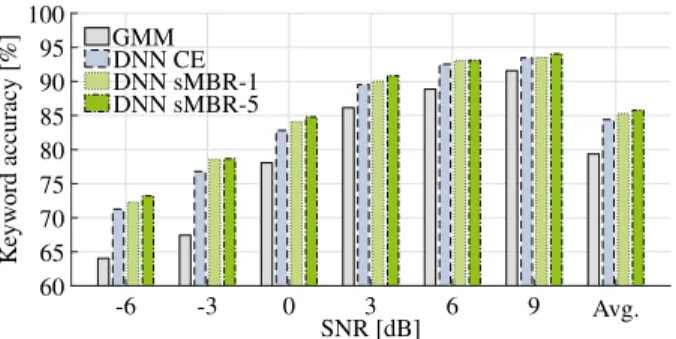
We compare the performance between different models, i.e., the GMM-based system and the DNN-based systems at dif-ferent training stages when using MFCC features in Fig. 1. We can see that DNN-based systems are able to outperform the GMM-based system for each SNR, where the largest rel-ative improvements are seen for very low SNR conditions. The recognition accuracy further increases when using the sMBR criterion for training, where a higher number of iter-ations (i.e., sMBR-5 vs. sMBR-1) yields slight performance improvements on average over all SNRs. For the sake of com-pactness, we thus limit the ensuing evaluation to using only the strongest DNN system (DNN sMBR-5).
60 65 70 75 80 85 90 95 100 -6 -3 0 3 6 9 Avg. GMM DNN CE DNN sMBR-1 DNN sMBR-5 SNR [dB] K ey w o rd ac cu ra cy [% ]
Fig. 1: Comparison of models for MFCC features (development set).
5.2. Early integration
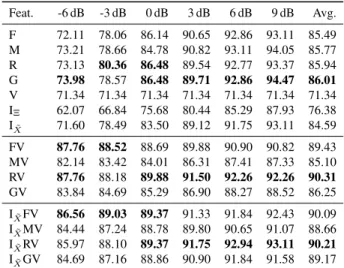
Table 1 shows the keyword accuracies that are achieved for single feature types and their combinations using early
inte-gration. The results show that a fusion of audio and video features (i.e., FV, MV, RV, and GV) can generally improve the recognition performance at low SNR conditions below 0 dB, whereas audio-only features (i.e., F, M, R, and G) are generally superior at higher SNR conditions (≥ 6 dB). A direct comparison of the isolated IMCRA-based reliability measures shows that the enhanced spectrum IX˜ outperforms
the estimated a-priori SNR IΞ for each condition. When
using IX˜ as an additional reliability feature for the early
in-tegration approach, the average recognition performance can be further improved as compared to the audio-visual fea-ture combinations in most cases (IX˜FV, IX˜MV, IX˜GV). The
ratemap features clearly outperform the other feature types when used in combination with the video features (i.e., RV and IX˜RV). Considering the lip-reading performance, the
video features alone yield a keyword recognition accuracy of 71.34 %, which corresponds to a word accuracy of 84.81 %.
Table 1: Keyword accuracies (%) obtained on the development set for various features: Mel filterbank (F), MFCC (M), Ratemap (R), GFCC (G), Video (V), IMCRA-enhanced spectrum (IX˜), IMCRA-estimated a-priori SNR (IΞ), and selected fused combinations.
Feat. -6 dB -3 dB 0 dB 3 dB 6 dB 9 dB Avg. F 72.11 78.06 86.14 90.65 92.86 93.11 85.49 M 73.21 78.66 84.78 90.82 93.11 94.05 85.77 R 73.13 80.36 86.48 89.54 92.77 93.37 85.94 G 73.98 78.57 86.48 89.71 92.86 94.47 86.01 V 71.34 71.34 71.34 71.34 71.34 71.34 71.34 IΞ 62.07 66.84 75.68 80.44 85.29 87.93 76.38 IX˜ 71.60 78.49 83.50 89.12 91.75 93.11 84.59 FV 87.76 88.52 88.69 89.88 90.90 90.82 89.43 MV 82.14 83.42 84.01 86.31 87.41 87.33 85.10 RV 87.76 88.18 89.88 91.50 92.26 92.26 90.31 GV 83.84 84.69 85.29 86.90 88.27 88.52 86.25 IX˜FV 86.56 89.03 89.37 91.33 91.84 92.43 90.09 IX˜MV 84.44 87.24 88.78 89.80 90.65 91.07 88.66 IX˜RV 85.97 88.10 89.37 91.75 92.94 93.11 90.21 IX˜GV 84.69 87.16 88.86 90.90 91.84 91.58 89.17 5.3. State-based integration
The analysis of the state-based integration approach is done using the ratemap acoustic features as they have achieved the best performance for the early integration approach. Figure 2 shows the optimal fixed stream weightsλopt that were found via parameter search on the development set. We can see that stream weights are roughly increasing with increasing SNR and their values are within the interval [0.60, 0.74].
The final results obtained on the test set using the ratemap acoustic features are given by Tab. 2. We can see that the early integration (RV, IX˜RV) outperforms the fixed stream
weights (Fixed) on average. However, the reliability features do not improve the performance for the early integration ap-proach (IX˜RV vs. RV). The best performance is achieved by
0.60 0.66 0.65 0.67 0.67 0.74 100 95 90 85 80 75 70 65 -6 -3 0 3 6 9 λopt λ= 1 λ= 0 SNR [dB] K ey w o rd ac cu ra cy [% ]
Fig. 2: Optimal fixed stream weights and corresponding keyword accuracies for ratemap acoustic features (development set).
the dynamic stream weights, where the frame-wise weighting (SNR-F) outperforms the utterance-wise weighting (SNR-U) for most SNRs above -3 dB and on average.
Table 2: Keyword accuracies (%) for early versus state-based in-tegration using the ratemap acoustic features. All scores are based on the test set. The methods R, V, RV, and IX˜RV correspond to the features of Tab. 1.Fixedcorresponds to the optimal fixed stream weights tuned on the development set.SNR-UandSNR-Fdenote the utterance and frame-wise dynamic stream weights estimated without oracle SNR knowledge. Method -6 dB -3 dB 0 dB 3 dB 6 dB 9 dB Avg. R 73.88 78.44 85.48 88.49 92.01 93.56 85.31 V 70.96 70.96 70.96 70.96 70.96 70.96 70.96 RV 87.20 87.63 89.60 90.64 91.58 91.58 89.70 IX˜RV 84.36 86.00 88.06 90.38 90.89 92.53 88.70 Fixed 71.48 79.21 89.35 94.76 94.85 93.56 87.20 SNR-U 88.32 90.21 93.04 94.67 95.02 96.74 93.00 SNR-F 87.97 90.12 93.47 95.02 94.76 96.82 93.03 6. CONCLUSIONS
We have analyzed the effect of an additional stream reliability estimate for improving the integration of acoustic and visual data in DNN-based AVSR. Specifically, we have compared its value in early integration and in state-based integration. All experiments have clearly shown that state-based integra-tion, with stream weighting based on the reliabilities, is su-perior to using reliabilities as additional features in early in-tegration, calling into question our original idea of letting the DNN learn the optimal integration from data alone. Under all conditions, the introduced dynamic weighting mechanism has also outperformed a strong baseline setting using fixed stream weights that exploit oracle knowledge of the current SNR.
Furthermore, we have compared a range of acoustic fea-ture types for use in DNN-based AVSR, finding that the auditory-inspired ratemap features show superior perfor-mance compared to other feature types that are more com-monly used for speech recognition applications (such as Mel filterbank features).
7. REFERENCES
[1] Ahmed Hussen Abdelaziz and Dorothea Kolossa, “Dy-namic Stream Weight Estimation in Coupled-HMM-based Audio-visual Speech Recognition using Multi-layer Perceptrons,” inProc. INTERSPEECH, 2014, pp. 1144–1148.
[2] Ahmed Hussen Abdelaziz, Steffen Zeiler, and Dorothea Kolossa, “Learning Dynamic Stream Weights for Coupled-HMM-based Audio-visual Speech Recogni-tion,” IEEE/ACM Transactions on Audio, Speech, and Language Processing, vol. 23, no. 5, pp. 863–876, 2015. [3] Kwanchiva Thangthai, Richard Harvey, Stephen Cox, and Barry-John Theobald, “Improving Lip-reading Per-formance for Robust Audiovisual Speech Recognition using DNNs,” inProc. Joint Conference on Facial Anal-ysis, Animation and Audio–Visual Speech Processing, 2015.
[4] Kuniaki Noda, Yuki Yamaguchi, Kazuhiro Nakadai, Hi-roshi G. Okuno, and Tetsuya Ogata, “Audio-visual Speech Recognition Using Deep Learning,”Applied In-telligence, vol. 42, no. 4, pp. 722–737, June 2015. [5] Hiroshi Ninomiya, Norihide Kitaoka, Satoshi Tamura,
Yurie Iribe, and Kazuya Takeda, “Integration of Deep Bottleneck Features for Audio-visual Speech Recogni-tion,” inProc. INTERSPEECH, 2015.
[6] Jing Huang and Brian Kingsbury, “Audio-visual Deep Learning for Noise Robust Speech Recognition,” in
Proc. IEEE International Conference on Acoustics, Speech and Signal Processing (ICASSP), May 2013, pp. 7596–7599.
[7] Martin Heckmann, Fr´ed´eric Berthommier, and Kristian Kroschel, “Noise Adaptive Stream Weighting in Audio-visual Speech Recognition,” EURASIP Journal on Ap-plied Signal Processing, vol. 2002, no. 1, pp. 1260– 1273, Jan. 2002.
[8] Daniel Povey, Arnab Ghoshal, Gilles Boulianne, Lukas Burget, Ondrej Glembek, Nagendra Goel, Mirko Han-nemann, Petr Motlicek, Yanmin Qian, Petr Schwarz, Jan Silovsky, Georg Stemmer, and Karel Vesely, “The Kaldi Speech Recognition Toolkit,” inProc. IEEE Workshop on Automatic Speech Recognition and Understanding, Dec. 2011.
[9] Daniel Povey and George Saon, “Feature and Model Space Speaker Adaptation with Full Covariance Gaus-sians,” inProc. INTERSPEECH, 2006.
[10] Shakti P. Rath, Daniel Povey, Karel Vesel´y, and Jan Cer-nock´y, “Improved Feature Processing for Deep Neural Networks,” inProc. INTERSPEECH, 2013, pp. 109– 113.
[11] Emmanuel Vincent, Jon Barker, Shinji Watanabe, Jonathan Le Roux, Francesco Nesta, and Marco Matas-soni, “The second ’CHiME’ Speech Separation and Recognition Challenge: Datasets, tasks and baselines,” inProc. IEEE International Conference on Acoustics, Speech, and Signal Processing (ICASSP), May 2013, pp. 126–130.
[12] Geoffrey E. Hinton, Simon Osindero, and Yee-Whye Teh, “A Fast Learning Algorithm for Deep Belief Nets,”
Neural Computation, vol. 18, no. 7, pp. 1527–1554, July 2006.
[13] Karel Vesel´y, Arnab Ghoshal, Luk´as Burget, and Daniel Povey, “Sequence-discriminative Training of Deep Neu-ral Networks,” in Proc. INTERSPEECH, 2013, pp. 2345–2349.
[14] Guy J. Brown and Martin Cooke, “Computational au-ditory scene analysis,” Computer Speech & Language, vol. 8, no. 4, pp. 297 – 336, 1994.
[15] Y. Shao, Z. Jin, D. Wang, and S. Srinivasan, “An auditory-based feature for robust speech recognition,” inIEEE International Conference on Acoustics, Speech and Signal Processing (ICASSP), April 2009, pp. 4625– 4628.
[16] Ahmed Hussen Abdelaziz, Steffen Zeiler, and Dorothea Kolossa, “Twin-HMM-based Audio-visual Speech En-hancement,” inProc. IEEE International Conference on Acoustics, Speech and Signal Processing (ICASSP), May 2013, pp. 3726–3730.
[17] Israel Cohen, “Noise Spectrum Estimation in Adverse Environments: Improved Minima Controlled Recursive Averaging,” IEEE Transactions on Speech and Audio Processing, vol. 11, no. 5, pp. 466–475, Sept 2003. [18] Sundarrajan Rangachari and Philipos C Loizou, “A
Noise-estimation Algorithm for Highly Non-stationary Environments,” Speech communication, vol. 48, no. 2, pp. 220–231, 2006.
[19] Martin Cooke, Jon Barker, Stuart Cunningham, and Xu Shao, “An Audio-visual Corpus for Speech Percep-tion and Automatic Speech RecogniPercep-tion,” The Journal of the Acoustical Society of America, vol. 120, no. 5, pp. 2421–2424, 2006.