Master thesis Psychology, specialization Social and Organisational Psychology Institute of Psychology
Faculty of Social and Behavioral Sciences – Leiden University
Date: May 2015
Student number: s1434268
First examiner of the university: Dr. Fieke Harinck Second examiner of the university: Dr. Said Shafa
The effect of culture and
receiving compliments on
helping behaviour
Melissa van der Geest
1
Abstract
This study consisted of a 2 (compliment on performance versus no compliment) by 2 (collectivistic culture versus individualistic culture) between subjects design with the
following dependent variables: the amount of pencils that were picked up and the amount of seconds of the participant before starting to help. The current study showed that there are no effects of culture and receiving a compliment versus no compliment on helping behaviour among students, while previous research did found an effect of receiving a compliment versus no compliment on helping behaviour (Lekx & Harinck, 2014). A remarkable result was that the negative mood after receiving a compliment versus no compliment was different for people with a individualistic- and collectivistic culture. The negative mood of people with an individualistic culture was considerably higher when they had received a compliment on their performance, than when they had not received a compliment. In addition, the negative mood of people with a collectivistic culture was slightly lower when they had received a
2
Introduction
If you get a compliment, how do you react? Specifically, do you help other people more? A recent study of Lekx and Harinck (2014) showed that people show less helping behaviour after receiving a compliment on performance (Lekx & Harinck, 2014). Is this the same for people with a different culture? Because people from a collectivistic culture are more cooperative (Grimm, Church, Katigbak, & Reyes, 1999) and therefore they might be extra willing to help. On the other hand, people from a individualistic culture favour personal goals over group norms and therefore they might be less willing to help (Finkelstein, 2010). And what underlying mechanism provides the outcome of showing less helping behaviour after receiving a compliment? The present study attempts to answer these questions.
When you know what the effect of compliments and culture is on helping behaviour, then it could have a lot of practical implications. For example, it could have practical
3
Compliments
According to Holmes (1988) a compliment is ‘’a speech act which explicitly or implicitly attributes credit to someone other than the speaker, usually the person addressed, for some ‘good’ which is positively valued by the speaker and the hearer’’ (Holmes, 1988). As reported by Holmes (1988) there are four types of compliments, namely: compliments that refer to a) appearance b) ability or performance c) possessions d) personality or friendliness. A compliment on appearance is regarded as most appropriate between equals, friends and intimates. It is also considered as least threatening, most gratuitous and most other-oriented. When people have a different status, they compliment each other more on performance and abilities. Of the four types of compliments, women give each other mostly compliments on appearance and men mostly on possessions (Holmes, 1988).
The receiver of a compliment can agree with the complimenter and accept the
compliment or reject the compliment to avoid or minimize self-praise (Holmes, 1988; Chen & Yang, 2010). By accepting the compliment, the receiver can give an appreciation (e.g. saying ‘Thanks’), can give an agreeing utterance (e.g. saying ‘I know’), can give a
4 Before we examine the relationship between compliments and pro-social behaviour, we first have to know what pro-social behaviour is.
Pro-social and helping behaviour
Pro-social behaviour protects or enhances the welfare of others and includes helpful interventions, volunteer work, and the donating of money or blood. These behaviours each have unique characteristics, but they all involve intentional actions that help or benefit others. Acting in a pro-social manner has a good effect on the individual; when acting in a pro-social manner, the individual has higher levels of mental health, life adjustment, and lower feelings of hopelessness and depression (Weinstein & Ryan, 2010).
Weinstein and Ryan (2010) examined whether positive effects of volitional or
5
Figure 1. Predictors of well-being
As stated before, helping behaviour is also a kind of pro-social behaviour. Helping is generally perceived as an act of kindness, but also can portray important qualities such as knowledge or skill (van Leeuwen, Oostenbrink, & Twilt, 2014). Helping is determined by the interplay of two distinct motivational systems: the explicit (conscious) system and the implicit (unconscious) system. Planned helping is determined by explicit pro-social behaviour and spontaneous helping is determined by the interplay between explicit and implicit pro-social behaviour. The effect of explicit prosocial motivation on spontaneous help is moderated by high implicit prosocial behaviour (see Figure 2). Spontaneous helping is most likely to occur when both high implicit and high explicit motivation come together (Aydinli, Bender, Chasiotis, Cemalcilar, & Van de Vijver, 2014). We do know now more about
pro-social/helping behaviour, but we do not know how a person behaves in a pro-social (helping) manner after receiving a compliment.
6
Compliments and pro-social behaviour
Complimenting may affect pro-social/helping behaviour. When someone accepts the compliment, a compliment can be seen as a positive reciprocator, because when someone gets a compliment, he or she follows the other’s positive action; the receiver of the compliment wants to do something in return, like helping the other (Perugini, Gallucci, Presaghi, & Ercolani, 2003). A study that investigates the effect of compliments and pro-social behaviour showed a counterintuitive result.
A remarkable result in the study of Lekx and Harinck (2014) was that people
performed less pro-social behaviour when they were complimented on their performance. The participant received a compliment based on his or her appearance, performance or no
compliment at all. At the beginning of the experiment the participant had to fill in a Sudoku. The compliment on performance was based on the Sudoku result of the participant. After bringing back a questionnaire, the experimenter ‘accidentally’ dropped 20 pens off the table
and saying he or she would go and get the right questionnaire, in order to provide the
opportunity for the participant to start helping. At the same time, the other experimenter was measuring the amount of seconds before the participant started to help and the amount of pens that were picked up by the participant. Remarkably, the participants who received a
compliment about their performance picked up less pencils than people who received no compliment about their performance (Lekx & Harinck, 2014). This result may be explained by the Negative State Relief model. This model asserts that one will be altruistic - increase the tendency to help - in order to reduce general affective negativity. The participant could feel bad about him- or herself after filling in the Sudoku, because he or she might think filling in the Sudoku was a hard task. When the participant in the compliment condition felt bad about him- or herself after filling in the Sudoku, the negative feeling could be relieved by a
7 participant to perform charitable acts to remove the negative mood, which reduced the helping behaviour (Cialdini, Darby & Vincent, 1973). Therefore, the first hypothesis is: People
perform less helping behaviour after receiving a compliment than after receiving no
compliment at all. We know more about the relationship between compliments and pro-social behaviour, but what about these two in collectivistic and individualistic cultures?
Collectivistic and individualistic cultures
Culture is a kind of ‘norm’ for human behaviour, influencing individual thoughts, actions and collectively influencing a particular society. It has a diverse influence which is learned by direct and indirect daily experiences based on what people do, say, make and use. A child learns a life pattern of beliefs and values which shapes the way that he or she believes, thinks, perceives, feels and behaves (Levine, 1987).
Different cultures can be categorized in two broad cultures: a collectivistic and an individualistic culture. Hofstede stated: ‘’Individualism pertains to societies in which the ties between individuals are loose: everyone is expected to look after him- or herself and his or her immediate family. Collectivism as its opposite pertains to societies in which people from birth onward are integrated into strong, cohesive in-groups, which throughout people’s lifetime continue to protect them in exchange for unquestioning loyalty’’ (Hofstede, 1980/2001, p. 51, as described in Marcus & Le, 2013).
Individualists focus on autonomy and self-fulfilment. They favour personal goals and personal attitudes over group norms (Finkelstein, 2010). For instance, a person from a
individualistic culture prefers a bonus even though it is at the expense of the bonuses of his or her group. The following characteristics are typical for individualists: independence, pleasure seeking, assertiveness, creativity, curiosity, competiveness, self-assurance, efficiency,
8 In contrast, collectivists define themselves in terms of their group membership. They submerge personal goals for the good of the whole and maintain relationships with the group even when the cost to the individual exceeds the benefits (Finkelstein, 2010). For example, a person from a collectivistic culture prefer that the members get a bonus instead of him- or herself. For collectivists, the following characteristics are typical: attentiveness,
respectfulness, humility, deference, dependence, empathy, harmony, self-control, sharing, moderation, nurturance, obedience, dutifulness, reciprocity, self-sacrifice, security, traditionalism, conformity, and cooperativeness (Grimm et al., 1999).
But what about receiving compliments in different cultures? Specifically, are there differences in whether or not the collectivistic and individualistic cultures accept
compliments?
Compliments and cultures
9 finding is that the Mandarin Chinese speakers used far fewer combination strategies than the Australians, which indicates that the Australians made more effort when responding to compliments (Tang & Zhang, 2009). Now we know how people with a different culture respond to compliments, but what about pro-social (helping) behaviour among collectivistic and individualistic people? Specifically, is there a difference in pro-social behaviour between collectivistic and individualistic cultures?
Pro-social behaviour and cultures
Research of Marcus and Le (2013) showed that collectivism is positively related to cooperation at the individual and organizational level, which indicates that the more
collectivistic a person of an organization is, the more cooperative behaviour the person or the organization shows. At societal level, collectivism is negatively related to cooperation, which indicates that the more collectivistic the society is, the less cooperation behaviour the society expresses (Marcus & Le, 2013). Compared with people in individualistic societies, people in collectivistic societies are more likely to distinguish between in-groups and out-groups during situations of cooperation (Imai & Gelfand, 2009, as described in Marcus & Le, 2013). The result at societal level could be explained by this fact, because strangers are not considered as a part of their in-group and thus they show less cooperation to them (Finkelstein, 2010).
Another study of Finkelstein (2010) showed that collectivism was most closely
10 instance, helping co-workers and helping to organize group events (Gagné & Deci, 2005). Therefore, it could be that people with a collectivistic culture are more willing to help others. Again, these beneficiaries are only applied on persons that belong to the in-group of the collectivists (Finkelstein, 2010). All in all, the second hypothesis is: 2)The more collectivistic a person is, the more he or she shows helping behaviour, compared to a more individualistic
person.
Current study
Both, culture and it whether or not receiving a compliment, have influence on helping behaviour. Therefore, the interaction-effect of these two variables is measured. My
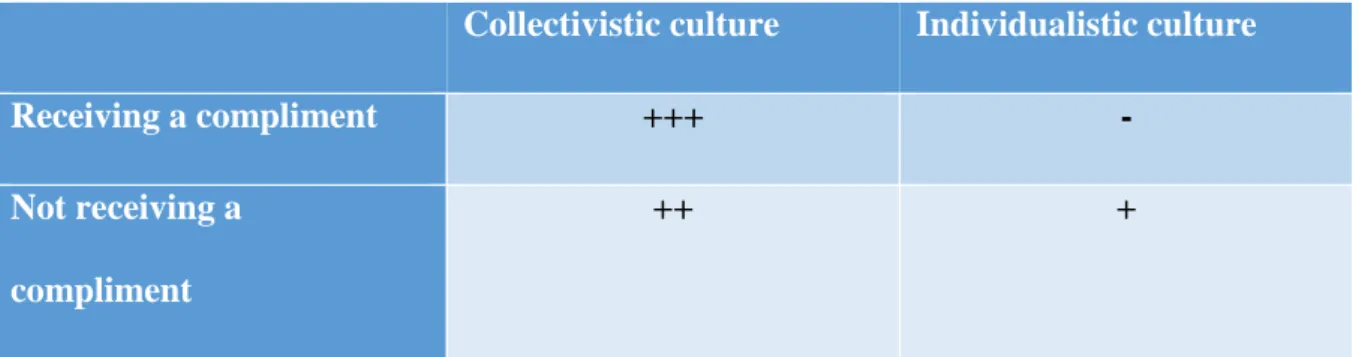
expectation of the interaction-effect is shown in Table 1. I expect that the Negative State Relief model is less applicable to people from a collectivistic culture, because a collectivistic culture is characterized by altruistic- and cooperative behaviour. Thus, I argue that people from a collectivistic culture will show helping behaviour, regardless of if they received or do not receive a compliment. On the other hand, I expect that the Negative State Relief model is applicable to people from an individualistic culture, because they favour personal attitudes over group norms. As a consequence, people from an individualistic culture will show less helping behaviour if they received a compliment. Therefore, the third hypothesis is: A person with a collectivistic culture helps more than a person with a individualistic culture, especially
11
Table 1. Expectation of the interaction-effect on helping behaviour
Collectivistic culture Individualistic culture
Receiving a compliment +++ -
Not receiving a
compliment
++ +
++ = strong positive relationship with helping behaviour + = positive relationship with helping behaviour +++ = very strong relationship with helping behaviour - = negative relationship with helping behaviour
This study examined the following hypotheses (see Figure 3):
1) People perform less helping behaviour after receiving a compliment than after
receiving no compliment at all.
2) The more collectivistic a person is, the more he or she shows helping behaviour, compared to a more individualistic person.
3) A person with a collectivistic culture helps more than a person with a individualistic
culture, especially if they get a compliment.
12
Method
Participants
84 students of Leiden University participated, three students from an University of Applied Sciences and one person was not a student (see Figure 4 in Appendix A for the studies of the participants). 75 percent of the participants was female and the mean age was 22.11 years. 39.3% of the participants were Dutch. See Figure 5 in Appendix A for the country of origin of the participants. The participants have received 2 course credits or €6,00 for their participation.
49 participants had a collectivistic culture and 33 participants had an individualistic culture (following the questionnaire Individualism-Collectivism from Triandis and Gelfland (1998)). There were two scales created: One individualistic-scale with the items of horizontal- and vertical individualism and one collectivistic-scale with the items of horizontal- and
13 the four participants were left out. In this condition, 47 participants had a collectivistic culture and 31 participants had an individualistic culture.
Design
This study consisted of a 2 (compliment on performance versus no compliment) by 2 (collectivistic culture versus individualistic culture) between-subjects design with the
following dependent variables: amount of pencils picked up and amount of seconds of the participant before starting to help.
Procedure
During the experiment there was an English dictionary available for the participant, because for the most participants English was not their native language and therefore some participants could had trouble with certain English words. First, the participant was escorted to his or her place. After that, the participant filled in the informed consent. Then, the
participant was asked what his or her age and gender is. Also, the participant was asked what he or she studies. Next, the participant was asked to fill in a questionnaire with twelve items (adjusted Individualism-Collectivism; Triandis & Gelfland, 1998, as described in Cozma, 2011).
14 experimenter ‘accidentally’ dropped twenty pens off the table and said he or she will go and
get the right questionnaire, in order to provide to opportunity for the participant to started helping. At the same time, the other experimenter measured the amount of seconds before the participant start to help, and the amount of pens that he or she picks (Lekx & Harinck, 2014). For the third time, the participant filled in the PANAS. Also, the following things has been asked: a) the country of origin b) how long he or she has lived in his/her country of origin c) if he or she has lived in other countries than their country of origin – if yes, where he or she has lived – d) if and what kind of compliment was given e) what he or she thought the experiment was about (Lekx & Harinck, 2014) f) his or her level of English g) if he or she has trouble with English.
See Appendix B for the questionnaires. Finally, the participant has been debriefed and received his/her course credits or money.
Dependent variables
The helping behaviour of the participant was measured by the amount of seconds before the participant started to help and by the amount of pens the participant picked up.
The Individualism-Collectivism (1999) measured the attitude of horizontal
15 The reliability of the scales ‘horizontal individualism’, ‘vertical individualism’, ‘horizontal collectivism’ and ‘vertical collectivism’ were reasonable (a = .68; C= .65; a = .63; a = .68)1.
The Contextualism scale measured cultural collectivism. This scale contained six items and the items were answered six-point scales, where 1 = completely disagree and 6 = completely agree. Examples of items were ‘One can understand a person well without
knowing about his/her family’ and ‘To understand a person well, it is essential to know about which social groups he/she is a member of’ (Owe et al., 2013). The reliability of
Contextualism scale was good (a = .83). When the item ‘To understand a person well, it is essential to know about the place he/she comes from’ was deleted, then the reliability improved slightly (a = .84).
1Triandis (1986; 1998) has conducted a great deal of research on individualism-collectivism (IND-COL) and
invented four constructs: horizontal individualism, vertical individualism, horizontal collectivism, and vertical collectivism. He differentiated between vertical and horizontal IND-COL that address the belief in
equality/inequality among members of a cultural group. Horizontal individualists want to be unique and distinct from groups. They see themselves as being of equal status with other group members and are less likely to compare themselves to others. The self is independent and the same as the self of others. Vertical individualists value being independent and autonomous, but they are also competitive and strive to be the best. They seek to gain positions of high status and the self is independent and different from the self of others. Competition is an important aspect of this pattern. Horizontal collectivists see themselves as being similar to others and emphasize common goals with others, interdependence, and sociability, but they do not submit easily to authority. The self is merged with the members of the in-group, all of whom are extremely similar to each other. Vertical
16 The Self-Construal scale measured the perception of the relationship between oneself and others. Specifically, the degree to which the self was seen as independent of or
independent with others (Christopher, Norris, D’Souza, & Tierman, 2012). This scale contained nine items. Responses were made on seven-point scales, where 1 = strongly disagree and 7 = strongly agree. Examples of items were ‘It is important for me to maintain harmony within my group’ and ‘I act the same way no matter who I am with’ (Christopher et
al., 2012). The reliability of the items that measures individualism and the items that measures collectivism were very low to low (a = .17; a = .37). Therefore, only the
Individualism-Collectivism questionnaire and the Contextualism scale served as manipulation checks for culture, because of their reasonable to high reliabilities.
The PANAS measured the mood that the participant had at that moment. The PANAS was answered on five-point scales, where 1 = very slightly or not at all, 2 = a little, 3 = moderately, 4 = quite a bit and 5 = extremely. The scale ‘positive mood’ contained the items ‘interested’, ‘excited’, ‘strong’, ‘enthusiastic’, ‘alert’, ‘inspired’, ‘attentive’, ‘active’ and ‘proud’. In addition, the scale ‘negative mood’ contained the items ‘distressed’, ‘upset’, ‘guilty’, ‘scared’, ‘hostile’, ‘irritable’, ‘ashamed’, ‘nervous’, ‘determined’, ‘jittery’ and ‘afraid’ (Watson, Clark, & Tellegen, 1988). The reliability of the positive- and negative
formulated items of the PANAS measured for the first time were good to reasonable (a = .79;
17
Results
Helping behaviour: amount of seconds before starting to help
There was one univariate outlier (case 13) on the dependent variable ‘amount of seconds before the participant starts to help’ (standardized residual respectively 7.02). The outlier had a Cook’s D of 1.11, which indicated that the outlier was influential (1.11 >1.00 (Field, 2012)). Therefore, the outlier was removed from the data-set. A Kolmogorov-Smirnov test was conducted to check the assumption of normality. The assumption of normality was not met, KS-test = .22, df = 70, p < .001. However, the F-test was robust against the violation of the assumption of the normality, because the sample is large enough (70 > 15 (Field, 2012)). A Levene’s test was conducted to check the assumption of homogeneity of variance. The assumption of homogeneity of variance was met, F (3, 66) = .29, p = .830.
To examine the three hypotheses ‘People perform less helping behaviour after receiving a compliment than after receiving no compliment at all’, ‘The more collectivistic a
person is, the more he or she shows helping behaviour, compared to a more individualistic
person’ and ‘A person with a collectivistic culture helps more than a person with a
individualistic culture, especially if they get a compliment’, a two-way between subjects ANOVA was performed. The dependent variable was ‘amount of seconds before the
18
Helping behaviour: amount of pens picked up
There were no outliers on the dependent variable ‘amount of pens that the participant picks up’. A Kolmogorov-Smirnov test was conducted to check the assumption of normality. The assumption of normality was not met, KS-test = .36, df = 78, p < .001. However, the F-test was robust against the violation of the assumption of the normality, because the sample is large enough (78 > 15 (Field, 2012)). A Levene’s test was conducted to check the assumption of homogeneity of variance. The assumption of homogeneity of variance was met, F (3, 74) = 2.25, p = .089.
To examine the three hypotheses ‘People perform less helping behaviour after receiving a compliment than after receiving no compliment at all’, ‘The more collectivistic a
person is, the more he or she shows helping behaviour, compared to a more individualistic
person’ and ‘A person with a collectivistic culture helps more than a person with a
individualistic culture, especially if they get a compliment’, a two-way between subjects
ANOVA was performed. The dependent variable was ‘amount of pens that the participant picks up’ and the independent variables were ‘receiving a compliment versus no compliment’ and ‘culture’ (individualistic or collectivistic). There was no significant main effect of
19
Dependent variables: Correlation Table
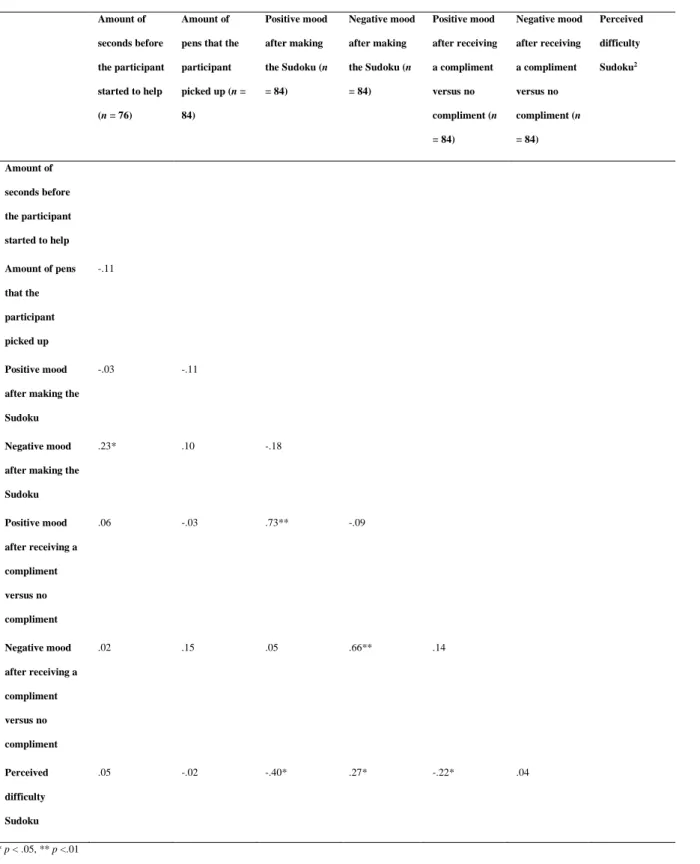
Table 3. Correlation Table of the dependent variables: Pearson correlation (r), p-value and n Amount of
seconds before
the participant
started to help
(n = 76)
Amount of
pens that the
participant
picked up (n =
84)
Positive mood
after making
the Sudoku (n
= 84)
Negative mood
after making
the Sudoku (n
= 84)
Positive mood
after receiving
a compliment
versus no
compliment (n
= 84)
Negative mood
after receiving
a compliment
versus no
compliment (n
= 84) Perceived difficulty Sudoku2 Amount of seconds before the participant
started to help
Amount of pens
that the
participant
picked up
-.11
Positive mood
after making the
Sudoku
-.03 -.11
Negative mood
after making the
Sudoku
.23* .10 -.18
Positive mood
after receiving a
compliment
versus no
compliment
.06 -.03 .73** -.09
Negative mood
after receiving a
compliment
versus no
compliment
.02 .15 .05 .66** .14
Perceived
difficulty
Sudoku
.05 -.02 -.40* .27* -.22* .04
* p < .05, ** p <.01
2n = 73 by correlation between ‘Amount of seconds before the participant started to help’ and ‘Perceived difficulty of
20
Checks
Effect of culture on mood after making the Sudoku
Effect on positive mood
There were no outliers on the dependent variable ‘positive mood after making the Sudoku’. The assumption of normality was met, KS-test = .06, df = 82, p = .20. A Levene’s
test was conducted to check the assumption of homogeneity of variance. The assumption of homogeneity of variance was not met, F (1, 80) = 4.60, p = .035. The groupsizes of
participants who had a collectivistic culture and participants who had a individualistic culture were approximately equal (49 / 33 = 1.48 < 1.50 (Field, 2012)). Therefore, the F-test was robust.
To examine the effect of culture (individualistic and collectivistic) on positive mood after making the Sudoku (but before receiving a compliment versus no compliment), an one-way between subjects ANOVA was performed. The dependent variable was ‘positive mood after making the Sudoku’ and the independent variable was ‘culture’ (individualistic or
collectivistic). There was a significant main effect of culture on positive mood of the participants after making the Sudoku, F (1, 80) = 6.30, p = .014, η𝑝2 = .07, which indicated that participants with a collectivistic culture scored relatively higher (M = 2.94, SD = .90) on positive mood after making the Sudoku than participants with an individualistic culture (M = 2.51, SD = .66).
Effect on negative mood
There were two univariate outliers (cases 44 and 48) on the dependent variable
non-21 influential (.20 < 1.00 (Field, 2012)). A Kolmogorov-Smirnov test was conducted to check the assumption of normality. The assumption of normality was not met, KS-test = .17, df = 82,
p < .001. However, the F-test was robust against the violation of the assumption of the normality, because the sample is large enough (82 > 15 (Field, 2012)). A Levene’s test was conducted to check the assumption of homogeneity of variance. The assumption of
homogeneity of variance was met, F (1, 80) = .69, p = .409.
To examine the effect of culture (individualistic and collectivistic) on negative mood after making the Sudoku (but before receiving a compliment versus no compliment), an one-way between subjects ANOVA was performed. The dependent variable was ‘negative mood after making the Sudoku’ and the independent variable was ‘culture’ (individualistic or collectivistic). There was no significant main effect of culture on the negative mood of the participants after making the Sudoku, F (1, 80) = .92, p = .340, η𝑝2 = .01.
Effect of culture and receiving a compliment versus no compliment on mood
Effect on positive mood
There was one univariate outlier (case 12) on the dependent variable ‘positive mood after receiving a compliment versus no compliment’ (standardized residual respectively 4.89). The outlier had a Cook’s D of .46, which indicated that the outlier was not influential (.46 < 1.00 (Field, 2012)). A Kolmogorov-Smirnov test was conducted to check the
assumption of normality. The assumption of normality was not met, KS-test = .10, df = 78, p = .038. However, the F-test was robust against the violation of the assumption of the normality, because the sample is large enough (78 > 15 (Field, 2012)). A Levene’s test was conducted to check the assumption of homogeneity of variance. The assumption of homogeneity of
22 To examine the effect of culture (individualistic and collectivistic) and receiving a compliment versus no compliment on positive mood after receiving a compliment versus no compliment, a two-way between subjects ANOVA was performed. The dependent variable was ‘positive mood after receiving a compliment versus no compliment’ and the independent variables were ‘receiving a compliment versus no compliment’ and ‘culture’ (individualistic or collectivistic). There was no significant main effect of receiving a compliment versus no compliment on the positive mood of the participants after receiving a compliment versus no compliment, F (1, 74) = .04, p = .845, η𝑝2 = .00. Also, there was no significant main effect of culture on the positive mood of the participants after receiving a compliment versus no compliment, F (1, 74) = 1.29, p .260, η𝑝2 = .02. Further, there was no significant interaction effect between culture and receiving a compliment versus no compliment on the positive mood of the participants after receiving a compliment versus no compliment, F (1, 74) = .01,
p = .913, η𝑝2 = .00.
Effect on negative mood
There was one univariate outlier (case 70) on the dependent variable ‘negative mood after receiving a compliment versus no compliment’ (standardized residual respectively 4.55). The outlier had a Cook’s D of .26, which indicated that the outlier was not influential (.26 < 1.00 (Field, 2012)). A Kolmogorov-Smirnov test was conducted to check the
assumption of normality. The assumption of normality was not met, KS-test = .17, df = 78, p < .001. However, the F-test was robust against the violation of the assumption of the normality, because the sample is large enough (78 > 15 (Field, 2012)). A Levene’s test was conducted to check the assumption of homogeneity of variance. The assumption of homogeneity of
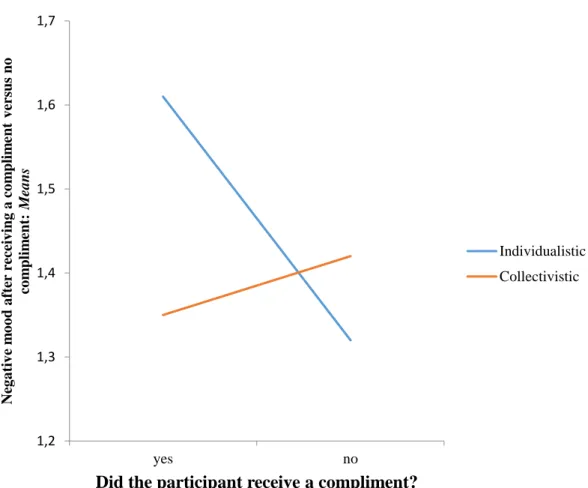
23 To examine the effect of culture (individualistic and collectivistic) and receiving a compliment versus no compliment on negative mood after receiving a compliment versus no compliment, a two-way between subjects ANOVA was performed. The dependent variable was ‘negative mood after receiving a compliment versus no compliment’ and the independent variables were ‘receiving a compliment versus no compliment’ and ‘culture’ (individualistic or collectivistic). There was a significant interaction effect between culture and receiving a compliment versus no compliment on negative mood of the participants after receiving a compliment versus no compliment, F (1, 74) = 5.32, p = .024, η𝑝2 = .07. This effect indicated that people from different cultures reacted different on receiving a compliment versus no compliment on performance. The negative mood of participants with an individualistic culture was considerably higher when they had received a compliment on their performance (M = 1.61, SD = .39) than when they had not received a compliment (M = 1.32, SD = .23). This difference was significant, t (30) = 16.62, p < .001. The negative mood of participants with a collectivistic culture was slightly lower when they had received a compliment on their performance (M = 1.35, SD = .25) than when they had not received a compliment (M = 1.42,
24
Figure 6. Interaction effect of culture x receiving a compliment versus no compliment on negative mood after receiving a compliment versus no compliment
There was no significant main effect of receiving a compliment versus no compliment on negative mood of the participants after receiving a compliment versus no compliment, F (1, 74) = 1.99, p = .163, η𝑝2 = .03. In addition, there was no significant main effect of culture on negative mood of the participants after receiving a compliment versus no compliment, F (1, 74) = 1.16, p = .286, η𝑝2 = .02.
1,2 1,3 1,4 1,5 1,6 1,7 yes no Neg a tiv e m o o d a ft er re ce iv ing a co m pli m e nt v er sus no co m pli m ent : Me a ns
Did the participant receive a compliment?
25
Effect of mood after making Sudoku on helping behaviour
Helping behaviour: amount of seconds before starting to help
See Table 3 for the correlations between the dependent variables. Pearson correlations (two-tailed) between the variable ‘amount of seconds before the participant starts to help’ and the variables ‘positive mood after making the Sudoku, ‘negative mood after making the Sudoku’ were performed. There was a positive relationship (r = .24, p = .044, n = 71) between the amount of seconds before the participants started to help and their negative mood after making the Sudoku, which indicated that the more the participants had a negative mood after making the Sudoku, the longer it took before they started to help. There was no significant relationship between the amount of seconds before the participants started to help and their positive mood after making the Sudoku (r = -.01, p = .910, n = 71).
Helping behaviour: amount of pens picked up
Pearson correlations (two-tailed) between the variable ‘amount of pens that the participant picks up’ and the variables ‘positive mood after making the Sudoku’, ‘negative mood after making the Sudoku’ were performed. There were no significant relationships between the amount of pens the participants picked up and their negative- (r = .10, p = .370, n
= 78) and positive mood after making the Sudoku (r = -.11, p = .333, n = 78).
Effect of perceived difficulty of the Sudoku on mood
Perceived difficulty of the Sudoku
26
Effect on positive mood
Pearson correlations (two-tailed) between the variables ‘positive mood before making the Sudoku’, ‘positive mood after making the Sudoku’ and ‘perceived difficulty of Sudoku’. The aim was to examine if there was an effect of perceived difficulty of the Sudoku on positive mood.
There was a significant negative relationship (r = -.22, p = .047, n = 81) between the perceived difficulty of the Sudoku and the positive mood before making the Sudoku, which indicated that the higher the positive mood of the participants before making the Sudoku, the lower the perceived difficulty of the Sudoku. This effect was even stronger for the positive mood of the participants after making the Sudoku (r =-.40, p < .001, n = 81).
Effect on negative mood
Pearson correlations (two-tailed) between the variables ‘negative mood before making the Sudoku’, ‘negative mood after making the Sudoku’ and ‘perceived difficulty of Sudoku’. The aim was to examine if there was an effect of perceived difficulty of the Sudoku on negative mood.
27
Discussion
In this study the effect of culture (individualistic or collectivistic) and receiving a compliment versus no compliment on helping behaviour was examined. First, the participant filled in several questionnaires about their culture. Then, he or she made a Sudoku on which the participant received a compliment or no compliment. After that, the experimenter ‘accidentally’ dropped 20 pens and in the meantime the other experimenter measured the amount of seconds before the participant started to help and the amount of pens the he or she picked up.
The three hypotheses were disconfirmed:
1. People perform less helping behaviour after receiving a compliment than after
receiving no compliment at all.
2. The more collectivistic a person is, the more he or she shows helping behaviour,
compared to a more individualistic person.
3. A person with a collectivistic culture helps more than a person with a individualistic
culture, especially if they get a compliment.
28 perform charitable acts to remove the negative mood, which reduced the helping behaviour (Cialdini, Darby & Vincent, 1973). However, the participants did not feel that bad after filling in the Sudoku and therefore the Negative State Relief model may not apply.
Secondly, no difference was found between people from an individualistic culture and people from a collectivistic culture in regard to helping behaviour. This could be explained by the fact that collectivistic people show helping behaviour more and more in the same way as individualistic people. Studying and living in a western country - the Netherlands - as a originally collectivist increases the chance to westernise. I argue that the above result can be explained by the westernisation of people from a collectivistic culture. Consequently, they act in the same way as individualistic people. People from western countries tend to be more individualistic than people from non-western countries (Green & Paèz, 2005).
Other results showed that there is an effect of people’s culture on their positive mood after making the Sudoku. People with a collectivistic culture scored relatively higher on positive mood after making the Sudoku than people with an individualistic culture. Furthermore, an effect of culture and receiving a compliment versus no compliment on people’s negative mood after receiving a compliment versus no compliment was found. The negative mood of people with an individualistic culture was considerably higher when they had received a compliment on their performance than when they had not received a
compliment. The negative mood of people with a collectivistic culture was slightly lower when they had received a compliment on their performance than when they had not received a compliment. These effects were unexpected, because most people with an individualistic culture like a compliment on performance and most people from a collectivistic culture like a compliment on personality. Moreover, research of Nelson and colleagues showed that
29 inner qualities and what a person is and Americans value what a person does (Nelson, El Bakary & Al Batal, 1993). The current study suggests that people with an individualistic culture do not value a compliment on performance, because they had a more negative mood when they received a compliment on performance than when they did not receive a
compliment. The negative mood of people with a collectivistic culture was slightly lower when they received a compliment on performance than when they did not receive a
compliment, while they value mostly a compliment on personality. Thus, the current study suggests that people with a collectivistic culture do value a compliment on performance. Furthermore, the more people had a negative mood after making the Sudoku, the longer it took before they started to help. This suggests that when people feel bad, they are less willing to help. If this is true, the Negative State Relief model might not be true, because than there would be a decrease in the tendency to help instead of an increase in tendency to help. The Negative State Relief model states that one will increase the tendency to help, in order to reduce general affective negativity.
30 think that the perceived difficulty did not trigger strong feelings among the participants. Therefore I argue that neither a positive- nor a negative mood before making the Sudoku did not have a causal influence on the perceived difficulty of the Sudoku. I think that there could be a causal relationship between mood before making the Sudoku and the perceived difficulty of the Sudoku, if the perceived difficulty trigger strong feelings among the participants.
Limitations
31 collectivistic group F could be too conservative and in the individualistic group F could be too liberal.
Future research
There are several recommendations for future research. Again, it could be examined if there is an effect of receiving a compliment versus no compliment on helping behaviour, because there is little research on this topic. Also, recent research showed that there is an effect (Lekx & Harinck, 2014). Apart from that, it could also be examined if there is a mediation effect of feeling bad about oneself between receiving a compliment and helping behaviour, because the finding in the current study between the negative mood and the amount of seconds before the participants started to help was only correlational. It is recommended to use a very negative stimulus to evoke a very negative mood within the participants.
32
Conclusion
The current study showed that there are no effects of culture and receiving a
compliment versus no compliment on helping behaviour among students, while prior research did have found an effect of receiving a compliment versus no compliment on helping
33
References
Aydinli, A., Bender, M., Chasiotis, A., Cemalcilar, Z., & Van de Vijver, F. J. R. (2014). When does self-reported prosocial motivation predict helping? The moderating role of implicit prosocial motivation. Motivation and Emotion, 38, 645-658.
Chen, R. & Yang, D. (2010). Responding to compliments in Chinese: Has it changed?
Journal of Pragmatics, 42, 1951-1963.
Christopher, M. S., Norris, P., D’Souza, J. B., & Tierman, K. A. (2012). A test of the
multidimensionality of the Self-Construal Scale in Thailand and the United States.
Journal of Cross-Cultural Psychology, 43, 758-773.
Cialdini, R. B., Darby, B. L., & Vincent, J. E. (1973). Transgression and altruism: A case for hedonism. Journal of Experimental Social Psychology, 9, 502-516.
Cozma, I. (2011). How are individualism and collectivism measured? Romanian Journal Of Applied Psychology, 13, 11-17.
Field, A. (2012). Discovering statistics using IBM SPSS Statistics. London, United Kingdom: SAGE Publications Ltd.
Finkelstein, M. A. (2010). Individualism/collectivism: Implications for the volunteer process.
Behavior and personality, 4, 445-452.
Gagné, M. & Deci, E. L. (2005). Self-determination theory and work motivation. Journal of Organizational Behavior, 26, 331-362.
34 Grimm, S. D., Church, A. T., Katigbak, M. S., & Reyes, J. A. S. (1999). Self-described traits,
values, and moods associated with individualism and collectivism. Journal of cross- cultural psychology, 4, 466-500.
He, Y. (2012). Different generations, different face? A discursive approach to naturally occurring compliment responses in Chinese. Journal of Politeness Research, 8, 29-51.
Holmes, J. (1987). Paying compliments: A sex-preferential politeness strategy. Journal of Pragmatics, 12,445-465.
Lekx, M. & Harinck, F. (2014). The effect of complimenting on self-esteem and helping behaviour. Leiden, the Netherlands: Leiden University.
Levine, R. E. Culture: A factor influencing the outcomes of occupational therapy.
Occupational Therapy in Health Care, 4, 3-16.
Lin, Y. L., Woodfield, H., & Ren, W. (2012). Compliments in Taiwan and Mainland Chinese: The influence of region and compliment topic. Journal of Pragmatics, 44, 1486-1502. Maíz-Arévalo, C. (2013). ‘’Just click ‘Like’’’: Computer-mediated responses to Spanish
Compliments. Journal of Pragmatics, 51, 47-67.
35 Owe, E., Vignoles, V. L., Becker, M., Brown, R., Smith, P. B., Lee, S. W. S., (..), Jalal, B.
(2013). Contextualism as an important facet of individualism-collectivism:
Personhood beliefs across 37 national groups. Journal of Cross-Cultural Psychology, 44, 24-45.
Parvaresh, V. & Tavakoli, M. (2009). Discourse completion tasks as elicitation tools: How convergent are they? The Social Sciences, 4, 366-373.
Perlow, L. & Weeks, J. (2002). Who’s helping whom? Layers of culture and workplace behavior. Journal of Organizational Behavior, 23,345-361.
Perugini, M., Gallucci, M., Presaghi, F., & Ercolani, A. P. (2003) The personal norm of reciprocity. European Journal of Personality, 17, 251-283.
Tang, C. & Zhang, G. Q. (2009). A contrastive study of compliment responses among Australian English and Mandarin Chinese speakers. Journal of Pragmatics, 41, 325-345.
Van Leeuwen, E., Oostenbrink, J., & Twilt, A. (2014). The combined effects of meta- Stereotypes and audience on outgroup and ingroup helping. American
Psychological Association, 14,1089-2699.
Watson, D., Clark, L. A., & Tellegen, A. (1988). Development and validation of brief measures of positive and negative affect: The PANAS scales. Journal of Personality and Social Psychology, 54, 1063-1070.
Weinstein, N. & Ryan, R. M. (2010) When helping helps: Autonomous motivation for pro-social behaviour and its influence on well-being for the helper and recipient.
36
Appendix A: Figures and Tables
Figure 4. Study of the participants
37
Table 2. Adjusted scales of Individualism-Collectivism (Triandes & Gelfland, 1998)
Horizontal individualism Vertical individualism Horizontal collectivism Vertical collectivism
I rely on myself most of the time, I rarely rely on others.
It is important for me to do my job better than the others.
The well-being of my coworkers is important to me.
Parents and children must stay together as much as possible.
I often do my own thing.
Competition is the law of nature.
To me, pleasure is spending time with others.
It is my duty to take care of my family, even when I have to sacrifice what I want.
My personal
identity, independent of others, is very important to me.
When another person does better than I do, I get tense and aroused.
I feel good when I cooperate with others.
38
Appendix B: Questionnaires
General information
1. What is your age? ………
2. What is your gender?
o Male
o Female
3. What do you study?
………
Preferences
Below are a number of statements. Please indicate to what extent you agree with these statements. There are no right or wrong answers.
The statements will be answered on 9-point scales, where 1 = never or definitely no and 9 = always or definitely yes. Circle the number that applies.
1. It is important for me to do my job better than the others.
1 2 3 4 5 6 7 8 9
2. Parents and children must stay together as much as possible.
1 2 3 4 5 6 7 8 9
3. I rely on myself most of the time, I rarely rely on others.
1 2 3 4 5 6 7 8 9
4. The well-being of my co-workers is important to me.
1 2 3 4 5 6 7 8 9
5. It is my duty to take care of my family, even when I have to sacrifice what I want.
39 6. I often do my own thing.
1 2 3 4 5 6 7 8 9
7. Competition is the law of nature.
1 2 3 4 5 6 7 8 9
8. To me, pleasure is spending time with others.
1 2 3 4 5 6 7 8 9
9. My personal identity, independent of others, is very important to me.
1 2 3 4 5 6 7 8 9
10.When another person does better than I do, I get tense and aroused
1 2 3 4 5 6 7 8 9
11.I feel good when I cooperate with others.
1 2 3 4 5 6 7 8 9
12.It is important to me that I respect the decision made by my groups.
1 2 3 4 5 6 7 8 9
Again, there number of statements. Please indicate to what extent you agree or disagree with these statements. There are no right or wrong answers.
The statements will be answered on 6-point scales, where 1 = completely disagree, 2 = moderately disagree, 3 = slightly disagree, 4 = slightly agree, 5 = moderately agree and 6 = completely agree. Circle the number that applies.
1. To understand a person well, it is essential to know about which social groups he/she is a member of.
1 2 3 4 5 6
2. One can understand a person well without knowing about his/her family.
40 3. To understand a person well, it is essential to know about the place he/she comes
from.
1 2 3 4 5 6
4. One can understand a person well without knowing about his/her social position.
1 2 3 4 5 6
5. One can understand a person well without knowing about the place he/she comes from.
1 2 3 4 5 6
6. To understand a person well, it is essential to know about his/her family.
1 2 3 4 5 6
Again, there number of statements. Please indicate to what extent you agree or disagree with these statements. There are no right or wrong answers.
The statements will be answered on 7-point scales, where 1 = strongly disagree and 7 = strongly agree. Circle the number that applies.
1. It is important for me to maintain harmony within my group.
1 2 3 4 5 6 7
2. I respect people who are modest about themselves.
1 2 3 4 5 6 7
3. I often have the feeling that my relationships with others are more important than my own accomplishments.
1 2 3 4 5 6 7
4. It is important to me to respect decisions made by the group.
1 2 3 4 5 6 7
5. Even when I strongly disagree with group members, I avoid an argument.
1 2 3 4 5 6 7
6. Speaking up during class is not a problem for me.
1 2 3 4 5 6 7
7. Having a lively imagination is important to me.
1 2 3 4 5 6 7
8. I am comfortable with being singled out for praise or rewards.
1 2 3 4 5 6 7
9. Being able to take care of myself is a primary concern for me.
41
Mood at the moment
This scale consists of a number of words that describe different feelings and emotions (see below the definitions of the feelings and emotions). Read each item and then mark the appropriate answer in the space next to that word.
Indicate to what extent you feel this way right now, that is, at the present moment. Use the following scale to record your answers: 1 = very slightly or not at all, 2 = a little, 3 = moderately, 4 = quite a bit and 5 = extremely.
…….. interested …….. irritable …….. proud
…….. distressed …….. alert …….. afraid
…….. excited …….. ashamed
…….. upset …….. inspired
…….. strong …….. nervous
…….. guilty …….. determined …….. scared …….. attentive …….. hostile …….. jittery …….. enthusiastic …….. active
Definitions
Interested: Having or showing interest.
Distressed: anxious or uneasy.
Excited: having great enthusiasm.
Upset: unhappy.
Strong: forceful.
Guilty: having a sense of guilt.
Scared: having fear; afraid, frightened.
Hostile: inimical.
Enthusiastic: Excited, motivated.
Proud: feeling honoured (by something).
Irritable: capable of being irritated.
Alert: attentive.
Ashamed: feeling shame.
Inspired: Filled with inspiration or motivated.
Nervous: high-strung.
Determined: decided; resolute.
Attentive: paying attention.
Jittery: nervy, jumpy, on edge.
Active: energetic.
42
General information
1. During the experiment, did you get a compliment about your Sudoku result from the experimenter?
o Yes
o No
2. How hard was Sudoku? 1 = not at all, 7 =very hard
1 2 3 4 5 6 7
3. If you were complimented by the experimenter, what did he or she say? ………... ………... ………... ………... 4. What do you think what the goal was of the experiment?
………... ………... ………... ………... 5. What is your level of English?
o A1 Breakthrough or beginner
o A2 Way stage or elementary
o B1 Threshold or intermediate
o B2 Vantage or upper intermediate
o C1 Effective Operational Proficiency or advanced
o C3 Mastery or proficiency
6. How would you describe your level of English? 1 = very poor, 10 = excellent
1 2 3 4 5 6 7 8 9 10
7. I had trouble with this questionnaire being in English. 1 = strongly disagree, 2 = disagree, 3 = neither agree nor disagree, 4 = agree, 5 = strongly agree
1 2 3 4 5
8. What is your mother language?
………
9. Are you an exchange student at Leiden University?
o Yes
o No
10.What is your country of origin?
………... 11.What is your fathers country of origin?
43 12.What is your mothers country of origin?
………... 13.What is your country of residency?
………... 14.Have you lived in a different country during your life?
o Yes
o No
15.If question 12 is answered with yes, where did you live, for how long and for what reason (e.g. study, work)?