519
Earth Science
Introduction to Chapter 28
Powerful events cause changes on Earth’s surface such that the way Earth looked 4.6 billion years ago is much different that the way it looks today. In this chapter, you will learn that Earth is a layered ball covered with thin pieces that move, interact, and shape Earth’s surface. The theory of plate tectonics, which you will learn about in the second section, explains the dramatic movements of these pieces called tectonic plates. Friction and pressure intensify at the boundaries of the plates. When pressure is released, an earthquake occurs. Whereas, the movement of tectonic plates causes slow changes on Earth, amazing and fast changes occur when an earthquake strikes. Earthquakes are the subject of the third section.
Investigations for Chapter 28
Studying the Earth is like detective work—you use clues to uncover the fascinating history waiting to be told. In this Investigation, you will have the opportunity to reconstruct the underlying stories in different situations and rock formations.
The theory of plate tectonics explains how and in what direction tectonic plates move on Earth’s surface. In this Investigation, you will simulate the movement of the plates and predict how Earth will look in 50 million years.
In this Investigation, you will simulate the causes and effects of an earthquake. In the process, you will discover some of the factors that affect the timing and magnitude of an earthquake and use the results to develop a simple explanation of the cause of earthquakes.
28.1 Understanding Earth What story is hidden here?
28.2 Plate Tectonics What will Earth look like in 50 million years?
28.3 Earthquakes What mechanical factors affect earthquakes?
10
Chapter 28
520
Learning Goals
In this chapter, you will:
D Use relative dating to sequence events recorded in a rock formation.
D Learn about Earth’s interior and the role it plays in shaping Earth’s surface.
D Apply basic science concepts like density, viscosity, convection, and energy transformation to earth science.
D Learn about the theory of plate tectonics and be about to explain evidence that supports this theory.
D Learn about the three main kinds of plate boundaries: convergent, divergent, and transform.
D Learn about the causes and effects of earthquakes and where they occur.
D Learn about the role of seismic waves in understanding Earth’s interior.
D Learn about the scales that are used to rate the magnitude of an earthquake.
D Calculate the location of an epicenter of an earthquake using seismic data.
D Learn how to keep safe during an earthquake.
Vocabulary
asthenosphere focus original horizontally sea-floor spreading
continental drift geology paleontology seismic wave
cross-cutting relationships inclusions Pangaea subduction
epicenter lateral continuity plate tectonics superposition
fault lithosphere P-wave S-wave
521
28.1 Understanding EarthFigure 28.1: This illustration is from Nicholas Steno’s 1667 paper titled “The Head of a Shark Dissected.”
Figure 28.2: This graphic illustrates three events: a footstep, a tire track, and snowfall. Which event happened first? Sequencing these events in the correct order is a form of relative dating.
28.1 Understanding Earth
In the 1600s, all rocks and minerals found in the ground were called fossils. Today, we define a fossil as the preserved remains of ancient animals, plants, or preserved evidence of life such as footprints or nests). Our understanding of fossils is based on the work of people who were fascinated by the planet Earth. The purpose of this section is to encourage your curiosity about Earth’s land formations. Soon you will be able to explain mountains, earthquakes, volcanoes, and the long history of a rock. In other words, you will be able to explain some of Earth’s geology. Geology is the study of rocks and materials that make up Earth and the processes that shape it. Below you will learn about the beginnings of geology and the methods that are used in geology today.
The beginnings of modern geology
Tonguestones and shark’s teeth
In 1666, Nicholas Steno (1638-87), a Danish physician with a strong interest in science, received the head of a shark from some local fishermen. Curious about the shark’s anatomy, Steno dissected the head and published his findings (Figure 28.1). While dissecting, Steno noticed that the shark’s teeth resembled mysterious stones called “tonguestones” that were found in local rocks. From ancient times until the 1600s, people believed that tonguestones were mystical and had fallen from the moon. Others believed they grew inside rocks.
How did shark’s teeth get into a rock?
Although scientists had noticed that tonguestones looked like sharks’ teeth, they had not understood how the teeth could have gotten into a rock. In puzzling over this problem, Steno realized that the remains of an animal will be covered by layers of sediment. After a short time, the soft parts decay, but harder parts like bones and teeth resist decomposing. After a very long time, the sediment surrounding a decayed animal can become a rock formation.
Relative dating and modern geology
522
Steno’s ideas and relative dating
What is relative dating?
In Earth science, relative dating is a method used to determine the general age of a rock, rock formation, or fossil. When you use relative dating, you are not trying to determine the exact age of something. Instead, you use clues to sequence events that occurred first, then second, and so on. Steno’s ideas—superposition, original horizontality, and lateral continuity—help identify the clues.
Superposition The approximate age of each layer of a rock formation can be determined by applying Steno’s idea called superposition. Superposition states that the bottom layer of a rock formation is older than the layer on top because the bottom layer formed first. Stacking old newspapers in the order in which you received them illustrates superposition (Figure 28.3). The oldest newspaper tends to be on the bottom, and the newest on the top.
Original horizontality
Original horizontality states that sediment particles fall to the bottom of a basin, such as a riverbed, in response to gravity and result in horizontal layers. Over time, these layers can become layers of rock. Sometimes rock layers are found in a vertical position. Steno realized that slow movements of Earth could move horizontalrock layers to the verticalposition.
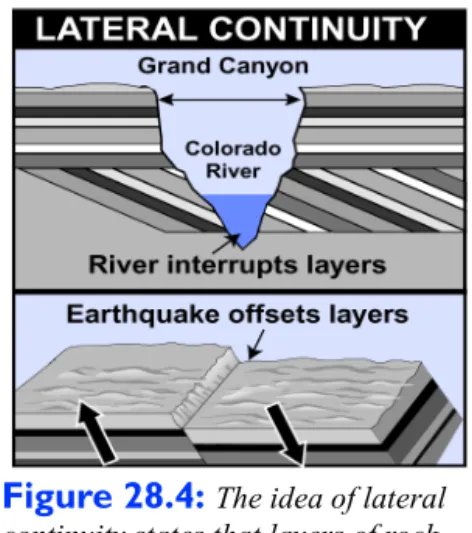
Lateral continuity Lateral continuity is the idea that layers of sediment extend in all directions when they form and before they become rock layers. For example, if you were to compare rock layers in the Grand Canyon, you would find that the layers on one side more or less match up with the layers on the other. A flowing river can interrupt these layers and an earthquake can offset them (Figure 28.4). The Colorado River formed the gap that is now the canyon of the Grand Canyon.
Figure 28.3: A stack of
newspapers illustrates superposition. Superposition means that the bottom layers of rock are older than the layers on the top.
523
28.1 Understanding EarthInterpreting rocks formations
The present explains the past
Using Steno’s ideas, you can begin to describe the history of a rock formation. Another important idea, developed by Scottish geologist James Hutton (1726-97), is that the present explains the past. In other words, if you understand the geologic processes that are happening now, you can explain what happened a long time ago. Both Hutton and Steno were important in the development of relative dating and modern geology. The following ideas are also useful in relative dating.
Cross-cutting relationships
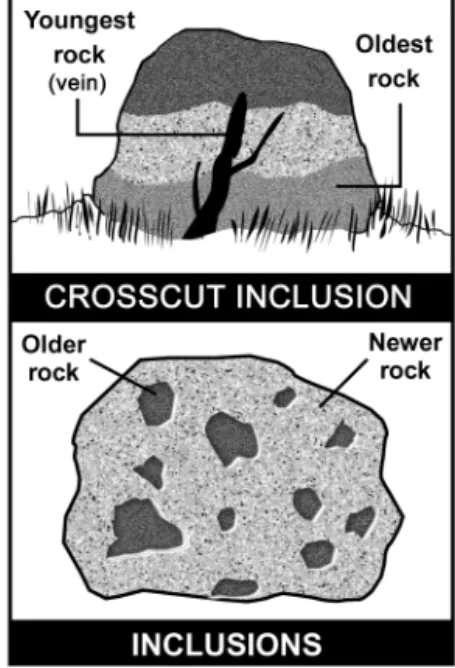
The idea of cross-cutting relationships states that a vein of rock is younger than the rock that surrounds a vein. Figure 28.5 shows a rock formation with three layers and a cross-cutting vein. The layers formed first. The vein formed when melted rock oozed into the original rock, cutting across the layers. Then the melted rock solidified. The bottom layer is the oldest part of the rock formation and the vein is the youngest. The middle and top layers formed after the bottom layer and before the vein.
Inclusions Sometimes rock pieces called inclusions are contained in another rock. During the formation of a rock with inclusions, sediments or melted rock surrounded the inclusion and then solidified. Therefore, the inclusions are older than the surrounding rock (Figure 28.5). A rock with inclusions is like a chocolate chip cookie. The chocolate chips are made first by a manufacturer. Then they are added to the batter before baking.
Faunal succession Over geologic history, many animals and plants have lived and become extinct. Their remains have become fossils. The idea of faunal succession states that fossils can be used to identify the relative age of layers of a rock formation (Figure 28.6). For example, dinosaur fossils are found in rock that is about 65 to 200 million years old because these animals lived on Earth about 65 to 200 million years ago. We can learn what else lived with the dinosaurs by studying other kinds of fossils found in layers of rock that are this old. The fossils of modern human beings (Homo sapiens) are found in rock that is about 40,000 years old, but not in rock that is 65 to 200 million years old. And dinosaur fossils are not found in rock that is 40,000 years old. Faunal succession also assumes that evolution occurs in one direction. For example, present-day animals will not evolve into dinosaurs.
Figure 28.5: Cross-cutting relationships versus inclusions.
524
Calculating Earth’s age
Calculating Earth’s age
William Thompson Kelvin (1824-1907), known for proposing the absolute temperature scale that came to be named after him, meticulously calculated Earth’s age to be between 10 million and 100 million years. His calculations were based on his prediction of how long it would take for a hot Earth to cool.
Radioactive decay and Earth’s age
Lord Kelvin’s calculation was not accurate because he did not realize that Earth has internal heat from the core and radioactive decay. Radioactivity was not understood until the early 1900s. In 1907, Earth’s age was estimated by measuring the radioactive decay of uranium to lead. This estimation was performed by comparing the amount of lead to uranium in a piece of uranium ore. With improved techniques and evidence from tree rings and glaciers, the age of Earth is estimated to be about 4.6 billion years.
Comparing ages Moon rocks, meterorites, and the solar system are estimated to be about the same age as Earth, about 4.6 billion years. This information indicates that the solar system, the moon, and Earth were formed around the same time.
The geologic time scale
The geologic time scale is a model of Earth’s history. In this model, time is divided into eras and periods. Figure 28.7 includes pictures of organisms and events that characterize the periods. For example, Earth was covered with glaciers during the Ordovician period. Flowering plants evolved during the Cretaceous period. A giant meteor hit Earth at the beginning of the Tertiary period. Scientists believe this event may have ended the existence of the dinosaurs. Modern humans appeared 40,000 years ago during the Cenozoic era. Before these periods of time, the Precambrian era lasted from 4.6 billion to 570 million years ago. During this earliest time period, layers of rock at the bottom of the Grand Canyon were forming and only single-celled organisms lived on Earth.
525
28.1 Understanding EarthInside Earth
Earth’s beginnings and the formation of layers
Scientists believe that Earth formed when cosmic particles collected into a sphere due to the gravitational attraction between the particles. As these particles gathered, pressure inside the sphere increased. Iron particles melted and percolated to the core. The “fall” of iron to the core was accompanied by the conversion of potential energy to kinetic energy. This energy transformation generated intense heat that melted other particles in the sphere. At this point in Earth’s formation, the densest materials like iron and nickel sank to Earth’s center and formed its core. Layers of less dense material formed the mantle. The least dense elements rose to the outer surface and formed our planet’s crust.
The lithosphere and asthenosphere
The shallowest 100- to 150-kilometer layer of Earth is the lithosphere (lithos is Greek for “stone’’). This layer includes the crust and upper mantle. The lithosphere is about two percent of the 12,756-kilometer diameter of Earth—like the skin of an apple compared with the whole apple. Below the lithosphere is the asthenosphere (asthen is Greek for “weak’’), a layer of the mantle that is
composed of material that flows. Convection inside Earth
526
The layers of Earth
Earth’s crust Earth’s surface is covered with a thin crust. There are two kinds of crust, continental and oceanic (Figure 28.8). Continental crust is older, thicker, and less dense than oceanic crust. Continental crust is composed primarily of granite, a usually light-colored rock rich in silica. Oceanic crust is made of basalt, a dark-colored rock relatively low in silica and containing iron and magnesium. Both continental and oceanic crusts are brittle and tend to crack when pushed or pulled as pieces of the crust move. A crack in the crust is called a fault.
The mantle The mantle of Earth is a 2,900-kilometer-thick layer of molten material between the crust and core. The density of this material is 3.3 g/cm3. The continental and oceanic crusts float on top of the mantle because they are less dense. Blocks of foam and wood floating in water demonstrate the floating of the continental and oceanic crusts in the mantle (Figure 28.9). Being less dense, a foam block floats higher in water than wood. Likewise, continental crust floats higher in the mantle than oceanic crust. The result is that much of the water on Earth has collected on top of the oceanic crust, forming the oceans.
The core Earth has a two-layer core. The inner core is made of solid iron and nickel, while the outer core is made of molten iron, nickel, and oxygen. Both of these layers are denser than the mantle. The temperature of the core ranges from 2,000°C to 5,000°C. In comparison, the surface of the sun is estimated to be 5,500°C. The density difference between the core and the middle layer of Earth (the mantle) is twice the density difference between the atmosphere and Earth’s crust. The core is about one-third of Earth’s mass and a little smaller than the moon.
Continental crust Oceanic crust
Average thickness 10-80 km 5-10 km
Density 2.75 g/cm3 3.0 g/cm3
Oldest known age 3.5 billion years 200 million years Composition mostly granite basalt
Figure 28.8: The oceanic crust is made of basalt. The continental crust is made mostly of granite.
527
28.1 Understanding EarthImportant concepts that will help you understand Earth science
Concepts you already know
This section begins your study of the processes that shape Earth. The concepts you have learned in this section will help you understand mountains, earthquakes, volcanoes, and the formation of rocks. As you continue to read, you will see the following familiar concepts.
Concept How the concept applies to understanding Earth
Density The layers of Earth are separated according to density. For example, the core of Earth is much denser than the continental and oceanic crusts.
Viscosity The molten material of the mantle is viscous. For example, molasses is much more viscous than water which flows very quickly. The viscosity of lava explains the kinds of volcanic eruptions that occur.
Convection currents The convection currents in the mantle are similar to the convection currents in the atmosphere.
Potential and kinetic energy As Earth formed, the fall of iron to the core was accompanied by the conversion of potential energy to
kinetic energy. Heat was produce inside Earth as a result of this energy conversion. Also, earthquakes are caused by a conversion of potential energy to kinetic energy.
Cycles Cycle is a term used to describe various processes that move matter from place to place on Earth. Water is transported on Earth via the water cycle. The energy source driving this cycle is the sun. The rock cycle is a set of processes that lead to the formation and recycling of the various kinds of rocks. Energy sources driving this cycle are climate changes (driven by the sun) and convection currents that distribute heat in Earth’s mantle.
Plate tectonics
528
Figure 28.10: About 225 million years ago, the land on Earth was part of one supercontinent called Pangaea. About 200 million years ago, this huge landmass began to split apart into many sections—seven of the largest sections are our continents. It is important to note that the forces that brought Pangaea together had been working for a long time. Before Pangaea, there were other earlier oceans and continents.
28.2 Plate Tectonics
If you look at a map of the world, it is easy to imagine the continents like puzzle pieces. In particular, South America and Africa seem to fit together. If the continents were once connected, how did they move apart? The theory of plate tectonics explains the movement of continents and other geological events like earthquakes and volcanoes. In this section, you will learn about the theory of plate tectonics.
The surface of Earth
Pangaea and continental drift
In 1915, Alfred Wegener (1880-1930), a German meteorologist, wrote a book titled The Origin of Continents and Oceans. In this book, he proposed that millions of years ago, the land on Earth formed a single, huge landmass. He named it Pangaea, a Greek name that means “all lands.” Wegener’s theory was that pieces of Pangaea moved apart to form the seven continents (Figure 28.10). This idea was called continental drift. Wegener’s idea was not accepted by all scientists because it did not explain what caused the continents to move.
Plate tectonics How continents moved is explained by a theory called plate tectonics. The term tectonics means construction or building. The theory of plate tectonics, stated in 1965, refers to the movement of giant pieces of solid rock on Earth’s surface called tectonic plates. The movement of one plate causes the pulling or pushing of other plates, significantly affecting Earth’s surface.
The movement of tectonic plates affects Earth’s
surface and causes earthquakes and volcanoes.
What is happening now?
529
28.2 Plate TectonicsContinental drift
Wegener’s evidence for continental drift
For a long time, scientists could not explain why South America and Africa appeared to fit together. Wegener gathered evidence that supported his idea that all the continents had been connected. Some of this evidence is illustrated in the graphic and described in the sidebar.
Mountains are in certain locations on Earth
Wegener’s scientific colleagues thought it was foolish to propose that continents could move. Instead, they had other ideas to explain features on Earth. One idea was the “dry apple skin” model, which assumed that the Earth is shrinking and mountains are the result of the wrinkling of the crust. If this were true, mountains would be all over the surface of Earth. Instead, mountains tend to be in long bands. For example, there are bands of mountains on the west coast of North America and the west coast of South America (Figure 28.11).
Continental drift was not accepted until the 1960s
Wegener believed the continents had pushed through the ocean floor. However, he did not have a satisfactory explanation for how this happened. There was no known source of energy large enough to move continents through the sea floor. Also, although scientists had data about the interior of Earth from earthquakes, there were no clues in Earth's crust to show that the continents had broken through the sea floor. Given this lack of evidence to explain the mechanism of continental drift, scientists did not accept this idea. However, in the 1960s, a scientific breakthrough occurred. Evidence showed that the continents and sea floor moved
together on Earth’s surface. Figure 28.11: in North and South America.Mountain ranges
Continental drift
Distribution of mountains and coal:
Mountain ranges on the east coast of South America match mountains on the west coast of Africa. The North American Appalachian Mountains match the Atlas Mountains of northwest Africa. Coal beds in North America match those in Europe.
Distribution of fossils:
Fossils of a particular plant are found on continents that are now far apart. This plant only spreads across land, not across oceans.
The past does not match the present:
530
Sea-floor spreading
Mountain ranges on the sea floor
The sea floor is mostly flat. However, in the middle of the oceans (namely the Atlantic, Pacific, and Indian), there are more than 50,000 kilometers of mountain ranges called the mid-ocean ridges. The average height of the mountains at the ridges is 4,500 meters or about 2.8 miles above the sea floor. The ridges are split in the middle by either a valley or by a rise (see sidebar). The valleys can be as much as 800 kilometers across. However, they are usually less than 50 kilometers across for slow-spreading ocean ridges.
Echo sounding Scientists first described the appearance of the sea floor using echo sounders. An echo sounder on a ship sends and collects sound waves. These waves bounce off objects and the sea floor. The data collected by an echo sounder is used to determine the depth of the sea floor. The combined depth readings for an area are used to make a profile of the sea floor (Figure 28.12).
Sea-floor spreading
In the early 1960s, Henry Hess (1906-69), a geologist and former commander of a Navy ship equipped with an echo sounder, used the profile of the sea floor to propose that it was spreading at the mid-ocean ridges. Around the same time, Robert Dietz (1914-95), a scientist with similar ideas, coined the term sea-floor spreading. Sea-floor spreading describes the sea floor on either side of a mid-ocean ridge as moving away from the ridge and creating a rise or valley. Hot fluid from the mantle (called magma) enters the rise or valley and cools, creating new sea floor (also called oceanic crust).
Proving sea-floor spreading
Not every scientist accepted the idea of sea-floor spreading. If you were going to prove this idea, what would you do? What kind of evidence would you need to prove that the sea floor was spreading apart at the ridges?
Figure 28.12: An echo sounder is used to make a profile of the sea floor.
Mid-ocean ridges
531
28.2 Plate TectonicsMagnetic patterns on the sea floor
Earth is a giant magnet
Like a giant magnet, Earth has a magnetic north and south pole. Scientists believe Earth’s magnetism is due to convection currents in the liquid outer core. These currents generate a magnetic field around Earth. Not only does this magnetic field provide us with a means of navigation, but it also blocks some of the sun’s harmful electromagnetic radiation from reaching Earth’s surface.
Earth’s polarity has switched over time
Over geologic time, the magnetic polarity of Earth has switched. Scientists believe the poles switch because of a magnetic interaction between the planet’s inner and outer core. Eventually, the interaction diminishes the magnetic field to a point that encourages the poles to reverse. This reversal recharges the magnetic field. The last time Earth’s polarity switched was about 780,000 years ago. Rocks on Earth act as a record of these switching events. When molten lava cools and becomes a rock, the grains in the rock are oriented with the magnetic polarity of Earth.
Magnetic patterns on the sea floor
In the 1950s and 1960s, scientists discovered that the rocks of the sea floor have a very interesting magnetic pattern. Figure 28.13 illustrates what this pattern looks like. Stripes of rock with a north-south orientation (normal) alternate with stripes of rock with a south-north orientation (reversed). Scientists also discovered that the pattern of stripes matches on either side of a mid-ocean ridge (Figure 28.13).
Evidence for sea-floor spreading
On the previous page, you were asked how you would prove that the sea floor was spreading apart at the mid-ocean ridges. Now, you have some new information. First of all, you know the polarity of Earth switches over time. Second, you know that newly formed rock records Earth’s polarity. Thirdly, you know that the rocky sea floor on either side of mid-ocean ridges has a matching pattern of magnetic stripes. Together, this information provides evidence for sea-floor spreading. The matching striped pattern shows that Earth’s polarity was recorded on either side of the ridge as lava oozed from the ridge and cooled. Since the mid-ocean ridge is a site where new sea floor is made, the newest rock is always near the ridge and the oldest rock is always far from the ridge (Figure 28.13).
Figure 28.13: Magnetic patterns on the sea floor show the reversal of Earth’s magnetic field and provide evidence of sea-floor spreading. The blue and white stripes you see in the figure are an interpretation of a magnetic profile.
l
Think about it532
The theory of plate tectonics
The theory of plate tectonics
The theory of plate tectonics is consistent with the observed magnetic patterns on the sea floor, sea-floor spreading, continental drift, and the idea that the lithosphere is divided into tectonic plates. This theory also provides possible explanations for many things about Earth’s geology such as mountain-building, earthquakes, and volcanoes.
Plates are pieces of the lithosphere
The tectonic plates that cover Earth’s surface are pieces of the lithosphere that fit together and float on the asthenosphere (a part of the mantle). There are a number of large tectonic plates on Earth’s surface, and smaller plates are being identified all the time. Below is a list of the bigger plates. Find these plates on the graphic below. Then find the plate that goes with each of the seven continents. Many of the plates are made up of both continental and oceanic crust. Can you identify which of the plates are only made of oceanic crust?
The biggest tectonic plates
Eurasian Philippine North American Juan de Fuca African
Arabian Iranian Antarctic Scotia South American
Cocos Caribbean Nazca Pacific Indo-Australian
Oceanic crust is younger than continental crust
533
28.2 Plate TectonicsDescribing plate boundaries
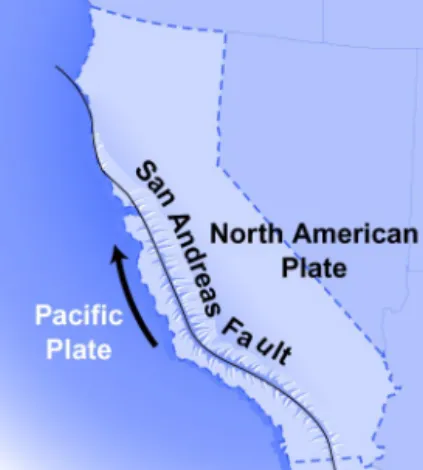
Faults Whenever one tectonic plate moves, another is affected. Most geologic activity occurs at plate boundaries. There are three main kinds of plate boundaries: divergent, convergent, and transform. These boundaries are illustrated below and described on the following pages. Each of these boundaries is associated with faults. Faults are breaks and cracks in Earth’s crust where two pieces of the crust become offset. The build up and release of pressure at a fault causes earthquakes. Large earthquakes tend to be more frequent near convergent plate boundaries than at divergent plate boundaries. The San Andreas fault is a transform plate boundary that extends 600 mile along California’s coast (Figure 28.14). Earthquakes occur frequently in regions near this kind of boundary.
Zones of activity at plate boundaries
At a plate boundary, crust can be created, consumed, or crumpled into mountains. In some cases, plates slide past each other. With all that can happen at a boundary, the effects occur over a region or zone rather than on a single line. The zone of activity at a plate boundary can range from tens to hundreds of kilometers wide. For example, the zone of activity for a divergent boundary spans about 30 kilometers on the sea floor and 100 to 200 kilometers on a continent.
Figure 28.14: The San Andreas fault is a transform plate boundary. The arrow shows the movement of the Pacific plate relative to the North American plate.
Where do earthquakes and volcanoes occur?
534
Divergent plate boundaries
Description Divergent plate boundaries are places where plates move apart. Divergent boundaries are sites of earthquakes and volcanic activity. As molten material from the mantle reaches Earth’s surface at these boundaries, new crust is created.
Diverging plates move apart. New crust forms.
Examples Mid-ocean ridges and associated sea-floor spreading occur at divergent plate boundaries. Magma from the mantle erupts along cracks created by the separation of plates along the mid-ocean ridge. In effect, a mid-ocean ridge is like a very long volcano. A continental version of a divergent plate boundary is the Great Rift Valley in East Africa. The Great Rift Valley is 6,400 kilometers long and averages 48 to 64 kilometers across. It is the largest continental rift in the world and extends from Jordan to Mozambique. As plates pull apart at the Great Rift Valley, the land sinks forming a valley that may eventually fill with ocean water. Once it was underwater, the Great Rift Valley would become part of the mid-ocean ridge system. Although scientists think that eastern Africa could become a site for a new ocean, this will not happen for a very long time.
Divergent Plate Boundary
Description Place where plates are separating; new crust is created.
Earthquake activity? Yes
Volcanic activity? Yes
Examples Mid-Atlantic Ridge East Pacific Rise Great Rift Valley
Why doesn’t Earth get bigger and bigger?
535
28.2 Plate TectonicsConvergent plate boundaries
Subduction and trenches
Convergent plate boundaries occur where two plates approach each other. One result of two plates converging is subduction. In subduction, a denser plate slides under a less dense plate and enters the mantle, where it melts or becomes part of the mantle. Subduction can occur between an oceanic plate and a continental plate or between two oceanic plates. In either case, the subducting plate causes volcanic activity on the less dense plate. When an oceanic plate subducts under a continental plate, volcanoes occur on the continental plate such as the volcanic Cascade Mountains in the northwestern United States. When an oceanic plate subducts under another oceanic plate, an arc of volcanic islands is formed such as the Caribbean Islands. A deep oceanic trench marks the boundary between a subducting and an overriding plate at a convergent boundary.
Converging plates meet. Subduction occurs or
mountains form.
Mountain building The collision of two continental plates is a third kind of convergent boundary. Because both plates resist sinking in the mantle, they crumple. The crust is pushed upward forming mountain peaks and downward forming deep mountain “roots.” The Himalayan Mountains are the result of colliding continental plates.
Convergent Plate Boundary
Description Place where plates meet; mountains form or plates are consumed by subduction.
Earthquake activity? Yes
Volcanic activity? Yes
Features at this boundary
Mariana Trench Caribbean Islands Himalayan Mountains
Deep oceanic trenches
536
Transform plate boundaries
Transform plate boundaries
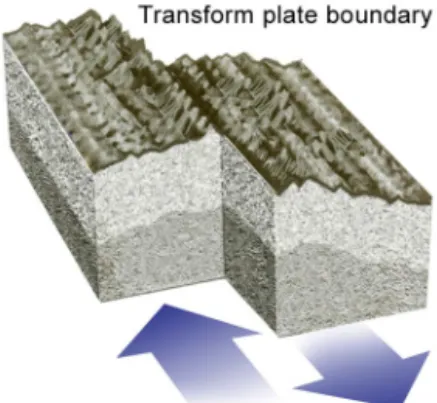
At transform plate boundaries, two plates slide by each other and crust is not created or consumed (Figure 28.15). The San Andreas fault in California is a well-known transform plate boundary. The build up of friction and pressure between sliding plates often results in earthquakes. Volcanic activity is not associated with transform plate boundaries; however, divergent plate boundaries which are sites of volcanic activity often occur near transform plate boundaries.
Plates slide past each other at transform plate
boundaries. Crust is not created or consumed.
Movement of plates
How plates move The movement of tectonic plates is related to the distribution of heat by convection currents in the mantle. At the mid-ocean ridges where new crust is forming, a plate is relatively hot and less dense. Away from the ridges, a plate begins to subduct because it is cooler and denser. The subduction of a plate causes the pulling apart of plates at the mid-ocean ridge. Scientists believe that this pulling effect, which depends on heat distribution, causes the interaction and movement of the plates on Earth’s surface.
An analogy to explain how plates move
An air mattress floating in a pool can illustrate the motion of a plate on the mantle. If you sit on one end of the mattress, it sinks (or subducts) underwater. As a result, the other end of the mattress moves toward the sinking end like a divergent plate.
Figure 28.15: At transform plate boundaries, plates slide past each other. Crust is not created or consumed at these boundaries.
Transform Plate Boundary
Description Place where plates slide past each other; no crust is created or consumed
Earthquake activity? Yes
Volcanic
activity? No (but divergent plateboundaries and their associated volcanoes are often near transform boundaries)
537
28.3 EarthquakesFigure 28.16: These recent moderate earthquakes in Japan are associated with subduction occurring at plate boundaries.
Figure 28.17: The focus, epicenter, and seismic waves of an earthquake occurring at an active fault.
28.3 Earthquakes
The majority of earthquakes occur at the edges of tectonic plates. For example, Japan’s location near convergent plate boundaries (Figure 28.16) explains why earthquakes occur regularly in that country. If you mark the locations of earthquakes on a world map, you see the outlines of Earth’s tectonic plates. This section is all about earthquakes and how they are related to plate tectonics.
What is an earthquake?
Energy and earthquakes
As tectonic plates move, friction causes the rocks at plate boundaries to stretch or compress. Like a stretched rubber band or a compressed spring, these rocks store energy. When the rocks break, change shape, or decrease in volume, the stored energy is suddenly converted to movement energy and an earthquake occurs.
Potential (stored) energy in rocks transformed
to ground-shaking kinetic (movement) energy
causes an earthquake.
The focus Earthquakes begin in the lithosphere at a point typically no more than 50 kilometers deep called a focus (Figure 28.17). At this depth, rock breaks easily under pressure. Earthquakes usually do not occur deeper than this because the rock is closer to the mantle, very hot, and more flexible. Deeper earthquakes (about 700 kilometers) occur at subduction zones when a subducting plate breaks.
Seismic waves The conversion of potential energy in rocks to kinetic energy results in seismic waves. Seismic waves radiate from the focus, traveling through the ground about 20 times faster than the speed of sound (about 5 kilometers per second). These waves can be slowed or bent depending on the properties of rock they encounter.
538
Seismic waves
On the previous page, you learned about seismic waves. There are two main kinds of seismic waves: body waves and surface waves.
Body waves Body waves originate from the focus of an earthquake. There are two kinds of body waves that travel through Earth (Figure 28.18). P-waves (primary waves) are compression waves that push and pull rock as they move through it. These waves travel about 5 kilometers per second. P-waves move through water and other liquids. S-waves (secondary waves) move sideways and up and down, traveling about 3 kilometers per second. S-waves do not travel through liquids.
Surface waves Once body waves reach the epicenter of an earthquake, they become surface waves. These waves move more slowly (about 10 percent slower than S-waves), but can be very damaging. When these waves have a lot of energy, the ground rolls like the surface of the ocean. Surface waves can also move side to side and cause buildings to collapse.
What we can learn from seismic waves
People who record and interpret seismic waves are called seismologists. Seismic waves are recorded and measured by a seismograph (Figure 28.19). A worldwide network of seismographs at stations on land and in the oceans record earthquakes. The amplitudes of the recorded waves are related to the rating of the earthquake on the Richter scale (see next page). In addition to measuring earthquakes, seismologists use seismic waves to study Earth’s internal structure. This is similar to how a doctor uses X rays to look at bone structure. P-waves and S-waves are able to travel through the Earth's interior (Figure 28.18). However, there is evidence that S-waves do not pass through the outer core. Since S-waves do not travel through liquids, this indicates to seismologists that the outer core is liquid.
What happens during an earthquake?
During the earthquake, there is a strong burst of shaking that lasts for a few minutes. The longest ever recorded earthquake occurred in 1964 in Alaska and lasted for four minutes. Foreshocks are small bursts of shaking called tremors that may precede a large earthquake. Foreshocks occur days to minutes before the earthquake hits. Aftershocks are small tremors that follow an earthquake. These may last for hours to days after the earthquake. The frequency of foreshocks and aftershocks is greatest just before and just after the earthquake.
Figure 28.18: P- and S-waves.
539
28.3 EarthquakesMeasuring the magnitude of an earthquake
The magnitude of an earthquake
The magnitude or size of an earthquake is based on the energy of the seismic waves produced and the amount of ground movement and damage that results. Earthquake rating scales are described below.
The Mercalli scale The Mercalli scale has 12 descriptive categories. Each category is a rating of the damage caused to buildings, to the ground, and to people. Because earthquake damage can be different from place to place, a single earthquake may have different Mercalli numbers in each location where the quake is recorded.
The Richter scale The Richter scale ratings of earthquakes are related to the amplitude of the waves recorded on a seismograph. Each level of the scale indicates a tenfold increase in energy released by the earthquake (Figure 28.20). Unlike the Mercalli scale, the Richter scale does not describe the amount of damage from an earthquake. The Richter scale provides accurate measurements for earthquakes that are near, but not for those that are far away.
The Moment Magnitude scale
The Moment Magnitude scale rates the total energy released by an earthquake. This scale can be used at locations that are close to and far away from an epicenter. The numbers on this scale combine energy ratings and descriptions of rock movements. Up to a rating of about 5, the Richter and Moment Magnitude scales are about the same. However, when earthquakes are larger, seismologists tend to use the more descriptive Moment Magnitude scale.
Using seismographs to understand Earth
Seismographs show the kinds of waves that occur, their amplitude, and the timing of these waves. Using the network of seismographic stations and combining data from many different locations, scientists can also create a scan of Earth to distinguish hot and cool places in the planet’s interior. In hot places, seismic waves travel slower. In cool places, seismic waves travel faster. This information has been used to figure out that magma from Earth’s mantle is associated with mid-ocean ridges. Today, seismologists cannot reliably predict the date and exact time of an earthquake, but they can identify which areas are likely to have an earthquake in the next 10 or more years. Seismographs are also used to tell the difference between an earthquake and a nuclear explosion. Nuclear testing, which is banned world-wide, causes unique seismic waves to travel through Earth.
Figure 28.20: The Richter scale with a description of the effects at each magnitude and the amount of energy released in terms of tons of the explosive TNT. The largest
earthquake recorded occurred in Chile in 1960. It was off the Richter scale; seismologists estimated this quake to be 9.5.
The Richter scale
Rating Effects Energy
in terms of tons of TNT < 3.5 Barely felt;
recorded on seismographs.
< 73
3.5-5.4 Felt; objects
toppled. 73 to80,000
5.5-6.0 People run outside; damage to poorly built buildings.
80,000 to 1 million
6.1-6.9 Damage over
a large area. 1 million to32 million
7.0-7.9 Major earthquake; serious damage over a large area.
32 million to 1 billion
> 8.0 Great earthquake; tragic damage over an area hundreds of kilometers across.
540
Where do earthquakes occur?
Where are earthquakes?
The majority of earthquakes occur at the boundaries of tectonic plates. The map below illustrates these boundaries and the general positions of earthquakes in the world. At the boundaries, chunks of rock below the surface are disturbed and move, causing an earthquake. Important world cities that experience earthquakes include Mexico City (Mexico), Tokyo (Japan), San Salvador (El Salvador), Santiago (Chile), and Istanbul (Turkey). Individual earthquakes also occur where there is a fault. A fault is a place in Earth’s crust such as a crack or a transform plate boundary. In California, the San Andreas fault is a big fault along which lie the cities of Los Angeles and San Francisco (Figure 28.21).
Figure 28.21: Earthquakes occur along the San Andreas fault.
Figure 28.22: Recent
earthquakes and their Richter scale magnitude. These earthquakes are all associated with subduction zones.
Worldwide earthquakes
Place Date Richter
mag
Ceram Sea, near
Indonesia 1998 7.8 Vanuatu, South
Pacific island 1999 7.5 New Guinea 2000 8.0 Peru, off Pacific
coast 2001 8.4 Hindu Kush
region, Afganistan
2002 7.4
South-central
541
28.3 EarthquakesEarthquakes in the United States
Earthquakes in the United States
The west coast of the United States, including Alaska, experiences frequent earth-quakes because those regions are near the San Andreas fault and a plate boundary. By comparison, the Midwest and eastern United States experience earthquakes only rarely. These regions are not near a plate boundary. The last time a major earthquake occurred in the Midwest was 1895. The last time that a strong earth-quake occurred in the eastern U.S. was in 1886 when a 6.6 (Richter scale) earth-quake hit Charleston, South Carolina.
The New Madrid fault
The New Madrid fault is a 250-mile long fault located in the Midwest. Scientists believe this fault and earthquakes in the Midwest are related to processes at plate boundaries or glaciers that once covered North America. These glaciers were so heavy that they pushed down on Earth’s surface in this region. Now that these gla-ciers are gone, scientists believe that the surface is slowly moving back into place, with earthquakes the result.
Concern about earthquakes
There are three main concerns if a big earthquake were to occur in the eastern or midwestern United States. First, these regions are centered on the North America Plate, where seismic waves can travel a long way without losing much energy. As a result, more earthquake damage can occur over a larger area. For example, when the Charleston quake struck in 1886, it was felt in New York City, Boston, Milwaukee, Canada, and Cuba. A second concern is that there have been no earthquakes in this region for a long time. This means that the faults may have a lot of potential energy that could release a lot of kinetic energy and cause a big earthquake. Finally, few buildings in the Midwest and East are built to withstand earthquakes, whereas buildings in the West now must be built to withstand quakes.
Figure 28.23: The frequency of earthquakes worldwide. (Information provided by US Geological Survey.)
Frequency of Earthquakes
Descrip-tion
Richter
mag Avg. # per year
Great > 8 1
Major 7-7.9 18
Strong 6-6.9 120
Moderate 5-5.9 800
Light 4.-4.9 ~6,200
Minor 3.0-3.9 ~49,000
Very minor 1 - 2.9 ~9000/ day
The importance of minor earthquakes
542
What do seismologists do?
Locating an epicenter
Seismographic stations are set up around the world. These stations can measure the arrival time and speed of seismic waves but not the direction from which they are coming. For this reason, it is important to have data from three of these stations (Figure 28.24). At each station, the difference in arrival time between the P-waves (which arrive first) and the S-waves is recorded. The greater the difference in arrival time between P- and S- waves, the farther away an epicenter is from the site of recording. The next step is to use the collected data to figure out the distance to the epicenter. Once the distances are known for the three different sites, circles are drawn around each seismographic station on a map. The radius of each circle is directly related to the difference in arrival time of the P- and S-waves. The point where the three circles intersect is the estimated location of the epicenter.
Locating epicenters with computers
For any earthquake, seismologists locate the epicenter and find out when a series of seismic waves started. Seismologists are also able to identify the focus of the earthquake. Up until the 1960s, they used graphical techniques like the one described above to locate these earthquake features. Then scientists began to take advantage of the development of high-speed computers. They wrote computer programs that could be used to detect epicenters. As these programs improved, they were also used to identify and map the boundaries of plates.
Creating artificial seismic waves
Our understanding of seismic waves has also led to creating them artificially in order to explore shallow, internal structures of our planet. Seismic vibrator trucks are designed to create artificial seismic waves by hitting the ground (Figure 28.25). As the ground is “thumped” by the truck, seismologists record the resulting seismic waves. They use this data to study underground rock structures. This information is often used by companies who are looking for oil and gas deposits. Oil and gas exploration also occurs in the oceans. Seismic waves are generated in the ocean by a gun that sends out a blast of compressed air or water from a ship. As the seismic waves bounce back to the ship, they are recorded by a hydrophone that is towed about 5 to 10 kilometers behind the ship.
Figure 28.24: An epicenter is identified using data collected from seismographic stations in three different locations.
543
28.3 EarthquakesProblem solving: How to determine the distance to an epicenter
Data collected at three seismographic stations includes the speed of the P- and S-waves and the time between the arrival of the P- and S-S-waves. At each station the speed of the P-wave is 5 kilometers per second and the speed of the S-wave is 3 kilometers per second. The time between the arrival of the waves is recorded in the table at right. Given this information, what is the distance traveled by the waves from the earthquake’s epicenter?
Step 1: To calculate the distance to the epicenter for each station, use the equation: distance = rate x time. This equation is a rearranged version of the rate (or speed) equation: speed = distance/time.
Step 2: Use the variables listed in the bottom table at right to solve this problem. Step 3: The distances traveled by the P- and S-waves are equal, therefore:
dp = ds
rp x tp = rs x ts
Step 4: Since the travel time for S-waves is longer than the travel time for P-waves, then:
ts = tp + (extra travel time)
Step 5: Plug this information into a equation and solve for tp. Use the data for Station 1:
5 km/sec x tp = 3 km/sec x (tp + 75 sec) (5 km/sec)tp = (3 km/sec)tp + 225 km (2 km/sec)tp = 225 km
tp = 112.5 seconds
Step 6: Substitute the value for tp into the equation: distance = speed x time. dp = 5 km/sec x 113 seconds
dp = 565 km (This is the same distance that S-waves travel.)
Step 7: Find the calculated distance for the other two stations. These distances are given in the sidebar. Then, draw a circle around each seismic station on a map that shows the locations of the stations. The radius of each circle should be proportional to the distance from the station to the epicenter. The location of the epicenter is where the circles intersect.
Answers
Distances to the epicenter: Station 1: 565 km
Station 2: 750 km Station 3: 675 km
Station #
Time between arrival of P- and S- waves
1 75 seconds
2 100 seconds
3 90 seconds
Variables
dp distance traveled by P-waves
rp speed of P-waves
tp travel time of P-waves
ds distance traveled by S-waves
rs speed of S-waves
544
Preventing earthquake damage
Earthquake damage
The shaking ground during an earthquake is not very dangerous. If you were standing in an open space when an earthquake hit, you might fall when the ground moved, but you would be all right. What makes earthquakes dangerous is that the shaking causes buildings, bridges, and roads to collapse and crack. Additional side effects of an earthquake are fires that result from broken gas pipes, huge waves called tsunamis, and massive erosion events like mudslides and avalanches.
Damage prevention for buildings
How can buildings be built to survive an earthquake? First of all, the building foundation is very important. A structure built on loose soil will sustain more damage during an earthquake. Structures built on land that has a layer of rock below it (called bedrock) will better withstand earthquakes. Strong supports in building frames can keep a building together as it is shaken. Also, engineers have learned that structures can be built to move with the ground. When buildings are too rigid, they are brittle and thus are more likely to crack in an earthquake. Brittle materials are rock, concrete, brick, and glass. When a building is flexible, it can move with the ground as it shakes. Flexible buildings are better able to survive an earthquake. Flexible materials are wood, steel, and fiberglass. How would you design a building to withstand an earthquake? The graphic below compares the safety of certain locations during an earthquake.
Earthquake safety tips
In 1995, a 7.2 earthquake struck Kobe, Japan. During the quake, two college students from California quickly ran to stand in a door frame to be safe. They were surprised to see each other. They had never met before. Simply knowing how to be safe during an earthquake brought them together. Follow these safety tips in the event of a earthquake: Getting outside is the safest thing you can do. Once you are outside:
• Get to an open area, far from buildings and objects that could fall.
• Sit down to avoid falling. If you are inside:
• Drop, cover, and hold:
Get under a heavy table and hold on to it to keep it from moving away from you.
• If there isn’t a heavy table, stand in a door frame or near an inside wall. Protect your head and neck from falling objects.
545
28.3 EarthquakesPreparing for earthquakes: tsunamis and seismic networks
What are tsunamis?
A huge wave generated by an underwater earthquake or landslide is called a tsunami. The speed at which this wave travels can be about 700 kilometers per hour. In the open ocean, you would not notice this wave. However, as the wave reaches a shallow area, the water piles up so that the wave may get as high as 25 meters. Tsunamis cause serious flooding and the power of their waves wrecks buildings and can cause loss of life.
Where do tsunamis occur?
Tsunamis occur in coastal areas that experience earthquakes. In particular, tsunamis occur in the Pacific Ocean and can affect countries like Japan and Indonesia. Alaska and Hawaii are also affected by tsunamis. When an earthquake happens in the area near Alaska, a tsunami may affect both the Alaskan shoreline and Hawaii (Figure 28.26).
How do scientists predict tsunamis?
Around the Pacific coastline of Alaska and the west coast of the Lower 48 states, there are ocean-bound tsunami detectors and seismographs. Scientists use information from the detectors and seismographs to forecast tsunamis. Because scientists know how fast a tsunami can travel after it has been triggered by an earthquake, they can warn people in coastal places to evacuate to higher ground.
546
Chapter 28 Review
Vocabulary review
Match the following terms with the correct definition. There is one extra definition in the list that will not match any of the terms.
Concept review
1. Define superposition and lateral continuity. Why are these ideas useful in interpreting how the Grand Canyon formed? 2. Compare the convection currents within the mantle to those in
the atmosphere. What energy source drives each current? 3. Compare and contrast the asthenosphere and the lithosphere. 4. Which of the largest tectonic plates are mainly made of oceanic
crust and do not include major continents? Use the diagram of the tectonic plates in the section entitled Plate Tectonics to help you answer this question.
5. Describe an example of a divergent plate boundary and a transform plate boundary. Describe two examples of a convergent plate boundary—one example should illustrate where subduction occurs, and the other example should illustrate where mountains occur.
6. What is the difference between the focus and the epicenter of an earthquake?
7. Draw a diagram that shows the difference between a P-wave and an S-wave. Describe the differences between these two kinds of earthquake waves.
Set One Set Two
1. paleontologist a. The idea that the continents were once a super-continent called Pangaea.
1. lithosphere a. A process that occurs at diverging tectonic plates.
2. cross-cutting relationships
b. For a layered rock, the youngest layer is on top and the oldest layer is on the bottom.
2. asthenosphere b. An ocean mountain range that occurs where tectonic plates diverge.
3. superposition c. A scientist who studies fossils. 3. sea-floor spreading c. The layer of the mantle below the lithosphere. 4. relative dating d. A method used to determine the order in which
geologic events happened.
4. mid-ocean ridge d. Earth’s crust plus the rigid, upper layer of the mantle.
5. continental drift e. The vein of rock is younger than the rock surrounding the vein.
5. original horizontality
e. Sediment forms horizontal layers under the influence of gravity.
547
Problems
1. This diagram shows a series of three lines that have been drawn on top of each other. Which line was drawn first? Which line was drawn last? Use relative dating to identify the order in which each line was drawn.
2. North America and Europe are separating at a rate of about 2.5 centimeters a year. How much farther apart will these continents be in 75 million years? Record your answer in kilometers.
3. The geologic time scale covers a very long period. To help you make sense of this length of time, compare the lengths of each of the periods with the lengths of something you are familiar with (e.g., a football field, a mile, or the distance from school to your house).
For example, compare history of the planet with a football field, which is 100 yards long (not including the end zones). If the age of Earth is 4.6 billion years and Homo sapiens have been on Earth for 40,000 years, where on the football field would humans have appeared?
4. Explain why the following examples support the theory of continental drift: (1) Fossils of an ancient and aquatic reptile (Lystrosaurus) have been found in rocks of the same age on the continents of Antarctica, Africa, and South America. (2) Today, you can find the same species of earthworm in southern African and South America.
5. The average density of Earth is 5.52 g/cm3. You learned that the densities of the continental crust and the oceanic crust were 2.75 g/cm3 and 3.0 g/cm3, respectively. Come up with a hypothesis to explain why the average density of Earth is greater than the density of its crust.
6. A seismograph records the arrival of the P-waves of an earthquake and then, 3 1/2 minutes later, the arrival of the S-waves. If the P-waves were traveling at 8 kilometers per second and the S-waves were traveling at 60 percent of the speed of the P-waves, how far away is the epicenter of the earthquake? 7. Seismic waves are about 20 times faster than the speed of
548
l
Applying your knowledge
1. The terms density, potential energy, and kinetic energy were used in this unit. Each of these terms was presented in previous units. Define each term in your own words and explain why they are important for understanding earth science.
2. Review some recent popular science magazines to find out about the present day activities of geologists and paleontologists. Write a short paragraph that describes a current topic of research in the area of either geology or paleontology.
3. Another important figure in developing the field of geology is Charles Lyell (1797-1875), a Scottish geologist. Like James Hutton, Lyell was important in establishing the idea that the events in the present explain events of the past. Lyell’s term for this concept was uniformitarianism. Further research the scientific contributions of both scientists on the Internet or in your local library. Explain their contributions in the form of an one-minute advertisement for television. Write the script for your advertisement and present it to your class. You may use props and other actors in your advertisement.
4. The geologic time scale shown in the section titled Understanding Earth illustrates some of the events that have occurred over geologic time. By doing research on the Internet or in your local library, identify when the following events occurred during Earth’s geologic history: (1) the appearance of the first trees, (2) the formation of Mount Everest, and (3) the formation of the Mediterranean Sea.
5. Compare Wegener’s theory of continental drift with the theory of plate tectonics. Explain why one theory became accepted while the other theory did not.
6. At the site of the Great Rift Valley in Africa, three plates are pulling apart. An eventual consequence of this is that an ocean will form between these plates. When this happens, what will this divergent plate boundary become? Hint: The Atlantic Ocean has this feature.
7. Your property and your neighbor’s is separated by a newly formed fault. A year ago, an earthquake occurred at the site of this fault. A month ago, your neighbor discovered a vein of gold on her property. The location of this vein is shown on this diagram. Assuming
that the vein continues on to your property, where would you start looking for it? Choose the probable location (either A, B, C, or D) and explain why you chose it. The direction of movement along the fault is shown in the diagram.
8. An earthquake in the eastern hemisphere of Earth is recorded in the western hemisphere. However, only P-waves are recorded. Review what you know about P- and S-waves and come up with an explanation for this data.