O R I G I N A L R E S E A R C H
Open Access
PreHospital Ambulance Stroke Test - pilot
study of a novel stroke test
Gunnar Andsberg
1*, Magnus Esbjörnsson
2, Arne Olofsson
3, Arne Lindgren
1, Bo Norrving
1and Mia von Euler
4Abstract
Background:There is a need for a prehospital stroke test that in addition to high sensitivity for stroke, also is able to communicate stroke severity similar to the National Institute of Health Stroke Scale (NIHSS).
Methods:The PreHospital Ambulance Stroke Test (PreHAST), an eight item test based on NIHSS, which scores stroke severity from 0–19 points, was designed and adapted for the ambulance services. In the pilot study the ambulance nurses used PreHAST to assess patients with suspected stroke in the prehospital setting. Regardless of the results after PreHAST testing the patients were triaged with a provisional stroke diagnosis. The PreHAST scores were compared with the final diagnosis and the ability to differentiate stroke and transient ischemic attacks (TIA) with ongoing symptoms at evaluation from non-stroke patients was analysed.
Results:69 patients were included in the study, 26 had stroke/TIA and 43 other diagnoses. All stroke/TIA patients were identified by PreHAST (sensitivity 100% (95% CI; 87-100%)). The specificity increased with higher PreHAST scores and the discriminative capacity for PreHAST for different cut off values showed an area under the curve of 0.77 (95%CI; 0.66-0.88) in the receiver operating characteristic (ROC) analysis.
Discussion:PreHAST is designed for high sensitivity, screening for a broad range of stroke symptoms including most key components of NIHSS. The promising sensitivity between 87 and 100% in our study has to be confirmed in a larger study also including multiple centres. Higher PreHAST scores implied more typical patterns of stroke and accordingly the proportion of stroke mimics decrease with higher scores. However, also stroke mimics with epilepsy/seizure and patients with deficit after prior stroke could show higher PreHAST scores. Other prehospital stroke tests that evaluate stroke severity have been designed with the main purpose to screen for large vessel occlusion. The advantage of PreHAST is the dual purpose not only to evaluate stroke severity but also to screen for stroke in general.
Conclusions:PreHAST is a new screening test of stroke adapted for ambulance services that in addition to high sensitivity for stroke, provides a grading system with increasing specificity with higher scores.
Keywords:Cerebrovascular diseases, Strokes, TIA, Treatment, Prehospital, Stroke Scale
Background
With new reperfusion treatments for stroke, i.e. thromb-ectomy, fast identification of stroke and stroke severity have become crucial [1]. Prehospital identification and pre notification of stroke minimize time loss to acute stroke treatments [2] instigating a need for a compre-hensive test of typical stroke symptoms for ambulance services [3]. The prehospital tests for stroke screening
with the highest reported sensitivity are the Face Arm Speech Test (FAST) [4, 5] and the Cincinnati Prehospital Stroke Scale (CPSS) [3, 6]. A concern is that these tests restrict evaluation to unilateral facial palsy, arm paresis and speech disturbances, and may miss patients with other disabling stroke symptoms. Furthermore, a mod-ern prehospital stroke test should, in addition to high sensitivity for stroke, also be able to identify patients with severe stroke symptoms and thus the most likely candidates for thrombectomy [7].
* Correspondence:[email protected]
1Department of Rehabilitation Medicine and Neurology, Lund University, Skane University Hospital, Lund SE-221 85, Sweden
Full list of author information is available at the end of the article
Methods
The basis of the PreHAST design
The PreHAST was designed to screen for common stroke symptoms and grade severity, similarly to the NIHSS [8]. Evaluation of neurological signs with high prevalence in stroke as compared to stroke mimics in prehospital screening, i.e. facial palsy, arm paresis, dysphasia/dys-arthria, hemianopia and sensory loss of arm and leg [9], were included. Beyond evaluation of common stroke symptoms, items which in multivariate analysis predict main arterial vessel occlusion were also incorporated, viz. the sub item “questions” in level of consciousness (LOC) evaluation, gaze, leg paresis and neglect [10].
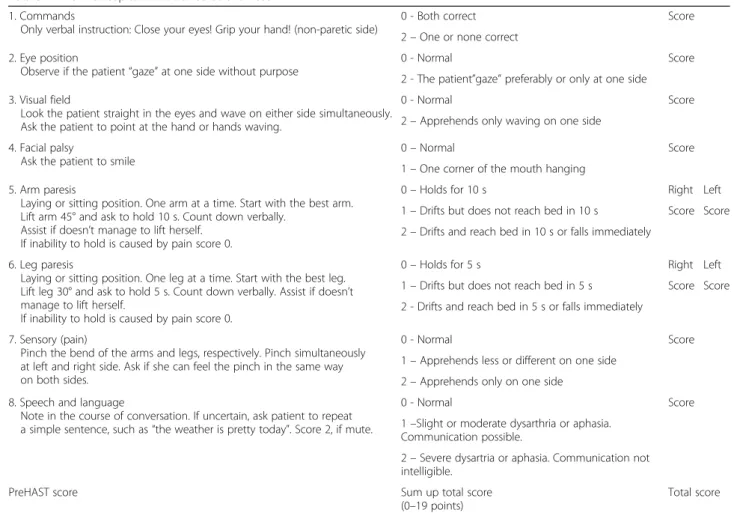
To make the test more feasible in prehospital-paramedics setting than NIHSS the following simplifica-tions were made. Simultaneous testing of right and left side for visual field and sensory items should ensure sen-sitivity also in patients with neglect. By only allowing verbal instructions in the commands item this indirectly also tests for sensory (Wernicke’s) aphasia. In the speech/language item “dysarthria” is not distinguished from “aphasia”. This resulted in an eight item test (Table 1), which scores stroke severity from 0–19 points.
Furthermore, PreHAST is intended for use only in con-scious patients,i.e. alert or aroused by minor stimulation.
Use of PreHAST in a prehospital setting
A pilot study of all patients assessed with PreHAST was performed January 9 to May 23, 2014, in the ambulance district, staffed by 43 ambulance nurses for service around the clock for the community hospital of Hässleholm. The hospital catchment area is 2 068 km2, population 70 000 and stroke incidence approximately 305/100,000/year.
Before the study period all ambulance nurses received a 4-h education program, covering basic stroke knowledge and assessment and grading of stroke symptoms accord-ing to PreHAST. The education program included prac-tical PreHAST training in pairs, where each ambulance nurse performed the PreHAST items under supervision and proper execution. During the study an instruction video for PreHAST was available on YouTube [11].
During the study period neurological assessment with PreHAST was done if stroke was suspected, defined as sudden onset of focal neurological symptoms/signs, in conscious patients above 18 years. Regardless of test
Table 1The PreHospital Ambulance Stroke Test
1. Commands
Only verbal instruction: Close your eyes! Grip your hand! (non-paretic side)
0 - Both correct Score
2–One or none correct
2. Eye position
Observe if the patient“gaze”at one side without purpose
0 - Normal Score
2 - The patient”gaze”preferably or only at one side
3. Visual field
Look the patient straight in the eyes and wave on either side simultaneously. Ask the patient to point at the hand or hands waving.
0 - Normal Score
2–Apprehends only waving on one side
4. Facial palsy
Ask the patient to smile
0–Normal Score
1–One corner of the mouth hanging
5. Arm paresis
Laying or sitting position. One arm at a time. Start with the best arm. Lift arm 45° and ask to hold 10 s. Count down verbally.
Assist if doesn’t manage to lift herself. If inability to hold is caused by pain score 0.
0–Holds for 10 s Right Left
Score Score 1–Drifts but does not reach bed in 10 s
2–Drifts and reach bed in 10 s or falls immediately
6. Leg paresis
Laying or sitting position. One leg at a time. Start with the best leg. Lift leg 30° and ask to hold 5 s. Count down verbally. Assist if doesn’t manage to lift herself.
If inability to hold is caused by pain score 0.
0–Holds for 5 s Right Left
Score Score 1–Drifts but does not reach bed in 5 s
2 - Drifts and reach bed in 5 s or falls immediately
7. Sensory (pain)
Pinch the bend of the arms and legs, respectively. Pinch simultaneously at left and right side. Ask if she can feel the pinch in the same way on both sides.
0 - Normal Score
1–Apprehends less or different on one side
2–Apprehends only on one side
8. Speech and language
Note in the course of conversation. If uncertain, ask patient to repeat a simple sentence, such as“the weather is pretty today”. Score 2, if mute.
0 - Normal Score
1–Slight or moderate dysarthria or aphasia. Communication possible.
2–Severe dysartria or aphasia. Communication not intelligible.
PreHAST score Sum up total score
(0–19 points)
result, the ambulance teams transported the patients ac-cording to the guidelines for suspected stroke. Informed consent was obtained the following working day. Pa-tients with stupor or coma are in our region transported according to the rapid emergency triage and treatment system (RETTS) [12, 13] as “unstable vital signs” with highest priority for further acute evaluation of cause at the emergency room.
Two stroke physicians (GA, ME), blinded to the PreHAST scores, independently reviewed the medical cords of the patients, for current diagnosis. If the re-viewers disagreed after evaluation of history, clinical and radiological findings, a third evaluator (AL) adjudicated the final diagnosis. The diagnoses were divided in
“stroke/TIA” with ongoing symptoms at ambulance
evaluation and “Non-stroke” diagnosis (stroke mimics). A time based definition for TIA was used, thus for tem-porary focal neurological symptoms or amaurosis fugax not lasting more than 24 h irrespective of stroke treat-ment, with no apparent cause other than cerebral, retinal or spinal ischemia. The TIA patients included in the study were required to have ongoing symptoms when evaluated by the ambulance staff. Stroke was defined as rapidly developing clinical signs of focal or global disturb-ance of cerebral function, with symptoms lasting 24 h or longer or leading to death, with no other apparent cause than vascular. Information on treatment with intravenous thrombolysis (IVT) was collected. Patients with deficit in any PreHAST item (score 1–19) were defined as Pre-HAST positive. After the study was completed, the ambu-lance staff received a questionnaire about ease/difficulties with and time to perform PreHAST.
Correlation analysis between PreHAST and NIHSS
A theoretical simulation of correlation between NIHSS and PreHAST was made based on a registry of thromb-olysis of 132 patients where complete NIHSS scores were recorded.
Statistical analyses
The accuracy of PreHAST to identify stroke/TIA with ongoing symptoms was analyzed by calculating sensitiv-ity, specificity and positive and negative predictive values. The discriminative capacity of the full range of the PreHAST scores was analyzed for different cut-off values using the area under the receiver operating char-acteristic (ROC) curve.
A descriptive analysis of the patients with Non-stroke diagnoses with positive scores after PreHAST evaluation was performed. This group of patients is of special inter-est because these by the screening instrument falsely identified patients are at risk of time delay to correct treatment for other conditions than stroke.
The NIHSS and the simulated PreHAST scores were plotted and correlation coefficient was calculated using Excel® and the 95% confidence interval was calculated using VasserStats.net.
Results
In all, 78 patients were assessed with PreHAST. Nine patients were excluded; in five informed consent was not obtained; in two PreHAST was not possible to perform due to agitation and ongoing epileptic seizure, respect-ively, and two patients had no symptoms at ambulance arrival.
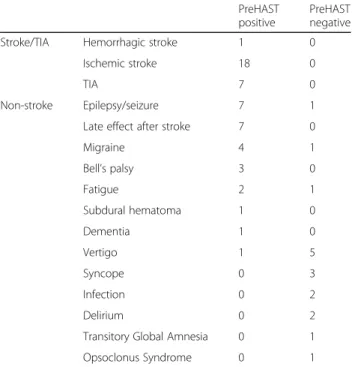
Of the remaining 69 patients, the final diagnosis was stroke/TIA for 26 and other diagnosis for 43 patients (Non-stroke) (Table 2). All Stroke/TIA were identified by PreHAST, (Table 3). Nine patients received IVT, all of which were identified by PreHAST (Fig. 1).
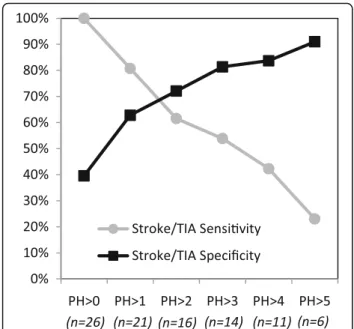
The pilot study showed a sensitivity of 100% (95%CI; 87-100%) and a specificity of 40% (95%CI; 25-56%) for Stroke/TIA when a positive score in any PreHAST item (PreHAST score 1–19 points) was found after prehospital assessment in patients with suspected stroke. Further-more, the positive - and negative predictive value was 50% and 100%, respectively, for a positive PreHAST score.
The discriminatory capacity for different cut off values for the PreHAST scores is illustrated in Fig. 2. The ROC analysis showed an area under the curve (AUC) of 0.77 (95%CI; 0.66-0.88).
Patients with Non-stroke diagnoses who showed def-icit at PreHAST evaluation and thereby had positive
Table 2Diagnoses for the patients in the Stroke/TIA, and Non-stroke groups tabulated for results after PreHAST
PreHAST positive
PreHAST negative
Stroke/TIA Hemorrhagic stroke 1 0
Ischemic stroke 18 0
TIA 7 0
Non-stroke Epilepsy/seizure 7 1
Late effect after stroke 7 0
Migraine 4 1
Bell’s palsy 3 0
Fatigue 2 1
Subdural hematoma 1 0
Dementia 1 0
Vertigo 1 5
Syncope 0 3
Infection 0 2
Delirium 0 2
Transitory Global Amnesia 0 1
PreHAST scores are shown in Table 2. The four most frequent Non-stroke diagnoses with PreHAST positive scores were epilepsy/seizure, late effect after stroke, mi-graine and Bells palsy. The distribution of the PreHAST scores among those most frequent Non-stroke diagnoses is shown in Fig. 3. Patients with Bells palsy or migraine showed low PreHAST scores, while if the final diagnosis was epilepsy/seizure and in patients with deficit after prior stroke (late effect after stroke) often had PreHAST scores between 2–5 points or even higher scores.
In the post-study survey, the ambulance staff reported PreHAST easy to execute and estimated the test time to be 2–3 min.
The correlation between the NIHSS and simulated PreHAST scores in the separate thrombolysis registry showed a correlation coefficient of 0.92 (95%CI 0.89-0.94)
Discussion
PreHAST is a new screening test of typical stroke symp-toms based on items from NIHSS, adapted for ambu-lance services, requiring 2–3 min to execute.
Los Angeles Prehospital Stroke Screen (LAPSS), Mel-bourne Ambulance Stroke Screen (MASS), Recognition of Stroke in the Emergency Room (ROSIER) and other prehospital stroke scales have balanced criteria for eligi-bility in favour of high specificity, i.e. excluding patients with suspected seizures (LAPSS, MASS, ROSIER) and age < 45 years (LAPSS, MASS) [3]. This may be unfortu-nate as seizure could be a sign of stroke and stroke may also well occur in the young. In FAST/CPSS, evaluation is limited to evaluation of facial palsy, arm paresis and speech disturbances. Patients with isolated hemianopia, neglect or leg paresis are therefore not captured, which could delay recognition and impede treatment.
PreHAST screens for a broad range of stroke symp-toms including most key components of NIHSS. There is indirect evaluation of neglect and Wernicke’s aphasia built in the examination technique for the visual field, sensory and commands items. In our pilot, PreHAST identified all patients with stroke/TIA when stroke was suspected by ambulance personnel. However, patients with mild or unusual symptoms of stroke may be missed by the test. The calculated sensitivity between 87 and 100% is based on single centre observation in a small material and the diagnostic accuracy has to be con-firmed in a larger study also including multiple centres. Furthermore, we did not include testing of interrater agreement in the design of our pilot study. Further stud-ies will need to include this important element in the de-velopment of a new scale.
The high sensitivity for PreHAST could be at the ex-pense of lower specificity. Stroke mimics are difficult to exclude from stroke triage and further investigation are
Fig. 1Distribution of the PreHAST scores in the cohort
Table 3Agreement Between PreHAST Result and Consultant’s diagnosis
Consultant´s diagnosis
Test result Stroke or TIA Non-stroke
PreHAST result
Positive 26 26
Negative 0 17
sometimes necessary to exclude stroke. Patients without deficit according to PreHAST often had unspecific diag-nosis such as vertigo or syncope, but were included by the ambulance staff, maybe to avoid missing vertebroba-silar stroke. A higher PreHAST score implied more specific pattern of symptoms for stroke, e.g. isolated dys-arthria may be stroke but could have several other causes, whereas a pattern of dysarthria combined with
hemianopia and left sided hemiparesis makes stroke more plausible. Accordingly, our study showed increas-ing specificity with higher PreHAST scores. Epilepsy/ seizure, sequelae after prior stroke (late effect after stroke) and migraine regularly raises suspicion of stroke in the acute phase [14, 15] and were the most frequent stroke mimics, showing deficit after PreHAST evaluation in our study. To exclude patients with seizure at debut, prior stroke or known migraine from acute stroke triage could lead to decreased “over triage”, but with a risk of excluding true stroke patients from acute stroke treat-ment. Prior stroke is a risk factor of stroke, seizure could be the first sign of severe stroke and aura like symptoms could also be signs of a stroke [15]. A telephone or tele medicine support line to a stroke experienced physician for the ambulance staff [16] could in selected cases be of help but to a prize of time loss to transportation and a risk to overestimate the probability of stroke mimics. In patients with more severe deficit and a higher probabil-ity of large vessel occlusion it may be justified to weigh in the higher probability of stroke mimics in some patient groups before a decision of a change to another triage to minimize time to e.g. endovascular treatment is taken.
The Los Angeles Motor Scale (LAMS) [17], the Rapid Arterial oCclusion Evaluation (RACE) scale [18], the Cincinnati Prehospital Stroke Severity Scale (CPSSS) [19] and Prehospital Acute Stroke Severity Scale (PASS scale) [20] are other prehospital scores designed to grade stroke severity. Those are developed to identify patients with large vessel occlusion and are not intended for
Fig. 3Stroke mimics with positive PreHAST scores The distribution of PreHAST scores in the subgroup of Non stroke patients (stroke mimics) who showed deficit at PreHAST evaluation (positive PreHAST scores). The four most frequent stroke mimic diagnosis with positive PreHAST scores is shown in different shadows of grey bars according to the PreHAST score category
stroke screening in general. Furthermore, only the RACE scale has been evaluated in prehospital settings. The ad-vantage of PreHAST is the dual purpose, both showing high sensitivity for stroke in general and grading stroke severity.
During 2017 we will start a multicenter triage study to evaluate the usefulness of PreHAST to identify thromb-ectomy candidates in the prehospital setting.
Conclusions
PreHAST is a comprehensive test of typical stroke symptoms adapted for ambulance services with a high sensitivity for stroke. The grading system, similar to NIHSS, gives the test a quality with increasing specificity with higher scores. The properties of PreHAST, with the dual purpose of stroke screening in general and grading stroke severity, have the potential to be an important part in a prehospital triage system to identify patients for acute stroke treatments.
Abbreviations
AUC:Area under the curve; CPSS: Cincinnati Prehospital Stroke Scale; CPSSS: Cincinnati Prehospital Stroke Severity Scale; FAST: Face Arm Speech Test; LAMS: The Los Angeles Motor Scale; LAPSS: Los Angeles Prehospital Stroke Screen; LOC: Level of consciousness; MASS: Melbourne Ambulance Stroke Screen; NIHSS: National Institute of Health Stroke Scale;
PreHAST: PreHospital Ambulance Stroke Test; RACE: Rapid Arterial oCclusion Evaluation; RETTS: Rapid emergency triage and treatment system; ROC: Receiver Operating Characteristic; ROSIER: Recognition of Stroke in the Emergency Room
Acknowledgements
The authors thanks the ambulance staff in the catchment area of the community hospital of Hässleholm and the research nurses at the stroke unit at the department of Medicine in Hässleholm for their contribution to the study.
Funding
This study was financed by departmental funds
Availability of data and materials
The datasets for the study are available from the corresponding author on reasonable request.
Authors’contributions
GA, ME, AO, BN and MvE created the PreHospital Ambulance stroke test. GA, ME, AO and MvE designed and implemented the study. GA obtained approval from the ethics committee. GA, ME and MvE were responsible for data acquisition and analysis. All authors contributed to analysis of data. GA and MvE drafted the manuscript and all authors participated in the revision and final approval.
Competing interest
The authors declare that they have no competing interests.
Consent for publication
Not applicable.
Ethics approval and consent to participate
Ethical approval was achieved from the Regional Ethical Board in Lund (approval number 2013/8). Informed consent was obtained from all patients taking part in the study.
Publisher’s Note
Springer Nature remains neutral with regard to jurisdictional claims in published maps and institutional affiliations.
Author details
1Department of Rehabilitation Medicine and Neurology, Lund University, Skane University Hospital, Lund SE-221 85, Sweden.2Department of Medicine, Hässleholm, Sweden.3Region Skåne Prehospital Unit, Lund, Sweden.4Department of Clinical Science and Education, Södersjukhuset, Karolinska Institutet, Karolinska Institutet Stroke Research Network at Södersjukhuset, Stockholm, Sweden.
Received: 29 November 2016 Accepted: 20 March 2017
References
1. Goyal M, Menon BK, van Zwam WH, Dippel DW, Mitchell PJ, Demchuk, et al. Endovascular thrombectomy after large-vessel ischaemic stroke: a meta-analysis of individual patient data from five randomised trials. Lancet. 2016; 387:1723–31.
2. Fassbender K, Balucani C, Walter S, Levine SR, Haass A, Grotta J. Streamlining of prehospital stroke management: the golden hour. Lancet Neurol. 2013; 12:585–96.
3. Brandler ES, Sharma M, Sinert RH, Levine SR. Prehospital stroke scales in urban environments A systematic review. Neurology. 2014;82:2241–9. 4. Whiteley WN, Wardlaw JM, Dennis MS, Sandercock PA. Clinical scores for
the identification of stroke and transient ischaemic attack in the emergency department: a cross-sectional study. J Neurol Neurosurg Psychiatry. 2011;82: 1006–10.
5. Berglund A, Svensson L, Wahlgren N, Von Euler M. for the HASTA collaborators. Face arm speech time test use in the prehospital setting, better in the ambulance than in the emergency medical communication center. Cerebrovasc Dis. 2014;37:212–6.
6. Studnek JR, Asimos A, Dodds J, Swanson D. Assessing the validity of the Cincinnati Prehospital Stroke Scale and the Medic Prehospital Assessment for Code Stroke in an urban emergency medical services agency. Prehosp Emerg Care. 2013;17:348–53.
7. Heldner MR, Zubler C, Mattle HP, Schroth G, Weck A, Mono M-L, et al. National Institutes of Health stroke scale score and vessel occlusion in 2152 patients with acute ischemic stroke. Stroke. 2013;44:1153–7.
8. Kasner SE. Clinical interpretation and use of stroke scales. Lancet Neurol. 2006;5:603–12.
9. Nor AM, Davis J, Sen B, Shipsey D, Louw SJ, Dyker AG, et al. The Recognition of Stroke in the Emergency Room (ROSIER) scale: development and validation of a stroke recognition instrument. Lancet Neurol. 2005;4:727–34.
10. Fischer U, Arnold M, Nedeltchev K, Brekenfeld C, Ballinari P, Remonda L, et al. NIHSS score and arteriographic findings in acute ischemic stroke. Stroke. 2005;36:2121–5.
11. Andsberg G. PreHAST. 2013. https://youtu.be/jXdIpl8I61w. Accessed 15 Oct 2016. 12. Nissen L, Kirkegaard H, Perez N, Hørlyk U, Larsen LP. Inter-rater agreement
of the triage system RETTS-HEV. Europ J Emerg Med. 2014;21:37–41. 13. Farrokhnia N, Göransson KE. Swedish emergency department triage and
interventions for improved patient flows: a national update. Scand J Trauma Resusc Emerg Med. 2011;19:1–5.
14. Quenardelle V, Lauer-Ober V, Zinchenko I, Bataillard M, Rouyer O, Beaujeux R, et al. Stroke mimics in a stroke care pathway based on MRI screening. Cerebrovasc Dis. 2016;42:205–12.
15. Long B, Koyfman A. Clinical Mimics: An Emergency Medicine-Focused Review of Stroke Mimics. J Emerg Med. 2017;52:176–83.
16. Ali SF, Viswanathan A, Singhal AB, Rost NS, Forducey PG, Davis LW, et al. The TeleStroke mimic (TM)-score: a prediction rule for identifying stroke mimics evaluated in a Telestroke Network. J Am Heart Ass 2014; doi:10. 1161/JAHA.114.000838.
17. Nazliel B, Starkman S, Liebeskind DS, Ovbiagele B, Kim D, Sanossian N, et al. A brief prehospital stroke severity scale identifies ischemic stroke patients harboring persisting large arterial occlusions. Stroke. 2008;39:2264–7. 18. De la Ossa NP, Carrera D, Gorchs M, Querol M, Millán M, Gomis M, et al. Design
and validation of a prehospital stroke scale to predict large arterial occlusion The Rapid Arterial Occlusion Evaluation Scale. Stroke. 2014;45:87–91. 19. Katz BS, McMullan JT, Sucharew H, Adeoye O, Broderick JP. Design and
validation of a prehospital scale to predict stroke severity Cincinnati Prehospital Stroke Severity Scale. Stroke. 2015;46:1508–12.