The Evolution of Lua
Roberto Ierusalimschy
Department of Computer Science,PUC-Rio, Rio de Janeiro, Brazil [email protected]
Luiz Henrique de Figueiredo
IMPA–Instituto Nacional de Matem´atica Pura e Aplicada, BrazilWaldemar Celes
Department of Computer Science,PUC-Rio, Rio de Janeiro, Brazil [email protected]
Abstract
We report on the birth and evolution of Lua and discuss how it moved from a simple configuration language to a versatile, widely used language that supports extensible semantics, anonymous functions, full lexical scoping, proper tail calls, and coroutines.
Categories and Subject Descriptors K.2 [HISTORY OF COMPUTING]: Software; D.3 [PROGRAMMING LAN-GUAGES]
1.
Introduction
Lua is a scripting language born in 1993 at PUC-Rio, the Pontifical Catholic University of Rio de Janeiro in Brazil. Since then, Lua has evolved to become widely used in all kinds of industrial applications, such as robotics, literate programming, distributed business, image processing, exten-sible text editors, Ethernet switches, bioinformatics, finite-element packages, web development, and more [2]. In par-ticular, Lua is one of the leading scripting languages in game development.
Lua has gone far beyond our most optimistic expecta-tions. Indeed, while almost all programming languages come from North America and Western Europe (with the notable exception of Ruby, from Japan) [4], Lua is the only language created in a developing country to have achieved global rel-evance.
From the start, Lua was designed to be simple, small, portable, fast, and easily embedded into applications. These design principles are still in force, and we believe that they account for Lua’s success in industry. The main characteris-tic of Lua, and a vivid expression of its simplicity, is that it offers a single kind of data structure, thetable, which is the Lua term for an associative array [9]. Although most
script-ing languages offer associative arrays, in no other language do associative arrays play such a central role. Lua tables provide simple and efficient implementations for modules, prototype-based objects, class-based objects, records, arrays, sets, bags, lists, and many other data structures [28].
In this paper, we report on the birth and evolution of Lua. We discuss how Lua moved from a simple configuration language to a powerful (but still simple) language that sup-ports extensible semantics, anonymous functions, full lexical scoping, proper tail calls, and coroutines. In§2 we give an overview of the main concepts in Lua, which we use in the other sections to discuss how Lua has evolved. In§3 we re-late the prehistory of Lua, that is, the setting that led to its creation. In§4 we relate how Lua was born, what its original design goals were, and what features its first version had. A discussion of how and why Lua has evolved is given in§5. A detailed discussion of the evolution of selected features is given in§6. The paper ends in§7 with a retrospective of the evolution of Lua and in§8 with a brief discussion of the reasons for Lua’s success, especially in games.
2.
Overview
In this section we give a brief overview of the Lua language and introduce the concepts discussed in§5 and §6. For a complete definition of Lua, see its reference manual [32]. For a detailed introduction to Lua, see Roberto’s book [28]. For concreteness, we shall describe Lua 5.1, which is the current version at the time of this writing (April 2007), but most of this section applies unchanged to previous versions. Syntactically, Lua is reminiscent of Modula and uses familiar keywords. To give a taste of Lua’s syntax, the code below shows two implementations of the factorial function, one recursive and another iterative. Anyone with a basic knowledge of programming can probably understand these examples without explanation.
function factorial(n) function factorial(n)
if n == 0 then local a = 1
return 1 for i = 1,n do
else a = a*i
return n*factorial(n-1) end
end return a
Semantically, Lua has many similarities with Scheme, even though these similarities are not immediately clear be-cause the two languages are syntactically very different. The influence of Scheme on Lua has gradually increased during Lua’s evolution: initially, Scheme was just a language in the background, but later it became increasingly important as a source of inspiration, especially with the introduction of anonymous functions and full lexical scoping.
Like Scheme, Lua is dynamically typed: variables do not have types; only values have types. As in Scheme, a variable in Lua never contains a structured value, only a reference to one. As in Scheme, a function name has no special status in Lua: it is just a regular variable that happens to refer to a function value. Actually, the syntax for function definition ‘function foo() · · · end’ used above is just syntactic sugar for the assignment of an anonymous function to a variable: ‘foo = function ()· · ·end’. Like Scheme, Lua has first-class functions with lexical scoping. Actually, all values in Lua are first-class values: they can be assigned to global and local variables, stored in tables, passed as arguments to functions, and returned from functions.
One important semantic difference between Lua and Scheme — and probably the main distinguishing feature of Lua — is that Lua offerstables as its sole data-structuring mechanism. Lua tables are associative arrays [9], but with some important features. Like all values in Lua, tables are first-class values: they are not bound to specific variable names, as they are in Awk and Perl. A table can have any value as key and can store any value. Tables allow sim-ple and efficient imsim-plementation of records (by using field names as keys), sets (by using set elements as keys), generic linked structures, and many other data structures. Moreover, we can use a table to implement an array by using natural numbers as indices. A careful implementation [31] ensures that such a table uses the same amount of memory that an array would (because it is represented internally as an actual array) and performs better than arrays in similar languages, as independent benchmarks show [1].
Lua offers an expressive syntax for creating tables in the form of constructors. The simplest constructor is the expression ‘{}’, which creates a new, empty table. There are also constructors to create lists (or arrays), such as
{"Sun", "Mon", "Tue", "Wed", "Thu", "Fri", "Sat"} and to create records, such as
{lat= -22.90, long= -43.23, city= "Rio de Janeiro"} These two forms can be freely mixed. Tables are indexed using square brackets, as in ‘t[2]’, with ‘t.x’ as sugar for ‘t["x"]’.
The combination of table constructors and functions turns Lua into a powerful general-purpose procedural data-description language. For instance, a bibliographic database in a format similar to the one used in BibTEX [34] can be written as a series of table constructors such as this:
article{"spe96",
authors = {"Roberto Ierusalimschy", "Luiz Henrique de Figueiredo", "Waldemar Celes"},
title = "Lua: an Extensible Extension Language", journal = "Software: Practice & Experience", year = 1996,
}
Although such a database seems to be an inert data file, it is actually a valid Lua program: when the database is loaded into Lua, each item in it invokes a function, because ‘article{· · ·}’ is syntactic sugar for ‘article({· · ·})’, that is, a function call with a table as its single argument. It is in this sense that such files are called procedural data files.
We say that Lua is an extensible extension language [30]. It is anextension languagebecause it helps to extend ap-plications through configuration, macros, and other end-user customizations. Lua is designed to be embedded into a host application so that users can control how the application be-haves by writing Lua programs that access application ser-vices and manipulate application data. It is extensible be-cause it offersuserdatavalues to hold application data and extensible semanticsmechanisms to manipulate these values in natural ways. Lua is provided as a small core that can be extended with user functions written in both Lua and C. In particular, input and output, string manipulation, mathema-tical functions, and interfaces to the operating system are all provided as external libraries.
Other distinguishing features of Lua come from its im-plementation:
Portability: Lua is easy to build because it is implemented in strict ANSI C.1 It compiles out-of-the-box on most
platforms (Linux, Unix, Windows, Mac OS X, etc.), and runs with at most a few small adjustments in virtually all platforms we know of, including mobile devices (e.g., handheld computers and cell phones) and embedded mi-croprocessors (e.g., ARM and Rabbit). To ensure porta-bility, we strive for warning-free compilations under as many compilers as possible.
Ease of embedding: Lua has been designed to be easily embedded into applications. An important part of Lua is a well-defined application programming interface (API) that allows full communication between Lua code and external code. In particular, it is easy to extend Lua by exporting C functions from the host application. The API allows Lua to interface not only with C and C++, but also with other languages, such as Fortran, Java, Smalltalk, Ada, C# (.Net), and even with other scripting languages (e.g., Perl and Ruby).
1Actually, Lua is implemented in “clean C”, that is, the intersection of C
Small size: Adding Lua to an application does not bloat it. The whole Lua distribution, including source code, doc-umentation, and binaries for some platforms, has always fit comfortably on a floppy disk. The tarball for Lua 5.1, which contains source code, documentation, and exam-ples, takes 208K compressed and 835K uncompressed. The source contains around 17,000 lines of C. Under Linux, the Lua interpreter built with all standard Lua li-braries takes 143K. The corresponding numbers for most other scripting languages are more than an order of mag-nitude larger, partially because Lua is primarily meant to be embedded into applications and so its official distri-bution includes only a few libraries. Other scripting lan-guages are meant to be used standalone and include many libraries.
Efficiency: Independent benchmarks [1] show Lua to be one of the fastest languages in the realm of interpreted scripting languages. This allows application developers to write a substantial fraction of the whole application in Lua. For instance, over 40% of Adobe Lightroom is written in Lua (that represents around 100,000 lines of Lua code).
Although these are features of a specific implementation, they are possible only due to the design of Lua. In particular, Lua’s simplicity is a key factor in allowing a small, efficient implementation [31].
3.
Prehistory
Lua was born in 1993 inside Tecgraf, the Computer Graph-ics Technology Group of PUC-Rio in Brazil. The cre-ators of Lua were Roberto Ierusalimschy, Luiz Henrique de Figueiredo, and Waldemar Celes. Roberto was an assis-tant professor at the Department of Computer Science of PUC-Rio. Luiz Henrique was a post-doctoral fellow, first at IMPA and later at Tecgraf. Waldemar was a Ph.D. student in Computer Science at PUC-Rio. All three were members of Tecgraf, working on different projects there before getting together to work on Lua. They had different, but related, backgrounds: Roberto was a computer scientist interested mainly in programming languages; Luiz Henrique was a mathematician interested in software tools and computer graphics; Waldemar was an engineer interested in appli-cations of computer graphics. (In 2001, Waldemar joined Roberto as faculty at PUC-Rio and Luiz Henrique became a researcher at IMPA.)
Tecgraf is a large research and development laboratory with several industrial partners. During the first ten years after its creation in May 1987, Tecgraf focused mainly on building basic software tools to enable it to produce the inter-active graphical programs needed by its clients. Accordingly, the first Tecgraf products were drivers for graphical termi-nals, plotters, and printers; graphical libraries; and graphical interface toolkits. From 1977 until 1992, Brazil had a
pol-icy of strong trade barriers (called a “market reserve”) for computer hardware and software motivated by a national-istic feeling that Brazil could and should produce its own hardware and software. In that atmosphere, Tecgraf’s clients could not afford, either politically or financially, to buy cus-tomized software from abroad: by the market reserve rules, they would have to go through a complicated bureaucratic process to prove that their needs could not be met by Brazil-ian companies. Added to the natural geographical isolation of Brazil from other research and development centers, those reasons led Tecgraf to implement from scratch the basic tools it needed.
One of Tecgraf’s largest partners was (and still is) Petro-bras, the Brazilian oil company. Several Tecgraf products were interactive graphical programs for engineering appli-cations at Petrobras. By 1993, Tecgraf had developed little languages for two of those applications: a data-entry appli-cation and a configurable report generator for lithology pro-files. These languages, called DEL and SOL, were the an-cestors of Lua. We describe them briefly here to show where Lua came from.
3.1 DEL
The engineers at Petrobras needed to prepare input data files for numerical simulators several times a day. This process was boring and error-prone because the simulation programs were legacy code that needed strictly formatted input files — typically bare columns of numbers, with no indication of what each number meant, a format inherited from the days of punched cards. In early 1992, Petrobras asked Tecgraf to create at least a dozen graphical front-ends for this kind of data entry. The numbers would be input interactively, just by clicking on the relevant parts of a diagram describing the simulation — a much easier and more meaningful task for the engineers than editing columns of numbers. The data file, in the correct format for the simulator, would be generated automatically. Besides simplifying the creation of data files, such front-ends provided the opportunity to add data validation and also to compute derived quantities from the input data, thus reducing the amount of data needed from the user and increasing the reliability of the whole process.
To simplify the development of those front-ends, a team led by Luiz Henrique de Figueiredo and Luiz Cristov˜ao Gomes Coelho decided to code all front-ends in a uni-form way, and so designed DEL (“data-entry language”), a simple declarative language to describe each data-entry task [17]. DEL was what is now called a domain-specific lan-guage [43], but was then simply called a little lanlan-guage [10]. A typical DEL program defined several “entities”. Each entity could have several fields, which were named and typed. For implementing data validation, DEL had predi-cate statements that imposed restrictions on the values of entities. DEL also included statements to specify how data was to be input and output. An entity in DEL was essen-tially what is called a structure or record in conventional
programming languages. The important difference — and what made DEL suitable for the data-entry problem — is that entity names also appeared in a separate graphics metafile, which contained the associated diagram over which the en-gineer did the data entry. A single interactive graphical inter-preter called ED (an acronym for ‘entrada de dados’, which means ‘data entry’ in Portuguese) was written to interpret DEL programs. All those data-entry front-ends requested by Petrobras were implemented as DEL programs that ran under this single graphical application.
DEL was a success both among the developers at Tec-graf and among the users at Petrobras. At TecTec-graf, DEL simplified the development of those front-ends, as originally intended. At Petrobras, DEL allowed users to tailor data-entry applications to their needs. Soon users began to de-mand more power from DEL, such as boolean expressions for controlling whether an entity was active for input or not, and DEL became heavier. When users began to ask for con-trol flow, with conditionals and loops, it was clear that ED needed a real programming language instead of DEL.
3.2 SOL
At about the same time that DEL was created, a team lead by Roberto Ierusalimschy and Waldemar Celes started working on PGM, a configurable report generator for lithology pro-files, also for Petrobras. The reports generated by PGM con-sisted of several columns (called “tracks”) and were highly configurable: users could create and position the tracks, and could choose colors, fonts, and labels; each track could have a grid, which also had its set of options (log/linear, verti-cal and horizontal ticks, etc.); each curve had its own sverti-cale, which had to be changed automatically in case of overflow; etc. All this configuration was to be done by the end-users, typically geologists and engineers from Petrobras working in oil plants and off-shore platforms. The configurations had to be stored in files, for reuse. The team decided that the best way to configure PGM was through a specialized description language called SOL, an acronym for Simple Object Lan-guage.
Because PGM had to deal with many different objects, each with many different attributes, the SOL team decided not to fix those objects and attributes into the language. In-stead, SOL allowed type declarations, as in the code below:
type @track{ x:number, y:number=23, id=0 } type @line{ t:@track=@track{x=8}, z:number* } T = @track{ y=9, x=10, id="1992-34" }
L = @line{ t=@track{x=T.y, y=T.x}, z=[2,3,4] } This code defines two types,trackandline, and creates two objects, a trackTand a lineL. Thetracktype contains two numeric attributes,xandy, and an untyped attribute,id; attributesyandidhave default values. Thelinetype con-tains a tracktand a list of numbersz. The trackthas as default value a track withx=8,y=23, andid=0. The syntax
of SOL was strongly influenced by BibTEX [34] and UIL, a language for describing user interfaces in Motif [39].
The main task of the SOL interpreter was to read a report description, check whether the given objects and attributes were correctly typed, and then present the information to the main program (PGM). To allow the communication between the main program and the SOL interpreter, the latter was implemented as a C library that was linked to the main program. The main program could access all configuration information through an API in this library. In particular, the main program could register a callback function for each type, which the SOL interpreter would call to create an object of that type.
4.
Birth
The SOL team finished an initial implementation of SOL in March 1993, but they never delivered it. PGM would soon require support for procedural programming to allow the creation of more sophisticated layouts, and SOL would have to be extended. At the same time, as mentioned before, ED users had requested more power from DEL. ED also needed further descriptive facilities for programming its user interface. Around mid-1993, Roberto, Luiz Henrique, and Waldemar got together to discuss DEL and SOL, and con-cluded that the two languages could be replaced by a single, more powerful language, which they decided to design and implement. Thus the Lua team was born; it has not changed since.
Given the requirements of ED and PGM, we decided that we needed a real programming language, with assignments, control structures, subroutines, etc. The language should also offer data-description facilities, such as those offered by SOL. Moreover, because many potential users of the language were not professional programmers, the language should avoid cryptic syntax and semantics. The implemen-tation of the new language should be highly portable, be-cause Tecgraf’s clients had a very diverse collection of com-puter platforms. Finally, since we expected that other Tec-graf products would also need to embed a scripting lan-guage, the new language should follow the example of SOL and be provided as a library with a C API.
At that point, we could have adopted an existing scripting language instead of creating a new one. In 1993, the only real contender was Tcl [40], which had been explicitly designed to be embedded into applications. However, Tcl had unfa-miliar syntax, did not offer good support for data description, and ran only on Unix platforms. We did not consider LISP or Scheme because of their unfriendly syntax. Python was still in its infancy. In the free, do-it-yourself atmosphere that then reigned in Tecgraf, it was quite natural that we should try to develop our own scripting language. So, we started working on a new language that we hoped would be simpler to use than existing languages. Our original design decisions were: keep the language simple and small, and keep the
im-plementation simple and portable. Because the new language was partially inspired by SOL (sunin Portuguese), a friend at Tecgraf (Carlos Henrique Levy) suggested the name ‘Lua’ (moonin Portuguese), and Lua was born. (DEL did not in-fluence Lua as a language. The main inin-fluence of DEL on the birth of Lua was rather the realization that large parts of complex applications could be written using embeddable scripting languages.)
We wanted a light full language with data-description fa-cilities. So we took SOL’s syntax for record and list con-struction (but not type declaration), and unified their imple-mentation using tables: records use strings (the field names) as indices; lists use natural numbers. An assignment such as
T = @track{ y=9, x=10, id="1992-34" }
which was valid in SOL, remained valid in Lua, but with a different meaning: it created an object (that is, a table) with the given fields, and then called the functiontrackon this table to validate the object or perhaps to provide default values to some of its fields. The final value of the expression was that table.
Except for its procedural data-description constructs, Lua introduced no new concepts: Lua was created for production use, not as an academic language designed to support re-search in programming languages. So, we simply borrowed (even unconsciously) things that we had seen or read about in other languages. We did not reread old papers to remem-ber details of existing languages. We just started from what we knew about other languages and reshaped that according to our tastes and needs.
We quickly settled on a small set of control structures, with syntax mostly borrowed from Modula (while,if, and
repeat until). From CLU we took multiple assignment
and multiple returns from function calls. We regarded mul-tiple returns as a simpler alternative to reference parameters used in Pascal and Modula and to in-out parameters used in Ada; we also wanted to avoid explicit pointers (used in C). From C++ we took the neat idea of allowing a local vari-able to be declared only where we need it. From SNOBOL and Awk we took associative arrays, which we called tables; however, tables were to be objects in Lua, not attached to variables as in Awk.
One of the few (and rather minor) innovations in Lua was the syntax for string concatenation. The natural ‘+’ operator would be ambiguous, because we wanted automatic coer-cion of strings to numbers in arithmetic operations. So, we invented the syntax ‘..’ (two dots) for string concatenation.
A polemic point was the use of semicolons. We thought that requiring semicolons could be a little confusing for en-gineers with a Fortran background, but not allowing them could confuse those with a C or Pascal background. In typi-cal committee fashion, we settled on optional semicolons.
Initially, Lua had seven types: numbers (implemented solely as reals), strings, tables, nil, userdata (pointers to C objects), Lua functions, and C functions. To keep the lan-guage small, we did not initially include a boolean type: as in Lisp, nil representedfalseand any other value repre-sentedtrue. Over 13 years of continuous evolution, the only changes in Lua types were the unification of Lua functions and C functions into a single function type in Lua 3.0 (1997) and the introduction of booleans and threads in Lua 5.0 (2003) (see§6.1). For simplicity, we chose to use dynamic typing instead of static typing. For applications that needed type checking, we provided basic reflective facilities, such as run-time type information and traversal of the global en-vironment, as built-in functions (see§6.11).
By July 1993, Waldemar had finished the first implemen-tation of Lua as a course project supervised by Roberto. The implementation followed a tenet that is now central to Extreme Programming: “the simplest thing that could pos-sibly work” [7]. The lexical scanner was written withlex and the parser withyacc, the classic Unix tools for imple-menting languages. The parser translated Lua programs into instructions for a stack-based virtual machine, which were then executed by a simple interpreter. The C API made it easy to add new functions to Lua, and so this first version provided only a tiny library of five built-in functions (next, nextvar,print,tonumber,type) and three small exter-nal libraries (input and output, mathematical functions, and string manipulation).
Despite this simple implementation — or possibly be-cause of it — Lua surpassed our expectations. Both PGM and ED used Lua successfully (PGM is still in use today; ED was replaced by EDG [12], which was mostly written in Lua). Lua was an immediate success in Tecgraf and soon other projects started using it. This initial use of Lua at Tec-graf was reported in a brief talk at the VII Brazilian Sympo-sium on Software Engineering, in October 1993 [29].
The remainder of this paper relates our journey in im-proving Lua.
5.
History
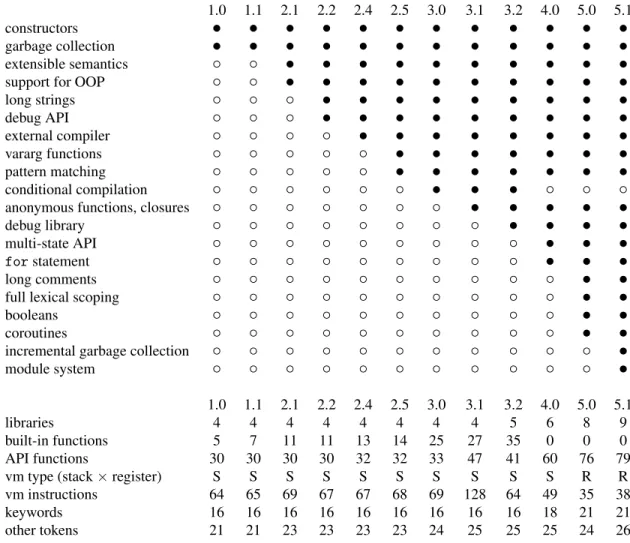
Figure 1 shows a timeline of the releases of Lua. As can be seen, the time interval between versions has been gradually increasing since Lua 3.0. This reflects our perception that
1993 1994 1995 1996 1997 1998 1999 2000 2001 2002 2003 2004 2005 2006
1.0 1.1 2.1 2.2 2.4 2.5 3.0 3.1 3.2 4.0 5.0 5.1
1.0 1.1 2.1 2.2 2.4 2.5 3.0 3.1 3.2 4.0 5.0 5.1
constructors
•
•
•
•
•
•
•
•
•
•
•
•
garbage collection
•
•
•
•
•
•
•
•
•
•
•
•
extensible semantics
◦
◦
•
•
•
•
•
•
•
•
•
•
support for OOP
◦
◦
•
•
•
•
•
•
•
•
•
•
long strings
◦
◦
◦
•
•
•
•
•
•
•
•
•
debug API
◦
◦
◦
•
•
•
•
•
•
•
•
•
external compiler
◦
◦
◦
◦
•
•
•
•
•
•
•
•
vararg functions
◦
◦
◦
◦
◦
•
•
•
•
•
•
•
pattern matching
◦
◦
◦
◦
◦
•
•
•
•
•
•
•
conditional compilation
◦
◦
◦
◦
◦
◦
•
•
•
◦
◦
◦
anonymous functions, closures
◦
◦
◦
◦
◦
◦
◦
•
•
•
•
•
debug library
◦
◦
◦
◦
◦
◦
◦
◦
•
•
•
•
multi-state API
◦
◦
◦
◦
◦
◦
◦
◦
◦
•
•
•
forstatement
◦
◦
◦
◦
◦
◦
◦
◦
◦
•
•
•
long comments
◦
◦
◦
◦
◦
◦
◦
◦
◦
◦
•
•
full lexical scoping
◦
◦
◦
◦
◦
◦
◦
◦
◦
◦
•
•
booleans
◦
◦
◦
◦
◦
◦
◦
◦
◦
◦
•
•
coroutines
◦
◦
◦
◦
◦
◦
◦
◦
◦
◦
•
•
incremental garbage collection
◦
◦
◦
◦
◦
◦
◦
◦
◦
◦
◦
•
module system
◦
◦
◦
◦
◦
◦
◦
◦
◦
◦
◦
•
1.0 1.1 2.1 2.2 2.4 2.5 3.0 3.1 3.2 4.0 5.0 5.1
libraries 4 4 4 4 4 4 4 4 5 6 8 9
built-in functions 5 7 11 11 13 14 25 27 35 0 0 0
API functions 30 30 30 30 32 32 33 47 41 60 76 79
vm type (stack×register) S S S S S S S S S S R R
vm instructions 64 65 69 67 67 68 69 128 64 49 35 38
keywords 16 16 16 16 16 16 16 16 16 18 21 21
other tokens 21 21 23 23 23 23 24 25 25 25 24 26
Table 1. The evolution of features in Lua.
Lua was becoming a mature product and needed stability for the benefit of its growing community. Nevertheless, the need for stability has not hindered progress. Major new versions of Lua, such as Lua 4.0 and Lua 5.0, have been released since then.
The long times between versions also reflects our release model. Unlike other open-source projects, our alpha versions are quite stable and beta versions are essentially final, except for uncovered bugs.2 This release model has proved to be
good for Lua stability. Several products have been shipped with alpha or beta versions of Lua and worked fine. How-ever, this release model did not give users much chance to experiment with new versions; it also deprived us of timely feedback on proposed changes. So, during the development of Lua 5.0 we started to release “work” versions, which are just snapshots of the current development of Lua. This move brought our current release model closer to the “Release Early, Release Often” motto of the open-source community.
2The number of bugs found after final versions were released has been
consistently small: only 10 in Lua 4.0, 17 in Lua 5.0, and 10 in Lua 5.1 so far, none of them critical bugs.
In the remainder of this section we discuss some mile-stones in the evolution of Lua. Details on the evolution of several specific features are given in§6. Table 1 summarizes this evolution. It also contains statistics about the size of Lua, which we now discuss briefly.
The number of standard libraries has been kept small be-cause we expect that most Lua functions will be provided by the host application or by third-party libraries. Until Lua 3.1, the only standard libraries were for input and output, string manipulation, mathematical functions, and a special library of built-in functions, which did not use the C API but directly accessed the internal data structures. Since then, we have added libraries for debugging (Lua 3.2), interfacing with the operating system (Lua 4.0), tables and coroutines (Lua 5.0), and modules (Lua 5.1).
The size of C API changed significantly when it was re-designed in Lua 4.0. Since then, it has moved slowly toward completeness. As a consequence, there are no longer any built-in functions: all standard libraries are implemented on top the C API, without accessing the internals of Lua.
The virtual machine, which executes Lua programs, was stack-based until Lua 4.0. In Lua 3.1 we added variants
for many instructions, to try to improve performance. How-ever, this turned out to be too complicated for little per-formance gain and we removed those variants in Lua 3.2. Since Lua 5.0, the virtual machine is register-based [31]. This change gave the code generator more opportunities for optimization and reduced the number of instructions of typi-cal Lua programs. (Instruction dispatch is a significant frac-tion of the time spent in the virtual machine [13].) As far as we know, the virtual machine of Lua 5.0 was the first register-based virtual machine to have wide use.
5.1 Lua 1
The initial implementation of Lua was a success in Tec-graf and Lua attracted users from other TecTec-graf projects. New users create new demands. Several users wanted to use Lua as the support language for graphics metafiles, which abounded in Tecgraf. Compared with other programmable metafiles, Lua metafiles have the advantage of being based on a truly procedural language: it is natural to model com-plex objects by combining procedural code fragments with declarative statements. In contrast, for instance, VRML [8] must use another language (Javascript) to model procedural objects.
The use of Lua for this kind of data description, especially large graphics metafiles, posed challenges that were unusual for typical scripting languages. For instance, it was not un-common for a diagram used in the data-entry program ED to have several thousand parts described by a single Lua ta-ble constructor with several thousand items. That meant that Lua had to cope with huge programs and huge expressions. Because Lua precompiled all programs to bytecode for a vir-tual machine on the fly, it also meant that the Lua compiler had to run fast, even for large programs.
By replacing thelex-generated scanner used in the first version by a hand-written one, we almost doubled the speed of the Lua compiler on typical metafiles. We also modified Lua’s virtual machine to handle a long constructor by adding key-value pairs to the table in batches, not individually as in the original virtual machine. These changes solved the initial demands for better performance. Since then, we have always tried to reduce the time spent on precompilation.
In July 1994, we released a new version of Lua with those optimizations. This release coincided with the publication of the first paper describing Lua, its design, and its implementa-tion [15]. We named the new version ‘Lua 1.1’. The previous version, which was never publicly released, was then named ‘Lua 1.0’. (A snapshot of Lua 1.0 taken in July 1993 was released in October 2003 to celebrate 10 years of Lua.)
Lua 1.1 was publicly released as software available in source code by ftp, before the open-source movement got its current momentum. Lua 1.1 had a restrictive user license: it was freely available for academic purposes but commercial uses had to be negotiated. That part of the license did not work: although we had a few initial contacts, no commer-cial uses were ever negotiated. This and the fact that other
scripting languages (e.g, Tcl) were free made us realize that restrictions on commercial uses might even discourage aca-demic uses, since some acaaca-demic projects plan to go to mar-ket eventually. So, when the time came to release the next version (Lua 2.1), we chose to release it as unrestricted free software. Naively, we wrote our own license text as a slight collage and rewording of existing licenses. We thought it was clear that the new license was quite liberal. Later, how-ever, with the spread of open-source licenses, our license text became a source of noise among some users; in particular, it was not clear whether our license was compatible with GPL. In May 2002, after a long discussion in the mailing list, we decided to release future versions of Lua (starting with Lua 5.0) under the well-known and very liberal MIT license [3]. In July 2002, the Free Software Foundation con-firmed that our previous license was compatible with GPL, but we were already committed to adopting the MIT license. Questions about our license have all but vanished since then. 5.2 Lua 2
Despite all the hype surrounding object-oriented program-ming (which in the early 1990s had reached its peak) and the consequent user pressure to add object-oriented features to Lua, we did not want to turn Lua into an object-oriented language because we did not want to fix a programming paradigm for Lua. In particular, we did not think that Lua needed objects and classes as primitive language concepts, especially because they could be implemented with tables if needed (a table can hold both object data and methods, since functions are first-class values). Despite recurring user pres-sure, we have not changed our minds to this day: Lua does not force any object or class model onto the programmer. Several object models have been proposed and implemented by users; it is a frequent topic of discussion in our mailing list. We think this is healthy.
On the other hand, we wanted to allow object-oriented programming with Lua. Instead of fixing a model, we de-cided to provide flexible mechanisms that would allow the programmer to build whatever model was suitable to the ap-plication. Lua 2.1, released in February 1995, marked the in-troduction of theseextensible semanticsmechanisms, which have greatly increased the expressiveness of Lua. Extensible semantics has become a hallmark of Lua.
One of the goals of extensible semantics was to allow ta-bles to be used as a basis for objects and classes. For that, we needed to implement inheritance for tables. Another goal was to turn userdata into natural proxies for application data, not merely handles meant to be used solely as arguments to functions. We wanted to be able to index userdata as if they were tables and to call methods on them. This would allow Lua to fulfill one of its main design goals more naturally: to extend applications by providing scriptable access to ap-plication services and data. Instead of adding mechanisms to support all these features directly in the language, we de-cided that it would be conceptually simpler to define a more
generalfallbackmechanism to let the programmer intervene whenever Lua did not know how to proceed.
We introduced fallbacks in Lua 2.1 and defined them for the following operations: table indexing, arithmetic oper-ations, string concatenation, order comparisons, and func-tion calls.3 When one of these operations was applied to
the “wrong” kind of values, the corresponding fallback was called, allowing the programmer to determine how Lua would proceed. The table indexing fallbacks allowed userdata (and other values) to behave as tables, which was one of our motivations. We also defined a fallback to be called when a key was absent from a table, so that we could support many forms of inheritance (through dele-gation). To complete the support for object-oriented pro-gramming, we added two pieces of syntactic sugar: method definitions of the form ‘function a:foo(· · ·)’ as sugar for ‘function a.foo(self,· · ·)’ and method calls of the form ‘a:foo(· · ·)’ as sugar for ‘a.foo(a,· · ·)’. In§6.8 we discuss fallbacks in detail and how they evolved into their later incarnations: tag methods and metamethods.
Since Lua 1.0, we have provided introspective functions for values: type, which queries the type of a Lua value; next, which traverses a table; andnextvar, which traverses the global environment. (As mentioned in§4, this was par-tially motivated by the need to implement SOL-like type checking.) In response to user pressure for full debug fa-cilities, Lua 2.2 (November 1995) introduced a debug API to provide information about running functions. This API gave users the means to write in C their own introspective tools, such as debuggers and profilers. The debug API was initially quite simple: it allowed access to the Lua call stack, to the currently executing line, and provided a function to find the name of a variable holding a given value. Following the M.Sc. work of Tom´as Gorham [22], the debug API was improved in Lua 2.4 (May 1996) by functions to access local variables and hooks to be called at line changes and function calls.
With the widespread use of Lua at Tecgraf, many large graphics metafiles were being written in Lua as the output of graphical editors. Loading such metafiles was taking in-creasingly longer as they became larger and more complex.4
Since its first version, Lua precompiled all programs to byte-code just before running them. The load time of a large pro-gram could be substantially reduced by saving this bytecode to a file. This would be especially relevant for procedural data files such as graphics metafiles. So, in Lua 2.4, we in-troduced an external compiler, calledluac, which precom-piled a Lua program and saved the generated bytecode to a binary file. (Our first paper about Lua [15] had already
an-3We also introduced fallbacks for handling fatal errors and for monitoring
garbage collection, even though they were not part of extensible semantics.
4Surprisingly, a substantial fraction of the load time was taken in the lexer
for converting real numbers from text form to floating-point representation. Real numbers abound in graphics metafiles.
ticipated the possibility of an external compiler.) The format of this file was chosen to be easily loaded and reasonably portable. Withluac, programmers could avoid parsing and code generation at run time, which in the early days were costly. Besides faster loading, luac also allowed off-line syntax checking and protection from casual user changes. Many products (e.g., The Sims and Adobe Lightroom) dis-tribute Lua scripts in precompiled form.
During the implementation ofluac, we started to restruc-ture Lua’s core into clearly separated modules. As a conse-quence, it is now quite easy to remove the parsing modules (lexer, parser, and code generator), which currently repre-sent 35% of the core code, leaving just the module that loads precompiled Lua programs, which is merely 3% of the core code. This reduction can be significant when embedding Lua in small devices such as mobile devices, robots and sensors.5 Since its first version, Lua has included a library for string-processing. The facilities provided by this library were minimal until Lua 2.4. However, as Lua matured, it became desirable to do heavier text processing in Lua. We thought that a natural addition to Lua would be pattern matching, in the tradition of Snobol, Icon, Awk, and Perl. However, we did not want to include a third-party pattern-matching engine in Lua because such engines tend to be very large; we also wanted to avoid copyright issues that could be raised by including third-party code in Lua.
As a student project supervised by Roberto in the second semester of 1995, Milton Jonathan, Pedro Miller Rabinovitch, Pedro Willemsens, and Vinicius Almendra pro-duced a pattern-matching library for Lua. Experience with that design led us to write our own pattern-matching en-gine for Lua, which we added to Lua 2.5 (November 1996) in two functions: strfind (which originally only found plain substrings) and the newgsubfunction (a name taken from Awk). Thegsubfunction globally replaced substrings matching a given pattern in a larger string. It accepted either a replacement string or a function that was called each time a match was found and was intended to return the replace-ment string for that match. (That was an innovation at the time.) Aiming at a small implementation, we did not include full regular expressions. Instead, the patterns understood by our engine were based on character classes, repetitions, and captures (but not alternation or grouping). Despite its sim-plicity, this kind of pattern matching is quite powerful and was an important addition to Lua.
That year was a turning point in the history of Lua be-cause it gained international exposure. In June 1996 we pub-lished a paper about Lua inSoftware: Practice & Experi-ence[30] that brought external attention to Lua, at least in
5Crazy Ivan, a robot that won RoboCup in 2000 and 2001 in Denmark,
had a “brain” implemented in Lua. It ran directly on a Motorola Coldfire 5206e processor without any operating system (in other words, Lua was the operating system). Lua was stored on a system ROM and loaded programs at startup from the serial port.
academic circles.6In December 1996, shortly after Lua 2.5
was released, the magazine Dr. Dobb’s Journal featured an article about Lua [16].Dr. Dobb’s Journalis a popular publication aimed directly at programmers, and that article brought Lua to the attention of the software industry. Among several messages that we received right after that publication was one sent in January 1997 by Bret Mogilefsky, who was the lead programmer of Grim Fandango, an adventure game then under development by LucasArts. Bret told us that he had read about Lua inDr. Dobb’sand that they planned to re-place their home-brewed scripting language with Lua. Grim Fandango was released in October 1998 and in May 1999 Bret told us that “a tremendous amount of the game was written in Lua” (his emphasis) [38].7Around that time, Bret attended a roundtable about game scripting at the Game De-velopers’ Conference (GDC, the main event for game pro-grammers) and at the end he related his experience with the successful use of Lua in Grim Fandango. We know of several developers who first learned about Lua at that event. After that, Lua spread by word of mouth among game developers to become a definitely marketable skill in the game industry (see§8).
As a consequence of Lua’s international exposure, the number of messages sent to us asking questions about Lua increased substantially. To handle this traffic more effi-ciently, and also to start building a Lua community, so that other people could answer Lua questions, in February 1997 we created a mailing list for discussing Lua. Over 38,000 messages have been posted to this list since then. The use of Lua in many popular games has attracted many people to the list, which now has over 1200 subscribers. We have been fortunate that the Lua list is very friendly and at the same time very technical. The list has become the focal point of the Lua community and has been a source of motivation for improving Lua. All important events occur first in the mailing list: release announcements, feature requests, bug reports, etc.
The creation of a comp.lang.lua Usenet newsgroup was discussed twice in the list over all these years, in April 1998 and in July 1999. The conclusion both times was that the traffic in the list did not warrant the creation of a newsgroup. Moreover, most people preferred a mailing list. The creation of a newsgroup seems no longer relevant because there are several web interfaces for reading and searching the complete list archives.
6In November 1997, that article won the First Prize (technological
cate-gory) in the II Compaq Award for Research and Development in Computer Science, a joint venture of Compaq Computer in Brazil, the Brazilian Min-istry of Science and Technology, and the Brazilian Academy of Sciences.
7Grim Fandango mentioned Lua and PUC-Rio in its final credits. Several
people at PUC-Rio first learned about Lua from that credit screen, and were surprised to learn that Brazilian software was part of a hit game. It has always bothered us that Lua is widely known abroad but has remained relatively unknown in Brazil until quite recently.
5.3 Lua 3
The fallback mechanism introduced in Lua 2.1 to support extensible semantics worked quite well but it was a global mechanism: there was only one hook for each event. This made it difficult to share or reuse code because modules that defined fallbacks for the same event could not co-exist eas-ily. Following a suggestion by Stephan Herrmann in Decem-ber 1996, in Lua 3.0 (July 1997) we solved the fallback clash problem by replacing fallbacks withtag methods: the hooks were attached to pairs (event,tag) instead of just to events. Tags had been introduced in Lua 2.1 as integer labels that could be attached to userdata (see§6.10); the intention was that C objects of the same type would be represented in Lua by userdata having the same tag. (However, Lua did not force any interpretation on tags.) In Lua 3.0 we extended tags to all values to support tag methods. The evolution of fallbacks is discussed in§6.8.
Lua 3.1 (July 1998) brought functional programming to Lua by introducing anonymous functions and function clo-sures via “upvalues”. (Full lexical scoping had to wait until Lua 5.0; see§6.6.) The introduction of closures was mainly motivated by the existence of higher-order functions, such as gsub, which took functions as arguments. During the work on Lua 3.1, there were discussions in the mailing list about multithreading and cooperative multitasking, mainly moti-vated by the changes Bret Mogilefsky had made to Lua 2.5 and 3.1 alpha for Grim Fandango. No conclusions were reached, but the topic remained popular. Cooperative multi-tasking in Lua was finally provided in Lua 5.0 (April 2003); see§6.7.
The C API remained largely unchanged from Lua 1.0 to Lua 3.2; it worked over an implicit Lua state. However, newer applications, such as web services, needed multiple states. To mitigate this problem, Lua 3.1 introduced multiple independent Lua states that could be switched at run time. A fully reentrant API would have to wait until Lua 4.0. In the meantime, two unofficial versions of Lua 3.2 with ex-plicit Lua states appeared: one written in 1998 by Roberto Ierusalimschy and Anna Hester based on Lua 3.2 alpha for CGILua [26], and one written in 1999 by Erik Hougaard based on Lua 3.2 final. Erik’s version was publicly avail-able and was used in the Crazy Ivan robot. The version for CGILua was released only as part of the CGILua distribu-tion; it never existed as an independent package.
Lua 3.2 (July 1999) itself was mainly a maintenance re-lease; it brought no novelties except for a debug library that allowed tools to be written in Lua instead of C. Neverthe-less, Lua was quite stable by then and Lua 3.2 had a long life. Because the next version (Lua 4.0) introduced a new, incompatible API, many users just stayed with Lua 3.2 and never migrated to Lua 4.0. For instance, Tecgraf never mi-grated to Lua 4.0, opting to move directly to Lua 5.0; many products at Tecgraf still use Lua 3.2.
5.4 Lua 4
Lua 4.0 was released in November 2000. As mentioned above, the main change in Lua 4.0 was a fully reentrant API, motivated by applications that needed multiple Lua states. Since making the API fully reentrant was already a major change, we took the opportunity and completely redesigned the API around a clear stack metaphor for exchanging val-ues with C (see§6.9). This was first suggested by Reuben Thomas in July 2000.
Lua 4.0 also introduced a ‘for’ statement, then a top item in the wish-list of most Lua users and a frequent topic in the mailing list. We had not included a ‘for’ statement earlier because ‘while’ loops were more general. However, users complained that they kept forgetting to update the control variable at the end of ‘while’ loops, thus leading to infinite loops. Also, we could not agree on a good syntax. We considered the Modula ‘for’ too restrictive because it did not cover iterations over the elements of a table or over the lines of a file. A ‘for’ loop in the C tradition did not fit with the rest of Lua. With the introduction of closures and anonymous functions in Lua 3.1, we decided to use higher-order functions for implementing iterations. So, Lua 3.1 provided a higher-order function that iterated over a table by calling a user-supplied function over all pairs in the table. To print all pairs in a tablet, one simply said ‘foreach(t,print)’.
In Lua 4.0 we finally designed a ‘for’ loop, in two vari-ants: a numeric loop and a table-traversal loop (first sug-gested by Michael Spalinski in October 1997). These two variants covered most common loops; for a really generic loop, there was still the ‘while’ loop. Printing all pairs in a tabletcould then be done as follows:8
for k,v in t do print(k,v) end
The addition of a ‘for’ statement was a simple one but it did change the look of Lua programs. In particular, Roberto had to rewrite many examples in his draft book on Lua programming. Roberto had been writing this book since 1998, but he could never finish it because Lua was a moving target. With the release of Lua 4.0, large parts of the book and almost all its code snippets had to be rewritten.
Soon after the release of Lua 4.0, we started working on Lua 4.1. Probably the main issue we faced for Lua 4.1 was whether and how to support multithreading, a big is-sue at that time. With the growing popularity of Java and Pthreads, many programmers began to consider support for multithreading as an essential feature in any programming language. However, for us, supporting multithreading in Lua posed serious questions. First, to implement multithread-ing in C requires primitives that are not part of ANSI C —
8With the introduction of ‘for’ iterators in Lua 5.0, this syntax was marked
as obsolete and later removed in Lua 5.1.
although Pthreads was popular, there were (and still there are) many platforms without this library. Second, and more important, we did not (and still do not) believe in the stan-dard multithreading model, which is preemptive concur-rency with shared memory: we still think that no one can write correct programs in a language where ‘a=a+1’ is not deterministic.
For Lua 4.1, we tried to solve those difficulties in a typi-cal Lua fashion: we implemented only a basic mechanism of multiple stacks, which we calledthreads. External libraries could use those Lua threads to implement multithreading, based on a support library such as Pthreads. The same mech-anism could be used to implement coroutines, in the form of non-preemptive, collaborative multithreading. Lua 4.1 alpha was released in July 2001 with support for external multi-threading and coroutines; it also introduced support for weak tables and featured a register-based virtual machine, with which we wanted to experiment.
The day after Lua 4.1 alpha was released, John D. Rams-dell started a big discussion in the mailing list about lexi-cal scoping. After several dozen messages, it became clear that Lua needed full lexical scoping, instead of the upvalue mechanism adopted since Lua 3.1. By October 2001 we had come up with an efficient implementation of full lexi-cal scoping, which we released as a work version in Novem-ber 2001. (See§6.6 for a detailed discussion of lexical scop-ing.) That version also introduced a new hybrid representa-tion for tables that let them be implemented as arrays when appropriate (see§6.2 for further details). Because that ver-sion implemented new basic algorithms, we decided to lease it as a work version, even though we had already re-leased an alpha version for Lua 4.1.
In February 2002 we released a new work version for Lua 4.1, with three relevant novelties: a generic ‘for’ loop based on iterator functions, metatables and metamethods as a replacement for tags and fallbacks9 (see §6.8), and
coroutines (see §6.7). After that release, we realized that Lua 4.1 would bring too many major changes — perhaps ‘Lua 5.0’ would be a better name for the next version.
5.5 Lua 5
The final blow to the name ‘Lua 4.1’ came a few days later, during the Lua Library Design Workshop organized by Christian Lindig and Norman Ramsey at Harvard. One of the main conclusions of the workshop was that Lua needed some kind of module system. Although we had always con-sidered that modules could be implemented using tables, not even the standard Lua libraries followed this path. We then decided to take that step for the next version.
9The use of ordinary Lua tables for implementing extensible semantics had
already been suggested by Stephan Herrmann in December 1996, but we forgot all about it until it was suggested again by Edgar Toernig in Octo-ber 2000, as part of a larger proposal, which he called ‘unified methods’. The term ‘metatable’ was suggested by Rici Lake in November 2001.
Packaging library functions inside tables had a big practi-cal impact, because it affected any program that used at least one library function. For instance, the oldstrfindfunction was now calledstring.find(field ‘find’ in string library stored in the ‘string’ table);openfilebecameio.open; sinbecamemath.sin; and so on. To make the transition easier, we provided a compatibility script that defined the old functions in terms of the new ones:
strfind = string.find openfile = io.open sin = math.sin ...
Nevertheless, packaging libraries in tables was a major change. In June 2002, when we released the next work version incorporating this change, we dropped the name ‘Lua 4.1’ and named it ‘Lua 5.0 work0’. Progress to the final version was steady from then on and Lua 5.0 was re-leased in April 2003. This release froze Lua enough to allow Roberto to finish his book, which was published in Decem-ber 2003 [27].
Soon after the release of Lua 5.0 we started working on Lua 5.1. The initial motivation was the implementation of incremental garbage collection in response to requests from game developers. Lua uses a traditional mark-and-sweep garbage collector, and, until Lua 5.0, garbage col-lection was performed atomically. As a consequence, some applications might experience potentially long pauses dur-ing garbage collection.10At that time, our main concern was
that adding the write barriers needed to implement an incre-mental garbage collector would have a negative impact on Lua performance. To compensate for that we tried to make the collector generational as well. We also wanted to keep the adaptive behavior of the old collector, which adjusted the frequency of collection cycles according to the total memory in use. Moreover, we wanted to keep the collector simple, like the rest of Lua.
We worked on the incremental generational garbage col-lector for over a year. But since we did not have access to applications with strong memory requirements (like games), it was difficult for us to test the collector in real scenarios. From March to December 2004 we released several work versions trying to get concrete feedback on the performance of the collector in real applications. We finally received re-ports of bizarre memory-allocation behavior, which we later managed to reproduce but not explain. In January 2005, Mike Pall, an active member of the Lua community, came up with memory-allocation graphs that explained the prob-lem: in some scenarios, there were subtle interactions be-tween the incremental behavior, the generational behavior, and the adaptive behavior, such that the collector “adapted”
10Erik Hougaard reported that the Crazy Ivan robot would initially drive
off course when Lua performed garbage collection (which could take a half second, but that was enough). To stay in course, they had to stop both motors and pause the robot during garbage collection.
for less and less frequent collections. Because it was getting too complicated and unpredictable, we gave up the genera-tional aspect and implemented a simpler incremental collec-tor in Lua 5.1.
During that time, programmers had been experimenting with the module system introduced in Lua 5.0. New pack-ages started to be produced, and old packpack-ages migrated to the new system. Package writers wanted to know the best way to build modules. In July 2005, during the development of Lua 5.1, an international Lua workshop organized by Mark Hamburg was held at Adobe in San Jose. (A similar work-shop organized by Wim Couwenberg and Daniel Silverstone was held in September 2006 at Oc´e in Venlo.) One of the presentations was about the novelties of Lua 5.1, and there were long discussions about modules and packages. As a re-sult, we made a few small but significant changes in the mod-ule system. Despite our “mechanisms, not policy” guideline for Lua, we defined a set of policies for writing modules and loading packages, and made small changes to support these policies better. Lua 5.1 was released in February 2006. Although the original motivation for Lua 5.1 was incremen-tal garbage collection, the improvement in the module sys-tem was probably the most visible change. On the other hand, that incremental garbage collection remained invisible shows that it succeeded in avoiding long pauses.
6.
Feature evolution
In this section, we discuss in detail the evolution of some of the features of Lua.
6.1 Types
Types in Lua have been fairly stable. For a long time, Lua had only six basic types: nil, number, string, table, function, and userdata. (Actually, until Lua 3.0, C functions and Lua functions had different types internally, but that difference was transparent to callers.) The only real change happened in Lua 5.0, which introduced two new types: threads and booleans.
The type thread was introduced to represent coroutines. Like all other Lua values, threads are first-class values. To avoid creating new syntax, all primitive operations on threads are provided by a library.
For a long time we resisted introducing boolean values in Lua: nil was false and anything else was true. This state of affairs was simple and seemed sufficient for our purposes. However, nil was also used for absent fields in tables and for undefined variables. In some applications, it is important to allow table fields to be marked as false but still be seen as present; an explicit false value can be used for this. In Lua 5.0 we finally introduced boolean valuestrueandfalse. Nil is still treated as false. In retrospect, it would probably have been better if nil raised an error in boolean expres-sions, as it does in other expressions. This would be more consistent with its role as proxy for undefined values.
How-ever, such a change would probably break many existing programs. LISP has similar problems, with the empty list representing both nil and false. Scheme explicitly represents false and treats the empty list as true, but some implementa-tions of Scheme still treat the empty list as false.
6.2 Tables
Lua 1.1 had three syntactical constructs to create tables: ‘@()’, ‘@[]’, and ‘@{}’. The simplest form was ‘@()’, which created an empty table. An optional size could be given at creation time, as an efficiency hint. The form ‘@[]’ was used to create arrays, as in ‘@[2,4,9,16,25]’. In such tables, the keys were implicit natural numbers start-ing at 1. The form ‘@{}’ was used to create records, as in ‘@{name="John",age=35}’. Such tables were sets of key-value pairs in which the keys were explicit strings. A table created with any of those forms could be modified dynam-ically after creation, regardless of how it had been created. Moreover, it was possible to provide user functions when creating lists and records, as in ‘@foo[]’ or ‘@foo{}’. This syntax was inherited from SOL and was the expression of procedural data description, a major feature of Lua (see§2). The semantics was that a table was created and then the function was called with that table as its single argument. The function was allowed to check and modify the table at will, but its return values were ignored: the table was the final value of the expression.
In Lua 2.1, the syntax for table creation was unified and simplified: the leading ‘@’ was removed and the only con-structor became ‘{· · ·}’. Lua 2.1 also allowed mixed con-structors, such as
grades{8.5, 6.0, 9.2; name="John", major="math"} in which the array part was separated from the record part by a semicolon. Finally, ‘foo{· · ·}’ became sugar for ‘foo({· · ·})’. In other words, table constructors with func-tions became ordinary function calls. As a consequence, the function had to explicitly return the table (or whatever value it chose). Dropping the ‘@’ from constructors was a trivial change, but it actually changed the feel of the language, not merely its looks. Trivial changes that improve the feel of a language are not to be overlooked.
This simplification in the syntax and semantics of ta-ble constructors had a side-effect, however. In Lua 1.1, the equality operator was ‘=’. With the unification of table con-structors in Lua 2.1, an expression like ‘{a=3}’ became am-biguous, because it could mean a table with either a pair ("a", 3) or a pair (1,b), whereb is the value of the equal-ity ‘a=3’. To solve this ambiguity, in Lua 2.1 we changed the equality operator from ‘=’ to ‘==’. With this change, ‘{a=3}’ meant a table with the pair ("a", 3), while ‘{a==3}’ meant a table with the pair (1,b).
These changes made Lua 2.1 incompatible with Lua 1.1 (hence the change in the major version number). Neverthe-less, since at that time virtually all Lua users were from
Tec-graf, this was not a fatal move: existing programs were easily converted with the aid of ad-hoc tools that we wrote for this task.
The syntax for table constructors has since remained mostly unchanged, except for an addition introduced in Lua 3.1: keys in the record part could be given by any ex-pression, by enclosing the expression inside brackets, as in ‘{[10*x+f(y)]=47}’. In particular, this allowed keys to be arbitrary strings, including reserved words and strings with spaces. Thus, ‘{function=1}’ is not valid (because ‘function’ is a reserved word), but ‘{["function"]=1}’ is valid. Since Lua 5.0, it is also possible to freely intermix the array part and the record part, and there is no need to use semicolons in table constructors.
While the syntax of tables has evolved, the semantics of tables in Lua has not changed at all: tables are still asso-ciative arrays and can store arbitrary pairs of values. How-ever, frequently in practice tables are used solely as arrays (that is, with consecutive integer keys) or solely as records (that is, with string keys). Because tables are the only data-structuring mechanism in Lua, we have invested much ef-fort in implementing them efficiently inside Lua’s core. Un-til Lua 4.0, tables were implemented as pure hash tables, with all pairs stored explicitly. In Lua 5.0 we introduced a hybrid representation for tables: every table contains a hash part and an array part, and both parts can be empty. Lua de-tects whether a table is being used as an array and automat-ically stores the values associated to integer indices in the array part, instead of adding them to the hash part [31]. This division occurs only at a low implementation level; access to table fields is transparent, even to the virtual machine. Ta-bles automatically adapt their two parts according to their contents.
This hybrid scheme has two advantages. First, access to values with integer keys is faster because no hashing is needed. Second, and more important, the array part takes roughly half the memory it would take if it were stored in the hash part, because the keys are implicit in the array part but explicit in the hash part. As a consequence, if a table is being used as an array, it performs as an array, as long as its integer keys are densely distributed. Moreover, no mem-ory or time penalty is paid for the hash part, because it does not even exist. Conversely, if the table is being used as a record and not as an array, then the array part is likely to be empty. These memory savings are important because it is common for a Lua program to create many small ta-bles (e.g., when tata-bles are used to represent objects). Lua tables also handle sparse arrays gracefully: the statement ‘a={[1000000000]=1}’ creates a table with a single entry in its hash part, not an array with one billion elements.
Another reason for investing effort into an efficient im-plementation of tables is that we can use tables for all kinds of tasks. For instance, in Lua 5.0 the standard library func-tions, which had existed since Lua 1.1 as global variables,
were moved to fields inside tables (see§5.5). More recently, Lua 5.1 brought a complete package and module system based on tables.
Tables play a prominent role in Lua’s core. On two oc-casions we have been able to replace special data structures inside the core with ordinary Lua tables: in Lua 4.0 for repre-senting the global environment (which keeps all global vari-ables) and in Lua 5.0 for implementing extensible seman-tics (see §6.8). Starting with Lua 4.0, global variables are stored in an ordinary Lua table, called the table of globals, a simplification suggested by John Belmonte in April 2000. In Lua 5.0 we replaced tags and tag methods (introduced in Lua 3.0) by metatables and metamethods. Metatables are ordinary Lua tables and metamethods are stored as fields in metatables. Lua 5.0 also introduced environment tables that can be attached to Lua functions; they are the tables where global names in Lua functions are resolved at run time. Lua 5.1 extended environment tables to C functions, userdata, and threads, thus replacing the notion of global en-vironment. These changes simplified both the implementa-tion of Lua and the API for Lua and C programmers, be-cause globals and metamethods can be manipulated within Lua without the need for special functions.
6.3 Strings
Strings play a major role in scripting languages and so the facilities to create and manipulate strings are an important part of the usability of such languages.
The syntax for literal strings in Lua has had an interesting evolution. Since Lua 1.1, a literal string can be delimited by matching single or double quotes, and can contain C-like escape sequences. The use of both single and double quotes to delimit strings with the same semantics was a bit unusual at the time. (For instance, in the tradition of shell languages, Perl expands variables inside double-quoted strings, but not inside single-quoted strings.) While these dual quotes allow strings to contain one kind of quote without having to escape it, escape sequences are still needed for arbitrary text.
Lua 2.2 introducedlong strings, a feature not present in classical programming languages, but present in most script-ing languages.11 Long strings can run for several lines and
do not interpret escape sequences; they provide a convenient way to include arbitrary text as a string, without having to worry about its contents. However, it is not trivial to de-sign a good syntax for long strings, especially because it is common to use them to include arbitrary program text (which may contain other long strings). This raises the ques-tion of how long strings end and whether they may nest. Until Lua 5.0, long strings were wrapped inside matching ‘[[· · ·]]’ and could contain nested long strings. Unfortu-nately, the closing delimiter ‘]]’ could easily be part of a valid Lua program in an unbalanced way, as in ‘a[b[i]]’,
11‘Long string’ is a Lua term. Other languages use terms such as ‘verbatim
text’ or ‘heredoc’.
or in other contexts, such as ‘<[!CDATA[· · ·]]>’ from XML. So, it was hard to reliably wrap arbitrary text as a long string. Lua 5.1 introduced a new form for long strings: text de-limited by matching ‘[===[· · ·]===]’, where the number of ‘=’ characters is arbitrary (including zero). These new long strings do not nest: a long string ends as soon as a closing de-limiter with the right number of ‘=’ is seen. Nevertheless, it is now easy to wrap arbitrary text, even text containing other long strings or unbalanced ‘]=· · ·=]’ sequences: simply use an adequate number of ‘=’ characters.
6.4 Block comments
Comments in Lua are signaled by ‘--’ and continue to the end of the line. This is the simplest kind of comment, and is very effective. Several other languages use single-line comments, with different marks. Languages that use ‘--’ for comments include Ada and Haskell.
We never felt the need for multi-line comments, or block comments, except as a quick way to disable code. There was always the question of which syntax to use: the famil-iar ‘/*· · ·*/’ syntax used in C and several other languages does not mesh well with Lua’s single-line comments. There was also the question of whether block comments could nest or not, always a source of noise for users and of complexity for the lexer. Nested block comments happen when program-mers want to ‘comment out’ some block of code, to disable it. Naturally, they expect that comments inside the block of code are handled correctly, which can only happen if block comments can be nested.
ANSI C supports block comments but does not allow nesting. C programmers typically disable code by using the C preprocessor idiom ‘#if 0· · ·#endif’. This scheme has the clear advantage that it interacts gracefully with existing comments in the disabled code. With this motivation and in-spiration, we addressed the need for disabling blocks of code in Lua — not the need for block comments — by introducing conditional compilation in Lua 3.0 via pragmas inspired in the C preprocessor. Although conditional compilation could be used for block comments, we do not think that it ever was. During work on Lua 4.0, we decided that the support for conditional compilation was not worth the complexity in the lexer and in its semantics for the user, especially after not having reached any consensus about a full macro facil-ity (see§7). So, in Lua 4.0 we removed support for con-ditional compilation and Lua remained without support for block comments.12
Block comments were finally introduced in Lua 5.0, in the form ‘--[[· · ·]]’. Because they intentionally mimicked the syntax of long strings (see§6.3), it was easy to modify the lexer to support block comments. This similarity also helped users to grasp both concepts and their syntax. Block
12A further motivation was that by that time we had found a better way to
generate and use debug information, and so the pragmas that controlled this were no longer needed. Removing conditional compilation allowed us to get rid of all pragmas.