Chapter 6: Develop a Stakeholder Engagement Strategy
Questions from Diagnostic Tool• Have we created core messages for our adoption and implementation plan?
• Have we identified the stakeholders whose support we will need? Do our messages speak to them?
• Do we have a plan for engaging stakeholders, including champions in the field and the public at large?
• Have we identified our key opponents and their points of opposition, and do we have a strategy for addressing the challenges they may pose?
The success of NGSS adoption and implementation will depend not just on its substance but also on the support of critical stakeholders. In Chapter 1, you identified the strategic leadership team — those tasked with creating an overall vision for the NGSS and the timeline, phase-in strategy and work plan for both adoption and implementation. In this chapter, you will explore what it means to widen the circle to include additional supporters. However, stakeholder engagement is only one piece of a larger
communications plan, which your state will need to create. If your state is trying to establish a new communications plan or strengthen an existing one, additional resources are available through Achieve’s Future Ready Project.8
A common mistake is to think of stakeholder engagement as an add-on to an adoption and
implementation plan. Too often, states create communications plans without sufficient attention to stakeholder engagement. In truth, not communicating enough is one of the biggest risk factors for any major change effort, particularly one as high profile as NGSS adoption and implementation.
Communicating and engaging with key stakeholders is important as you gear up for NGSS adoption and implementation. The work will inevitably be difficult, and you may suffer setbacks. In those moments, you will want to know that you can count on your key stakeholders to support your work so you can continue to move forward. For this reason, think of stakeholder engagement as a process that requires planning at the same level of rigor as the policy and practice changes covered in prior chapters. Many of the principles are the same, even if the tools are different. This chapter provides advice and exercises on how to use these tools to maximum effect.
Action Steps
Step 1: Develop key three messages.
Step 2: Identify and analyze the stakeholders who are most critical to successful adoption and implementation.
Step 3: Build your guiding coalition.
Step 4: Establish a process and plan to handle potential challenges. Step 5: Develop a stakeholder outreach strategy.
Step 1: Develop Key Three Messages
The key messages are at the heart of your stakeholder engagement plan.They aim to take your state’s overall adoption and implementation plan and translate it into terms that make sense for others.Ideally, you should be able to boil down what you want to communicate to three central messages — the “key three.” Typically, the first message will define the issue, the second will outline the problem and the
third will explain the solution. The key three are most effective if they are developed and owned by a large group of stakeholders;used byall relevant leaders and advocates; and communicated consistently, without variation, at all times.
The discipline of repetition should be carried across all communications channels. And while you will develop submessages for each target audience or around common criticisms of the NGSS, those
submessages will fit under the key three, and overarching key three messages should be communicated at all times by all leaders/members in all media.
The first step in developing the key three messages for the NGSS begins with your state’s aspiration (see Chapter 2) as the starting point. Specifically, key messages can answer any of the following questions:
• What are we trying to accomplish for our students and the United States in science education and why?
• How will we know that we have done it? What are our specific goals/targets?
• What is holding us back from reaching our goals/targets?
• Why and how are the NGSS essential to our success? How are they different from what we already do? How will they help us overcome the challenges we face?
• What are the benefits to students, our economy and the workforce by having college- and career-ready graduates in not only English language arts/literacy and math but also science?
While these topics may not be appropriate to address in the top-level messages, it is important to have ready messages and responses to address these questions as well:
• What strategies are we undertaking to implement the NGSS?
• What are the biggest changes these strategies will require in our districts, schools and classrooms? As you can see, you will find the answers to these questions in the work that you have done in the first five chapters of this workbook. The key is to distill this thinking down into a few bullet points that can anchor your effort.
FIGURE 12: Sample Key Three NGSS Messages Following are two sets of sample key three messages: Sample 1:
• Science education in the United States has gone stagnant; more than a third of 8th graders score below basic on science assessments, and fewer students choose to pursue science-based careers every year.
• It has been 15 years since K–12 science standards were revised. Since then, there have been many advances in the fields of science and technology, science education, and the innovation-driven economy, yet our science standards — and science education — have not kept pace.
• The NGSS — developed by educators, scientists and experts in science education — will, by design, engage students at the earliest grades through graduation so that all students become informed citizens who are knowledgeable about how science and technology affect everyday life.
Sample 2:
• The United States has a leaky K–12 STEM talent pipeline, with too few students entering STEM majors and careers at every level — from those requiring relevant postsecondary certificates to
risk.
• We cannot successfully prepare students for college and careers — and keep the United States competitive — unless we set the right expectations and goals. While standards alone are no silver bullet, they provide the necessary foundation upon which the rest of the science (and STEM) education system can be built.
• Implementing the new NGSS will help ensure that all students graduate with critical skills in specific science disciplines as well as problem-solving, inquiry and reasoning — preparing them for the rigors of science-based college courses and STEM careers and securing their future and the future of our country.
EXERCISE 20: Develop Key Three Messages
Objective(s) for participants:
• Identify the key questions that need to be answered.
• Create key three messages to answer the identified key questions. Instructions:
• Using the list of key questions, identify those that are most important to the communications effort or those that should be emphasized to key stakeholders and circle them on the flipchart.
• As a group, draft answers to each of the questions and record those as core messages on the flipchart.
• Reflect on the list of core messages.
▪
Are they complete?▪
Are they concise?▪
Do they provide the information stakeholders most need?• Adjust the core messages as necessary to fit those characteristics. Materials needed:
• Flipchart
• Markers
Template for Exercise 20 Key Questions
(circle the ones to emphasize)
Key Messages What are we trying to accomplish for our
students and the United States in science education and why?
How will we know that we have done it? What are our specific goals/targets?
What is holding us back from reaching our goals/targets?
Why and how are the NGSS essential to our success? How are they different from what we already do? How will they help us overcome the challenges we face?
Secondary Questions Supporting Messages
What strategies are we undertaking to implement the NGSS?
What are the biggest changes these strategies will require in our districts, schools and classrooms?
Step 2: Identify and Analyze the Stakeholders Who Are Most Critical to Successful
Adoption and Implementation
Once you have decided on your key messages, you are ready to identify the most critical stakeholder groups to serve as audiences for those messages. Beyond your guiding coalition, what stakeholder groups could potentially be most relevant? Some ideas to consider:
• Students;
• Teachers, teachers unions, and state and local chapters of professional associations of science teachers such as the National Science Teachers Association, the National Association of Biology Teachers, the American Association of Physics Teachers and STEM networks in your state;
• Parents and parent associations;
• Guidance counselors;
• School administrators and their professional associations;
• District curriculum staff;
• Regional service centers and education providers;
• State education leaders and staff (including state science standards leadership teams);
• State science supervisor;
• Public and private institutions of higher education, particularly schools of education;
• Informal science education providers;
• Civil rights organizations, philanthropic organizations and other third-party advocacy groups;
• The business community (e.g., chambers of commerce, local STEM industry leaders);
• STEM organizations and networks;
• Workforce development organizations and agencies;
• The scientific community; and
• State leadership teams.
It is also important to identify the decisionmakers from your state who are responsible for adopting the NGSS and allocating funding to support implementation. Such decisionmakers include:
• School board members and associations;
• District superintendents;
• Chief state school officer;
• State board of education members;
• State legislators, particularly chairs of education committees and appropriators; and
• The governor, including education policy advisers.
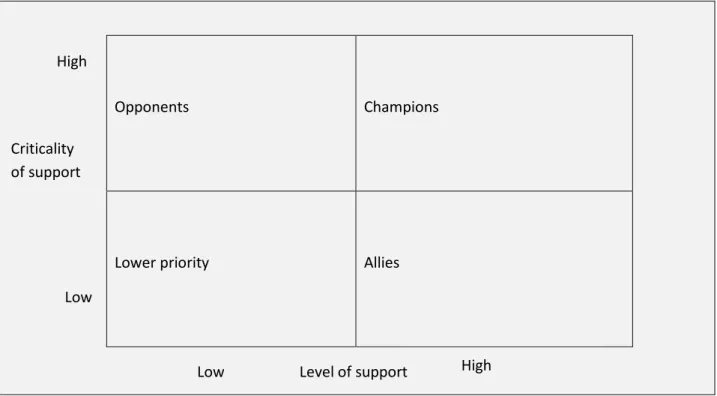
As you are selecting your key stakeholders or stakeholder groups, try to be as specific as possible — for example, by naming a particular professional association or distinguishing supportive legislators from those who are opposed. The point is to identify all of the individuals and groups you may need to directly engage and then answer two critical questions about each:
• Criticality of their support: How important is it that they support your plans for NGSS adoption and implementation? When, where and how will their support be needed?
• Level of support: How supportive are they currently?
FIGURE 13: Stakeholder Mapping
Opponents Champions
Lower priority Allies
A stakeholder group’s location on this map has implications for your approach to the group. For example, stakeholder groups that are critical to your success and already very supportive are your champions — they are the type of group that you must keep engaged and deploy to engage others. Similarly supportive groups that are less critical to your success are allies — it is nice to have their support, but they need to be engaged with less intensity. Working to develop allies is especially important because they may become champions with enough exposure to the issue. Critical but
unsupportive groups are opponents. Most opponents will never be converted into champions; your goal may simply be to minimize their numbers by broadening your base of support and be able to respond to their concerns. Almost always, increasing your pool of champions is more productive than trying to convert opponents.
Level of support Criticality
of support
Low High
Low High
EXERCISE 21: Identify and Map Your Stakeholders
Objective(s) for participants:
• Identify those stakeholders who are most critical to successful adoption and implementation.
• Determine the current level of support and criticality of support for each stakeholder. Instructions:
• Brainstorm the stakeholders who will need to be involved at all levels of adoption of the NGSS. Be sure to consider those at the state, district, school and classroom levels, as well as external stakeholders. Use the list on page 87 of the workbook as a guide.
• Using the 2 x 2 matrix template, place each of the key stakeholders on the template according to their current level of support and the criticality of their engagement in NGSS implementation. • Reflect on which stakeholder groups fall into which categories (champions, allies, opponents)
according to the matrix.
• Repeat the exercise for stakeholders who will need to be involved in the implementation of the NGSS.
Materials needed:
• Flipchart
• Markers Exercise notes:
• Participants should use the full spectrum provided by the matrix to indicate which stakeholders are higher or lower than others.
• Urge participants to avoid placing stakeholders “on the line” and to make a judgment as to whether those stakeholders are slightly more on the high or low side.
• Participants should focus on developing strategies for increasing the group of champions (moving allies to champions) and having a crisis management strategy for dealing with opponents.
Template for Exercise 21
Level of support Criticality
of support
Low High
Low High
Step 3: Build Your Guiding Coalition
As discussed in Chapter 2, an aspiration is not real unless it is collectively shared. While the overall case for adoption is broader than just the aspiration, grounding your aspiration with the support of a critical mass of stakeholders will be crucial to your ability to make that case.
But building stakeholder support starts with a smaller group of people: the guiding coalition. A guiding coalition is a small group of highly visible and credible leaders who share your aspiration and will sustain your effort to adopt and implement the NGSS in the face of pushback and other challenges. The guiding coalition ought to consist of a subset of influential stakeholders whose collective efforts have the potential to make a significant difference in reaching your aspiration. A guiding coalition is not a steering committee or a formal decisionmaking body, nor is it the same thing as the state’s strategic leadership team. Critically important is to determine who is responsible for this coalition once it is built; it is not realistic to think the group will convene itself.
The role of the guiding coalition is to help remove barriers to change, exert influence at key moments to support adoption and implementation, and provide counsel to the strategic leadership team that is responsible for developing the state’s strategy. The guiding coalition can serve as a sounding board, and their opinions may help shape the policy recommendations made by the strategic leadership team. Interactions can take place informally and formally, through both individual conversation and/or small-group meetings.
Figure 14 gives some examples of people you might want to include in your guiding coalition. As you can see, “official” leaders figure prominently in the list, but informal influence is just as important.
FIGURE 14: Members of the Guiding Coalition
The composition of a guiding coalition will inevitably vary across states; no single formula will work for everyone. Your state may want to consider the following list of influential stakeholders as potential guiding coalition members:
• Governor’s office;
• Legislature (particularly crucial committee chairs, their advisers and permanent staff);
• State board of education members and/or staff;
• Higher education governing board members and/or staff;
• State education agency leadership;
• Workforce development agency leadership;
• Business community leadership (chambers and/or roundtables);
• Philanthropic community leadership;
• The engaged public, including advocacy and other third-party organization leadership, and civil rights organizations; and
• Union and association leadership, including teachers and administrators.
You may choose to involve your guiding coalition at different stages of your adoption and implementation effort. Initially, you may choose to engage members of the guiding coalition for
refinement and feedback on your aspiration. (See Chapter 2.) The objective would be to align a powerful group of people around a shared aspiration for NGSS adoption and implementation and to secure their commitment to supporting it.
EXERCISE 22: Build Your Guiding Coalition
Objective(s) for participants:
• Identify the members of the guiding coalition.
• Develop a strategy for engaging and deploying each member to support NGSS adoption and implementation.
Instructions:
• Brainstorm possible members of the guiding coalition, casting the widest net possible.
• Narrow the list by excluding those who would be unlikely to ever support the aspiration.
• Evaluate the list using a criterion of diversity, balance, potential to work together, etc. Materials needed:
• Flipchart paper
• Markers Exercise notes:
• Guiding coalitions are typically comprised of seven to 10 key external members. Template for Exercise 22
Potential Guiding Coalition Member
Current Level of Engagement and Interest in Adoption/ Implementation Effort
Sphere of Influence (Legislature, Teachers, Department of Education, etc.)
Top Two to Three “Asks” for Each
Step 4: Establish a Process and Plan To Handle Potential Challenges
In addition to developing your key messages, you will need to establish a process for handling potential issues that may arise. You may face challenges from opponents of the NGSS and will need a process for addressing these issues efficiently and effectively. In many cases, it makes sense for there to be a clear point person/organization for tracking pushback and coordinating your coalition’s response to such challenges — and for this point person/organization to be outside the government. By using a third-party organization or leaders — such as a business organization or advocacy coalition — you can ensure that the defense is protected from changes in leadership and remains independent. In the past, the states that have been able to most successfully sustain reforms as significant as the NGSS have had strong third-party partners supporting communications and advocacy throughout adoption, implementation and beyond. Your process could include the following:
• Creating a crisis management plan that identifies ahead of time potential issues, responses and spokespeople;
• Communicating to the guiding coalition and other champions about the problem;
• Determining the best surrogates — and how you would deploy them effectively;
• Creating a communications strategy for making your point of view known (media contacts, press releases, op-eds, events, surrogates, social media, etc.); and
• Contacting Achieve to strategize.
Having a process and a plan to handle the issues in advance will assist you in ensuring that any issues that arise are handled quickly and will not result in a loss of support.
Step 5: Develop a Stakeholder Outreach Strategy
Stakeholder engagement, while it encompasses all of the work in your plan, must be treated as a strategy in and of itself, worthy of the same planning and monitoring as any other part.
To map out your specific engagement strategy, consider six sets of questions for each priority stakeholder group you identified in the previous step:
Objective: Starting from your stakeholder group’s current position, where would you like to move them? Is your objective for them to be supportive when asked? To be “out in front,” winning other converts?
Tailored message: How will you refine your key messages from Step 1 to resonate with all of your stakeholders? You may need to consider what the coming changes mean for them and what you need them to do. Tailoring messages does NOT mean having a different message; your key three messages should be the same for everyone. Tailoring messages means adding to the key messages by speaking to the needs and concerns of your audience. For example, elementary school teachers will understandably want to know about the plan for their professional development around the NGSS and how/when new instructional materials will be developed.
Communications channels and activities: What existing or new mechanisms will you use to reach these stakeholders? These mechanisms could include face-to-face meetings, e-mails/newsletters, social media, conferences, paid media, town halls/roundtables, etc.
Timeline for engagement: When and how often will you engage this group in this way? This is the part that puts the “plan” in your outreach plan; for each action you identify, be sure to assign responsibility
Surrogates from this group: Who from this stakeholder group can you call upon to be on the record? Who are your key messengers, and how will you recruit more over time? These are essentially
ambassadors you will want to work with to communicate and advocate among their peers on behalf of the NGSS.
Feedback loops: As with your adoption and implementation strategies in Chapter 4, how will you know you have succeeded? What processes do you have in place to collect and respond to both positive and negative feedback about your outreach efforts? Consider some of the tools for evidence collection, particularly surveys and interviews, covered in Chapter 4.
What is most important is that stakeholders are engaged often and that you provide them with the information and support they need to be successful champions and allies. For example, providing professional associations of science teachers with customizable cards with key messages that can then be disseminated to their members will empower members to serve as champions and allies for the NGSS. Engaging business leaders by connecting the NGSS to STEM education and U.S. innovation through roundtable discussions can help ensure that you have respected champions. Exercise 23 will help your team work through these questions and develop your own stakeholder outreach strategy.
EXERCISE 23: Develop a Stakeholder Outreach Strategy
Objective(s) for participants:
• Create an outreach strategy for each priority stakeholder group. Instructions:
• Using the priority stakeholder groups identified in Exercise 21, answer the following for each and record on the flipchart:
▪
What is our objective for this group? That is, taking into account their current level of support, where would we like to move them? What ideal role will they play?▪
What is the tailored message for this group? That is, what from the core messages we identified in Exercise 20 is most important for this group to know and understand?▪
What are the existing or new channels of communication needed to reach them?▪
What is the timeline for engagement with this group? When and how often? Who is responsible, and what are the deadlines?▪
Who are our key messengers or communicators drawn from each stakeholder group? How will we recruit them and ensure that they remain engaged and informed?▪
What will our feedback loops be for this group? That is, how will we know our messages have been successful? What processes do we have in place or will we put in place to collect and respond to feedback?Materials needed:
• Flipchart
• Markers
• List of priority stakeholders identified in Exercise 21 Template for Exercise 23
Stakeholder Group
Objective Tailored Message
Channels or Activities
Timeline for Engagement
Surrogates from This Group
Feedback Loops
Conclusion
You should now have the beginnings of a robust stakeholder engagement strategy. The plan contains key messages and messengers to support the adoption of the NGSS. The next chapter on establishing routines and solving problems will assist you in ensuring that your broader stakeholder efforts drive adoption and implementation forward.