U.S. Fish & Wildlife Service
How to Develop Survey Protocols
A Handbook (Interactive Edition)
i
Preface
This handbook is supplemental guidance for the U.S. Fish and Wildlife Service policy Inventory and Monitoring in the National Wildlife Refuge System (701 FW 2). It provides additional details not found in the policy on how to develop, review, approve, and document protocols for
conducting surveys in the National Wildlife Refuge System (Refuge System). Using the handbook and the resulting protocols will promote consistent implementation of surveys and enhance scientific credibility of survey results.
Acknowledgments
A number of people within the Refuge System worked on drafts of the Inventory and Monitoring (I&M) policy and deserve credit for outlining the key elements of the guidance in this handbook. Melinda Knutson and Joel Reynolds were the primary authors of protocol components that appeared in the initial draft policy, which were modeled after long-term monitoring guidance followed by the National Park Service (Oakley et al. 2003). This handbook builds on the extensive knowledge of the scientific process and survey implementation provided in these previous documents, and we owe a debt of gratitude to those who were instrumental in earlier drafts of the I&M policy.
The National I&M Coordination Team of the Refuge System convened a small team of I&M or Regional Biological staff to draft this handbook. Members, Pat Ward, Paige Schmidt, Sean Blomquist, Nathan Roberts and Brian Root authored the handbook narratives, figures, and boxes 1, 3 and 5. The other boxes were carried over from the initial draft I&M policy. Peter Dratch and Lee O’Brien provided comments throughout development and helped edit multiple drafts to produce a more succinct handbook.
Penny Latham and Bruce Bingham, both with the National Park Service, provided materials and helpful insight about protocol development. Jana Newman, Keenan Adams, Kevin Kilbride, Kris Metzger, Pat Heglund, Melinda Knutson, Brian Loges, Pauline Drobney, Laurel Barnhill, Nicole Rankin, Kristine Evans, Timothy Fotinos, Bill Thompson, Soch Lor, Jeff Warren, Murray
Laubhan, Cami Dixon, Diane Granfors, Anna-Marie Benson, Carol Damberg, Karen Laing, Giselle Block, Orien Richmond and several anonymous reviewers from the Refuge System provided valuable comments on drafts of this handbook. The National Conservation Training Center cadre for the 2012 course, Designing a Biological Monitoring Program: Concepts and Examples, provided a glossary that defines many of the scientific terms in the handbook. We also thank the monitoring experts that provided scientific reviews: Jeffrey Herrick (USDA), Douglas Johnson (USGS), Penny Latham (NPS), Loyal Mehrhoff (FWS) and Karen Oakley (USGS).
Several USFWS employees provided photos for the handbook. David Payer provided the cover photo of long-term vegetation monitoring in the Brooks Range, Arctic National Wildlife Refuge for the GLORIA network (Global Observation Research Initiative in Alpine environments); Guthrie Zimmerman provided the photo on page 14 showing aerial surveys of waterfowl; Roy Lowe provided the photo on page 16 of counting nests of Laysan Albatross at Midway Atoll; Robert Pos provided the photo on page 27 of a biologist tagging a horseshoe crap on Bowers Beach Delaware; the photo on page 30 of Finley and Bohlman watching birds and taking notes at the Klamath Marsh in 1905 was taken from their report; Nicole Rankin provided the photo on page 39 of contracted scientists installing a benchmark for monitoring surface elevation (SET) within a saltmarsh at Pinckney Island National Wildlife Refuge, South Carolina.
ii Suggested citation:
US Fish and Wildlife Service. 2013. How to develop survey protocols, a handbook (Version 1.0). Fort Collins, Colorado: US Department of Interior, Fish and Wildlife Service, National Wildlife Refuge System, Natural Resource Program Center.
iii
Table of Contents
Preface ... i
Acknowledgments... i
Introduction ... 1
How Does this Handbook Support Inventory and Monitoring in the Refuge System? ... 1
What is a Survey Protocol? ... 1
Site-specific Survey Protocol ...
2
Protocol Framework ...
2
Why Use a Protocol to Conduct a Survey? ... 3
Developing a Protocol ... 3
What is Required in a Survey Protocol? ... 3
Narrative ...
4
Standard Operating Procedures ...
4
Supplemental Materials ...
5
How is a Site-specific Survey Protocol Produced? ... 5
Adding Site-specific Details to a Protocol Framework ...
5
Modifying a Similar Site-specific Protocol ...
6
Developing a New Site-specific Protocol ...
6
Approving a Protocol ... 6
How is a Survey Protocol Reviewed and Approved? ... 6
How is an Approved Protocol Documented and Archived? ... 8
Revising a Protocol ... 9
iv
Standard Operating Procedures (SOPs) ... 11
SOP 1. Instructions for the Introduction ... 11
SOP 2. Instructions for Sampling Design ... 15
SOP 3. Instructions for Field Methods and Sample Processing ... 18
SOP 4. Instructions for Data Management and Data Analysis ... 21
SOP 5. Instructions for Survey Reports ... 23
SOP 6. Instructions for Personnel Requirements and Training ... 26
SOP 7. Instructions for Operational Requirements ... 28
SOP 8. Instructions for References ... 30
APPENDIX A. Glossary ... 31
APPENDIX B. References ... 35
APPENDIX C. I&M Protocol Review Documentation Form ... 40
APPENDIX D. I&M Protocol Approval Form ... 41
Figures and Boxes
Figure 1. Content of protocols for conducting surveys in the Refuge System... 4Box 1. What is the appropriate level of protocol review? ... 8
Box 2. What attributes should be surveyed? ... 14
Box 3. How do surveys maintain proper animal welfare standards? ... 19
Box 4. How are survey results reported? ... 24
1
Introduction
How
Does this Handbook Support Inventory and Monitoring in the
National Wildlife Refuge System?
This handbook provides details on how to develop a survey protocol for conducting inventory,
baseline monitoring (i.e., monitoring to understand system condition and dynamics), and
monitoring to inform management. Using protocols will provide consistency in how the U.S. Fish and Wildlife Service (Service) conducts inventories and monitoring and will enhance the
credibility of our inventory and monitoring results.
An inventory is a type of survey that is used to determine the location or condition of a resource (e.g., presence, abundance, distribution, status) at a specific time. Inventories may also
establish a beginning time-step (baseline) or reference information for subsequent monitoring. For example, a well-designed inventory may be repeated at a later time to assess the status and trends in the same location, which would then be considered monitoring. A useful protocol for an inventory should provide an appropriate spatial context and sampling design so that the breadth of inference from the results will be known. For example, an inventory conducted by convenience only along roads or trails may produce results limited to the extent of areas effectively sampled and not beyond. Protocol development provides the opportunity to assess or establish a suitable design that will, in turn, maximize applicability of inventory results for a given amount of sampling effort.
Monitoring consists of repeated survey efforts and is more complex than inventories because it is conducted to understand how resources vary over time (e.g., months to years) and space. Commonly, baseline monitoring (also referred to as surveillance monitoring [Nichols and Williams 2006] or context monitoring [Holthausen et al. 2005]) is needed to understand the pattern and temporal variation of indicators in a system. For example, baseline monitoring can be used to produce a time series of indicators such as water salinity or fish survival. Results from this type of monitoring can be used to assess changes in a system or to develop models of system function. Monitoring to inform management is the other type of monitoring for which a survey protocol is developed and has the additional purpose of directly influencing a
management decision. This form of monitoring may be used to evaluate model values and performance in adaptive management projects or used to identify effects on trends in attributes produced by quasi-experiments (see BACI designs in Morrison et al. 2008).
What is a Survey Protocol?
In general, a survey protocol is a comprehensive set of instructions for conducting an inventory or monitoring project (referred to in this document as a ‘survey’). A survey protocol should include enough detail to allow someone unfamiliar with the survey to know what, why, where, by whom, when, and how a survey is conducted. This includes instructions, considerations and costs for data collection, data management, analysis, and reporting of results. Thus, a survey protocol is analogous to a study plan for conducting inventory and monitoring (I&M) tasks. There are two basic forms of survey protocols for Refuge System I&M activities: (1) a site-specific survey protocol, which is used to implement a survey at a refugeand (2) a survey protocol framework, which is more general in scope and can be used to create a site-specific protocol. For the
2
purposes of this document, we use the term protocol when a description applies to either a site-specific survey protocol or a survey protocol framework.
Site-specific Survey Protocol
A site-specific survey protocolhas the details necessary to conduct a survey at a particular
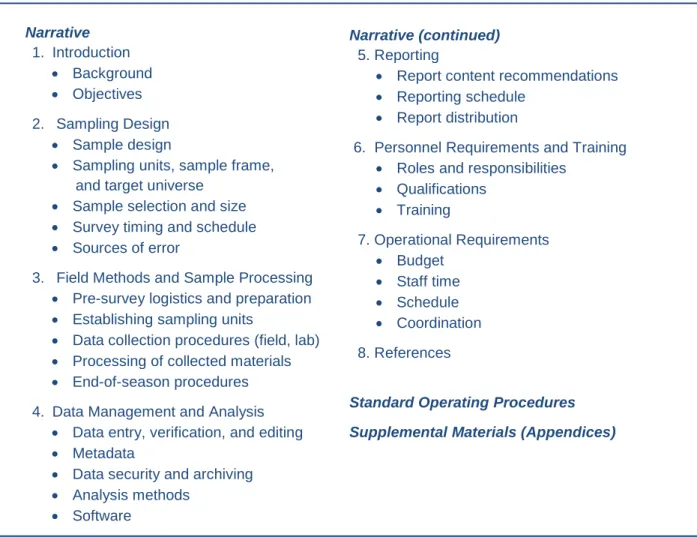
refuge. Every survey in a refuge Inventory and Monitoring Plan (IMP) will eventually be guided by this type of protocol. At a minimum, a survey protocol needs to address eight elements in the narrative section (Figure 1):
1. Introduction
2. Sampling Design
3. Field Methods and Sample Processing
4. Data Management and Analysis 5. Reporting
6. Personnel Requirements and Training 7. Operational Requirements
8. References
You can find additional information about what to include in each element in the standard operating procedures (SOPs) of this handbook. The magnitude of detail included for each element of a protocol will vary according to the objectives, the intended scale of inference (i.e., providing data for addressing questions at local, regional, landscape, or national scales), difficulty in sampling, types of indicators measured, and the complexity of measuring devices. For many simple localized surveys, a complete protocol may only need a brief paragraph for some of the elements. The goal is to provide enough information to communicate what will be done in a survey. Typically, you will describe data collection and analytical details in SOPs. Refuge System staff can often use or modify SOPs in survey protocols of other refuges. In some cases what initially may be presumed to be a protocol will not address all eight elements, but focus only on instructions for collecting data. These instructions are not considered complete protocols for purposes of an IMP or other policy requirements and are referred to as initial survey instructions. There are three ways to produce a site-specific protocol when an approved version is not
available. These include: (1) adding refuge-specific details to an existing protocol framework,( 2) modifying an existing specific protocol for a similar survey, or (3) developing a new site-specific protocol from various materials like initial survey instructions, methods in published papers, or notes about past survey activities. When you use a survey protocol framework to develop a site-specific protocol, then that resulting protocol will be a complete, stand-alone document, which also includes the general information from the protocol framework. All surveys will need refuge-specific details in their protocols.
Protocol Framework
A protocol frameworkprovides a foundation for conducting a survey, but lacks refuge-specific guidance or details for some of the eight elements (e.g., locations of sampling units; operational guidelines; safety procedures). See Knutson et al. (2008) for an example of a protocol framework used to monitor landbirds.
Although a protocol framework is typically more general in content, it provides a foundation for developing a site-specific protocol that will help ensure consistent methodology among multiple refuges within a Region (regional scale) or across two or more Regions (national scale). If you use a protocol framework, it also reduces the time and resources you need to produce a
site-3
specific survey protocol. When a protocol framework includes a statistically derived allocation of sampling locations, then data generated from surveys conducted at multiple refuges will be comparable and can be used to quantify large scale patterns. Thus, a protocol framework can be used to produce a site-specific protocol to conduct surveys at local or larger scales.
Why Use a Protocol to Conduct a Survey?
Protocols ensure that the collection and analysis of data are consistent, reliable, repeatable, and appropriate to address the intended objective. Use of a protocol helps to ensure that the survey results will be defensible. By having a written protocol, the people who will later use the data, conduct subsequent surveys, or interpret the relevance and reliability of results will understand how the surveys were conducted. As some surveys can be expensive, a protocol can provide insight into the costs and requirements for successfully completing a survey and help evaluate whether the benefit justifies the cost (Caughlan and Oakley 2001).
A survey protocol helps staff to compare and coalesce data over time because they can repeat surveys in a consistent manner. Accordingly, by adhering to a protocol, there is greater
confidence that differences in results among locations or time periods are real and not simply caused by differences in the way surveys are conducted or how survey data are managed, analyzed, or reported.
Developing a Protocol
You will need a site-specific protocol for each survey that you are conducting. For some surveys, protocols have already been developed. To find existing protocols, you can (1) search the Service document catalog (ServCat) for protocols, (2) search PRIMR for surveys with similar objectives and their assigned protocols, or (3) ask I&M staff or subject matter experts. If a suitable protocol cannot be found, you can begin the development of a site-specific survey protocol by reviewing initial survey instructions or related materials. There are several ways to produce a survey protocol, as explained below. Each require different amounts of effort depending on the spatial scale (local, regional, or national) and type of survey (inventory, baseline, or monitoring to inform management) that will be conducted.
Use Figure 1 to organize a new protocol into a Narrative with eight elements, a set of Standard Operating Procedures (SOPs), and appendices of Supplemental Materials (Oakley et al. 2003). Preface a survey protocol with an abstract that describes the type and purpose of the survey and the key features of the protocol (see the Survey Protocol Template).
What is Required in a Survey Protocol?
At a minimum, a site-specific protocol or protocol framework should clearly address all of the eight narrative elements described in this handbook (Figure 1). In the case of a protocol framework, it will only be possible to include general guidance for some of these elements. For any protocol, you may need to present detailed, step-by-step instructions for data collection, data management, or analytical methods in SOPs. When necessary, you can add appendices to the protocol to include supporting information or tools (Supplemental Materials).
4
Figure 1.
Content of protocols for conducting surveys in the Refuge System.
Narrative
The narrative includes a general description of each of the eight protocol elements as well as the rationale for the sampling design, methods of data collection, and data analysis (Figure 1). Every site-specific survey protocol should address all eight elements of a narrative in enough detail so that new staff could repeat the survey, or analyze and interpret survey results to complete the survey objectives. You should base estimates of costs and time in the protocol on actual sampling requirements and refined knowledge of survey methodology.
Standard Operating Procedures
An SOP is a document that describes the details of regularly occurring or repetitive activity. Write an SOP as a concise, step-by-step set of instructions that can be followed successfully by any person (given some basic level of experience and training). SOPs provide consistency in the implementation and completion of specific tasks and confidence in the results. Having a stand-alone SOP may be valuable when survey activities are implemented at multiple sites. You can find additional guidance on developing SOPs in EPA (2007) and in Decoster et al. (2009), and in this handbook.
Narrative 1. Introduction
• Background
• Objectives 2. Sampling Design
• Sample design
• Sampling units, sample frame, and target universe
• Sample selection and size
• Survey timing and schedule
• Sources of error
3. Field Methods and Sample Processing
• Pre-survey logistics and preparation
• Establishing sampling units
• Data collection procedures (field, lab)
• Processing of collected materials
• End-of-season procedures 4. Data Management and Analysis
• Data entry, verification, and editing
• Metadata
• Data security and archiving
• Analysis methods
• Software
Narrative (continued) 5. Reporting
• Report content recommendations
• Reporting schedule
• Report distribution
6. Personnel Requirements and Training
• Roles and responsibilities
• Qualifications
• Training
7. Operational Requirements
• Budget
• Staff time
• Schedule
• Coordination 8. References
Standard Operating Procedures Supplemental Materials (Appendices)
5
Although many existing protocols incorporate methodological descriptions as part of a single, large Methods section, there are many benefits to preparing a series of separate, stand-alone SOPs. Stand-alone SOPs are an efficient means for packaging procedures within a protocol. Including them can substantially shorten the narrative section, allowing for a more concise presentation of the survey’s scope, implementation, and use. Separate SOPs also help others conducting I&M efforts, because they can select appropriate SOPs and incorporate them into different site-specific protocols. Stand-alone SOPs also expedite required protocol review and revision processes. For example, an SOP from a previously approved Refuge System protocol typically will not require additional review if applied to a new protocol being developed for a similar I&M survey. Some SOPs may describe details that are likely to change regularly (e.g., data storage locations, minor cost changes, vendors/sources for equipment), and in these cases only the revised SOP requires a review.
The number of SOPs required will depend on the scope and complexity of the survey. Any component of a protocol’s narrative section that requires substantial detail to ensure successful implementation would be a candidate for a separate SOP. Single elements can be described in separate SOPs, or can be combined in different themes. For example, a protocol narrative on sampling design may relate different designs to different data collection techniques. In this case, an SOP may combine details on sampling and data collection (Elements 2 and 3). Whichever way you organize the protocol, each SOP should include its own list of references.
Supplemental Materials
You should include any other materials not already specified above that are either required or helpful to implement the survey in the survey protocol. These materials may include example databases or templates, maps, photographs, supporting documents (e.g., reports), and descriptions or reference links to specialized data management, data analysis, or decision-support tools. Supplemental materials are commonly included as protocol appendices.
How is a Site-specific Survey Protocol Produced?
There are three ways you can produce a site-specific survey protocol: (1) add details to an existing protocol framework, (2) modify a site-specific protocol developed for a survey at another site with similar objectives, or (3) develop a new site-specific protocol from scratch or from various materials compiled as initial survey instructions.
Adding Site-specific Details to a Protocol Framework
Protocol frameworks need site-specific details to be implemented at a refuge. Some examples of site-specific information include exact locations and directions to sampling units, procedures unique to the refuge’s environments, or timing of surveys as a function of refuge resources or geographic location. The protocol framework should provide guidance on how a refuge will select sampling units and explain how the sampling units selected at a local scale contribute to local and larger-scale objectives. When a larger-scale sampling design is used, you may need to add sampling locations to meet refuge objectives.
Adding site-specific details to an existing protocol framework also entails including a written justification for using the selected protocol framework based on similarity to the respective survey purposes and objectives. You can include this justification in the Protocol Summary.
6
You also need to document and justify differences in procedures between the framework and site-specific protocol. Include refuge-specific information for the various procedures in a copy of the protocol framework as continuations of existing framework sections. If the framework has been published under copyright, link the site-specific information as a separate document in ServCat with the framework.
Modifying a Similar Site-specific Protocol
Modifying an existing site-specific protocol is appropriate when (1) a protocol framework is not available, (2) objectives of both surveys are similar, and (3) the sampling design, methods, and analytical approach will be suitable for the refuge requiring the survey protocol. Include a justification statement in the site-specific protocol you’re developing that explains the similarity of the objectives, sampling design, field methods, and analytical approach for the new refuge and the existing, approved site-specific protocol. Add this statement as a separate paragraph in the appropriate element of the protocol narrative. You will also need to provide the specific details for implementing the site-specific protocol at the new refuge, such as maps and
directions to the sampling units and other logistical considerations, such as storage and access to sampling equipment. Make these modifications in the protocol narrative sections describing data collection methods and operations as well as any site-specific SOPs.
Developing a New Site-specific Protocol
When a suitable protocol is not available, you will need to develop a new site-specific protocol to conduct a survey. Use information cited as Initial Survey Instructions, subject matter experts, and consultation with I&M staff. In some cases, you may choose to contract the development of a new protocol.
All eight elements (Figure 1) should be addressed in a site-specific survey protocol. Include these elements in the narrative section of the protocol. Depending on the survey objectives, some of these elements may require elaboration in SOPs with tools or other support materials appended as Supplemental Materials Sampling designs (see SOP 2. Instructions for Sampling Design) may require assistance from I&M staff or other technical experts. Once a draft is completed, you should contact the appropriate I&M staff for uploading the protocol into ServCat and for arranging reviews. You should consider testing complex, novel, or long-term monitoring protocols prior to review.
Approving a Protocol
Peer review of survey protocols is necessary to ensure that the recommended, modified, or newly developed protocol is suitable for achieving survey objectives. All sections of a new protocol and modified sections of an adopted protocol, require review. When surveys are controversial or involve the collection of influential scientific information, their protocols may trigger special reviews required by the Service’s Information Quality Guidelines (FWS 2012a).
How is a Survey Protocol Reviewed and Approved?
The goals of the protocol review process are to (1) ensure protocols are scientifically credible; (2) ensure the most suitable design, methods, and analysis are used; (3) promote consistency
7
and efficiency; and (4) foster transparency and objectivity in conducting surveys.
A Refuge Biologist or other survey coordinator typically initiates a review request. I&M staff will coordinate the review process, soliciting reviews from appropriate subject matter experts. In some cases, I&M staff will conduct the single internal review that is required for site-specific survey protocols that were developed from other reviewed and approved protocols. Reviewers should have relevant expertise and not be involved with the development of the protocol framework or survey protocol.
Protocol review should be a transparent process and may be internal (Refuge System staff) or external, depending on intended use of the protocol (see Box 1). All new protocol frameworks need internal and external review. Revisions to approved frameworks generally require internal review, and may require external review depending on the magnitude of the revisions. For example, if the sampling objectives, sampling design, and methods of an approved protocol framework are changed, then conduct both internal and external reviews.
Newly developed or revised site-specific protocols generally require only internal review. For example, if you adopt the sampling objectives, sampling design (except for sampling unit locations), and methods of an approved protocol, the review and approval can be a streamlined internal process. When you modify the sampling objectives, sampling design, or methods of a site-specific protocol, the modified protocol requires more rigorous review (see Box 1). If you develop a site-specific protocol from an approved protocol framework or by modifying an existing site-specific protocol without changing the sampling objectives, design (other than addition of sampling units), or methods, it will only require review of the added material.
Developed protocol frameworks that are intended to be used to guide surveys within two or more Regions are considered national-level protocols, and the National I&M Coordination Team will coordinate their review. Because these protocols will guide multiple refuges over large areas and require cumulatively larger amounts of capacity to implement, at least two external reviews will be required in addition to any internal reviews. Protocol frameworks that guide multiple refuges within a Region need at least one external review in addition to any internal reviews. The Regional I&M Coordinator will either assign or assume the lead in reviewing Regional-level protocol frameworks. These standards allow survey protocols that guide surveys to comply with the Information Quality Act and the Service’s associated guidelines for influential scientific information (FWS 2012a).
Reviewers should consult this handbook for the requirements of a complete survey protocol. Figure 1 and the eight SOPs may be particularly useful to reviewers. The content and
expected rigor in a survey protocol varies according to the survey objectives, scale of intended use of the protocol, and other factors (e.g., potential for controversy or litigation). Instructions to reviewers may need to identify particular elements unique to protocols not typically included in manuscript or report reviews, like treatment of metadata or the level of detail about methods that will be needed in site-specific protocols.
The review lead will document the review process, including the reviewers’ comments and the response to reviewer comments on the I&M Protocol Review Documentation Form (Appendix C). Complete and submit this form with the survey protocol or protocol framework for approval. Archive the completed forms and reviews in ServCat with the protocol.
The approval process entails procuring the appropriate signature on the I&M Protocol Approval Form (Appendix D). Protocol frameworks and site-specific protocols can be approved following adequate peer review, testing, and revision if needed, and after they have been submitted with
8
Box 1. What is the appropriate level of protocol review?
Protocol Type Development Stage Reviewed Content reviewsInternal ± reviewsExternal ± reviews Total
National Framework New All >2 >2 >4
National Framework Revision Revised >2 0−2 >2
Regional Framework New All >2 >1 >3
Regional Framework Revision Revised >2 0−2 >2
Site-specific New All >1 0−1 >1
Site-specific Modified* Added 1 0 1
Site-specific Revision Revised >1 0−1 >1
* Modified from a protocol framework or a site-specific protocol from another refuge. ± Number of reviews determined by the expected use of the survey protocol.
required documentation to the appropriate I&M staff (Appendix D). Typically, an I&M Zone Biologist approves site-specific survey protocols, and I&M Coordinators approve Regional protocol frameworks. The National I&M Program Manager approves national protocol frameworks.
Approved protocol frameworks and site-specific survey protocols that have revisions will also undergo review, as described below in “When and How is a Survey Protocol Revised?” Depending on the nature of the changes, revised survey protocols based on protocol
frameworks typically won’t require review of the entire document (see Box 1). Only SOPs that have been modified need to be reviewed. I&M staff can expedite the review by providing instructions to reviewers with a synopsis of any revisions and by identifying new material that has not previously been reviewed and approved.
How is an Approved Protocol Documented and Archived?
The Refuge Biologist or other survey coordinator is responsible for coordinating the
development and reporting of site-specific protocols. Newly developed survey protocols should follow the Survey Protocol Template. Once you draft a protocol, it can be tested or submitted for the appropriate formal review. The draft survey protocol should be entered into ServCat and given a status that denotes “Complete Draft.” Once a draft survey protocol is submitted for review, its status should be changed to “In Review.” After final review and approval at the appropriate level (see Box 1), the status of the survey protocol should be changed to “Approved” for site-specific use.
The I&M review lead is responsible for ensuring that an electronic copy of the protocol is
9
Data Resource Management (274 FW 1, FWS 2009), and Electronic Records (282 FW 4, FWS 1995) policies. The I&M lead provides the appropriate name, version number, search terms (i.e., key words), and status for the protocol. Once the final approved protocol is available, the same I&M lead ensures that electronic copies of the approved protocol, formal reviews, revision logs, and signed approval signature pages are also archived in ServCat (Appendixes C and D). If the protocol is revised in accordance with the “When and How is a Survey Protocol Revised?” section of this handbook, then the I&M review lead ensures that the updated version of the survey protocol and documentation for the revision also are archived.
Regional and national I&M staff should use a similar process for reporting and archiving regional or national protocol frameworks. In these situations, staff must assign the proper scale of use to the status of the protocol framework.
Revising a Protocol
When and How is a Survey Protocol Revised?
Changes to any of the following should prompt you to consider revising a survey protocol: objectives, sampling design, field methods, or analytical approach. A revision to these elements of a protocol will require the appropriate level of review based on expected use of the protocol. For example, one of the most common reasons for revising a protocol is the advent of an improved technique for collecting data. These new techniques may change the precision of estimates in the survey. Consequently, the survey power may change and cause a revision of the sampling design, and ultimately, the reliability of conclusions used to inform a management decision. However, when long-term monitoring is in place, one of the factors for making the decision to revise an existing site-specific protocol is the cost of adopting the new techniques (including concurrently collecting data under former and new methods to determine compatibility with survey objectives and existing data) relative to the benefit (e.g., magnitude of improvement in accuracy or reliability of information). Another reason for revision is when aspects of a site-specific protocol are not applicable at your refuge.
Any time a protocol is revised because of new field methods or a change in sample design and analytical approach, the Refuge Biologist or other survey coordinator should consult with the appropriate I&M staff to determine how best to continue the survey. Depending on the nature and magnitude of change, and if the two procedures are not compatible, the resulting data will need to be analyzed as two, rather than one, data source. You may also want to revise a survey protocol when the survey objectives are not adequately met with the existing sample design, field methods, or analytical approach.
If the objectives, sampling design, field methods, and analytical approach of the existing,
approved protocol and the revised protocol are similar, then the review process may be reduced based on the discretion of or consultation with the appropriate I&M staff (see Box 1). When the objectives, sampling design, field methods, or analytical approach of the approved survey protocol or protocol framework are substantially revised, it is likely that a more formal review will be required.
The revised version of a survey protocol or protocol framework should include a description of the reasons for the changes. Add this information as a separate paragraph to the appropriate element of the protocol narrative. Additionally, if the revision is to a site-specific protocol, include
10
specific details required to implement the survey at the refuge, such as maps and directions to the sampling sites and other logistical considerations. Typically you make these revisions to the Field Methods and Sample Processing section and Operations section of the protocol narrative, as well as to relevant SOPs. Assign the appropriate version identifier (see versioning
instructions in the Survey Protocol Template) to the revised protocol and store it in ServCat. Complete the approval form (Appendix D), which includes a brief revision record, before requesting approval of the protocol, and include it with the archived survey protocol or protocol framework.
11
Standard Operating Procedures (SOPs)
SOPs may expand on individual elements that require additional instructions, or may be
organized by themes that include multiple elements. In this handbook, the SOPs are presented for each element for ease of access, but they can be organized as best suits a particular
protocol.
SOP 1. Instructions for the Introduction
The first element of a protocol should provide an Introduction with background information on the reasons for conducting a survey, and the objectives of the survey. Clear and concise
objectives provide the cornerstone of a useful protocol. You cannot determine what, how, where, and when to survey without knowing the reasons for conducting a survey or the desired type of information to be gained. In most cases, background and objectives will follow from information in the refuge Inventory and Monitoring Plan (IMP).
Background
Explain the need for the survey in the Background, including a description of the resource issues that will be addressed by the proposed survey. Also indicate any general conservation goals that require the type of survey guided by the protocol. Include any historical information that supports the need for the survey. Usually, you can find this information in refuge planning documents: Comprehensive Conservation Plan (CCP), Habitat Management Plan (HMP), species recovery plan, or other resource management plans.
Objectives
Clearly define the objectives before beginning a survey to ensure that you get the required information. Well-written objectives define needed outcomes and help identify the design and methods for obtaining data and analyzing results. Objectives should be Specific, Measurable, Achievable, Results-oriented, and Time-sensitive (SMART).You can find tips on writing SMART objectives in the Handbook for Identifying Refuge Resources of Concern and Management
Priorities (FWS 2010:23). Optimally, a survey conducted to support a management objective will
provide feedback on how well the objectives were met and on any needed changes in management actions.
Two types of objectives need to be explicit in a survey protocol. The first type states the
management objective of the refuge activity that triggers a survey. The second type establishes the sampling objective for that survey. Management and sampling objectives are described below and in more detail in Elzinga et al. (2001:247–270).
Management objectives—are statements detailing the resource outcomes a refuge plans to
achieve. Review existing management objectives for adequate content and detail and refine when necessary (see Writing Refuge Management Goals and Objectives: A Handbook, FWS 2004). Detailed management objectives will be used to develop explicit sampling objectives. For a well-written example, consider the following management objective to provide habitat for riparian-associated species at the Arapaho National Wildlife Refuge (2004 CCP, page 48):
12
“Restore 50–100 acres of dense (40–100 percent) willow in patches greater than 0.5 acre and 20 meters wide in the central third of the Illinois River (from the north end of the island to the confluence with Spring Creek), to connect existing willow patches by 2014. Maintain 535 acres of dense willow in patches in the upper third of the Illinois River to benefit nesting Neotropical migratory songbirds (yellow warbler and willow flycatcher) and resident moose, river otter, and beaver.”
In this case, the management objective includes a quantitative target rate of change in riparian habitat (50 to 100 acres over 10 years), with rationale and supporting science provided in an Appendix of the CCP (Arapaho National Wildlife Refuge 2004). This management objective is habitat-related, but also has wildlife population-related goals that may trigger survey needs and shape sampling objectives. For example, you could use an inventory of the attributes of riparian habitat prior to restoration to establish where restoration may best occur and the pre-restoration habitat condition. If the inventory is followed by a post-restoration survey, then together, these monitoring data could inform management if and when the riparian restoration targets were achieved. If you want to determine the effectiveness of the riparian habitat restoration in
meeting the conservation goal (benefit to migratory yellow warblers and willow flycatchers, and resident moose, river otter and beaver), you will need to conduct pre- and post-restoration monitoring of focal wildlife species or related indicators (see examples in Mulder et al. 1999). Finally, if you want to know about best practices for achieving the riparian restoration, you should establish surveys associated with a more encompassing adaptive management project. Alternatively, if little was known about the temporal change of restored riparian systems, you may want to use baseline monitoring of habitat and select wildlife indicators. This type of survey will indirectly provide information to management on the duration of restoration outcomes. You could also use baseline monitoring to determine how well the 534 acres of riparian habitat were being maintained in the upper third of the Illinois River. However, should a change be detected, this type of monitoring alone would not explain why habitat was changing.
Sampling objectives—provide the specifics for measuring the resource or related indicator
targeted in the management objectives. You need to determine the following to develop sampling objectives (Elzinga et al. 2001):
1. what will be surveyed (resource or ecological indicator);
2. where the survey will be conducted (geographic location and type of environment); 3. the attribute actually measured or estimated (e.g., body size, cover, density); 4. the target response from management (direction of resource change);
5. the measurable state or amount of change in the attribute (quantity/status); and 6. when you expect to see a response to the management action (time frame).
When the objective of a survey is to understand the ecology of the refuge rather than to address a particular management objective, you can use conceptual models to develop sampling
objectives (Fancy et al. 2009). If you use modeling techniques, describe the model types and identify the relevant model parameters.
You should consider the desired results (e.g., a species distribution map, an estimated
parameter like population size, a predictive model) and how they address the objectives of the survey. These objectives should lead to an understanding of why you are measuring or
13
Sampling objectives should also include the: 7. desired accuracy of estimates,
8. magnitude of change one wants to detect, 9. chance of error you are willing to accept, and 10. power to detect a change of a specified magnitude.
This information is necessary for guiding decisions about the sampling design. The power for detecting a change of specified magnitude can be estimated for different sample sizes given estimates of precision (part of item 7) and your acceptable chance of error. When conducting inventories, you typically don’t need items 8-10.
The following is a sampling objective developed from the preceding management objective to restore riparian habitat at a target rate of 50 to 100 acres in 10 years. There are two
corresponding sampling objectives for the attributes, patch size and amount of willow cover: Detect with 95% confidence that 50 new acres have a minimum patch size > 0.5 acres and 66-foot width, with a 10% chance of wrongly concluding that the target patch size was not met, when in fact it was.
Detect with 95% confidence that 50 new acres have a minimum willow cover (% of patch) of 40%, with a 20% chance of wrongly concluding that the target amount was not met, when in fact it was.
In these sampling objectives, the acceptable errors for the two attributes are stated differently, with emphasis on greater rigor in making inferences about meeting the target patch size. You may want to use the stricter standard for patch size because ecologically it may be more critical in deciding the success of the management action, or because the higher standard could not be achieved for estimates of willow density given that you will likely encounter greater sampling variation for this attribute.
Before finalizing a sampling objective that is realistic, you may need further investigation and decisions on methods based on traits and performance of available measuring techniques or estimators. Is there an alternative attribute that can be measured or estimated with less effort and cost, and that has similar ecological relevance while providing the desired standard of accuracyand resolution? In the example above, could you use remotely sensed data? Deciding on an appropriate attribute to measure should follow from the management objective and will influence some of the specifics in the sampling objective. Box 2 provides considerations for scrutinizing and selecting a suitable attribute.
In situations where management objectives focus on changes in wildlife populations (e.g., recovery of endangered species or removal of noxious non-native species) that may require the most reliable information for subsequent decisions, then you may want to use a protocol that requires methods that yield the most accurate estimate of absolute abundance instead of less expensive index counts that do not include measures of detectability. In any event, you should clearly describe the indicators and attributes, along with rationale for selection, in this element of a protocol narrative.
14
Box 2
.
What attributes should be surveyed?
An attribute is a measurable feature of the resource or resource indicator (e.g., vegetation cover, vegetation height, or number of shorebirds/hectare, bird species evenness/hectare). When choosing an attribute, consider the following questions:
1. Can the attribute be measured accurately (i.e., with low bias and high precision) given available resources?
2. Is the species, species group, habitat, or environmental indicator readily detectible? 3. What’s the sampling window (time-frame) during which it can be measured?
4. Do the measurement and analytical methods require special technical capabilities? 5. What training, permits, and equipment are required?
6. Does measurement involve destructive or disruptive sampling (e.g., clipping for plant biomass, disturbance to rare species or protected communities)?
Additionally, when monitoring triggers a management action:
7. Is the attribute response to management likely to be predictable and consistent? 8. Is response time of the attribute appropriate for the management objective?
When selecting among possible attributes, look for one that can be measured accurately, will require less effort to detect or observe, has a broad time window for sampling, does not require highly complex methodology or technical expertise to measure or analyze, minimizes time and cost, and does not require destructive or disruptive sampling.
15
SOP 2. Instructions for Sampling Design
A survey protocol must fully describe the sampling design. Proper sampling design supports accurate and efficient assessments of wildlife populations or habitat condition. It creates scientific credibility in surveys, makes management decisions defensible, and can save time and money. The sampling design is the foundation for extending inference and conclusions of a survey. Consulting a biometrician or technical expert can help to develop a robust sampling design. You should also document why you select a particular sampling design.
Ecological systems, by their very nature, present many obstacles to collecting accurate monitoring data. You should design the survey to avoid or accommodate known obstacles. Inferior sampling designs may lead to erroneous interpretations of results with potentially serious consequences for management decisions. For example, population estimates may be too high or low (Anderson 2001), or measured values may vary so much that no conclusions can be drawn. Consider the data analysis when designing the survey to identify desired parameters, trends, or comparisons, and the methods you will use to assess them.
Sample design: inventory vs. monitoring
Data collection methods may be similar for an inventory or monitoring project, but sample design, analysis, and inference varies greatly depending on survey objectives. Inventories are intended to evaluate the distribution and existing status of a resource over a specified spatial scale and at a particular moment or period in time. Inventories can be used to describe biotic communities or enumerate certain ecological indices (e.g., species richness, species diversity, species evenness). Generally, monitoring includes similar elements and adds repeated measurements to detect changes over time. Important considerations are selecting
representative sampling units and a sample size large enough to estimate parameters with desired precision or to test for differences among sampled populations.
Sampling units and sample frame
Provide a clear description of the biological population, resource, or resource indicator that will be surveyed. Include the spatial and temporal boundaries of the resource of interest, the sampling units you will observe (e.g., m2 quadrats of vegetation) and the specific attributes that you will measure and record (e.g., diameter at breast height of trees or presence/absence of a species). The spatial and temporal distribution of the all possible sampling units is called the
sample frame. In addition, identify the population to which you want to make an inference, the
target universe. Identify the relationship between sample frame and the target universe before making inferences from your survey data. In order to make inference to the target universe, all members of the target universe must have a non-zero probability of being selected as a sample. You should select sampling units in a way that allows the survey results to be representative of the target universe (i.e., random, stratified random), and you should describe when these differ. Determining how representative your sample is may require evaluating the composition of your sample at multiple scales relative to the target universe. For additional information on these concepts, see Morrison et al (2008).
Sample selection and size
Sample selection is a critical aspect of inventory and monitoring design because it influences the scope and quality of survey conclusions. The survey protocol should define the procedure for selecting sampling units from the sample frame. The observations or measurements from the selected units constitute the sample.
16
There are a number of designs for selecting sampling units. More conventional designs include simple random, stratified-random, systematic, cluster, and opportunistic sampling. There are more recent spatially balanced design that can prove efficient for natural resource sampling in some environments (Stevens and Olson 2003, 2004). There are trade-offs among designs in logistical ease, cost, reduction of uncertainty and complexity of data analysis. For example, opportunistic sampling requires less effort, but may have limited inference. Conversely, a strictly randomized sample selection has much greater inference, but is often much more logistically complex and can result in undersampling of rare communities or species.
For additional information and examples of conventional sampling designs, see Environmental Protection Agency (2002). Use of a Geographic Information System (GIS) can simplify and facilitate sample selection under different designs.
This section of the protocol should also define the required size of the sample and justify why this level of effort will meet the sampling and management objectives. Justification should be based on a power analysis that demonstrates the minimum expected sampling effort that will achieve the sampling objectives appropriate to the management issue, while limiting the chance of making incorrect conclusions (e.g., Type I errors or Type II errors ). If the management objectives focus on estimates of change or trends, then the sampling effort is impacted by the precision required from each survey, the expected temporal variation in true attribute values, and the magnitude of the change or trend that you want to detect. Base your sampling justification on relevant literature or pilot studies.
17 Survey timing
Describe the period during which the survey should occur, including specific timing restrictions or durations and their underlying reasons. Timing stipulations may be a function of survey objectives and biological traits associated with seasonal phenology. Changes in survey timing relative to the phenomenon of interest can confound estimates of long-term trends. For example, the detectability of many species from fixed-wing aircraft is highly dependent on the amount of leaf cover and snow conditions. Similarly, bird surveys that rely on detecting calls depend greatly on the timing of breeding activities, both seasonally and diurnally. As such, timing may not be readily predicted or described by a calendar, but may need to be described in more appropriate phenological terms (e.g., at degree days x, after first snow). When this is necessary, you should provide approximate timing for budgeting and permitting purposes. Once you’ve selected a sample and determined the timing, you should produce a map showing primary and any alternative locations that will be visited to collect data and a visitation schedule. If the sampling design is so complex (e.g., panel designs) that sample selection and visitation procedures are explained in an SOP, then you can include the resulting map and schedule in that SOP. Otherwise, you should display a map of sampling locations and sampling schedule in the narrative discussion of sampling design. Summarizing the numbers of sample units by space and time in a table or chart also provides a useful overview of the sampling design. To mark sampling locations, you should use an Global Positioning System (locations to within 3 m), even when permanent markers have been established. Use a coordinate system
compatible with use of a GIS when documenting a sampling location. Don’t use the cadastral (Section-Township-Range) system as it is inadequate for these purposes.
Sources of error
Most surveys have assumptions regarding bias of the estimator. Describe potential sources of measurement error, such as imperfect detection rates, animal movement, and lack of
independence among measurements (Williams et al. 2002). Describe steps taken for assessing, quantifying, or removing sources of error. Describe which variables cannot be controlled, and explain the specific effects these sources of error could have on the results.
18
SOP 3. Instructions for Field Methods
and Sample Processing
A survey protocol should provide detailed descriptions of methods for data collection, handling, and post-collection processing. This includes pre-survey logistic checklists, descriptions for how to establish new (and relocate existing) sampling units, methods for field and laboratory data collection, as well as processing and disposition of samples, and end-of-season procedures.
Many of these methodological details can be presented in separate SOPs, after referencing them in the protocol narrative. Regardless of where you put this information, it should include adequate detail to correctly repeat required procedures. Below is a list of field methods and sample processing instructions to include in a protocol.
Pre-survey logistics and preparation
Provide a list of field and laboratory equipment/supplies.
1. Include item name, order number, source and cost.
2. When using specialized or electronic devices for measuring and collecting data, document measurement accuracy and calibration procedures of the equipment.
3. This information is useful for time-sensitive monitoring because it helps ensure that required supplies and equipment are available when it’s time to conduct field sampling. Develop and provide training materials (see SOP 6. Instructions for Personnel Requirements and Training).
Develop and include staff work schedules during the field season.
Describe the arrangements needed to reserve housing and suitable vehicles. Describe safety precautions.
1. Include techniques for prevention of potential injury from equipment operation, animal handling, weather, terrain, and exposure to plant- or animal-borne irritants and diseases.
2. Reference relevant Service safety policies for specific requirements.
3. Explain emergency communication and response procedures. Identify required compliance or authorization documentation.
1. Secure permission from private land owners, explaining survey objectives.
2. Address applicable laws and policies, including Endangered Species Act (e.g., Section 7 and 10), National Historic Preservation Act (especially section 106), Animal Welfare Act (see Box 3).
3. Obtain appropriate wildlife permits (State and Federal).
4. Complete volunteer services agreements (150 FW 1, FWS 2003) when necessary.
19
Box 3. How do surveys maintain proper animal welfare standards?
Some inventory and monitoring projects may require capture, handling, and marking individual vertebrates. Others may require taking whole-specimens or collecting voucher specimens. The techniques and methods of these types of surveys should comply with the Animal Welfare Act (7 U.S.C. 2131 et seq.), which requires a review of the relevant
activities procedures by an Institutional Animal Care and Use Committee (IACUC) and adherence to other standards (APHIS 1995, 2007; OLAW 2002a, b). Foremost, these other standards include the Public Health Service Policy on Human Care and Use of Laboratory Animals the National Research Council Guide for the Care and Use of Laboratory Animals (NRC 2011) and taxa-specific guidance on care and use of free-ranging wild vertebrates developed by professional societies as requested by the National Science Foundation (Sikes et al. 2012). Protocols for these types of surveys should provide adequate detail on
procedures that involve vertebrate care and use. When reviewed and followed, protocols with these standards will meet the intent of the Animal Welfare Act. The following
references on specific animal care and use guidance for different groups of vertebrates should be used in developing survey protocols:
Vertebrate Group Reference
Birds Fair et al. 2010
Mammals Sikes et al. 2011
Amphibians and Reptiles Herpetological Animal Care and Use Committee 2004
Fishes Nickum et al. 2004
Establishment of sampling units
Describe how sampling units will be located.
1. GIS-compatible location coordinates.
2. Required maps, aerial photographs, plot diagrams, and compass directions.
3. Navigation to sampling units (Global Positioning System use and travel instructions). Describe the marking and layout of sampling units (both permanent and temporary)
Data collection procedures (field and/or laboratory)
Provide step-by-step procedures to detail all aspects of field and laboratory data collection.
1. Observational techniques.
2. Measurement procedures.
3. Calibration and quality control for measuring devices.
4. Within- and among-year survey timing.
5. Capture and marking techniques.
20 Processing of collected material
Describe the proper handling, preparation, storage, and shipping procedures.
1. Samples requiring laboratory analyses (e.g., soil, water, plant/animal tissues).
2. Disposition of voucher or tissue specimens (e.g., plant/animal specimens, genetic materials, blood/culture samples).
Identify the names and contact information for facilities conducting laboratory analyses or collections used to house voucher specimens.
End-of-season procedures
Describe procedures for cleaning, testing, and storing data collections and sampling equipment.
1. Archive non-digital data (e.g., paper forms, notebooks, field maps).
21
SOP 4. Instructions for Data Management
and Data Analysis
A protocol should describe the data management system (DMS), including both the field
component (e.g., how the data are recorded) and the office components (e.g., how the data are stored and archived for permanent documentation). Reference the appropriate data standards for recording and entering data (FWS 2012b) and consult with a I&M Data Manager for detailed guidance on data management. An example of core standards for data management can be found in NPS (2008). You may want to summarize this information for those that will enter and check data and include it in the site-specific protocol. These instructions may include the software available for use and examples of completed forms.
You can store data in many formats, but you should always include a universal flat file that is not platform or database-specific, such as text or comma-delimited (.csv) files. Templates for these files may prove useful in an SOP on data management or as supplemental materials.
Data entry, verification, and editing
Describe the process for initial data entry into a DMS and include the data dictionary for the DMS. Provide a schedule for post-collection entry of data when paper forms are used, and for review and error-checking. Describe or cite the quality assurance and error-checking
procedures, such as double entry or by using a second observer to compare completed field forms with the DMS. Time and costs associated with these tasks should be accounted for in the budget (see SOP 7. Instructions for Operational Requirements) to ensure that survey results can be provided in a timely manner.
Metadata
Metadata describe the data files, data fields, and the nature of attribute values, including the who, what, where, and when of the collected data. Provide a description of how you will record and store metadata. Documentation of geospatial and biological metadata should adhere to standards recommended for the Service (Federal Geographic Data Committee 1999).
When monitoring is part of an adaptive management project, it is necessary that you maintain a project record. A project record is a set of documents that records project-related activities such as meetings, survey progress, progress reports, decisions, and changes in staff. All revisions should be annotated with the date of the respective action. This can be a brief summary that is stored with the project documents. A project record will include details and decisions made throughout the project, which can be vital to analysis and interpretation of the monitoring results. Because the main goal for adaptive management is to determine if a particular course of action is working as expected, poor documentation undermines the project’s purpose.
Data security and archiving
Indicate that reports and small data sets should be stored in ServCat and linked to the protocol that guided the survey. Community data sets housed by a non-Service party may still be described in ServCat with a digital link to that data set. For locally managed and stored data, provide the schedule and location (device and pathway) for regularly backing up files containing survey data, where one copy is kept at a separate location in case of catastrophic events such as fire, flood, tornado, or hurricane. If data are originally recorded on paper forms and in staff record field notes, then describe how to copy and archive this information. Also, describe how
22
different versions and updates of the data will be identified. Lastly, describe procedures to archive data and define the location of the archived data (see 701 FW 2: section 2.13G).
Analysis methods
Describe the proposed analytical methods as explicitly as possible in the protocol. Include the analyses needed to assess whether the objectives of the survey are achieved. In cases where post-treatment monitoring is conducted, describe how you will determine if a target value was reached. Include how your analysis will incorporate measures of uncertainty (e.g., detectability, precision). When developing predictive models for informing management, your description should include procedures that evaluate the accuracy of individual model coefficients and estimators, along with information about model performance (Burnham and Anderson 2002).
Specify the steps or reference used for calculating any summary statistics and estimates of uncertainty. Helpful fundamental guides for statistical analyses of biological inventory and monitoring data include Nur et al. (1999), Elzinga et al. (2001), and Williams et al. (2002). If these estimates are extracted from a database, describe that process and the algorithms or commands employed.
When you use modeling techniques, describe the model types with appropriate citations. Identify the model parameters and how they are derived. Describe underlying assumptions of the analytical methods (e.g., normality, independent observations, equal probability of being sampled across space and time, equal variances, linearity, model selection), the methods for assessing assumptions, and potential consequences of violating assumptions.
Software
Identify software that you will use for analysis and data display (e.g., Excel, R, SAS,
OpenBUGS, MARK). Specify what procedures you will employ in the software (e.g., SAS = proc GLIMMIX, R = glmm, MARK = robust model) unless the procedures are manually programmed (e.g., C++, FORTRAN). When manually programmed, you should provide the code for
frequently anticipated routines, like annual estimation of key parameters, in Supplemental
Materials. This provides institutional memory of procedures used to produce results. Information produced after a protocol is approved can be added to an approved protocol as a revision.
23
SOP 5. Instructions for Survey Reports
A survey is not complete until the results have been documented in one or more reports, archived for future reference in ServCat, and disseminated to interested parties (see Box 3). Regular and timely dissemination of survey results are essential for making informed
management decisions. A protocol should clearly identify the information that needs to be conveyed in periodic and final reports of survey results. Periodic reports for each survey also contribute to a refuge progress report on all I&M activities.
There are two types of reports that should be outlined in the survey protocol: progress reports and a final report. Progress reports summarizing the survey completed with general findings are typically brief. Final reports provide conclusions based on more comprehensive data analyses, and are the main focus of reporting described in the survey protocol. Final or long-term survey results should be published, whenever possible, in scientific journals, technical papers,
symposium proceedings, or the U.S. Fish and Wildlife Service technical publication series.
A primary goal for conducting surveys is learning, and this goal should be reflected in the survey reports. When discussing survey report requirements, a survey protocol can express the types of media or report formats for expected audiences. This type of guidance can improve the likelihood that survey results will be applied. For this reason, when recommending a survey report, the protocol should also indicate the intended format and audience of that report.
A survey protocol should describe the expected schedule and appropriate distribution (when and to whom) of survey reports. Box 4 presents key information that you should put in a survey report. In addition to guidance on report scheduling, distribution, and content, describe any special review requirements and where the report will be archived. For example, reports that will include influential scientific information must undergo proper, usually external, review to comply with the Information Quality Act (FWS Information Quality Guidelines 2012a).
Report content recommendations
Objectives and Methods—All survey reports should include information about objectives and
methods to communicate the reasons and procedures for conducting a survey. Because the approved survey protocol includes this information, it’s sufficient for most reports to just include a brief statement of the survey objectives and cite the guiding protocol. If methods differed from the survey protocol, document analytical methods, assumptions, or decisions that are not included in the protocol. This also includes identifying new statistical software or versions used for data management and analyses that differ from the protocol. If custom programming code is required to conduct the analysis, include documentation of the programming code used or refer to appropriate supplemental materials in a protocol. If you use projection models to produce results, describe the key assumptions that define each model.
Summary of Results—Identify the data summaries that are relevant to convey the purpose and
findings of the survey. Summarize data about the attributes that you identified in the objectives section of the protocol, and describe other results (tables or graphs) that you anticipate including in the report.
Important Findings—Report the implications of the survey results and provide recommendations
when appropriate. Explain how the survey objectives were met or if they were not, discuss the reasons why. For Adaptive Management projects, you may need to provide substantial