GRAPHS
LUKE KELLY, DANIELA K ¨UHN AND DERYK OSTHUS
Abstract. We show that for each α > 0 every sufficiently large oriented graph Gwith
δ+
(G), δ−(G) ≥ 3|G|/8 +α|G| contains a Hamilton cycle. This gives an approximate
solution to a problem of Thomassen [21]. In fact, we prove the stronger result that Gis still Hamiltonian if δ(G) +δ+
(G) +δ−(G) ≥ 3|G|/2 +α|G|. Up to the term α|G| this
confirms a conjecture of H¨aggkvist [10]. We also prove an Ore-type theorem for oriented graphs.
1. Introduction
An oriented graph G is obtained from a (simple) graph by orienting its edges. Thus between every pair of vertices of G there exists at most one edge. The minimum semi-degree δ0(G) of G is the minimum of its minimum outdegree δ+(G) and its minimum in-degree δ−(G). When referring to paths and cycles in oriented graphs we always mean that these are directed without mentioning this explicitly.
A fundamental result of Dirac states that a minimum degree of |G|/2 guarantees a Hamilton cycle in an undirected graph G. There is an analogue of this for digraphs due to Ghouila-Houri [9] which states that every digraph D with minimum semi-degree at least |D|/2 contains a Hamilton cycle. The bounds on the minimum degree in both re-sults are best possible. A natural question is to ask for the (smallest) minimum semi-degree which guarantees a Hamilton cycle in an oriented graph G. This question was first raised by Thomassen [20], who [22] showed that a minimum semi-degree of |G|/2−p
|G|/1000 suffices (see also [21]). Note that this degree requirement means thatGis not far from being a tournament. H¨aggkvist [10] improved the bound further to |G|/2−2−15|G| and
conjec-tured that the actual value lies close to 3|G|/8. The best previously known bound is due to H¨aggkvist and Thomason [11], who showed that for each α > 0 every sufficiently large oriented graph G with minimum semi-degree at least (5/12 +α)|G| has a Hamilton cycle. Our first result implies that the actual value is indeed close to 3|G|/8.
Theorem 1.1. For everyα >0 there exists an integer N =N(α) such that every oriented graph G of order |G| ≥N with δ0(G)≥(3/8 +α)|G| contains a Hamilton cycle.
A construction of H¨aggkvist [10] shows that the bound in Theorem 1.1 is essentially best possible (see Proposition 2.1).
In fact, H¨aggkvist [10] formulated the following stronger conjecture. Given an oriented graph G, let δ(G) denote the minimum degree of G (i.e. the minimum number of edges incident to a vertex) and setδ∗(G) :=δ(G) +δ+(G) +δ−(G).
Conjecture 1.2 (H¨aggkvist [10]). Every oriented graph G with δ∗(G) >(3n−3)/2 has a Hamilton cycle.
D. K¨uhn was partially supported by the EPSRC, grant no. EP/F008406/1. D. Osthus was partially supported by the EPSRC, grant no. EP/E02162X/1 and EP/F008406/1.
Our next result provides an approximate confirmation of this conjecture for large oriented graphs.
Theorem 1.3. For everyα >0 there exists an integer N =N(α) such that every oriented graph G of order |G| ≥N with δ∗(G)≥(3/2 +α)|G| contains a Hamilton cycle.
Note that Theorem 1.1 is an immediate consequence of this. The proof of Theorem 1.3 can be modified to yield the following Ore-type analogue of Theorem 1.1. (Ore’s theorem [19] states that every graph G on n ≥ 3 vertices which satisfies d(x) +d(y) ≥ n whenever xy /∈E(G) has a Hamilton cycle.)
Theorem 1.4. For everyα >0 there exists an integer N =N(α) such that every oriented graph G of order|G| ≥N withd+(x) +d−(y)≥(3/4 +α)|G| whenever xy /∈E(G) contains a Hamilton cycle.
A version for general digraphs was proved by Woodall [23]: every strongly connected digraphD on n≥2 vertices which satisfies d+(x) +d−(y) ≥n whenever xy /∈E(D) has a Hamilton cycle.
Theorem 1.1 immediately implies a partial result towards a conjecture of Kelly (see e.g. [3]), which states that every regular tournament on n vertices can be partitioned into (n−1)/2 edge-disjoint Hamilton cycles. (A regular tournament is an orientation of a complete graph in which the indegree of every vertex equals its outdegree.)
Corollary 1.5. For every α >0 there exists an integer N =N(α) such that every regular tournament of order n≥N contains at least (1/8−α)n edge-disjoint Hamilton cycles.
Indeed, Corollary 1.5 follows from Theorem 1.1 by successively removing Hamilton cycles until the oriented graph G obtained from the tournament in this way has minimum semi-degree less than (3/8 +α)|G|. The best previously known bound on the number of edge-disjoint Hamilton cycles in a regular tournament is the one which follows from the result of H¨aggkvist and Thomason [11] mentioned above. A related result of Frieze and Krivelevich [8] states that every dense ε-regular digraph contains a collection of edge-disjoint Hamilton cycles which covers almost all of its edges. This immediately implies that the same holds for almost every tournament. Together with a lower bound by McKay [18] on the number of regular tournaments, the above result in [8] also implies that almost every regular tournament contains a collection of edge-disjoint Hamilton cycles which covers almost all of its edges.
Note that Theorem 1.3 implies that for sufficiently large tournamentsT a minimum semi-degree of at least (1/4 +α)|T| already suffices to guarantee a Hamilton cycle. (However, it is not hard to prove this directly.) It was shown by Bollob´as and H¨aggkvist [5] that this degree condition even ensures the kth power of a Hamilton cycle (if T is sufficiently large compared to 1/α and k). The degree condition is essentially best possible as a minimum semi-degree of |T|/4−1 does not even guarantee a single Hamilton cycle.
Since this paper was written, we have used some of the tools and methods to obtain an exact version of Theorem 1.1 (but not of Theorems 1.3 and 1.4) for large oriented graphs [12] as well as an approximate analogue of Chv´atal’s theorem on Hamiltonian degree sequences for digraphs [17]. See [13] for related results about short cycles and pancyclicity for oriented graphs.
Our paper is organized as follows. In the next section we introduce some basic defi-nitions and describe the extremal example which shows that Theorem 1.1 (and thus also Theorems 1.3 and 1.4) is essentially best possible. Our proof of Theorem 1.3 relies on the Regularity lemma for digraphs and on a variant (due to Csaba [6]) of the Blow-up lemma. These and other tools are introduced in Section 3, where we also give an overview of the
proof. In Section 4 we collect some preliminary results. Theorem 1.3 is then proved in Section 5. In the last section we discuss the modifications needed to prove Theorem 1.4.
2. Notation and the extremal example
Before we show that Theorems 1.1, 1.3 and 1.4 are essentially best possible, we will introduce the basic notation used throughout the paper. Given two vertices x and y of an oriented graph G, we write xy for the edge directed from x to y. The order |G| of G is the number of its vertices. We write NG+(x) for the outneighbourhood of a vertex x and d+G(x) := |NG+(x)| for its outdegree. Similarly, we write NG−(x) for the inneighbourhood of x and d−G(x) := |NG−(x)| for its indegree. We write NG(x) := NG+(x)∪NG−(x) for the
neighbourhood of x and useN+(x) etc. whenever this is unambiguous. We write ∆(G) for the maximum of|N(x)|over all vertices x∈G.
Given a setAof vertices ofG, we writeNG+(A) for the set of all outneighbours of vertices in A. So NG+(A) is the union of NG+(a) over all a ∈ A. NG−(A) is defined similarly. The oriented subgraph of Ginduced by A is denoted by G[A]. Given two vertices x, y of G, an x-y path is a directed path which joinsxtoy. Given two disjoint subsetsAandBof vertices of G, an A-B edge is an edge abwhere a∈A and b ∈B, the set of these edges is denoted by EG(A, B) and we puteG(A, B) :=|EG(A, B)|.
Recall that when referring to paths and cycles in oriented graphs we always mean that they are directed without mentioning this explicitly. Given two verticesxandyon a directed cycleC, we writexCyfor the subpath ofCfromxtoy. Similarly, given two verticesxandy on a directed pathP such thatxprecedesy, we writexP yfor the subpath ofP fromxto y. Awalk in an oriented graphGis a sequence of (not necessary distinct) verticesv1, v2, . . . , vℓ
wherevivi+1 is an edge for all 1≤i < ℓ. The walk isclosed ifv1=vℓ. A 1-factor of Gis a
collection of disjoint cycles which cover all the vertices of G. We define things similarly for graphs and for directed graphs. Theunderlying graph of an oriented graph Gis the graph obtained from Gby ignoring the directions of its edges.
Given disjoint vertex setsAandBin a graphG, we write (A, B)Gfor the induced bipartite
subgraph ofGwhose vertex classes areAandB. We write (A, B) where this is unambiguous. We call an orientation of a complete graph a tournament and an orientation of a complete bipartite graph abipartite tournament. An oriented graph Gisd-regular if all vertices have in- and outdegree d. G is regular if it is d-regular for some d. It is easy to see (e.g. by induction) that for every oddnthere exists a regular tournament onnvertices. Throughout the paper we omit floors and ceilings whenever this does not affect the argument.
The following construction by H¨aggkvist [10] shows that Conjecture 1.2 is best possible for infinitely many values of |G|. We include it here for completeness.
Proposition 2.1. There are infinitely many oriented graphsGwith minimum semi-degree(3|G|−
5)/8 which do not contain a1-factor and thus do not contain a Hamilton cycle.
Proof. Let n := 4m+ 3 for some odd m ∈ N. Let G be the oriented graph obtained
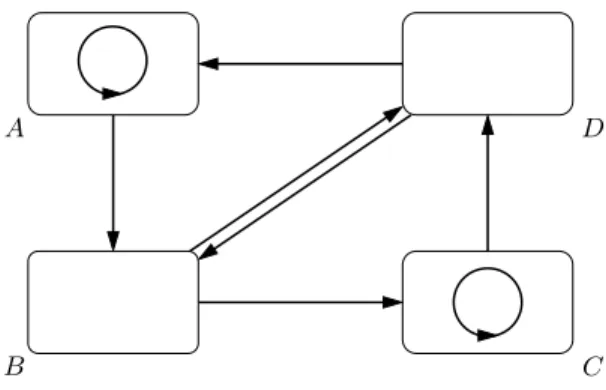
from the disjoint union of two regular tournamentsAandC onm vertices, a setB ofm+ 2 vertices and a set D of m+ 1 vertices by adding all edges fromA to B, all edges from B to C, all edges from C to D as well as all edges from D to A. Finally, between B and D we add edges to obtain a bipartite tournament which is as regular as possible, i.e. the in-and outdegree of every vertex differ by at most 1. So in particular every vertex inB sends exactly (m+ 1)/2 edges toD (Figure 1).
It is easy to check that the minimum semi-degree ofGis (m−1)/2 + (m+ 1) = (3n−5)/8, as required. Since every path which joins two vertices inB has to pass throughD, it follows
A
B C
D
Figure 1. The oriented graph in the proof of Proposition 2.1.
that every cycle contains at least as many vertices from D as it contains from B. As
|B|> |D| this means that one cannot cover all the vertices of G by disjoint cycles, i.e. G
does not contain a 1-factor.
3. The Diregularity lemma, the Blow-up lemma and other tools
3.1. The Diregularity lemma and the Blow-up lemma. In this section we collect all the information we need about the Diregularity lemma and the Blow-up lemma. See [16] for a survey on the Regularity lemma and [14] for a survey on the Blow-up lemma. We start with some more notation. The density of a bipartite graphG= (A, B) with vertex classesA and B is defined to be
dG(A, B) :=
eG(A, B)
|A| |B| .
We often write d(A, B) if this is unambiguous. Given ε > 0, we say that G is ε-regular
if for all subsets X ⊆ A and Y ⊆ B with |X| > ε|A| and |Y| > ε|B| we have that
|d(X, Y)−d(A, B)| < ε. Given d ∈ [0,1] we say that G is (ε, d)-super-regular if it is ε-regular and furthermore dG(a) ≥ (d−ε)|B| for all a ∈ A and dG(b) ≥ (d−ε)|A| for all
b∈B. (This is a slight variation of the standard definition of (ε, d)-super-regularity where one requiresdG(a)≥d|B|and dG(b)≥d|A|.)
The Diregularity lemma is a version of the Regularity lemma for digraphs due to Alon and Shapira [1]. Its proof is quite similar to the undirected version. We will use the degree form of the Diregularity lemma which can be easily derived (see e.g. [24]) from the standard version, in exactly the same manner as the undirected degree form.
Lemma 3.1 (Degree form of the Diregularity lemma). For every ε ∈ (0,1) and every integer M′ there are integers M and n
0 such that if G is a digraph on n≥n0 vertices and
d∈[0,1]is any real number, then there is a partition of the vertices ofGinto V0, V1, . . . , Vk,
a spanning subdigraph G′ of G and a set U of ordered pairs V
iVj (where 1 ≤ i, j ≤ k and
i6=j) such that the following holds: • M′ ≤k≤M,
• |V0| ≤εn,
• |V1|=· · ·=|Vk|=:m,
• d+G′(x)> d
+
• d−G′(x)> d −
G(x)−(d+ε)nfor all vertices x∈G,
• |U| ≤εk2,
• for every ordered pair ViVj ∈/ U with 1 ≤ i, j ≤ k and i 6= j the bipartite graph
(Vi, Vj)G whose vertex classes are Vi andVj and whose edge set is the set EG(Vi, Vj)
of all the Vi-Vj edges in Gis ε-regular,
• G′ is obtained from G by deleting the following edges of G: all edges with both endvertices in Vi for all i≥1 as well as all edges in EG(Vi, Vj) for all ViVj ∈U and
for all those ViVj ∈/ U with 1≤i, j≤k and i6=j for which the density of (Vi, Vj)G
is less than d.
V1, . . . , Vk are called clusters, V0 is called the exceptional set and the vertices in V0 are
calledexceptional vertices. U is called the set ofexceptional pairs of clusters. Note that the last two conditions of the lemma imply that for all 1 ≤ i, j ≤ k with i 6= j the bipartite graph (Vi, Vj)G′ isε-regular and has density either 0 or density at leastd. In particular, inG′
all pairs of clusters are ε-regular in both directions (but possibly with different densities). We call the spanning digraph G′ ⊆ G given by the Diregularity lemma the pure digraph. Given clusters V1, . . . , Vk and the pure digraph G′, the reduced digraph R′ is the digraph
whose vertices areV1, . . . , Vk and in whichViVj is an edge if and only if G′ contains a Vi-Vj
edge. Note that the latter holds if and only if (Vi, Vj)G′ is ε-regular and has density at
leastd. It turns out thatR′inherits many properties ofG, a fact that is crucial in our proof.
However,R′ is not necessarily oriented even if the original digraphGis, but the next lemma shows that by discarding edges with appropriate probabilities one can go over to a reduced oriented graphR⊆R′ which still inherits many of the properties ofG. (d) will only be used in the proof of Theorem 1.4.
Lemma 3.2. For every ε ∈ (0,1) there exist integers M′ = M′(ε) and n
0 = n0(ε) such
that the following holds. Let d ∈ [0,1] and let G be an oriented graph of order at least n0
and let R′ be the reduced digraph and U the set of exceptional pairs of clusters obtained by applying the Diregularity lemma toGwith parameters ε,dandM′. ThenR′ has a spanning oriented subgraph R with
(a) δ+(R)≥(δ+(G)/|G| −(3ε+d))|R|,
(b) δ−(R)≥(δ−(G)/|G| −(3ε+d))|R|,
(c) δ(R)≥(δ(G)/|G| −(3ε+ 2d))|R|,
(d) if 2ε≤d≤1−2ε andc≥0 is such thatd+(x) +d−(y)≥c|G|whenever xy /∈E(G)
then d+R(Vi) +d−R(Vj)≥(c−6ε−2d)|R| whenever ViVj ∈/ E(R)∪U.
Proof. Let us first show that every cluster Vi satisfies
(1) |NR′(Vi)|/|R′| ≥δ(G)/|G| −(3ε+ 2d).
To see this, consider any vertex x∈Vi. AsGis an oriented graph, the Diregularity lemma
implies that|NG′(x)| ≥δ(G)−2(d+ε)|G|. On the other hand,|NG′(x)| ≤ |NR′(Vi)|m+|V0| ≤
|NR′(Vi)||G|/|R′|+ε|G|. Altogether this proves (1).
We first consider the case when
(2) δ+(G)/|G| ≥3ε+d and δ−(G)/|G| ≥3ε+d and c≥6ε+ 2d.
Let R be the spanning oriented subgraph obtained from R′ by deleting edges randomly as
follows. For every unordered pairVi, Vj of clusters we delete the edgeViVj (if it exists) with
probability
(3) eG′(Vj, Vi)
eG′(Vi, Vj) +eG′(Vj, Vi)
Otherwise we delete VjVi (if it exists). We interpret (3) as 0 ifViVj, VjVi∈/ E(R′). So if R′
contains at most one of the edgesViVj, VjVi then we do nothing. We do this for all unordered
pairs of clusters independently and letXi be the random variable which counts the number
of outedges of the vertexVi∈R. Then E(Xi) =X
j6=i
eG′(Vi, Vj)
eG′(Vi, Vj) +eG′(Vj, Vi) ≥ X
j6=i
eG′(Vi, Vj)
|Vi| |Vj|
≥ |R ′| |G| |Vi|
X
x∈Vi
(d+G′(x)− |V0|)
(4)
≥(δ+(G′)/|G| −ε)|R| ≥(δ+(G)/|G| −(2ε+d))|R|(2)≥ ε|R|.
A Chernoff-type bound (see e.g. [2, Cor. A.14]) now implies that there exists a constantβ = β(ε) such that
P(Xi <(δ+(G)/|G| −(3ε+d))|R|)≤P(|Xi−E(Xi)|> εE(Xi))
≤e−βE(Xi)≤e−βε|R|.
WritingYifor the random variable which counts the number of inedges of the vertexVi inR,
it follows similarly that
P(Yi <(δ−(G)/|G| −(3ε+d))|R|)≤e−βε|R|.
Suppose that c is as in (d). Consider any pair ViVj ∈/ U of clusters such that either ViVj ∈/
E(R′) or ViVj, VjVi ∈ E(R′). (Note that each ViVj ∈/ E(R) ∪U satisfies one of these
properties.) As before, let Xi be the random variable which counts the number of outedges
of Vi inR and letYj be the number of inedges of Vj inR. Similary as in (4) one can show
that
(5) E(Xi+Yj)≥ |R
′| |G| |Vi|
X
x∈Vi
(d+G′(x)− |V0|) + X
y∈Vj
(d−G′(y)− |V0|)
.
To estimate this, we will first show that there is a setM of at least (1−ε)|Vi|disjoint pairs
(x, y) withx∈Vi,y ∈Vj and such that xy /∈E(G). Suppose first thatViVj, VjVi ∈E(R′).
But then (Vj, Vi)G isε-regular of density at least d and thus it contains a matching of size
at least (1−ε)|Vi|. As G is oriented this matching corresponds to a set M as required. If
ViVj ∈/ E(R′) then (Vi, Vj)G is ε-regular of density less than d (since ViVj ∈/ U). Thus the
complement of (Vi, Vj)G is ε-regular of density at least 1−dand so contains a matching of
size at least (1−ε)|Vi| which again corresponds to a setM as required. Together with (5)
this implies that
E(Xi+Yj)≥ |R
′| |G| |Vi|
X
(x,y)∈M
(d+G′(x) +d−G′(y)−2|V0|)
≥ |R ′| |G| |Vi|
(c−2(ε+d)−2ε)|G|(1−ε)|Vi| ≥(c−(5ε+ 2d))|R| (2)
≥ ε|R|. Similarly as before a Chernoff-type bound implies that
P(Xi+Yj <(c−(6ε+ 2d))|R|)≤e−βε|R|.
As 2|R|2e−βε|R|<1 if M′ is chosen to be sufficiently large compared to ε, this implies that
cluster Vi and so (1) implies that δ(R) ≥(δ(G)/|G| −(3ε+ 2d))|R|. Altogether this shows
thatR is as required in the lemma.
If neither of the conditions in (2) hold, then (a), (b) and (d) are trivial and one can obtain an oriented graph R which satisfies (c) fromR′ by arbitrarily deleting one edge from each double edge. If for example only the first of the conditions in (2) holds, then (b) and (d) are trivial. To obtain an oriented graphR which satisfies (a) we consider the Xi as before,
but ignore the Yi and the sums Xi+Yj. Again, NR′(Vi) =NR(Vi) for every cluster Vi and
so (c) is also satisfied. The other cases are similar.
The oriented graph R given by Lemma 3.2 is called the reduced oriented graph. The spanning oriented subgraph G∗ of the pure digraph G′ obtained by deleting all the Vi-Vj
edges whenever ViVj ∈ E(R′)\E(R) is called the pure oriented graph. Given an oriented
subgraph S ⊆ R, the oriented subgraph of G∗ corresponding to S is the oriented subgraph
obtained fromG∗ by deleting all those vertices that lie in clusters not belonging to S as well as deleting all the Vi-Vj edges for all pairs Vi, Vj withViVj ∈/ E(S).
In our proof of Theorem 1.3 we will also need the Blow-up lemma. Roughly speaking, it states the following. Let F be a graph on r vertices, let K be a graph obtained fromF by replacing each vertex ofF with a cluster and replacing each edge with a complete bipartite graph between the corresponding clusters. DefineGsimilarly except that the edges ofF now correspond to denseε-super-regular pairs. Then every subgraphH ofK which has bounded maximum degree is also a subgraph in G. In the original version of Koml´os, S´ark¨ozy and Szemer´edi [15]εhas to be sufficiently small compared to 1/r (and so in particular we cannot take r=|R|). We will use a stronger (and more technical) version due to Csaba [6], which allows us to take r =|R| and does not demand super-regularity. The case when ∆ = 3 of this is implicit in [7].
In the statement of Lemma 3.3 and later on we write 0< a1 ≪ a2 ≪ a3 to mean that
we can choose the constantsa1, a2, a3 from right to left. More precisely, there are increasing
functionsf and gsuch that, given a3, whenever we choose somea2 ≤f(a3) anda1 ≤g(a2),
all calculations needed in the proof of Lemma 3.3 are valid. Hierarchies with more constants are defined in the obvious way.
Lemma 3.3 (Blow-up Lemma, Csaba [6]). For all integers∆, K1, K2, K3 and every positive
constant cthere exists an integerN such that whenever ε, ε′, δ′, dare positive constants with
0< ε≪ε′ ≪δ′ ≪d≪1/∆,1/K1,1/K2,1/K3, c
the following holds. Suppose that G∗ is a graph of ordern≥N and V0, . . . , Vk is a partition
of V(G∗) such that the bipartite graph (Vi, Vj)G∗ is ε-regular with density either 0 or d for all1≤i < j ≤k. Let H be a graph on n vertices with ∆(H)≤∆and letL0∪L1∪ · · · ∪Lk
be a partition of V(H) with |Li|=|Vi| =: m for every i= 1, . . . , k. Furthermore, suppose
that there exists a bijection φ:L0 →V0 and a setI ⊆V(H)of vertices at distance at least 4
from each other such that the following conditions hold:
(C1) |L0|=|V0| ≤K1dn.
(C2) L0⊆I.
(C3) Li is independent for everyi= 1, . . . , k.
(C4) |NH(L0)∩Li| ≤K2dm for everyi= 1, . . . , k.
(C5) For each i = 1, . . . , k there exists Di ⊆ I ∩Li with |Di| = δ′m and such that for
D:=Sk
i=1Di and all 1≤i < j ≤k
(C6) If xy ∈ E(H) and x ∈ Li, y ∈ Lj where i, j 6= 0 then (Vi, Vj)G∗ is ε-regular with density d.
(C7) If xy∈E(H) and x∈L0, y ∈Lj then |NG∗(φ(x))∩Vj| ≥cm.
(C8) For each i = 1, . . . , k, given any Ei ⊆ Vi with |Ei| ≤ ε′m there exists a set Fi ⊆
(Li ∩(I \D)) and a bijection φi : Ei → Fi such that |NG∗(v) ∩Vj| ≥ (d−ε)m whenever NH(φi(v))∩Lj =6 ∅ (for all v∈Ei and all j= 1, . . . , k).
(C9) Writing F :=Sk
i=1Fi we have that |NH(F)∩Li| ≤K3ε′m.
Then G∗ contains a copy of H such that the image of Li is Vi for all i = 1, . . . , k and the
image of each x∈L0 is φ(x)∈V0.
The additional properties of the copy ofH inG∗ are not included in the statement of the
lemma in [6] but are stated explicitly in the proof.
Let us briefly motivate the conditions of the Blow-up lemma. The embedding ofH intoG guaranteed by the Blow-up lemma is found by a randomized algorithm which first embeds each vertexx∈L0toφ(x) and then successively embeds the remaining vertices ofH. So the
image of L0 will be the exceptional set V0. Condition (C1) requires that there are not too
many exceptional vertices and (C2) ensures that we can embed the vertices in L0 without
affecting the neighbourhood of other such vertices. AsLi will be embedded intoVi we need
to have (C3). Condition (C5) gives us a reasonably large setDof ‘buffer vertices’ which will be embedded last by the randomized algorithm. (C6) requires that edges between vertices ofH−L0 are embedded into ε-regular pairs of densityd. (C7) ensures that the exceptional
vertices have large degree in all ‘neighbouring clusters’. (C8) and (C9) allow us to embed those vertices whose set of candidate images in G∗ has grown very small at some point of the algorithm. Conditions (C6), (C8) and (C9) correspond to a substantial weakening of the super-regularity that the usual form of the Blow-up lemma requires, namely that wheneverH contains an edgexy with andx∈Li, y ∈Lj then (Vi, Vj)G∗ is (ε, d)-super-regular.
We would like to apply the Blow-up lemma with G∗ being obtained from the underlying
graph of the pure oriented graph by adding the exceptional vertices. It will turn out that in order to satisfy (C8), it suffices to ensure that all the edges of a suitable 1-factor in the reduced oriented graph R correspond to (ε, d)-superregular pairs of clusters. A well-known simple fact (see the first part of the proof of Proposition 3.4) states that this can be ensured by removing a small proportion of vertices from each cluster Vi, and so (C8) will
be satisfied. However, (C6) requires all the edges of R to correspond to ε-regular pairs of density precisely d and not just at least d. (As remarked by Csaba [6], it actually suffices that the densities are close to din terms of ε.) The second part of the following proposition shows that this too does not pose a problem.
Proposition 3.4. Let M′, n
0, D be integers and let ε, d be positive constants such that
1/n0 ≪ 1/M′ ≪ ε ≪ d ≪ 1/D. Let G be an oriented graph of order at least n0. Let R
be the reduced oriented graph and let G∗ be the pure oriented graph obtained by successively applying first the Diregularity lemma with parameters ε,dandM′toGand then Lemma 3.2. Let S be an oriented subgraph of R with ∆(S)≤D. Let G′ be the underlying graph of G∗. Then one can delete 2Dε|Vi| vertices from each cluster Vi to obtain subclusters Vi′ ⊆Vi in
such a way that G′ contains a subgraph G′S whose vertex set is the union of all the Vi′ and such that
• (V′
i, Vj′)G′ S is(
√
ε, d−4Dε)-superregular whenever ViVj ∈E(S),
• (V′
i, Vj′)G′ S is
√
ε-regular and has density d−4Dε whenever ViVj ∈E(R).
Proof. Consider any cluster Vi ∈ V(S) and any neighbour Vj of Vi in S. Recall that
andVj. Sodij ≥dand this bipartite graph isε-regular. Thus there are at most 2εmvertices
v ∈Vi such that ||NG′(v)∩Vj| −dijm|> εm. So in total there are at most 2Dεm vertices
v ∈Vi such that ||NG′(v)∩Vj| −dijm|> εm for some neighbour Vj of Vi in S. Delete all
these vertices as well as some more vertices if necessary to obtain a subclusterVi′⊆Vi of size
(1−2Dε)m=:m′. Delete any 2Dεmvertices from each cluster V
i∈V(R)\V(S) to obtain
a subclusterVi′. It is easy to check that for each edge ViVj ∈E(R) the graph (Vi′, Vj′)G′ is
still 2ε-regular and that its densityd′ij satisfies
d′ :=d−4Dε < dij−ε≤d′ij ≤dij+ε.
Moreover, wheneverViVj ∈E(S) and v∈Vi′ we have that
(dij−4Dε)m′ ≤ |NG′(v)∩Vj′| ≤(dij+ 4Dε)m′.
For every pair Vi, Vj of clusters with ViVj ∈ E(S) we now consider a spanning random
subgraphG′ij of (Vi′, Vj′)G′ which is obtained by choosing each edge of (Vi′, Vj′)G′ with
prob-ability d′/d′ij, independently of the other edges. Consider any vertex v ∈ Vi′. Then the expected number of neighbours ofvinVj′ (in the graphG′ij) is at least (dij−4Dε)d′m′/d′ij ≥
(1−√ε)d′m′. So we can apply a Chernoff-type bound to see that there exists a constant c=c(ε) such that
P(|NG′
ij(v)∩V ′
j| ≤(d′−
√
ε)m′)≤e−cd′m′. Similarly, whenever X⊆V′
i andY ⊆Vj′ are sets of size at least 2εm′ the expected number
of X-Y edges in G′
ij is dG′(X, Y)d′|X||Y|/d′ij. Since (Vi′, Vj′)G′ is 2ε-regular this expected
number lies between (1−√ε)d′|X||Y|and (1+√ε)d′|X||Y|. So again we can use a Chernoff-type bound to see that
P(|eG′
ij(X, Y)−d
′|X||Y||>√ε|X||Y|)≤e−cd′|X||Y|
≤e−4cd′(εm′)2.
Moreover, with probability at least 1/(3m′) the graph G′ij has its expected density d′ (see e.g. [4, p. 6]). Altogether this shows that with probability at least
1/(3m′)−2m′e−cd′m′ −22m′e−4cd′(εm′)2 >0
we have thatG′ij is (√ε, d′)-superregular and has densityd′. Proceed similarly for every pair of clusters forming an edge of S. An analogous argument applied to a pairVi, Vj of clusters
withViVj ∈E(R)\E(S) shows that with non-zero probability the random subgraphG′ij is
√
ε-regular and has densityd′. Altogether this gives us the desired subgraphG′
S ofG′.
3.2. Overview of the proof of Theorem 1.3. LetG be our given oriented graph. The rough idea of the proof is to apply the Diregularity lemma and Lemma 3.2 to obtain a reduced oriented graph R and a pure oriented graph G∗. The following result of H¨aggkvist implies that R contains a 1-factor.
Theorem 3.5 (H¨aggkvist [10]). Let R be an oriented graph with δ∗(R) > (3|R| −3)/2. Then R is strongly connected and contains a 1-factor.
So one can apply the Blow-up lemma (together with Proposition 3.4) to find a 1-factor in G∗−V0 ⊆ G−V0. One now would like to glue the cycles of this 1-factor together and
to incorporate the exceptional vertices to obtain a Hamilton cycle of G∗ and thus of G.
However, we were only able to find a method which incorporates a set of vertices whose size is small compared to the cluster size m. This is not necessarily the case for V0. So we
proceed as follows. We first choose a random partition of the vertex set ofGinto two setsA and V(G)\A having roughly equal size. We then apply the Diregularity lemma to G−A
in order to obtain clustersV1, . . . , Vk and an exceptional setV0. We letm denote the size of
these clusters and setB :=V1∪. . . Vk. By arguing as indicated above, we can find a Hamilton
cycleCB inG[B]. We then apply the Diregularity lemma to G−B, but with an εwhich is
small compared to 1/k, to obtain clusters V1′, . . . , Vℓ′ and an exceptional set V0′. Since the choice of our partitionA, V(G)\Awill imply thatδ∗(G−B)≥(3/2+α/2)|G−B|we can again
argue as before to obtain a cycleCAwhich covers precisely the vertices inA′:=V1′∪· · · ∪Vℓ′.
Since we have chosenεto be small compared to 1/k, the setV′
0 of exceptional vertices is now
small enough to be incorporated into our first cycle CB. (Actually, CB is only determined
at this point and not yet earlier on.) Moreover, by choosing CB and CA suitably we can
ensure that they can be joined together into the desired Hamilton cycle ofG. 4. Shifted Walks
In this section we will introduce the tools we need in order to glue certain cycles together and to incorporate the exceptional vertices. Let R∗ be a digraph and let C be a collection
of disjoint cycles in R∗. We call a closed walkW inR∗ balanced w.r.t. Cif
• for each cycle C ∈ C the walk W visits all the vertices on C an equal number of times,
• W visits every vertex of R∗,
• every vertex not in any cycle fromC is visited exactly once.
Let us now explain why balanced walks are helpful in order to incorporate the exceptional vertices. Suppose that C is a 1-factor of the reduced oriented graph R and that R∗ is obtained from R by adding all the exceptional vertices v ∈ V0 and adding an edge vVi
(where Vi is a cluster) whenever v sends edges to a significant proportion of the vertices
inVi, say we addvVi whenever v sends at leastcm edges to Vi. (Recall that m denotes the
size of the clusters.) The edges inR∗ of the formV
ivare defined in a similar way. LetGc be
the oriented graph obtained from the pure oriented graphG∗ by making all the non-empty bipartite subgraphs between the clusters complete (and orienting all the edges between these clusters in the direction induced byR) and adding the vertices inV0 as well as all the edges
of G between V0 and V(G−V0). Suppose that W is a balanced closed walk in R∗ which
visits all the vertices lying on a cycleC∈ C preciselymC ≤m times. Furthermore, suppose
that|V0| ≤cm/2 and that the vertices in V0 have distance at least 3 from each other onW.
Then by ‘winding around’ each cycle C∈ C precisely m−mC times (at the point whenW
first visitsC) we can obtain a Hamilton cycle inGc. Indeed, the two conditions onV
0 ensure
that the neighbours of each v ∈ V0 on the Hamilton cycle can be chosen amongst the at
least cm neighbours of v in the neighbouring clusters of v on W in such a way that they are distinct for different exceptional vertices. The idea then is to apply the Blow-up lemma to show that this Hamilton cycle corresponds to one in G. So our aim is to find such a balanced closed walk in R∗. However, as indicated in Section 3.2, the difficulties arising when trying to ensure that the exceptional vertices lie on this walk will force us to apply the above argument to the subgraphs induced by a random partition of our given oriented graphG.
Let us now go back to the case when R∗ is an arbitrary digraph and C is a collection of disjoint cycles inR∗. Given verticesa, b∈R∗, a shifted a-bwalk is a walk of the form
W =aa1C1b1a2C2b2. . . atCtbtb
where C1, . . . , Ct are (not necessarily distinct) cycles from C and ai is the successor of bi
on Ci for all i ≤ t. (We might have t = 0. So an edge ab is a shifted a-b walk.) We
not distinct, we say that W traverses t cycles. Note that for every cycle C ∈ C the walk W − {a, b} visits the vertices onC an equal number of times. Thus it will turn out that by joining the cycles from C suitably via shifted walks and incorporating those vertices of R∗ not covered by the cycles fromC we can obtain a balanced closed walk on R∗.
Our next lemma will be used to show that if R∗ is oriented and δ∗(R∗) ≥(3/2 +α)|R∗|
then any two vertices of R∗ can be joined by a shifted walk traversing only a small number of cycles from C (see Corollary 4.3). The lemma itself shows that the δ∗ condition implies
expansion, and this will give us the ‘expansion with respect to shifted neighbourhoods’ we need for the existence of shifted walks. The proof of Lemma 4.1 is similar to that of Theorem 3.5.
Lemma 4.1. LetR∗ be an oriented graph onN vertices withδ∗(R∗)≥(3/2 +α)N for some
α >0. If X ⊆V(R∗) is nonempty and |X| ≤(1−α)N then |N+(X)| ≥ |X|+αN/2.
Proof. For simplicity, we writeδ :=δ(R∗), δ+ :=δ+(R∗) and δ−:=δ−(R∗). Suppose the assertion is false, i.e. there exists X⊆V(R∗) with|X| ≤(1−α)N and
(6)
N+(X)
<|X|+αN/2.
We consider the following partition ofV(R∗):
A:=X∩N+(X), B :=N+(X)\X, C :=V(R∗)\(X∪N+(X)), D:=X\N+(X). (6) gives us
(7) |D|+αN/2>|B|.
Suppose A 6= ∅. Then by an averaging argument there exists x ∈ A with |N+(x)∩A| <
|A|/2. Hence δ+≤ |N+(x)|<|B|+|A|/2.Combining this with (7) we get
(8) |A|+|B|+|D| ≥2δ+−αN/2.
IfA=∅thenN+(X) =B and so (7) implies|D|+αN/2≥ |B| ≥δ+. Thus (8) again holds.
Similarly, if C6=∅ then considering the inneighbourhood of a suitable vertex x∈C gives (9) |B|+|C|+|D| ≥2δ−−αN/2.
If C =∅ then the fact that |X| ≤(1−α)N and (6) together imply thatD6=∅. But then N−(D) ⊆ B and thus |B| ≥ δ−. Together with (7) this shows that (9) holds in this case
too.
If D = ∅ then trivially |A|+|B|+|C| = N ≥ δ. If not, then for any x ∈ D we have N(x)∩D=∅ and hence
(10) |A|+|B|+|C| ≥ |N(x)| ≥δ. Combining (8), (9) and (10) gives
3|A|+ 4|B|+ 3|C|+ 2|D| ≥2δ−+ 2δ++ 2δ−αN = 2δ∗(R∗)−αN. Finally, substituting (7) gives
3N +αN/2≥2δ∗(R∗)−αN ≥3N +αN,
As indicated before, we will now use Lemma 4.1 to prove the existence of shifted walks in R∗ traversing only a small number of cycles from a given 1-factor of R∗. For this (and
later on) the following fact will be useful.
Fact 4.2. Let G be an oriented graph with δ∗(G)≥(3/2 +α)|G| for some constant α > 0. Then δ0(G)> α|G|.
Proof. Suppose that δ−(G) ≤α|G|. As Gis oriented we have that δ+(G) <|G|/2 and so
δ∗(G)<3n/2 +α|G|, a contradiction. The proof forδ+(G) is similar. Corollary 4.3. Let R∗ be an oriented graph on N vertices with δ∗(R∗) ≥ (3/2 +α)N for some α >0 and letC be a1-factor in R∗. Then for any distinct x, y∈V(R∗) there exists a shifted x-y walk traversing at most 2/α cycles from C.
Proof. LetXi be the set of verticesv for which there is a shiftedx-vwalk which traverses
at most icycles. So X0 =N+(x) 6=∅ and Xi+1 =N+(Xi−)∪Xi, where Xi− is the set of
all predecessors of the vertices in Xi on the cycles from C. Suppose that |Xi| ≤ (1−α)N.
Then Lemma 4.1 implies that
|Xi+1| ≥ |N+(Xi−)| ≥ |X
−
i |+αN/2 =|Xi|+αN/2.
So fori∗ :=⌊2/α⌋−1, we must have|Xi−∗|=|Xi∗| ≥(1−α)N. But|N−(y)| ≥δ−(R∗)> αN
and so N−(y)∩X−
i∗ 6=∅. In other words, y ∈ N+(Xi−∗) and so there is a shiftedx-y walk
traversing at mosti∗+ 1 cycles.
Corollary 4.4. LetR∗ be an oriented graph with δ∗(R∗)≥(3/2 +α)|R∗|for some0< α≤
1/6 and let Cbe a 1-factor inR∗. Then R∗ contains a closed walk which is balanced w.r.t.C and meets every vertex at most|R∗|/αtimes and traverses each edge lying on a cycle fromC at least once.
Proof. LetC1, . . . , Cs be an arbitrary ordering of the cycles inC. For each cycleCi pick a
vertex ci∈Ci. Denote byc+i the successor ofci on the cycle Ci. Corollary 4.3 implies that
for all ithere exists a shifted ci-c+i+1 walk Wi traversing at most 2/α cycles from C, where
cs+1:=c1. Then the closed walk
W′:=c+1C1c1W1c+2C2c2. . . Ws−1c+sCscsWsc+1
is balanced w.r.t. C by the definition of shifted walks. Since each shifted walk Wi traverses
at most 2/α cycles of C, the closed walk W meets each vertex at most (|R∗|/3)(2/α) + 1 times. Let W denote the walk obtained from W′ by ‘winding around’ each cycle C ∈ C once more. (That is, for each C∈ C pick a vertexv onC and replace one of the occurences of v onW′ byvCv.) ThenW is still balanced w.r.t.C, traverses each edge lying on a cycle fromC at least once and visits each vertex of R∗ at most (|R∗|/3)(2/α) + 2≤ |R∗|/αtimes
as required.
5. Proof of Theorem 1.3
5.1. Partitioning G and applying the Diregularity lemma. Let G be an oriented graph on n vertices with δ∗(G) ≥ (3/2 +α)n for some constant α > 0. Clearly we may assume that α≪1. Define positive constants ε, d and integersMA′, MB′ such that
Throughout this section, we will assume thatnis sufficiently large compared toMA′ for our estimates to hold. Choose a subsetA⊆V(G) with (1/2−ε)n≤ |A| ≤(1/2 +ε)n and such that every vertexx∈Gsatisfies
d+(x)
n − α 10 ≤
|N+(x)∩A|
|A| ≤
d+(x)
n + α 10
and such that N−(x)∩ A satisfies a similar condition. (The existence of such a set A can be shown by considering a random partition of V(G).) Apply the Diregularity lemma (Lemma 3.1) with parameters ε2, d+ 8ε2 and MB′ to G−A to obtain a partition of the vertex set of G−A into k ≥ M′
B clusters V1, . . . , Vk and an exceptional set V0. Set B :=
V1∪. . .∪Vk and mB := |V1| = · · · = |Vk|. Let RB denote the reduced oriented graph
obtained by an application of Lemma 3.2 and let G∗
B be the pure oriented graph. Since
δ+(G−A)/|G−A| ≥δ+(G)/n−α/9 by our choice of A, Lemma 3.2 implies that (11) δ+(RB)≥(δ+(G)/n−α/8)|RB|.
Similarly
(12) δ−(RB)≥(δ−(G)/n−α/8)|RB|
and δ(RB)≥(δ(G)/n−α/4)|RB|. Altogether this implies that
(13) δ∗(RB)≥(3/2 +α/2)|RB|.
So Theorem 3.5 gives us a 1-factorCB ofRB. We now apply Proposition 3.4 withCBplaying
the role of S, ε2 playing the role of ε and d+ 8ε2 playing the role of d. This shows that
by adding at most 4ε2nfurther vertices to the exceptional set V0 we may assume that each
edge of RB corresponds to an ε-regular pair of density d (in the underlying graph of G∗B)
and that each edge in the unionS
C∈CBC ⊆RB of all the cycles fromCB corresponds to an
(ε, d)-superregular pair. (More formally, this means that we replace the clusters with the subclusters given by Proposition 3.4 and replace G∗B with its oriented subgraph obtained by deleting all edges not corresponding to edges of the graphG′
CB given by Proposition 3.4,
i.e. the underlying graph of G∗
B will now be G′CB.) Note that the new exceptional set now
satisfies|V0| ≤εn.
Apply Corollary 4.4 with R∗ := R
B to find a closed walk WB in RB which is balanced
w.r.t. CB, meets every cluster at most 2|RB|/αtimes and traverses all the edges lying on a
cycle fromCB at least once.
LetGc
B be the oriented graph obtained fromG∗B by adding all theVi-Vj edges for all those
pairsVi, Vj of clusters withViVj ∈E(RB). Since 2|RB|/α≪mB, we could makeWB into a
Hamilton cycle of Gc
B by ‘winding around’ each cycle from CB a suitable number of times.
We could then apply the Blow-up lemma to show that this Hamilton cycle corresponds to one in G∗
B. However, as indicated in Section 3.2, we will argue slightly differently as it is
not clear how to incorporate all the exceptional vertices by the above approach.
Set εA := ε/|RB|. Apply the Diregularity lemma with parameters ε2A, d+ 8ε2A and MA′
to G[A ∪V0] to obtain a partition of the vertex set of G[A∪V0] into ℓ ≥ MA′ clusters
V1′, . . . , Vℓ′ and an exceptional set V0′. Let A′ := V1′∪ · · · ∪Vℓ′, let RA denote the reduced
oriented graph obtained from Lemma 3.2 and let G∗
A be the pure oriented graph. Similarly
as in (13), Lemma 3.2 implies that δ∗(RA) ≥ (3/2 +α/2)|RA| and so, as before, we can
apply Theorem 3.5 to find a 1-factor CA of RA. Then as before, Proposition 3.4 implies
that by adding at most 4ε2Anfurther vertices to the exceptional setV0′ we may assume that each edge of RA corresponds to an εA-regular pair of density d and that each edge in the
C1 C2
U−
1
U1 U2
U+ 2
v
Wv
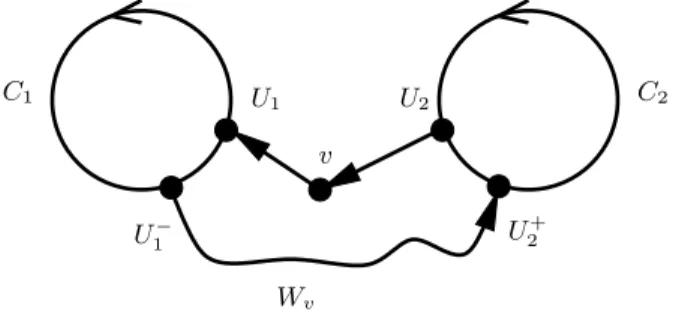
Figure 2. Incorporating the exceptional vertexv. union S
C∈CAC ⊆RA of all the cycles from CA corresponds to an (εA, d)-superregular pair.
So we now have that
(14) |V0′| ≤εAn=εn/|RB|.
Similarly as before, Corollary 4.4 gives us a closed walkWAinRAwhich is balanced w.r.t.CA,
meets every cluster at most 2|RA|/αtimes and traverses all the edges lying on a cycle fromCA
at least once.
5.2. Incorporating V0′ into the walk WB. Recall that the balanced closed walk WB
inRB corresponds to a Hamilton cycle inGcB. Our next aim is to extend this walk to one
which corresponds to a Hamilton cycle which also contains the vertices inV0′. (The Blow-up lemma will imply that the latter Hamilton cycle corresponds to one in G[B∪V′
0].) We do
this by extending WB into a walk on a suitably defined digraphR∗B ⊇RB with vertex set
V(RB)∪V0′ in such a way that the new walk is balanced w.r.t. CB. RB∗ is obtained from
the union of RB and the set V0′ by adding an edge vVi between a vertex v ∈ V0′ and a
cluster Vi ∈V(RB) whenever
NG+(v)∩Vi
> αmB/10 and adding the edge Viv whenever
NG−(v)∩Vi
> αmB/10. Thus
|NG+(v)∩B| ≤ |NR+∗
B(v)|mB+|RB|αmB/10.
Hence
|NR+∗
B(v)| ≥ |N
+
G(v)∩B|/mB−α|RB|/10≥ |NG+(v)∩B||RB|/|B| −α|RB|/10
≥(|NG+−A(v)| − |V0|)|RB|/|G−A| −α|RB|/10
≥(δ+(G)/n−α/2)|RB| ≥α|RB|/2.
(15)
(The penultimate inequality follows from the choice of A and the final one from Fact 4.2.) Similarly
|NR−∗
B(v)| ≥α|RB|/2.
Given a vertex v ∈ V′
0 pick U1 ∈ NR+∗
B(v), U2 ∈ N −
R∗
B(v)\{U1}. Let C1 and C2 denote the
cycles from CB containing U1 and U2 respectively. Let U1− be the predecessor ofU1 on C1,
andU2+ be the successor ofU2 on C2. (15) implies that we can ensureU1−6=U2+. (However,
we may have C1 =C2.) Corollary 4.3 gives us a shifted walkWv from U1−to U2+ traversing
at most 4/αcycles of CB. To incorporate v into the walkWB, recall that WB traverses all
those edges ofRB which lie on cycles fromCB at least once. Replace one of the occurences
of U1−U1 on WB with the walk
i.e. the walk that goes from U1− to U2+ along the shifted walk Wv, it then winds once
aroundC2but stops inU2, then it goes tovand further toU1, and finally it winds aroundC1.
The walk obtained from WB by includingv in this way is still balanced w.r.t. CB, i.e. each
vertex in RB is visited the same number of times as every other vertex lying on the same
cycle fromCB. We add the extra loop aroundC1because when applying the Blow-up lemma
we will need the vertices in V0′ to be at a distance of at least 4 from each other. Using this loop, this can be ensured as follows. After we have incorporated v into WB we ‘ban’ all
the 6 edges of (the new walk) WB whose endvertices both have distance at most 3 from v.
The extra loop ensures that every edge in each cycle from C has at least one occurence in WB which is not banned. (Note that we do not have to add an extra loop around C2
since ifC2 6=C1 then all the banned edges ofC2 lie on Wv′ but each edge ofC2 also occurs
on the original walk WB.) Thus when incorporating the next exceptional vertex we can
always pick an occurence of an edge which is not banned to be replaced by a longer walk. (When incorporating v we picked U1−U1.) Repeating this argument, we can incorporate all
the exceptional vertices inV0′ intoWB in such a way that all the vertices ofV0′have distance
at least 4 on the new walk WB.
Recall thatGc
B denotes the oriented graph obtained from the pure oriented graphG∗B by
adding all theVi-Vj edges for all those pairsVi, Vj of clusters withViVj ∈E(RB). LetGcB∪V′
0 denote the graph obtained from GcB by adding all the V0′-B edges of G as well as all the B-V0′ edges of G. Moreover, recall that the vertices inV0′ have distance at least 4 from each other onWB and|V0′| ≤εn/|RB| ≪αmB/20 by (14). As already observed at the beginning
of Section 4, altogether this shows that by winding around each cycle from CB, one can
obtain a Hamilton cycle Cc B∪V′
0 of G
c B∪V′
0 from the walk WB, provided that WB visits any clusterVi ∈RB at mostmB times. To see that the latter condition holds, recall that before
we incorporated the exceptional vertices in V′
0 into WB, each cluster was visited at most
2|RB|/αtimes. When incorporating an exceptional vertex we replaced an edge ofWB by a
walk whose interior visits every cluster at most 4/α+2≤5/αtimes. Thus the final walkWB
visits each cluster Vi∈RB at most
(16) 2|RB|/α+ 5|V0′|/α (14)
≤ 6εn/(α|RB|)≤√εmB
times. Hence we have the desired Hamilton cycle Cc B∪V′
0 of G
c B∪V′
0. Note that (16) implies that we can choose Cc
B∪V′
0 in such a way that for each cycle C ∈ CB there is subpath PC of Cc
B∪V′
0 which winds around C at least
(17) (1−√ε)mB
times in succession.
5.3. Applying the Blow-up lemma to find a Hamilton cycle in G[B ∪V′
0]. Our
next aim is to use the Blow-up lemma to show that Cc B∪V′
0 corresponds to a Hamilton cycle in G[B ∪V0′]. Recall that k= |RB| and that for each exceptional vertex v ∈V0′ the
outneighbour U1 of v on WB is distinct from its inneighbour U2 on WB. We will apply
the Blow-up lemma with H being the underlying graph of Cc B∪V′
0 and G
∗ being the graph
obtained from the underlying graph of G∗B by adding all the vertices v ∈ V0′ and joining each such v to all the vertices in NG+(v)∩U1 as well as to all the vertices in NG−(v)∩U2.
Recall that after applying the Diregularity lemma to obtain the clusters V1, . . . , Vk we used
Proposition 3.4 to ensure that each edge ofRB corresponds to anε-regular pair of densityd
(in the underlying graph of G∗B and thus also in G∗) and that each edge of the union
S
V0′ will play the role of V0 in the Blow-up lemma and we take L0, L1, . . . , Lk to be the
partition of H induced byV′
0, V1, . . . , Vk. φ:L0 →V0′ will be the obvious bijection (i.e. the
identity). To define the set I ⊆ V(H) of vertices of distance at least 4 from each other which is used in the Blow-up lemma, let PC′ be the subpath ofH corresponding toPC (for
all C ∈ CB). For each i = 1, . . . , k, let Ci ∈ CB denote the cycle containing Vi and let
Ji ⊆Li consist of all those vertices in Li∩V(PC′i) which have distance at least 4 from the
endvertices ofPC′i. Thus in the graphH each vertexu∈Ji has one of its neighbours in the
set L−i corresponding to the predecessor of Vi on Ci and its other neighbour in the set L+i
corresponding to the successor of Vi onCi. Moreover, all the vertices in Ji have distance at
least 4 from all the vertices inL0 and (17) implies that|Ji| ≥9mB/10. It is easy to see that
one can greedily choose a set Ii ⊆ Ji of size mB/10 such that the vertices in Ski=1Ii have
distance at least 4 from each other. We take I :=L0∪Ski=1Ii.
Let us now check conditions (C1)–(C9). (C1) holds with K1 := 1 since |L0| = |V0′| ≤
εAn=εn/k≤d|H|. (C2) holds by definition ofI. (C3) holds since H is a Hamilton cycle
in GcB∪V′
0 (c.f. the definition of the graph G
c B∪V′
0). This also implies that for every edge xy ∈H withx∈Li, y∈Lj (i, j≥1) we must have that ViVj ∈E(RB). Thus (C6) holds as
every edge of RB corresponds to anε-regular pair of clusters having densityd. (C4) holds
withK2 := 1 because
|NH(L0)∩Li| ≤2|L0|= 2
V0′
(14)
≤ 2εn/|RB| ≤5εmB ≤dmB.
For (C5) we need to find a setD⊆I of buffer vertices. Pick any setDi ⊆Iiwith|Di|=δ′mB
and letD:=Sk
i=1Di. SinceIi⊆Ji we have that|NH(D)∩Lj|= 2δ′mBfor allj= 1, . . . , k.
Hence
||NH(D)∩Li| − |NH(D)∩Lj||= 0
for all 1≤i < j≤kand so (C5) holds. (C7) holds withc:=α/10 by our choiceU1∈NR+∗ B(v)
andU2 ∈NR−∗
B(v) of the neighbours of each vertex v∈V ′
0 in the walkWB(c.f. the definition
of the graphR∗B).
(C8) and (C9) are now the only conditions we need to check. Given a setEi ⊆Vi of size
at most ε′mB, we wish to find Fi ⊆ (Li∩(I \D)) = Ii\D and a bijection φi :Ei → Fi
such that every v ∈Ei has a large number of neighbours in every cluster Vj for which Lj
contains a neighbour ofφi(v). Pick any set Fi ⊆Ii\Dof size |Ei|. (This can be done since
|D∩Ii|=δ′mBand so|Ii\D| ≥mB/10−δ′mB≫ε′mB.) Letφi :Ei →Fi be an arbitrary
bijection. To see that (C8) holds with these choices, consider any vertex v ∈Ei ⊆ Vi and
let j be such that Lj contains a neighbour of φi(v) in H. Since φi(v) ∈ Fi ⊆Ii ⊆Ji, this
means that Vj must be a neighbour of Vi on the cycle Ci ∈ CB containing Vi. But this
implies that |NG∗(v)∩Vj| ≥(d−ε)mB since each edge of the union SC∈CBC ⊆RB of all
the cycles from CB corresponds to an (ε, d)-superregular pair inG∗.
Finally, writingF :=Sk
i=1Fi we have
|NH(F)∩Li| ≤2ε′mB
(sinceFj ⊆Jj for eachj= 1, . . . , k) and so (C9) is satisfied withK3:= 2. Hence (C1)–(C9)
hold and so we can apply the Blow-up lemma to obtain a Hamilton cycle in G∗ such that the image ofLi is Vi for all i= 1, . . . , k and the image of each x ∈L0 isφ(x)∈V0. (Recall
that G∗ was obtained from the underlying graph of G∗B by adding all the vertices v ∈ V0′ and joining each such v to all the vertices in NG+(v)∩U1 as well as to all the vertices in
NG−(v)∩U2, where U1 and U2 are the neighbours of v on the walk WB.) Using the fact
thatH was obtained from the (directed) Hamilton cycle Cc B∪V′
v∈V0′, it is easy to see that our Hamilton cycle inG∗ corresponds to a (directed) Hamilton cycleCB in G[B∪V0′].
5.4. Finding a Hamilton cycle in G. The last step of the proof is to find a Hamilton cycle inG[A′] which can be connected withCBinto a Hamilton cycle ofG. Pick an arbitrary
edge v1v2 on CB and add an extra vertex v∗ to G[A′] with outneighbourhoodNG+(v1)∩A′
and inneighbourhood NG−(v2)∩A′. A Hamilton cycle CA in the digraph thus obtained
from G[A′] can be extended to a Hamilton cycle of Gby replacing v∗ withv2CBv1. To find
such a Hamilton cycle CA, we can argue as before. This time, there is only one exceptional
vertex, namely v∗, which we incorporate into the walk W
A. Note that by our choice of A
and B the analogue of (15) is satisfied and so this can be done as before. We then use the Blow-up lemma to obtain the desired Hamilton cycle CAcorresponding to this walk.
6. Proof of Theorem 1.4
The following observation guarantees that every oriented graph as in Theorem 1.4 has large minimum semidegree.
Fact 6.1. Suppose that0< α <1and thatGis an oriented graph such thatd+(x)+d−(y)≥
(3/4 +α)|G| whenever xy /∈E(G). Then δ0(G)≥ |G|/8 +α|G|/2.
Proof. Suppose not. We may assume that δ+(G)≤δ−(G). Pick a vertexx with d+(x) =
δ+(G). LetY be the set of all those verticesy withxy /∈E(G). Thus|Y| ≥7|G|/8−α|G|/2. Moreover, d−(y) ≥ (3/4 +α)|G| −d+(x) ≥ 5|G|/8 +α|G|/2. Hence e(G) ≥ |Y|(5|G|/8 +
α|G|/2) >35|G|2/64, a contradiction.
The proof of Theorem 1.4 is similar to that of Theorem 1.3. Fact 6.1 and Lemma 3.2 together imply that the reduced oriented graphRA(and similarlyRB) has minimum
semide-gree at least|R|/8 and it inherits the Ore-type condition fromG(i.e. it satisfies condition (d) of Lemma 3.2 with c = 3/4 +α). Together with Lemma 6.2 below (which is an analogue of Lemma 4.1) this implies that RA (and RB as well) is an expander in the sense that
|N+(X)| ≥ |X|+α|RA|/2 for all X ⊆ V(RA) with |X| ≤(1−α)|RA|. In particular, RA
(and similarly RB) has a 1-factor: To see this, note that the above expansion property
to-gether with Fact 6.1 imply that for any X ⊆ V(RA), we have |NR+A(X)| ≥ |X|. Together
with Hall’s theorem, this means that the following bipartite graphHhas a perfect matching: the vertex classesW1, W2 are 2 copies ofV(RA) and we have an edge inHbetweenw1 ∈W1
and w2∈W2 if there is an edge fromw1 to w2 inRA. But clearly a perfect matching in H
corresponds to a 1-factor in RA. Using these facts, one can now argue precisely as in the
proof of Theorem 1.3.
Lemma 6.2. Suppose that 0< ε≪α≪1. Let R∗ be an oriented graph on N vertices and let U be a set of at most εN2 ordered pairs of vertices of R∗. Suppose that d+(x) +d−(y)≥
(3/4 +α)N for all xy /∈ E(R∗)∪U. Then any X ⊆ V(R∗) with αN ≤ |X| ≤ (1−α)N satisfies |N+(X)| ≥ |X|+αN/2.
Proof. The proof is similar to that of Lemma 4.1. Suppose that Lemma 6.2 does not hold and letX ⊆V(R∗) withαN ≤ |X| ≤(1−α)N be such that
(18) N+(X)
<|X|+αN/2.
Call a vertex of R∗ good if it lies in at most√εN pairs fromU. Thus all but at most 2√εN vertices of R∗ are good. As in the proof of Lemma 4.1 we consider the following partition
of V(R∗):
(18) implies
(19) |D|+αN/2>|B|.
Suppose first that |D| > 2√εN. It is easy to see that there are vertices x 6= y in D such that xy, yx /∈ U. Since no edge of R∗ lies within D we have xy, yx /∈ E(R∗) and so d(x) +d(y)≥3N/2 + 2αN. In particular, at least one ofx, yhas degree at least 3N/4 +αN. But then
(20) |A|+|B|+|C| ≥3N/4 +αN.
If|D| ≤2√εN then|A|+|B|+|C| ≥N−|D|and so (20) still holds with room to spare. Note that (19) and (20) together imply that 2|A|+2|C| ≥3N/2+2αN−2|B| ≥3N/2−|B|−|D| ≥
N/2. Thus at least one ofA, C must have size at least N/8. In particular, this implies that one of the following 3 cases holds.
Case 1. |A|,|C|>2√εN.
Let A′ be the set of all good vertices in A. By an averaging argument there exists x ∈A′
with |N+(x)∩A′| < |A′|/2. Since N+(A) ⊆ A∪B this implies that |N+(x)| < |B|+
|A\A′|+|A′|/2. Let C′ ⊆ C be the set of all those vertices y ∈ C with xy /∈ U. Thus |C \C′| ≤ √εN since x is good. By an averaging argument there exists y ∈ C′ with
|N−(y)∩C′| < |C′|/2. But N−(C) ⊆ B ∪C and so |N−(y)| < |B|+|C \C′|+|C′|/2. Moreover,d+(x) +d−(y)≥3N/4 +αN sincexy /∈E(R∗)∪U. Altogether this shows that
|A′|/2 +|C′|/2 + 2|B| ≥d+(x) +d−(y)− |A\A′| − |C\C′| ≥3N/4 +αN/2. Together with (20) this implies that 3|A|+ 6|B|+ 3|C| ≥3N+ 3αN, which in turn together with (19) yields 3|A|+ 3|B|+ 3|C|+ 3|D| ≥3N + 3αN/2, a contradiction.
Case 2. |A|>2√εN and |C| ≤2√εN.
As in Case 1 we let A′ be the set of all good vertices in A and pick x∈A′ with|N+(x)|<
|B|+|A\A′|+|A′|/2. Note that (19) implies that|D|> N − |X| − |C| −αN/2 ≥√εN. Pick any y ∈ D such that xy /∈ U. Then xy /∈ E(R∗) since R∗ contains no edges from A
to D. Thusd+(x) +d−(y)≥3N/4 +αN. Moreover, N−(y)⊆B∪C. Altogether this gives
|A′|/2 + 2|B| ≥d+(x) +d−(y)− |A\A′| − |C| ≥3N/4 +αN/2. As in Case 1 one can combine this with (20) and (19) to get a contradiction. Case 3. |A| ≤2√εN and |C|>2√εN.
This time we letC′ be the set of all good vertices inC and picky∈C′ with|N−(y)∩C′|< |C′|/2. Hence |N−(y)|<|B|+|C\C′|+|C′|/2. Moreover, we must have |D|=|X| − |A|>
√
εN. Pick any x ∈ D such that xy /∈ U. Then xy /∈ E(R∗) since R∗ contains no edges from D to C. Thus d+(x) +d−(y)≥3N/4 +αN. Moreover, N+(x) ⊆A∪B. Altogether this gives
|C′|/2 + 2|B| ≥d+(x) +d−(y)− |A| − |C\C′| ≥3N/4 +αN/2,
which in turn yields a contradiction as before.
7. Acknowledgement
We are grateful to Peter Keevash for pointing out an argument for the ‘shifted expansion property’ which is simpler than the one presented in an earlier version of this manuscript.
References
[1] N. Alon and A. Shapira, Testing subgraphs in directed graphs, Journal of Computer and System Sci-ences 69(2004), 354–382.
[2] N. Alon and J. Spencer,The Probabilistic Method (2nd edition), Wiley-Interscience 2000. [3] J. Bang-Jensen and G. Gutin,Digraphs: Theory, Algorithms and Applications, Springer 2000. [4] B. Bollob´as,Random Graphs (2nd edition), Cambridge University Press 2001.
[5] B. Bollob´as and R. H¨aggkvist, Powers of Hamilton cycles in tournaments, J. Combin. Theory B 50
(1990), 309–318.
[6] B. Csaba, On the Bollob´as–Eldridge conjecture for bipartite graphs,Combin. Probab. Comput.16(2007),
661–691.
[7] B. Csaba, A. Shokoufandeh, and E. Szemer´edi, Proof of a conjecture of Bollob´as and Eldridge for graphs of maximum degree three,Combinatorica 23(2003), 35–72.
[8] A. Frieze and M. Krivelevich, On packing Hamilton cycles inε-regular graphs,J. Combin. Theory B94
(2005), 159–172.
[9] A. Ghouila-Houri, Une condition suffisante d’existence d’un circuit hamiltonien,C.R. Acad. Sci. Paris25
(1960), 495–497.
[10] R. H¨aggkvist, Hamilton cycles in oriented graphs,Combin. Probab. Comput.2(1993), 25–32.
[11] R. H¨aggkvist and A. Thomason, Oriented Hamilton cycles in oriented graphs, inCombinatorics, Geom-etry and Probability, Cambridge University Press 1997, 339–353.
[12] P. Keevash, D. K¨uhn and D. Osthus, An exact minimum degree condition for Hamilton cycles in oriented graphs, submitted.
[13] L. Kelly, D. K¨uhn and D. Osthus, Cycles of given length in oriented graphs, submitted. [14] J. Koml´os, The Blow-up lemma,Combin. Probab. Comput.8(1999), 161–176.
[15] J. Koml´os, G. N. S´ark¨ozy, and E. Szemer´edi, Blow-up lemma,Combinatorica 17(1997), 109–123.
[16] J. Koml´os and M. Simonovits, Szemer´edi’s Regularity Lemma and its applications in graph theory,Bolyai Society Mathematical Studies 2, Combinatorics, Paul Erd˝os is Eighty (Vol. 2)(D. Mikl´os, V. T. S´os and T. Sz˝onyi eds.), Budapest (1996), 295–352.
[17] D. K¨uhn, D. Osthus and A. Treglown, Hamiltonian degree sequences in digraphs, submitted.
[18] B. McKay, The asymptotic numbers of regular tournaments, Eulerian digraphs and Eulerian oriented graphs,Combinatorica 10(1990), 367–377.
[19] O. Ore, Note on Hamilton circuits,American Math. Monthly 67(1960), 55.
[20] C. Thomassen, Long cycles in digraphs with constraints on the degrees, in Surveys in Combinatorics
(B. Bollob´as ed.),London Math. Soc. Lecture Notes 38(1979), 211–228, Cambridge University Press.
[21] C. Thomassen, Long cycles in digraphs.Proc. London Math. Soc.42(1981), 231–251.
[22] C. Thomassen, Edge-disjoint Hamiltonian paths and cycles in tournaments,Proc. London Math. Soc.45
(1982), 151–168.
[23] D. Woodall, Sufficient conditions for cycles in digraphs,Proc. London Math Soc.24(1972), 739–755.
[24] A. Young, Extremal problems for dense graphs and digraphs, Master’s thesis, School of Mathematics, University of Birmingham 2005.
Luke Kelly, Daniela K¨uhn & Deryk Osthus School of Mathematics
University of Birmingham Edgbaston
Birmingham B15 2TT UK