Issue date: October 2009
Guide to the single
technology appraisal
process
© National Institute for Health and Clinical Excellence, 2009. All rights reserved. This material may be freely reproduced for educational and not-for-profit purposes. No reproduction by or for commercial organisations, or for commercial purposes, is allowed without the express written permission of NICE. ISBN 978-1-84936-104-0
Guide to the single technology appraisal process Issued: October 2009
This document is one of a series describing the processes and methods that NICE uses to undertake technology appraisals. For further information, please go to www.nice.org.uk It replaces the ‘Guide to the single technology appraisal (STA) process’ published in September 2006.
Nothing in this document shall restrict any disclosure of information by NICE that is required by law (including in particular, but without limitation, the Freedom of Information Act 2000).
The document is available from the NICE website (www.nice.org.uk) or from NICE
publications (phone 0845 003 7783 or email [email protected] and quote reference number N2021).
Contents
Acknowledgements 2
List of abbreviations 2
Foreword 3
1 Introduction 4
2 Selection of technologies 12
2.1 Developing the draft scope 12
2.2 Identifying interested parties 13
2.3 Consultation on the draft remit and draft scope 14
2.4 The scoping workshop 14
2.5 Final scope 15
2.6 Planning the referred appraisals into the work programme 17
3 The STA process 18
3.1 General points 18
3.2 Phase 1: initiation of the STA and evidence submission 18
3.3 Process timelines 27
3.4 Phase 2: evidence review 28
3.5 Phase 3: appraisal 32
4 Appeal 44
5 Patient access and flexible pricing schemes 46
6 Reviews 53
Appendix A: Steering Group and Process Working Party 55
Appendix B: STA process timelines 56
Acknowledgements
NICE is very grateful to everyone who contributed to the development of this guide (see appendix A).
List of abbreviations
See appendix C for a glossary of terms used in this document. ACD Appraisal consultation document
CHTE Centre for Health Technology Evaluation ERG Evidence Review Group
FAD Final appraisal determination HTA Health technology assessment MTA Multiple technology appraisal
NICE National Institute for Health and Clinical Excellence STA Single technology appraisal
Foreword
Foreword
This document is one of a series describing the processes and methods that the National Institute for Health and Clinical Excellence (NICE) uses to undertake technology appraisals. It focuses on the single technology appraisal (STA) process and provides an overview for the organisations invited to contribute to an STA.
The documents in the series are:
•
Guide to the multiple technology appraisal process•
Guide to the single technology appraisal process•
Guide to the methods of technology appraisal•
Technology appraisal process: guidance for appellants.Organisations invited to contribute to NICE technology appraisals (consultees and commentators) should read this guide in conjunction with the documents listed above. All documents are
1
Introduction
This guide describes the standard, open and transparent process, including expected timescales, that NICE follows when undertaking a single technology appraisal (STA). The process is designed to produce robust guidance for the NHS with appropriate contribution from stakeholders.
This guide should be read in conjunction with the ‘Guide to the methods of technology appraisal’, available on NICE’s website (www.nice.org.uk).
General description of NICE and the STA process
1.1 NICE is part of the NHS. It is an independent organisation responsible for providing national guidance on promoting good health and preventing and treating ill health. 1.2 The Centre for Health Technology Evaluation (CHTE), within NICE, develops STAs.
1.3 The STA process is designed to provide recommendations, in the form of NICE guidance, on the use of new and existing medicines, products and treatments in the NHS.
These include:
•
drugs•
medical devices (for example, hearing aids, inhalers, cochlear implants, pacemakers)•
diagnostic techniques (tests used to identify diseases, measure the severity of disease or the progression of disease)•
surgical procedures (for example, repairing hernias).1.4 The STA process is specifically designed to appraise a single product, device or other technology, with a single indication. The process normally covers new technologies (typically, new pharmaceutical products or licensed indications) and enables NICE to produce guidance soon after the technology is introduced in the UK. NICE seeks relevant evidence from several sources. The manufacturer or sponsor of the technology submits the principal evidence. The Evidence Review Group (ERG), an external academic organisation independent of NICE, produces a review of the evidence submission (see section 3.4.8). Consultees provide further information (see table 1) and selected clinical specialists, NHS commissioning experts and patient experts also give evidence (see section 3.4.12).
1.5 The decision to appraise a technology through the STA process is made during topic selection. Once published, NICE technology appraisal guidance has the same status, regardless of whether it followed the STA or the multiple technology appraisal (MTA) process (please see the ‘Guide to the multiple technology appraisal process’ for more details on MTAs).
1.6 The Secretary of State for Health formally refers technologies to NICE for appraisal either as an MTA or an STA.
1.7 The purpose of STAs, which is described in the directions of the Secretary of State for Health (www.nice.org.uk/aboutnice/whatwedo/niceandthenhs/directions_from_ the_secretary_of_state.jsp), is to appraise the health benefits and the costs of those technologies referred by the Secretary of State for Health and to make recommendations to the NHS in England and Wales.
1.8 An STA is based on a review of clinical and economic evidence principally provided by the manufacturer or sponsor. Clinical evidence measures how well the medicine or treatment works – the health benefits. The evidence includes the impact on quality of life (for example, pain relief, side effects and disability), and the likely effects on mortality. NICE also considers estimates of the associated costs, concentrating on costs to the NHS and personal social services (for example social services). The economic evidence shows how well the medicine or treatment works in relation to how much it costs the NHS and whether it represents value for money. Specific methods used for STAs are described in the ‘Guide to the methods of technology appraisal’.
1.9 The Appraisal Committee (see table 1) considers the evidence and makes a judgement on whether or not the technology should be recommended as a clinically and cost-effective use of NHS resources, or whether it should only be recommended for specific subgroups of patients.
1.10 The Appraisal Committee submits its recommendations to NICE in one of two forms: an appraisal consultation document (ACD) or a final appraisal determination (FAD). Normally, the Appraisal Committee submits an ACD only if its provisional recommendations are substantially more restrictive than the terms of the marketing authorisation (or equivalent, for example, CE marking for devices) of the technology being appraised. If the Committee submits an ACD then NICE invites consultees, commentators and the public to comment on the ACD. After considering these
comments, the Committee finalises its recommendations and submits them to NICE in the form of a FAD. If the Committee’s recommendations are generally in line with the licensed indication (or equivalent), it submits a FAD. The FAD forms the basis of the guidance that NICE issues to the NHS in England and Wales.
1.11 When formulating its recommendations, the Appraisal Committee considers the factors that are most appropriate to each appraisal. The Appraisal Committee takes into account legislation on human rights, discrimination and equality, and the directions from the Secretary of State. These directions include:
•
the broad balance of clinical benefits and costs•
the degree of clinical need of patients with the disease or condition under consideration•
any guidance issued to the NHS by the Secretary of State that is specifically drawn to the attention of NICE by the Secretary of State and any guidance issued by the Secretary of State•
the potential for long-term benefits to the NHS of innovation.1.12 NICE gives the Appraisal Committee advice on making scientific and social value judgements. This advice is informed by the work of the Citizens Council. The Appraisal Committee considers the social value judgements provided in ‘Social value judgements: principles for the development of NICE guidance’ (see www.nice.org.uk/aboutnice/ howwework/socialvaluejudgements/socialvaluejudgements.jsp).
Introduction
Table 1 Participants in the STA process
Appraisal Committee
The Appraisal Committee is an independent standing committee that produces recommendations. NICE recruits Committee members through open advertising and appoints members initially for a 3-year term. Committee members are from:
•
the NHS•
lay backgrounds (with an understanding of patient and public perspectives on healthcare issues)•
academia•
pharmaceutical and medical devices industries.Full details of how NICE recruits members can be found at www.nice.org. uk/getinvolved/joinnwc/advisorybodyrecruitmentpack.jsp
NICE is committed to equality and diversity and welcomes applications for membership from all sectors of the community.
NICE allocates Committee members to one of four standing Appraisal Committees. Members will normally remain in the same Committee for the duration of their membership.
Although the Appraisal Committee seeks the views of organisations representing healthcare professionals, patients, carers, manufacturers and government, its advice is independent. Names of Appraisal Committee members are posted on NICE’s website.
See www.nice.org.uk/aboutnice/howwework/devnicetech/
technologyappraisalcommittee/technology_appraisal_committee.jsp for the Appraisal Committee’s standing order and terms of reference.
Table 1 continued
Consultees NICE invites consultees to take part in the STA. They include:
•
national groups representing patients and carers•
organisations representing healthcare professionals•
manufacturer(s) or sponsor(s) of the technology•
the Department of Health•
the Welsh Assembly Government•
specialised commissioning groups•
primary care trusts and local health boards.As part of the scoping process, NICE invites consultees to comment on draft remits and draft scopes.
Consultees can submit a statement and participate in the consultation on the ACD (if produced). All non-manufacturer consultees can nominate clinical specialists and/or patient experts to verbally present their personal views to the Appraisal Committee. Manufacturer or sponsor consultees can also nominate clinical specialists. Representatives from the primary care trusts and local health boards invited to participate in the appraisal may also attend the Appraisal Committee as NHS commissioning experts. All consultees have the opportunity to appeal against the FAD.
Consultees can also comment on the proposal for reviewing the guidance. Commentators NICE invites commentator organisations, with an interest in the technology,
to take part in the STA. They include:
•
manufacturers or sponsors of comparator technologies•
NHS Quality Improvement Scotland•
any relevant National Collaborating Centres (groups commissioned by NICE to develop clinical guidelines) and/or the relevant Programme Development Group for public health guidance•
other related research groups (for example, the Medical Research Council and the National Cancer Research Institute)•
other groups (such as the NHS Confederation, the NHS Purchasing and Supplies Agency, the Scottish Medicines Consortium, the Medicines and Healthcare Products Regulatory Agency, the Department of Health, the Ministry of Defence, Social Services and Public Safety for Northern Ireland).Table 1 continued
Commentators (continued)
As part of the scoping process, NICE invites commentators to comment on draft remits and draft scopes.
Commentators can participate in the consultation on the ACD (if produced), but NICE does not ask them to make any submission to the appraisal. Commentator organisations representing non-manufacturers can nominate clinical specialists and patient experts to verbally present their personal views to the Appraisal Committee. Commentator organisations representing comparator manufacturers or sponsors can also nominate clinical specialists. These organisations receive the FAD for information only, without right of appeal.
Commentators can also comment on the proposal for reviewing the guidance.
Clinical
specialists and patient experts
The Chair of the Appraisal Committee and the NICE project team select clinical specialists and patient experts from nominations by non-manufacturer consultees and commentators. They attend the Appraisal Committee meeting to answer questions to help clarify issues about the submitted evidence. Before they attend the meeting, all experts must either submit a written statement (using a template) or indicate they agree with the statement made by their nominating organisation.
NHS
commissioning experts
NICE selects at random two primary care trusts or local health boards to be consultees. NICE invites two of their representatives to attend the Appraisal Committee meeting to offer their view, answer questions and help clarify issues about the submitted evidence and the impact of the technology on the NHS. Before they attend the meeting, NICE asks them to submit a written statement explaining their views and experiences of the technology and/or condition from an NHS perspective.
Evidence Review Group (ERG)
The ERG is an independent academic group that reviews the manufacturer or sponsor’s evidence submission. The ERG may also prepare some
additional analyses. The ERG is normally commissioned by the National Institute for Health Research – Health Technology Assessment Programme.
Introduction
Table 1 continued
NICE staff
Centre Director The Centre Director is responsible for delivering all outputs of the CHTE. The Centre Director must also ensure that appraisals are conducted in accordance with the published appraisal process and methods.
Programme Director
The Programme Director is responsible for all aspects of managing and delivering the STA work programme. The Programme Director interacts with the NICE sponsor branch at the Department of Health and other national bodies, and with healthcare industry bodies. The Programme Director is responsible for signing off guidance at specific stages of an individual appraisal. The Programme Director is also responsible for ensuring that appraisals are conducted in accordance with the published appraisal process and methods.
Associate Director
The Associate Director is responsible for developing individual appraisals within the appraisal programme and has delegated responsibility, from the Programme Director, for signing off guidance at specific stages of an individual appraisal.
Project manager The project manager is responsible for planning individual appraisal timelines, ensuring the timelines and process are followed, and liaising with consultees, commentators and other individuals and organisations contributing to the appraisal.
Technical lead The technical lead is the analyst responsible for the technical aspects of the STA, including liaising with the ERG, scoping the appraisal, preparing drafts of guidance and advising the Appraisal Committee. There may be more than one technical lead for an appraisal.
Technical adviser The technical adviser is responsible for the technical quality of the appraisal. This involves providing leadership on technical issues, and reviewing and quality assuring the work of the technical lead. The technical adviser also ensures a consistent approach is taken across the appraisal programme. Executive lead The executive lead is allocated from NICE’s Executive Directors. It is an
advisory role and involvement is limited to dealing with particularly complex issues.
Table 1 continued
Communications lead
The communications lead is responsible for circulating and communicating the guidance to appropriate groups within the NHS in England and Wales, and to patients and the public.
Information services lead
The information services lead is responsible for supporting the technical lead in scoping the appraisal. The information services lead gathers information to support the production of a draft scope and continues to track key information throughout the life cycle of the appraisal to support the work of the technical lead.
Editorial lead The editorial lead is responsible for ensuring that all STA guidance
documents are accurate, clear and consistent. The editorial lead prepares the final versions of the guidance for healthcare professionals (the quick reference guide) and patients and carers (‘Understanding NICE guidance’), and works with the implementation, audit and costing leads to make sure the tools that help the NHS put the guidance into practice are clear and understandable.
Patient and Public Involvement Programme (PPIP) project manager
The PPIP is the team at NICE that supports and develops patient and public involvement across NICE’s work programme. A PPIP project manager is assigned to each appraisal and supports patient and carer consultee organisations, their representatives, and individual patients or carers throughout the appraisal. This may include making it easier to attend workshops or meetings, giving advice on completing submissions, consultation responses or other documentation, and nominating experts. The PPIP project manager also supports the lay members of the Appraisal Committees and supplies the patient and carer group information for the ‘Understanding NICE guidance’.
Costing lead The costing lead works with the technical lead and clinical experts to produce guidance-related costing tools. The costing tools consist of a costing report and template to help organisations assess the financial impact of implementing NICE guidance. They are published at the same time as the appraisal and are subject to a limited consultation. The costing lead also provides input at the topic selection stage, assessing the potential financial impact of each topic scoped.
Introduction
Table 1 continued
Audit lead The audit lead is allocated from the implementation support team and is responsible for the development of audit support through the provision of ready-to-use criteria, including exceptions, definitions and data source suggestions, and a data collection tool. Audit support is externally validated and developed in collaboration with the technical lead.
Implementation adviser
The implementation adviser provides support from the scoping stage through to post-publication activities, liaising with the internal NICE teams, development teams and external organisations to support the implementation of NICE guidance, including the development of implementation support tools. A quarterly meeting is held with the appraisals and implementation team to identify STAs that might require additional implementation support.
2
Selection of technologies
NICE can only begin to appraise a technology when it has been formally referred by the Secretary of State for Health. A technology is referred as an MTA or an STA depending on various factors, such as the complexity of current standard treatment pathways and treatment options, and whether most of the evidence is held by the manufacturer or sponsor. In principle, any single technology for a single indication referred by the Secretary of State for Health can be assigned to the STA programme for appraisal. Details of how topics are selected for appraisal can be found on NICE’s website
(www.nice.org.uk/aboutnice/howwework/howguidancetopicsarechosen/how_guidance_ topics_are_chosen.jsp).
Developing the remit and scope
2.1 Developing the draft scope
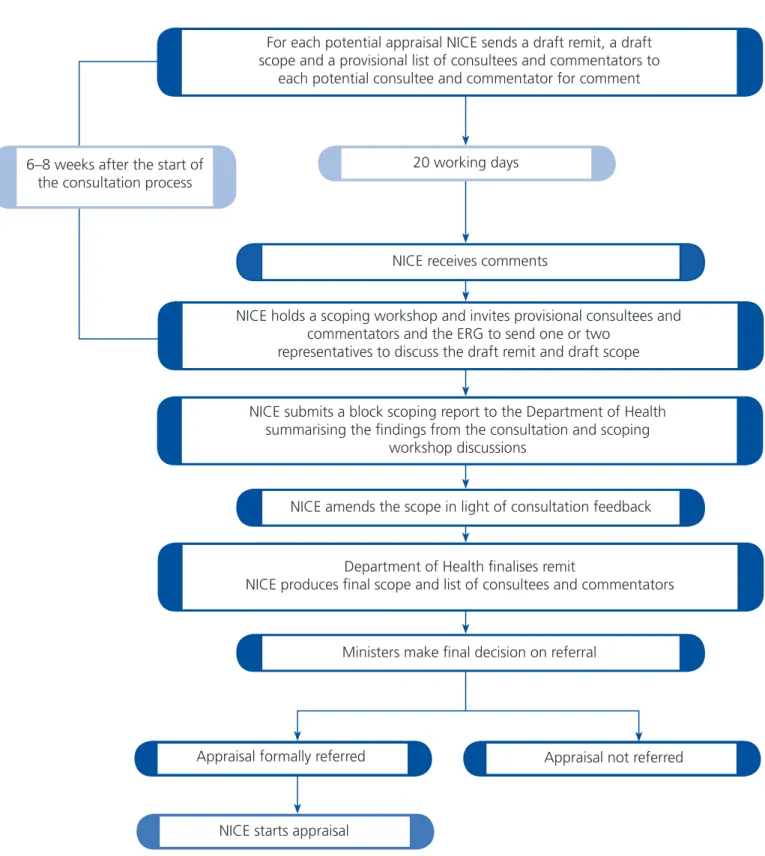
2.1.1 Before NICE receives a formal referral, it is asked to consider a list of possible appraisals, in the form of draft remits, and to seek the views of interested parties. At this stage, NICE develops a draft scope for each possible appraisal. The steps involved in developing a draft scope are shown in figure 1.
2.1.2 The draft scope sets out what the appraisal will cover and the questions that need to be addressed. It will steer and focus the appraisal if the technology is formally referred to NICE for appraisal.
2.1.3 The first step in the scoping process is to identify information relating to the technology. NICE’s information specialists, working with the appraisal team’s technical leads,
undertake this task, which includes conducting a literature search, identifying the availability of relevant evidence and contacting the manufacturer or sponsor of the technology. NICE uses this information to prepare a draft scope.
2.1.4 The draft scope defines a number of elements, including:
•
the clinical problem, the population(s) and any relevant subgroups in whom treatment with or use of the technology would be appraised•
the clinical setting – where the technology will be used•
the relevant comparator technologies – usually the treatment(s) used in current clinical practice in the NHS to manage the disease or condition (this may include non-licensed technologies if they are used in current clinical practice); sometimes the comparator is best supportive care, palliative therapy or no intervention (for further details, see the ‘Guide to the methods of technology appraisal’)•
the principal health outcome measures appropriate for analysis•
the measures of costs to be assessed•
the length of time over which the benefits and costs will be considered•
special considerations and issues that are likely to affect the potential STA, including equality and diversity issues.2.1.5 For further information on how scopes are developed, see the ‘Guide to the methods of technology appraisal’.
2.1.6 Unless the Department of Health specifically indicates otherwise, NICE will not publish guidance on the use of a technology for indications for which regulatory approval has not been granted in the UK (that is, off-licence use).
2.2 Identifying interested parties
2.2.1 Identifying interested parties (known as consultees and commentators; see table 1) is an important stage of the process. NICE identifies consultees and commentators before it consults on the draft remit and draft scope.
2.2.2 A patient or professional group can be a consultee if it works at a national level (covering the UK or England, or a UK branch of an international body) and represents patients, carers or healthcare professionals either broadly or directly related to the technology being considered. Other consultees include specialised commissioning groups – two primary care trusts or local health boards selected at random, and the manufacturer or sponsor of the technology.
2.2.3 Commentators include research organisations with an interest in the technology being considered, organisations that cover the NHS as a whole, such as the NHS Confederation, patient and professional groups covering Wales only, and the manufacturers or sponsors of relevant comparator technologies.
2.2.4 During the scoping phase, NICE aims to identify the widest range possible of relevant consultees and commentators who have an interest in the technology or disease area being considered. This includes, but is not restricted to, national organisations representing relevant specific ethnic groups, people with disabilities, mental health problems and/or learning disabilities.
2.2.5 Any organisation meeting the criteria that wishes to become a consultee or commentator for a proposed appraisal can contact the relevant project manager (see NICE’s website for details). An application to join the appraisal as a consultee or commentator can be made at any point during the scoping and appraisal phases of the process.
2.3 Consultation on the draft remit and draft scope
2.3.1 The next step is a consultation stage on the list of consultees and commentators, draft remit and draft scope for the potential appraisal with identified provisional consultees and commentators. The aim of this consultation is to gather views on whether NICE should appraise the technology, as well as to ensure that all the relevant areas and issues are covered if the technology is referred to NICE for appraisal. It is important that all the relevant organisations and interested parties are included in these consultations. NICE therefore asks identified provisional consultees and commentators if there are other organisations that need to be included in the consultation.
2.3.2 NICE sends the draft remit and draft scope to the identified provisional consultees and commentators, together with the list of consultees and commentators, for comment. NICE must receive comments within 20 working days of the date of sending.
2.3.3 NICE asks the manufacturer or sponsor to provide information about the expected timing of pending licence applications (or equivalent) for their technology in the UK. This must include, if applicable, the expected date for Committee for Medicinal Products for Human Use (CHMP) opinion and the date of receipt of regulatory approval (or
equivalent). The manufacturer or sponsor should also state whether they expect the launch date for their technology in the UK to differ from the regulatory approval date. Medical devices go through a different regulatory approval process than pharmaceuticals with different timelines and data requirements. It is important that the manufacturer or sponsor informs NICE of any change in the regulatory approval timelines as soon as possible. NICE uses this information to plan the appraisal.
2.3.4 NICE publishes the draft remit, draft scope and list of consultees and commentators on its website, for information, 5 working days after it sends these documents to the provisional consultees and commentators.
2.4 The scoping workshop
2.4.1 After provisional consultees and commentators have submitted their comments on the draft remit, draft scope and list of consultees and commentators, NICE holds a meeting called the scoping workshop. NICE invites all provisional consultees and commentators, and the ERG, to send one or two representatives to this meeting.
2.4.2 The aims of the workshop are to:
•
briefly explain the appraisal process•
ensure the scope is appropriately defined•
discuss the issues raised by provisional consultees and commentators during consultation on the draft remit and draft scope•
identify important evidence and any other issues relevant to the potential appraisal. 2.4.3 It is important that sufficient expertise is fed into the development of the scope. NICEwelcomes and values all specialist input from patient groups, NHS commissioners and healthcare professionals provided at consultation and during the workshop discussions. 2.4.4 At the scoping workshop, NICE encourages the manufacturer or sponsor to provide
preliminary details of the evidence it would submit if NICE were asked to appraise the technology. This may include details of trials in progress, for example the inclusion and exclusion criteria used. At the end of the workshop, the manufacturer or sponsor can discuss commercially sensitive information and technical issues relating to the potential appraisal with NICE, in confidence.
2.5 Final scope
2.5.1 NICE finalises the scope, taking into account comments received during the draft remit and draft scope consultation, and the discussions at the scoping workshop. This is in anticipation of receiving a formal referral to appraise the technology from the Secretary of State for Health.
2.5.2 NICE submits a report to the Department of Health summarising the results of the
consultation and scoping workshop discussions (known as the block scoping report). This information helps ministers to decide whether or not the technology should be formally referred to NICE for appraisal and whether it should be referred as an MTA or an STA. If ministers decide to refer a technology, the technology is formally referred to NICE for appraisal along with the final remit.
2.5.3 NICE publishes the block scoping report (with any ‘commercial in confidence’ information removed) on its website after formal referral.
2.5.4 If there is a significant length of time between scoping and the start of the appraisal, NICE may need to update the scope to ensure it is still relevant. Depending on the extent of this update, NICE may undertake further consultation with consultees and commentators.
2.5.5 NICE may need to refine the scope further at the request of ministers.
Appraisal not referred
Figure 1 Steps in developing the scope
For each potential appraisal NICE sends a draft remit, a draft scope and a provisional list of consultees and commentators to
each potential consultee and commentator for comment
6–8 weeks after the start of the consultation process
20 working days
NICE receives comments
NICE holds a scoping workshop and invites provisional consultees and commentators and the ERG to send one or two
representatives to discuss the draft remit and draft scope
NICE submits a block scoping report to the Department of Health summarising the findings from the consultation and scoping
workshop discussions
NICE amends the scope in light of consultation feedback
Department of Health finalises remit
NICE produces final scope and list of consultees and commentators
Ministers make final decision on referral
Appraisal formally referred
NICE starts appraisal
2.6 Planning the referred appraisals into the work programme
2.6.1 After formal referral, NICE plans the timelines for the STA and normally publishes them on its website within 6 weeks. NICE aims to hold the first Appraisal Committee meeting at the point the technology gains its positive opinion (or equivalent) from the licensing authority. It is therefore essential that the manufacturer or sponsor informs NICE of all developments in the regulatory approval process. This ensures that NICE publishes guidance on the use of the new technology as soon as possible after its introduction into the UK.
2.6.2 If possible, before the start of an STA, NICE informs the consultees and commentators of the expected timelines for the appraisal. Occasionally, timelines have to change, either before or during the appraisal. NICE will inform consultees and commentators about these changes and, if possible, explain the reasons for the changes. Sometimes, however, if the reasons are commercially sensitive, NICE cannot disclose them. NICE works with the manufacturer or sponsor of the technology to release as much information as possible to interested parties.
2.6.3 During the referral process of an STA, NICE asks the National Institute for Health Research – Health Technology Assessment Programme (NIHR HTA Programme) to formally commission the ERG to produce a report. The NIHR HTA Programme commissions the ERG report from one of a number of independent academic centres.
The STA process
3
The STA process
Section 3 sets out the STA process under the following headings:
•
General points•
Phase 1: initiation of the STA and evidence submission•
Phase 2: evidence review•
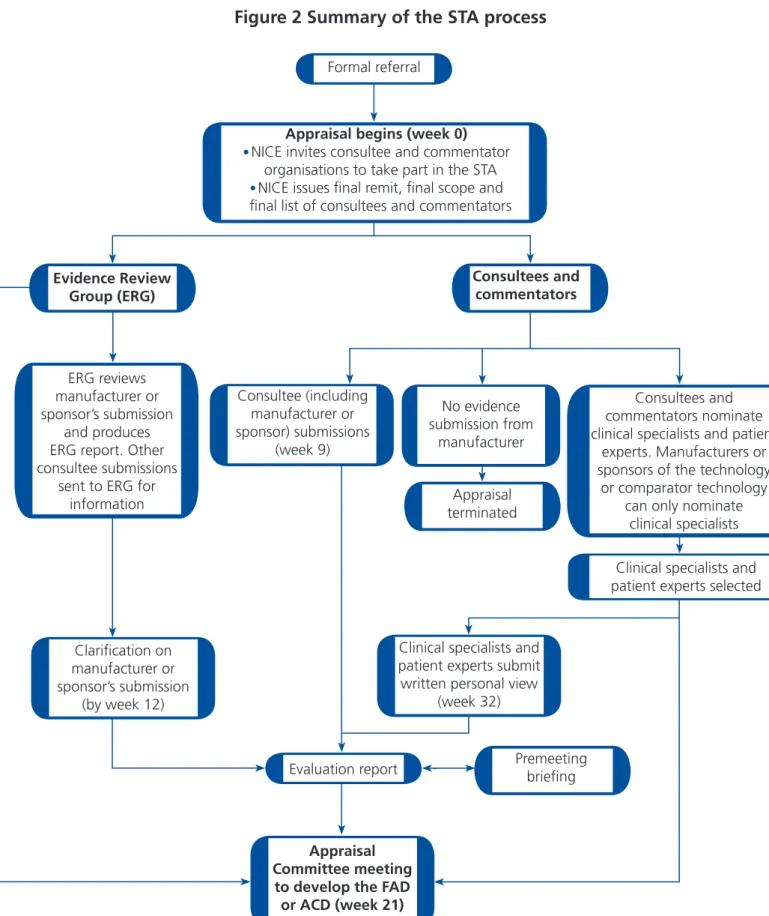
Phase 3: appraisalSee figure 2 and appendix B for an overview of the STA process and timelines.
3.1 General points
3.1.1 NICE sends the name and contact details of the project manager assigned to an individual STA to all consultees and commentators. Consultees and commentators should send all correspondence, including consultation responses, relating to an individual STA to the project manager to make sure it is dealt with effectively. 3.1.2 NICE sends correspondence for an appraisal by email or post to one key contact
identified by each consultee and commentator organisation. It is therefore essential that consultees and commentators notify the project manager of any change in contact details or in organisation or company name throughout the appraisal process.
3.1.3 NICE’s website has a page for each STA giving information about the timelines and progress of the appraisal. Further information is available from the project manager.
3.2 Phase 1: initiation of the STA and evidence submission
3.2.1 The STA process consists of three distinct phases: phase 1: initiation of the STA and evidence submission (including the decision problem); phase 2: evidence review
(including initial clarification); and phase 3: appraisal. Phase 1 begins after the scoping phase has been completed and NICE has received formal referral from the Secretary of State for Health (see figure 2 and appendix B for an overview of the STA process and timelines).
3.2.2 NICE publishes the final remit and final scope (see section 2.5), the name of the ERG and the list of consultees and commentators on its website at least 8 weeks before the manufacturer or sponsor’s evidence submission deadline. Each STA is assigned to a project team at NICE; the members are listed on NICE’s website. The roles of key members of the project team are summarised in table 1.
3.2.3 Phase 1 starts when NICE invites consultees and commentators to participate in the STA. NICE sends consultees and commentators a list of key dates for the STA along with their invitation to participate.
The STA process
Evidence submission from the manufacturer or sponsor
3.2.4 NICE invites the manufacturer or sponsor of the technology to provide an evidence submission using a detailed template and specification (see www.nice.org.uk/aboutnice/ howwework/devnicetech/singletechnologyappraisalsubmissiontemplates.jsp). The deadline for receipt of the evidence submission is at least 8 weeks from invitation. On receipt, NICE sends the evidence submission to the ERG for review.
3.2.5 The specification for the evidence submission is derived from the decision-analytical approach NICE uses to evaluate the clinical and cost effectiveness of health technologies. This approach is outlined in the ‘Guide to the methods of technology appraisal’. Page limits and instructions on the use of appendices are given in the specification for evidence submission. Submission appendices are not normally given to the Appraisal Committee.
3.2.6 If the manufacturer or sponsor plans to submit an economic model, they should inform NICE what software will be used. NICE accepts fully executable economic models using standard software, that is, Excel, DATA, R or WinBUGs. If the manufacturer or sponsor plans to submit a model in a non-standard package, they should tell NICE in advance. NICE, in association with the NIHR HTA and the ERG, will then investigate whether the requested software is acceptable. When the manufacturer or sponsor submits a fully executable electronic copy of the model, they must give NICE full access to the programming code. Care should be taken to ensure that the submitted versions of the model program and the written content of the evidence submission match.
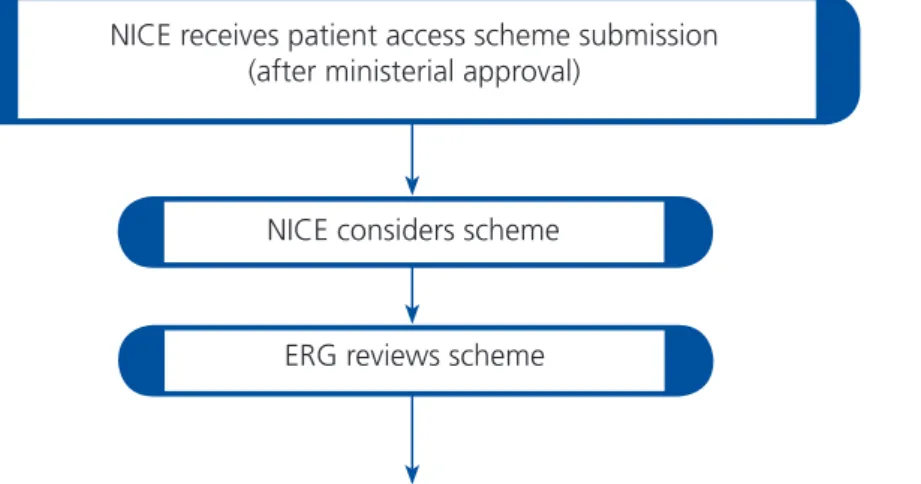
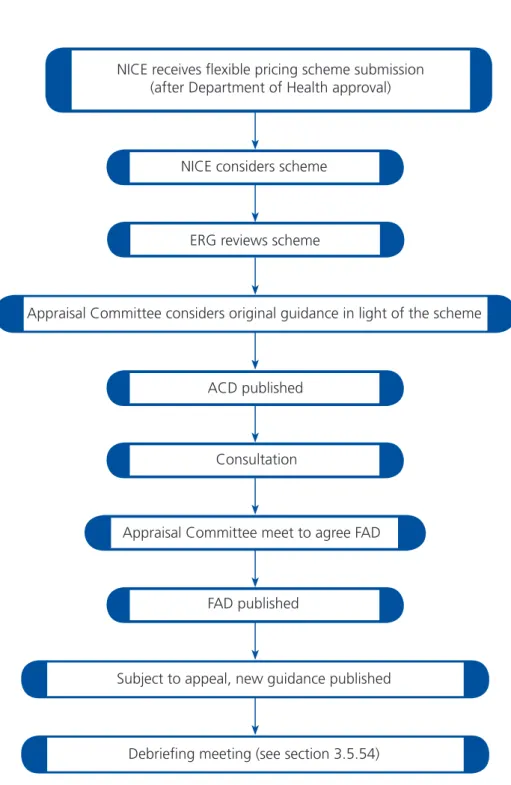
3.2.7 If the manufacturer or sponsor wishes to include a patient access scheme as part of their submission, they must agree this scheme with the Department of Health before submission to NICE. The Department of Health asks the Patient Access Scheme Liaison Unit (PASLU) at NICE to advise them on the feasibility of implementing a patient access scheme in the NHS in England and Wales. The PASLU provides advice to the Department of Health that will inform ministerial decisions on referring an agreed patient access scheme to NICE for consideration with the submission. NICE includes details of the scheme in the evaluation report (see section 5 of this guide for further details). 3.2.8 If the timelines of the STA are following the anticipated timeframe for regulatory
approval, the manufacturer or sponsor must notify NICE when it makes a submission for regulatory approval of the indication being appraised. The notification should also specify when an opinion is expected from the CHMP (or equivalent), when it expects to receive regulatory approval and the expected wording of the marketing authorisation. Manufacturers or sponsors are required to inform NICE immediately if there are changes in the regulatory approval process that will affect the timeframe or have implications for the wording of the marketing authorisation.
The STA process
Formal referral
Appraisal begins (week 0)
• NICE invites consultee and commentator organisations to take part in the STA
• NICE issues final remit, final scope and final list of consultees and commentators
Evidence Review Group (ERG) Consultees and commentators Consultees and commentators nominate clinical specialists and patient
experts. Manufacturers or sponsors of the technology
or comparator technology can only nominate
clinical specialists ERG reviews
manufacturer or sponsor’s submission
and produces ERG report. Other consultee submissions
sent to ERG for information
Consultee (including manufacturer or sponsor) submissions
(week 9)
Clinical specialists and patient experts submit written personal view
(week 32)
Evaluation report Premeeting briefing
Appraisal Committee meeting
to develop the FAD or ACD (week 21)
Clarification on manufacturer or sponsor’s submission
(by week 12)
No evidence submission from
manufacturer
Appraisal terminated
Figure 2 Summary of the STA process
Clinical specialists and patient experts selected
The STA process
ACD produced
ACD finalised
Evaluation report
Confidential information removed
NICE sends ACD to consultees, commentators, clinical specialists, patient experts and ERG (week 23/24)
Consultee and commentator comments Non-consultee and non-commentator comments
Appraisal Committee meeting to develop the FAD
Attended by representatives from the ERG (week 29)
NICE sends FAD to consultees for appeal
(15 working days) (week 34)
NICE sends FAD to commentators for information (week 34)
NICE publishes FAD on its website for information (week 34)
Factual error No appeal or
factual error Appeal received Upheld
Not upheld NICE Guidance
Executive amends errors and approves
NICE Guidance Executive approves
and finalises FAD
4-week consultation
3-week consultation
(on web)
NICE asks Appraisal Committee to reconsider the evidence Appraisal
Committee meeting to develop the FAD
or ACD (week 21)
The STA process
3.2.9 NICE asks the manufacturer or sponsor to submit a summary of the decision problem for their evidence submission 2 weeks after formally inviting them to provide an evidence submission for the STA. NICE sends this document to the ERG. It should summarise the analyses that will be performed, including details of the study population, the intervention, the comparators and the outcomes. The STA submission template ensures that the decision problem is specified appropriately in relation to the final scope. NICE invites the manufacturer or sponsor to attend a meeting to discuss the decision problem and to ensure that it is specified appropriately. This meeting also provides an opportunity for the manufacturer or sponsor to ask questions. NICE reports a summary of discussions from the decision problem meeting to the ERG.
3.2.10 NICE is unable to review or approve submissions during their preparation. Statements from non-manufacturer consultees
3.2.11 NICE invites all non-manufacturer consultees to submit a statement providing information on the potential clinical and cost effectiveness of a treatment using the appropriate templates available on NICE’s website (www.nice.org.uk/aboutnice/ howwework/devnicetech/singletechnologyappraisalsubmissiontemplates.jsp). The statement should reflect the patient or clinician’s experience of current standard treatment in the NHS in England and Wales and the potential impact of treatment on health-related quality of life. Implementation issues, such as staffing and training requirements, should also be included. Consultees have at least 8 weeks to provide their statements to NICE. On receipt, NICE sends the evidence submission to the ERG for information.
3.2.12 The Patient and Public Involvement Programme (PPIP) project manager at NICE offers support throughout the STA process to consultee groups representing patient or carer organisations and patient experts (see table 1 for further information).
3.2.13 NICE offers consultee groups representing patients, carers and healthcare professionals a financial contribution towards the cost of participating in the appraisal. Payments will normally be made only into a corporate bank account of the consultee organisation. Under exceptional circumstances, a payment may be made into a personal bank account but only after written authorisation has been received from the consultee organisation. 3.2.14 NICE is unable to review or approve statements during their preparation.
Information handling
3.2.15 NICE adheres to the principles and requirements of the Data Protection Act and the Freedom of Information Act when dealing with information received during an appraisal.
The STA process
3.2.16 With the exception of the draft scope, NICE will not make public, or circulate among consultees and commentators, any documents for consultation before the technology has received regulatory approval.
3.2.17 Care should be taken when submitting information relating to individuals. Personal and sensitive information, for example identifying an individual’s clinician, should be removed from submissions.
3.2.18 If an evidence submission from a manufacturer or sponsor, or a statement from a non-manufacturer consultee contains confidential information, it is the responsibility of the submitter to provide two versions, one complete (including the confidential information) and one for publication (with the confidential information removed), together with a checklist of the confidential information. Detailed instructions on submitting confidential information relating to an STA are available from the project manager.
3.2.19 NICE is required to meet the requirements of copyright legislation. If a manufacturer or sponsor of a technology cites journal articles in their submission, they must include the full journal articles in their submission and have copyright clearance for these articles. NICE will accept journal articles in electronic format only if they are provided on CD-ROM separate to the main submission and economic model. Copyright-controlled material may not be submitted by email or other Internet-based means. NICE will pass journal articles to the ERG in the format they are received (printed or electronic). NICE will not copy, print or store submitted references as this would breach copyright legislation.
3.2.20 NICE requires manufacturers and sponsors of technologies under appraisal to sign a statement declaring that all material relevant to the STA has been disclosed to NICE. 3.2.21 To ensure that the appraisal process is as transparent as possible, NICE considers it
essential that evidence on which the Appraisal Committee’s decisions are based is publicly available. Under exceptional circumstances, unpublished evidence is accepted under agreement of confidentiality. Such evidence includes ‘commercial in confidence’ information (for example, the findings of a research project defined as ‘confidential’ because its public disclosure could have an impact on the commercial interests of a particular company) and evidence that is awaiting publication (‘academic in confidence’). 3.2.22 NICE considers that evidence designated as ‘academic in confidence’ (but not
‘commercial in confidence’) can be presented at Appraisal Committee meetings with members of the public and press present. This should be highlighted to third party providers of ‘academic in confidence’ information.
3.2.23 NICE expects consultees to keep confidential material within a submission to an absolute minimum. When consultees believe that part of a submission should be
The STA process
treated as confidential, they must clearly state the reason for this according to the following principles:
•
Information that has been put into the public domain, in written form, anywhere in the world may not be marked as confidential.•
The list price of a technology (after launch) and incremental cost-effectiveness ratio (ICER) estimates cannot be marked as ‘commercial in confidence’.•
The results of clinical trials relating to products that have received regulatory approval should be available. When NICE documentation quoting evidence from a clinical trial is released before the results are published in a journal, as a minimum, a structured abstract should be made available for public disclosure. This abstract should follow a recognised format for a full trial report, such as that provided by the CONSORT statement (www.consort-statement.org).•
Manufacturers or sponsors can seek further information on guidelines for the release of data into the public domain during an STA from the agreement between the Association of the British Pharmaceutical Industry (ABPI) and NICE (www.nice.org.uk/aboutnice/howwework/devnicetech/technologyappraisal processguides/agreement_of_the_british_pharmaceutical_industry.jsp).3.2.24 The same principles apply to the manufacturer or sponsor’s economic model. The
manufacturer or sponsor should make available to NICE and the ERG the fully executable economic model used in the cost-effectiveness analysis, in electronic format. In addition, as a minimum, the manufacturer or sponsor should provide a structured abstract
describing the economic model for public disclosure.
3.2.25 The ERG and the Appraisal Committee, and the clinical specialists, NHS commissioning experts and patient experts invited to attend the Appraisal Committee meeting can review confidential information submitted by consultees. NICE distributes confidential information to consultees and commentators only with permission from the
evidence owners.
3.2.26 NICE releases the documents listed in table 2 to consultees and commentators during the STA process. NICE publishes these documents on its website at least 5 working days after they have been sent to consultees and commentators. After NICE has published these documents on its website they are no longer confidential.
3.2.27 NICE encourages consultees to make their individual submissions accessible – for example, by placing them on their own websites after they have sent their submission to NICE.
The STA process
3.2.28 NICE will not comment on the content of an STA until the process has been completed and its guidance has been produced, except in the following circumstances:
•
NICE reserves the right to make public comment if there has been an unauthorised disclosure from a confidential NICE document before it has been publishedon its website. The Chair or Vice Chair of NICE will take this decision on the recommendation of two Executive Directors. NICE will inform consultees and commentators of this decision as soon as possible.
•
NICE reserves the right to issue a correction if a public comment is made on an ACD or FAD that could mislead or misinform.3.2.29 Organisations participating in an STA must sign a confidentiality agreement before they are recognised as formal consultees and commentators. After this, NICE can release appraisal documents to them.
3.2.30 It is the responsibility of the consultees and commentators, and any other party that has signed a confidentiality agreement for the appraisal, to treat appraisal documents that are not in the public domain as confidential until NICE makes those documents public. NICE considers individuals within a consultee or commentator organisation who see appraisal documents to be bound by the terms of the confidentiality agreement signed by the consultee or commentator organisation.
3.2.31 Any organisation or individual not directly employed by the consultee or commentator organisation is a third party. Consultees and commentators may release the appraisal documents to third parties when:
•
it is necessary to enable the consultee or commentator to contribute to the appraisal, and•
the third party has seen and agreed to be bound by the terms of the confidentiality agreement.3.2.32 Consultees and commentators may discuss confidential appraisal documents with other consultees and commentators but, before doing so, they must be satisfied that the other consultees and commentators have signed and returned their confidentiality agreements to NICE.
3.2.33 In the evaluation report (see section 3.5.3), ACD and FAD, NICE reserves the right to use any material submitted during the STA process that is not marked as ‘confidential’ by the consultee, or which ceases to be so under sections 3.2.26 or 3.2.39. Reference will be made in the evaluation report to documents or information that have been marked as confidential by the consultee.
The STA process
3.2.34 If changes are made to the expected summary of product characteristics during the regulatory approval process, NICE will discuss the implications with the ERG and the manufacturer or sponsor and agree how to incorporate the changes into the submission and the ERG report.
3.2.35 An STA may begin before UK regulatory approval has been granted. NICE will not issue consultation documents or guidance on a technology until UK regulatory approval has been granted and the technology’s price is known.
Document For further
information, see section
List of consultees and commentators 2.2.1
Final scope and remit for the appraisal 2.5
Manufacturer or sponsor’s evidence submission (confidential information removed)*
3.2.4
Statements from non-manufacturer consultees* 3.2.11 Clarification letters sent to the manufacturer or sponsor and the
response to these letters*
3.4.2
Evidence Review Group (ERG) report* 3.4.8
Premeeting briefing* 3.5.2
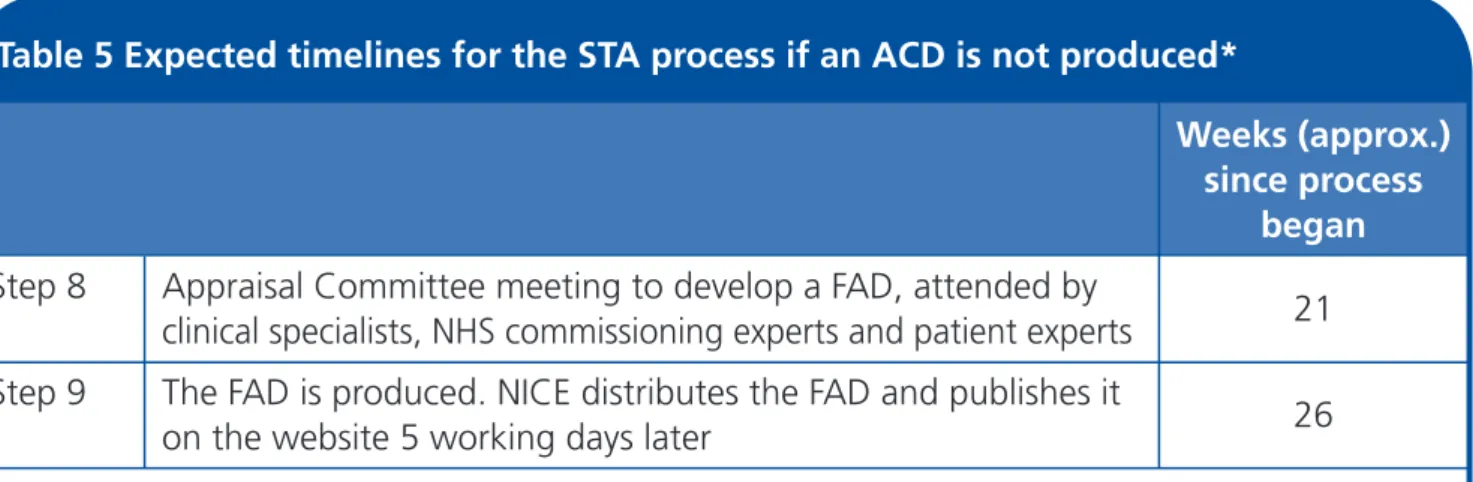
If produced, the appraisal consultation document (ACD) 3.5.22 Comments from consultees and commentators on the ACD, if
produced, and responses from NICE
3.5.30
Final appraisal determination (FAD)* 3.5.38
*NICE releases these documents to consultees and commentators who have signed a confidentiality agreement before publishing them on its website (5 working days later).
The STA process
Submitting confidential information
3.2.36 All confidential information NICE receives (in evidence submissions, statements,
responses to consultation and general correspondence) must be clearly underlined and highlighted. A checklist must also be provided explaining why the information is marked as confidential and when it will be made publicly available.
3.2.37 Confidential information in a submission should be kept to a minimum. It is not acceptable to mark a whole evidence submission as confidential.
3.2.38 If NICE does not receive a completed checklist with a document, none of the information will be considered confidential. If a document contains confidential information, it is the responsibility of the submitter to provide two versions, one complete (including the confidential information) and one for publication (with the confidential information removed).
3.2.39 NICE aims to provide a complete audit trail for all of its guidance. To make sure that the appraisal process is transparent, NICE considers it essential that evidence on which the Appraisal Committee’s decisions are based is publicly available. All the evidence seen by the Committee should be available to all consultees and commentators. This includes an executable version of the economic model. Under exceptional circumstances, unpublished evidence is accepted under agreement of confidentiality. It is important to consider carefully the information that is marked as confidential and therefore not releasable because it may be difficult to identify how evidence has been used and interpreted. NICE will ask for restrictions on release of evidence to be reconsidered if there appears to be no obvious reason for the restrictions, or when such restrictions would make it difficult or impossible for NICE to show the evidence on which the guidance is based.
3.3 Process timelines
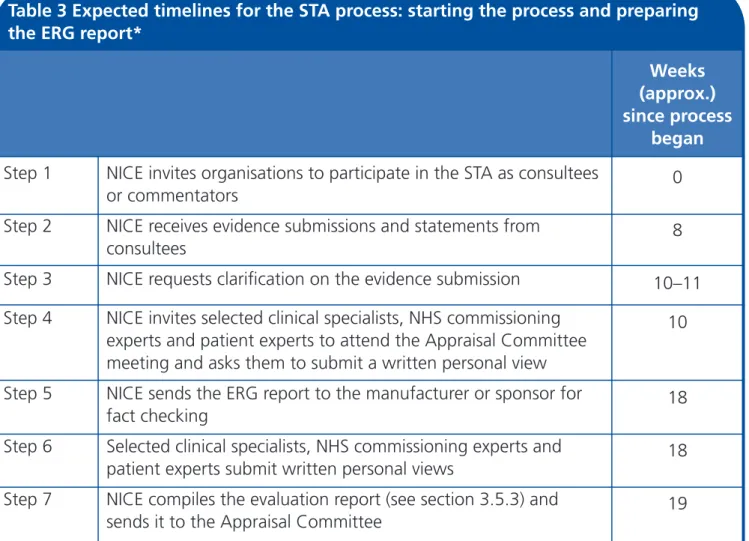
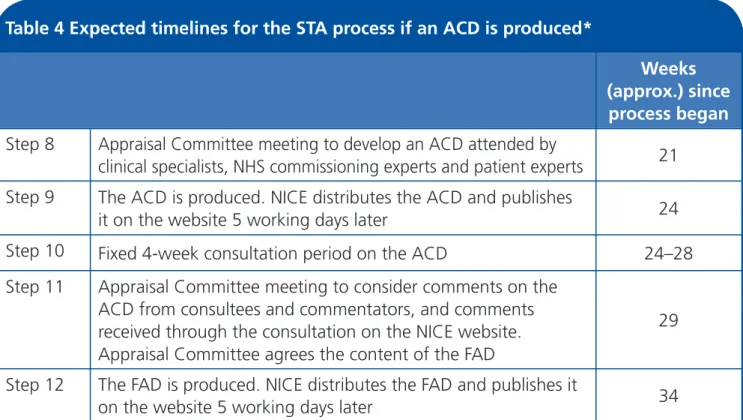
3.3.1 It is not possible to set absolute timelines for all stages of the appraisal process. The length of time needed for each stage can vary depending on the nature of the particular appraisal. The timelines set out in tables 3–5 and appendix B indicate the minimum number of weeks for each stage of the STA process.
3.3.2 Throughout an appraisal, up-to-date information about timelines and progress is available on NICE’s website. Further information is available from the project manager. 3.3.3 If possible, NICE informs the consultees and commentators about timeline changes and
the reasons for these changes. Sometimes, however, if the reasons are commercially sensitive, NICE cannot disclose them. NICE works with the manufacturer or sponsor of the technology to release as much information as possible to interested parties.
The STA process
3.4 Phase 2: evidence review
Evidence submission and clarification
3.4.1 On receipt of the manufacturer or sponsor’s evidence submission, NICE and the ERG assess whether the submission is complete and whether the decision problem is specified appropriately with reference to the final scope.
3.4.2 If the evidence submission is incomplete or the decision problem is not specified appropriately, NICE consults with the ERG and sends a letter of clarification to the manufacturer or sponsor within 15 working days of receiving the submission. The manufacturer or sponsor has 10 working days from the date of the correspondence to respond. NICE will organise a face-to-face meeting to discuss any issues that cannot be resolved by other means.
3.4.3 If such requests for clarification delay the published timelines, NICE informs consultees and commentators, and publishes the reason for the delay on its website.
3.4.4 The response to the clarification request allows the manufacturer or sponsor to review the confidential status of information in its evidence submission before the Appraisal Committee meeting (see sections 3.2.36–3.2.39 for details on submission of
confidential information).
3.4.5 The manufacturer or sponsor should not submit additional evidence during the evidence review phase unless NICE requests or agrees to this in advance.
Terminating an STA
3.4.6 NICE must ensure that the manufacturer or sponsor prepares the best possible evidence submission for the Appraisal Committee. NICE’s technical leads do not validate the submission but they help to clarify substantive issues. If, after all reasonable requests for clarification, NICE is not satisfied that the evidence submission is adequate for the Appraisal Committee to make a decision or no evidence submission has been received, the Centre Director will recommend to NICE’s Guidance Executive that the STA should be terminated. NICE will return an inadequate evidence submission to the manufacturer or sponsor noting that no submission has been received. NICE will subsequently advise the NHS that the appraisal has been terminated and that ‘NICE is unable to recommend the use in the NHS of the technology because no evidence submission was received from the manufacturer or sponsor of the technology’. NICE will also provide an explanation to help the NHS make local decisions on making the technology available.
3.4.7 A terminated appraisal can be re-initiated if the manufacturer or sponsor indicates that they wish to make a full evidence submission.
The STA process
Evidence Review Group report
3.4.8 When a manufacturer or sponsor submits an adequate evidence submission, the ERG reviews it.
3.4.9 The ERG prepares a report on the clinical and cost effectiveness of the technology consistent with the methodology of technology appraisal. The report is based on a review of the manufacturer or sponsor’s evidence submission and advice from their clinical advisers. The ERG prepares the report in accordance with the NIHR HTA Programme quality criteria (www.hta.ac.uk/investigators/authorinstructions.shtml) and an agreed report template. The ERG is responsible for the content and quality of the report.
3.4.10 The ERG critically evaluates the evidence submission. The ERG may suggest to NICE, during initial clarification, that the manufacturer or sponsor should undertake additional analyses. The manufacturer or sponsor should include full descriptions of any additional analyses as appendices to the original submission. If changes are made to the submitted model, the ERG should include technical details of these amendments and their impact in the ERG report. If appropriate, the ERG may perform exploratory and sensitivity analyses using the manufacturer or sponsor’s economic model. If undertaken, the ERG will include details of these analyses in their report. NICE sends the ERG report to consultees and commentators and publishes it on the website with either the ACD or the FAD.
3.4.11 NICE sends the ERG report to the manufacturer or sponsor before it is presented to the Appraisal Committee. The manufacturer or sponsor has 5 working days from the date of sending to check that the report (including confidential information provided by the manufacturer or sponsor) does not contain factual errors, for example, errors in the figures, incorrect quotes from the evidence submission or text that does not describe the facts accurately. NICE prepares a document highlighting any factual errors for the Appraisal Committee meeting and publishes the document on its website as part of the evaluation report. The manufacturer or sponsor cannot submit additional evidence during the evidence review phase unless NICE has agreed to this before the main evidence submission, or NICE asks for more evidence.
Participation of clinical specialists, NHS commissioning experts and patient experts
3.4.12 While the ERG is producing its report, and consultees are preparing their submissions, NICE organises phase 3 of the STA process. This involves planning the Appraisal Committee meetings (which are held in public). NICE encourages all consultees and commentators to nominate clinical specialists and patient experts to take part in the first
The STA process
Appraisal Committee meeting discussions. NICE asks the two primary care trusts or local health boards selected at random to be consultees to nominate two NHS commissioning experts to attend the Appraisal Committee meeting.
3.4.13 The Chair of the Appraisal Committee, NICE’s project team and PPIP team choose clinical specialists and patient experts from the nominations received.
3.4.14 The PPIP project manager gives advice and information to the organisations nominating patient experts. Individuals interested in being patient experts can also contact the PPIP project manager for information about how to be nominated. To do this, the individual and the nominating organisation complete a joint patient expert nomination form. This asks them to provide a short biography describing the nominee’s experience and knowledge of the condition and/or technology, and describing any previous involvement with NICE.
3.4.15 The Chair and NICE’s project team base their choice of clinical specialists and patient experts on the nominees’ experience of the technology and the condition(s) that the technology is designed to treat. If possible, the clinical specialists and patient experts will have complementary rather than similar backgrounds and experiences. NICE invites clinical specialists, NHS commissioning experts and patient experts to attend Appraisal Committee meetings provided they meet the following criteria:
•
They agree to be bound by the terms and conditions of NICE’s confidentiality agreement.•
They agree to their name and affiliation appearing in the ACD and/or FAD.•
They have knowledge and/or experience of the condition and/or technology under appraisal and/or the way it is used in the NHS.•
They are willing and able to discuss the condition and the technology withmembers of a large committee at a meeting where there may be members of the public and press observing.
•
They are familiar with the purpose and processes of NICE (the PPIP project manager at NICE can give patient experts an overview that enables them to contribute to the discussions at Appraisal Committee meetings).•
They are prepared to declare any interests they have in the technology under appraisal at Appraisal Committee meetings.•
They do not have any conflicts of interest that would prevent them from participating in the appraisal.3.4.16 Additionally, the following criteria are used to select clinical specialists:
•
They are in active clinical practice and have specialist expertise in the subject area of the appraisal.The STA process
•
If they have acted as a clinical expert for the ERG, they agree to declare this in their personal statement and at Appraisal Committee meetings.•
They hold no official office (that is, no paid employment, unpaid directorship or membership of a standing advisory committee) with the manufacturer or sponsor of the technology or any manufacturers or sponsors of comparator technologies. 3.4.17 Usually, two clinical specialists and two patient experts are selected. NICE asks the clinicalspecialists, NHS commissioning experts and patient experts to submit a short (4-page maximum) written personal view on the technology and the way it should be used in the NHS in England and Wales using a standard template. NICE gives the written personal views to the Appraisal Committee and publishes them as part of the evaluation report. However, if the clinical specialists and patient experts support the statement made by their nominating organisation they do not need to submit a personal view. Further advice about the contribution of clinical specialists, NHS commissioning experts and patient experts is available from the project manager.
3.4.18 Clinical specialists, NHS commissioning experts and patient experts attend Appraisal Committee meetings as individuals and not as representatives of their nominating organisation. NICE aims to select a cross-section of individuals from the nominations received for clinical specialists and patient experts. For example, for patient experts, NICE would select a person with direct personal experience of the technology and a representative of a patient, carer or professional organisation.
3.4.19 NICE publishes details of consultee and commentator organisations, which have provided nominations for clinical specialists, NHS commissioning experts and patient experts, on the Appraisal Committee agenda. NICE includes the names and affiliations of the selected clinical specialists, NHS commissioning experts and patient experts in the ACD, FAD and in the minutes of Appraisal Committee meetings.
3.4.20 It is important that sufficient expertise feeds into the technology appraisal. NICE welcomes and values the input from patient experts, NHS commissioning experts and clinical specialists.
Participation of manufacturer or sponsor representatives
3.4.21 Two representatives of the manufacturer or sponsor (normally one with health
economics expertise and one with medical expertise) of the technology being appraised can attend part 1 of the Appraisal Committee meeting discussions. The Chair will ask these representatives to respond to questions from the Appraisal Committee. The Chair will ask the representatives to comment on any matters of factual accuracy before concluding part 1 of the meeting. The Chair may ask the representatives to remain
The STA process
for part of the closed session (part 2) of the Appraisal Committee meeting, specifically to respond to questions from the Committee about confidential information in the manufacturer or sponsor’s submission. The project manager can give further advice on appropriate manufacturer or sponsor representation at Appraisal Committee meetings. 3.4.22 Each representative must:
•
be an employee of the manufacturer or sponsor or have been contracted by the manufacturer or sponsor to develop the evidence submission•
have relevant detailed knowledge of the technology under appraisal to engage effectively with the Appraisal Committee•
be able to comment on the clinical and cost effectiveness of the technology•
agree to be bound by the terms and conditions of NICE’s confidentiality agreement•
be willing and able to discuss the condition and the technology with members of a large committee at a meeting where there may be members of the public and press observing•
be familiar with the purpose and processes of NICE•
be prepared to declare any interests they have in the technology under appraisal at Appraisal Committee meetings.3.4.23 The ACD, FAD and the minutes of Appraisal Committee meetings will report the industry representation at the Appraisal Committee meetings but will not name the individuals in attendance.
3.5 Phase 3: appraisal
3.5.1 The appraisal phase of the STA process has four possible stages:
•
consideration of the evidence at an Appraisal Committee meeting to discuss the content of either the FAD or ACD•
if required, development of and consultation on the ACD•
review of the ACD (if produced) in the light of comments from consultation at a second Appraisal Committee meeting•
preparation of the FAD.Preparing for the meeting to develop the FAD or ACD
3.5.2 A lead team, selected from the Committee members at the start of each STA, helps the NICE technical lead prepare a summary of the evidence, known as the premeeting briefing. One of the lay representatives on the Committee is also selected to advise the lead team when developing the premeeting briefing. At the Appraisal Committee meeting, the lead team makes a brief presentation, based on the premeeting briefing, to introduce the STA topic.
The STA process
Weeks (approx.) since process
began
Step 1 NICE invites organisations to participate in the STA as consultees
or commentators 0
Step 2 NICE receives evidence submissions and statements from
consultees 8
Step 3 NICE requests clarification on the evidence submission 10–11 Step 4 NICE invites selected clinical specialists, NHS commissioning
experts and patient experts to attend the Appraisal Committee meeting and asks them to submit a written personal view
10
Step 5 NICE sends the ERG report to the manufacturer or sponsor for
fact checking 18
Step 6 Selected clinical specialists, NHS commissioning experts and
patient experts submit written personal views 18 Step 7 NICE compiles the evaluation report (see section 3.5.3) and
sends it to the Appraisal Committee 19
*Timelines may change in response to individual appraisal requirements.
Table 3 Expected timelines for the STA process: starting the process and preparing the ERG report*
3.5.3 In preparation for the Appraisal Committee meeting, the evaluation report is circulated to all attendees (except members of the public) usually 2 weeks before the meeting. The report consists of: