Informed Haar-like Features Improve Pedestrian Detection
Shanshan Zhang
∗, Christian Bauckhage
†‡, Armin B. Cremers
∗‡ ∗University of Bonn, Germany
†Fraunhofer IAIS, Germany
‡Bonn-Aachen International Center for Information Technology (B-IT)
{zhangs,abc}@iai.uni-bonn.de, [email protected]Abstract
We propose a simple yet effective detector for pedestrian detection. The basic idea is to incorporate common sense and everyday knowledge into the design of simple and com-putationally efficient features. As pedestrians usually ap-pear up-right in image or video data, the problem of pedes-trian detection is considerably simpler than general pur-pose people detection. We therefore employ a statistical model of the right human body where the head, the up-per body, and the lower body are treated as three distinct components. Our main contribution is to systematically de-sign a pool of rectangular templates that are tailored to this shape model. As we incorporate different kinds of low-level measurements, the resulting multi-modal & multi-channel Haar-like features represent characteristic differences be-tween parts of the human body yet are robust against vari-ations in clothing or environmental settings. Our approach avoids exhaustive searches over all possible configurations of rectangle features and neither relies on random sam-pling. It thus marks a middle ground among recently pub-lished techniques and yields efficient low-dimensional yet highly discriminative features. Experimental results on the INRIA and Caltech pedestrian datasets show that our de-tector reaches state-of-the-art performance at low compu-tational costs and that our features are robust against oc-clusions.
1. Introduction
Over the last decade, the question of how to detect pedes-trians in images has been thoroughly investigated [10]. Yet, primarily because of random influences such as scene struc-ture, lighting or people’s choice of clothing, the problem remains challenging and continues to attract research.
A noticeable trend in this domain is that researchers in-creasingly rely on huge feature pools and high dimensional feature vectors [27] since it is commonly believed that more features integrate more information and thus lead to better performances. As a consequence, many recent approaches
7HPSODWHV î
7HPSODWHV î
7HPSODWHV î
7HPSODWH SRRO
,QFUHDV H
WHPSO DWHVL]H
Figure 1: Illustration of our template pool. Templates are generated by sliding rectangular windows of pre-defined sizes over a pre-defined pedestrian shape model. Note that some templates are ternary (shown as white, black, and red areas) which are given the weights of+1,−1, and0, re-spectively.
rely on the availability of powerful computers and GPU computation in order to be capable of real-time detection. Also, aspects due to the peculiar geometry of high dimen-sional spaces,e.g. concentration of measure and neighbor-liness, appear to be disregarded. This raises the question, if there are alternative approaches which require less mem-ory and less computational resources but still perform ro-bust and reliable?
In this paper, we propose morecompact featureswhich simultaneously ensure effectiveness and efficiency. In par-ticular, we argue that by incorporating prior information as
to the appearance of the up-right human body, one can de-sign reasonable features for pedestrian detection. In fact, from the point of view of visual perception, pedestrians form a class of high intra-class similarity. This is because strong regularities of up-right body shapes limit how pedes-trians may appear in image data. In particular the head-shoulder area of the human body shows a geometry seldom found among other natural objects. Based on a careful ex-ploration of these characteristics, we design new features that enable efficient, state-of-the-art pedestrian detection.
Our approach is motivated by prior work on detecting objects of rather low intra-class variability. In particular, HOGs [5] and cascaded Haar-like features [24] have be-come the de-facto methods of choice in this area. Yet, we note that corresponding features are either determined by means of exhaustive searches over all possible varia-tions [24] or by means of less exhaustive random sampling [13]. In this paper, we propose a method that marks a mid-dle ground; we design compact, discriminative Haar-like features selected from a particular template pool that re-flects prior information about the pedestrian up-right body shape. Extensive experiments indicate that these features are highly characteristic and therefore enable very robust detection.
1.1. Related work
Because of its practical impact, research on pedestrian detection has noticeably intensified over the past decade and the literature on possible solutions is vast. Since an exhaustive survey is beyond the scope of this paper, our fol-lowing review therefore focuses onfeaturesthat have been proposed in this context.
As of this writing, the arguably most popular features for visual pedestrian detection are based onHistograms of Ori-ented Gradients(HOGs) as introduced in [5]. HOG features brought about significant improvements and therefore es-tablish an important baseline. Felzenszwalbet al. [LatSvm] [12, 11] successfully employed HOG features in a part-based model for object detection; Wang et al. [HogLbp] [26] combined HOG features with a particularLocal Binary Pattern(LBP) feature in order to cope with partial occlu-sions. Walket al. [25] combined HOG features with self-similarity features related to color channels [MultiFtr+CSS] as well as motion features [MultiFtr+Motion] in order to better integrate spatial and temporal information.
Deviating from the popular framework of “HOG+SVM” computations, Doll´aret al. [8] applied integral channel fea-tures which efficiently integrate multiple cues due to col-ors and gradients by means of employing integral images. For classification, they used boosting methods and thus obtained a real-time detector [ChnFtrs]. An extension of this approach has been called the “Fastest Pedestrian De-tection in the West” [FPDW] [7] and was shown to
en-able particularly fast multiscale detection. Due to its ef-ficiency and reasonable performance, many new detectors [3,6] therefore consider [ChnFtrs] as a baseline and sev-eral authors obtained even better performance by extending the feature pool in various ways. Benensonet al. [Roerei] [4] used irregular rectangles resulting in a718,080 dimen-sional feature pool; Limet al. [SketchTokens] [15] added self-similarity features, yielding a21,350dimensional fea-ture vector for image patches of a size of35×35pixels. Due to the extreme sizes of these feature pools, both cor-responding detectors require powerful computing hardware and large amounts of memory at training time. Addressing issues like these, our work aims at building new detectors based on small but intelligently designed feature pools that enable state-of-the-art detection accuracy.
Pioneering attempts of using Haar wavelets for pedes-trian detection are found in [17] where it was demonstrated that wavelet templates can be used to define the shape of an object. Later, Papageorgiouet al. [20] proposed a sim-ilar yet more general system for object detection and, sub-sequently, Haar-like features became popular in the object detection community. The epitome of such approaches is found in the work by Viola and Jones [24] who used Haar-like features in combination with boosting algorithms to build a successful face detector. Doll´aret al. [9] proposed to use feature mining strategies to select informative fea-tures from a large amount of Haar wavelets. In this con-text, we note that, in the recent literature, Haar-like fea-tures are also referred to as second-order channel feafea-tures [ChnFtrs]. However, Haar-like features are often discarded in pedestrian detection as they seem not to improve perfor-mance when combined with first-order channel features. In a closer analysis as to possible reasons for this behavior, we found that Haar-like templates that perform well for face detection are not necessarily suited for pedestrian detection as they may fail to capture visual characteristics of human body. As a remedy, we propose to design particularly tai-lored templates for up-right body shapes.
1.2. Contributions
Our main contribution in this paper is to model pedes-trian shapes in terms of three rectangles that are geared to-wards different body parts. Based on this shape model, we design compact Haar-like features to describe local differ-ences. Accordingly, we design a compact feature pool that is better tailored to pedestrian shapes than the ones covered in the above survey.
Template pool for pedestrian shape model: we find that up-right walking pedestrians share a common visual appearance especially w.r.t. the geometry of the head and shoulder region of the body. Based on this shape model, we design a pool of rectangle features (rectangular templates) that is adapted to these local structures. Our templates are
specific for pedestrians and therefore lead to a very good performance; on the other hand, they constitute only a small subset of the set of all possible rectangular templates so they significantly reduce training times.
Multi-modal & multi-channel Haar-like features:we use two template modalities –binary and ternary– for Haar-like features. The ternary modal is specifically proposed to represent corner regions found along the pedestrian sil-houette so as to enable rectangle features to represent more complex geometric configurations. In terms of channel fea-tures, we consider rectangle descriptors not only w.r.t. col-ors but also w.r.t. gradients. This addresses challenges due to variations in the choice of clothes.
We evaluate our approach in extensive experiments on several benchmark datasets and demonstrate that by em-ploying compact features, our new pedestrian detector achieves state-of-the-art performance while enjoying three advantages: it iseasy to implement,easy to train, andfast to applyon real world data.
2. Template pool
In this section, we describe how to generate a template pool that is tailored towards visual pedestrian detection. For this purpose, we first define a pedestrian body shape model and then generate templates by sliding bounding boxes of different sizes over this shape model. Fig.1illustrates the whole template pool and shows examples of templates of different sizes.
2.1. A pedestrian body shape model
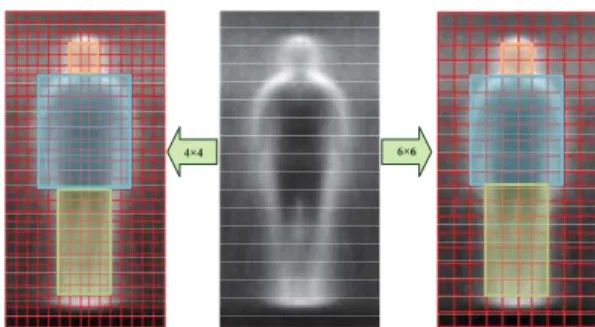
We define a pedestrian body shape based on statistical information. The INRIA dataset is arguably the most com-monly used benchmark for image-based pedestrian detec-tion. It contains annotated image patches showing pedestri-ans scaled to a height of96pixels; all patches are padded by 12 pixels in four directions in order to provide contex-tual information. We therefore perform a statistical analysis with pedestrian images of size60×120pixels. On these data, we compute an average edge map based on gradient magnitudes extracted from each sample. The resulting av-erage edge map is shown in Fig.2and clearly resembles a human body.
Features derived from rectangular image regions typi-cally allow for computational efficiency. We therefore de-cide to base our pedestrian detector on rectangular features and hence divide the edge map into squarecellswhose sizes may vary. Fig.2shows examples of cells of sizes4×4and 6×6pixels. Given these grids of cells, the whole body is approximately divided into three parts: the head, the upper body, and the lower body. This is intended to increase ro-bustness as these three parts generally appear in different colors or textures in real world images.
î
î
Figure 2: Illustration of a statistical pedestrian shape model in terms of an average edge map as shown in the middle. In this example, cell sizes are chosen to be 4×4 and6×6 pixels, respectively. Three bounding boxes approximately indicate the head, the upper body, and the lower body parts.
2.2. Generating templates
We constrain our templates to be of rectangular form as these allow for convenient implementation and efficient computation. Statistical variations are coped with by con-sidering different modalities as described in Sec. 3. First, however, we define a set of sizes
S={(w, h)|w≤wm, h≤hm, w, h∈N+}, (1) wherewandhindicate the width and height (in terms of covered cells) of a rectangular template; wm andhm are used to constrain the overall size of templates since we fo-cus on local image information.
As shown in Fig. 2, images of pedestrians available in the INRIA data consist of four logical components: back-ground, head, upper body, and lower body. We assign each cellc(i, j)to a set of labelsL(i, j)that indicate which com-ponents are found in the cell.
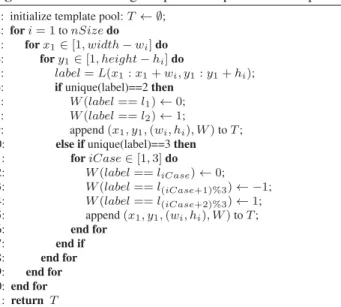
Next, for each pair of sizes inS, we slide a correspond-ing rectangular window over the whole shape model to gen-erate different templates at different positions and of differ-ent weights. At a certain position(x, y), the template to be created depends on how many different parts are contained in the rectangle. A binary template is generated if there are only two parts; ternary templates of different kinds are generated if there are three parts. Algorithm1provides de-tails as to this procedure. The resulting full template pool is given as a set:
T ={(x, y, s, W)|x, y∈N, s∈S, W ∈R2}, (2) wherexandyindicate the location of a template w.r.t. the human shape model andW is a weight matrix that is deter-mined according to the matrixLof labels for all cells.
3. Multi-modal, multi-channel Haar features
In the following, traditional Haar-like features will be re-ferred to as binary modalities as they only carry two
possi-Algorithm 1Generating templates for pedestrian shapes
1: initialize template pool:T← ∅; 2: fori= 1tonSizedo 3: forx1∈[1, width−wi]do 4: fory1∈[1, height−hi]do
5: label=L(x1:x1+wi, y1:y1+hi);
6: ifunique(label)==2then
7: W(label==l1)←0;
8: W(label==l2)←1;
9: append(x1, y1,(wi, hi), W)toT;
10: else ifunique(label)==3then
11: foriCase∈[1,3]do
12: W(label==liCase)←0;
13: W(label==l(iCase+1)%3)← −1;
14: W(label==l(iCase+2)%3)←1;
15: append(x1, y1,(wi, hi), W)toT;
16: end for
17: end if
18: end for
19: end for
20: end for 21: return T
ble weights (+1and−1) for different rectangles. However, this binary modality is ill suited to represent cusps or corner-like structures of the human silhouette. That is to say, that it hardly adapts to the description of the content of bound-ing boxes that contain three different logical components such as, say, head, upper body, and background. Yet, for efficient subsequent classification we are interested in com-puting the difference between parts w.r.t. two of them at a time. We therefore propose to consider ternary templates. An example is given in Fig.1where ternary2×2templates capture the local geometry of the image region where head, shoulders, and background meet in joint corners.
To integrate color and gradient information, we build a multi-channel descriptor for each cell. We consider a total of 10 different channels as it is done in the detector [Chn-Ftrs]: 3 channels for LUV colors, 1 channel for gradient magnitude information, and 6 channels for histograms of oriented gradients.
Assume we are given a templatet = (x, y,(w, h), W). We first count how often the weights +1and −1 appear and denote these counts asnaddandnsub. There are thus nadd additive cells andnsubsubtractive cells and we nor-malize each cell’s weight by the total number of correspond-ing cells covered by a rectangle. This results in an average weight matrix:
Wavg= sgnnadd(W)+sgnnsub(−W). (3) The feature value of any templatet for any channelk,
e.g. color or gradient information, can then be computed as a weighted sum:
f(t, k) = h
i=1 w
j=1
σ(x+i, y+j, k)Wavg(i, j), (4)
(a)
(b)
Figure 3: Illustration of representative features. (a) Cell weight map: different colors are used to indicate the accu-mulative weight of each cell after boosting. (b) Most in-formative templates: these binary and ternary rectangle fea-tures obtained high accumulative weights after boosting.
where, σ(i, j, k) denotes the sum of values in cell(i, j) along channelk.
4. Selecting features for pedestrian detection
Our detector employs the multi-modal and multi-channel Haar-like features proposed in Sec3. Note that these fea-tures are built on channel feafea-tures as in [ChnFtrs], but inter-pret local differences between rectangular regions over mul-tiple channels rather than over channel values themselves.
We apply a fast version of AdaBoost [1] for learning since it offers a convenient and fast approach to select from a large number of candidate features. We apply 2048 deci-sion trees of depth 2 to build our final strong classifier. Ini-tial negative training samples are randomly generated and, afterwards, hard negative samples are searched for three rounds over all negative example images so as to collect 20,000 negative samples in total. This multi-round training strategy is pivotal as it leads to a better performance than a simple one round training procedure with the same number of negative samples. From our experiments, three rounds of retraining were observed to yield optimal performance; additional rounds did not show significant improvements.
In order to look into which features are more informa-tive, we plot a weight image of the top 100 features as shown in Fig.3a. To generate this figure, we add the weight of each feature to the cells it covers and use different col-ors to indicate the accumulative weight of each cell after boosting. As expected, the head-shoulder area of the hu-man body shows to be more discriminative for pedestrian detection than other body parts.
The most discriminative binary and ternary templates de-termined by the boosting algorithm are then used for pedes-trian detection in still images. To this end, we slide a win-dow over the whole image and consider multiple scales. The spatial step size is set identical to the cell size for speed and the scale step is set to be1.09so that there are8scales in each octave. We use a simplified non-maximal suppres-sion (NMS) procedure [8] to suppress nearby detections.
5. Experiments
Experiments are conducted on two public benchmark datasets: the INRIA pedestrian dataset [5] and the Caltech pedestrian dataset [10]. The INRIA data is arguably the most popular dataset for people detection and comes along with pre-defined subsets for training and testing. The Cal-tech data is the largest and most challenging dataset for pedestrian detection and we consider subsets set00 - set05 for training and subsets set06 - set10 for testing.
5.1. Implementation details
To optimize our detector, we analyze the influences of different parameter settings. Next, we present various ex-perimental results on the INRIA dataset.
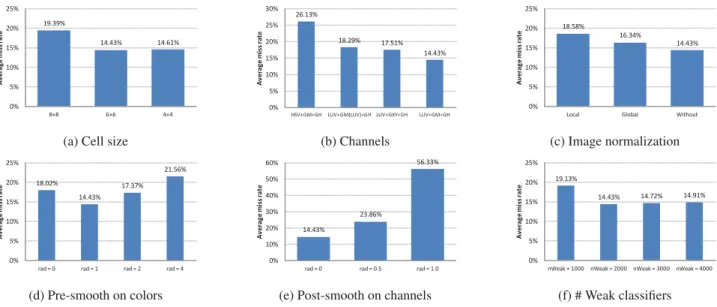
Cell size: the pedestrian body shape can be covered by arrays of different cell sizes as shown in Fig.2. We present experimental results for cell sizes of4×4,6×6and8×8. From Fig.4a, we find that a cell size of6×6pixels produces the best results so we choose it as our default setting.
Channels: we plot the performance of various channel combinations. As gradient histograms have been shown as the most informative channels in [8], we only try alter-natives for color and gradient magnitude channels. From Fig.4b it appears that LUV color channels are more dis-criminative than HSV channels, both are commonly used in this area; using three gradient magnitude channels (one for each color channel) or two gradient components (along the xandy directions respectively) lead to slight decrease in performance rather than improvements.
Image normalization: we analyze the influence of in-tensity normalization on our features as previous works on rectangular features typically employ various ways of nor-malization. [VJ] [24] used local normalization inside each detection window; [Roerei] [4] reported performance im-provements by applying global normalization on the input images. However, according to the results in Fig.4c, our features obtain best results without normalization.
Smoothing:while pre-smoothing input images with bi-nomial filters of radius 1 improves the performance by more than 3%, larger radii produce worse results; post-smoothing of channel features significantly decreases the performance and seems to inhibit characteristic local variations.
Number of weak classifiers: intuitively one would ex-pect more weak classifiers to lead to better performance
since decision boundaries become more accurate; on the other hand, too large number of weak classifiers may lead to overfitting of the training data. Accordingly, we find that detection performance starts to decrease slightly when the number of weak classifiers exceeds 2000.
For the results reported next, we therefore consider the following settings of our detector: cell size of6×6;channels of LUV+GM+GH; image smoothing with binomial filters of radius 1; no channel smoothing; no image normalization; 2000 weak classifiers.
5.2. Comparisons with state-of-the-art detectors
In this section, we compare our detector to other state-of-the-art detectors whose results are publicly available1. We
use the same experimental protocol as in [10] and evaluate performances in terms of ROC curves. Measurements of
average miss ratesare used to summarize the overall perfor-mances of different detectors. The overall results are pro-duced on thereasonable[10] subset of each test set which show pedestrians at a resolution of over 50 pixels in height and a visibility of at least 65%.
The results in Fig.5ashow that our detector outperforms the baseline detector [ChnFtrs] by about 8% and reaches the state-of-the-art performance. The two detectors with better results than ours consider feature pools that are more than 20 times larger and are about 100 times slower in training.
On the Caltech pedestrian dataset, our detector outper-forms not only the baseline detector [ChnFtrs] by about 20% but also yields the overall best performance as shown in Fig.5b. In particular, we note that it even outperforms detectors which consider additional motion information.
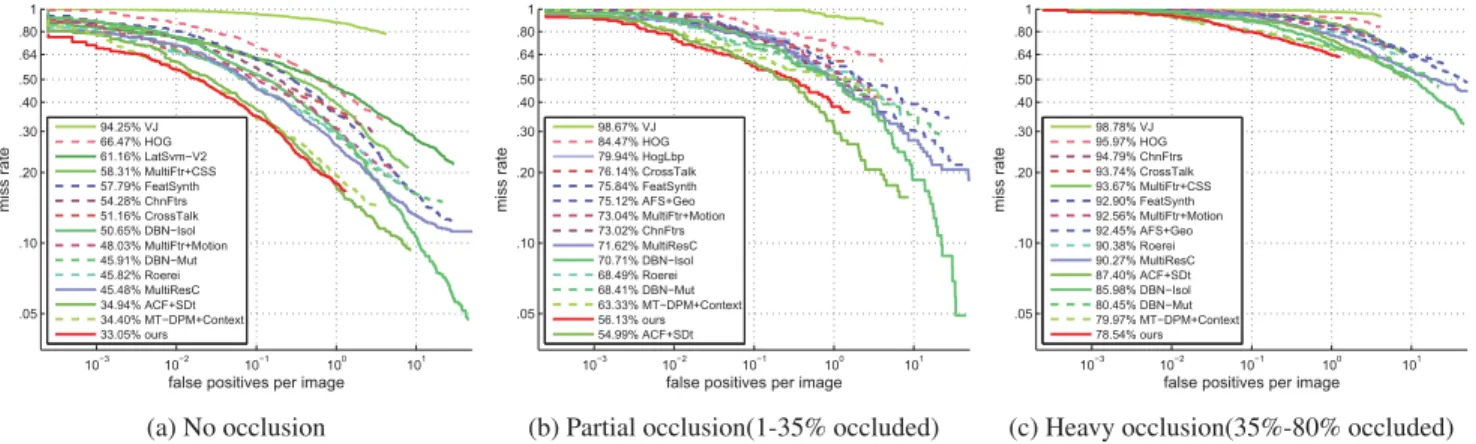
Fig.6shows evaluation results under different occlusion conditions for the Caltech pedestrian test data. As in [10], we use three occlusion levels: no occlusion (0% occluded), partial occlusion (1-35% occluded), and heavy occlusion (35%-80% occluded). The performance of all the detec-tors drops significantly as occlusion increases. Yet, our de-tector seems least affected by occlusion in the sense that it consistently ranks high for all occlusion levels. In fact, it achieves the best performance among all tested detec-tors for the cases of no and heavy occlusion and we con-clude that the informed design of our features yields robust-ness against occlusions. Notably, our detector even outper-forms those detectors that employ explicit occlusion han-dling strategies, e.g. [DBN-Isol] and [DBN-Mut], for all levels of occlusion.
5.3. Feature size and runtimes
We present our feature size with the optimal settings con-cluded from Sec.5.1. Given6×6cells and templates size ranging from1×2to4×3cells, we obtain 266 templates 1http://www.vision.caltech.edu/Image_Datasets/
ϭϵ͘ϯϵй
ϭϰ͘ϰϯй ϭϰ͘ϲϭй
Ϭй ϱй ϭϬй ϭϱй ϮϬй Ϯϱй
ϴпϴ ϲпϲ ϰпϰ
ǀ
ĞƌĂ
Ő
Ğ
ŵ
ŝƐƐ
ƌĂ
ƚĞ
(a) Cell size
Ϯϲ͘ϭϯй
ϭϴ͘Ϯϵй ϭϳ͘ϱϭй ϭϰ͘ϰϯй
Ϭй ϱй ϭϬй ϭϱй ϮϬй Ϯϱй ϯϬй
,^sн'Dн', >hsн'D;>hsͿн', >hsн'yzн', >hsн'Dн',
ǀ
ĞƌĂ
ŐĞ
ŵ
ŝƐƐ
ƌ
Ă
ƚĞ
(b) Channels
ϭϴ͘ϱϴй
ϭϲ͘ϯϰй
ϭϰ͘ϰϯй
Ϭй ϱй ϭϬй ϭϱй ϮϬй Ϯϱй
>ŽĐĂů 'ůŽďĂů tŝƚŚŽƵƚ
ǀ
ĞƌĂ
Ő
Ğ
ŵ
ŝƐƐ
ƌĂ
ƚĞ
(c) Image normalization
ϭϴ͘ϬϮй ϭϰ͘ϰϯй
ϭϳ͘ϯϳй Ϯϭ͘ϱϲй
Ϭй ϱй ϭϬй ϭϱй ϮϬй Ϯϱй
ƌĂĚсϬ ƌĂĚсϭ ƌĂĚсϮ ƌĂĚсϰ
ǀ
ĞƌĂ
Ő
Ğ
ŵ
ŝƐƐ
ƌĂ
ƚĞ
(d) Pre-smooth on colors
ϭϰ͘ϰϯй
Ϯϯ͘ϴϲй
ϱϲ͘ϯϯй
Ϭй ϭϬй ϮϬй ϯϬй ϰϬй ϱϬй ϲϬй
ƌĂĚсϬ ƌĂĚсϬ͘ϱ ƌĂĚсϭ͘Ϭ
ǀ
ĞƌĂ
Ő
Ğ
ŵ
ŝƐƐ
ƌĂ
ƚĞ
(e) Post-smooth on channels
ϭϵ͘ϭϯй
ϭϰ͘ϰϯй ϭϰ͘ϳϮй ϭϰ͘ϵϭй
Ϭй ϱй ϭϬй ϭϱй ϮϬй Ϯϱй
ŶtĞĂŬсϭϬϬϬ ŶtĞĂŬсϮϬϬϬ ŶtĞĂŬсϯϬϬϬ ŶtĞĂŬсϰϬϬϬ
ǀ
ĞƌĂ
Ő
Ğ
ŵ
ŝƐƐ
ƌĂ
ƚĞ
(f) # Weak classifiers
Figure 4: Evaluation of different parameters on the INRIA pedestrian dataset. (a) Cell sizes of the pedestrian shape model. (b) Channel combinations with color channels + gradient magnitude channels (GM) + gradient histogram channels (GH). (c) Image normalization methods. Local intensity normalization is done inside each detection window; global normalization is done for the whole input image. (d) Pre-smoothing of colors with binomial filters of different radii. (e) Post-smoothing of channels with binomial filters of different radii. (f) Number of weak classifiers.
Detector Features Classifier Training data Average miss rate INRIA Caltech
VJ[24] Haar AdaBoost INRIA 72.48% 94.73%
HOG[5] HOG linear SVM INRIA 45.98% 68.46%
Shapelet[23] gradients AdaBoost INRIA 81.70% 91.37% MultiFtr+CSS [25] HOG + CSS AdaBoost INRIA 24.74% 60.89% MultiFtr+Motion [25] HOG + CSS + motion linear SVM TUD-Motion / 50.88%
HikSvm [16] HOG HIK SVM INRIA 42.82% 73.39%
HogLbp [26] HOG + LBP linear SVM INRIA 39.10% 67.77%
LatSvm-V1 [12] HOG latent SVM PASCAL 43.83% 79.78%
LatSvm-V2 [11] HOG latent SVM INRIA 19.96% 63.26%
ChnFtrs [8] channels AdaBoost INRIA 22.18% 56.34%
FeatSynth [2] HOG + texture linear SVM INRIA 30.88% 60.16%
MultiResC [21] HOG latent SVM Caltech / 48.45%
CrossTalk [6] channels AdaBoost INRIA 18.98% 53.88%
VeryFast [3] channels AdaBoost INRIA 15.96% /
SketchTokens [15] channels AdaBoost INRIA 13.32% /
Roerei [4] channels AdaBoost INRIA 13.53% 48.35%
AFS+Geo [14] HOG + texture linear SVM INRIA / 66.76% MT-DPM+Context [28] HOG latent SVM Caltech / 37.64%
DBN-Isol [18] HOG DeepNet INRIA / 53.14%
DBN-Mut [19] HOG DeepNet INRIA / 48.22%
ACF+SDt [22] channels + motion AdaBoost Caltech / 37.34%
ours-INRIA Informed Haar AdaBoost INRIA 14.43% /
ours-Caltech Informed Haar AdaBoost Caltech / 34.60%
Table 1: Performance comparisons for state-of-the-art pedestrian detectors. Each row in this table summarizes information as to features and classifiers used in a particular approach, and displays the corresponding average performance in terms of miss rates. The approach proposed in this paper yields state-of-the-art performance on the INRIA dataset and consistently better results than previously reported on the Caltech dataset.
í í í
IDOVHSRVLWLYHVSHULPDJH
PLVVUDWH 9-+2*
+RJ/ES 0XOWL)WU&66 &KQ)WUV /DW6YPí9 &URVV7DON RXUV 5RHUHL 6NHWFK7RNHQV
(a) INRIA
í í í
IDOVHSRVLWLYHVSHULPDJH
PLVVUDWH
9-+2* $)6*HR /DW6YPí9 0XOWL)WU&66 )HDW6\QWK &KQ)WUV '%1í,VRO 0XOWL)WU0RWLRQ 0XOWL5HV& 5RHUHL '%1í0XW 07í'30&RQWH[W $&)6'W RXUV
(b) Caltech test
Figure 5: Results of different detectors on different datasets under standard evaluation settings.
at different positions. Shifting templates along 4 directions with a step of one cell yields a template pool of 1276 (some shifts are not possible at image borders); considering 10 channels, the final feature size is 12,760.
Our detector is implemented in Matlab, on an Intel Core-i7 CPU (3.5GHz). On the Caltech dataset, it takes 1 hour for training with 4 rounds and 1.6 seconds ( [ChnFtrs] 2s) for testing a640×480image using the optimal parameters as illustrated in Sec. 5.1. In addition to channel computation, our feature computation includes local sums and differenc-ing, both of which can be parallelized for further speed-up. Our detector is expected to reach real-time efficiency
run-ning on a powerful machine and with GPU computation en-abled.
6. Conclusion
We considered the problem of efficient yet robust pedes-trian detection from image data. The particular approach we presented in this paper was motivated by the observation that a current trend in work on pedestrian detection consists in analyzing feature vectors of ever increasing dimensions which necessitate the use of powerful hardware in order to guarantee real time capability.
Also, because of the peculiar geometry of high dimen-sional spaces (concentration of measure and neighborliness) it is not necessarily guaranteed that additional efforts spent on computing high dimensions pay off in terms of recogni-tion accuracies. We therefore explored more compact fea-tures could yield state-of-the-art performance in pedestrian detection if they were designed based on prior information as to the appearance of the up-right human body.
Given a large dataset of pedestrian images, we computed a statistical shape model which proved to consist of four clearly recognizable logical components. We covered this shape model with grids of cells and slid rectangular win-dows over these cell arrays to produce a set of location spe-cific weighted binary or ternary Haar-like templates that in-corporate information as to which of the four components of the shape are covered by a rectangle.
The weighting scheme provided us with a simple mecha-nism of generating multi-modal & multi-channel Haar-like features and we applied boosting to determine the most in-formative ones. As our approach does not require comput-ing any possible configuration of rectangles within a slidcomput-ing window nor is based on random sampling of rectangle fea-tures, it marks a middle ground among recently published similar approaches. Moreover, our detector is inherently simple to implement, easy to train, and fast during runtime. In extensive experiments with standard benchmark datasets, we found our detector to achieve state-of-the-art performance on the INRIA pedestrian dataset and, for the Caltech pedestrian dataset, we found it to outperform all other recent approaches considered in our tests. In addition, our model-based rectangular features proved to be highly robust under occlusion and even outperformed methods that contain explicit mechanisms for occlusion handling.
Given these results, it appears promising to further ex-plore model driven design of efficient rectangular features. Immediate extensions of the approach presented in this pa-per could be to incorporate additional channels such as mo-tion informamo-tion. More challenging extensions consist in adapting our scheme to scenarios where the objects to be detected show higher intra-class variations.
í í í
IDOVHSRVLWLYHVSHULPDJH
PLVVUDWH
9-+2* /DW6YPí9 0XOWL)WU&66 )HDW6\QWK &KQ)WUV &URVV7DON '%1í,VRO 0XOWL)WU0RWLRQ '%1í0XW 5RHUHL 0XOWL5HV& $&)6'W 07í'30&RQWH[W RXUV
(a) No occlusion
í í í
IDOVHSRVLWLYHVSHULPDJH
PLVVUDWH
9-+2* +RJ/ES &URVV7DON )HDW6\QWK $)6*HR 0XOWL)WU0RWLRQ &KQ)WUV 0XOWL5HV& '%1í,VRO 5RHUHL '%1í0XW 07í'30&RQWH[W RXUV $&)6'W
(b) Partial occlusion(1-35% occluded)
í í í
IDOVHSRVLWLYHVSHULPDJH
PLVVUDWH
9-+2* &KQ)WUV &URVV7DON 0XOWL)WU&66 )HDW6\QWK 0XOWL)WU0RWLRQ $)6*HR 5RHUHL 0XOWL5HV& $&)6'W '%1í,VRO '%1í0XW 07í'30&RQWH[W RXUV
(c) Heavy occlusion(35%-80% occluded)
Figure 6: Evaluation results under different occlusion conditions on the Caltech pedestrian test dataset.
References
[1] R. Appel, T. Fuchs, P. Doll´ar, and P. Perona. Quickly boost-ing decision trees-prunboost-ing underachievboost-ing features early. In ICML, 2013.4
[2] A. Bar-Hillel, D. Levi, E. Krupka, and C. Goldberg. Part-based feature synthesis for human detection. InECCV, 2010.
6
[3] R. Benenson, M. Mathias, R. Timofte, and L. V. Gool. Pedes-trian detection at 100 frames per second. InCVPR, 2012.2,
6
[4] R. Benenson, M. Mathias, T. Tuytelaars, and L. V. Gool. Seeking the strongest rigid detector. InCVPR, 2013.2,5,6
[5] N. Dalal and B. Triggs. Histograms of oriented gradients for human detection. InCVPR, 2005.2,5,6
[6] P. Doll´ar, R. Appel, and W. Kienzle. Crosstalk cascades for frame-rate pedestrian detection. InCVPR, 2012.2,6
[7] P. Doll´ar and P. Perona. The fastest pedestrian detector in the west. InBMVC, 2010.2
[8] P. Doll´ar, Z. Tu, P. Perona, and S. Belongie. Integral channel features. InBMVC, 2009.2,5,6
[9] P. Dollar, Z. Tu, H. Tao, and S. Belongie. Feature mining for image classification. InCVPR, 2007.2
[10] P. Doll´ar, C. Wojek, B. Schiele, and P. Perona. Pedestrian detection: an evaluation of the state of the art. IEEE Trans. PAMI, 34(4):743–761, 2011.1,5
[11] P. F. Felzenszwalb, R. B. Girshick, D. McAllester, and D. Ra-manan. Object detection with discriminatively trained part-based models. IEEE Trans. PAMI, 32(9):1627–1645, 2010.
2,6
[12] P. F. Felzenszwalb, D. McAllester, and D. Ramanan. A dis-criminatively trained, multiscale, deformable part model. In CVPR, 2008.2,6
[13] J. Gall, A. Yao, N. Razavi, L. V. Gool, and V. Lempit-sky. Hough forests for object detection, tracking, and action recognition.IEEE Trans. PAMI, 33(11):2188–2202, 2011.2
[14] D. Levi, S. Silberstein, and A. Bar-Hillel. Fast multiple-part based object detection using kd-ferns. InCVPR, 2013.6
[15] J. J. Lim, C. L. Zitnick, and P. Doll´ar. Sketch tokens: a learned mid-level representation for contour and object de-tection. InCVPR, 2013.2,6
[16] S. Maji, A. C. Berg, and J. Malik. Classification using inter-section kernel support vector machines is efficient. InCVPR, 2008.6
[17] M. Oren, C. Papageorgiou, P. Sinha, E. Osuna, and T. Pog-gio. Pedestrian detection using wavelet templates. InCVPR, 1997.2
[18] W. Ouyang and X. Wang. A discriminative deep model for pedestrian detection with occlusion handling. InCVPR, 2012.6
[19] W. Ouyang, X. Zeng, and X. Wang. Modeling mutual visi-bility relationship with a deep model in pedestrian detection. InCVPR, 2013.6
[20] C. Papageorgiou and T. Poggio. A trainable system for object detection.IJCV, 38(1):15–33, 2000.2
[21] D. Park, D. Ramanan, and C. Fowlkes. Multiresolution mod-els for object detection. InECCV, 2010.6
[22] D. Park, C. L. Zitnick, D. Ramanan, and P. Doll´ar. Exploring weak stabilization for motion feature extraction. InCVPR, 2013.6
[23] P. Sabzmeydani and G. Mori. Detecting pedestrians by learn-ing shapelet features. InCVPR, 2007.6
[24] P. Viola and M. J. Jones. Robust real-time face detection. IJCV, 57(2):137–154, 2004.2,5,6
[25] S. Walk, N. Majer, K. Schindler, and B. Schiele. New fea-tures and insights for pedestrian detection. InCVPR, 2010.
2,6
[26] X. Wang and T. X. Han. An HOG-LBP human detector with partial occlusion handling. InICCV, 2009.2,6
[27] C. Wojek, S. Walk, and B. Schiele. Multi-cue onboard pedes-trian detection. InCVPR, 2009.1
[28] J. Yan, X. Zhang, Z. Lei, S. Liao, and S. Z. Li. Robust multi-resolution pedestrian detection in traffic scenes. InCVPR, 2013.6