DOI 10.1007/s11117-014-0311-7
Positivity
Bands in partially ordered vector spaces with order unit
Anke Kalauch · Bas Lemmens · Onno van Gaans
Received: 1 August 2014 / Accepted: 23 September 2014 / Published online: 9 July 2015 © The Author(s) 2015. This article is published with open access at Springerlink.com
Abstract In an Archimedean directed partially ordered vector spaceX, one can define the concept of a band in terms of disjointness. Bands can be studied by using a vector lattice coverY of X. If X has an order unit,Y can be represented as a subspace of
C(), whereis a compact Hausdorff space. We characterize bands inX, and their disjoint complements, in terms of subsets of. We also analyze two methods to extend bands inXtoC()and show how the carriers of a band and its extensions are related. We use the results to show that in eachn-dimensional partially ordered vector space with a closed generating cone, the number of bands is bounded by 1422n forn ≥ 2. We also construct examples of(n+1)-dimensional partially ordered vector spaces
with2nn+2 bands. This shows that there aren-dimensional partially ordered vector spaces that have more bands than ann-dimensional Archimedean vector lattice when
n≥4.
Keywords Band·Disjointness·Functional representation·Order unit· Partially ordered vector space·Polyhedral cone·Riesz completion
Mathematics Subject Classification 46A40·06F20
A. Kalauch
FR Mathematik, Institut für Analysis, TU Dresden, 01062 Dresden, Germany B. Lemmens
School of Mathematics, Statistics and Actuarial Sciences, University of Kent, Canterbury CT27NF, UK
e-mail: [email protected] O. van Gaans (
B
)Mathematical Institute, Leiden University, P.O. Box 9512, 2300 RA Leiden, The Netherlands
1 Introduction
Bands play an important role in the theory of vector lattices. Together with concepts such as ideals and disjointness they are widely used to study the structure of vector lattices. Bands and disjointness are closely related, as in Archimedean vector lattices bands are exactly those subspaces that coincide with their double disjoint comple-ments. In the study of operators on vector lattices there is a particular interest in operators preserving certain structures of the lattice. Especially the study of band pre-serving and disjointness prepre-serving operators is an active field of research, see e.g. [1–3,11].
If one considers vector lattices, one naturally encounters ordered spaces that are not lattices. For instance, linear subspaces of vector lattices and spaces of operators between vector lattices are partially ordered vector spaces, but not lattices, in general. It is therefore of interest to extend the theory of vector lattices and operators on them to partially ordered vector spaces.
The notion of a band is defined in partially ordered vector spaces by means of disjointness in [5]. Fundamental properties of bands in partially ordered vector spaces are shown in [6] with the aid of vector lattice covers. In [9] a functional representation method provides a vector lattice cover of an Archimedean partially ordered vector spaceXwith unit by embeddingXinto a space of continuous functionsC(), where is a compact Hausdorff space. This raises the question whether the bands inXcan be identified in terms of subsets of. In Sect.2we establish a one-to-one correspondence between the bands inXand so-called ‘bisaturated’ subsets of.
It has been shown in [6] that bands inXcan be extended to bands in a vector lattice cover of X. In Sect. 3we consider two different extension methods using disjoint complements, for which we establish the relations between the ‘carrier’ of a band in
X and the carrier of the extension of the band inC().
In Sect.4we use the results of Sect.2to investigate bands in finite dimensional spaces. We show that the results provide a method to list all bands in spaces with poly-hedral cones. Further, we prove that the number of bands in a space with a polypoly-hedral cone is bounded by a constant only depending on the dimension of the space. By a plastering approximation we extend this result to arbitrary generating closed cones.
In the remainder of this section we fix our notation.
LetX be a real vector space and let K be aconeinX, i.e.,K is awedge(x,y ∈ K, λ, μ ≥ 0 implyλx+μy ∈ K) and K ∩(−K) = {0}. In X a partial order is introduced by definingy ≥ x if and only ify−x ∈ K. In this case X is called a
partially ordered vector space. The spaceXis calleddirectedifX =K −K; in this caseK is calledgenerating. The space X isArchimedeanif for anyx,y ∈ X with
nx ≤yfor alln∈Nwe havex≤0.
For a subsetM ofX the set of all upper bounds ofM is denoted byMu. As in [4, Definition 2.1], we callM ⊆X solidif fromx∈ X,y∈Mand{x,−x}u⊇ {y,−y}u
it follows thatx ∈ M. A solid linear subspace of X is called anideal. According to [5],x,y∈ Xare calleddisjoint, in symbolsx ⊥y, if
Thedisjoint complementof a subsetMof Xis the set
Md:= {y∈ X: x⊥yfor allx∈M}.
A linear subspaceBof Xis called abandif(Bd)d =B. IfX is an Archimedean vector lattice, these notions coincide with the usual ones. In a directed Archimedean partially ordered vector space X every band is an ideal [6, Theorem 5.14], and for a subsetB ⊆Xthe setBdis a band [5, Proposition 5.5 (ii)].
Throughout the exposition we assume thatX is an Archimedean partially ordered vector space and has anorder unit u∈K, i.e., for eachx∈ Xthere existsα≥0 such that
−αu ≤x≤αu.
ThenXis directed. As usual, an order unitu∈ Kgives rise to a norm · uonX by
x u=inf{α >0: −αu≤x≤αu}.
With respect to this norm each positive linear functionalϕ: X →Ris continuous, as|ϕ(x)| ≤ϕ(u)for allx∈X with x u ≤1. In the norm dualXthe set
K:= {ϕ ∈X:ϕ(K)⊆ [0,∞)}
is a cone.
Next we recall the functional representation ofX. Denote
:= {ϕ∈K:ϕ(u)=1}.
By the Banach–Alaoglu theorem the closed unit ballBofXis w*-compact.is a w*-closed subset ofB, and hence w*-compact. Let
:= {ϕ∈:ϕis an extreme point of}.
Recall thatϕ∈isextremeifϕis not in the (relative) interior of a line-segment in, and that= ∅by the Krein–Milman theorem. In general,need not be w*-closed, not even if X is finite dimensional. ForM ⊆ Xthe w*-closure ofM is denoted by
M. Thusis a compact Hausdorff space.
In the sequel we write: X→C()to denote the linear map
((x))(ϕ)=ϕ(x)forϕ ∈. (1)
(, )is a functional representation ofX, which means thatis linear, bipositive, mapsuto the constant 1 function (which implies isometry with respect to theu-norm) and the image ofseparates the points of. Recall that a linear map :U → V, whereU andV are partially ordered vector spaces, is calledbipositiveif for every
We proceed by recalling the vector lattice cover. A linear subspaceDof a partially ordered vector spaceY isorder denseif everyh ∈Y is the greatest lower bound of the set{g ∈ D: g≥h}. Avector lattice coverof a partially ordered vector spaceX is a vector latticeYfor which there exists a bipositive linear mapi: X →Ysuch thati(X)
is order dense inY. If in addition there is no proper vector sublattice ofY containing
i(X), then(Y,i)is called aRiesz completion[7]. A Riesz completionYis unique up to isomorphism [7, Remark 3.2], and hence we may speak ofthe Riesz completionofX. The partially ordered vector spaces that have a Riesz completion are calledpre-Riesz
spaces. It is shown in [7, Theorems 1.7, 3.5, 3.7, 4.13 and Corollaries 4.9–4.11] that, among other spaces, every directed Archimedean partially ordered vector spaceXhas a Riesz completion. If, in addition, there is an order unit inX, the Riesz completion can be obtained by means of.
Theorem 1 [9, Theorem 10]Let X be an Archimedean partially ordered vector space with order unit u. Then C() is a vector lattice cover of X . Moreover, the Riesz subspace of C()generated by(X)is the Riesz completion of X .
If (Y,i)is a vector lattice cover of X, then x ⊥ y if and only if i(x) ⊥ i(y)
[5, Theorem 4.1]. In this setting, the extension property for bands is shown in [6, Proposition 5.12], namely, ifB is a band inX, then there is a band BinY such that
i(B)= B∩i(X). To describe Bby means of the functional representation, we first recall well-known results concerning ideals and bands inC(), whereis a compact Hausdorff space, cf. e.g. [12, Example 9.4]. For a setS ⊆C()thecarrier of Sis defined by
car(S)= {ω∈: there iss∈Ssuch thats(ω)=0}.
The carrier of an ideal inC()is an open subset of. Different ideals inC()may have the same carrier. For an open subsetO ofthe set IO := {s ∈ C(): ∀ω ∈
\Oone hass(ω) =0}is the largest ideal havingO as its carrier. If P is an open subset ofas well, thenIO =IP if and only ifO=P.
Recall that f,g ∈C()are disjoint if and only if for everyω∈one hasf(ω)=0 or g(ω) = 0. For every band B inC()there is an open subset O ofsuch that
B = IO, so a band is determined whenever its carrier is known. On the other hand, for an open subsetOofthe setIOis not a band, in general. An open subsetOof is calledregularly openif it equals the interior of its closure, i.e.O=int(O). Bands inC()are characterized as follows (see for instance [8, 12.7–12.9] or [12, Example 9.4]).
Proposition 2 For an open subset O ofthe ideal IO is a band if and only if O is regularly open.
We combine properties of disjointness in vector lattice covers and inC(). IfXis an Archimedean partially ordered vector space with unit andis its embedding into
x⊥yinX ⇐⇒(x)⊥(y)inC()
⇐⇒for eachϕ∈one hasϕ(x)=0 orϕ(y)=0.
Moreover, ifBis a band inX, then there exists a regularly open setO⊆such that
B= {x∈ X:ϕ(x)=0 for allϕ∈\O}.
2 Characterization of bands
We consider an Archimedean partially ordered vector spaceX with order unit and its embeddingintoC()as given in Sect.1. ForB⊆Xwe will deal with car((B)),
which we abbreviate by car(B).
Remark 3 If X = C(), whereis a compact Hausdorff space, then =and are homeomorphic, such that the carrier of B ⊆ C()defined as a subset of corresponds to the carrier of Bseen as a subset of. In that sense the definition of the carrier inX is compatible with the definition of the carrier in Sect.1.
We denote
N(B):=\car(B)= {ϕ∈: ϕ(b)=0 for allb∈B}.
For a setM ⊆we also use the notationMc:=\M. span(M)denotes the linear subspace ofXspanned byMand the affine hull ofM is given by
aff(M)=
n
i=1
αimi:n∈N, αi ∈R, n
i=1
αi =1,mi ∈M
.
ForM ⊆denote thezero set induced by Mby
Z(M)= {x ∈X:ϕ(x)=0 for allϕ ∈M}.
In the present section, we will characterize those setsM ⊆that belong to a bandB
inXin the sense thatB=Z(M)andM =N(B). We need the following notion.
Definition 4 ForM ⊆we define thesaturationofM by
sat(M):=∩span(M).
A setM ⊆is calledsaturatedifM =sat(M).
Instead of the linear span one could also use the affine hull in the definition of saturation, see Corollary7below.
Lemma 5 Let M⊆. Then the following holds:
(i) sat(sat(M))=sat(M);
(ii) Z(sat(M))=Z(M).
Proof (i) Clearly,M ⊆sat(M)and ifN ⊆is such that M ⊆ N then sat(M)⊆
sat(N). Since sat(M)⊆span(M)it follows that
span(sat(M))⊆span(M),
so that sat(sat(M))⊆sat(M). Hence sat(sat(M))=sat(M).
(ii) sat(M)⊇ M, so Z(sat(M)) ⊆ Z(M). If x ∈ Z(M), thenϕ(x)= 0 for all ϕ∈ M, soϕ(x)=0 for allϕ∈span(M). Hencex∈Z(sat(M)).
The definitions ofN(B)andZ(M), whereB ⊆X andM ⊆, are closely related
to the notion of annihilator. Indeed, N(B) = ∩ B⊥ and Z(M) = ⊥M, where
B⊥ denotes the annihilator ofB inXand⊥M the annihilator of M in X (see [10, Definition 1.10.14]). The next proposition is a variant of [10, Proposition 2.6.6(b)].
Proposition 6 Let M ⊆. Then
sat(M)=N(Z(M)).
Proof Ifϕ ∈∩span(M)andx∈ Z(M), thenϕ(x)=0, so
∩span(M)⊆ {ϕ ∈:ϕ(x)=0 for allx∈ Z(M)}
=
x∈Z(M)
{ϕ∈:ϕ(x)=0}.
Since the right hand side of the equality is a w*-closed set, it follows that
∩span(M)⊆ {ϕ∈:ϕ(x)=0 for allx∈ Z(M)}.
Vice versa, let
ψ∈\span(M).
By the Hahn-Banach theorem, there is x ∈ X such thatψ(x) = 0 and for all ϕ∈span(M)one hasϕ(x)=0. In particular,x∈ Z(M). So,
ψ /∈ {ϕ ∈:ϕ(x)=0 for allx∈ Z(M)}.
It can be observed that the saturation ofM ⊆is the largest subsetN ofsuch thatZ(N)=Z(M).
Corollary 7 Let M⊆. Thensat(M)=∩aff(M).
Proof Since aff(M)⊆span(M)one has∩aff(M)⊆∩span(M)=sat(M).
It remains to show that∩aff(M)⊇sat(M). This is clear if M = ∅, so we may assume thatMis non-empty.
Letψ ∈\aff(M). By the Hahn-Banach theorem, there existx ∈ X andγ ∈R such thatψ(x) > γ andϕ(x) ≤ γ for allϕ ∈ aff(M). Ifϕ1, ϕ2 ∈ aff(M), then
ϕ1+α(ϕ2−ϕ1)∈aff(M)for allα∈R, henceϕ1(x)=ϕ2(x), asϕ(x)≤γ for all ϕ∈aff(M). Takeϕ0∈Mandz:=x−ϕ0(x)u. Then for everyϕ∈aff(M)we have ϕ(x)=ϕ0(x), soϕ(z)=ϕ(x)−ϕ0(x)ϕ(u)=0, since aff(M)⊆. In particular,z∈ Z(M). Also,ψ(z)=ψ(x)−ϕ0(x)ψ(u)=ψ(x)−ϕ0(x) > γ−γ =0, so thatψ /∈
N(Z(M)). Hence∩aff(M)⊇N(Z(M))=sat(M), according to Proposition6.
As a preparation for the main result concerning the characterization of bands by means of subsets of, we provide some lemmas.
Lemma 8 Let B⊆X . Then Z(car(B))=Bd.
Proof Letx ∈ Z(car(B)), then for allϕ ∈car(B)one hasϕ(x)=0, which implies (x)(ϕ) = 0. Letb ∈ B. Then for allϕ ∈ \car(B)it holds thatϕ(b) = 0, so (b)(ϕ)=0. Hence(b)⊥(x), sob⊥x. Consequently,x∈Bd.
Conversely, letx ∈ Bd, i.e., for allb∈ Bone has(b)⊥(x). Letϕ∈car(B),
then there isb ∈ Bsuch thatϕ(b) =0. This implies(b)(ϕ) =0, so(x)(ϕ)=
ϕ(x)=0. Consequently,x∈ Z(car(B)).
Lemma 9 Let B⊆X . Then B⊆Z(N(B))⊆Bdd.
Proof Ifx∈ B, then for allϕ∈N(B)it holds thatϕ(x)=0, hencex∈ Z(N(B)).
Letx ∈ Z(N(B))andy ∈ Bd. Ifϕ ∈ \N(B), then there isb ∈ B such that ϕ(b)= 0, consequently(b)(ϕ)= 0, henceϕ(y)=(y)(ϕ)=0. Thus, for each ϕ ∈ we have(x)(ϕ) = ϕ(x)= 0 or(y)(ϕ)= ϕ(y) =0, thereforex ⊥ y.
Hencex ∈Bdd.
As a direct consequence of Lemma9, we obtain the following result.
Proposition 10 Let B be a band in X . Then B=Z(N(B)).
Therefore, in analogy to bands inC()(which were discussed in Sect.1), a band in
X is determined whenever its carrier is known.
Lemma 11 Let B⊆X be such that B =Z(N(B)). Then
Bd= {x∈ X:ϕ(x)=0for allϕ∈sat((N(B))c)}.
Proof Due to Lemma8, one has
Bd=Z(car(B))= {x∈ X:ϕ(x)=0 for allϕ∈(N(B))c}.
Let x ∈ X be such that for all ϕ ∈ (N(B))c one has ϕ(x) = 0, and let ψ∈sat((N(B))c)=∩span((N(B))c). Then it is straightforward thatψ(x)=0,
The next definition introduces those saturated subsets ofthe zero sets of which turn out to be bands. Just as a band and its disjoint complement, also such saturated subsets appear in pairs. The ensuing definition makes sense in the more general setting of a topological vector space E (instead of X) and a subsetV of E (instead of). With hindsight and in view of Corollary7, we call a subsetM ofV saturated(inV) if
M=sat(M):=V ∩aff(M).
Definition 12 LetEbe a topological vector space and letVbe a subset ofE. A subset
M ofV is calledbisaturated(inV) if
M =V ∩aff(V\(V ∩aff(V\M))).
For two subsetsM1andM2ofV the set{M1,M2}is called abisaturated pair(inV) if
M1=V∩aff(V\M2) and M2=V ∩aff(V\M1).
For a subset M of V we abbreviate Mc := V\M. Note that a set M ⊆ V is bisaturated if and only if
M =sat((sat(Mc))c),
and for two subsetsM1,M2⊆V the set{M1,M2}is a bisaturated pair if and only if
M1=sat(M2c)andM2=sat(M1c).
Clearly, every bisaturated subset ofV is saturated. For an example of a saturated set which is not bisaturated see Example36below. Next we give an example of a bisaturated set.
Example 13 ConsiderX =C[0,1](soconsists of the point evaluations and can be identified with[0,1]), and
B= x ∈C[0,1]:x(t)=0 for allt∈12,1. We claim that the setN(B)=12,1is bisaturated. Indeed,
sat((N(B))c)=0,12,
so
sat[(sat[(N(B))c])c] =12,1=N(B).
The next lemma relates bisaturated sets and bisaturated pairs in V, whereV is a subset of a topological vector space E, and provides a geometric description of bisaturated sets. Observe that for a bisaturated pair{M1,M2}inV we have
M1∪M2=V, (2)
sinceM1∪M2=M1∪sat(M1c)⊇M1∪M1c=V.
Lemma 14 For two saturated sets M1,M2 ⊆ V the following four statements are
equivalent.
(a) M1is bisaturated and M2=sat(M1c); (b) {M1,M2}is a bisaturated pair;
(c) aff(M1)=aff(V\M2)andaff(M2)=aff(V\M1);
(d) there exist affine subspaces S1and S2of E such that
V ⊆S1∪S2, S1=aff(V\S2), S2=aff(V\S1), Mi =V ∩Si, i =1,2.
Proof (a)⇒(b):M1is bisaturated, soM1=sat((sat(M1c))c)=sat(M2c). (b)⇒(c): We have
M2=V ∩aff(M1c)⊆aff(M1c), so aff(M2)⊆aff(M1c). Also,
M2=V ∩aff(M1c)⊇V ∩M1c=M1c,
so aff(M2)⊇aff(M1c). Hence aff(M2)=aff(M1c). Similarly, aff(M1)=aff(M2c). (c)⇒(d): Choose Si = aff(Mi), i = 1,2. Since Mi is saturated, Mi = V ∩
aff(Mi)=V ∩Si. Hence
S1=aff(M1)=aff(V\M2)=aff(V\(V ∩S2))=aff(V\S2) and, similarly,S2=aff(V\S1).
(d)⇒(a): SinceV\M1=V\(V∩S1)=V\S1, we have
M1=V ∩S1=V ∩aff(V\S2)=V ∩aff
V\aff(V\S1)
=V ∩aff
V\aff(V\M1)
=V ∩aff
V\
V ∩aff(V\M1)
=sat((sat(M1c))c),
thusM1is bisaturated.
Proposition 15 Let M1,M2 ⊆ be saturated sets and B1 = Z(M1)and B2 =
Z(M2). Then{M1,M2}is a bisaturated pair if and only if B1=B2dand B2=B1d.
Proof Let{M1,M2}be a bisaturated pair. To show that B2 ⊆ B1d, let x1 ∈ B1,
x2 ∈ B2. For all ϕ ∈ M1 one has (x1)(ϕ) = 0 and for all ϕ ∈ M2 one has (x2)(ϕ)=0. SinceM1∪M2 ⊇, it follows that(x1)⊥(x2), which implies
x1⊥x2. HenceB2⊆B1d.
Vice versa, let x ∈ B1d. Then for every y ∈ B1 we have x ⊥ y and hence (x)⊥(y). Therefore,(x)(ϕ)=0 for every
ϕ∈car(B1)=\N(B1)=\M1,
due to Proposition6. Thus,(x)(ϕ)=ϕ(x)=0 for every
ϕ∈sat(car(B1))=sat(\M1)=M2.
Hencex ∈Z(M2)=B2. ThereforeB1d=B2and, by symmetry,B2d=B1. IfB2=B1d, then due to Proposition6,
\M1=\N(Z(M1))=\N(B1)=car(B1), so, by Lemma8,
Z(\M1)=Z(car(B1))=B1d. Again by Proposition6,
M2=N(Z(M2))=N(B2)=N(B1d)=N(Z(\M1))=sat(\M1). By symmetry,{M1,M2}is a bisaturated pair.
We arrive at the main result in this section. The assumption in the theorem is natural due to Proposition10.
Theorem 16 Let B⊆X be such that B=Z(N(B)). Then B is a band if and only if N(B)is bisaturated.
Proof Suppose that B1 := B = Z(N(B)) is a band. Define M1 := N(B) and
M2:=sat(M1c). Then by Lemma11,B2:= B1d = Z(M2). Hence by Proposition
15,{M1,M2}is a bisaturated pair. SoN(B)is a bisaturated set, according to Lemma
14.
Conversely, let M1 := N(B)be bisaturated and let B1 := B = Z(N(B)). Let
M2 := sat(M1c). Then, by Lemma14,{M1,M2}is a bisaturated pair. Let B2 :=
3 Extension of bands
LetX be a pre-Riesz space and let(Y,i)be a vector lattice cover ofX, for instance its Riesz completion. Recall thatu ⊥vinX is equivalent toi(u)⊥i(v)inY, such that forM ⊆X we havei(Md)=i(M)d∩i(X).
IfBis a band inX, then there are two natural procedures to construct a bandBin
Y such that
B∩i(X)=i(B). (3)
They are as follows:
(I) B:=(i(Bd))d. In [6, Proof of Proposition 5.12] it is shown that (3) is satisfied. (II) B:=(i(B))dd. In this case, the subsequent statement shows (3).
Proposition 17 (a) If B ⊆X , then i(B)dd∩i(X)⊆i(Bdd).
(b) If B is a band in X , then i(B)dd∩i(X)=i(B).
Proof (a) Letx∈i(B)dd∩i(X). Fory∈i(Bd)=i(B)d∩i(X)we havex⊥y, so
x∈i(Bd)d∩i(X)=i(Bdd).
(b) Clearly,i(B)⊆i(B)dd∩i(X). AsB=Bdd, (a) completes the proof.
The bandBin (II) is the smallest band inYextendingBin the sense of (3). Indeed, if
Fis a band inYwithF∩i(X)=i(B), thenFd ⊆i(B)d, soF=Fdd ⊇i(B)dd =B.
We further analyze procedures (I) and (II) in the case thatYis given by the functional representation as a subspace ofC(). B and B are determined by means of their carriers, so it is natural to ask how car(B)and car(B)are related and how to determine car(B)if car(B)is known.
For every bandFinC()extendingBone has
car(B)⊆car((B)dd)⊆car(F),
since (B)dd corresponding to (II) is the smallest band extending B. In general, car(B)and car((B)dd)may differ, as the next example shows.
Example 18 Let
X = x∈C[−1,1]:x(0)=12(x(−1)+x(1)).
The functionu=1 is an order unit inX, socan be identified with[−1,0)∪(0,1], andwith[−1,1]. Let
B= {x∈X:x(1)=0 andx(t)=0 for allt ∈ [−1,0]}.
Then
Furthermore,B=Bdd, soBis a band inXwith car(B)=(0,1). InC(), we obtain
(B)d= x∈C(): x(t)=0 for allt ∈ [0,1]
and
(B)dd = x∈C():x(t)=0 for allt ∈ [−1,0],
so car((B)dd)=(0,1] =car(B).
Let us investigate procedure (I) in more detail. To determine car((Bd)d)by means of car(B), we need the following identity.
Lemma 19 For a subset M ⊆X one hascar((M)d)=car(M)c.
Proof Fors∈C()one hass∈(M)dif and only ifs(ϕ)=0 for allϕ∈car(M),
which is equivalent tos(ϕ)=0 for allϕ ∈car(M). Hence car((M)d)⊆car(M)c. Ifψ∈car(M)c, then by Urysohn’s lemma there existss∈C()such thats(ψ)=0 ands(ϕ)=0 for allϕ∈car(M), sos∈(M)d. Therefore car((M)d)⊇car(M)c.
Theorem 20 For a band B in X , the carrier of(Bd)dis given by
car((Bd)d)=
(sat(car(B)))cc,
and(Bd)dis the largest ideal with carrier
(sat(car(B)))cc.
Proof Due to Lemmas11and5(ii), we have
Bd=Z(sat(N(B)c))=Z(N(B)c).
Then Proposition6implies
N(Bd)=sat(N(B)c)=sat(car(B)),
hence car(Bd)=(sat(car(B)))c. Applying Lemma19withM = Bdcompletes the
proof.
We proceed by discussing procedure (II). First we show that the carrier ofBand the carrier ofB have the same closure (in other words, the supports ofB andBare the same).
Proposition 21 For a band B in X one hascar(B)=car((B)dd).
Proof We know that car(B)⊆car((B)dd), so car(B)⊆car((B)dd).
Vice versa, suppose there is ϕ0 ∈ car((B)dd)\car(B). By Urysohn’s lemma,
then(b)(ϕ) = ϕ(b) = 0 for allϕ ∈ \car(B), so x ⊥ (b)for allb ∈ B. Hence x ∈ (B)d. Since ϕ0 ∈ car((B)dd)and x(ϕ0) = 0, there existsϕ1 ∈
car((B)dd)such thatx(ϕ1)=0. Moreover, there isy∈(B)dd such thaty(ϕ1)=
0. This implies x ⊥ y, which contradicts x ∈ (B)d, y ∈ (B)dd. Thus car(B)
=car((B)dd).
Since (B)dd is a band in C(), the set car((B)dd) is regularly open, i.e. car((B)dd)=int(car((B)dd)). Now apply Proposition21to obtain the following
result.
Theorem 22 For a band B in X , the carrier of(B)dd is given by
car((B)dd)=int(car(B)),
and(B)ddis the largest ideal with carrierint(car(B)).
Remark 23 car((B)dd)is the smallest regularly open set containing car(B). Indeed,
int(car(B)) is a regularly open set, car(B) ⊆ car(B) and car(B) is open, so car(B)⊆int(car(B)). Hence int(car(B))is a regularly open set containing car(B). Let O be any regularly open set with O ⊇ car(B). Then O ⊇ car(B), so
O = int(O) ⊇ int(car(B)). So car((B)dd) = int(car(B))is the smallest regu-larly open set containing car(B).
In Example18, car((B)dd)=(0,1]is indeed the smallest regularly open set in = [−1,1]containing car(B)=(0,1).
For a bandBinX, we address the question whether the carrier ofBcan be recovered if the carrier of(B)ddis known.
Observe that every saturated subset ofis w*-closed. On the contrary, a w*-closed subset ofis not saturated, in general (note that in Example36the set{f1,f2,f3} is w*-closed but not saturated). Nevertheless, a statement similar to Proposition21is true, concerning the saturations of car(B)and car((B)dd).
Proposition 24 For a band B in X , one has
sat(car(B))=sat(car((B)dd)).
Proof First observe that for setsM,N ⊆withM = N it follows that sat(M)=
sat(N). Indeed, the continuity of the vector space operations yields spanM ⊆
span(M), hence spanM=span(M), which implies span(M)=span(N).
Now the statement follows immediately from Proposition21.
Next we reconstruct car(B)provided car((B)dd)is known.
Proposition 25 For a band B in X , one has
Proof Due to Theorem16,(car(B))cis bisaturated. By Proposition24we obtain
(car(B))c=sat((sat(car(B)))c)=sat((sat(car((B)dd)))c),
which implies the assertion.
Summing up the above results, the extension method (II) is such that car(B)and car((B)dd)have the same closure and the same saturation, and if one of the two sets is known then the other one is determined.
Where procedure (II) yields the smallest band B inY extending a band B in X, there is no largest one, in general, as the next example shows.
Example 26 Let S be the unit circle in R2 and let X be the space of restrictions to S of affine functions fromR2toRwith pointwise order on S.C(S)is a vector lattice cover of X [4, Example 2.8]. Let O1 := {(a,b) ∈ S: a > 0,b > 0}and
O2:= {(a,b)∈S:a<0,b<0}. ThenO1andO2are regularly open subsets ofS, thereforeIO1 andIO2 are bands inC(S)by Proposition2. Affine functions in IO1 or
IO2 are identically zero, hence bothIO1 andIO2 extend the band{0}inX. The only
band inC(S)larger thanIO1 andIO2 isC(S), which does not extend{0} ⊆ X.
4 Bands in finite dimensional spaces
In this section we shall see how to use the characterization of bands in terms of bisaturated sets of, given in Theorem16, to analyze the following question.
Question 27 Does there exist an a-priori upper bound for the number of bands in a finite dimensional partially ordered vector space X with a closed and generating cone K in terms of the dimension of X ? If so, what is the optimal upper bound?
Clearly the number of bands inn-dimensional partially ordered vector space is 2 if
n=1. Forn ≥2 we have the following result.
Theorem 28 The number of bands in an n-dimensional partially ordered vector space
(X,K), where is K is a closed generating cone and n≥2, does not exceed
1 42
2n
.
The proof of this result consists of two parts. First it will be shown that the upper bound holds for partially ordered vector spaces with polyhedral cones. Subsequently we use the Plastering Lemma34to show that the same upper bound holds for general cones.
non-empty interior, then eachuin the interior ofKis an order unit. Fix such au. Then there existm≥dimXfunctionals,ϕ1, . . . , ϕm ∈ Xwithϕi(u)=1 for alli, so that
K = {x∈X:ϕi(x)≥0 fori =1, . . . ,m}. (4)
The functionalsϕi define the facets ofK. Recall that afacetof a polyhedral coneK
is an (exposed) face F = {x ∈ K:ψ(x)= 0}, whereψ ∈ K, such that dimF =
dimK −1=dimX−1. Observe that
K= ϕ∈ X:ϕ(x)≥0 for allx∈ K=
i
αiϕi:αi ≥0 for alli
.
Indeed, {iαiϕi:αi ≥ 0 for alli} ⊆ K. Now if there exists ψ ∈ K withψ /∈ {iαiϕi:αi ≥0 for alli}, then we can use the Hahn-Banach separation theorem to
findz∈X=Xsuch thatψ(z) <0 andϕi(z)≥0 for alli. AsK = {x∈X:ϕi(x)≥
0 for alli}, we see thatz∈K, which is impossible, asψ∈ Kandψ(z) <0. Letbe the set of extreme points of := {ϕ ∈ K:ϕ(u) =1}. We claim that = {ϕ1, . . . , ϕm}, which is a closed set. Indeed, if there existσ andρinsuch that
λσ +(1−λ)ρ =ϕi for 0 < λ <1 and somei, thenF = {x ∈ K: ϕi(x)=0}is
contained in kerσ∩kerρ. As dimF =dimX−1, we find thatσ =αϕiandρ=βϕi
for someα, β∈R. It now follows thatσ =ϕi =ρ, asσ(u)=ϕi(u)=ρ(u).
The space X with polyhedral cone K as defined above fits in the setting of the functional representation given in Sect.1. As K is closed, X is Archimedean. By Theorem1,
:(Rn,K)→C(), x→(ϕ1(x), . . . , ϕ m(x)),
is bipositive and(Rn)is order dense inC(), whereC()is identified withRm
ordered by the standard coneRm+. By [9, Proposition 13],(Rm, )is even the Riesz completion ofX.
Observe that for a setM ⊆
sat(M)=∩aff(M).
Remark 29 Since every subset ofis regularly open, we know that Bis a band in the vector latticeRm ordered by the standard cone if and only if there exists N ⊆ {1, . . . ,m}such that
B=
(x1, . . . ,xm)T:xi =0 for alli ∈ N
. (5)
Moreover, by Theorem22, a bandBinXsatisfies car(B)=car((B)dd).
Theorem 30 The number of bands in an n-dimensional partially ordered vector space X ordered by a generating polyhedral cone K does not exceed 1422n, provided n≥2.
By using Theorem16, the proof of Theorem30 reduces to a purely combinatorial problem concerning polytopes. Indeed, note that in the setting above, the set is a closed convex polytope in the(n −1)-dimensional affine hyperplane H = {ϕ ∈ X:ϕ(u)=1}with vertex setV = {ϕ1, . . . , ϕm}. From Theorem16we know thatB
is a band inX if and only ifN(B)is a bisaturated set in. Therefore the number of bands equals the number of bisaturated sets.
Given a finite setV inX, Definition12entails that a setS⊆Vis bisaturated inV
if and only if
S =V ∩aff(V\(V ∩aff(V\S))),
and{S,T}is a bisaturated pair inV if and only if
S=V∩aff(V\T) and T =V ∩aff(V\S).
Thus, to prove Theorem30it suffices to show the following combinatorial statement.
Theorem 31 In a vertex set V of a polytope P inRn−1, with n≥2, there are at most
1 42
2n
bisaturated sets.
Proof Suppose that there exists a polytope P inRn−1withq bisaturated sets in the vertex setVofP. We wish to show thatq≤ 1422n. Without loss of generality we may assume that P is chosen such that the number of its vertices is minimal among the cardinalities of the vertex sets of polytopes inRn−1with at leastqbisaturated sets.
Claim 1For eachk-dimensional affine subspaceUinRn−1, with 1≤k≤n−1, we have that
|V∩U| ≤2k+1−2.
Assuming the claim for the moment, we see thatV has at most 2n−2 points, so the number of bisaturated sets ofPcannot exceed 22n−2. So, it remains to prove the claim. Obviously, the claim is true fork=1, as no three vertices ofPlie on a line.
For the sake of contradiction, assume that there exists ak-dimensional affine sub-spaceU, withk≥2, such that
|U∩V|>2k+1−2. Now takek≥2 as small as possible.
Claim 2For eachW ⊆V with|W ∩U|>2k−2, we have thatU ⊆affW.
We continue the proof of Claim 1 and fixu∈ V ∩U. To arrive at a contradiction we show that the polytopePwith vertex setV=V\{u}has the property that ifSis a bisaturated set inV, thenS=S\{u}is a bisaturated set inV. Moreover,Vcontains at least as many bisaturated sets asV. The last statement contradicts the minimality assumption on the number of vertices of P.
Let{S,T}be a bisaturated pair ofV, and writeS=S\{u}andT=T\{u}. Then sinceS∪T = V, either|S∩U| > 2k −1 or|T ∩U| > 2k −1. Without loss of generality we may assume that|S∩U|>2k−1. ThenU∩V ⊆S, asU ⊆affS(by Claim 2) andV ∩affS =S, and henceu∈ S. This implies thatV\S =V\S; so,
T=T\{u} =V∩aff(V\S)\{u} =V∩aff(V\S)=V∩aff(V\S).
To show thatS = V∩aff(V\T)we distinguish two cases:u ∈ T andu ∈/ T. If
u ∈T, then
S=S\{u} =V∩aff(V\T)=V∩aff(V\T).
On the other hand, ifu ∈/ T, then|T ∩U| ≤2k−2. Indeed,|T ∩U| >2k−2 by means of Claim 2 impliesU ⊆affT, so thatU∩V ⊆V ∩affT =T, which shows thatu ∈ T. Thus|(V\T)∩U| ≥ 2k, which implies that|(V\T)∩U| >2k−2. Again by Claim 2, it follows thatU⊆aff(V\T); in particular,u∈aff(V\T). So,
S=S\{u} =V∩aff(V\T)=V∩aff(V\T).
We conclude that{S,T}is a bisaturated pair ofP.
It remains to show that Phas at least as many bisaturated sets as P. Recall that for each bisaturated setSof P,S=S\{u}is a bisaturated set ofP. So, it suffices to show that ifSis a bisaturated set ofPandu ∈S, thenSis not a bisaturated set ofP. Assume that both SandSare bisaturated sets of P. Note that if|S∩U|>2k−1, then|S∩U|>2k−2. But this implies (by Claim 2) thatU ⊆aff(S), soV ∩U⊆ V∩affS=S, which is impossible, asu ∈/S. Now assume that|S∩U| ≤2k−1;
so|(V\S)∩U| ≥2k >2k−1 and then (by Claim 2 for the last time)U ⊆aff(V\S). LetT = V ∩aff(V\S)and R = V ∩aff(V\S). Obviously, if we can show that
T = R, then it follows thatS = S and we are done. Note that, asu ∈ aff(V\S), aff(V\S)=aff(V\S), and henceT =R.
We next generalize the upper bound in Theorem30for the polyhedral case to the general finite dimensional case. LetX be a finite dimensional vector space andK a generating closed cone inX. We denote by(X,K)the partially ordered vector space
X ordered by K. We fix an interior pointu of K and consider the corresponding functional representation(, )as in Sect.1. Given bandsB1,B2, . . . ,Bqin(X,K),
the idea now is to construct a polyhedral coneLinXcontainingKsuch that eachBi
is a band in(X,L). The construction uses the characterisation of bands by means of
bisaturated sets ofand the following two technical lemmas.
next lemma says that the pair of their saturations inW = W1∪W2is a bisaturated pair inW.
Lemma 32 Let{M1,M2}be a bisaturated pair in. If W1⊆\M2and W2⊆\M1
are such that
aff(Wi)=aff(Mi),for i =1,2,
and if F is a closed subset ofwith W1∪W2⊆F , then for the sets
Ni :=F∩aff(Wi),with i=1,2,
the pair(N1,N2)is bisaturated in F . Proof We have
F\N1=F\(F∩aff(W1))=F∩(\aff(W1))
=F∩(\(∩aff(M1)))=F∩(\M1)=F\M1,
asM1is saturated in, so
aff(F\N1)=aff(F\M1).
On the one hand,F\M1⊆\M1; so,
aff(F\M1)⊆aff(\M1)=aff(M2)=aff(W2),
by Lemma14. On the other hand,
F\M1=F∩(\M1)⊇F∩W2=W2, so that aff(F\M1)⊇aff(W2). Thus
aff(F\N1)=aff(F\M1)=aff(W2)
and therefore
F∩aff(F\N1)=F∩aff(W2)=N2.
Similarly,F∩aff(F\N2)=N1.
Lemma 33 If B is a subspace of a finite dimensional vector space, then
Proof DenoteC=aff{ϕ∈:ϕ(x)=0 for somex ∈ B}. Since⊆, aff(C)⊆
aff(car(B)). The affine subspace aff(C)is finite dimensional, hence closed, so it contains the closure ofC. It remains to show that car(B)⊆C.
Ifϕ∈andx∈Bare such thatϕ(x)=0, then there are(ϕα)αinwithϕα→ϕ (in weak* topology) and thenϕα(x)=0 forαlarge. Thereforeϕα ∈C forαlarge, soϕ∈C. Thus aff(car(B))⊆aff(C)=aff(C).
Now we are in a position to present the plastering lemma.
Lemma 34 Let(X,K)be a finite dimensional partially ordered vector space with a closed generating cone K . For any choice of bands B1, . . . ,Bqin(X,K), there exists a closed generating polyhedral cone L in X with K ⊆ L such that Bi is a band in
(X,L)for all i=1, . . . ,q.
Proof Due to Proposition 10, Bi = Z(N(Bi)) and Bid = Z(N(Bid)) and then according to Proposition6the setsN(Bi)andN(Bid)are saturated. By Proposition
15, it follows that{N(Bi),N(Bid)}is a bisaturated pair in. By definition,
car(Bi)=\N(Bi) and car(Bid)=\N(Bid).
Choose, with the aid of Lemma33, finite sets
Ui ⊆car(Bi)∩andVi ⊆car(Bid)∩
such that aff(Ui)=aff(car(Bi))and aff(Vi)=aff(car(Bid)). Define
F:= N
i=1
(Ui ∪Vi)
andL := {x∈ X: ϕ(x)≥0 for everyϕ ∈ F}. Since for eachi,{N(Bi),N(Bid)}is a bisaturated pair, we obtain
∩aff(Ui ∪Vi)⊇∩aff(Ui)=∩aff(car(Bi)) =∩aff(\N(Bi))=N(Bid)
and, similarly,∩aff(Ui∪Vi)⊇N(Bi), which implies
=N(Bi)∪N(Bid)⊆∩aff(Ui ∪Vi),
due to (2). Hence ⊆ aff(F), so thatL is a cone. Also, since F ⊆ , we have
L ⊇ K, so that L is generating. Moreover, the order unitu of(X,K)is an interior point ofK, hence an interior point ofLand therefore an order unit in(X,L).
Every element ofFis an extreme point of
Indeed, ifϕ ∈ F, 0< λ <1, andϕ1, ϕ2 ∈L are such thatϕ =λϕ1+(1−λ)ϕ2,
thenϕ ∈andϕ1, ϕ2∈, soϕ1=ϕ2=ϕ, asconsists of extreme points of. In conclusion, L is a generating polyhedral cone in X,u is an order unit in(X,L),
andF is the set of extreme points ofL.
It remains to show that for eachithe subspaceBiis a band in(X,L). For 1≤i ≤N
we have
Ui ⊆car(Bi)=\N(Bi),
Vi ⊆car(Bid)=\N(Bid),
and, since{N(Bid),N(Bi)}is a bisaturated pair in,
aff(Ui)=aff(car(Bi))=aff(\N(Bi))=affN(Bid),
aff(Vi)=aff(N(Bi)).
According to Lemma 32, the saturations in F of the sets Ui and Vi constitute a bisaturated pair inF, so that, according to Proposition15,Z(Ui)andZ(Vi)are bands in(X,L)andZ(Ui)d =Z(Vi).
Finally, by Lemma5(ii),
Z(Ui)=Z(sat(Ui))=Z(sat(car(Bi)))=Z(sat(\N(Bi))),
henceZ(Ui)=Bidby Lemma11. Similarly,Z(Vi)=Bi. It follows that everyBi is
a band in(X,L).
A combination of Theorem30and Lemma34yields Theorem28. We believe that the upper bound in Theorem28is far from optimal. The following example shows that there exist(n+1)-dimensional partially ordered vector spaces with2nn+2 bands. In particular, it follows that there exist partially ordered vector spaces with dimension
n≥4 that have more bands than ann-dimensional Archimedean vector lattice, which has 2nbands.
Example 35 LetP be a polytope inRnwith vertex setV = {v1, . . . , v2n}that is in general linear position, i.e., for each affine subspaceU ⊂Rn with dimU < n we have that |V ∩U| ≤ dimU +1. In other words, there are no 3 points in V on a line, no 4 points inV in a plane, etc. To show existence of such a setV, letn ≥ 1 and Sn−1 be the unit sphere inRn. Choose uniformly at randomv1, . . . , v2n from Sn−1. Then the convex hull of{v1, . . . , v2n}is, with probability 1, a polytope,P, with non-empty interior. If necessary apply a translation, so that 0 is in the interior of P. By construction, the vertex setV = {v1, . . . , v2n}ofPis in general linear position.
Fori =1, . . . ,2nletwi =(vi,1)∈Rn×R=Rn+1and define KV = {x∈Rn+1: wi,x ≥0 for alli =1, . . . ,2n}.
Here·,·denotes the usual inner-product onRn+1. Asw1, . . . , w2nspanRn+1,KVis
= {z∈ KV : z,u =1} = {z∈ KV :z=(v,1)andv∈P}
and= {w1, . . . , w2n}, asVis in general linear position. Moreover, ifUis an affine subspace ofRn+1contained inwith dimU <n, then|∩U| ≤dimU+1.
Next we prove that (Rn+1,KV)has2nn+2 bands by showing that S ⊆ is bisaturated if and only if S = ∅,S = , or|S| = n. Clearly, if S is a bisaturated set inand|S| > n, then dimS > n−1, asV is in general linear position. So,
S =∩affS=. Likewise, ifSis bisaturated inand|S|<n, then|\S|>n, and henceS= ∅.
On the other hand, if|S| =n, then dim(S)=n−1 and dim(\S)=n−1, asV
is in general linear position. This implies that
|∩affS| ≤dim(aff(∩affS))+1=dim(S)+1=n= |S|,
and since∩affS⊇Sit follows that∩affS=S. Similarly∩aff(\S)=\S. Thus,{S, \S}is a bisaturated pair in. It follows that(Rn+1,KV)has2nn+2 bands.
We conjecture that the optimal upper bound for the number of bands in an(n+
1)-dimensional partially ordered vector space(X,K)with closed generating cone K, is 2n
n
+2.
If the functionals{ϕ1, . . . , ϕm}determining a polyhedral coneKinRnaccording to
(4) are explicitly given, Theorem16can be used to list all bands in(Rn,K). Namely, after determining the linear dependence ofϕ1, . . . , ϕm, the saturation of every subset M of{ϕ1, . . . , ϕm}is known, and one can check whetherM is bisaturated.
Example 36 LetX =R4, define
ϕ1= ⎛ ⎜ ⎜ ⎝ 0 2 1 1 ⎞ ⎟ ⎟ ⎠, ϕ2=
⎛ ⎜ ⎜ ⎝ 2 0 1 1 ⎞ ⎟ ⎟ ⎠, ϕ3=
⎛ ⎜ ⎜ ⎝ 1 1 0 2 ⎞ ⎟ ⎟ ⎠, ϕ4=
⎛ ⎜ ⎜ ⎝ 1 1 2 0 ⎞ ⎟ ⎟ ⎠, ϕ5=
⎛ ⎜ ⎜ ⎝ 4 0 0 0 ⎞ ⎟ ⎟ ⎠
and consider K = {x ∈ R4: ϕi(x) ≥ 0 for alli ∈ {1, . . . ,5}}. Since ϕ1, ϕ2, ϕ3,
ϕ5 are linearly independent, K is a cone in R4. For u = 14(1,1,1,1)T we have ϕi(u) =1 for alli ∈ {1, . . . ,5}, thusu is an interior point of K, and we set :=
ϕ∈ K: ϕ(u)=1. A straightforward calculation shows thatϕiis an extreme point
offor alli, hence
= {ϕ1, ϕ2, ϕ3, ϕ4, ϕ5}.
Observe that span{ϕ1, ϕ2, ϕ3, ϕ4}has dimension 3. Indeed,
ϕ1+ϕ2−ϕ3−ϕ4=0,
andϕ1, ϕ2, ϕ3are linearly independent. We embed(R4,K)into(R5,R5+)under. We want to determine all bands in(R4,K). Due to Proposition10every band equalsZ(M)
for some saturated setM ⊆ {ϕ1, . . . , ϕ5}. Theorem16implies that for a saturated set
v
1v
2v
3v
4v
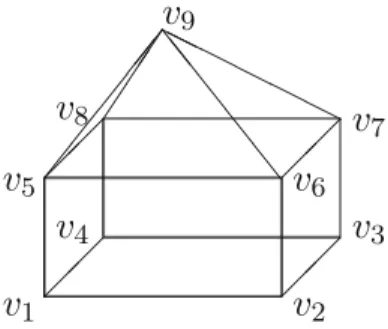
9v
5v
6v
7v
8Fig. 1 The polytopeP
the sets N ⊆ {1, . . . ,5}for which{ϕi: i ∈ N}is bisaturated:∅,{5},{1,2},{1,3}, {1,4},{2,3},{2,4},{3,4},{1,2,5},{1,3,5},{1,4,5},{2,3,5},{2,4,5},{3,4,5},
{1,2,3,4},{1,2,3,4,5}. So, we obtain 16 bands in(R4,K).
Recall that a band B in a partially ordered vector space is directed if for each
x,y ∈ B there exists z ∈ B such that x ≤ zand y ≤ z. In the examples above the partially ordered vector spaces have directed and non-directed bands, whereas in vector lattices all bands are directed. The next example shows that there exists a partially ordered vector space whose non-trivial bands are all non-directed. Here it turns out that the carriers ofBin the extension procedures (I) and (II) (see Sect. 3) differ, in contrast to the situation in Example18.
Example 37 LetPbe the polytope, with vertex setv1, . . . , v9, depicted in Fig.1. The spaceR4equipped with the polyhedral cone,
KP= {x∈R4: (vi,1),x ≥0 fori=1, . . . ,9},
has two non-trivial bands corresponding to the bisaturated sets
B1= {v1, v3, v5, v7, v9}andB2= {v2, v4, v6, v8, v9}.
Both these bands are non-directed. Also observe that car(B1) = {v2, v4, v6, v8} =
car((B1)dd) by Remark 29, whereas car((B1d)d) = {v2, v4, v6, v8, v9} by Theorem20.
It is interesting to analyze the number of directed bands in ann-dimensional partially ordered vector space(X,K). In particular, it would be nice to know the answers to
following questions. Is the number of bands Bsuch that bothBandBd are directed in an n-dimensional partially ordered vector space (X,K), with generating closed
coneK, bounded by 2n? If so, is the upper bound attained if and only if(X,K)is an
n-dimensional Archimedean vector lattice?
Open Access This article is distributed under the terms of the Creative Commons Attribution 4.0 Interna-tional License (http://creativecommons.org/licenses/by/4.0/), which permits unrestricted use, distribution, and reproduction in any medium, provided you give appropriate credit to the original author(s) and the source, provide a link to the Creative Commons license, and indicate if changes were made.
References
1. Abramovich, Y.A., Kitover, A.K.: Inverses of disjointness preserving operators. Mem. Am. Math. Soc. 679, 143 (2000)
2. Abramovich, Y.A., Kitover, A.K.: Inverses and regularity of band preserving operators. Indag. Math. N. S.13(2), 143–167 (2002)
3. Boulabiar, K.: Recent trends on order bounded disjointness preserving operators. Irish Math. Soc. Bull. 62, 43–69 (2008)
4. van Gaans, O.: Seminorms on ordered vector spaces that extend to Riesz seminorms on larger Riesz spaces. Indag. Math. N. S.14, 15–30 (2003)
5. van Gaans, O., Kalauch, A.: Disjointness in partially ordered vector spaces. Positivity10(3), 573–589 (2006)
6. van Gaans, O., Kalauch, A.: Ideals and bands in pre-Riesz spaces. Positivity12(4), 591–611 (2008) 7. van Haandel, M.: Completions in Riesz space theory, Ph.D. thesis, University of Nijmegen (1993) 8. de Jonge, E., van Rooij, A.C.M.: Introduction to Riesz Spaces. Mathematical Centre Tracts 78.
Math-ematisch Centrum, Amsterdam (1977)
9. Kalauch, A., Lemmens, B., van Gaans, O.: Riesz completions, functional representations, and anti-lattices. Positivity18(1), 201–218 (2014)
10. Megginson, R.E.: An Introduction to Banach Space Theory. Springer, New York (1998)
11. Randrianantoanina, B.: A disjointness type property of conditional expectation operators. Colloq. Math.102(1), 9–20 (2005)