Original Research Article
Effectiveness of awareness lecture in improving the knowledge about
learning disability among primary school teachers
Basim Ali C. T., Fysal N.*, Akhila Thasneem A., Aswathy P. S.
INTRODUCTION
Learning Disability (LD) is one of the most important causes of poor scholastic performance among school going children. The lack of awareness and basic knowledge about LD among primary school teachers are the biggest hurdles to identify this problem in children of developing countries like India. Along with this, inadequate human resources and improper infrastructure make this common neuro developmental problem akin to hypertension, seen only as a tip of an iceberg, rarely identified and corrected. Early identification and intervention by proper remedial measures can go a long way in improving the quality of academic skills among children with LD.
The term learning disability was first coined in 1963 by Dr. Samuel Kirk, a psychologist while delivering a speech at an education conference held in Chicago.1 He
had worked extensively with many students who were repeatedly failing in their examinations but were clearly not retarded. He observed that these so called scholastically backward students could be helped by specific methods of teaching.2 Poor school performance
or scholastic backwardness is estimated to affect one in every five school children in India.3 Specific learning
disabilities are recognized as an important cause for the scholastic backwardness even though many other reasons such as below average intelligence ,vision and hearing impairment ,chronic medical and mental disorders ,emotional problems and poor socio cultural ABSTRACT
Background: This study was done to assess the pre-existing knowledge about Learning Disability (LD) among primary school teachers and the effect of awareness lecture on improving their skills in early identification and remediation of LD among children having poor scholastic performance.
Method: The study was conducted as a part of the IAP state President’s action plan 2018-2019 “VIBGYOR”. The study sample consisted of 709 primary school teachers of government schools in Malappuram district in Kerala. The teacher’s knowledge level on LD was assessed using a questionnaire following which an awareness class was given. Their knowledge level was assessed again at the end of the class.
Results: There is a significant increase in knowledge level about learning disability among the teachers after the awareness lecture (p value<0.001).
Conclusion: This study implicates the need for intensive training programmes to primary school teachers on learning disability so as to identify it at an early stage among children with poor scholastic performance.
Keywords: Dyslexia, Knowledge, Learning disability, Scholastic
Department of Paediatrics, MES Medical College, Perinthalmanna, Kolathur, Kerala, India
Received: 16 August 2019
Revised: 24 August 2019
Accepted: 28 August 2019
*Correspondence:
Dr. Fysal N,
E-mail: [email protected]
Copyright: © the author(s), publisher and licensee Medip Academy. This is an open-access article distributed under the terms of the Creative Commons Attribution Non-Commercial License, which permits unrestricted non-commercial use, distribution, and reproduction in any medium, provided the original work is properly cited.
environments are also suggested.4 Undetected and
unmanaged special learning disability results in chronic scholastic backwardness ensue school drop outs, emotional and behavioural problems such as depression, substance abuse and social delinquency.3-9
METHODS
This interventional study was conducted among the primary school teachers of government schools in Malappuram district, Kerala, India from April 16 2018 to May 20, 2018. Convenient sampling method was adopted. The study sample consisted of 709 primary school teachers. Permission to collect data was taken from the relevant Block resource centres (BRC) in Malapuram district.
Inclusion criteria
All teachers who were attending the training program.
Exclusion Criteria
Teachers who have already attended BRC training classes on Learning Disability
Initially a test was conducted using a questionnaire following which we conducted an awareness class for 1 hour which focused on concepts about LD, some myths regarding it, tips to identify affected children earlier and steps to support them. Then a post test was conducted based on the class to assess the effectiveness of the training session.
Statistical analysis
Authors performed statistical analysis using excel. SPSS trial version 22 and Paired T test was used to compare baseline data with post intervention data. P value less than 0.05 was considered significant.
RESULTS
Among 709 study sample,56% were female and 44% were male.
Figure 1: Gender distribution of study population.
Mean score attained by the teachers significantly improved following the awareness class.
Table 1: statistical analysis of the effect of awareness class in the knowledge level among teachers.
Total Pre Total Post
Mean 7.43 10.3
N 709 709
Std. Deviation 2.179 2.783
Std. Error Mean 0.082 0.105
t value 27.346
p value <0.001
*paired t test, significant at 99% confidence level
Table 2: scores attained by teachers before and after the awareness class.
Total Pre Total Post
N 709 709
Minimum 0 0
Maximum 14 16
Mean 7.43 10.3
Std. Error 0.082 0.105
Std. Deviation 2.179 2.783
Variance 4.748 7.744
There is significant increase in knowledge about LD among the teachers after the awareness class shown by an increase in score attained by them
Figure 2: Mean score attained by teachers before and after attending the awareness class.
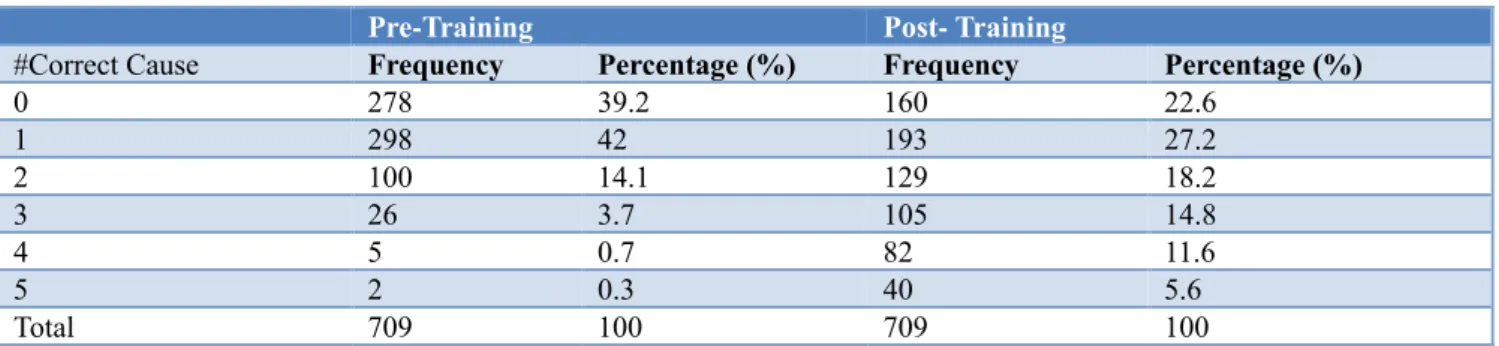
Among the study population 278(39.2%) had no knowledge about the causes of poor scholastic performance, whereas 42 % of them answered one, 14% answered two and only 2% of the participants could answer five causes of poor scholastic performance. (Table 3)
After the training 160 participants (22.6%) still couldn’t recollect the causes of poor scholastic performance, while 27.2% answered one, 18.2% answered two and 5% of the participants answered five causes correctly. Before training only 4.7% of the participants could identify 3 or MALE
44% FEMALE
56%
7.43
10.3
before awareness lecture
after awareness lecture 0
2 4 6 8 10 12
Mea
n
more causes of poor scholastic performance but after the
training 32% of the participants were able to identify 3 or more causes, demonstrating an increase in awareness among participants.
Table 3: Major causes of Poor scholastic performance.
Pre-Training Post- Training
#Correct Cause Frequency Percentage (%) Frequency Percentage (%)
0 278 39.2 160 22.6
1 298 42 193 27.2
2 100 14.1 129 18.2
3 26 3.7 105 14.8
4 5 0.7 82 11.6
5 2 0.3 40 5.6
Total 709 100 709 100
Table 4: Most commonly observed LD.
Q2 Pre-Training Post- Training
Frequency Percentage (%) Frequency Percentage (%)
0 657 92.7 467 65.9
1 52 7.3 242 34.1
Total 709 100 709 100
Table 5: Hormone essential for mental growth.
Q3 Pre-Training Post- Training
Frequency Percentage (%) Frequency Percentage (%)
0 648 91.4 240 33.9
1 61 8.6 467 65.9
Sub-Total 709 100 707 99.7
Missing - - 2 0.3
Total 709 100 709 100
Table 6: Relation between LD &intellectual disability.
Q4 Pre-Training Post- Training
Frequency Percentage (%) Frequency Percentage (%)
0 113 15.9 140 19.7
1 596 84.1 569 80.3
Total 709 100 709 100
Before training only 7.3 % of the participants were able to answer correctly that Dyslexia was the most common learning disorder. After the training session this increased multi-fold to 34.1% (Table 4).
Only 8.6% of the participants could state that “Thyroid Hormone” is the most essential hormone for mental growth. But after the class 65.9% could respond to it correctly (Table 5).
Out of 596 (84.1%) participants correctly mentioned that learning disability is not due to intellectual disability. But, after training this slightly reduced to 569 (80.3%),
displaying that though more than 4 in 5 participants still correctly understood this concept, the training could still have improved in clarifying this important aspect (Table 6).
Out of 505 (71.2%) teachers believed that Learning Disorder was not caused due to impairment in Communication skills. But after the Training session this understanding slightly reduced to 496 (70%) participants, displaying that though 70% of the participants still correctly understood this concept, the training could still improve on explicitly clarifying this important concept
Three-fourths (75.3%) of the study population correctly
stated that Learning Disability is treatable. After the Training session this awareness was increased to 84.3%. (Table 8).
Table 7: Is Learning disorder due to impairment in communication skill?
Q5 Pre-Training Post- Training
Frequency Percentage (%) Frequency Percentage (%)
0 204 28.8 213 30
1 505 71.2 496 70
Total 709 100 709 100
Table 8: Is LD treatable?
Q6 Pre-Training Post- Training
Frequency Percentage (%) Frequency Percentage (%)
0 175 24.7 111 15.7
1 534 75.3 598 84.3
Total 709 100 709 100
Table 9: Higher education possible or not.
Q7 Pre-Training Post- Training
Frequency Percentage (%) Frequency Percentage (%)
0 94 13.3 56 7.9
1 615 86.7 653 92.1
Total 709 100 709 100
Table 10: Should students with LD sent to “Special Schools”?
Q8 Pre-Training Post- Training
Frequency Percentage (%) Frequency Percentage (%)
0 151 21.3 110 15.5
1 558 78.7 598 84.3
Total 709 100 708 99.9
Table 11: Should children with LD be given more time for writing an exam?
Q9 Pre-Training Post- Training
Frequency Percentage(%) Frequency Percentage(%)
0 137 19.3 58 8.2
1 572 80.7 651 91.8
Total 709 100 709 100
Table 12: Association between LD and ADHD.
Q10 Pre-Training Post- Training
Frequency Percentage (%) Frequency Percentage (%)
0 304 42.9 182 25.7
1 405 57.1 527 74.3
Total 709 100 709 100
A significant majority of the participants (86.7%) believed that Children with Learning Disability could
A decisive majority (78.7%) of the respondents felt that students with learning disability did not need “Special Schools” for education. After the awareness lecture this understanding further increased to 84.3%. (Table 10)
Before training, almost 4 in 5 (80.7%) of the respondents felt that students with learning disability should be given
more time to complete their exams. After the training session this increased to 91.8%. (Table 11)
Before training, more than half of the participants (57.1%) answered that there was a relation between learning disability and ADHD. After the Training session this understanding further increased to 74.3% (Table 12).
Table 13: Is anxiety more commonly observed in children with LD?
Q11 Pre-Training Post- Training
Frequency Percentage (%) Frequency Percentage (%)
0 184 26 93 13.1
1 525 74 616 86.9
Total 709 100 709 100
Table 14: Average IQ of a person.
Q12 Pre-Training Post- Training
Frequency Percentage (%) Frequency Percentage (%)
0 470 66.3 117 16.5
1 239 33.7 592 83.5
Total 709 100 709 100
Almost three quarters (74%) of the participants correctly stated that there was an increased incidence of anxiety among children with learning disorder. After the Training session this understanding further increased to 86.9% confirming the impact of training. (Table 13)
Only one-third (33.7%) of the participants correctly answered that the average IQ of a person is between 90 and 110. After the training session this further increased to 83.5% (Table 14).
DISCUSSION
Low level of awareness on LD among schoolteachers were reported by earlier researchers.10,11 In other
countries, various studies on the subject found that teachers had low to moderate knowledge and awareness about learning disabilities.12-14 Few Indian studies have
revealed that the teachers had an average level of knowledge about specific learning disabilities, irrespective of their gender and teaching experience.15,16
Furthermore, the teachers’ age, years of teaching experience and the nature of the school were not related to knowledge and awareness about learning disabilities among them.17 However, teachers with higher education
qualifications exhibited better awareness (Dharmaraj, 2000).18
This study reveals there is a significant increase in knowledge about learning disability among the teachers
after attending the awareness class (p value<0.001). But the training could still improve on explicitly clarifying some important aspects like absence of intellectual disability in children with LD. The study also emphasizes the need for intensive training of primary school teachers about LD and the importance of including basic concepts about common causes of poor scholastic performance in their education curriculum.
Since teachers and parents are the ones who first encounter academic difficulties of children, their knowledge in LD is of utmost importance in order to identify learning disability at the initial stage so as to prevent the incidence of further mental and social damage. Hence it is essential to take necessary steps for proper training of teachers to ensure identification and management of children with learning disability at an early stage. The study shows that as an academic body IAP can be proactive in social issues and can stimulate the members in research activities.
ACKNOWLEDGEMENTS
The authors would like to thank the faculty and technical staff members of the Department of Paediatric, MES Medical college, Perinthalmanna, Kerala, India involved in the study for their cooperation and support.
Funding: No funding sources Conflict of interest: None declared
REFERENCES
1. Hammil DD. On defining learning disabilities, an emerging consensus. J Learn Disabil.1990;23(2):74-84.
2. Richardson SO. Historical perspectives on dyslexia. J Learn Disabil.1992;25(1):40-7.
3. Thacker N. Poor scholastic performance in children and adolescents. Indian Paediatr. 2007;44:411-2. 4. Karande S, Kulkarni M. Poor school performance.
Indian J Paediatr. 2005;72(11):961-7.
5. Lyon GR. Learning Disabilities. Future Child.1996;6:54-76.
6. Strawderman WC, Watson BL. The Prevalence of Depressive Symptoms in children with learning disabilities. J Learn Disabil.1992;25:258-64. 7. Karande S, Mehta V, Kulkarni M. Impact of an
education program on parental knowledge of specific learning disability. Indian J Med Sci. 2007;61(7):398-406.
8. Shaywitz SE. Dyslexia. New England Journal of Medicine. 1998 Jan 29;338(5):307-12.
9. Winters CA. Learning disabilities, crime, delinquency and special education placement. 1997;32(126):451-62.
10. Gandhimathi U, Eljo JO. Awareness about learning disabilities among the primary school teachers. Cauvery Research J. 2010;3(1):71-8.
11. Adebowale, OF, Moye GP. Learning Difficulties in Primary schools: Teachers attitudes and coping strategies. Int J Hum Soc Sci. 2012;2(3):113-8. 12. Al Khatib JM. A Survey of General Education
Teachers' Knowledge of Learning Disabilities in Jordan. Int J Special Education. 2007;22(1):72-6.
13. Saludes MC, Dante A. The knowledge and perceptions on learning disabilities in the cities of region XI of the Philippines and a region in New York City, USA. The 19th Asian Conference on Mental Retardation, Singapore, 2009:22-6.
14. Adebowale OF, Moye GP. Teachers’ knowledge of and attitude towards learning disabilities. The Online Educational Research J. 2013. Available at: www.oerj.org.
15. Kamala R, Ramganesh E. Knowledge of specific learning disabilities among teacher educators in Puducherry, Union Territory in India. International Rev Social Sciences and Humanities. 2013;6(1):168-75.
16. Lingeswaran A. Assessing knowledge of primary school teachers on specific learning disabilities in two schools in India. Journal of education and health promotion. 2013;2.
17. Sarojini R. Awareness of primary school teachers towards learning disabilities in English at primary stage. Unpublished M. Phil. Dissertation, Alagappa University. 2000.
18. Dharmaraj P. Awareness of primary school teachers towards learning disabilities in mathematics at primary level. Unpublished M.Phil. Dissertation, Alagappa University. 2000.