http://www.ijpediatrics.com pISSN 2349-3283 | eISSN 2349-3291
Original Research Article
A study of immunization status of children in the age group 2-5 years
Anil B. Kurane, Dokku Swathi*
INTRODUCTION
India has experienced 1.21 billion population explosion which has led to crucial alteration between age groups, economic status, residential areas.1 Options chosen by
millions of couples, in future and at present, will influence how the future of this nation is shaped. Subcontinent of India, the world’s 2nd leading populous
nation with 3/4th population coming from a rural
background with poor economic status and illiteracy.2
12-15% of this population constitutes children below 5 years. In children morbidity and mortality is caused mostly by infections. Approximately three million children die annually worldwide, and several others become disabled as a result of vaccine-preventable diseases.3 In India 5 lakh yearly deaths of children are
recorded because of diseases that can be prevented by vaccination.4
Despite all efforts put in by the governmental and non-governmental institutes for 100% immunization coverage
ABSTRACT
Background: An evaluation by UNICEF India coverage survey (2009) showed that in India, 61% of children are fully immunized which is significantly low. Objectives of this study were to determine Immunization status of children in the age group of 2 to 5 years and study the social factors influencing immunization status of a child. To know the reasons for partial and non-immunization and study relation of socio-economic status with immunization status.
Methods: A total 2000 children aged 2-5 years who are attending Pediatric OPD, Immunization clinics and admitted in Pediatric ward between May 2015 to May 2017 are enrolled in the present study. Subjects were selected by Simple random sampling method. Immunization status of these children was analyzed and the cause for partial and un-immunization were studied.
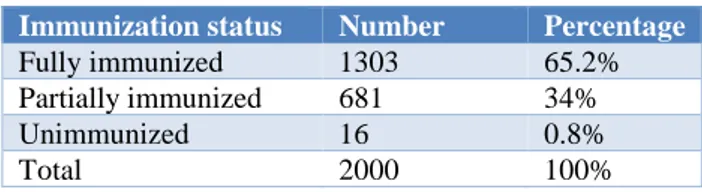
Results: Of 2000 children studied, 1303 (65.2%) were fully immunized,681 were partially immunized (34%) i.e the child had received at least one of the immunization mentioned in NIP and 16 of them were un-immunized (0.8%) i.e they had not received even a single vaccine.
Conclusions: The present study of immunization coverage of 65.2% among children attending pediatric hospital is far from satisfactory. The goal of achieving even 85% coverage seems to be an uphill task. Adverse effects following immunization, busy parents, lack of knowledge seems to be a major contributing factor for the non-success of this national programme. Age, birth order, parent’s occupation. parent’s education, mother’s age are statistically significant contributing factors for the poor immunization coverage among these children.
Keywords: Fully immunized, Partially immunized, Unimmunized
Department ofPediatrics, D. Y. Patil Medical College and Hospital, Kolhapur, Maharashtra, India
Received: 27 January 2018
Accepted: 28 February 2018
*Correspondence:
Dr. Dokku Swathi,
E-mail: [email protected]
Copyright: © the author(s), publisher and licensee Medip Academy. This is an open-access article distributed under the terms of the Creative Commons Attribution Non-Commercial License, which permits unrestricted non-commercial use, distribution, and reproduction in any medium, provided the original work is properly cited.
there are still clusters of low coverage. Immunization services in India are free of cost in public sector, nevertheless, some areas lag in immunization coverage. In India, National Family Health survey (NFHS-4) publishes that only 56.3% of the children of age one to two years have received the basic package. In 5 rural areas of Maharashtra, 66.7% were fully immunized status, 1.8% were unimmunized as per DLHS-4 (2012-2013), while the total rates in the state of Maharashtra were 65.3% and 1.5%, respectively.5 NFHS-4 data
revealed that the percentage of children in Maharashtra with full immunization (measles, BCG, and DPT/three doses of polio) was 55.8%, in the rural area of Maharashtra it was 56.7%.6
METHODS
The present study was conducted on children aged 2 to 5 years attending Pediatric OPD, immunization clinics and children admitted in Pediatric ward in D. Y. Patil hospital, Kolhapur.
The study was conducted between the periods of May 2015 to May 2017 and was studied total 2000 children.
Based on hospital statistics of 2015, 2016, 2017 an average number of admissions, number of OPD and immunization clinics visiting study age group (2-5 year) children was found to be 2500/year Depending on this information about 4000 children were expected to get enrolled during present study period (22 months).
Sampling method
Sampling was determined as follows:
Sampling Interval = Population size (N) (4000 = 2) Sample no. (2000)
Simple random sampling method was applied to select 2000 children i.e. every 2nd child in the age group of 2 to
5 years was taken for analysis.
Data collection
Parents of all children aged 2-5 years visiting OPD, immunization clinics and those admitted in the ward at our hospital were interviewed and information in a structured format was collected regarding immunization status of the child. Subjects were selected by systematic sampling method. Immunization status of these children was analyzed and the cause for partial and un-immunization were studied.
Information on socio demographic factors and immunization status was analyzed. The immunization status was confirmed by inspecting the immunization card of the child. If immunization card is not available, BCG scar was inspected to confirm whether BCG was given. If scar was not present, we enquired about the age
of child when the immunization was given and site of injection. For DPT, Measles, Hepatitis B vaccination we enquired the age of child when the child was immunized, site of injection gives us an accurate data.
Informed oral and written consent was taken from parents of the child. All the information was filled, studied, tabulated and interpreted through standard statistical methods.
Inclusion criteria
Children in the age group of 2 to 5 years attending Pediatric OPD, immunization clinics and children admitted in pediatric ward in D. Y. Patil hospital, Kolhapur.
Exclusion criteria
Children enrolled during previous visit.
Analysis
Codes were prepared for each options of the questionnaire. Data was entered in excel sheet to prepare a master chart. Chi square test was used to find out factors affecting immunization status.
Immunization status7,8
Fully immunized
The child who had received all primary doses of BCG, DPT /OPV123, Hepatitis-B, Measles and 1st booster
doses of OPV/DPT as mentioned in immunization schedule. J. E. vaccine was not included in this study as our area is non-endemic.
Partially immunized
If child had missed even a single dose as mentioned in immunization schedule.
Un-immunized
If the child had not received even a single dose of any vaccine. Considering these variables, we under took this study.
RESULTS
Table 1: Distribution of children according to immunization status.
Immunization status Number Percentage
Fully immunized 1303 65.2%
Partially immunized 681 34%
Unimmunized 16 0.8%
Table 2: Association of age and immunization status.
Age group (years)
Fully immunized Partially immunized Unimmunized Total %
No. % No. % No. %
2-3 703 100% 0 0% 0 0% 703 35.2%
3-4 0 0% 681 100% 0 0% 681 34%
4-5 600 97.4% 0 0% 16 2.6% 616 30.8%
Total 1303 65.2% 681 34% 16 0.8% 2000 100%
Chi-Square value (2.02), Degree of freedom (4), P value (<0.000); significant
Table 3: Association of socioeconomic status and immunization status.
socioeconomic status
Fully immunized Partially immunized Unimmunized Total %
No. % No. % No. %
Class I 144 60% 94 39.2% 2 0.8% 240 12%
Class II 225 67.2% 109 32.5% 1 0.3% 335 16.7%
Class III 287 66.7% 140 32.6% 3 0.7% 430 21.5%
Class IV 198 58.8% 135 40.1% 4 1.1% 337 16.9%
Class V 449 68.2% 203 30.8% 6 1% 658 32.9%
Total 1303 65.2% 681 34% 16 0.8% 2000 100%
Chi-Square Value-14.18, degree of freedom= 8, P value= 0.077(not significant).
Table 4: Association of birth order and immunization status.
birth order Fully immunized Partially immunized Unimmunized Total %
No. % No. % No. %
One 649 64.3% 353 35% 7 0.7% 1009 50.4%
Two 500 65.5% 256 33.5% 7 1.6% 763 38.2%
Three 121 62.4% 71 36.6% 2 1% 194 9.7%
Four 23 95.8% 1 4.2% 0 0% 24 1.2%
Five 10 100% 0 0% 0 0% 10 0.5%
Total 1303 65.2% 681 34% 16 0.8% 2000 100%
Chi-Square value-16.7, degree of freedom= 8, P value= 0.033(significant)
Table 5: Association of mother’s education and immunization status.
Mothers education
Fully immunized Partially immunized Unimmunized Total %
No. % No. % No. %
Illiterate 461 69% 204 30.55% 3 0.45% 668 33.4%
Primary school 244 62.24% 148 37.76% 0 0% 392 19.6%
Middle school 54 73% 20 27% 0 0% 74 3.7%
High school 230 60.7% 141 37.2% 8 2.1% 379 19%
PUC 174 63.5% 98 35.8% 2 0.7% 274 13.7%
Degree 136 65.07% 70 33.5% 3 1.43% 209 10.4%
Post graduate 4 100% 0 0% 0 0% 4 0.2%
Chi-Square value-26.5, degree of freedom= 12, P value= 0.009(significant)
Table 6: Association of mother’s occupation and immunization status.
Mother’s occupation
Fully immunized Partially immunized Unimmunized Total %
No. % No. % No. %
Professional 43 55.85% 31 40.26% 3 3.89% 77 3.8%
Business 3 42.9% 4 57.1% 0 0% 7 0.4%
Skilled 13 48.1% 14 51.9% 0 0% 27 1.4%
Unskilled 232 65.16% 123 34.55% 1 0.29% 356 17.8%
Housewife 1012 66.01% 509 33.21% 12 0.78% 1533 76.6%
Total 1303 65.2% 681 34% 16 0.8% 2000 100%
Table 1 shows immunization status of children ,1303 (65.2%) children were fully immunized, 681 (34%) are partially immunized and 16 (0.8%) children were un-immunized.
Present study showed that 100% fully immunized in 2-3 years age group, 100% partially immunized in 3-4 years age group and 97.4% were fully immunized and 2.6% were unimmunized in 4-5 years age group which is statistically significant.
Parents are more concerned about the immunization of the child at younger age.
Table 3 shows that socio-economic status of all the children included in the study and majority belongs to class V i.e. 658 (32.9%) as this is a sub-urban area. This may be because of free cost of vaccination and mass immunization campaign conducted by the government.
And in class I fully immunized are only 144 (60%) because of AEFI, immunization session inconvenience. This is statistically not significant.
Majority of the children belongs to 1st born i.e. 1009 (50.40%) and number decreases as the birth order increases. In 4th born 23 (95.8%) fully immunized and in 5th born 100 % fully immunization was seen because in class IV and V the population was small (1.2% and 0.5%), so immunization coverage was high. It is statistically significant.
Only 461 (69%) among children of illiterate mothers as they are unaware of need to return for booster doses. Parental education status had significant role to play in the immunization status of child. These values were statistically significant. The immunization was highest among children (66.01%) of mother who are housewife because of immunization session and time convenience. These values were statistically significant.
Table 7: Association of age of mother and immunization status.
Age of mother Fully immunized Partially immunized Unimmunized Total %
No. % No. % No. %
16-20 years 119 62.6% 71 37.4% 0 0% 190 9.5%
21-25 years 844 65.7% 414 32.6% 12 1.7% 1270 63.5%
26-30 years 286 63.8% 158 35.3% 4 0.9% 448 22.4%
31-35 years 44 53.7% 38 46.3% 0 0% 82 4.1%
36-40 years 10 100% 0 0% 0 0% 10 0.5%
Total 1303 65.2% 681 34% 16 0.8% 2000 100%
Chi-Square value-11.4, degree of freedom= 8, P value= 0.051 (significant)
Table 8: Distribution of children according to causes for partial and un-immunization.
Causes for partial and un-immunization No. %
Adverse effects following immunization 154 22%
Busy parents 140 20%
Lack of health facility near by 121 17.32% Not aware of need to return for 2nd and
3rd dose 109 16%
Concern for loss of work /wages 105 15%
Unwell child 85 12.25%
Ignorance of parents 82 11.8%
Lack of motivation 77 11%
Time inconvenience 74 10.70%
Lack of knowledge of immunization
schedule 70 10%
Belief that immunization may be harmful 32 4.5% Child was away from home 7 1%
Table 7 Shows Unimmunized were (1.7%) among children born to mother of 21-25yrs and (0%) in children born to mother of 36-40yrs. As they have better
awareness about immunization. It is statistically significant.
Table 8 shows causes for partial and un-immunization and major causes are AEFI 22%, busy parent’s 20%, lack of health facility near by 17.32%, concern for loss of work 15%.
Table 9: Distribution of children according to number of causes for partial and un-immunization.
Causes for partial and
un-immunization Number Percentage
One cause 471 56.4%
Two causes 192 23%
More than two causes 171 20.6%
Total 834 100%
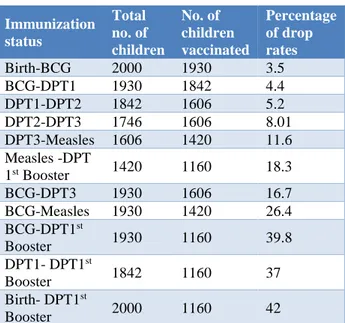
Table 10: Dropout rates.
Immunization status
Total no. of children
No. of children vaccinated
Percentage of drop rates
Birth-BCG 2000 1930 3.5
BCG-DPT1 1930 1842 4.4
DPT1-DPT2 1842 1606 5.2
DPT2-DPT3 1746 1606 8.01
DPT3-Measles 1606 1420 11.6 Measles -DPT
1st Booster 1420 1160 18.3
BCG-DPT3 1930 1606 16.7
BCG-Measles 1930 1420 26.4 BCG-DPT1st
Booster 1930 1160 39.8
DPT1- DPT1st
Booster 1842 1160 37
Birth- DPT1st
Booster 2000 1160 42
Birth to DPT 1ST dose overall has 42% drop out. So, we see a progressive rise in the drop out levels for subsequent immunization. Overall dropout rate for DPT was 37%. This is due to unaware of need to return for 2nd
and 3rd dose and lack of motivation. Hence it is very
important to lay a heavy emphasis on importance of follow up visits for subsequent vaccines.
DISCUSSION
In the present study the percentage of fully immunized children was 65.2%. Similar findings on fully immunized children were noted in studies of Malini Kar et al (69.3%), Yadhav et al (60.8%) and Prabhakaran Nair et al (77.5%).9-11 While Mathew et al and Nirupam et alnoted
25% and 34.5% of fully immunized children which was very low percentage.12,13
Thirty four percentage were partially immunized children in the present study and similar findings were also seen by Manjunath et al (31.3%), Malini Kar et al (15.7%), Prabhakaran Nair et al (18.3%), Yadhav et al (27.7%) and Nirupam et al (32.6%).9-11,13,14 While in the study
conducted by Kumar et al shows 48% of the children assessed in tertiary care hospital of North India were partially immunized which was very high as compared to above studies.15
0.8% children in the present study were un-immunized which was less in comparison with Prabhakaran Nair et al (4.2%) in Kerala (Trivandrum) and Kumar et al (34.15%), Manjunath et al (18.7%), Yadhav et al (11.5%), Malini Kar et al (15.1%), and Nirupam et al (32.9%).9-11,13-15 The difference in the observations of
these studies make it necessary for the effective and uniform implementation strategy of UIP to cover every child in society.
In the present study 100% immunization was seen in the age group 2-3 years, 100% partial immunization was seen in 3-4 years age group and 2.6% un-immunization was seen in 4-5 years age group. Similar findings were observed by Anjani Kumar Srivastava, and Gowri Shankar showed 52.6% children were fully immunized in 24-60 month.16 Common reasons observed were not
aware of need to return for 2nd and 3rd doses and
inconvenient immunization session.
As author observed most of the children belongs to socio-economic class III (21.5%) and class V (32.9%), immunization status is also more in these two classes (66.7% and 68.2%).Similar observations made by Srivastava AK et al and Malini Kar et al states that there is no association between socio-economic status and immunization status of children where, 73.5% children of lower socioeconomic group were fully immunized as compared to middle S. E. group (59.2%).9,16 The common
reasons are free of cost vaccination, mass immunization campaign.
Present study shows that fully immunized are 64.3% of 1st born, 65.5% of 2nd born, 62.4% of 3rd born and 95.8%
of 4th born which is similar to study conducted by
Khargekar NC in which he had observed 66.6 % in 4th
born are fully immunized.17 As the total number of
children in 4th and 5th birth order is low, immunization
status is high. Parent’s education and occupation status had a significant impact on immunization status of the child. Most of the parent’s in the study are illiterates and employed in skilled work who showed high immunization status. The most common reasons for under immunization were fear of AEFI, busy parents, inconvenient immunization camps.
100% full immunization was observed in children born to mothers of age 36-40 years where as it is only 62.6% in mother’s aged 16-20 years. These findings are similar to study conducted by Elizabeth et al observed 70.3% children of mother <19yrs, 71.9% of children of mother 19-29yrs and 76.5% of children of mother 30+yrs are fully immunized.18 So younger mothers are less likely get
their children fully immunized compared to older ones probably because they may be unaware of immunization schedule.
Author had taken 12 reasons in to consideration to know the causes for partial and un-immunization of the child. Out of which the most common reasons are AEFI (22%), busy parent’s (20%), lack of health facility nearby (17.32%), not aware of need to return to 2nd and 3rd doses
(16%) and concern of loss of wages / work (15%) constituting almost 60%. Similarly, lack of knowledge about immunization schedule was the reasons responsible for under immunization noted by Kumar et al, (52.4%) and Tiwari et al (29.8%) while, ignorance was the reason quoted by Tiwari et al, (36.8%), Yadav et al (80.36%).10,15,19 Thus, even after 25 years of UIP
basic right of immunization. This underlines the intensive need to create awareness about immunization among the parents. In the present study, 8% children among the partial and unimmunized were due to unaware of missed dose and 1% is due to child is away from home.
Limitations of present study include, as this is a hospital-based study, it does not represent the component of the society. Since study group was between 2 to 5 years there might be chances for recall bias in those who don’t have immunization card.
CONCLUSION
Out of 2000 children, 1303 (65.2%) were fully immunized, 681 (34%) were partially immunized and 16 (0.8%) were un-immunized. Education and age of the mother significantly influences the immunization coverage. Though the immunization coverage has increased over the last few years in general, booster doses are still neglected and there is need to create awareness about importance of booster doses. Parents should be given counselling regarding AEFI and its management.
ACKNOWLEDGEMENTS
Authors would like to thank to the patients and their parents participate in this study.
Funding: No funding sources Conflict of interest: None declared
Ethical approval: The study was approved by the Institutional Ethics Committee
REFERENCES
1. Chandramauli C. Census of India 2011: provisional population totals paper 1 of 2011 India Series 1, Chapter 6. New Delhi, India: Office of the Registrar General and Census Commissioner. 2011.
2. Narayanan A. Comparative and critical analysis of the importance given to Rural Development issues in The Times of India and The Hindu in the Months of February and March, 2012.
3. Andre FE, Booy R, Bock HL, Clemens J, Datta SK, John TJ, et al. Vaccination greatly reduces disease, disability, death and inequity worldwide. Bulletin WHO. 2008 Feb;86(2):140-6.
4. Vashishtha VM, Kumar P. 50 years of immunization in India: progress and future. Indian pediatrics. 2013 Jan 1;50(1):111-8.
5. Abhiyan WN. Sustainable Development Goals: Agenda 2030.
6. Madhavi N, Manikyamba D. Evaluation of immunization status and factors responsible for drop outs in primary immunization in children between 1-2 years: a hospital based study. Pediatric Review. Int J Pediatr Res. 2016;3(5).
7. Deivanayagam N, Nedunchelian K, Mala N, Ashok TP, Rathnam SR, Ahmed SS. Missed opportunities for immunization in children under 2 years attending an urban teaching hospital. Indian pediatrics. 1995 Jan 1;32(1):51-7.
8. Pande RP. Selective gender differences in childhood nutrition and immunization in rural India: the role of siblings. Demography. 2003 Aug 1;40(3):395-418. 9. Kar M, Reddaiah VP, Shashi Kant. Primary
Immunization Status of Children in Slum Areas of South Delhi - The Challenge of Reaching the Urban Poor. Indian J Comm Med. 2001;26(3):151-4. 10. Yadav J, Singh P. Immunization Status of Children
and Mothers in the State of Madhya Pradesh. Indian J Comm Med. 2004;29(3):147-8.
11. Prabhakaran TN, Varughese E. Immunization coverage of infants-Rural-Urban difference in Kerala. Indian Pediatr. 1994;31:139-43.
12. Mathew JL, Babbar H, Yadav S. Reasons for non-immunization of children in an urban, low income group in North India. Trop Doct. 2002;32(3):135-8. 13. Nirupam S. UIP in Sarojini Nagar block of
Lucknow district. Indian J Comm Med. 1991;16(2):82-4.
14. Manjunath U, Pareek RP. Maternal knowledge and perceptions about the routine immunization programme -a study in a semiurban area in Rajasthan. Indian J Med Sci. 2003;57:158-63. 15. Kumar D, Aggarwal A, Gomber S. Immunization
status of children admitted to a tertiary-care hospital of north India: Reasons for partial immunization or non-immunization. J Health Popul Nutr. 2010;28:300-4.
16. Srivastava AK, Shankar G. A study of immunization coverage and its determinants among under five children residing in urban field practice area of SN Medical College, Bagalkot, Karnataka, India. Indian J Forensic Community Med. 2017;4(1):48-52.
17. Khargekar NC, Khargekar VC, Shingade PP. Immunization Status of Children Under 5 Years in a Tribal Area, Parol, Thane District. Natl J Community Med. 2015;6(4):522-7.
18. Luman ET, McCauley MM, Shefer A, Chu SY. Maternal characteristics associated with vaccination of young children. Pediatrics. 2003;111:1215-8. 19. Tiwari RR, Kulkarni PN. Delayed immunisation
against vaccine preventable diseases - factors responsible among children under 5 years of age. Indian J Med Sci. 1999;53:212-5.