PaperID#24694
E-Learning
Tools
to
Facilitate
Instruction
of
a
Large
Enrollment
Structural
Engineering
Course
Ms.MaellevanThienen,UniversityofAuckland,NewZealand
Maelle vanThienen isadoctoralcandidateincivilengineeringattheUniversity of AucklandinNew Zealand. ShehasbeeninvolvedwithSTEMeducationsince2011,beginningasatutortohigh-school studentswhilecompletingherengineeringdegree. Shehasbeenengagedwithundergraduateand post-graduatecoursedeliveryinthetopicareasoflightgaugesteel,buildinginformationmodellingand struc-tural engineeringattheUniversity of Auckland(2016-present). ShegainedaMSincivilengineering fromtheENISE(NationalEngineeringSchoolofSaint-Etienne)inFrance.
Dr.JamesBoonPiangLim,UniversityofAuckland
JamesLimisanassociateprofessorofcivilengineeringattheUniversityofAuckland. Jameshasbeen teachingtheconceptsofbendingmomentsandshearforcesformorethantenyears. Heisinterestedto helpstudentsovercomeconceptualhurdlesinlearningstructuralengineering.
Dr.AnahidBehrouzi,CaliforniaPolytechnicStateUniversity,SanLuisObispo
Anahid Behrouzi isan assistantprofessor of architecturalengineering atCaliforniaPolytechnic State University - San LuisObispo. She has been involvedwith STEMeducation beginning in2003 as a volunteer andsummer instructorwiththeNorthCarolina Museumof LifeandScience. Shehasbeen engagedwithundergraduate/graduatecoursedeliveryinthetopicareasofengineeringproblem-solving andstructuralengineeringatNorthCarolina StateUniversity (2008-2011), theUniversityof Illinoisat Urbana-Champaign(2012-2015),TuftsUniversity(2015-2016),andCalPoly- SanLuisObispo (2016-present).ShehasaBSincivilengineeringandBAinSpanishlanguage&literaturefromNorthCarolina StateUniversity,andaMS/PhDincivilengineeringfromtheUniversityofIllinoisatUrbana-Champaign.
Mr.PabloGarcia,XorroSolutionsLtd
ablo Garcia (ME, MBA) is Managing Director for Xorro Solutions Ltd based out of Auckland, NZ, developerof theXorroassessment authoringtoolXorro-Q.Hisentrepreneurialcareer spanseducation, health, energyandgamingsectors. Pabloisanenthusiasticadvocateforsolutionsandpracticeswhich opennewlearningandcollaborationhorizons.
Mr.WyattBanker-HixP.E.,CaliforniaPolytechnicUniversity,SanLuisObispo
Wyatt Banker-Hixisalicensedprofessionalengineer inthe stateof Californiawithoverfouryearsof industryexperienceinstructuralandtransportationengineering. Healsoservesasapart-timelecturerat CaliforniaPolytechnicStateUniversity- SanLuisObispo(CalPoly)intheCivilEngineeringdepartment. Heenjoysteachingahands-onmaterialslaboratorycoursesprinkledwithhistoricalanecdotesandhumor. WyattearnedaBSandMSinCivilEngineeringfromCalPoly.
E-Learning Tools to Facilitate Instruction of a
Large Enrollment Structural Engineering Course
Abstract
A significant challenge in teaching large civil engineering courses is engaging and providing feedback to students in a meaningful and timely manner. This paper presents a solution that uses e-learning tool Xorro-Q in the successful instruction of a Structures II course of 250+ second year students since 2016 at a research-intensive university in New Zealand.
During the course, Xorro-Q has been utilized as an online practice-based learning tool where students can repeat questions without penalty and automatically receive detailed instructor-developed feedback (diagrams, text, or link to website/video) in response to specific incorrect answers. Additionally, Xorro-Q permits a variety of questions used to promote student
proficiency in both calculations and intuition of structural behavior. Some question styles come standard with other online homework interfaces such as multiple choice, numeric or word input, and labelling; others like hotspot images and extended text input are uniquely able to serve the needs of this type of structural engineering course. Together, the grading metrics from Xorro-Q has enabled students to receive useful feedback and instructors a snapshot of student
understanding that is necessary to implement just-in-time teaching.
This paper will include examples of structural engineering question styles posed to students in Xorro-Q. Furthermore, it will provide an analysis of student surveys to guide other engineering instructors on utilizing similar e-learning tools in a large enrollment course. To date, the two completed surveys indicate that repetition of questions in Xorro-Q –especially hotspot drawing questions –allowed students to develop confidence in the course topics, and detailed feedback helped them immediately address their conceptual difficulties.
Introduction
Xorro-Q is an online learning tool utilized to conduct synchronous (in-class) and asynchronous (homework) assessment of students using a smartphone and/or a laptop which can be either embedded into an instructor’s existing online course management system (CMS) webpage or sipmly linked to their CMS gradebook. The automatic grading and graphical feedback
summaries have proven to be useful to support just-in-time teaching strategies. Before discussing the specific benefits of Xorro-Q, specifically as it was utilized in the large enrollment
introductory structural engineering course, it is critical to explore the state-of-practice in online teaching technologies for assessment and just-in-time teaching.
Asynchronous Online Learning Tools
Rockland et al.1 summarizes the benefits of utilizing online CMS, specifically Moodle, as being a single repository for teaching materials and assignments. Assignments from students can be uploaded to the CMS, graded by the instructor, and re-posted onto the course page for student viewing. A disadvantage of this system is that each assignment must still be graded manually by the instructor, and for more complicated assignments beyond True/False and Multiple Choice, each submission must be commented and then posted back onto the course page.
Institute (WEI) and hosted on a Moodle provided by the Network of Earthquake Engineering Simulation NEEShub. The intent was to provide online media-rich lecture materials followed by short online quizzes with conceptual and technical questions. These quizzes were graded and scores presented to the student within the Moodle. A majority of grading effort for the remainder of the course remained the responsibility of the instructor which was deemed acceptable since assignments were completed by group and class sizes were relatively small.
The University of Washington and the Boeing Company3 partnered to create an updated online training course to replace the existing one that was long, complex, and had constantly evolving content. Originally, the course consisted of slides followed by a comprehensive exam. The new version leveraged Moodle to create a video lecture series with core concepts and applied activities where students completed formative quizzes with multiple correct answers and detailed, instant feedback. This approach led to improved learning gains among the surveyed, which was promising as the online course was slated for implementation at Boeing with the potential for thousands of users. One major complaint was the simplicity of the quizzes, since drawing figures and more substantial responses from the students were not possible.
Teaching by Examples and Learning by Doing (TELD) is a pedagogy based around cooperative and interactive learning, but requires specific resources for successful implementation. Huang et al.4 developed an online platform that utilizes the TELD method where lectures contain
embedded quizzes and homework assignments as well as design projects could be tracked and uploaded. This approach effectively engaged the students and required significantly less effort than a traditional teaching method, but still required quizzes, homework and project memos to be graded by instructors. Nevertheless, the technology developed proved critical in teaching the TELD method to a large engineering classes.
Synchronous Online Learning Tools
While Course Management Systems provide a tremendous benefits to instructors, they are often accessed outside of the classroom environment which can make it difficult for an instructor to judge the degree of understanding students possess during a lecture. A powerful tool to address this issue is Audience Response Systems (ARS), Poll Everywhere being a common example.
Popescu et al.5 details the integration of Poll Everywhere into an engineering classroom which
allowed students to integrate their smartphones into the classroom discussion to provide instant feedback to the instructor on their knowledge of a topic. Students in the classroom answered true/false, multiple choice and free response questions created by the instructor before class or in real time. Each response was sent to the instructor in the form of a text message that could appear on a PowerPoint slide or the computer screen. The study saw an increase in student motivation and participation, as well as a more informed and confident instructor. This was particularly valuable due to diverse student body in the classroom, many of whom were reluctant to participate in hand raising.
Kappers and Cutler6 investigated the use of Poll Everywhere in a classroom with large
Another instructor blended the use of Poll Everywhere and hand-drawn engineering sketches submitted separately. Bernold7 taught a large engineering class, and used the ARS technology to increase engagement in large problem solving situations. To gauge retention, he additionally utilized sketches, whereby students were briefly exposed to a situation, then would be required to summarize it in a sketch. These simple sketches were collect and graded by hand, then returned and further iterated upon throughout the quarter.
Online Learning Tools for Just-in-Time Teaching
Both the synchronous and asynchronous technologies discussed previously can enhance the just-in-time (JIT) teaching approach, combining virtual and real classrooms to hone topics of
instruction.
A study at University of New York, Pantaleev et al.8 examined a JIT learning environment with
Computer Science and Physics students, spanning introductory and advanced topics. The authors utilized a quiz placed on an online learning system, which covered topics in the textbook. These quizzes were due shortly before each class, giving authors the opportunity to review the quiz grades and student feedback. The lecture was modified to focus on areas of poor understanding and foster a more complete discussion on course material. Students responded positively, reporting more interest in class discussions and feeling more confident in the course material. Exam performance was also positively increased compared to traditional teaching methods.
Das9 utilizes a similar style of JIT teaching, but created modules for students to review on Blackboard. During each module, a series of quizzes are taken by the student to build their understanding and confidence on the topic, in this case a structural analysis course. The multiple choice quizzes provide feedback instantaneously to the student and the results are available to the instructor to utilize lecture periods as an opportunity for discussion on the material.
A team of educators at Michigan State University10 developed a system of JIT teaching that
allowed for more in-depth student feedback to be rapidly analyzed. Faced with large introductory Biology courses, the instructors decided to utilize feature-based lexical analysis to automatically gauge free-response questions from quizzes submitted hours before each class began. This program allowed much greater flexibility in question type and student response when compared to multiple choice, while generating feedback reports for the instructors to rapidly process the massive amount of text delivered in each quiz. The instructors were able to adjust their traditional lectures, group guided discussion and in class clicker exercises for each classroom based on their quiz feedback. Instructors saw increased student performance in those who chose to participate, and were better able to gauge student progress on topics week to week. Another benefit was that the instructors felt more confident in their lectures and activities.
Motivation for Use of Online Learning Tools in Current Course
Institution & Course Description
The University of Auckland (UoA) is recognized as New Zealand’stop university for civil and structural engineering. With a particular focus on training students to fulfill the shortage of engineering professionals in the country, there are significant undergraduate enrollment demands placed on a limited group of faculty. This results in lower division courses that have 250+
students in a single lecture hall with a primary instructor and only 3-4 student teaching assistants. In spite of this, faculty remain committed to excellence in engineering education. The remainder of this paper focuses on the use of an e-learning tools Xorro-Q, which the UoA faculty co-author has implemented successfully in a large-enrollment structural analysis since 2016.
The Civil 211: Structures and Design I course is required for all sophomore (Part II) civil engineering students. The prior course Civil 210: Introduction to Structures is students first introduction to the fundamentals of structural analysis related to: beam, cable, and arch members; loading, boundary conditions, internal actions, strength, stiffness, and stability; principal stresses/strains; as well as ultimate and serviceability design philosophies. Civil 211 expands on these topics over a 12-week semester with 3 one-hour lectures per week and a drop-in lab. In particular the curriculum covered the course drop-includes:
Introduction and Review of Topics from Civil 210 Qualitative Analysis of Beams
Slope Deflection Method
Buckling of Compression Members Shear Stresses in Beams
Virtual Work and Unit Load Method Flexibility Method
Review of Course topics
Implementation of Xorro-Q
Xorro-Q is an online educational tool that can enable in-class or asynchronous learning that has proven to be particularly fruitful in the large enrollment Civil 211 course. There is an existing repository of questions (Q-bank) associated with an array of course subjects developed by other instructors, including civil engineering which currently has 97 questions. A faculty member can keep their questions private, share with other instructors from their institution or globally. A relevant note is that students are assigned a different account type from faculty.
The following section includes several examples of capabilities that enable structural analysis specific questioning not possible in most learning management systems utilized in university courses. These examples are organized based on a selection of topics from the Civil 211, and were developed by the instructor and teaching assistants for the course between 2016 and the Winter 2018 offering of the course. Assistance was provided from Xorro Solutions staff to accommodate new question features to support the instruction of the structural engineering course, and for the benefit of future users of the online teaching platform.
Sample Student Questions
Topic: Beam Shear, Moment, and Deflection
The following is a selection of questions from a Xorro-Q activity that requires students to analyze a beam and complete the following tasks (grouped by question type).
Hotspot questions where students use mouse click(s) or finger tap(s) to select locations on a diagram and are graded against correct regions as defined by the instructor:
Draw deflected shape
Indicate side of the beam in tension, top or bottom (at designated points A, B, C) Indicate magnitude of bending moment diagram (at location of pink bands) Indicate magnitude of shear force diagram (at location of pink bands)
a) Draw Deflected Shape
b) Indicate Location of Tension
c) Indicate Magnitude of Shear Force
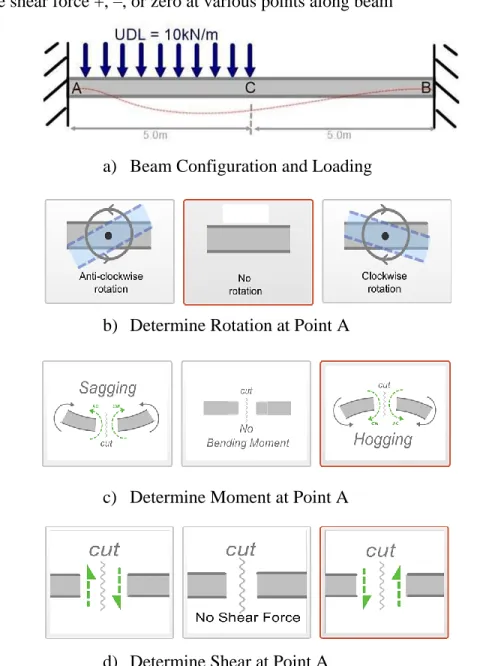
Multiple choice questions that involve selection from three image choices (toggle button).
Indicate direction of rotation at various points along beam
Indicate bending moment + = sagging, –= hogging, or zero at various points along beam Indicate shear force +, –, or zero at various points along beam
a) Beam Configuration and Loading
b) Determine Rotation at Point A
c) Determine Moment at Point A
d) Determine Shear at Point A
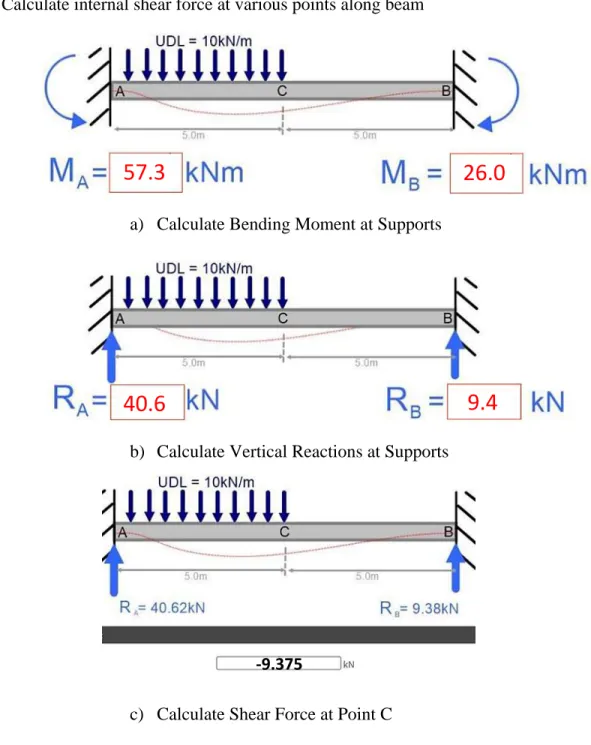
Calculation questions where students provide an answer rounded to the tolerance indicated:
Calculate bending moments at various points along beam or at supports Calculate reaction forces at supports
Calculate internal shear force at various points along beam
57.3
26.0
a) Calculate Bending Moment at Supports
40.6
9.4
b) Calculate Vertical Reactions at Supports
-9.375
c) Calculate Shear Force at Point C
Topic: Qualitative Analysis of Beams
A variation on the hotspot question where the instructor divides a figure consisting of multiple images into zones and assigns one zone as the correct answer. From the student perspective, this appears as similar to a multiple choice image selection. The student selection appears as a check mark (see Figure 4: column 2, row 3).
Figure 4: Sample of Qualitative Beam Hotspot Questions
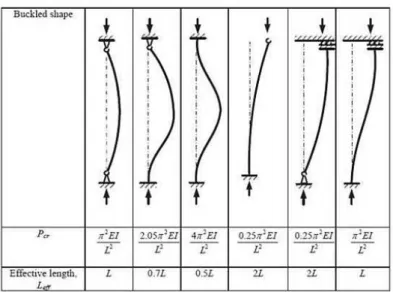
Topic: Buckling of Compression Members
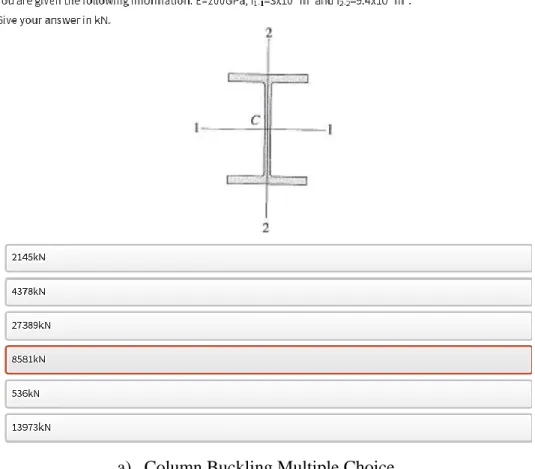
In a homework module with a series of questions in a single topic area it is possible for faculty to embed useful resources for students to reference, such as images or links to websites and videos.
a) Column Buckling Multiple Choice
b) Column Buckling Calculation (numeric fill-in)
Feedback to Students
Another significant benefit of the Xorro-Q online learning platform is the immediate and specific feedback provided to students when they input either a correct answer (justification for why their logic or calculation was valid = positive reinforcement of accurate knowledge) or an incorrect answer (explanation of why their logic or calculation procedure was erroneous = resolving misconceptions of inaccurate knowledge). Feedback accompanies all aforementioned question types: hotspot, multiple choice image and numeric selection, calculation (numeric fill-in).
a) Feedback for Correctly Drawn Deflected Shape
b) Feedback for Correct Indication of Location of Tension
a) Feedback for Correct Indication of Direction of Rotation
b) Feedback for Incorrect Indication of Direction of Shear Force
Figure 8: Samples of Student Feedback for Multiple Choice Image Selection See Figure 2 (b&d) for associated question and correct response
Furthermore, Xorro-Q keeps track of student performance in a particular module and indicates positive performance metrics (medals) compared to other student performance, which serves as motivation in particularly difficult activities.
Figure 10: Samples of student score / rank metrics
Feedback to Instructor
There are several forms of feedback that an instructor receive after a student completes a module. One of the most important is thatthe instructor’s Xorro-Q course portal can be linked to their university’se-learning platform to directly import student scores into the course gradebook where they can be accessed with grades on other assignments and assessments.
Instructors are also provided summary graphics that summarize student performance which can enable just-in-time teaching. Faculty can rapidly identify muddiest points associated with the homework that was submitted priorto class, and modify the day’s lecture based accordingly.
a) Correct = green, incorrect = red
b) Saturation indicates number of responses
To clarify the summary graphics for the beam deflected shape presented in Figure 11, there are two view modes. Figure 11(a) simply indicates each click/tap location input by students with a circular marker that is colored green for correct responses and red for incorrect answers. Figure 11(b) shows a temperature map where green indicates a correct answer and the yellow to red range indicates incorrect answer, and the regions have more saturated/intense color indicate the most commonly selected locations in a hotspot question. This can be utilized for hotspot
questions associated with shear and moment diagrams as well. For multiple choice (image or numeric) questions it is possible to produce a histogram that indicates what percentage of student participants selected a particular response. An example is not shown here as it is a common feature on most online learning quiz modules, and not unique to Xorro-Q.
Students are also encouraged to provide feedback at the end of each module through a free response portal which can be used to improve the online assignments and provide a more effective learning environment for their peers in the large enrollment course.
Figure 12: Samples of Instructor Feedback for Hotspot Question on Beam Deflection See Figure 1(a) for associated question
Student Assessment
Three student surveys were conducted throughout the Winter 2018 semester to assess the efficacy of Xorro-Q as a means to practice structural analysis concepts introduced in the large enrollment Civil 211 lecture course. The response rate of each survey was 150, 122, and 24 students (the last survey was administered after the final exam, while the first two were conducted during the class session).
In terms of time students engaged with the Xorro-Q activities, the majority of survey respondents indicated that they completed each module 1-2 times to receive a sufficient grade ( ≥75%) and that they spent 1-3 hours on each weekly set of activities.
41% 21% 14% 29% 15% 19% 37% 57% 61% 43% 63% 49% 7% 11% 20% 19% 17% 29%
0% 10% 20% 30% 40% 50% 60% 70% 80% 90% 100%
3% 13% 10% 3% 5% 5% 2%
For Figures 13 and 14, the five-point Likert scale survey questions Q1-Q6 are as follows:
Q1. Did the activities help you understand the course content? Avg = 4.05 (5 - Almost Always True, 1 - Almost Never True)
Q2. The questions in the activities could be easily understood. Avg = 3.91 (5 - Strongly Agree, 1 - Strong Disagree)
Q3. The activities enhanced your interest in the content of the course. Avg = 3.69 (5 - Strongly Agree, 1 - Strongly Disagree)
Q4. The activities helped you prepare for deflections, bending moment and shear force diagrams for the upcoming test. Avg = 3.93
(5 - Strongly Agree, 1 - Strongly Disagree)
Q5. Comment on the following statement: Xorro-Q was easy to use. Avg = 3.67 (5 - Strongly Agree, 1 - Strong Disagree)
Q6. Describe the helpfulness of the feedback given for each incorrect answer. Avg = 3.35 (5 - Excellent, 1 - Extremely Poor)
Q1 Q2 Q3 Q4 Q5 Q6
1 2 3 4 5
In Survey 2, following the first exam, it was possible to examine if there were any major changes in student perception regarding how useful Xorro-Q was to understanding of course content (Q1) and test preparation (Q4). Figure 14 presents results from Surveys 1 and 2 for direct comparison.
100%
80%
60%
49% 50%
1% 2%
19%
29%
0% 3%
20%
26%
0% 20% 40%
1 2 3 4 5
Survey 1 Survey 2
a) Q1: Xorro-Q aided understanding of course content (Avg = 3.93 and 3.78)
100%
80%
61% 57%
1 2 3 4 5
Survey 1 Survey 2
b) Q4: Xorro-Q aided in preparations for test (Avg = 4.05 and 3.99)
Figure 14: Comparison of Student Feedback, Before and After First Test (Survey 1 had 150 participants; Survey 2 had 122 participants)
2% 3%
14%
20%
2% 7%
16% 16%
The student survey results summarized in Figures 13-14 indicate that the strongest motivations for using Xorro-Q is its ability to allow students to independently complete a number of activities to better understand the course content as well as prepare for examinations. The feedback provided for incorrect solutions were noted to be above average or higher.
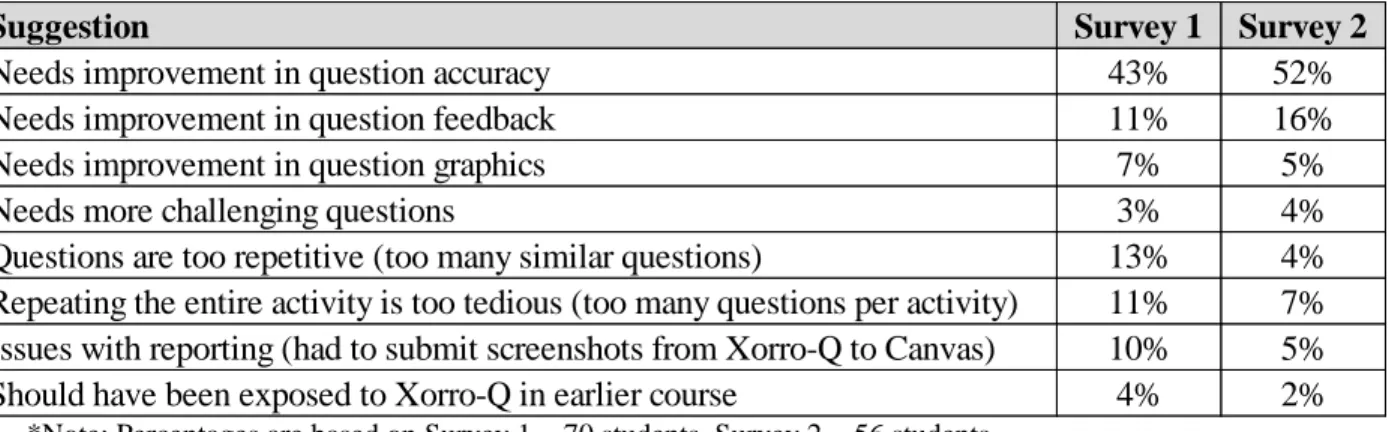
Some suggestions for improvement are included in the table below. These were coded from free response questions asking for student input on how to improve Xorro-Q activities.
Table 1: Summary of suggestions/feedback provided by students on Xorro-Q activities
Suggestion Survey 1 Survey 2
Needs improvement in question accuracy 43% 52%
Needs improvement in question feedback 11% 16%
Needs improvement in question graphics 7% 5%
Needs more challenging questions 3% 4%
Questions are too repetitive (too many similar questions) 13% 4%
Repeating the entire activity is too tedious (too many questions per activity) 11% 7%
Issues with reporting (had to submit screenshots from Xorro-Q to Canvas) 10% 5%
Should have been exposed to Xorro-Q in earlier course 4% 2%
*Note: Percentages are based on Survey 1 = 70 students, Survey 2 = 56 students.
Conclusions
The following conclusions were based on the survey feedback and observations from the instructor-of-record for the course:
Xorro-Q has typically been implemented as a synchronous (in-class) learning tool similar to Poll Everywhere, and the course discussed in this paper highlights a successful
application of this outside of class where grading is linked to the online CMS. Thus, Xorro-Q was a complement to an instructor’s online CMS.
Xorro-Q empowers structural engineering educators to assess students with a wider range of assessment objects compared to other online learning platforms as students can input drawings/diagrams and receive a grade for their accuracy in doing so (deflected shape, shear/moment diagrams). However, some refinement is still needed to improve grading accuracy which is currently being addressed by Xorro Solutions.
Related to the previous statement, Xorro-Q has enabled a high enrollment course of over 250 students to engage in a range of meaningful course homework beyond the typical numerical input and multiple choice of other online assessment systems.
For these reasons, the authors believe there is the potential to utilize Xorro-Q as a practice or assessment platform for structural engineering courses of various sizes that provides automatic feedback to both students and educators, which ultimately aids with learning and instruction.
Acknowledgements
The authors would like to thank University of Auckland undergraduate students Yash Anchan and Hitesh Patel for their contributions to the research study, specifically preparing and administering survey instruments to collect feedback on the use of Xorro-Q as a teaching tool. Thanks also to all the Civil 211 students that participated in this research study.
References
[1] Rockland, R., Kimmel H. and Carpinelli J. (2011) Moodle As A Course Management System IT isn’t Just For Distance Learning. Proceedings of the 2011 ASEE Conference.
[2] Gershfeld, M., Chadwell, C. and Brophy, S. (2012) Online Modules For Wood Design Courses Through NEESHub. Proceedings of the 2012 ASEE Conference.
[3] Lawton, D., Vye, N., Bransford, J., Sanders, E., Richey, M., French, D. and Stephens, R. Online Learning Based on Essential Concepts and Formative Assessments. Journal of Engineering Education, April 2012.
[4] Huang, G., Shen, B. and Mak, K. Participatory and Collaborative Learning with TELD Courseware Engine. Journal of Professional Issues in Engineering Education and Practice, January 2002.
[5] Popescu, O., Chezan, L, Jovanovic, V. and Ayala, O. (2015) The Use of Polleverywhere in Engineering Technology Classes to Student Stimulate Critical Thinking and Motivation. Proceedings of the 2015 ASCEE Conference.
[6] Kappers, W. and Cutler, S. Poll Everywhere! Even in the Classroom: An investigation into the impact of using PollEverywhere in a large-lecture classroom. Proceedings of the 2014 ASEE Conference.
[7] Bernold, L. Student Centered Teaching Construction Equipment and Methods to 350 Students. Proceedings of 2012 Construction Research Congress.
[8] Pantaleev, A., Ieta, A and Illie, C. Just-In-Time Teaching: Computer Science Meets Physics. Proceedings of the 2012 ASEE Conference.
[9] Das, N. Just-In-Time Teaching (JITT) In Civil Engineering Technology. Proceedings of the 2009 ASEE Conference.