PUBLIC RELATIONS AS A TOOL FOR ATTAINING EDUCATIONAL INSTITUTION OBJECTIVES IN ENUGU STATE
OKAFOR, OZOEMENA CHRISTIAN
Department of Marketing, Faculty of Management Sciences Nnamdi Azikiwe University Awka, Nigeria
NWATU, CHIBUIKE BASIL
Department of Marketing, Faculty of Management Sciences Nnamdi Azikiwe University Awka, Nigeria
Abstract
Public relation is very relevant in institution today since it has become the most powerful tool to express the image of an institution to the public community. The study assessed public relations as a tool for attaining educational institution objectives. The major problem of this study was the presence of social vices such as bribery, cultism and corruption, sex scandal that make communities dissatisfied with the Nigeria education sector. The major objective of the study was to examine public relations as a tool for attaining educational institution objectives. Descriptive design was used with a sample size of 77 subjects, stratified was use to group the population and sample randomly selected. A structured questionnaire was the instrument used to gather data from the field for analysis. Regression analysis was employed to test the five hypotheses formulated. Findings reveal that reputation management, customer relations, media relations, social media and corporate social responsibility on achieving educational institution objectives was positively significant respectively. The study concluded that institutions should pay more attention to those variables for attainment of their educational institution objectives. And recommended among others that the models used in this study should be properly adopted by the institutions for adequate sustainability of their existence.
INTRODUCTION
In this interdependent world, it has really become important for almost every kind of institutions to keep a long term and trustworthy relations with the community or public groups in order to handle upcoming challenges and also to maintain its survival and success. The evolution of public relations in this century is something too wonderful because it strikes a balance between man and God. It also serves as a middle man between an organization and the public from my own thought or calculation. The first public relation officer, the researcher knows or thinks of is Jesus Christ who played a role of mediating between God and mankind; reconciled both and concretized God‟s relationship with man. The first need for public relations arose in heaven when God asked “who shall I send and who will go for me? And there was a response “Father send me”. This is the origin foundation of public relations practice. (Isaiah 6:8).
Over the years, public relations have been very important communication in society. Business all over the world have been using such public relations tools as publicity, sponsorship, event management as well as image and identity buildings to promote their products and services (Dornyo, & Adiku, 2015). Having realized that public relations is a necessary tool in making their needs and programs known, higher educational institutions also began to use it to gain publics support. Posit that educational Public Relation is a planned systematic management function designed to help improve the programs and services of an educational organizations. It relies on a comprehensive, two-way communication process involving both internal and external publics with the goal of stimulating better understanding of the role, objectives, accomplishments, and needs of the organization”.
Globally, many institutions virtually and physically interact and communicate with Publics and audience outside their own country of origin to build a dynamic set of relationships trade, directs foreign investment, political coalitions, worthy global causes, information flow, and social networking, among other phenomena, are increasing the complexity of these relationship dramatically. Moreover, this complexity results in greater interdependence and interconnectivity among societies, groups of ideology-driven or cause-driven individuals, and institutions worldwide (Sharp & Pritchard, 2003). This reality parallels the evaluation of public relations as a profession, practice and field of study in every corner of the planet (Bates, 2006, Sharp & Pritchard, 2003). So, they states that the growth of the world‟s interdependences on role of public relations play in this dynamics have motivate the creation and development of several institutions that represent and contribute to the professionalism.
development and capacity building in Nigeria, is done at the tertiary education level, the effective and efficient management of the human and material resources of all the tertiary educational institutions will definitely and surely enhance national security in the country. The field of public relations is all about developing understanding and building good relationship with various public groups including, government, institution, media, employee, investor, supplier, retailer and customer etc. because institutions cannot do without public relations. He who thinks so is mistakes for “No man is an island” according to an ancient author. In other words, public relations produces good fruit, it enhances growth and builds up understanding and good relationship which leads to success of organizations.
Holistically, this study captures some independent variables, which are reputation management, customer or students relationship management, media relations, social media and corporate social responsibility as certain if they might have influence in attaining educational institution objectives particularly from the perspective of a developing country.
1.2 Statement of the Problem
In many institutions‟ in Nigeria, there is the presence of social vices such as bribery, cultism and corruption, sex scandal that make communities dissatisfied with the Nigerian education sector. Omonijo and Nnedum (2012), observed that exposure of students to social media has been instrumental to the rising wave of social vices. Today, Nigerian institutions‟ are mere shadows of their past, in terms of academic standards. Quality has been sacrificed due to the insatiable desire by politicians, some educational bureaucrats, institutions‟ administrators and teachers, instructors, lecturers, professors to find the easiest means to accumulate wealth, (Asemah, 2009). Thus, there is a need to examine public relations as a tool for attaining educational institutions objectives in Enugu state.
1.3 Objective of the Study
The general objective of the study is to examine public relations as a tool for attaining educational institution‟ objectives in Enugu State. Other Specific objectives includes, to;
i. Determine the influence of reputation management for attaining community‟s friendly
relationship.
ii. Determine if there is any relationship between customer relations management and the
attainment of students‟ co-operation.
iii. Ascertain the influence of media relations for the attaining increase in student‟s
enrolment.
iv. Ascertain the influence of social media for attaining positive public image.
v. Examine the influence of corporate social responsibility for manpower development.
REVIEW OF RELATED LITERATURE 2.1 Conceptual Framework
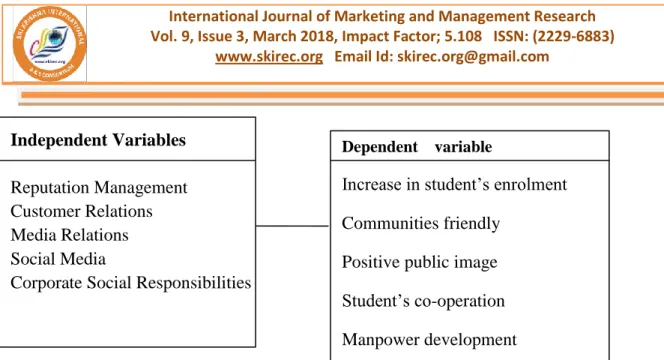
Independent Variables
Reputation Management
Customer Relations Media Relations Social Media
Corporate Social Responsibilities
Fig 1: Conceptual framework showing the relationship existing between independent variables and dependent variable. Sources: Researcher, 2016.
2.1.1 Public Relations
While a lot people seem to have a good idea about public relations, few seem to agree on one definition American historian Robert Heilbronercas cited in Cutlip & Center, 1978), describe the field as “a brotherhood of some 100,000 whose common bond is its profession and whose common woe is that no two of them can ever quite agree on what the profession is”. Basically, Heibroner is right, although there have been serious efforts to come up with a suitable definition. One of the most ambitious searches for a universal definition was that commissioned in 1975 by the foundation of public relations research and education. Sixty public relations leaders participated in the study, which analyzed 472 different definitions and offered the following definition. Public relations are a distinctive management function which helps to establish and maintain mutual lines of communications, understanding, acceptance and cooperation between the organization and its public. Involves the management of problems or issues, helps management to keep Informed on and responsive to public opinion. The British Institute of public relations “public relation is a deliberate, planned, and sustained effort to establish and maintain mutual understanding between an organization and its publics” (Jethwaney & Sarkar, 2000). Broom and Trucker, (2008) defines public relations as the management process whose goal is to attain and maintain accord and positive behaviours among social groupings on which an organization depends to achieve its mission. Its fundamental responsibility is to build and maintain a hospitable environment for an organization. James (2006), defines public relations as the management of communication between an organization and its publics.
2.1.2 Reputation management
The concept of reputation management was introduced in 1985 by Albert and when, including the characteristics of an organization that members understand them as nuclear features, the unique and continuous in organization. There is quite some difficulty in finding a well-crafted definition of reputation management in the available literature of reputation management which
Dependent variable
Increase in student‟s enrolment
Communities friendly
Positive public image
Student‟s co-operation
succinctly captures the subject. Earlier definitions tended to mimic the professional orientation or bias of this authors along economic, strategies, marketing organizational, sociological and accounting lines of thought. But a definition offered by Argenti and Druckenmllor, (2009). In their work titled “reputation and the corporate brand” is quite helpful especially as it is a departure from the lines of thought identified above they defines reputation management and the objective representation of multiple constituencies linkages of a company, built up over time. Based on a company‟s identity programs, its performance and how constituencies have perceived its behavior. On the other hand, after reviewing the definitional literature on the subject, Barnett, (2006) in landscape”, proposed another good definition which to me is comparable to that of Argenti and Druckenmllor, (2009) stated above. He define the subject as observers‟ collective judgment of a corporation based on assessments of the financial, social and environmental impacts attributed to the corporation over time. Barnett, (2006) identified three clusters of meanings in the definitional statements of reputation which suggest that reputation accrue as an asset through three stages they identified as awareness, assessment and consolidation. In this sequence, the first thing is for people to notice or become aware of the presence of an organization in the community. This initial awareness of the organization‟s presence in the community gradually leads to the awareness of its unique culture (ie the nature of its buildings, offices, color, logo, relationship with its staff and the community in which it operates behavior of its directors, its social responsibility thrust, and nature of its governance. Bahrain, Samadi and Sohrabi, (2014) examine the role of corporate reputation on customer loyalty. The study adopts a descriptive research design-survey. Statistical population includes customers of 25 banks and financial Institutions of public and private in the city of Hamadan. The sample size by Morgan table was obtained. 384 customers were selected randomly and answered the questionnaire. Research tool used is questionnaire for data analysis. Correlation coefficients of Pearson and spearman are used for testing hypotheses and finally the result shows that there is significant relationship between corporate reputation and customer loyalty in banks and financial Institutions. Miremadi, Babakhani, Yousefian, and Fotoohi, (2010) mentioned the importance of the corporate reputation in B2B context. The study adopts descriptive survey research design, with structured questionnaire distributed among 80 except for managers who work in variety industries such as construction, mining and generator motor equipment in Iran. The findings presented in this study conclude that corporate reputation has effect on loyalty but with less impact compared to satisfaction. Moreover, the personal elation has no significant impact on loyalty.
2.1.3 Customer Relations
other business sectors, HEI's managers, by adopting CRM initiatives, intend to increase performance, promote better management practices, and improve the HEI's relationship with current and potential students, especially in executive education. To be more exact, as HEIs adopt CRM strategy, they are developing a “student-as-customer” perspective. An educational CRM system helps HEIs to have a holistic understanding of students´ needs as it gathers customer knowledge collected in all phases of student interaction phases (admission, registration, fee payment, course conclusion, etc.) (Grant & Anderson, 2002; Seeman & O'Hara, 2006). Customer relationship management is defined as a firm‟s practices to systematically manage its customers to maximize value across the relationship life cycle. (Martin, Oliver, & Jacquelyn, 2010). Furthermore, customer relationship management is defined as the overall process of building and maintaining profitable customer relationship by delivering superior customer value and satisfaction. (Kotler & Armstrong, 2010). More so, it could be defined as managing detailed information about individual customers and carefully managing customer touch points. Maximize customer loyalty (Kotler & Armstrong, 2010). Understanding the needs of customers and offering value added services are recognized as factors that determined the success or failure of companies. Customer relationship management is increasingly important to firms as they seek to improve their profit through long term relationship with customers. Saeednia, Dastjerdi and Jafari (2012), investigated prioritization of effective factors on customer relationship management implementation in Persian International holds company. The results revealed a direct and significant relationship between CRM and other variables, and shows significant differences among the influence of various factors. Based on the result, the study concludes that the staff factor and the technology factor were the most and the least effective factors on CRM Implementation. Mahesh and Fatemeh, (2013), examined customer relationship management of new media intervention in Iranian and Indian. The result revealed that it was imperative to formulate a CRM policy as a competitive business management strategy in the new millennium. The study concludes that CRM system should be well equipped with competent human resources and also organizes necessary training and orientation programmes to the CRM professionals in order to develop their vision and mission in the field of activity concerned.
2.1.4 Media Relations
even to generate a massive file of press cutting. The true purpose of media relations they states is “to enhance the reputation of an organization and its products and to influence and inform the target audiences”. Nevertheless, Holtz (2002) argues that the role of an organizational media relations department is not to make company look good in the press, nor it to keep the company out of the newspaper. Ideally, the job of the media relations department is “to help reporters, and editors to do their Job. This explains why Ajala (2005), noted, that good media relations can only be established if public relations practitioners have an understanding of the functions of the media in the society.
2.1.5 Social Media
aimed at identifying market segments based on its social media use; include analyzing empirical data collected through a survey among future university students in the Netherlands. The study methodology used to gather and analyze data was post-hoc descriptive method and survey include the target population was mentioned. Results of a study aimed at identifying the role and importance of the social media on the choice of future students for a study and university in comparison with the traditional university marketing channels in the Netherlands. The conclusion of study was to identify and describe three market segments (Information, interaction and socialization) among future students based on their use of social media.
2.1.6 Corporate Social Responsibility
2.2 Theoretical Framework
Three theories have been chosen to provide the theoretical framework for this study. These theories are System theory, Situational theory and Public Relations Transfer theory.
The system theory was propounded by Grunig, Grunig and Dozier, (2006) states that the
systems perspective emphasizes the interdependence of organizations with their environments, both informal and external to the organization. According to systems perspective organizations depend on resources from their environments, such as raw materials, a source of employees and customers for the services or products they produce. “The environment needs the organization for its product and services” organizations with “open systems” used public relations people to bring back information on how productive their relationships are with clients, customers and other stakeholders. Organizations with “closed systems” do not seek new information but operate on past history or the preference of decision makers.
The situational theory was propounded by Grunig and Repper (1999), it is a good start to use
the concept of stakeholders as a way for describing relationships. However, they concluded that not all people in stakeholder groups would be equally likely to communicate with the organization. They felt that public relations people could more effectively manage communications by identifying specific publics within stakeholders groups.
The public relations Transfer theory was propounded by frank Jefkins in 1988. According to
Nweke (2001), the theory is an antidote against some negative developments in organizations. Jefkins (1988) states that when the negative situation is converted into posited achievements through knowledge. The result predictably is the primary objective of public relations, Practice- understanding. Among the three theories mentioned, the study anchored significantly on the transfer process theory. The theory was suitable for the study, because perfection is something humanity cannot attain but always Strive towards. Based on this premise, organizations are bound to experience hostility, apathy and prejudice from members of their publics, and once an organization experiences any of these, the transfer process theory comes in handy. As such the model is said to be relevant to this work.
2.3 Empirical Studies
In a related study of Odhiambo (2012) examined social media as a tool of marketing and creating brand awareness-in Nigeria. The purpose of the study was to examine whether social media as a marketing tool has impact in creating brand awareness. The study adopted a case study research design. The findings presented in this study conducted that even though social media was more effective than some of the traditional advertising channels, it cannot be implemented in isolation without augmenting it with other forms of traditional advertising channels. The implications were that social channels. The Implications were that social media alone cannot single handedly create brand awareness or even develop business.
Odinioha and Wadike (2013) examined the social responsibility performance of higher educational institutions in Nigeria. The purpose of study was to check the impact level of Higher Institutions acted as socially responsible citizens. The study adopts a descriptive survey and a total of 120 respondents were issued questionnaire or interviewed, out of which only 86 copies of the questionnaire were successfully retrieved in usable form. The study found that host communities‟ rates the institutions moderate in their social responsibility performance. They concluded part was that higher institutions should boost their relationship with communities through increased response to social issues.
Krishnan (2007) the role of media relations in corporate public relations practice in Klang valley Malaysia. The purpose of the study was discovering how media relations is viewed and utilized in Malaysian organizations. These issues are explored in 15 public listed companies across all industries in the Klang valley. The study adopted in-depth interviews. A structured interview questionnaire was used as the research instrument to elicit participant responses. The findings suggests that media relations play a strategic role to build relationship with the media as well as to inform and educate stakeholders in profiting and better managing the organizations reputations.
Raha, Long, Wan and Zaleha (2013) examined impact of customer relationship management on customer satisfaction and loyalty in Malaysia. The purpose of the study was to examine whether customer relationship management has impact on customer satisfaction and loyalty. The study employs quantitative approach based on 300 respondents. Multiple regression analysis was used to examine the relationship of the variables. The finding shows that behavior of the employee‟s is significantly related and contributes to customer satisfaction and loyalty.
METHODOLOGY 3.1 Research Design
Okaja (2003) defines research design as the structuring of investigation aimed at identifying
variables and their relationship. It is used for the purpose of obtaining data to enable the
Investigator test hypothesis or answer research question by providing procedural outline for conducting research. This research design utilized for the purpose of this study was descriptive research design. The subject used for the study were administrative staff and public relations
The public relations tools were reputation management, customer relations, media relation, social media and corporate social responsibility.
3.2 Area of the Study
The study was carried out in Enugu State of Nigeria; specifically in the metropolis where the majority of the selected institutions were located. This enabled the researcher gained easy access to information.
3.3 Pilot Study
Pre-testing was carried out before the questionnaires were administered to the respondents, to testify whether the questions were relevant made sense and clearly understandable. Pre-testing aimed at determining the reliability of the research instrument including the sequence of the questions, wording and structure. In this study pre-testing was carried using small copies of questionnaire which were distributed to the eight (8) educational institutions, on two different occasions. Thereafter, the returned copies of questionnaire from the pilot survey were coded and a cronbach alpha test was used by SPSS to ensure the reliability of the research instrument. 3.4 Source of Data
Sources of data for this study were done through primary and secondary sources. The primary sources of data were got from the questionnaire, personal Interview and observation. The secondary sources were also got from extensive review of textbooks from seasoned authors, Internet materials, Journal publications etc.
3.5 Population of the Study
The population of this study comprised of administrative staff and public relations‟ staff of
ESUT, UNN, GODFREY OKOYE, IMT, ESCET, Eha-Amufu, Caritas and Peacland in Enugu
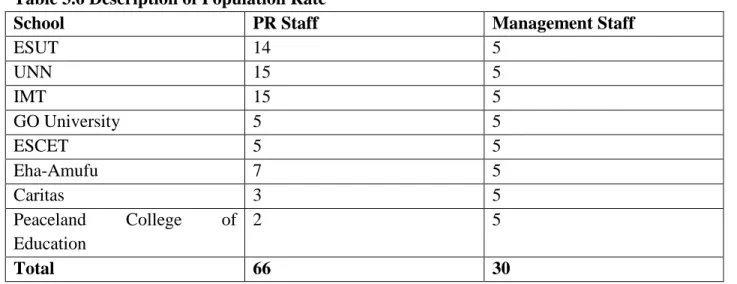
state. The total population of the study was estimated at 96. Table 3.6 Description of Population Rate
School PR Staff Management Staff
ESUT 14 5
UNN 15 5
IMT 15 5
GO University 5 5
ESCET 5 5
Eha-Amufu 7 5
Caritas 3 5
Peaceland College of
Education
2 5
Total 66 30
3.6 Determination of Sample Size
Sample size determination is the act of choosing the number of observations or replicates to include in a statistical sample. The sample size is an important feature of any empirical study in which the goal is to make inferences about a population from a sample. In practice, the sample size used in a study is determined based on the expense of data collection, and the need to have sufficient statistical power (Kish, 2005). The following formula was used to determine the sample size. When using the formula the study involves statistical assumptions that the selection of individuals is random and unbiased. The decision to include an individual in the study cannot depend on whether or not that individual has the characteristics or outcome being studied (Pagano & Gauyreau, 2000).
Equation I: Sample Size
n = Z2PqN
2(N-1)+Z2Pq --- equation (1)
Where n = the required sample size P = 0.5; q =0.5, Z = 0.0025
= 1.96
e = 0.05, where e = expected error. N = Entire population
Z = Level of Significance
P = Probability that individual has the characteristics or outcome of being studied
q = Probability that individual does not have the characteristic or outcome being studied. = Substituting in the formula
n = 1.962 x 0.5 x 0.5 x 96
0.052(96-1)+1.962 x 0.5 x 0.5
n = 3.8416 x 0.25 x 96
0.0025(96-1) + 3.8416x0.25
92.1984 = 92.1984
0.2375 + 0.9604 1.1919
n= 77.3
3.7 Sampling Procedure
Stratified and simple random sampling procedures are integrated to select the sample size for the study. Stratified sampling procedure, was used to divide the sample into eight (8) distinct strata consequently, the simple random sampling was used to select suitable sample from each of the stratum. The essence was to ensure equal opportunity participation of members in the population and, to prevent unnecessary bias during selection.
3.8 Instrument for data Collection
deals with the demographic characteristics of the subjects ranging from sex, marital status, educational qualifications etc. The second part also deals with staff assessment of public relations as a tool for attaining educational institution objectives. Questions for this study were generated by the researcher to suit the purpose of the study. Respondents were asked to Indicate their responses on five points likert scale; ranging from strongly agree, agree, undecided, strongly disagree, and disagree (SA-SD). Three research assistants were employed to administer the Instrument. These research assistants were been trained for one week by the researcher and the instrument were administer over a period of two weeks. 77 questionnaires were distributed 7 were discarded due to non-completion by respondents.
3.9 Reliability of Test Instrument
Onwumere (2005) defined reliability as the degree to which similar outcomes are produced by a measuring instrument where used in different situation. To ensure the reliability of the instrument, factor analysis was undertaken to assess the reliability of the measurement items and the internal uniformity of the research constructs. In specific terms, factors loadings, the cronbach‟s alpha values were determined using SPSS in order to check measurement items reliability. Since the alpha result above are significantly greater than 0.7, the questionnaire is deemed to have excellent stability and consistency. see Appendix 2.
3.10 Validity of the Instrument
Onwumere (2005) defined validity as the extent to which a measuring instrument on application performs the function for which it is designed. To ensure the validity of the research instrument used, a draft copy of the instrument were given to the researcher‟s supervisor and some professors in marketing for their inputs in order to determine the face validity of the research instrument. Their suggestions and comments were incorporated into the final copy of the instrument. Convergent and discriminate validity of the research constructs were determined by checking the inter-correlation between the researches constructs and by comparing the average variance extracted (AVE). Regarding convergent validity, the item-to-total values, AV, was used as indicators.
3.11 Procedure for Data Analysis
Both the descriptive and inferential statistical tools were employed in this study. In the descriptive statistics, the descriptive analysis of the responses were associated with simple frequencies, percentages, mean and standard deviation while in the inferential statistics, the multiple regression analysis and testing the hypotheses by using parametric test. The parametric test that were used includes:- the independent sample t-tests and ANOVA tests. According to Pallant (2010) these tests were used to test differences between groups.
4.1 DATA PRESENTATION AND ANALYSES
table below 77 questionnaire copies were distributed to the public relations staff and administrative staff of the institutions. A total of 3 were loss and 4 discarded due to non-completion by respondents.
Table 4.1Distribution of Questionnaires by Respondents
Questionnaires Frequency Percentage
Returned Rate 70 90.9
Non completion Rate 4 5.1
Loss rate 3 3.8
Total 77 100
Source: Field Survey, 2016
Table 4.1 above shows that 70 questionnaire were returned while 7 were not returned from the
respondents. Therefore, the total of 70 copies questionnaire were used for the analysis. 4.2 Demographic Data Presentation
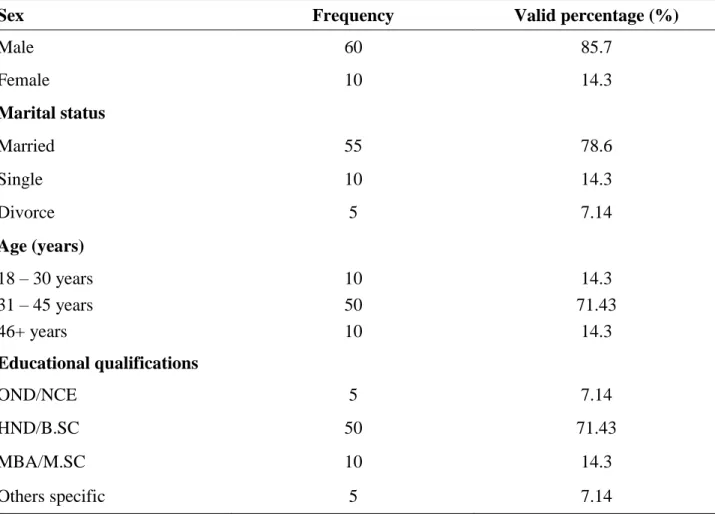
This section shows the analysis of respondents according to Sex, Marital status, Age and Educational qualifications.
Table 4.2.1: Presentation of Respondents’ Bio-data
Sex Frequency Valid percentage (%)
Male 60 85.7
Female 10 14.3
Marital status
Married 55 78.6
Single 10 14.3
Divorce 5 7.14
Age (years)
18 – 30 years 10 14.3
31 – 45 years 50 71.43
46+ years 10 14.3
Educational qualifications
OND/NCE 5 7.14
HND/B.SC 50 71.43
MBA/M.SC 10 14.3
Others specific 5 7.14
Table 4.2.1 above shows that 85.7% of the respondents were male while 14.3% were female. Coming to marital status, out of the total respondents 78.6% were married, 14.35 are single and 7.1% were divorced. In age, we notice that 14.3% respondents were between the ages of 18-30 years, 71.4% and 14.3% respondents were between the ages of 31-45 years and 46 years above respectively. From table above, it was observed that 7.14% respondents were OND/NCE holders, 71.43% were HND/B.Sc. holders, while 14.3% were MBA/M.Sc. holders and 7.14% were holders of related educational qualification.
4.3 The Regression Analyses
This analysis was employed to understand which among the independent variables are related to the dependent variable, and to explore the forms of these relationships. The table below depicts the summary of the regression results and the analysis of variance.
Table 4.3.1 Summary of Regression Analysis Results
Regression Model Summary: Dependent variable institutions objectives
R Squared 0.9513
Adjusted R Squared 0.9093
Observations 5
ANOVA (Analysis of Variance) Degree of
Freedom
Sum of Squares
Mean Square
Regression 3 3.679 1.226
Residual 1 1.362 1.3628
Total 4 5.041
Calculated F 79.511
Significant F 0.0019
Output of Regression – Co-efficient
Independent variables Coefficients Standard error t-statistics
(Constant) -0.411927 9.534550 -0.52
R-M 1.239171 0.1761758 8.57**
CRM 1.933912 0.3949586 5.34**
MR 0.439358 0.2594685 4.92**
SM 1.074127 0.3443411 5.54 **
CSR 0.977053 0.1578200 5.31**
Note: Significance at 5%
The hypotheses of our study will be evaluated with the aid of the statistical tool of analysis such as t-statistics, f-statistics, R-squared, Adjusted R-squared.
T-statistics: This is the test for individual significance of variables and a variable is said to be
Using 95% confidence interval and 4 degrees of freedom (5-1) will give you the value 2.132 from the statistical table. Since the t-statistics of reputation management (8.57), customer relations management (5.34), media relations (4.92), social media (5.54) and corporate social responsibilities (5.31) are higher than the one from the table (2.132), it can be concluded that reputation management, customer relations management, media relations, social media and corporate social responsibilities are significant in describing variations in public relations tool in attaining educational institution objectives and cannot be ignored.
F-statistics: This is the test for overall significance of variables and also the measure of
goodness of fit of the model. Using 95% confidence interval and 5, 4 degree of freedom gives the figure 6.26 from the statistical table. Since the f-statistics from our result is 79.511, which is higher than that from the table, we reject the null hypothesis and accept the alternative hypothesis, concluding that the joint influence of all included independent variables is significant and therefore cannot be ignored in policy options pertaining explaining variations in attaining educational institution objectives.
R-squared: This is the explanatory power of the variables modeled. The coefficient of
determination (R2) from our result is 0.9513. This implies that 95% of the variations in attaining
educational institution objectives are accounted for by the included independent variables of reputation management, customer relations management, media relations, social media and corporate social responsibilities.
Adjusted R-squared: This is the explanatory power of the insensitive number of variables
modeled. The adjusted coefficient of determination (Adjusted R2) is given as 0.9093. This means
that approximately 91% of the variations in attaining educational institution objectives are accounted for by the included variables, after the coefficient of determination has been adjusted to make it insensitive to the number of included variables.
4.4 Test of Hypotheses
Hypotheses were rejected if the t-calculated is greater than the critical t0.05 level and if the
relationship between the dependent variable and the independent variables is positive. Otherwise, hypotheses were supported.
Table 4.4.1 Summary of Hypotheses testing Hypothese s Independent variables Dependent variable
R/ship
t-calculate d Critical t0.05 Hypothes es rejected
H1 Reputation
management Education institution objectives +1.23917 1
8.57 2.132 YES
H2 Customer
relations Education institution objectives +1.93391 2
H3 Media relations
Education institution objectives
+0.43935 8
4.92 2.132 YES
H4 Social media Education
institution objectives
+1.07412 7
5.54 2.132 YES
H5 Corporate
social
responsibility
Education institution objectives
+0.97705 3
5.31 2.132 YES
Authors’ computations 5.1 Summary of Findings
1. The study finds that reputation management is positive and significant in its influence on
attaining educational institution objectives.
2. The study also observes that customer relations management is positive and significant in
its influence on attaining education institution objectives.
3. The study shows us a positively significant influence of media relations on attaining
education institution objectives.
4. The study finds also that social media is positive and significant in its influence on
attaining educational institution objectives.
5. The study also observes that corporate social responsibility is positive and significant in
its influence on attaining educational institution objectives. 5.2 Conclusion
The study investigated public relations as a tool for attaining educational institution objectives in selected institutions in Enugu State. The findings of the study revealed that reputation management, customer relationship and the media relations have a strong association with educational institution objectives. Therefore, it is concluded that institutions in attaining their educational objectives needs to strengthen on these factors or these public relations tools for attaining their institution objectives.
5.3 Recommendations
The institution should train, educate and develop their staff on how to apply public relations strategies for attaining institution objectives. A strong reputation culture should be cultivated by the institutions as a necessary foundation to beat the completion, enhance their community were the institution exist for better development and continuous existence.
5.4 Contributions to knowledge.
Key: Stronger:-Reputation management has a strong relationship. Stronger:-Customer relations have a strong relationship. Weaker:-media relations have a weaker relationship. Stronger:-social media have a strong relationship.
Moderate:-corporate social responsibility has a moderate relationship.
References
Aikins. E.A., & Akua, O.A, (2015). Using public relations as a Management tool in tertiary
institutions: Afro Asian journal of Social Sciences, I,(2), 2229 – 5313.
Aswmah, E (2009). Public relations and organizational management: An assessment of jose
international breweries Plc. Am MSc Dissertation Submitted to the Department of Mass
Communication, Benue State University Markurdi.
Argenti. S., & Druckernmilor, .B (2009). Reputation and the corporate brand: Corporate
reputation Review, 6,(4), 368-374.
Ajala. V.O. (2005). Public relations: In search of professional excellence. Ibadan: Afri Link Ltd.
Blond, B & Bivins. T. (1996). Public relations writing: The essentials of style and format 6th
Edition, Boston: Mc Graw Hill.
Broom, G.H. & Trucker, M. (2008). Using research in public relations: application to
program’s management. Englwood Cliffs, NJ. Prentice Hall.
Barnett, P. (2006). Customer relationship management: Related theories, challenges and
application in banking sector, Banking Journal,1(1), 23-56
Bahrami .R., Samadi. A., & Sohrabi, R. (2014). The role of corporate reputation on customer
loyalty‟ Journal of business and behaviour sciences, 4,(5), 20-35
Brassingbor. E., & Pattil, S. (2002). Principles of marketing 10th Edition, London: Prentice Hall.
Bates, D. (2006). Institute for Public relations website. Retrieved August 28,2008,from
http://www.institutefor pr.org/research singles/mini me history.
Caves .G., & Porter, M. (2013). „How competitive forces shape strategy; The Mckinsely
Quartely, Spring, 34-50.
Reputation management
Customer relations
Media relations
Social media
CSR
Carmeli, A., & Tishler .A. (2005). Perceived organization reputation and organizational
performance: An empirical investigation of industrial enterprises‟ corporate reputation
review. 8. 13-30.
Cutlip, S.M., & Centre, A. (1978). Effective public relations (8thed). NJ. Prentice Hall.
Constantinides. E., & Fountain, S.J. (2008). Web 2.0. conceptual foundations and marketing
Issues. Journal of direct, data and digital marketing practice, 9(3), 231-244.
Dahan G.S., & Senol, I (2012). Corporate social responsibility in higher education institutions:
Instanbus bilgi university case American international of contemporary research. 2,(3),
95-103.
Dornyo .P., & Aduku, E.A. (2015). Public relations practice in tertiary institutions: International
Journal of ICT and management: 3,(2), 2026 - 6839
Efthymios. C., & Marc, Z.S., (2011). A study on the impact of social media. international
journal of technology and education marketing, 3,(2), 41-58.
Grant, G.B., & Anderson, G. (2002). Customer relationship management: a vision for higher
education, in Katz, R.N. and Associates, Web portals and higher education: Technologies
to make IT Personal, John Wiley & Sons, Inc., New York, 23–32.
Grunig J.E, Grunig L.A., & Dozier D.M, (2002). Excellent public relations and effective
organizations, A study of communication management in three countries. new jersey;
lawrence erlbaum associations, mahwah: NJ.
Grunig J.E & Ripper A; (1999). Strategic management, public, and issues, in excellence in
public relations and communication management, ed. (hillsdale, NJ: Erlbaum,117-58).
Hilbert, A., Schonbrunn, K., & Schmode, S. (2007). Student relationship management in
germany foundations and opportunities. Management review, 18(2), 204–219.
Hayes, S.S, Ruschman, P.H., & Walker, J.H (2009). Historical, Practical and Theoretical
Prospective on Green Management: An Exploratory Analysis. Management Journal.
47(7), 41-55.
Holtz, S. (2002). Public relations on the net: Winning strategies to informs, and influence the
media, the investment, the government the public and more. http.//www. Universal
research journals.org/ deceased 8/6/2013.]
Jefkins, F. (1988). Public relations techniques, Oxford heinemann.
Jan, .H.K., & Hermkens, .K. (2011). Social Media? Get serious understanding the functional
building blacks of social media. Business horizons 2,(54),241-251
Jethwaney, J.N., & Sarkar, N.N (2000). Public relations, New Delhi: Sterling.
James, C. (2006). Public relations theory, Lawrence eribaum association.
Kaplan, A. M., & Hainan, M. (2009). Users of the world, unit, the challenges and opportunities
of social media: Business horizons, 53; 59-68.
Kotler, P., & Armstrong, G. (2010). Principles of marketing, 12th Eds… upper sorddle river new
Kietzmannn, J.B (2012). Unpacking the social media phenomenon towards a research agenda,
Journal of public affairs 122;109-119.
Kim, W., Jeong, O.R., & Lee, S.W (2009). On social web sites, information systems, 35(2),
215-236.
Kish, L. (2000).Survey sampling. New York (NY): John Wiley and Sons Inc.
Krishnan, S.R. (2007). The role of media relations in corporate public relations practice: Study of University Sains Malaysia.
Miremadi. A, Babakhani .N., yousefian. M. & Fotoohi. H; (2011). Important of the corporate
reputation in b2b context in iran: an empirical study, International Journal of Marketing
Studies, 3,(4), 23-45.
Mansa, A. E., & Kumah C.H (2011). Social media: a tool to use for effective service delivery to
clients by African libraries. http:11 Conference: ifla.org/ifla 77
Mahesh B.P & Fatemeh.G, (2013). Customer relationship management: an empirical study of
new media intervention in Iranian and Indian corporate houses, International journal of
logistics and supply chain management. 2,(4), 2319-9032
Martin. R., Oliver. S., & Jacquelyn, B. (2010). Customer relationship management and firm
performance: the mediating role of business strategy, Journal of the academy of
marketing science. 1,(3),326-346.
Nambisan, S. & Nambiasan, P. (2008). How to profit from a better virtual customer
environment. MIT sloan management review, 49 (3), 53.
Odhiambo C.A (2012). Social media as a tool of marketing and creating brand awareness,
university of applied sciences, bachelor of business administration.
Odinioha, G.J., & Wadike, G., (2013). Social responsibility performance of educational
institutions of high or learning in Nigeria. International Journal of Asian Social Science,
3,(3), 552-557
Okaja, P. (2003). The research design and now to solve problems (P.2).
Onwumere, J.U.J (2005). Business and economic research method. Lagos: Vinton Limited.
Olaleke, O., Taiye, B. & Jeje, O.E. (2014). Customer relationship management approach and
student satisfaction in higher education marketing, Journal of competition, 6(3), 49-62
Omonyo, H., & Nnedum, B. (2012). Too much corporate power. Business Week, 11 September,
p.149.
Orukan .B. (2010). Public relations: the most excellent profession, Port –Harcourt Nigeria,
Newsfair Communication.
Pallant, .J (2010). SPSS survival manual, 4th ed. maidenhead: McGraw-Hill.
Pagano .A., & Gunyrean, P. (2005), A Strategic Framework for Customer Relationship
Management‟ Journal of Marketing, 69(4),167-176
Raha, K., Long C.S., Wan, K. & Zaleha, A. S, (2013), Impact of cusotemr relationship
management on customer satisfaction and loyalty, Asian social science. 9,(10),
Sharpe, M.L. & Pritchard, B.J. (2003), The historical empowerment of public opinion and its relationship to the emergence of public relations as a profession. In D.J. Tilson & E.C.
Alozie (Eds). Toward the Common good; Perspectives in International Public relations
(pp.14-36). Boston, M.A: xllyn and Bacon.
Seeman, D. E., & O‟Hara, M. (2006). Customer relationship management in higher education:
Using information systems to improve the student-school relationship. Campus Wide
Information Systems, 23(1), 24–34.
Saeednia. H, Dastjerdi. A. & Jafari A.S., (2012), Prioritization of effective factors on crm
implementation‟ International journal management business, 2(1), 13-22.
Shankar. V. & Mulhouse E.C (2009). A peek into the future of interactive marketing, Journal of
interactive marketing. 23 (1), 1-3.
Safko, L & Brake, O.K (2009), The social media bible. tactics, tools and strategies for business
success. John wiley and some Hoboken NJ WA.
Shawyun, T. (2011), From corporate social responsibility to universities‟ social responsibility: A
paper presented at the second asia-europe education workshop titled “universities and
their corporate social responsibilities” 5 – 6, june, 2011
Tench, R & Yeomans, L. (2006), Exploring public relations london: Pearson Education.
Waters, R.D, (2009). Engaging Stakeholders through social networking: How nonprofit