Statistical Analysis of a Telephone Call Center:
A Queueing-Science Perspective
∗Lawrence Brown, Noah Gans, Avishai Mandelbaum, Anat Sakov, Haipeng Shen, Sergey Zeltyn and Linda Zhao
October 5, 2004
Corresponding author: Lawrence D. Brown
Department of Statistics, The Wharton School, University of Pennsylvania, Philadelphia, PA 19104-6340
Email: [email protected], Phone: (215)898-4753, Fax: (215)898-1280
∗Lawrence Brown is Professor, Department of Statistics, The Wharton School, University of Pennsylvania,
(email: [email protected]). Noah Gans is Associate Professor, Department of Operations and
In-formation Management, The Wharton School, University of Pennsylvania, (email: [email protected]). Avishai Mandelbaum is Professor, Faculty of Industrial Engineering and Management, Technion, Haifa, Israel, (email: [email protected]). Anat Sakov is post-doctoral fellow, Tel-Aviv University, Tel-Aviv, Israel, (email: [email protected]). Haipeng Shen is Assistant Professor, Department of Statistics, University of North Carolina, (email: [email protected]). Sergey Zeltyn is Ph.D. Candidate, Faculty of Industrial Engineering and Manage-ment, Technion, Haifa, Israel, (email: [email protected]). Linda Zhao is Associate Professor, Department of Statistics, The Wharton School, University of Pennsylvania, (email: [email protected]). This work was sup-ported by the NSF DMS 9971751 and 9971848, the Sloane Foundation, the ISF (Israeli Science Foundation) Grants 388/99 and 126/02, the Wharton Financial Institutions Center, and the Technion funds for the promotion of research and sponsored research.
Abstract
A call center is a service network in which agents provide telephone-based services. Customers that seek these services are delayed in tele-queues.
This paper summarizes an analysis of a unique record of call center operations. The data comprise a complete operational history of a small banking call center, call by call, over a full year. Tak-ing the perspective of queueTak-ing theory, we decompose the service process into three fundamental components: arrivals, customer patience, and service durations. Each component involves different basic mathematical structures and requires a different style of statistical analysis. Some of the key empirical results are sketched, along with descriptions of the varied techniques required.
Several statistical techniques are developed for analysis of the basic components. One of these is a test that a point process is a Poisson process. Another involves estimation of the mean function in a nonparametric regression with lognormal errors. A new graphical technique is introduced for nonparametric hazard rate estimation with censored data. Models are developed and implemented for forecasting of Poisson arrival rates.
We then survey how the characteristics deduced from the statistical analyses form the building blocks for theoretically interesting and practically useful mathematical models for call center oper-ations.
Key Words: call centers, queueing theory, multiserver queues, Erlang-C, Erlang-A, queueing sci-ence, arrivals, abandonment, service times, lognormal distribution, inhomogeneous Poisson process, censored data, human patience, prediction of Poisson rates, Khintchine-Pollaczek formula.
1
INTRODUCTION
Telephone call centers are technology-intensive operations. Nevertheless often 70% or more of their operating costs are devoted to human resources. Well-run call centers adhere to a sharply-defined balance between agent efficiency and service quality, and to do so they use queueing-theoretic models. Inputs to these mathematical models are statistics concerning system primitives, such as the number of agents working, the rate at which calls arrive, the time required for a customer to be served, and the length of time customers are willing to wait on hold before they hang up the phone andabandonthe queue. Outputs are performance measures, such as the distribution of time that customers wait “on hold” and the fraction of customers that abandon the queue before being served. In practice, the number of agents working becomes a control parameter which can be increased or decreased to attain the desired efficiency-quality tradeoff.
Estimates of these primitives are needed to calibrate queueing models, and in many cases the models make distributional assumptions concerning the primitives. In theory, the data required to validate and properly tune these models should be readily available, since computers track and control the minutest details of every call’s progress through the system. It is thus surprising that operational data, collected at an appropriate level of detail, has been scarcely available. The data that are typically collected and used in the call-center industry are simple averagesthat are calculated for the calls that arrive within fixed intervals of time, often 30 minutes. There is a lack of documented, comprehensive, empirical research on call-center performance that employs more detailed data.
The immediate goal of our study is to fill this gap. In this paper, we summarize a comprehensive analysis of operational data from a bank call center. The data span all twelve months of 1999 and are collected at the level of individual calls. Our data source consists of over 1,200,000 calls that arrived to the center over the year. Of these, about 750,000 calls terminated in an interactive voice response unit (IVR or VRU), a type of answering machine that allows customers serve themselves. The remaining 450,000 callers asked to be served by an agent, and we have a record of the event-history of each of these calls.
This paper is an important part of a larger effort to use both theoretical and empirical tools to better characterize call center operations and performance. It is an abridged version of Brown et al. (2002b), which provides a more complete treatment of the results reported here. Mandel-baum, Sakov and Zeltyn (2000) presents a comprehensive description of our call-by-call database.
Gans, Koole and Mandelbaum (2003) reviews queueing and related models of call centers, and Mandelbaum (2001) contains an extensive bibliography.
1.1 QUEUEING MODELS OF CALL CENTERS
The queueing model that is simplest and most widely used in call centers is the so-called M/M/N system, sometimes referred to as Erlang-C (Erlang, 1911; Erlang, 1917).
The M/M/N model is quite restrictive. It assumes, among other things, a steady-state environment in which arrivals conform to a Poisson process, service durations are exponentially distributed, and customers and servers are statistically identical and act independently of each other. It does not acknowledge, among other things, customer impatience and abandonment behavior, time-dependent parameters, customers’ heterogeneity, or servers’ skill levels. An essential task of contemporary queueing theorists is to develop models that account for these effects.
Queueing science seeks to determine which of these effects is most important for modelling real-life situations. For example, Garnett, Mandelbaum and Reiman (2002) develops both exact and approximate expressions for M/M/N+M (also called Erlang-A) systems, which explicitly model customer patience (time to abandonment) as being exponentially distributed. Empirical analysis can help us to judge how well the Erlang-C and Erlang-A models predict customer delays – whether or not their underlying assumptions are met.
1.2 Structure of the paper
The paper is structured as follows. In Section 2, we describe the call center under study and its database.
Each of Sections 3 to 5 is dedicated to the statistical analysis of one of the stochastic primitives of the queueing system: Section 3 addresses call arrivals; Section 4, service durations; and Section 5, tele-queueing and customer patience. Section 5 also analyzes customer waiting times, a performance measure that is deeply intertwined with the abandonment primitive.
A synthesis of the primitive building blocks is typically needed for operational understanding. To this end, Section 6 discusses prediction of the arriving “workload”, which is essential in practice for setting suitable service staffing levels.
Once each of the primitives has been analyzed, one can also attempt to use existing queueing theory, or modifications thereof, to describe certain features of the holistic behavior of the system. In Section 7 we conclude with analyses of this type. We validate some classical theoretical results from queueing theory and refute others.
Finally, we note that many statistical tests are considered throughout the paper, which raises the problem of multiplicity (Benjamini and Hochberg, 1995). When data from call centers are analyzed in support of operational decisions, the multiplicity problem needs to be addressed.
2
THE CALL CENTER OF BANK ANONYMOUS
The source of our data (Call Center Data, 2002) is a small call center of one of Israel’s banks. The center provides several types of basic services, as well as others that include stock trading and technical support for users of the bank’s internet site. On weekdays (Sunday through Thursday in Israel) the center is open from 7am to midnight. During working hours, at most 13 regular agents, 5 Internet agents, and one shift supervisor may be working.
A simplified description of the path that each call follows through the center is as follows. A cus-tomer calls one of several telephone numbers associated with the call center, the number depending on the type of service sought. Except for rare busy signals, the customer is then connected to a VRU and identifies herself. While using the VRU, the customer receives recorded information, general and customized (e.g. an account balance). It is also possible for the customer to perform some self-service transactions here, and 65% of the bank’s customers actually complete their service via the VRU. The other 35% indicate the need to speak with an agent. If there is an agent free who is capable of performing the desired service, the customer and the agent are matched to start service immediately. Otherwise the customer joins the tele-queue.
Customers in the tele-queue are nominally served on a first-come first-served (FCFS) basis, and customers’ positions in queue are distinguished by the times at which they arrive. In practice, the call center operates a system with two priorities - high and low - and moves high-priority customers up in queue by subtracting 1.5 minutes from their actual arrival times. Mandelbaum et al. (2000) compares the behavior of the two priority groups of customers.
specifically, she is told the amount of time that the first person in queue has been waiting, as well as her approximate location in the queue. The announcement is replayed every 60 seconds or so, with music, news, or commercials intertwined.
In each of the 12 months of 1999, roughly 100,000-120,000 calls arrived to the system, 65,000-85,000 terminating in the VRU. The remaining 30,000-40,000 calls per month involved callers who exited the VRU indicating a desire to speak to an agent. These calls are the focus of our study. About 80% of those requesting service were, in fact served, and about 20% abandoned before being served.
Each call that proceeds past the VRU can be thought of as passing through up to three stages, each of which generates distinct data. The first is thearrivalstage, which is triggered by the call’s exit from the VRU and generates a record of anarrival time. If no appropriate server is available, then the call enters thequeueingstage. Three pieces of data are recorded for each call that queues: the time it entered the queue; the time it exited the queue; and the manner in which it exited the queue, by being served or abandoning. The last stage is service, and data that are recorded are the starting and ending times of the service. Note that calls that are served immediately skip the queueing stage, and calls that abandon never enter the service stage.
In addition to these time stamps, each call record in our database includes a categorical description of the type of service requested. The main call types are Regular (PS in the database), Stock Transaction (NE), New / Potential Customer (NW), and Internet Assistance (IN). Mandelbaum et al. (2000) describes the process of collecting and cleaning the data and contains a variety of additional descriptive analysis of it.
Over the year there were two operational changes that are important to note. First, from January through July, all calls were served by the same group of agents, but beginning in August, internet (IN) customers were served by a separate pool of agents. Thus, from August through December the center can be considered to be two separate service systems, one for IN customers and another for all other types. Second, as will be noted in Section 5, one aspect of the service-time data changed at the end of October. In several instances this paper’s analyses are based on only the November and December data. In other instances we have used data from August through December. Given the changes noted above, this ensures consistency throughout the manuscript. November and December were also convenient because they contained no Israeli holidays. In these analyses, we also restrict the data to include only regular weekdays – Sunday through Thursday, 7am to midnight – since these are the hours of full operation of the center. We have performed similar analyses for other
Figure 1: Arrivals in Calls/Hr by Time-of-day, weekdays Nov. - Dec. (Left) PS Calls (Right) IN, NW and NE Calls 6 8 10 12 14 16 18 20 22 24 20 30 40 50 60 70 80 90 100 110 120
Time (24 hour clock)
Calls/Hr (Reg) 0 5 10 15 20 25 # o f C A L L S /H R 7 8 9 10 11 12 13 14 15 16 17 18 19 20 21 22 23 24 TIME (24 HR CLOCK) IN NW NE
parts of the data, and in most respects the November–December results do not differ noticeably from those based on data from other months of the year.
3
THE ARRIVAL PROCESS
Figure 1 shows, as a function of time of day, the average rate per hour at which calls come out of the VRU. These are composite plots for weekday calls in November and December. The plots show calls according to the major call types. The volume of Regular (PS) calls is much greater than that of the other 3 types; hence those calls are shown on a separate plot. (These plots were fit by using the root un-root method described in Brown, Zhang and Zhao (2001), along with the adaptive free knot spline methodology of Mao and Zhao (2003).) For a more precise study of these arrival rates, including confidence and prediction intervals. See Section 6 and also Brown et. al. (2001, 2002).
Note the bimodal pattern of Regular call-arrival times in Figure 1. It is especially interesting that Internet service calls (IN) do not show a similar bimodal pattern and, in fact, have a peak in volume after 10pm. (This peak can be partially explained by the fact that internet customers are sensitive to telephone rates, which significantly decrease in Israel after 10pm, and that they also tend to be people who stay late.)
3.1 Arrivals are inhomogeneous Poisson
Common call-center models and practice assume that the arrival process is Poisson with a rate that remains constant for blocks of time (e.g. half-hours) with a separate queueing model fitted for each block of time.
A more natural model for capturing changes in the arrival rate is a time inhomogeneous Pois-son process. Following common practice, we assume that the arrival rate function can be well approximated as being piecewise constant.
We now construct a test of the null hypothesis that arrivals of given types of calls form an inho-mogeneous Poisson process with piecewise constant rates. The first step in the construction of our test involves breaking up the duration of a day into relatively short blocks of time, short enough so that the arrival rate does not change significantly within a block. For convenience we used blocks of equal time-length, L, though this equality assumption could be relaxed. One can then consider the arrivals within a subset of blocks – for example, blocks at the same time on various days or successive blocks on a given day. The former case would, for example, test whether the process is homogeneous within blocks for calls arriving within the given time span.
LetTij denote thej-th ordered arrival time in thei-th block, i= 1, . . . , I. ThusTi1 ≤. . .≤TiJ(i),
whereJ(i) denotes the total number of arrivals in thei-th block. Then define Ti0= 0 and
Rij = (J(i) + 1−j) µ −log µ L−Tij L−Ti,j−1 ¶¶ , j = 1, ..., J(i).
Under the formal null hypothesis that the arrival rate is constant within each given time interval, the{Rij} will be independent standard exponential variables as we now discuss.
Let Uij denote the j-th (unordered) arrival time in the i-th block. Then the assumed constant
Poisson arrival rate within this block implies that, conditionally onJ(i), the unordered arrival times are independent and uniformly distributed, i.e. Uij i.i.d.∼ U(0, L). Note that Tij =Ui(j). It follows
that L−Tij
L−Ti,j−1 are independent Beta(J(i) + 1−j,1) variables. (See, for example, Problem 6.14.33(iii)
in Lehmann 1986.) A standard change of variables then yields the conditional exponentiality of the Rij given the value of J(i). (One may alternatively base the test on the variables R∗ij =
j³−log Tij
Ti,j+1
´
, where j= 1, . . . , J(i) and Ti,J(i)+1 =L. Under the null hypothesis these will also
be independent standard exponential variables.)
The null hypothesis does not involve an assumption that the arrival rates of different intervals are equal or have any other pre-specified relationship. Any customary test for the exponential distri-bution can be applied to test the null hypothesis. For convenience we use the familiar Kolmogorov-Smirnov test, even though this may not have the greatest possible power against the alternatives of most interest. In addition, exponential Q-Q plots can be very useful in ascertaining goodness-of-fit
to the exponential distribution.
Brown et. al. (2002b) contains quantile plots for a few applications of this test. For the Regular (PS) data we found it convenient to useL= 6 minutes. For the other types we useL= 60 minutes, since these calls involved much lower arrival rates.
We omit the plots here to save space and because they show only minor deviations from the ideal straight line pattern. One example involves arrival times of the Regular (PS) calls arriving between 11:12am and 11:18am on all weekdays in November and December. A second example involves arrival of IN calls throughout Monday, November 23; from 7am to midnight. This was a typical midweek day in our data set.
For both of the examples, the null hypothesis is not rejected, and we conclude that their data are consistent with the assumption of an inhomogeneous Poisson process for the arrival of calls. The respective Kolmogorov-Smirnov statistics have values K = 0.0316 (P-value ≈ 0.8 with n = 420) andK = 0.0423 (P-value≈0.9 withn= 172). These results are typical of those we have obtained from various selections of blocks of the various types of calls involving comparable sample sizes. Thus, overall from tests of this nature there is no evidence in this data set to reject a null hypothesis that the arrival of calls from the VRU is an inhomogeneous Poisson process.
As an attempt to further validate the inhomogeneous Poisson character we applied this method to the 48,193 Regular (PS) calls in November and December in blocks of 6 minutes. With this large amount of data one could expect to detect more than statistically negligible departures from the null hypothesis because of rounding of times in the data (to the nearest second) and because arrival rates are not exactly constant within 6 minute time spans. To compensate for the rounding we “unrounded” the data before applying the test by adding independent uniform (0,1) noise to each observation. (This unrounding did noticeably improve the fit to the ideal pattern.) After the unrounding the resulting K-S statistic wasK = 0.009. This is a very small deviation from the ideal; nevertheless the P-value for this statistic with such a largen= 48,963 isP ≈0.00007. (In order to provide an additional bench mark to evaluate the (lack of) importance of this value we note that this same statistic withn≈22,000 would have had P-value≈0.05, which is just acceptable.)
4
SERVICE TIME
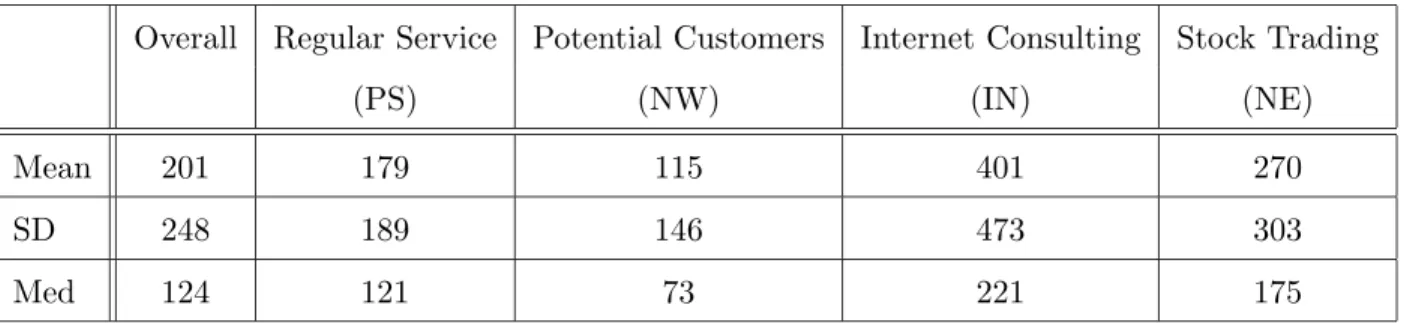
The goal of a visit to the call center is the service itself. Table 1 summarizes the mean, SD and median service times for the four types of service of main interest. The very few calls with service time larger than one hour were not considered (i.e. we treat them as outliers). Including these calls has little effect on the numbers.
Table 1: Service time by type of service, truncated at 1 hour, Nov.–Dec.
Overall Regular Service Potential Customers Internet Consulting Stock Trading
(PS) (NW) (IN) (NE)
Mean 201 179 115 401 270
SD 248 189 146 473 303
Med 124 121 73 221 175
Internet consulting calls have the longest service times, and trading services are next in duration. Potential customers have the shortest service time (which is consistent with the nature of these calls). An important implication is that the workload that Internet consultation imposes on the system is more than its share in terms of percent of calls. In Brown et al. (2002b) we also verify that the full cumulative distributions of the service times are stochastically ordered in the same fashion as the means in Table 1.
4.1 Very short service times
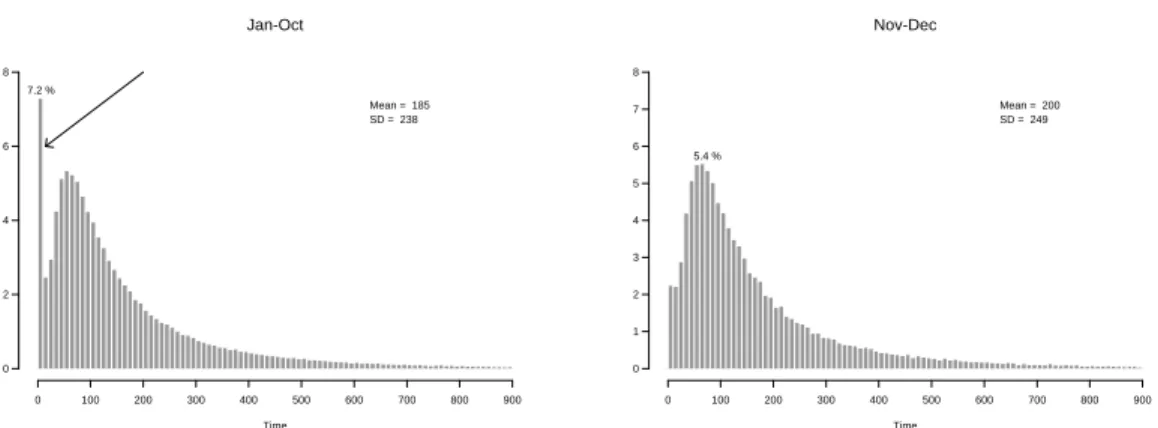
Figure 2 shows histograms of the combined service times for all types of service for January through October and for November–December. These plots resemble those for Regular Service calls alone, since the clear majority of calls are for regular service. We see that, in the first 10 months of the year, the percent of calls with service shorter than 10 seconds was larger than the percent at the end of the year (7% vs. 2%).
Service times shorter than 10 seconds are questionable. And, indeed, the manager of the call center discovered that short service times were primarily caused by agents that simply hung-up on customers to obtain extra rest-time. (The phenomenon of agents “abandoning” customers is not uncommon; it is often due to distorted incentive schemes, especially those that over-emphasize
Figure 2: Distribution of service time Time Jan-Oct 0 100 200 300 400 500 600 700 800 900 0 2 4 6 8 7.2 % Mean = 185 SD = 238 Time Nov-Dec 0 100 200 300 400 500 600 700 800 900 0 1 2 3 4 5 6 7 8 5.4 % Mean = 200 SD = 249
short average talk-time, or equivalently, the total number of calls handled by an agent). The problem was identified and steps were taken to correct it in October of 1999. For this reason, in the later analysis of service times we focus on data from November and December. Suitable analyses can be constructed for the entire year through the use of a mixture model or in a somewhat less sophisticated manner by deleting from the service-time analysis all calls with service times under 10 seconds.
4.2 On service times and queueing theory
Most applications of queueing theory to call centers assume exponentially distributed service times as their default. The main reason is the lack of empirical evidence to the contrary, which leads one to favor convenience. Indeed, models with exponential service times are amenable to analysis, especially when combined with the assumption that arrival processes are homogeneous Poisson processes. This is the reason that M/M/N is the prevalent model used in call center practice.
In more general queueing formulae, the service time often affects performance measures through its squared-coefficient-of-variationCs2 =σ2s/E2(S), E(S) being the average service time, andσs its
standard deviation. For example, a common useful approximation for the average waiting time in an M/G/N model (Markovian arrivals, Generally distributed service times, N servers), is given by:
E[Wait for M/G/N]≈E[Wait for M/M/N] × (1 +C
2
s)
2 . (1)
See Sze (1984) and Whitt (1993); note that for large call centers this formula is only to be used with care, as discussed in Mandelbaum and Schwartz (2002). Thus, average wait with general service times is multiplied by a factor of (1 +Cs2)/2 relative to the wait under exponential service times.
For example, if service times are, in fact, exponential then the factor is 1. Deterministic service timeshalve the average wait of exponential. In our data the observed factor is (1 +C2
s)/2 = 1.26.
4.3 Service times are lognormal
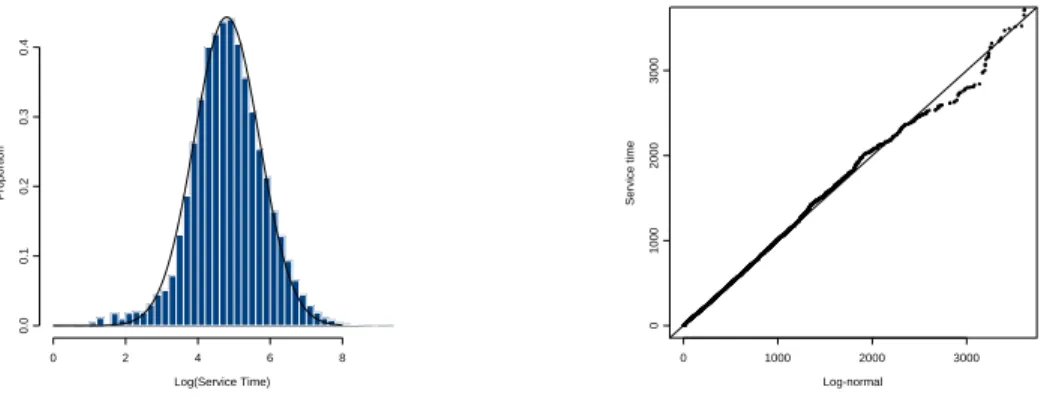
Looking at Figure 2, we see that the distribution of service times is clearly not exponential, as assumed by standard queueing theory. In fact, after separating the calls with very short service times, our analysis reveals a remarkable fit to thelognormaldistribution.
The left panel of Figure 3 shows the histogram of log(service time) for November and December, in which the short service phenomenon was absent or minimal. We also superimpose the best fitted normal density as provided by Brown and Hwang (1993). The right panel shows the lognormal Q-Q plot of service time. This does an amazingly good imitation of a straight line. Nevertheless the Kolmogorov-Smirnov test decisively rejects the null hypothesis of exact lognormality. (The K-S statistic here isK = 0.020. This is quite small, but still much larger than the value of K = 0.009 that was attained for a similarly large sample size in the inhomogeneous Poisson test of Section 4.) We only provide the graphs to qualitatively support our claim of lognormality. Thus, the true distribution is very close to lognormal but is not exactly lognormal. (The most evident deviation is in the left tail of the histogram where both a small excess of observations is evident and the effect of rounding to the nearest second further interferes with a perfect fit.) This is a situation where a very large sample size yields a statistically significant result, even though there is no “practical significance”.
Figure 3: Histogram, QQ Plot of Log(Service Time) (Nov.–Dec.)
0 2 4 6 8 0.0 0.1 0.2 0.3 0.4 Log(Service Time) Proportion Log-normal Service time 0 1000 2000 3000 0 1000 2000 3000
for all other months. It also holds for various types of callers, even though the parameters depend on the type of call. This means that, in this case, a mixture of log-normals is empirically log-normal, even though mathematically this cannot exactly hold. (We refer the reader to Mandelbaum et al. (2000) where the phenomenon is discussed in the context of the exponential distribution.) Brown and Shen (2002) gives a more detailed analysis of service times.
Lognormality of processing times has been occasionally recognized by researchers in telecommuni-cations and psychology. Bolotin (1994) shows empirical results which suggest that the distribution of the logarithm of call duration is normal for individual telephone customers and a mixture of nor-mals for “subscriber-line” groups. Ulrich and Miller (1993) and Breukelen (1995) provide theoretical arguments for the lognormality of reaction times using models from mathematical psychology. Man-delbaum and Schwartz (2002) use simulations to study the effect of lognormally distributed service times on queueing delays.
4.4 Regression of log service times on time-of-day
The important implication of the excellent fit to a lognormal distribution is that we can apply standard techniques to regress log(service time) on various covariates, such as time-of-day. For example, to model the mean service time across time-of-day, we can first model the mean and variance of the log(service time) across time-of-day and then transform the result back to the service-time scale. (Shen (2002) contains a detailed analysis of service service-times against other covariates, such as the identities of individual agents (servers), as well as references to other literature involving lognormal variates.)
LetS be a lognormally distributed random variable with meanν and varianceτ2, thenY = log(S) will be a normal random variable with some mean µ and variance σ2. It is well known that
ν=eµ+12σ
2
. This parameter (rather thanµorµ+σ2/2) is the primitive quantity that appears in calculations of offered load, as in Section 7. In order to provide a confidence interval forν, we need to derive confidence intervals forµand σ2, or more precisely, forµ+σ2/2.
For our call center data, let S be the service time of a call and T be the corresponding time-of-day at which the call begins service. Let {Si, Ti}ni=1 be a random sample of size n from the joint
distribution of{S, T}and sorted according toTi. ThenYi = log(Si) will be the Log(Service Time) of the calls, and these are (approximately) normally distributed, conditional on Ti. We can fit a
regression model ofYi onTi as Yi =µ(Ti) +σ(Ti)²i, where²i|Ti are i.i.d. N(0,1).
4.4.1 Estimation of µ(·) and σ2(·)
If we assume thatµ(·) has a continuous third derivative, then we can use local quadratic regression to derive an estimate forµ(·). (See Loader (1999).) Suppose ˆµ(t0) is a local quadratic estimate for
µ(t0), then an approximate 100(1−α)% confidence interval forµ(t0) is ˆµ(t0)±zα/2seµ(t0), where
seµ(t0) is the standard error of the estimate of the mean at t0 from the local quadratic fit.
Our estimation of the variance functionσ2(·) is a two-step procedure. At the first step, we regroup
the observations{Ti, Yi}ni=1 into consecutive non-overlapping pairs{T2i−1, Y2i−1;T2i, Y2i}bi=1n/2c. The
variance atT2i,σ2(T2i), is estimated by a squared pseudo-residual,D2i, of the form (Y2i−1−Y2i)2/2,
a so-called difference-based estimate. The difference-based estimator we use here is a simple one that suffices for our purposes. In particular, our method yields suitable confidence intervals for the estimation ofσ2. More efficient estimators might slightly improve our results. There are many other difference-based estimators in the literature. See M¨uller and Stadtm¨uller (1987), Hall, Kay and Titterington (1990), Dette, Munk and Wagner (1998) and Levins (2002).
During the second step, we treat {T2i, D2i}bi=1n/2c as our observed data points and apply local
quadratic regression to obtain ˆσ2(t0). Part of our justification is that, under our model, the{D2i}’s
are (conditionally) independent given the {T2i}’s. A 100(1−α)% confidence interval for σ2(t0) is
approximately ˆσ2(t0)±zα/2seσ2(t0).
Note that we usezα/2 as the cutoff value when deriving the above confidence interval, rather than a quantile from a Chi-squared distribution. Given our large data set the degree of freedom is large, and a Chi-squared distribution can be approximated well by a normal distribution.
4.4.2 Estimation of ν(·)
We now use ˆµ(t0) and ˆσ2(t0) to estimate ν(t0), as eµˆ(t0)+ˆσ
2(t
0)/2. Given the estimation methods
used forµ(t0) and σ2(t0), ˆµ(t0) and ˆσ2(t0) are asymptotically independent, which gives us
se(ˆµ(t0) + ˆσ2(t0)/2)≈
q
seµ(t0)2+ seσ2(t0)2/4.
distribution. Then the corresponding 100(1−α)% confidence interval for ν(t0) is exp µ (ˆµ(t0) + ˆσ2(t0)/2)±zα/2 q seµ(t0)2+ seσ2(t0)2/4 ¶ .
4.4.3 Application and model diagnostics
In the following analysis, we apply the above procedure to the weekday calls of November and December. The results for two interesting service types are shown in Figures 4(a) and 4(b), below. There are 42,613 Regular Service (PS) calls and 5,066 Internet Consulting (IN) calls. To produce the figures, we use the tricube function as the kernel and nearest-neighbor type bandwidths. The bandwidths are automatically chosen via cross-validation.
Figure 4(a) shows the mean service time for PS calls as a function of time-of-day, with 95% con-fidence bands. Note the prominent bimodal pattern of mean service time across the day for PS calls. The accompanying confidence band shows that this bimodal pattern is highly significant. The pattern resemble that for arrival rates of PS calls. (See Figure 1. This issue is discussed further in Brown et. al. (2002b).)
Figure 4: (left) Mean Service Time (PS) versus Time-of-day (95% CI) (right) Mean Service Time (IN) versus Time-of-day (95% CI)
Time (24-hour clock)
Mean Service Time
10 15 20 100 150 200 250 7 8 9 10 11 12 13 14 15 16 17 18 19 20 21 22 23 24 (a)
Time (24-hour clock)
Mean Service Time
10 15 20 300 350 400 450 500 7 8 9 10 11 12 13 14 15 16 17 18 19 20 21 22 23 24 (b)
Figure 4(b) plots an analogous confidence band for IN calls. One interesting observation is that IN calls do not show a similar bimodal pattern. We do see some fluctuations during the day, but they are only mildly significant, given the wide confidence band. Also notice that the entire confidence band for IN calls lies above that of PS calls. This reflects the stochastic dominance referred to in the discussion of Table 1.
comparable to that in Figure 3.
5
WAITING FOR SERVICE OR ABANDONING
In Sections 3 and 4 we characterized two primitives of queueing models: the arrival process and service times. In each case we were able to directly observe and analyze the primitive under investigation.
We next address the last system primitive, customer patience and abandonment behavior, and the related output of waiting time. Abandonment behavior and waiting times are deeply intertwined.
There is a distinction between the time that a customer needs to wait before reaching an agent versus the time that a customer is willing to wait before abandoning the system. The former is referred to asvirtual waiting time, since it amounts to the time that a (virtual) customer, equipped with infinite patience, would have waited until being served. We refer to the latter as patience. Both measures are obviously of great importance, but neither is directly observable, and hence both must be estimated.
A well known queueing-theoretic result is that, in heavily loaded systems (in which essentially all customers wait and no one abandons), waiting time should be exponentially distributed. See Kingman (1962) for an early result and Whitt (2002) for a recent text. Although our system is not very heavily loaded, and in our system customers do abandon, we find that the observed distribution of time spent in queue conforms very well to this theoretical prediction. See Brown et. al. (2002b) for further details.
5.1 Survival curves for virtual waiting time and patience
Both times to abandonment and times to service are censored data. Denote by R the “patience” or “time willing to wait”, by V the “virtual waiting time”, and equip both with steady-state distributions. One actually samplesW = min{R, V}, as well as the indicator 1{R<V} for observing
RorV. To estimate the distribution ofR, one considers all calls that reached an agent as censored observations, and vice versa for estimating the distribution of V. We make the assumption that (as random variables) R and V are independent given the covariates relevant to the individual customer. Under this assumption, the distributions of R and V (given the covariates) can be
estimated using the standard Kaplan-Meier product-limit estimator.
One may plot the Kaplan-Meier estimates of the survival functions ofR (time willing to wait), V
(virtual waiting time) and W = min{V, R}. Again, see Brown et. al. (2002b). There is a clear stochastic ordering between V and R in which customers are willing to wait (R) more than they need to wait (V). This suggests that our customer population consists of patient customers. Here we have implicitly, and only intuitively, defined the notion of apatient customer. (To the best of our knowledge systematic research on this subject is lacking).
We also consider the survival functions ofR for different types of service. Again, a clear stochastic ordering emerges. For example, customers performing stock trading (type ‘NE’) are willing to wait more than customers calling for regular services (type ‘PS’). A possible empirical explanation for this ordering is that type NE needs the service more urgently. This suggests a practical distinction between tolerance for waiting and loyalty/persistency.
5.2 Hazard rates
Palm (1953) was the first to describe impatience in terms of a hazard rate. He postulated that the hazard rate of the time-willing-to-wait is proportional to a customer’s irritation due to waiting. Aalen and Gjessing (2001) advocate dynamic interpretation of the hazard rate, but warn against the possibility that the population hazard rate need not represent individual ones.
We have found it useful to construct nonparametric estimates of the hazard rate. It is feasible to do so because of the large sample size of our data (about 48,000). Figure 5 shows such plots forR
andV, respectively.
The nonparametric procedure we use to calculate and plot the figures is as follows. For each interval of lengthδ, the estimate of the hazard rate is calculated as
[ # of events during (t, t+δ] ] [ # at risk at t] × δ .
For smaller time values,t, the numbers at risk and event rates are large, and we let δ = 1 second. For larger times, when fewer are at risk, larger δ’s are used. Specifically, the larger intervals are constructed to have an estimated expected number of events per interval of at least four. Finally, the hazard rate for each interval is plotted at the interval’s midpoint.
practice we used LOCFIT (Loader, 1999), though other techniques, such as kernel procedures or smoothing splines, would yield similar fits. The smoothing bandwidth was chosen by generalized cross-validation. (We also smoothly transformed the x-axis, so that the observations would be more nearly uniformly placed along that axis, before producing a fitted curve. The x-axis was then inversely transformed to its original form.) We experimented with fitting techniques that varied the bandwidth to take into account the increased variance and decreased density of the estimates with increasing time. However, with our data these techniques had little effect and so are not used here.
Figure 5(a) plots the hazard rates of the time willing to wait for regular (PS) calls. Note that it shows two main peaks. The first occurs after only a few seconds. When customers enter the queue, a “Please wait” message, as described in Section 2, is played for the first time. At this point some customers who do not wish to wait probably realize they are in queue and hang up. The second peak occurs at aboutt= 60, about the time the system plays the message again. Apparently, the message increases customers’ likelihood of hanging up for a brief time thereafter, an effect that may be contrary to the message’s intended purpose (or, maybe not!).
Figure 5: (a) Hazard rate for the time willing to wait for PS calls (Nov.–Dec.) (b) Hazard rate for virtual waiting time (Nov.–Dec.)
Time Hazard Rate 0 200 400 600 800 0.0 0.002 0.004 0.006 (a) Time Hazard Rate 0 200 400 600 800 0.0 0.002 0.004 0.006 0.008 0.010 (b)
In Figure 5(b), the hazard rate for the virtual waiting times is estimated forallcalls. (The picture for PS alone is very similar.) The overall plot reveals rather constant behavior and indicates a moderate fit to an exponential distribution. (The gradual general decrease in this hazard rate (from about.008 to.005) suggests an issue that may need further investigation.)
5.3 Patience Index
Customer patience on the telephone is important, yet it has not been extensively studied. In the search for a better understanding of patience, we have found arelativedefinition to be of use. Let the means ofV and R be mV and mR, respectively. One can define the patience index to be the
ratiomR/mV, the ratio of the mean time a customer is willing to wait to the mean time he or she
needs to wait. The justification for calling this a patience index is that, for experienced customers, the time one needs to wait is in fact that time one expects to wait. While this patience index makes sense intuitively, its calculation requires the application of survival analysis techniques to call-by-call data. Such data may not be available in certain circumstances. Therefore, we wish to find anempirical index which will work as an auxiliary measure for the patience index.
For the sake of discussion, we assume thatV andRare independent and exponentially distributed. As a consequence of these assumptions, one can demonstrate that
Patience Index=4 mR
mV =
P(V < R)
P(R < V) .
Furthermore, P(V < R)/P(R < V) can be estimated by (# served)/(# abandoned), and we define
Empirical Index=4 # served # abandoned.
Both the numbers of served and of abandoned calls are very easy to obtain from either call-by-call data or more aggregated call-center management reports. We have thus derived an easy-to-calculate empirical measure from a probabilistic perspective. The same measure can also be derived using the MLE’s for the mean of the (right-censored) exponential distribution, applied separately to R
and toV.
We can use our data to validate the empirical index as an estimate of the theoretical patience index. Recall, however, that the Kaplan-Meier estimate of the mean is biased when the last observation is censored or in the presence of heavy censoring. Nevertheless, a well known property of exponential distributions is that their quantiles are just the mean multiplied by certain constants, and we use quantiles when calculating the patience index. In fact because of heavy censoring, we sometimes do not obtain an estimate for the median or higher quantiles. Therefore, we used 1st quartiles when calculating the theoretical patience index.
The empirical index turns out to be a very good estimate of the theoretical patience index. For each of 68 quarter hours between 7am and midnight, we calculated the 1st quartiles of V and R
from the survival curve estimates. We then compared the ratio of the first quartiles to that of (# of served) to (# of abandoned). The resulting 68 sample pairs had an R-square of 0.94. See Brown et. al. (2002b) for a plot. This result suggests that we can use the empirical measure as an index for human patience.
With this in mind we obtain the following empirical indices for regular weekdays in November and December: regular customers (PS)= 5.34, stock trading (NE) = 8.71; new customers (NW) = 1.61; internet technical support (IN) = 3.74. We thus find that stock trading customers are the most patient, perhaps because their business is the most important to them. On the other hand internet customers are less patient by this measure than regular customers. In this context we emphasize that the patience index measures time willing to wait normalized by time needed to wait. In our case (as previously noted) the internet customers are in a separate queue from that of the regular customers. The internet customers on average are willing to wait slightly longer than regular customers. (See Brown et. al. (2002b).) However they also need to wait longer, and overall their patience index is less than that of regular customers.
Recall that the linear relationship between the two indices is established under the assumption thatR and V are exponentially distributed and independent. As Figure 5(a) shows, however, the distribution forRis clearly not exponential. Similarly, Figure 5(b) shows thatV also displays some deviation from exponentiality. Furthermore, sequential samples ofV are not independent of each other. Thus, we find the linear relation to be surprisingly strong.
Finally, we note another peculiar observation: the line does not have an intercept at 0 or a slope of 1, as suggested by the above theory. Rather, the estimated intercept and slope are -1.82 and 1.35, and are statistically different from 0 and 1. We are working on providing a theoretical explanation that accounts for these peculiar facts, as well as an explanation for the fact that the linear relationship holds so well even though the assumption of exponentiality does not hold for our data. (The assumption of independence ofR and V may also be questionable.)
6
PREDICTION OF THE LOAD
This section reflects the view of the operations manager of a call center who plans and controls daily and hourly staffing levels. Prediction of the system “load” is a key ingredient in this planning. Statistically, this prediction is based on a combination of the observed arrival times to the system
(as analyzed in Section 3), and service times during previous, comparable periods (as analyzed in Section 4).
In the following discussion we describe a convenient model and a corresponding method of analysis that can be used to generate prediction confidence bounds for the load of the system. More specifically, we present a model in Section 6.4 for predicting the arrival rate and in Section 6.6 for predicting mean service time. In Section 6.7 we combine the two predictions to obtain a prediction (with confidence bounds) for the load according to the method discussed in Section 6.3.
6.1 Definition of load
In Section 3 we showed that arrivals follow an inhomogeneous Poisson process. We let Λj(t) denote
the true arrival rate of this process at timeton a day indexed by the subscriptj. Figure 1 presents a summary estimate of ¯Λ·(t), the average of Λj(t) over weekdays in November and December.
For simplicity of presentation we treat together here all calls except the Internet calls (IN), since these were served in a separate system from August to December. The arrival patterns for the other types of calls appear to be reasonably stable from August through December. Therefore, in this section we use August–December data to fit the arrival parameters. To avoid having to adjust for the short-service-time phenomenon noted in Section 4.1, we use only November and December data to fit parameters for service times. Also, we consider here only regular weekdays (Sunday through Thursday) that were not full or partial holidays.
Together, an arbitrary arrival rate Λ(t) and mean service time ν(t) at tdefine the “load” at that time,L(t) = Λ(t)ν(t). This is the expected time units of work arriving per unit of time, a primitive quantity in building classical queueing models, such as those discussed in Section 7.
Briefly, suppose one adopts the simplest M/M/N queueing model. Then if the load is a constant,
L, over a sufficiently long period of time, the call center must be staffed, according to the model, with at leastL agents; otherwise the model predicts that the backlog of calls waiting to be served will explode in an ever-increasing queue. Typically, a manager will need to staff the center at a staffing level that is some function ofL – for example L+c√L for some constant c – in order to maintain satisfactory performance. See Borst, Mandelbaum and Reiman (2004) and Garnett et al. (2002).
6.2 Independence of Λ(t) and ν(t)
In Section 5.4.4 we noted a qualitative similarity in the bimodal pattern of arrival rates and mean service times. To try to explain this similarity we tested several potential explanations, including a causal dependence between arrival rate and service times. We were led to the conclusion that such a causal dependence is not a statistically plausible explanation. Rather, we concluded that the heavier volume periods involve a different mix of customers, a mix which includes a higher population of customers that require lengthier service. The statistical evidence for this conclusion is indirect and is reported in Brown et. al. (2002b).
Thus we proceed under the assumption that arrival rates and mean service times are conditionally independent given the time of day.
6.3 Coefficient of Variation for the prediction of L(t)
We discuss below the derivation of approximate confidence intervals for Λ(t) andν(t) that are based on observations of quarter-hour groupings of the data. The load, L(t), is a product of these two quantities. Hence, exact confidence bounds are not readily available from individual bounds for each of Λ(t) andν(t). As an additional complication, the distributions of the individual estimates of these quantities are not normally distributed. Nevertheless one can derive reasonable approximate confidence bounds from the coefficient of variation (CV) for the estimate ofL.
For any non-negative random variableW with finite, positive, mean and variance, define the coef-ficient of variation (as usual) byCV(W) =SD(W)/E(W).
IfU and V are two independent variables andW =U V then an elementary calculation yields
CV(W) =pCV2(U) +CV2(V) +CV2(U)·CV2(V).
In our caseU and V correspond to Λ andν. Predictions for Λ andν are discussed in Sections 7.4 and 7.6. As noted above these predictions can be assumed to be statistically independent. Also, their CVs are quite small (under 0.1). Note that ˆL(t) = ˆΛ(t)ˆν(t) and using standard asymptotic normal theory we can approximateCV( ˆL)(t) as CV( ˆL)(t)≈
q
CV2(ˆΛ)(t) +CV2(ˆν)(t).
This leads to approximate 95% confidence intervals of the form ˆL(t)±2 ˆL(t)CV( ˆL)(t). The constant 2 is based on a standard asymptotic normal approximation as being roughly 1.96.
6.4 Prediction of Λ(t)
Brown and Zhao (2001) investigates the possibility of modeling the parameter Λ as a deterministic function of time of day, day of week and type of customer, and it rejects such a model. Here we construct a random-effects model that can be used to predict Λ and to construct confidence bands for that prediction. The model that we construct includes an autoregressive feature that incorporates the previous day’s volume into the prediction of today’s rate.
In the model, which will be elaborated on below, we predict the arrival on a future day using arrival data for all days up to that day. Such predictions should be valid for future weekdays on which the arrival behavior follows the same pattern as those for that period of data.
Our method of accounting for dependence on time and day is more conveniently implemented with balanced data, although it can also be used with unbalanced data. For convenience we have thus used arrival data from only regular (non-holiday) weekdays in August through December on which there were no quarter-hour periods missing and no obvious gross outliers in observed quarter-hourly arrival rates. This leaves 101 days. For each day (indexed byj= 1, . . . ,101) the number of arrivals in each quarter hour from 7am through 12 midnight was recorded asNjk,k= 1, . . . ,68. As noted
in Section 3, these are assumed to be Poisson with parameter Λ = Λjk.
One could build a fundamental model for the values of Λ according to a model of the form
Njk = Poiss(Λjk), Λjk =Rjτk+ε0jk, (2)
where the τk are fixed deterministic quarter-hourly effects, the Rj denote random daily effects
with a suitable stochastic character, and theε0jk are random errors. Note that this multiplicative structure is natural, in that theτk’s play the role of the expected proportion of the day’s calls that
fall in the k-th interval. This is assumed to not depend on theRj’s, the expected overall number of calls per day. (We accordingly impose the side condition thatP
τk= 1.)
We will, instead, proceed in a slightly different fashion that is nearly equivalent to (2), but is computationally more convenient and leads to a conceptually more familiar structure. The basis for our method is a version of the usual variance stabilizing transformation. If X is a Poiss(λ) variable then V = qX+14 has approximately a mean θ = √λ and variance σ2 = 1
4. This is
nearly precise even for rather small values ofλ. (One could instead use the simpler form √X or the version of Anscombe (1948) that has qX+38, in place of qX+14; only numerically small
changes would result. Our choice is based on considerations in Brown et al. (2001).) Additionally,
V is asymptotically normal (as λ→ ∞), and it makes sense to treat it as such in the models that follow. We thus letVjk =
q
Njk +14, and assume the model
Vjk =θjk +ε∗jk with ε∗jk iid ∼N¡ 0,14¢ , θjk =αjβk+εjk, αj =µ+γVj−1,++Aj, (3) where Aj ∼ N(0, σA2), εjk ∼ N(0, σε2), Vj,+ = P k
Vjk, and Aj and εjk are independent of each
other and of values ofVj0,k for j0 < j. Note thatαj is a random effect in this model. Furthermore the model supposes a type of first order auto-regressive structure on the random daily effects. The correspondence between (2) and (3) implies that this structure is consistent with an approximate assumption that Rj = Ã γX k r Nj−1,k+ 1 4 +Aj !2 .
The model is thus not quite a natural one in terms ofRj, but it appears more natural in terms of
theVjk in (3) and is computationally convenient.
The parameters γ and βk need to be estimated, as well as µ, σ2A and σ2ε. We impose the side
condition P
βk2 = 1, which corresponds to the condition P
τk = 1. The goal is then to derive
confidence bounds for θjk = pΛjk in (3), and squaring the bounds yields corresponding bounds
for Λjk.
The parameters in the model (3) can easily be estimated by a combination of least-squares and method-of-moments. Begin by treating the {αj}’s as if they were fixed effects and using
least-squares to fit the model
Vjk =αjβk+
¡
εjk+ε∗jk
¢
.
This is an easily solved nonlinear least squares problem. It yields estimates ˆαj, ˆβk and ˆσ2, where
the latter estimate is the mean square error from this fit. σ2
ε can then be estimated by
method-of-moments as
ˆ
σ2ε = ˆσ2−1
4.
Then use the estimates{αˆj}to construct the least squares estimates of these parameters that would
be appropriate for a linear model of the form
ˆ
This yields least-squares estimates, ˆµ and ˆγ, and the standard mean square error estimator ˆσ2Afor the variance ofAj.
The estimates calculated from our data for the quantities related to the random effects are
ˆ
µ= 97.88, γˆ= 0.6784 (with corresponding R2 = 0.501),
ˆ
σA2 = 408.3, σˆε2 = 0.1078 (since ˆσ2= 0.3578).
(5)
The value ofR2reported here is derived from the estimation ofγ in (3) and it measures the reduction
in sum of squared error due to fitting the{αˆj}by this model, which captures the previous day’s call
volumes,Vj−1,+. The large value ofR2 makes it clear that the introduction of the auto-regressive
model noticeably reduces the prediction error (by about 50%) relative to that obtainable from a model with no such component (i.e., one in which a model of the form (3) holds withγ = 0).
For a prediction, ^Λk, of tomorrow’s value of Λk at a particular quarter hour (indexed by k), one
would use the above estimates along with today’s value ofV+. From (3) it follows that tomorrow’s
prediction is ^ θk = ˆβk(ˆγV++ ˆµ) (6) as an estimate of θk=βk(γV++µ+A) +ε (7) whereA∼N(0, σ2
A) andε∼N(0, σε2) are independent. The variance of the term in parentheses in
(7) is the prediction variance of the regression in (6). Denote this by PredVar(V+). The coefficient
of variation of ˆβk turns out to be numerically negligible compared to other coefficients of variation
involved in (6) and (7). Hence
Var(^θk)≈βˆk2×PredVar(V+) + ˆσε2. (8)
These variances can be used to yield confidence intervals for the predictions of θk. The bounds
of these confidence intervals can then be squared to yield confidence bounds for the prediction of Λk. Alternatively one may use the convenient formula CV(
^
θ2k) ≈ 2×CV(^θk), and produce the
corresponding confidence intervals. See Brown et. al. (2002b) for such a plot.
We note that the values of CV(^θ2k) here are in the range of 0.25 (for early morning and late evening) down to 0.16 (for mid-day). Note also that both parts of (8) are important in determining variability – the values of Var(^θk) range from 0.14 (for early morning and late evening) up to 0.27
(for mid-day). The fixed part of this is ˆσε2 = 0.11, and the remainder results from the first part of (8), which reflects the variability in the estimate of the daily volume figure,A, in (3).
Correspondingly, better estimates of daily volume (perhaps based on covariates outside our data set) would considerably decrease the CVs during mid-day but would not have much effect on those for early morning and late evening. (Incidentally, we tried including day of the week – Sunday, Monday, etc. – as an additional covariate in the model (3), but with the present data this did not noticeably improve the resulting CVs.)
A natural suggestion would be to use a nonparametric model for the curve Λ(t) in place of the binned model in (2), (3). This suggestion is appealing, and we plan to investigate it. However we have not so far succeeded in producing a nonparametric regression analysis that incorporates all the features of the above model and also provides theoretically unbiased prediction intervals.
The preceding model includes several assumptions of normality. These can be empirically checked in the usual way by examining residual plots and Q-Q plots of residuals. All the relevant diagnostic checks showed good fit to the model. For example, the Q-Q plots related toA and ε support the normality assumptions in the model. According to the model the residuals corresponding to εjk
should also be normally distributed. The Q-Q plot for these residuals has slightly heavier-than-normal tails; but only 5 (out of 6,868) values seem to be heavily extreme. These heavy extremes correspond to quarter-hour periods on different days that are noticeably extreme in terms of their total number of arrivals.
6.5 Prediction of ν(t)
In this section we also model the service time according to quarter hour intervals. This allows us to combine (in Section 6.6) the estimates ofν(t) derived here with the estimates of Λ(t) derived in Section 6.4, and to obtain rigorously justifiable, bias-free prediction confidence intervals. In other respects the model developed in this section resembles the nonparametric model of Section 4.4.
We use weekday data from only November and December. The lognormality discussed in Section 4.3 allows us to model log(service times), rather than service times. LetYjkldenote the log(service
time) of the l-th call served by an agent on day j, j = 1, . . . ,44, in quarter-hour interval k,
k= 1, . . . ,68. In total there aren= 57,152 such calls. (We deleted the few call records showing
model similar to that of Section 4.4, namely
Yjkl=µ+κk+εjkl, εjkl∼N(0, σk2) (indep.). (9)
Before adopting such a model we investigate whether there are day-to-day inhomogeneities that might improve the prediction model. This was done by adding a random day effect to the model in (9). The larger model had a partialR2= 0.005. This is statistically significant (P-value <0.0001)
due to the large sample size, but it has very little numerical importance. We also investigated a model that used the day – Sunday, Monday, etc. – as an additional factor but found no useful information in doing so. Hence in what follows we use model (9).
The goal is to produce a set of confidence intervals (or corresponding CVs) for the parameter
νk= exp µ µ+κk+ σ2 k 2 ¶ . (10)
The basis for this is contained in Section 4.4, except that here we use estimates from within each quarter-hour time period, rather than kernel smoothed estimates. This enables us to get rigorously justifiable, bias-free prediction confidence intervals. The most noticeable difference is that the standard error ofσ2 k is now estimated by seσ2 k ≈ r 2 nk−1 Sk2, (11)
wherenk denotes the number of observations within the quarter hour indexed bykandSk2 denotes
the corresponding sample variance from the data within this quarter hour. This estimate is moti-vated by the fact that ifX ∼N(µ, σ2) then Var((X−µ)2) = 2σ4. See Brown et. al. (2002b) for a plot of these prediction intervals.
Coefficients of Variation for these estimates can be calculated from the approximate (Taylor series) formulaCV∗(ˆν k)≈CV ³ ˆ µ+ ˆκk+σˆ 2 k 2 ´
. (The intervals ˆνk±1.96×νˆk×CV∗agree with the above to
within 1 part in 200, or better.) The values of CV here range from 0.03 to 0.08. This is much smaller than the corresponding values of CVs for estimating Λ(t). Consequently in producing confidence intervals for the load,L(t), the dominant uncertainty is that involving estimation of Λ(t).
6.6 Confidence intervals for L(t)
The confidence intervals can be combined as described in Section 6.3 to obtain confidence intervals forL in each quarter hour period. Care must be taken to first convert the estimates of Λ and ν
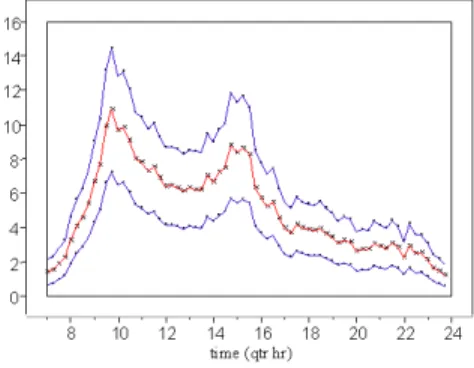
to suitable, matching units. Figure 6 shows the resulting plot of predicted load on a day following one in which the arrival volume hadV+= 340.
Figure 6: 95% prediction intervals for the load, L, following a day withV+= 340.
The intervals in Figure 6 are still quite wide. This reflects the difficulty in predicting the load at a relatively small center such as ours. We might expect that predictions from a large call-center would have much smaller CVs, and we are currently examining data from such a large center to see whether this is the case. Of course, inclusion (in the data and corresponding analysis) of additional informative covariates for the arrivals might improve the CV’s in a plot such as Figure 6.
7
SOME APPLICATIONS OF QUEUEING SCIENCE
Queueing theoryconcerns the development of formal, mathematical models of congestion in stochas-tic systems, such as telephone and computer networks. It is a highly-developed discipline that has roots in the work of A. K. Erlang (Erlang 1911, 1917) at the beginning of the 20th century. Queue-ing science, as we view it, is the theory’s empirical complement: it seeks to validate and calibrate queueing-theoretic models via data-based scientific analysis. In contrast to queueing theory, how-ever, queueing science is only starting to be developed. While there exist scattered applications in which the assumptions of underlying queueing models have been checked, we are not aware of previous systematic effort to validate queueing-theoretic results.
One area in which extensive work has been done – and has motivated the development of new theory – involves the arrival processes of internet messages (or message packets). See for example, Willinger, Taqqu, Leland and Wilson (1995), Cappe, Moulines, Pesquet, Petropulu and Yang (2002) and the references therein. These arrivals have been found to involve heavy tailed distributions and/or long range dependencies (and thus differ qualitatively from the results reported in our
Section 3).
In this section, we use our call-center data to produce two examples of Queueing Science. In Section 7.1 we validate (and refute) some classical theoretical results. In Section 7.2, we demonstrate the robustness (and usefulness) of a relatively simple theoretical model, namely the M/M/N+M (Erlang-A) model, for performance analysis of acomplicatedreality, namely our call center.
7.1 Validating Classical Queueing Theory
We analyze two congestion laws: first, the relationship between patience and waiting, which is a byproduct of Little’s law (Zohar, Mandelbaum and Shimkin (2002), Mandelbaum and Zel-tyn(2003)); then, the interdependence between service quality and efficiency, as it is manifested through the classical Khintchine-Pollaczek formula. (See, for example, Equation (5.68) in Hall (1991).)
On Patience and Waiting: We consider the relationship between average waiting time and the fraction of customers that abandon the queue. To do so, we compute the two performance measures for each of the 3,867 hourly intervals that constitute the year. Regression then shows that a strong linear relationship exists between the two, with a value ofR2= 0.875.
Indeed, if W is the waiting time and R is the time a customer is willing to wait (referred to as patience), the law
% Abandonment = E(W)
E(R) (12)
is provable for models with exponential patience as in Baccelli and Hebuterne (1981) or Zohar et al. (2002). However, exponentiality isnot the case here. (See Figure 5.)
Thus, the need arises for a theoretical explanation of why this linear relationship holds in models withgenerally distributedpatience. Similarly, the identification and analysis of situations in which non-linear relationships arise remains an important research question (Motivated by the present study, Mandelbaum and Zeltyn (2003) pursues both directions.)
Under the hypothesis of exponentiality, we use (12) to estimate the average time that a customer is willing to wait in queue, an absolute measure of customer patience. (Compare this to the relative index defined in Section 5.3.) From the inverse of the regression-line slope, we find that the average patience is 446 seconds in our case.
On Efficiency and Service Levels: As fewer agents cope with a given workload, operational efficiency increases. The latter is typically measured by the system (or agents’) “occupancy,” the average utilization of agents over time. Formally, it is defined as
ρ = λef f
N µ , (13)
where λef f is the effective arrival rate (namely the arrival rate of customers who get served), µ
is the service rate (E(S) = 1/µ is the average service time), and N is number of active agents, either serving customers or available to do so. Thus, the staffing level N is required to calculate agents’ occupancy. Neither occupancies nor staffing levels are explicit in our database, however, so we derive indirect measures of these from the available data. See Brown et. al. (2002b) for details.
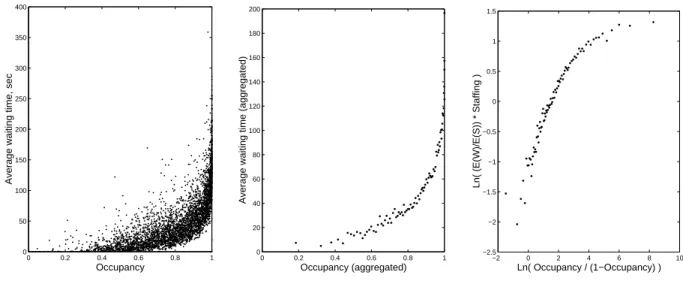
The three plots of Figure 7 depict the relationship between average waiting time and agents’ occupancy. The first plot shows the result for each of the 3,867 hourly intervals over the year. In the second and third, the patterns are emphasized by aggregating the data. (The hourly intervals were ordered according to their occupancy and adjacent groups of 45 were then averaged together.)
Figure 7: Agents’ occupancy vs. average waiting time
0 0.2 0.4 0.6 0.8 1 0 50 100 150 200 250 300 350 400 Occupancy
Average waiting time, sec
0 0.2 0.4 0.6 0.8 1 0 20 40 60 80 100 120 140 160 180 200 Occupancy (aggregated)
Average waiting time (aggregated)
−2 0 2 4 6 8 10 −2.5 −2 −1.5 −1 −0.5 0 0.5 1 1.5 Ln( Occupancy / (1−Occupancy) ) Ln( (E(W)/E(S)) * Staffing )
The classical Khintchine-Pollaczek formula suggests the approximation
E(W)≈ 1 N ρ 1−ρ 1 +Cs2 2 E(S), (14)
which is a further approximation of (1). See, for example Whitt (1993). Here Cs denotes the
coefficient of variation of the service time and ρdenotes the agents’ occupancy.
The third plot of Figure 7 tests the applicability of the Khintchine-Pollaczek formula in our setting by plottingN·E(W)/E(S) versusρ/(1−ρ). To check if the two exhibit the linear pattern implied
by (14), we display an aggregated version of the data as a scatter plot on a logarithmic scale. The graph pattern isnotlinear. This can be explained by the fact that classical versions of Khintchine-Pollaczek formula are not appropriate for queueing systems with abandonment.
Note that queueing systems with abandonment usually give rise to dependence between successive interarrival times of served customers, as well as between interarrival times of served customers and service times. For example, long service times could engender massive abandonment and, therefore, long interarrival times of served customers. A version of the Khintchine-Pollaczek formula that can potentially accommodate such dependence is derived in Fendick, Saksena and Whitt (1989). Theoretical research is needed to support the fit of these latter results to our setting with abandonment, however.
7.2 Fitting the M/M/N+M model (Erlang-A)
The M/M/N model (Erlang-C), by far the most common theoretical tool used in the practice of call centers, does not allow for customer abandonment. The M/M/N+M model (Palm (1943)) is the simplest abandonment-sensitive refinement of the M/M/N system. Exponentially distributed, or Markovian, customer patience (time to abandonment) is added to the model, hence the ‘+M’ notation. This requires an estimate of the average duration of customer patience, 1/θ, or equiv-alently an individual abandonment rate θ. Because it captures Abandonment behavior, we call M/M/N+M the “Erlang-A” model. See Garnett et al. (2002) for further details. The 4CallCenters software (4CallCenters, 2002) provides a valuable tool for implementing Erlang A calculations.
The analysis in Sections 4 and 5 shows that, in our call center, both service times and patience are notexponentially distributed. Nevertheless, simple models have often been found to be reasonably robust in describing complex systems. We therefore check whether the M/M/N+M model provides a useful description of our data.
7.2.1 Use of the Erlang-A Model
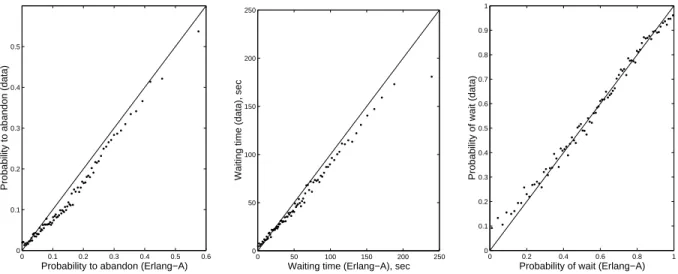
Erlang-A Analysis – Overall Assessment.We now validate the Erlang-A model against the overall hourly data used in Section 7.1. Three performance measures are considered: probability of abandonment, average waiting time and probability of waiting (at all). Their values are calculated for our 3,867 hourly intervals using exact Erlang-A formulae. Then the results are aggregated along
the same method employed in Figures 7. The resulting 86 points are compared against the line
y=x.
As before, the parameters λ and µ are easily computed for every hourly interval. For the overall assessment, we calculate each hour’s average number of agents N. Because the resultingN’s need not be integral, we apply a continuous extrapolation of the Erlang-A formulae, obtained from relationships developed in Palm (1943).
Forθ, we use formula (12), valid for exponential patience, in order to compute 17 hourly estimates of 1/θ=E(R), one for each of the 17 one-hour intervals 7am-8am, 8am-9am,. . . , 11pm-12pm. The values for E(R) ranged from 5.1 min (8am-9am) to 8.6 min (11pm-12pm). We judged this to be better than estimating θindividually for each of the 3,867 hours (which would be very unreliable) or, at the other extreme, using a single value for all intervals (which would ignore possible variations in customers’ patience over the time of day, see Zohar et al. (2002)).
The results are displayed in Figure 8. The figure’s two left-hand graphs exhibit a relatively small yet consistent overestimation with respect to empirical values, for moderately and highly loaded hours. (We plan to explore the reasons for this overestimation in future research.) The right-hand graph shows a very good fit everywhere, except for very lightly and very heavily loaded hours. The underestimation for small values of P{Wait} can probably be attributed to violations of work conservation (idle agents do not always answer a call immediately). Summarizing, it seems that these Erlang-A estimates can be used as usefulupper bounds for the main performance characteristics of our call center.
Figure 8: Erlang-A formulas vs. data averages
0 0.1 0.2 0.3 0.4 0.5 0.6 0 0.1 0.2 0.3 0.4 0.5
Probability to abandon (Erlang−A)
Probability to abandon (data)
0 50 100 150 200 250 0 50 100 150 200 250
Waiting time (Erlang−A), sec
Waiting time (data), sec
0 0.2 0.4 0.6 0.8 1 0 0.1 0.2 0.3 0.4 0.5 0.6 0.7 0.8 0.9 1
Probability of wait (Erlang−A)