Address for correspondence Dr. Attiya Tareen
Department of Dermatology,
Fauji Foundation Hospital, Rawalpindi E mail:[email protected]
Original Article
Diagnostic accuracy of antinuclear antibodies
and anti-double stranded DNA antibodies in
patients of systemic lupus erythematosus
presenting with dermatological features
Attiya Tareen*, Nighat Naqi**, Aamir Afzal†, Uzma Malik* * Department of Dermatology, Fauji Foundation Hospital, Rawalpindi ** Department of Pathology, Fauji Foundation Hospital, Rawalpindi † Foundation University Medical College, Rawalpindi
Abstract
Objective To determine the diagnostic accuracy of antinuclear antibodies (ANA) and anti-double stranded DNA (dsDNA) antibodies in systemic lupus erythematosus patients presenting with dermatological features.Methods In this cross-sectional study, 82 patients diagnosed as having systemic lupus erythematosus (SLE) per American College of Rheumatology (revised criteria 1997) from October 2012 to October 2013 and fulfilling the study’s inclusion criteria were enrolled. These patients were first assessed by the dermatologist for four dermatological features, namely malar rash, discoid rash, photosensitivity and oral ulcers and were than referred to Department of Pathology for assessment of serological markers i.e. ANA and anti-dsDNA antibodies. The diagnostic accuracies of serological markers were analyzed to determine which one of the two serological markers is associated with any of the four dermatological features under observation in our study.
Results Out of 82 SLE patients, 77 (93.9%) patients were females and 5 (6.1 %) were males. Male to female ratio in this study was 1:15. Mean age of patients was 34.91 years and ranged between 8-62 years. Photosensitivity, malar rash, oral ulcers and discoid rash were found in 97.5%, 85.3%, 76.8% and 46.3% patients, respectively. ANA was not found to be statistically significantly associated with any of the dermatological features under observation in our study. However, anti-dsDNA antibodies were strongly associated with photosensitivity 0.024 (p<0.05) and malar rash was 0.003 (p<0.05).
Conclusion The study proves that anti-dsDNA antibodies have high diagnostic accuracy for photosensitivity and malar rash in SLE patients and can be used alone with confidence in patients presenting with these two dermatological features, without burdening the lab with a lengthy serological evaluation.
Key Words
Systemic lupus erythematosus (SLE), dermatological features, serological markers.
Introduction
Systemic lupus erythematosus (SLE) is a
multisystem autoimmune disorder and therefore has diverse clinical manifestations of variable intensity.1Importance ofdermatological changes
very common and are known to be seen in 72% to 85% of SLE patients.3 Autoantibodies testing
is used to confirm the diagnosis of SLE and they are also part of diagnostic criteria of SLE. Antinuclear antibodies (ANA) and anti-double stranded DNA (dsDNA) antibodies are important antibodies determinants, in the evaluation of patients suspected of having SLE.4
These serological variables were selected for this study because of their proved diagnostic significance in SLE. No study has yet been conducted to determine diagnostic accuracy of ANA and anti-dsDNA antibodies in SLE patients presenting with dermatological features and sufficient data are lacking in this context in Pakistani population. This study was, therefore, conducted with the objective to determine diagnostic accuracy of the two serological markers in Pakistani SLE patients presenting with four dermatological features namely photosensitivity, malar rash, discoid rash, and oral ulcers all included in diagnostic criteria of SLE.
Methods
The study was conducted at Department of Dermatology in collaboration with Department of Pathology (Immunology), Fauji Foundation Hospital, Rawalpindi from October 2012 to October 2013. A total of 82 patients diagnosed as having SLE as per American College of Rheumatology revised criteria 1997 and fulfilling the inclusion criteria were included in the study. SLE patients who had none of the four dermatological features were excluded from the study. These patients after being assessed by the dermatologist for four dermatological features, namely, malar rash, discoid rash, photosensitivity and oral ulcers were than referred to Department of Pathology (Immunology) for assessment of serological markers i.e. ANA and anti-dsDNA antibodies.
For laboratory testing venous blood sample was collected and serum separated for quantitative detection of ANA and anti-dsDNA antibodies. ANA was tested by ANA screen ELISA (IMMCO Diagnostics Inc., U.S.A) and anti-dsDNA antibodies were tested by anti-dsDNA Anti body ELISA ImmuLisa Enhanced Kit by (IMMCO Diagnostics Inc., U.S.A).The cut off value for ANA for negative, borderline and positive cases were <20 IU/ml, 20-25 IU/ml and >25 IU/ml, respectively. The cut off value for anti dsDNA antibodies for negative, borderline and positive cases were <50 IU/ml, 50-60 IU/ml and 60 IU/ml, respectively. Statistical Package for Social Sciences (SPSS) version 17 was used for statistical analysis of the data. A p value of <0.05 was considered statistically significant.
Results
82 SLE patients were included in this study. Mean age of patients was 34.91 years and ranged between 8-62 years. Out of 82, SLE patients, 77 (93.9%) patients were females and 5 (6.1 %) were males. Male to female ratio in this study was 1:15.
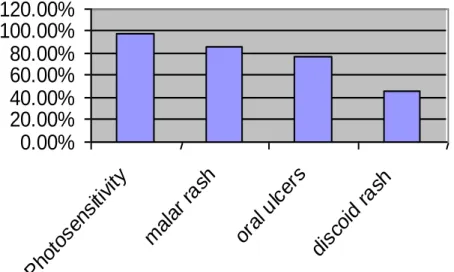
Photosensitivity, malar rash, oral ulcers and discoid rash were found positive in 97.5%, 85.3%, 76.8 % and 46.3 % patients, respectively as shown in Figure 1.
Association of ANA and anti-dsDNA antibodies with dermatological changes in systemic lupus erythematosus patients are shown in Table 1.
0.00%
20.00%
40.00%
60.00%
80.00%
100.00%
120.00%
P
ho
to
se
ns
iti
vi
ty
m
al
ar
ra
sh
or
al
u
lc
er
s
di
sc
oi
d
ra
sh
Figure 1 Frequencies of dermatological features in SLE patients.
Table 1 Association of ANA and anti-dsDNA antibodies with dermatological features in SLE patients. Serological markers Photosensitivity Malar rash Oral ulcers Discoid rash ANA positive patients 32 (39.2%) 26 (31.7%) 24( 29.2% ) 16(19.5%) ANA negative patients 8 (9.7%) 4 (4.8%) 5 (6.09 %) 3 (3.6%) Anti-dsDNA positive patients 27 (32%) 18 (21.9 %) 23 (28.0%) 12 (14.6%) Anti-dsDNA negative patients 13 (15.8%) 12 (14.6 %) 6 (7.3%) 7 (8.5 %)
Table 2 Association of ANA with Dermatological features in SLE.
Parameter Photosensitivity Malar rash Oral ulcers Discoid rash
Sensitivity 80% 86.6% 82.7% 84.2%
Specificity 21.9% 30.2% 26% 27%
Positive predictive value 49.2% 40% 36.9% 24.6%
Negative predictive value 52.9% 76.4% 70.5% 82.3%
p value 0.873 0.209 0.564 0.544
Table 3 Association of anti-dsDNA antibodies with dermatological features in SLE.
Parameter Photosensitivity Malar rash Oral ulcers Discoid rash
Sensitivity 67.5% 60% 79.3% 63.1%
Specificity 12.5% 10% 17.1% 18.6%
Positive predictive value 42.1% 28.1% 35.9% 18.7%
Negative predictive value 27.7% 33.3% 66.6% 61.1%
p value 0.024 0.003 0.838 0.074
Discussion
The mean age of patients in our study was 34.9 years and ranged between 8-62 years. Our results are very near to the results of the study conducted earlier on Pakistani SLE patients showing mean age of 30.35 years.5 Another
international study has shown that the disease is frequently seen between 20 and 40 years, with a female predominance of 3:1.6A study on Indian
population has reported that 98% patients were female and 84% patients were under the age of 40 years.7 Thefemale to male ratio in this study
was in line with the one conducted earlier showing high female preponderance with a ratio ranging from 7:1 to 15:1.8
SLE patients followed by malar rash (85.3%), oral ulcers (76.8%) and discoid rash (46.3%), respectively. However, the study conducted by Agrawal et al.7 has shown malar rash to be the
most common clinical feature where 71.3% patients presented with malar rash followed by photosensitivity (63.2%) and oral ulcers (42.5%). A study done by Malaviya et al.9
analyzing 1366 SLE patients from different part of India reported significantly high proportion of SLE patients presenting with mucocutaneous manifestations specially malar rash (58.5%). According to Ahmed et al.10 fever was the most
common presenting feature seen in 100% SLE patients, followed by arthritis (98%), malar rash (64%) and oral ulcers (58%).This difference in dermatological presentation of SLE patients in various studies could be due to different geographical and ethnic groups.
ANA was positive in 79.3% and anti-dsDNA antibodies in 78% of SLE patients showing statistically insignificant difference in sensitivity of both serological parameters for SLE patients presenting with dermatological features. Also the ANA was negative in 20.7% and anti-dsDNA was negative in 22 % cases at the time of diagnosis of SLE patients showing statistically insignificant difference between the specificities of the two markers having skin changes associated with SLE. These results state that both ANA and anti-dsDNA antibodies or either one can be used to identify SLE patients presenting with skin manifestations. Likewise Hussain’s study on Pakistani SLE patients has also concluded that no single clinical or immunological feature can be used to confirm diagnosis.5 Another study states that ANA and
anti-dsDNA antibodies can be positive for years before clinical symptoms appear thus proving our point that both serological markers have equal diagnostic accuracy for SLE.11 A previous
study shows different results than ours, reporting sensitivity of ANA for SLE patients to be 93% to 95% and specificity 57%.12Similarly, another
study reported sensitivity of anti-dsDNA antibodies for SLE patients to be 57.3% and specificity of anti-dsDNA antibodies 97.4% much higher than ours.13 The possible
explanation for this difference in sensitivities and specificities of the two serological markers in our study when compared with previous ones, could be due to the difference in technique used for determination of both serological markers. In our study both serological markers were analyzed by ELISA technique, which is less specific for antibodies detection as compared to gold standard immunofluorescence testing.14
Other studies have reported that while ELISA assays have advantage of being less labor intensive and usage of detecting a panel of common specific autoantibodies, they are not 100% sensitive when compared with immunofluorescence.15,16 Thus the technique
used in our study can attribute to the low sensitivity and specificity of both serological markers as compared to other studies .
malar rash in SLE patients and can be used with confidence in patients presenting with these two dermatological features.
The positive predictive value of ANA was highest for photosensitivity and negative predictive value was highest for discoid rash in our study group. Similarly in our study the positive predictive value of anti-dsDNA antibodies was highest for photosensitivity and negative predictive value was highest for oral ulcers. Nevertheless we cannot ignore a previous study that states thatELISA technique produces more false positive results, which may reduce the positive predictive value of the test.17
Conclusion
This study would prove helpful in the accurate and early diagnosis of SLE patients presenting with dermatological features with anti-dsDNA antibodies.
References
1. Arbuckle MR, James JA, Dennis GJ et al. Rapid clinical progression to diagnosis among African-American men with systemic lupus erythematosus. Lupus. 2003;12:99-106.
2. Hochberg MC. Updating the American College of Rheumatology revised criteria for the classification of SLE. Arthritis Rheum. 1997;40:1725.
3. Yell JA, Mbuagbaw J, Burge SM. Cutaneous manifestations of systemic lupus erythematosus. Br J Dermatol. 1996;135:355-62.
4. Eriksson C, Kokkonen H, Johansson M et al. Autoantibodies predate the onset of Systemic Lupus Erythematosus in northern Sweden. Arthritis Res Ther. 2011;13:R30. 5. Hussain N. Clinical and laboratory
manifestations of systemic lupus erythematosus in Pakistani lupus patients. Pak J Zool. 2013;45:605-13.
6. Tebbe B. Clinical course and prognosis of cutaneous lupus erythematosus. Clin Dermatol. 2004;22:121-4.
7. Agrawal SR, Tiewsoh I, Rajput A et al. A cross-sectional hospital based study of clinical and immunological profile of systemic lupus erythematosus patients from central rural India. Indian J Allergy Asthma Immunol. 2013;27:33-7.
8. Lahita RG. The role of sex hormones in systemic lupus erythematosus. Curr Opin Rheumatol. 1999;11:352-6.
9. Malaviya AN, Chandrasekaran AN, Kumar A, Shamar PN. Systemic lupus erythematosus in India. Lupus. 1997;6:690-70.
10. Ahmed TA, Ikram N, Hussain T et al. Clinical and laboratory features of SLE in Pakistani patients. J Pak Med Assoc. 2002;52:5-12.
11. Arbuckle MR, McClain MT, Rubertson MV et al. Development of autoantibodies before the clinical onset of systemic lupus erythematosus. N Engl J Med. 2003;349:1526-33.
12. Solomon DH, Kavanaugh AF, Schur PH. Evidence-based guidelines for the use of immunologic tests: Antinuclear antibody testing. Arthritis Rheum. 2002;47:434-45. 13. Kavanaugh AF, Solomon DH. Guidelines
for immunologic laboratory testing in rheumatic diseases: Anti DNA antibody tests. Arthritis Rheum. 2002;47:546-55. 14. Mutasim FD, Adams BB. A practical guide
for serologic evaluation of autoimmune connective tissue disease. J Am Acad Dermatol. 2000;42:159-74.
15. Tozzoli R, Bizzaro N, Tonutti E et al. Guidelines for laboratory use of autoantibody tests in the diagnosis and monitoring of autoimmune rheumatic diseases. Am J Clin Pathol. 2002;117:316-24.
16. Emlen W, O’Neill L. Clinical significance
of antinuclear antibodies: comparison of detection with immunofluorescence and
enzyme-linked immunosorbent assay.
Arthritis Rheum.1997;40:1612-8.