Address for correspondence
Dr. HumairaTalat, Assistant Professor, Dermatology Department,
Dow University of Health Sciences, Civil Hospital, Karachi
Email: [email protected]
Original Article
Patterns of psoriasis in pediatric age group
Introduction
Psoriasis is a chronic, immune-mediated,papulosquamous disorder with a variable clinical spectrum affecting a wide range of age groups.1 Psoriasis in childhood is not
uncommon. As many as 40% of adult patients with psoriasis have reported manifestations of this condition in childhood, with at least one-third of patients demonstrating features of psoriasis before the age of 16.2 Its multifactorial
etiology including genetics and environmental factors is well known.3,4 More than 20 new
genetic loci have been linked to this disease5
;
with PSORS1 locus on chromosome 6p213 being
generally understood to offer most risk for early onset psoriasis.6 Environmental triggers are also
somewhat different than adult disease, as pharyngitis, stress, and trauma are more common triggers of disease activity in childhood than in adulthood.7,8The clinical spectrum
include plaque-type, guttate, erythrodermic and napkin psoriasis.9,10 Other less frequent
presentations in children include nail psoriasis and pustular psoriasis. In children psoriasis is associated with other co-morbidities such as allergic contact dermatitis, eczema, vitiligo and alopecia areata.11
In a retrospective study of 419 children done in North India during 2004, the age of onset ranged from 4 days to 14 year. The peak age of onset in boys was in the 6-10 year age group, whereas
HumairaTalat, SabaMajeed, Zarnaz Wahid, Sana Siddiqui
Dermatology Department, Dow University of Health Sciences, Civil Hospital, Karachi
Abstract ObjectiveTo determine the patterns of psoriasis in pediatric age group.
Methods In this cross-sectional study, 30 patients meeting inclusion criteria were included by nonprobability consecutive sampling technique in a period of 6 months. Patients aged 1 month to 14 years, visiting dermatology OPD or getting admitted in Department of Dermatology, CHK, were examined by a dermatologist to make a diagnosis of psoriasis and its particular pattern. Biopsies were taken wherever required. Frequency and percentages were computed for age, gender, pattern of psoriasis, severity of diseases and site of involvement.
Results The median age of patients was 8 years, majority (56.7%) falling in the range of 6-10 years with equal gender distribution. Most of the patients presented with plaque type of psoriasis (43.3%), followed by guttate (13.3%), palmoplantar (10%) and nail involvement (10%). Psoriatic diaper rash and erythrodermic variety were seen in only 6.7% patients each. Lesions were primarily on the trunk (33.3%). However, only 1-10 % of body surface was involved in 50% of the patients, but at the same time 22.2% patients reported a greater involvement falling in range of 30-90% body surface area.
ConclusionWe conclude that plaque type is the most common pattern of psoriasis seen in children of our region and trunk is the most commonly affected site.
Key words
the majority of girls showed an onset of psoriasis between the ages of 10 and 14 years. This study showed equal gender distribution and classic plaque psoriasis as the most common type of psoriasis.8Extensors of the legs were the
most common initial site affected [105 (25%) cases], followed by the scalp [87 (20.7%)].In another study of 137 children from Central China12 demonstrated a female preponderance
(53.3%) and the most common variety remained plaque psoriasis. A study in Saudi Arabia of 36 patients also demonstrated plaque psoriasis as the most common pattern and a female preponderance.13Seyhan et al.7 in a study of 61
patients demonstrated that mean age at the onset of the disease was 6.89 ± 4.14 years in all patients with 23% of the cases showing a positive family history. The most frequent localizations at onset were trunk 44.3%, extremities 54.0%, and scalp 36.0%. Tollefson
et al.14 concluded that the incidence of pediatric
psoriasis increased with age and both males and females suffer equally, the most common pattern being plaque psoriasis (73.7%), and the most commonly involved sites were the extremities 59.9% and the scalp 46.8%.
Childhood psoriasis can significantly affect physical, as well as, mental health of a child. As it is a dermatosis with a wide clinical spectrum and a waxing and waning course, its early and proper diagnosis is difficult in pediatric age group, especially in our population where referral to a dermatology specialty unit is not common. Hence knowledge of its common clinical spectrum becomes important. This study aimed to determine the patterns of psoriasis in pediatric age group.This study will help in determining frequencies of different patterns of psoriasis seen in the affected children of our region.
Methods
It was a cross-sectional study conducted in outpatient and inpatient of dermatology department, Dow University of Health Sciences, Civil Hospital Karachi over a 6-month period from 1st January 2015 to 30 June 2015. By nonprobability consecutive sampling, a total of 30 patients were included.Inclusion criteria were patients aged 1 month to 14 years, of both genders whothemselves or their parents had given informed consent. Patients of psoriatic arthritis or juvenile arthritis were excluded.
After taking informed consent, patients or their parents were interviewed by a dermatologist. Besides recording demographics, complete history along with cutaneous and systemic examination of the patients were done to make a diagnosis of psoriasis and its particular pattern on clinical basis. However, punch biopsies were also taken wherever required and were fixed in 10% formalin for the hematoxylin and eosin staining. Severity was assessed according to the Physician's Global Assessment and body surface area measurements
Data were analyzed through SPSS version 17. Frequency and percentages were computed for age, gender, severity of diseases, site of involvement as well as for the pattern of psoriasis.
Results
In a study of 30 patients, the median age of patient was 8 years, most of the patients (56.7%) falling in the age range of 6-10 years. The disease was equally distributed in males and females as shown in the Table 1.
Table 1 Demographic data of study population(n=30).
Demographic information N(%) Gender
Female 15 (50.0)
Male 15 (50.0)
Age (years)
1 - 5 years 7 (23.3)
6 - 10 years 17 (56.7)
> 10 years 6 (20.0)
Table 2Frequency of type of psoriasis in children (n=30).
Type of Psoriasis in children N (%)
Plaque 13 (43.3)
Guttate 4 (13.3)
Nail 3 (10.0)
Palmoplantar 3 (10.0)
Erythrodermic 2 (6.7)
Psoriatic diaper rash 2 (6.7)
Scalp 2 (6.7)
Pustular 1 (3.3)
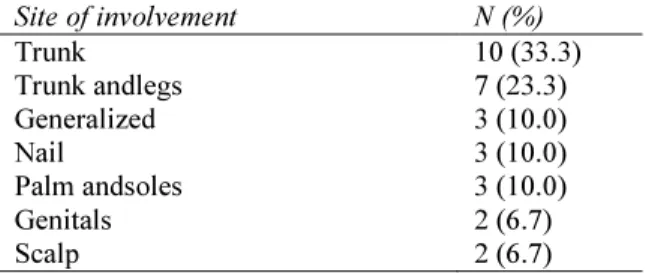
Table 3Frequency of site of psoriasis in children (n=30).
Site of involvement N (%)
Trunk 10 (33.3)
Trunk andlegs 7 (23.3)
Generalized 3 (10.0)
Nail 3 (10.0)
Palm andsoles 3 (10.0)
Genitals 2 (6.7)
Scalp 2 (6.7)
Table 4Frequency of area affected by psoriasis in children (n=).
Percent body surface area affected by disease
N (%)
Nails 3 (10.0)
1 - 10 % 15 (55.6)
20 - 30 % 6 (22.2)
30 - 90 % 6 (22.2)
(10%).Only 2 patients presented with psoriatic diaper rash and erythrodermic variety. Table 2
shows frequency of different types of psoriasis.
Regarding sites of involvement, 10 (33.3%) presented with lesions primarily on the trunk, while 7 of them (23.3%) had involvement of the
trunk and legs both. Genital involvement was found in only 2 patients (6.7%) [Table 3].
Half of the patients (50%) had body surface involvement in range of 1-10 %, while6 (22.2%) patients showed a greater body surface area involvement in range of 30-90%as shown in
Table 4.
Figures 1-5 show different morphological patterns of psoriasis.
Discussion
A total of 30 patients with childhood psoriasis were evaluable. Median age of presentation was 8 years in our study whereas most of the patients presented within a range of 6-10 years. This is close to the ranges seen in the North Indian study8 where the peak age of onset in boys was
in the 6-10 years age group, whereas the majority of the girls showed onset of psoriasis between the ages of 10 and 14 years. It is also close to the mean age noted in a study done in Saudi Arabia13 that revealed mean age of 8.46
years.
Gender predisposition was not seen in our study similar to that in the Australian study of 1262 children.15 A slight female predisposition was
reported in Chinese surveys (1:1.14).12
Most common type of psoriasis in our study was plaque psoriasis affecting 43.3% of the patients, which is same as the pattern seen in other studies.8,12,13Other patterns seen in our study
Figure 1Plaque variety of psoriasis.
Figure 3 Generalizedpustular psoriasis in a child.
Figure 5Nail psoriasis.
Figure 2Guttate variety.
Figure 4Plaque psoriasis with involvement of scalp.
seen in Chinese population (25.5%)13
and North Indian study (31%).8
Most commonly involved site of the body according to our study was trunk, as seen in 33.3% of the cases, which is in contrast with thestudy of Seyhanet al.7 and Tollefsonet al.14
accordingto which extremities are the most commonly affected site at onset.North Indian study revealed the extensors of the legs as the most common initial site affected in 25% cases,8
followed by the scalp in 20.7%. Similarly, in the study fromCentral China, scalp was the most common initial site affected in 69 (50.3%) patients.13
who had a disease affecting 30-90% of body surface area at the time of presentation, which is quite significant for a child.
Conclusion
We conclude that childhood psoriasis is common and has no gender predisposition. Plaque type psoriasis is the most common type prevalent in our region with trunk as the most commonly affected site.
References
1. Langley RG, Krueger GG, Griffiths CE. Psoriasis: Epidemiology, clinical features, and quality of life.Ann Rheum Dis. 2005;64:18-23.
2. Pootrakul L, Kalb RE. The management of psoriasis in children and adolescents. G Ital DermatolVenereol. 2010;145:259-68 3. Lowes MA, Bowcock AM, Krueger JG.
Pathogenesis and therapy of psoriasis. Nature. 2007;445:866-73.
4. Nestle FO, Kaplan DH, Barker J. Psoriasis. N Engl J Med. 2009;361:496-509.
5. Richardson SK, GelfandJM. Update on the natural history and systemic treatment of psoriasis. AdvDermatol. 2008;24:171-96. 6. Nair RP, Stuart PE, Nistor IHiremagalore
R, Chia NV, Qin ZSet al. Sequence and haplotype analysis supports HLA-C as the psoriasis susceptibility 1 gene. Am J Hum Genet. 2006;78:827-51.
7. Seyhan M, Coșkun BK, Sağlam H, Ozcan H, Karincaoğlu Y. Psoriasis in childhood and adolescence: evaluation of demographic and clinical features. Pediatr Int. 2006;48:525-30.
8. Kumar B, Jain R, Sandhu K, Kaur I, Handa S. Epidemiology of childhood psoriasis: a study of 419 patients from northern India. Int J Dermatol. 2004;43:654-8.
9. Swanbeck G, Inerot A, Martinsson T, Wahlstrφm J, Enerbδck C, Enlund F et al. Age at onset and different types of psoriasis. Br J Dermatol. 1995;133:768-73. 10. Karthikeyan K, Thappa DM, Jeevankumar B. Pattern of pediatric dermatoses in a referral center in South India. Indian Pediatr. 2004;41:373-7.
11. Dhar S, Banerjee R, Agrawal N, Chatterjee S, Malakar R. Psoriasis in children: an insight. Indian J Dermatol. 2011;56:262-5. 12. Wu Y, Lin Y, Liu HJ, Huang CZ, Feng AP,
Li JW. Childhood psoriasis: A study of 137 cases from central China. World J Pediatr. 2010;6:260-4.
13. Bhutto AM, Majeed A. Childhood psoriasis: Analytic retrospective study in Saudi patients. JPak Assoc Dermatol. 2011;21:159-64.
14. Tollefson MG, Crowson CS, McEvoy MT, Kremers HM.Incidence of psoriasis in children: a population based study. J Am Acad Dermatol. 2010;62:979-98.