Address for correspondence Dr. Sandeep Kaur,
Skin OPD, Guru Gobind Singh Medical Hospital, Sadiq Road, Faridkot, Punjab, India. 151203 Email: [email protected]
Original Article
Psychosocial impact of acne on quality of life in
North India: A hospital-based cross-sectional study
Introduction
It is well-known that acne vulgaris is a common malady of adolescence and is easily recognized. It is common enough to be called as physiological process, but is better recognized as a disease due to its inflammatory component. It
can have significant psychosocial disturbances as it affects adolescence that is the critical period during which emotional development and maturity starts taking place.1
Skin plays an important role in socialization, as skin is considered as an organ of communication. Cosmetic disfigurement produces social disapproval and increase in self consciousness. It can result in social withdrawal, poor eye contact, academic under achievements and psychosocial disturbances especially when Sumir Kumar*, Ravinder Singh*, Sandeep Kaur*, Bharat Bhushan Mahajan**
* Department of Dermatology, Venereology & Leprology, Guru Gobind Singh Medical Hospital, Sadiq Road, Faridkot, Punjab, India
** Department of Dermatology, Venereology & Leprology, Government Medical College, Amritsar, Punjab, India
Abstract Objective To evaluate the level of impact among acne patients on their quality of lifestyle and emotional well-being and to highlight the wider spectrum of problems that the patients face with acne.
Methods A total of 125 patients were enrolled for the study. Acne severity was graded using Global Acne Grading System (GAGS) after the clinical diagnosis. All the patients went through self-administered questionnaire of Cardiff Acne Disability Index (CADI) to fill out, to assess the reflection of patients’ experiences and perceptions.
Results Out of 125 patients, 72 (57.6%) were females and 53 (42.4%) were males. The age ranged
from 14 to 38 years. The maximum number of patients was in the age group of 14-20 years (90/125, 72%). Out of total 53 males, 33 (62.3%) had moderate to severe acne, whereas 58.3% females had such a severe acne. 47.2% (34/72) of females had high CADI scores in comparison to only 30.2% (16/53) of males. The impact on quality of life was more in the age-group of 21-30 years even though in this age group clinical severity of acne was mild to moderate only. According to duration of acne, patients having longer history of acne (>1 year) had highest CADI scores. There was significant correlation between severity of acne and CADI.
Conclusion We found compelling evidence that individuals with acne had profound emotional, as
well as, social impact on their quality of life. Greater efforts are needed to improve physician-patient communication while consultation, and provide more information to the physician-patients. Patients should be managed rather than treated.
Keywords
skin diseases like acne occur during adolescence.2 Acne may also be associated with
increased levels of anxiety, anger, depression and frustration.3 This psychological stress can
further aggravate acne through hormonal changes thereby setting up a vicious cycle. It is important to have reliable epidemiological data on acne and its psychosocial impact so that physician can show quantitatively that effective treatment of acne can have significant benefit to patient’s psychosocial life, apart from physical benefit to their acne.
Methods
This study was done in outpatient skin department of a tertiary care hospital in North India from June, 2013 to December, 2013. A total of 125 patients with clinical diagnosis of acne, aged more than 13 years were enrolled in the study after taking an informed consent. Both new and follow-up patients were included in the study. A detailed history was also taken according to proforma. The severity of acne was graded using Global Acne Grading System (GAGS). The patient was then given a self-administered Cardiff Acne Disability Index (CADI) questionnaire.
Global Acne Grading System (GAGS) Acne was graded using GAGS4 It avoids time consumption
in counting the lesions and cost of photographs. The GAGS considers six locations on face and chest/ upper back with a factor for each location based on surface area, distribution and density of pilosebaceous units. (Area factor: forehead-2, right cheek-2, left cheek-2, nose-1, chin-1, chest and upper back-3). Each of the location was graded separately on 0-4 scale with the most severe lesion within that area determining the local score. (Grade: 0-no lesion, 1-comedone, 2- papule, 3-pustule, 4-nodule). Under good light
Table 1 Global acne grading system
Location Factor
Forehead 2
Right cheek 2
Left cheek 2
Nose 1
Chin 1
Chest and upper back 3
Severity is graded as follows: no lesions=0, comedones=1, papules=2, pustules=3 and nodules=4. Local score is calculated using the formula: Local score= factor ˟ grade (0-4). The global score is sum of local scores, and a score of 1-18 is considered mild; 19-30, moderate; 31-38, severe; and >39, very severe.
and without touching, all the manifestations of acne ranging from comedones to nodule were recorded. Local score is calculated by multiplying area factor with the grade of most severe lesion within that location. Global score is the summation of all the local scores. GAGS is graded as shown in Table 1.
Cardiff Acne Disability Index (CADI) All the enrolled patients with acne above the age of 13 years completed CADI questionnaire made available in Hindi. It is a detailed questionnaire designed to assess disability caused by acne.5 It
Results
Out of 125 patients, 72 (57.6%) were females and 53 (42.4%) were males (M:F ratio being 0.74:1). The age ranged from 14 to 38 years. The maximum number of patients was in the age group of 14-20 years (90/125, 72%) with decreasing trend in incidence with age. Family history of acne was present in 48 (38.4%) patients. Appearance of facial acne was preceded by application of topical steroids in 25 (20%) patients. History of regular application of hair oil was given by 29 (23.2%) subjects. About 45 (36%) patients gave history of aggravation of acne with intake of oily and spicy food. More females (31.6%) remained worried due to acne as compared to males (9.3%).
Out of total 53 males, 33 (62.3%) had moderate to severe acne, whereas 58.3% females had such a severe acne (Table 2). 47.2% (34/72) of females had high CADI scores in comparison to only 30.2% (16/53) of males (Table 3).
Out of the total 125 patients, majority of the subjects (97/125, 77.6%) had mild to moderate acne according to GAGS (Table 4). Amongst patients with mild to moderate acne, 93/97 (95.9%) were in the age group of 11-30 years (Table 4). The impact on quality of life was more in the age-group of 21-30 years even though in this age group clinical severity of acne was mild to moderate only. All the patients above 30 years of age had low psychological impact of acne (Table 5).
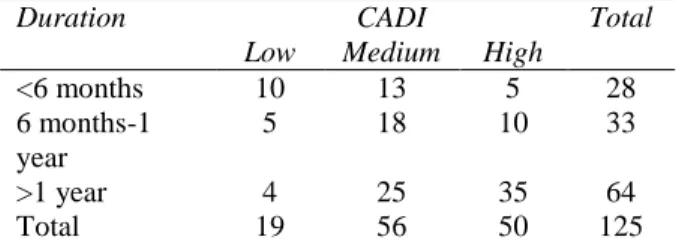
According to duration of acne, patients having longer history of acne (>1 year) had highest CADI scores (Table 6).
There was significant correlation between severity of acne and CADI (Table 7), (p=0.001, highly significant) severe or very severe acne were present in 1/19 (5.2%) patients with low
Table 2 Relationship between acne severity Global Acne Grading System (GAGS) and gender.
Acne severity (GAGS) Males Females Total
Mild 20 30 50
Moderate 21 26 47
Severe and very severe 12 16 28
Total 53 72 125
Chi square=0.220; df=2; p=0.896; non significant at p<0.05. For statistical purposes, severe and very severe GAGS were considered as one group.
Table 3 Relationship between Cardiff Acne Disability Index and gender.
Gender Cardiff Acne Disability Index Total
Low Medium High
Male 12 25 16 53
Female 7 31 34 72
Total 19 56 50 125
Chi square=5.68; df=2; p=0.05; significant
Table 4 Relationship between acne severity Global Acne Grading System (GAGS) and age.
Acne severity (GAGS)
11-20 years
21-30 years
31-40 years
Total
Mild 28 19 3 50
Moderate 40 6 1 47
Severe and very severe
18 10 0 28
Total 86 35 4 125
Chi square=11.7; df=4; p=0.020; significant at p<0.05. For statistical purposes, severe and very severe GAGS were considered as one group
Table 5 Relationship between Cardiff Acne Disability Index and age.
Age (years)
CADI Total
Low Medium High
11-20 10 45 31 86
21-30 6 11 18 35
31-40 3 0 1 4
Total 19 56 50 125
Chi square=16.2; df=4; p=0.003; highly significant at p<0.05.
Table 6 Relationship between Cardiff Acne Disability Index (CADI) and duration of acne.
Duration CADI Total
Low Medium High
<6 months 10 13 5 28
6 months-1 year
5 18 10 33
>1 year 4 25 35 64
Total 19 56 50 125
Table 7 Relationship between Global Acne Grading System (GAGS) and Cardiff Acne Disability Index (CADI).
GAGS CADI Total
Low Medium High
Mild 11 21 18 50
Moderate 7 28 12 47
Severe and very severe
1 7 20 28
Total 19 56 50 125
chi square=18.4; df=4; p=0.001; highly significant at p<0.05. For statistical purposes, severe and very severe GAGS were considered as one group
CADI, in 7/56 (12.5%) subjects with medium CADI while 20/50 (40%) with high CADI.
Discussion
Acne has shown significant psychological impact in the previous studies. The severity of acne was measured by different grading methods in various studies. Kilkenny et al.6 used Leeds
acne grading technique in a study done in UK. Korean acne grading system was employed by Do et al.7 to assess the acne severity. Two
different studies in Turkey and Malaysia used Global acne grading system.8,9 In 2008, Hayashi
et al.10 used standard photographs and lesion
counting to classify acne into four groups. They classified acne based on the number of inflammatory eruptions on half of the face as 0-5, "mild"; 6-20, "moderate"; 21-50, "severe"; and more than 50, "very severe." Various grading systems have been recommended to grade acne severity, yet none of them has been internationally agreed. Out of these, GAGS has been found to be accurate with less chances of interobserver variations.
According to our study, females outnumbered males in seeking treatment for acne. It may be because females are more conscious of their cosmetic appearance as compared to males. Most of the patients were adolescents as acne is more prevalent in this age group.11
About 38.4% of patients gave history of acne in parents or siblings. This is in accordance with various studies which show that genetic factors influence susceptibility to acne.12 One-fifth of
patients had applied topical steroids which lead to further aggravation of acne. It is due to easy availability and indiscriminate use of topical steroids and marked transient improvement which ultimately results in steroid dependence.
In our study, males had more moderate to severe acne as compared to females. This finding is similar to the previous studies.7-9 It may be due
to increased androgen levels in males.11
Many new acne-specific indices or scores have been tried to assess the psychological burden on patients with acne.6,7,13,14 Cardiff Acne Disability
Index (CADI) consists of acne-specific questionnaire which includes feeling of aggression, frustration, embarrassment, interference with social life, social events or relationships with members of opposite sex, avoidance of public changing facilities, concern over appearance of skin and perception of acne as a problem. Most of the patients felt aggressive, frustrated or embarrassed due to acne.
Acne may have different psychosocial morbidity according to gender. Our study showed higher CADI scores in females as compared to males. This is similar to previous studies which also found more psychological impact on females.7,15
Facial disfigurement makes females present earlier to treatment even for milder acne.
be attributed to decreased severity of acne with age, as well as, acceptance of mild acne cosmetically.
Patients with persistent acne were reported to have higher CADI scores.6,7 This study
demonstrated a significant relation between GAGS and CADI scores. The impact on quality of life increased with acne severity. It is consistent with previous studies which also found the similar findings.6,7,9,16 Also patients
with higher CADI scores tend to present with suicidal ideations.
In order to decrease psychological stress associated with acne and to build up self-esteem, it is the need of hour in a developing country like India to establish acne clinic with provision of counselors. This need stems out of high patient burden with low doctor: patient ratio. In order to increase time spent per patient, these acne clinics with counselors will help achieve the targets. Also the patients can be involved in group discussions.
The major limitation of our study is that it was hospital-based and of cross-sectional design. A hospital-based study may overestimate the psychological morbidity due to acne. Also, a prospective study would be better to consider the influence of various confounding factors like treatment, seasonal variation, difference in pubertal stage, change in hygiene and eating habits.
Conclusion
Our study confirmed that acne has profound effect on psychosocial behaviour. The impact on quality of life has been significantly associated with severity of acne, female gender, age and long disease duration. Clinicians should be aware that early treatment of acne and avoidance
of aggravating factors can prevent significant psychological morbidity.
References
1. Koo J. The psychosocial impact of acne: patients' perceptions. J Am Acad Dermatol.1995;32:S26–S30.
2. Fried RG, Wechsler A. Psychological problems in the acne patient. Dermatol Ther. 2006;19:237-40.
3. Thomas DR. Psychosocial effects of acne. J Cutan Med Surg. 2004;8(Suppl 4):3-5. 4. Doshi A, Zaheer A, Stiller MJ. A
comparison of current acne grading systems and proposal of a novel system. Int J Dermatol. 1997;36:416-8.
5. Motley RJ, Finlay AY. Practical use of a disability index in the routine management of acne. Clin Exp Dermatol 1992;17:1-3. 6. Kilkenny M, Stathakis V, Hibbert ME,
Patton G, Caust J, Bowes G. Acne in Victorian adolescents: associations with age, gender, puberty and psychiatric symptoms. J Paediatr Child Health. 1997;33:430-3.
7. Do JE, Cho SM, Sung-II In, Lim KY, Lee S, Lee ES. Psychosocial Aspects of Acne Vulgaris: A Community-based Study with Korean Adolescents. Ann Dermatol. 2009;21:125-9.
8. Atkan S, Ozmen E, Sanli B. Anxiety, depression and nature of acne vulgaris in adolescents. Int J Dermatol. 2000;39:354-7.
9. Hanisah A, Omar K, Shah SA. Prevalence of acne and its impact on the quality of life in school-aged adolescents in Malaysia. J Primary Health Care. 2009;1:20-5. 10. Hayashi N, Akamatsu H, Kawashima M;
Acne Study Group. Establishment of grading criteria for acne severity. J Dermatol. 2008;35:255-60.
11. Burton JL, Cunliffe WJ, Stafford L, Shuster S. The prevalence of acne vulgaris in adolescents. Br J Dermatol. 1971;85:119-26.
12. Walton S, Wyatt E, Cunliffe WJ. Genetic control of sebum excretion and acne. A twin study. Br J Dermatol. 1988;18:393-6. 13. Clark SM, Goulden V, Finlay AY, Cunliffe
14. Gupta MA, Johnson AM, Gupta AK. The development of an Acne Quality of Life Scale: reliability, validity and relation to the subjective acne severity in mild to moderate acne vulgaris. Acta Derm Venereol (Stockh). 1998;78:451-8.
15. Smithard A, Glazebrook C, Williams HC. Acne prevalence, knowledge about acne and psychological morbidity in
mid-adolescence: a community-based study. Br J Dermatol. 2001;145:274-9.