Crowd-Sourced Iterative Annotation for Narrative Summarization
Corpora
Jessica Ouyang and Serina Chang and Kathleen McKeown
Department of Computer Science, Columbia University, New York, NY 10027
{ouyangj, kathy}@cs.columbia.edu
Abstract
We present an iterative annotation pro-cess for producing aligned, parallel cor-pora of abstractive and extractive sum-maries for narrative. Our approach uses a combination of trained annotators and crowd-sourcing, allowing us to elicit human-generated summaries and align-ments quickly and at low cost. We use crowd-sourcing to annotate aligned phrases with the text-to-text generation techniques needed to transform each phrase into the other. We apply this pro-cess to a corpus of 476 personal narratives, which we make available on the Web.
1 Introduction
With the tremendous amounts of text published on the Web every day, automatic text summarization is more relevant than ever. Web content must com-pete for readers’ attention, and the existence of click bait links shows that content providers are very aware that a short, appealing summary may be their only chance to attract readers. For the readers’ part, summaries stating exactly what a piece of content is about protects them from wast-ing time on topics that do not interest them.
Research on summarization has long focused on extraction: selecting the most salient sentences from a text without any modifications. These sum-maries can be incoherent or incomprehensible due to unresolved pronouns and references, and sen-tences containing irrelevant information (Nenkova and McKeown, 2011), and this is particularly problematic with informal web text. Thus abstrac-tive summarization is critical for the web, with rewriting of extracted sentences, as humans write summaries (Jing and McKeown, 1999).
To develop an abstractive summarization sys-tem, we need data: parallel corpora that align extractive summaries with abstractive summaries. Such corpora would allow researchers to develop text-to-text generation approaches to produce ab-stractive summaries from extractive ones. While there are many summarization copora available, most provide abstractive summaries only (Meyer et al., 2016), extractive summaries only or un-aligned abstractive and extractive summaries (e.g., as in (Over et al., 2007; Dang and Owczarzak, 2008)).
In this work, we present an iterative annotation process for producing aligned summaries anno-tated with text-to-text generation techniques. Fig-ure 1 shows a human-written abstractive summary and human-selected extractive summary from our corpus. The extractive summary suggests the nar-rator was already uneasy and leaves the reader wondering why. This information is unimpor-tant, but the extractive summary must include it because it is in the same sentence as the bloody woman, just as it must include an extra character: the man in medical attire. Text-to-text generation techniques, such as sentence compression, could be used to rewrite this extractive summary to more closely match the abstractive summary.
Abstractive: While driving home I saw a woman cov-ered in blood standing by the side of the road. As I passed she attempted to launch herself at my car.
Extractive:As I’m looking around as to what the fuck is going on, we approach the roundabout and there is a man in medical attire next to a woman in white pyjamas, with blood covering her clothing. I go straight, and as we go past the woman attempts to launch herself at my car.
Figure 1: Abstractive and extractive summaries.
While the extractive summary contains some extraneous information, it does include
thing present in the abstractive summary. We use crowd-sourcing with Amazon Mechanical Turk (AMT) to produce our extractive summaries, and workers are given the abstractive summaries as a prompt, ensuring high-quality extractive sum-maries despite using inexpensive crowd-sourcing. In the next stage of our annotation process, we use AMT workers (Turkers) to align phrases from the extractive summaries to the abstractive sum-maries. Finally, we use Turkers to annotate the aligned phrases with the five rewriting operations identified by Jing and McKeown (1999) – re-duction (compression), combination (fusion), syn-tactic transformation, lexical paraphrasing, gen-eralization/specification – indicating how best to rewrite each extracted phrase. We make our cor-pus available on the Web1.
2 Related Work
Text-to-text generation for abstractive summa-rization is the task of revising extracted sen-tences using techniques such as sentence compres-sion (Knight and Marcu, 2000; Lin, 2003; Zajic et al., 2007; Liu and Liu, 2009) and fusion (Barzi-lay and McKeown, 2005). Unfortunately, cor-pora for text-to-text generation are rare and time-consuming to produce. Marcu (1999) created a corpus of nearly 7,000 abstractive and extractive summaries of news articles by automatically ex-tracting sentences based on a human-written sum-mary, building a large corpus at the cost of some noise. Murray et al (2005) created a corpus of 61 paired, human-written abstractive/extractive maries of meeting transcripts, but the gain in sum-mary quality achieved using human annotators is offset by the small size of the corpus.
This work uses personal narratives, widely found on social networks, weblogs, and online forums. The availability of online narrative be-gins to address a problem facing the text-to-text generation approach to summarization: lack of data. Gordon and Swanson (2009) trained a clas-sifier to identify narratives in blog posts with 75% precision and built a corpus of 937,994 narra-tives. Ouyang and McKeown (2015) created a corpus of 4,647 narratives collected automatically from Reddit, achieving 94% precision in collect-ing only narrative text. They argue that the Most Reportable Event (MRE) is the most salient event
1www.cs.columbia.edu/∼
ouyangj/aligned-summarization-data
and thus the shortest possible summary; they an-notated a subset of 476 narratives by extracting sentences that referred to MREs.
The Murray et al corpus includes alignments between phrases in the extractive summaries and sentences in the abstractive summaries. How-ever, none of the corpora described above pro-vides an analysis of how a summarizer might transform an extracted phrase into its abstractive form. While corpora exist for some rewrites in McKeown and Jing (1999), such as compression (Ziff-Davis, Filippova and Altun (2013), Kaji-wara and Komachi (2016)), fusion (McKeown et al (2010)), and lexical paraphrasing/syntactic re-ordering (Ganitkevitch et al (2013)), these corpora exist in isolation. A human summarizer may apply multiple rewrites to a single phrase, and our work captures this information with annotations for all of the rewrites over each alignment.
3 Data Collection
We use the annotated subset of 476 personal nar-ratives in Ouyang and McKeown (2015), although we do not use their annotations.
3.1 Stage One: Abstractive Summaries We partitioned the 476 stories into 7 slices of 68 narratives. The narratives were written for 19 dif-ferent prompts, which roughly correspond to top-ics (eg. “Your best ‘Accidentally Racist’ story?”). We randomly assigned an equal number of narra-tives from each prompt to each of the seven slices. We trained four graduate student annotators from our university’s Department of English and Comparative Literature. Each was assigned four slices: one in common with each other annotator, and one among all annotators. Each participated in a 30-minute training session: they were told to imagine they were about to tell a story to a friend and wanted to ask, “Did I tell you about. . . ?” They should write one or two sentences to complete the question and include any context they thought nec-essary for their friend to understand it.
in the other. We required Turkers to complete a qualification test before working on the HIT, en-suring they had read and understood the task in-structions. The test consisted of pairs of example summaries constructed so that the correct answers to our two questions were clear: the paired sum-maries were identical except for pieces of extra in-formation that we inserted into one or both sum-maries. Three Turkers worked on each hit, and we considered a pair of summaries to be in agreement if at least two out of three Turkers indicated that the summaries described the same event.
Abstract A: My neighbor’s mom saved me from being kidnapped into a car when I was six.
Abstract B:Someone tried to kidnap me when I was six, but a neighbor’s mom grabbed me before they got me.
(a) Agreeing abstractive summaries. Abstract A: I ran my mouth off at this rude woman. Abstract B:I held a door for a lady and she told someone on the phone that I had rudely ran around her.
(b) Disagreeing abstractive summaries.
Figure 2: Examples of agreeing and disagreeing abstractive summaries for two different narratives.
Our annotators achieved 90.38% observed agreement, producing a total of 1088 different ab-stractive summaries. Figure 2 shows a pair of agreeing and a pair of disagreeing abstractive sum-maries. With the disagreeing summaries, we see that annotators A and B focused on different as-pects of the narrative: A summarized the narra-tor’s confrontation with the rude woman, while B explains why the narrator was angry with the woman. Figure 3 shows a pair of agreeing maries where Turkers indicated that both sum-maries contained important information not found in the other summary. We see that annotator A focused on the event’s emotional effect on the nar-rator, while annotator C emphasized the irrespon-sible friend’s bad behavior.
Abstract A: This one friend never gave back the 360 and netbook I let him borrow, so now I have a hard time doing good deeds for other people.
Abstract C:I lent my friend my netbook and xbox 360 and he broke the netbook and claimed the 360 was stolen. He only ever gave me 100 bucks for it.
Figure 3: Extra information in a agreeing summaries.
3.2 Stage Two: Extractive Summaries
To produce the corresponding extractive sum-maries, we created another HIT that showed Turk-ers a narrative, one of its abstractive summaries, and instructions to compose an equivalent sum-mary by selecting as few sentences as possible from the narrative. We once again required Turk-ers to complete a qualification test before working on our HITs. The test consisted of a single story and abstractive summary, written so that the sum-mary was a word-for-word paraphrase of a single sentence in the narrative that did not overlap with any other sentences. We also required that Turk-ers be at least 18 years old and have completed at least 10,000 HITs with 98% acceptance on pre-vious HITs. Three Turkers worked on each of our HITs, and Turkers achieved substantial agree-ment on which sentences they selected: Fleiss’sκ of0.748. Figure 4 shows an extractive summary where they achieved perfect agreement.
Abstractive:At a concert, I grabbed a chunk of dirt in mid-air that was being thrown at a woman, and security thought I was throwing the dirt.
Extractive:There is a woman standing next to me when a huge piece of dirt comes flying straight at her face. I grab the chunk inches from her face mid-air. Security sees me with a chunk of dirt in my hand and instantly grab and pull me out of the crowd.
Figure 4: Perfect agreement among Turkers in constructing the extractive summary.
Combining our abstractive and extractive sum-maries, we have 476 narratives, 408 with two ab-stractive summaries and 68 with four. For each abstractive summary, we have six extractive sum-maries, one for each Turker and an additional three created by aggregating the Turkers’ summaries: sentences selected by at least one (union), two (majority), and all three (intersect) Turkers.
3.3 Stage Three: Phrase Alignments
We used another AMT HIT to produce phrase alignments between the extractive and abstractive summaries. We showed Turkers one of the ab-stractive summaries produced in Stage One and its corresponding extractive summary produced in Stage Two (using union aggregation). The task was to align phrases between the summaries, and to submit as many alignments as they could find.
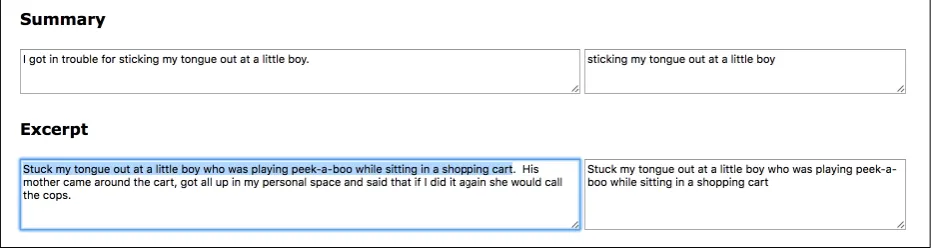
Figure 5: Highlighting interface for Phrase Alignment HIT.
“summary” and the extractive summary as the “ex-cerpt.” We defined aligning as “matching phrases from the summary with phrases from the excerpt that effectively mean the same things.” The HIT interface (Figure 5), allowed Turkers to select phrases by highlighting, save alignments as they went along, and submit all their saved alignments at the end. Three Turkers worked on each HIT.
As in the previous stages, we required Turkers to complete a qualification test where we showed Turkers one phrase from an abstractive summary and four phrases from the corresponding extrac-tive summary and asked them to decide which of the four extractive options would make a good alignment with the abstractive phrase. We also presented them with a link to a demo of the in-terface, so that they could try the highlighting and saving functions before working on the actual HIT.
3.4 Stage Four: Rewriting Operations
Our final HIT asked Turkers to review the align-ments produced in Stage Three, and to identify the rewrite operation(s) involved in transforming the extractive phrase into the abstractive phrase. When performing the task, Turkers were only con-cerned with one rewrite at a time, and simply had to select whether the presented alignment em-ployed that rewrite or not. We designed our task in this way because an alignment could employ more than one rewrite, and we wanted the Turk-ers to consider each rewrite independently.
We defined the rewrite operations for the Turk-ers as follows, and provided examples of each.
• Reduction keeps key parts word-for-word and removes less important information.
• Lexical paraphrasing replaces words or word sequences with paraphrases, ie. other words that have the same meaning.
• Syntactic reorderingchanges the grammat-ical structure (eg. passive vs active).
• Generalizationreplaces longer strings of de-tail with shorter, more general descriptions.
• Specificationreplaces short, general descrip-tions with longer strings of detail.
As in Stages Two and Three, we tested the Turkers’ understanding of the task before allow-ing them to work on the HITs. Since we ask about one rewrite operation at a time, we designed separate qualification tests for each rewrite. For each test, we selected one abstractive/extractive summary pair and constructed two different align-ment examples where one alignalign-ment employed the rewrite in question and the other did not. The Turkers were asked whether or not the rewrite was used in each of the two alignments.
Rewrite Operation Counts
Reduction 216 Generalization 3359 Lexical Para. 1218 Specification 1250 Syntactic Reor. 916
Table 1: Rewrite operation counts.
For each alignment, we put up four HITs (we combined generalization and specification so that Turkers could choose one or neither, but not both). Table 1 lists each rewrite and how many align-ments used it; we include an alignment when at least 2 out of 3 Turkers agreed it used the rewrite. We found that generalization was by far the most popular rewrite operation, and reduction was the least, likely because reduction’s definition was the most demanding, as it required word-for-word matching outside of the removed parts. Figure 6 shows an example each of generalization and its counterpart specification from our annotations.
Fusion Reduction Lexical Para. Syntactic Reor. Generalization Specification
Fusion 1052 36 214 151 695 165
Reduction 185 34 32 113 24
Lexical Para. 1068 179 564 237
Syntactic Reor. 772 391 165
Generalization 2802 0
Specification 1093
Table 2: Rewrite co-occurences produced from confident and precise alignments.
3.5 Discussion
We evaluated our Stage Three and Four data from the Turkers by assigning confidence levels to the alignments and judging annotator agreement on the rewrite labels. It would be difficult to deter-mine interannotator agreement in Stage Three be-cause Turkers could submit any number of align-ments of any size for each HIT. Instead, we evalu-ated on the level of individual alignments. A con-fident alignment had to agree with another align-ment, where two alignments agreed if (1) differ-ent Turkers submitted them; (2) the selected ab-stractive phrases overlapped enough that at least half of the shorter phrase was covered by the lap; and (3) the selected extractive phrases over-lapped enough that at least half of the shorter was covered. A precise alignment does not contain an extractive phrase that was over two sentences long, because the longer the alignment, the more difficult to identify the rewrite components in-volved. Thus aconfidentalignment is one where at least two different Turkers aligned the same spans, within a margin of error of a few words, while a
precisealignment is one where it is easier to pin-point the spans where rewrite operations apply.
Out of the 6173 alignments the Turkers pro-duced, 5836 (95%) were confident, 5602 (91%) wereprecise, and 5281 (86%) were both. When we evaluated the rewrite labels produced for these confident and precise alignments, we found that many were labeled for multiple rewrite techniques at once, indicating that quality phrase transforma-tions often involved stitching together rewrites in-stead of performing them separately. Figure 7 below displays an example of such an align-ment, which was labeled for lexical paraphrasing (3/3 Turker agreement), syntactic reordering (2/3 agreement), and generalization (2/3 agreement).
Table 2 further displays the interactions be-tween rewrites in the form of a co-occurence ma-trix of the five rewrites we tested on AMT, plus fusion, which we identified automatically.
Extractive: My SO at the time had been de-pressed/suicidal and I had been making posts in rele-vant subs with a different account asking for advice.I didn’t really have any experience with depression/suicide at the time, so it was a very scary situation for me . . . Abstractive: My friend identified some of my Reddit postsabout my suicidal SO at the time,and I was kind of relieved that I ended up getting to confide in him about the situation.
Figure 7: A confident and precise alignment (in bold) with multiple rewrite labels: lexical paraphrasing, syntactic re-ordering, and generalization. The extractive summary shown is truncated due to length.
4 Conclusion
We have presented a new corpus of 1088 aligned abstractive and extractive summaries, totaling 6173 phrase-level alignments, each annotated with rewrite operations, which we make available on the Web. Our iterative annotation process uses trained annotators to generate abstractive sum-maries and Amazon Mechanical Turk to pro-duce extractive summaries, phrase alignments, and rewrite annotations. We found substantial agreement among annotators and Turkers for all tasks, demonstrating our ability to elicit high-quality summaries and alignments despite using inexpensive crowd-sourcing.
Acknowledgments
This paper is based upon work supported by the National Science Foundation under Grant No. IIS-1422863. Any opinions, findings and conclusions or recommendations expressed in this material are those of the author(s) and do not necessarily reflect the views of the National Science Foundation.
References
Regina Barzilay and Kathleen McKeown. 2005. Sen-tence fusion for multidocument news summariza-tion. Computational Linguistics, 31(3):297–328. Hoa Trang Dang and Karolina Owczarzak. 2008.
Overview of the tac 2008 update summarization task. InProceedings of Text Analysis Conference. Katja Filippova and Yasemin Altun. 2013.
Overcom-ing the lack of parallel data in sentence compres-sion. In Proceedings of the 2013 Conference on Empirical Methods in Natural Language Process-ing, pages 1481–1491, Seattle, Washington, USA, October. Association for Computational Linguistics. Juri Ganitkevitch, Benjamin Van Durme, and Chris Callison-Burch. 2013. Ppdb: The paraphrase database. InProceedings of the 2013 Conference of the North American Chapter of the Association for Computational Linguistics: Human Language Tech-nologies, pages 758–764, Atlanta, Georgia, June. Association for Computational Linguistics.
Andrew Gordon and Reid Swanson. 2009. Identify-ing personal stories in millions of weblog entries. In
Proceedings of the 3rd International Conference on Weblogs and Social Media, Data Challenge Work-shop. Association for the Advancement of Artificial Intelligence.
Hongyan Jing and Kathleen McKeown. 1999. The de-composition of human-written summary sentences. InProceedings of the 22nd ACM SIGIR Conference on Research and Development in Information Re-trieval, pages 129–136. Association for Computing Machinery.
Tomoyuki Kajiwara and Mamoru Komachi. 2016. Building a monolingual parallel corpus for text sim-plification using sentence similarity based on align-ment between word embeddings. In Proceedings of COLING 2016, the 26th International Confer-ence on Computational Linguistics: Technical Pa-pers, pages 1147–1158, Osaka, Japan, December. The COLING 2016 Organizing Committee. Kevin Knight and Daniel Marcu. 2000.
Statistics-based summarization-step one: Sentence compres-sion. In Proceedings of the Twelth Conference on Innovative Applications of Artificial Intelligence, pages 703–710. Association for the Advancement of Artificial Intelligence.
Chin-Yew Lin. 2003. Improving summarization per-formance by sentence compression — a pilot study. InProceedings of the Sixth International Workshop on Information Retrieval with Asian Languages, pages 1–8, Sapporo, Japan, July. Association for Computational Linguistics.
Fei Liu and Yang Liu. 2009. From extractive to ab-stractive meeting summaries: Can it be done by sen-tence compression? In Proceedings of the ACL-IJCNLP 2009 Conference Short Papers, pages 261– 264, Suntec, Singapore, August. Association for Computational Linguistics.
Daniel Marcu. 1999. The automatic construction of large-scale corpora for summarization research. In
Proceedings of the 22nd ACM SIGIR Conference on Research and Development in Information Re-trieval, pages 137–144. Association for Computing Machinery.
Kathleen McKeown, Sara Rosenthal, Kapil Thadani, and Coleman Moore. 2010. Time-efficient creation of an accurate sentence fusion corpus. In Human Language Technologies: The 2010 Annual Confer-ence of the North American Chapter of the Associa-tion for ComputaAssocia-tional Linguistics, pages 317–320, Los Angeles, California, June. Association for Com-putational Linguistics.
Christian M. Meyer, Darina Benikova, Margot Mieskes, and Iryna Gurevych. 2016. Mdswriter: Annotation tool for creating high-quality multi-document summarization corpora. InProceedings of ACL-2016 System Demonstrations, pages 97–102, Berlin, Germany, August. Association for Computa-tional Linguistics.
Gabriel Murray, Steve Renals, Jean Carletta, and Jo-hanna Moore. 2005. Evaluating automatic sum-maries of meeting recordings. InProceedings of the ACL Workshop on Intrinsic and Extrinsic Evaluation Measures for Machine Translation and/or Summa-rization, pages 33–40, Ann Arbor, Michigan, June. Association for Computational Linguistics.
Ani Nenkova and Kathleen McKeown. 2011. Auto-matic summarization. Foundations and Trends in Information Retrieval, 5:103–233.
Jessica Ouyang and Kathleen McKeown. 2015. Mod-eling reportable events as turning points in narrative. In Proceedings of the 2015 Conference on Empiri-cal Methods in Natural Language Processing, pages 2149–2158, Lisbon, Portugal, September. Associa-tion for ComputaAssocia-tional Linguistics.
Paul Over, Hoa Dang, and Donna Harman. 2007. Duc in context. Information Processing & Management, 43(6):1506–1520.