Address for correspondence
Dr. Mohd. Nurul Alam, Assistant Professor, Department of Dermatology and Venereology, Ibn Sina Medical College & Hospital, 1/1-B, Kallyanpur, Mirpur, Dhaka, Bangladesh. Ph: 01715620130
Email: [email protected]
Original Article
A comparative study of once daily tazarotene versus
combination of tazarotene and betamethasone
valerate in the treatment of plaque psoriasis
Introduction
Psoriasis is a common, chronic, recurrent,
inflammatory disease of the skin characterized by round, circumscribed, erythematous, dry scaling plaque of various sizes, covered by grayish white or silvery, imbricated or lamellar scale.1 Psoriasis is equally common in males and females. The prevalence in different populations varies from 0.1 percent to 11.8 percent. Psoriasis may begin at any age, but uncommon under the age of 10 years, most likely to appear between
Humaira Afreen, A.K.M Shariful Islam, Mohd. Nurul Alam*, Farzana Afroz**, Tahmina Sultana#
Department of Dermatology & Venereology, Sir Salimullah Medical College, Dhaka *Department of Dermatology & Venereology, IbnSina Medical College, Dhaka **Department of Dermatology & Venereology, International Medical College, Dhaka
# Department of Dermatology & Venereology, Dhaka Medical College, Dhaka
Abstract Objective To compare the efficacy of once daily tazarotene and combination of tazarotene and betamethasone valerate in the treatment of plaque psoriasis.
Materials and Methods A clinical trial was carried out for the duration of six months from
November 2012 to April 2013 in the department of Dermatology and Venereology, Sir Salimullah Medical College, Mitford hospital, Dhaka. Patients who presented with mild to moderate plaque psoriasis, aged 18 to 60 years, were included in the study. In group A, 30 patients applied only tazarotene (0.1%) once in the evening and in group B, 30 patients applied once daily betamethasone in the morning plus tazarotene (0.1%) in the evening. The effectiveness of treatment was assessed at baseline and at the end of 4th week and 12th week of the study.
Results The mean PASI Score in group A and group B reduced from 17.61±2.23, 19.16±2.37
respectively to 9.24±1.09 and 4.92±0.51 (p<0.001), after 3 months of treatment. In group A and group B, 47.48% and 74.24% reduction of PASI was observed respectively after treatment. In Group A, among 30 patients, 21 (70%) had adverse effects. The most common adverse effects were burning 7(33.3%), irritation 4(19.0%), dry skin and pruritus 3(14.3%), fissuring, bleeding and worsening of psoriasis 2(9.5%). In Group B, among 30 patients, 10 (33.3%) experienced adverse effects. The most common adverse effects were burning 4(40%), irritation 3(30%), dry skin and pruritus 2(20.0%).
Conclusion Topical tazarotene seems to be significant and well tolerated agent for the treatment of
plaque type psoriasis. But combination of tazarotene and betamethasone valerate proved to be more significant and well tolerated in terms of effectiveness and safety measures.
Key words
the age of 15 and 30 years.2 The extent of body surface area affected by psoriasis is variable, ranging from limited disease (less than 2% body surface area) in approximately 80% of patients to more extensive skin involvement in
approximately 20 % of patients.3
Psoriasis, common skin pathology in our dermatological practice, has serious impacts on health related quality of life, even in patients with limited body surface area involvement.4 Several epidemiological studied has shown that hypertension, heart failure and diabetes are significantly more common in patients with psoriasis.5 Psoriasis may confer an independent risk of myocardial infarction specially in young
patients.6 Approximately 6-11% of patients with
psoriasis also have an associated inflammatory arthropathy (psoriatic arthritis).7
Several treatment regimens have been proposed for the treatment of psoriasis. The goal of psoriasis treatment are to gain initial and rapid control of the disease process, decrease the percentage of body surface area involved, decrease lesions, achieve and maintain long time remission, minimize adverse events and improve patients’ quality of life.8 Currently available topical therapies for psoriasis include emollients, keratolytics, coal tar, corticosteroids, anthralin and calcipotriol. Of these corticosteroids are probably the most commonly prescribed, but they do not have a sustained effect9 and in the long term may be associated with adverse effects
like atrophy, tachyphylaxis and
telangiectasia.10,12
Thus new and effective topically applied agents are needed. Retinoids have been used to treat a variety of skin disorders, including psoriasis and
acne.13 Second generation retinoids (e.g.
etretinate and acitretin) administered
systematically have proved effective in treating certain forms of psoriasis. However, the adverse
effect of orally administered retinoids are frequently severe and include both dermatologic and systemic effects.14 Additionally, there is concern about the teratogenic potential of these
compounds.15 Tazarotene is a novel
third-generation acetylenic retinoid that is being
investigated as a topical treatment for
psoriasis.16
Although tazarotene monotherapy is generally efficacious and well tolerated, studies show that both the efficacy and tolerability of tazarotene therapy can be further improved when it is used
in combination with certain topical
corticosteroids.17 The use of a topical
corticosteroid in combination with tazarotene has theoretic appeal because each drug has a different mechanism of action, and it is therefore likely that combination therapy will offer additive or synergistic effects. For example, the steroid may promote a rapid initial response together with minimization of erythema during the treatment period, and tazarotene may prolong the duration of the therapeutic effect and lower the probability of relapse.18
Common adverse events associated with tazarotene therapy are skin associated events such as pruritus, burning and erythema. Combination therapy with tazarotene and mild to high potency topical corticosteroid generally result in a greater therapeutic effect than that with tazarotene alone, reduce the irritancy of tazarotene and decrease the risk of post treatment disease flare seen with corticosteroids. It also has the potential to reduce the degree of
skin atrophy associated with topical
corticosteroid.19
Materials and Methods
Sir Salimullah Medical College, Mitford Hospital, Dhaka, Bangladesh. Sixty patients clinically and histopathologically diagnosed as plaque psoriasis were taken for this study. Purposive non probability sampling technique was applied to enroll the patients. Patients who gave written consent to participate in the study with mild to moderate plaque type psoriasis involving at least 2% of the total body surface area but not exceeding 36% of the total surface area, belonging to age group 18-60 years, of both sexes were included in the study. Patients who were excluded from the study were: pregnant and lactating mothers, those who were planning to become pregnant, individuals of child bearing potential unwilling to practice adequate contraception, patients using topical therapies and ultraviolet B within 2 weeks before study, patients using oral retinoids within 8 weeks and other drugs such as methotrexate within 4 weeks before study, patients receiving
thiazide diuretics, antibiotics such as
tetracycline, fluroquinolone, sulfonamide,
phenothiazine, other topical and systemic therapies for psoriasis and other drugs which cause aggravation of psoriasis like beta blocker, ACE inhibitor.
Procedure of data collection Data was collected for 120 days. The minimum time to take an interview was 30 minutes. The enrolled patients were divided into two groups and provided with any one of the two following therapeutic interventions. Patients were advised not to use or mix any other treatment. Group A: Tazarotene (0.1%) alone and Group B: Betamethasone valerate and Tazarotene (0.1%) combination. Patients of both Group A and B were instructed to apply a thin film of their medications to all psoriatic lesions every evening daily if randomized to tazarotene group or once daily betamethasone in the morning and tazarotene in the evening if randomized to combination group. Application to normal skin was avoided.
Patients were examined every two weeks interval after starting the treatment. At each visit side effects such as irritation, burning, pruritus etc. were determined by query and physical examination. Improvement was noted on the basis of Psoriasis Area and Severity Index
(PASI) score. For convenience only 4th week and
12th week records were taken for analysis. The effectiveness of treatment was assessed at baseline and at the end of 4th week and 12th week of the study. Information obtained from history, physical examination, measures of disease activity were recorded in patient's data sheet.
Scoring of psoriasis Severity of psoriasis was measured by using Psoriasis Area and Severity Index (PASI). Individual component, especially the grade of erythema (E), infiltration or induration (I) and desquamation/ scaling (D) was used for score calculation.
We used visual impression and palpation for erythema, induration and desquamation on a scale from 0 (none), 1 (slight), 2 (moderate), 3 (severe), 4 (very severe). To calculate PASI body was divided into four regions:
A. Head and neck (H)
B. Upper extremity (U)
C. Trunk (T)
D. Lower extremity (L), Buttock is count as a part of the lower extremity, axilla and groin as part of trunk. The percentage of each area involved will be given a number of 0 to 6.
• 0% = none No involvement
• <10% = 1 (1-9% involvement equivalent to taken as a score 1)
• 10-29% = 2 (10-29% involvement equivalent
to taken as a score 2)
• 30-49% = 3 (30-49% involvement equivalent
to taken as a score 3)
• 50-69% = 4 (50-69% involvement equivalent
• 70-89% = 5 (70-89% involvement equivalent to taken as a score 5)
• 90-100% = 6 (90-100% involvement
equivalent to taken as a score 6)
The PASI formula:
0.1(EH+IH+DH)AH+0.2(EU+IU+DU)AU+0.3 (ET+IT+DT)AT+0.4(EL+IL+DL)AL
PASI score can range from 0-72.
Results
In Group A, among 30 patients, 11 (36.7%) patients were in the age group of 28-37 years, followed by 8 (26.7%) patients in the age group of 38-47 years, 6 (20.0%) patients in the age group of 48-60 years, 5 (16.7%) patients in the age group of 18-27. In Group B, among 30 patients, 10 (33.3%) patients were in the age group of 28-37 years, followed by 7 (23.3%) patients each in the age groups 38-47 years and 48-60 years, 6 (20.0%) patients in the age group of 18-27 years. The mean age of the patients was 37.20±11.13 (range 18-60 yrs.) and 36.80±11.37 (range 18-60 years). The difference between the mean age of Group A and Group B was not significant (p=0.891)
In Group A, among 30 patients, males were more than females, 19 (63.3%) and 11 (36.7%) respectively. The ratio between male and female
was 1.72:1. In group B, among 30 patients, males and females were 20 (66.7%) and 10 (33.3%) respectively. The ratio between male and female was 2:1. The difference between male and is female in Group A and Group B was not significant (p=0.787).
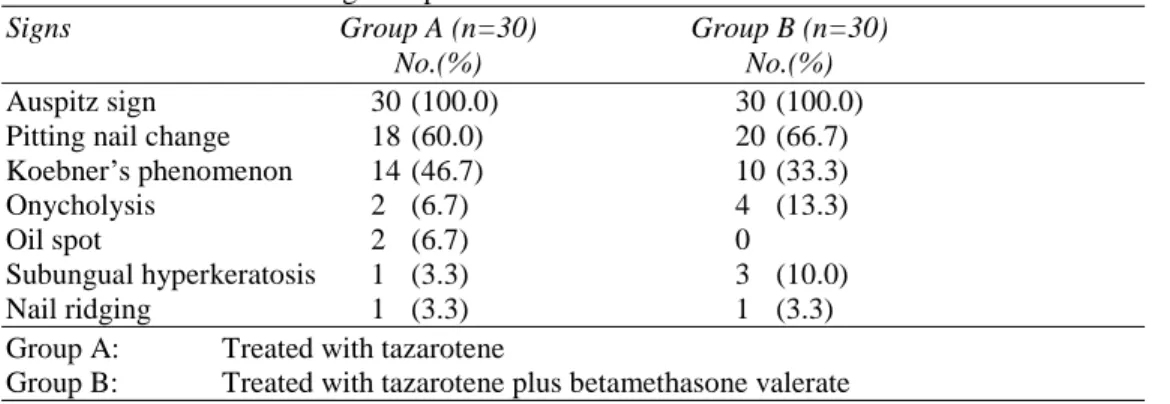
Table 1 In Group A, among 30 patients, all had positive Auspitz’s sign (100%), 18 (60%) had pitting, 14 (46.7%) had Koebner’s phenomenon, 2 (6.7%) had onycholysis, 2 (6.7%) had oil spot, 1 (3.3%) had subungual hyperkeratosis, and 1 (3.3%) had nail ridging. In Group B, among 30 patients, all respondents had Auspitz sign which was 30 (100%), 20 (66.7%) had pitting nail change, 10 (33.3%) had Koebner’s phenomenon, 4 (13.3%) had onycholysis, none had oil spot, 3 (10%) had subungual hyperkeratosis, and 1 (3.3%) had nail ridging.
Table 2 In Group A, the mean PASI Score at enrolment was 17.61±2.23, at 1st follow-up it was I2.61±2.23 and at final follow-up it was 9.24±1.09. Statistically significant improvement of psoriasis based on PASI was observed at 1st follow-up after 1 month of treatment (P<0.001). Significant result was also observed at final follow-up after 2 months of treatment from 1st follow-up (P<0.001). During 1st follow-up, after 1 month of treatment, 28.88% reduction of PASI was observed and at final follow-up, after 2 months of 1st follow-up, 47.48% reduction of PASI was observed.
Table 1 Different clinical signs of psoriasis
Signs Group A (n=30) Group B (n=30)
No.(%) No.(%)
Auspitz sign 30 (100.0) 30 (100.0)
Pitting nail change 18 (60.0) 20 (66.7)
Koebner’s phenomenon 14 (46.7) 10 (33.3)
Onycholysis 2 (6.7) 4 (13.3)
Oil spot 2 (6.7) 0
Subungual hyperkeratosis 1 (3.3) 3 (10.0)
Nail ridging 1 (3.3) 1 (3.3)
Group A: Treated with tazarotene
Group B: Treated with tazarotene plus betamethasone valerate
Table 2 Mean PASI Score and reduction of PASI
PASI score Group A Group B P valuea
(n=30) (n=30) t value
df
Baseline Mean±SD 17.61±2.23 19.16±2.37 0.012*
Range 13.60-21.50 13.30-22.30 -2.605 58 At 1st follow-up Mean±SD 12.61±2. 13.56±2.93 0.162ns
Range 8.60-16.50 10.10-20.10 -1.418
58 At final follow-up Mean±SD 9.24±1.09 4.92±0.51 0.0001***
Range 7.20-11.20 3.60-5.50 -19.671
58 P valueb P valueb
t value t value
df df
Comparison between 1st follow-up 0.0001*** 0.0001***
and baseline -751.000 -10.345
29 29
Mean change -5.01 -5.60
% change -28.88 -28.82
Comparison between final follow-up 0.0001*** 0.0001***
and baseline -39.961 -41.331
29 29
Mean change -8.37 -14.24
Group A : Treated with tazarotene Group B: Treated with tazarotene plus betamethasone valerate
a
unpaired/ bPaired Student's ‘t’ test ns = Not significant
* = Significant at P<0.05 *** = Significant at P<0.001
Table 3 Adverse effects Adverse
effects
Group A (n=30) No. (%)
Group B (n=30) No. (%)
Statistics
Yes 21 (70.0) 10 (33.3) Pvalue 0.004**
Df 1
X²value 8.076
No 9 (30.0) 20 (66.7)
Types (n=21) (n=10)
Burning 7 (33.3) 4 (40.0)
Irritation 4 (19.0) 3 (30.0) Dry skin 3 (14.3) 2 (20.0)
Erythema 2 (9.5) 1 (10.0)
Worsening of
psoriasis 2 (9.5) 0
Pruritus 3 (14.3) 2 (20.0)
Fissuring 2 (9.5) 0
Bleeding 2 (9.5) 0
Photosensitivity 1 (4.8) 0
Atrophy 0 4 (40.0)
Striae 0 2 (20.0)
Telangiectasia 0 1 (10. 0)
Group A: Treated with tazarotene
Group B: Treated with tazarotene plus betamethasone valerate Note: Some of the patients developed more than one adverse effect. Chi-square test
In Group B, the mean PASI score at enrollment
was 19.16±2.37, at 1st follow-up was I3.56±2.93
and at final follow-up was 4.92±0.51.
Statistically significant improvement of psoriasis based on PAS1 was observed at 1st follow-up after 1 month of treatment (P<0.001). More significant result was also observed at final follow-up after 2 months of treatment from 1st follow-up (p<0.0001). During 1st follow-up, after 1 month of treatment, 28.82% reduction of PASI was observed and at final follow-up, after 2 months of 1st follow-up, 74.24% reduction of PASI was observed.
Table 3 In Group A, among 30 patients, 21 (70%) had adverse effects. In Group B, 10 (33.3%) experienced adverse effects.
Discussion
This prospective non randomized comparative clinical trial was conducted in a tertiary care hospital serving an urban and suburban population in Dhaka. Sixty patients of psoriasis were selected for the study from the Sir Salimullah Medical College, Mitford Hospital, Dhaka, during a period of six months from 1st
November 2012 - to 30th April 2013. Among
them 30 patients were treated with tazarotene (Group A) and 30 patients were treated with tazarotene and betamethasone valerate (Group B).
Schon et al.20 found mean age of psoriatic patients was 44.9 with a range from 21 to 78 years. The age incidence in the current study was different from national and international studies probably due to small selection group of study patients.
In Group A, among 30 patients, 19 were males and 11 were females. The ratio between male and female was 1.72:1. In Group B, among 30 patients, 20 were male and 10 were female. The
ratio between male and female was 2:1.The results of this study correlated with the international studies described later.
Inderjeet et al.21 described psoriasis as a male predominant disease. Some studies differ from present study as they found psoriasis affects both sexes equally.2
From present study it is revealed that all respondents had positive Auspitz sign. In Group A, 60% patients had nail pitting, 46.7% patients had Koebners phenomenon, 6.7% patients had onycholysis, oil spot, 1% patients had subungual hyperkeratosis and nail ridging. In Group B, 66.7% patients had nail pitting, 33.3% patients had Koebner’s phenomenon, 13.3% patients had onycholysis, 10% patients had subungual hyperkeratosis and 3.3% patients had nail ridging and none oil spot.
The Auspitz sign has diagnostic value; it is not present in inverse and pustular psoriasis and may help to differentiate psoriasis from other skin
conditions with similar morphology.2
Christophers et a.l22 described approximately 20% patients had Koebner’s phenomenon which differs from the present study.
Christophers et al.22 stated that nail changes are frequent in psoriasis. The variety of nail changes from minor defects in the nail plate (pits) to
severe alterations of the nail organ
(onychodystrophy) and loss of nail plate when the pustular forms of psoriasis involve the nail.
In Group A, during 1st follow-up, after 1 month of treatment, 28.88% reduction of PASI was observed and at final follow-up, after 2 months of 1st follow-up, 47.48% reduction of PASI was observed. Reduction was statistically significant. In Group B, during 1st follow-up, after 1 month of treatment, 28.82% reduction of PASI was observed and at final follow-up, after 2 months of 1st follow-up, 74.24% reduction of PASI was observed. Reduction was statistically more significant. A 50% reduction in the psoriasis area and severity index (PASI) is a clinically significant end point in the assessment of psoriasis, as many consider PASI 75 as an end point as it places potentially useful therapies at risk of failing to demonstrate efficacy.23
In Group A, among 30 patients, 21 (70%) observed adverse effects. None had atrophy, striae and telangiectasia. In Group B, among 30 patients, 10 (33.3%) observed adverse effects. 4(40%) had atrophy, 2(20%) had striae and 1(10%) had telangiectasia. Common adverse effects associated with tazarotene therapy are skin associated events, such as pruritus, burning, and erythema. Combination therapy with tazarotene and mild to high potency topical corticosteroids generally resulted in a greater therapeutic effect than that with tazarotene alone, reduced the irritancy of tazarotene, and decreased the risk of post treatment disease flare seen with corticosteroids; it also has the potential to reduce the degree of skin atrophy associated with topical corticosteroids.24
References
1. James WD, Berger TG, Elston DM. Psoriasis: Andrews' Diseases of the Skin. Clinical Dermatology. 10th ed. Canada: Saunders Elsevier; 2006: p.193-201. 2. Wolff K, Goldsmith LA, Katz SI. Psoriasis.
Dermatology in General Medicine. 7th ed. USA: McGraw Hill; 2008: p.169-193. 3. Gelfard JM, Feldman SR, Stern RS. et al.
Determinants of quality of life in patients
with psoriasis; Study from the US population. J Am Acad Dermatol 2004; 51: 704.
4. Rapp SR, Feldman SR, Exam ML. et al. Psoriasis causes as much disability as other major medical diseases. J Am Acad Dermatol 1999; 41: 401.
5. Henseler T, Christophers E. Disease concomitance in Psoriasis. J Am Acad Dermatol 1995; 32: 982-6.
6. Gelfard JM, Neiman AN, et al. Risk of myocardial infarction in patients with psoriasis. JAMA 2006; 296: 1735-41. 7. Gelfard JM, Gladman DD, Mease PJ, et al.
Epidemiology of psoriatic arthritis in the population of United States. J Am Acad Dermatol 2005; 53: 573.
8. Lebwohl M. A clinician's paradigm in the treatment of psoriasis. J Am Acad Dermatol. 2005; 53: 559-69.
9. Liem WH, McCullough JL, Weinstein GD. Is topical therapy effective for psoriasis? Results of a survey of US dermatologists 1992; 40: 495.
10. Stoughton RB, Cornell RI. Review of super-potent topical corticosteroids Semin Dermatol 1987; 6: 72-6.
11. Johns AM, Bower BD. Wasting of napkin area after repeated use of fluorinated steroid ointment. Br Med J 1970; 1: 347.
12. Stenmovic DV. Corticosteroid involved atrophy of the skin with telangiectasia: A clinical and experimental study. Br J Dermatol 1972; 87: 548-56.
13. Lowe NJ. Systemic retinoid therapy. In: Weinstein GD, Gottlieb AB, eds. Therapy of moderate to severe Psoriasis. Portland, Ore: National Psoriasis Foundation; 1993: 94-105.
14. Nesher G, Zuckner J. Rheumatologic complications of vitamin A and retinoids. Semin Arthritis Rheum 1995; 24: 291-296. 15. Mitchell AA. Oral retinoids: what should the
prescriber know about their teratogenic hazards among women of child-bearing potential? Drug Saf 1992; 7: 79-85.
16. Esgleyes-Ribot T, Chandraratna RA, et al. Response of psoriasis to a new topical retinoid, tazarotene. J Am Acad Dermatol. 1994; 30: 581-590.
17. Chandraratna RAS. Tazarotene- first of a new generation of receptor-selective retinoids. Br J Dermatol 1996; 135: 18-25. 18. Esgleyes-Ribot T, Chandraratna RAS, et al.
retinoid. J Am Acad Dermatol 1994; 30: 581-90.
19. Menter A. Pharmacokinetics and safety of Tazarotene. J Am Acad Dermatol 2000; 43: S31-5.
20. Schon, MP, Boehncke WH, 2005, 'Psoriasis' New England Journal of Medicine, Vol. 352, pp. 1899-1912.
21. Inderjeet, K, Bhusian K, et al. 'Epidemiology of Psoriasis in a Clinic from North India'. Indian J Dermatol Venereol Leprol 1986; 52(4): 208-212.
22. Christophers E, Mrowietz U. 1995, 'The inflammatory infiltrate in psoriasis'. Clin Dermatol 1995; 13(2): 131-5.
23. Puri N, Mahajah B, et al. 'Clinical Evaluation of Different Therapeutic Modalities In Psoriasis by PASI Score', Dermatol online 2013; 4(1): 16-22.