An Improved Trace Driven Instruction Cache Timing
Attack on RSA
Chen Cai-Sen 1*, Wang Tao1, Chen Xiao-Cen2 and Zhou Ping1 1
Department of Computer Engineering, Ordnance Engineering College, China
2
Department of Optical and Electrical Engineering, Ordnance Engineering College, China
Abstract. The previous I-cache timing attacks on RSA which exploit the in-struction path of a cipher were mostly proof-of-concept, and it is harder to put them into practice than D-cache timing attacks. We propose a new trace driven timing attack model based on spying on the whole I-cache. An improved analy-sis algorithm of the exponent using the characteristic of the size of the window is advanced, which could further reduce the search space of the bits of the key than the former and provide an error detection mechanism to detect some erro-neous decisions of the operation sequence. We implemented an attack on RSA of OpenSSL under a practical environment, proving that the feasibility and ef-fectiveness of I-Cache timing attack could be improved.
Keywords. Instruction cache-timing attacks, side channel attack, RSA crypto-graphic algorithm, Trace-driven.
1
Introduction
Side channel attacks are based on information that is gained from the physical im-plementation of the system, which were firstly proposed by Kocher in 1996 [1]. The channel information can be power consumption, timings, electromagnetic radiation and so on. MicroArchitectural Attack (MA) is one kind of the side channel attacks, which exploits the microarchitectural behavior of the modern systems, was first pro-posed by Aciicmez in 2007. There are currently three different types of MA that had been identified so far: D-Cache, Branch Prediction, and I-Cache Analysis.
In this paper, our focus is trace driven I-Cache attack on RSA. The idea of using the nonuniform memory access timings to launch attacks on crypto systems was firstly proposed by Kelsey et. al.[2]. The side channel information is gained by meas-uring cache access times. All cache attacks can be categorized into three classes [3]: cache trace attacks, cache access attacks, and cache timing attacks. We mainly con-sider the trace attacks which require detailed profiling of cache access patterns during the encryption or decryption and are first used to Cache attack on AES [3, 4].
*
pare with D-Cache attacks which reveal the data-access patterns of cryptosystems, the I-Cache analysis reveals the instruction flow of cryptosystems. The cryptosystem implementations with fixed instruction flow, which is usually the case for block ci-phers like AES, are not vulnerable to I-cache and Branch prediction analysis whilst D-cache attacks can exploit the table lookups of such ciphers. It is also possible to determine the execution flow of a cipher (e.g. RSA) by analyzing the data access patterns as done in [5]. I-cache analysis mainly compromises the implementations of which the execution flow remains key-dependent, such as RSA, which has been proved by Aciicmez [6].
The goal of this paper is to improve the feasibility and effectiveness of current I-cache attacks on RSA, especially Aciicmez’s I-I-cache attack (Aciicmez’s attack in short) [6, 7]. We analyze the complications in Aciicmez’s attack in practical attack, there are some reasons show that it is hard to put into practice. For example, the spy routine requires the knowledge of logical address space of the multiplication function instructions (target instructions in short), but it is hard to get it in real attack; Even if we could get these logical addresses of the target instructions, the spy routine could not always spy on the access state of the I-cache set which maps to the target instruc-tions, because the spy routine instructions may be mapped to different cache line of the same I-cache sets with the target instructions; Finally, the number of bits evolved by the former analysis algorithm is too limited to break RSA in polynomial time. The detailed analysis will be described as follows.
Our Contributions.
• The first contribution of our work is to propose a new trace drive I-cache timing attack model on RSA, which utilized a spy routine to spy on the access state of the whole L1 I-cache, instead of the special instruction cache to which the target in-structions mapped;
• The main contribution is that we advance an improved analysis algorithm of the exponent based on the characteristic of the size of the window in Sliding Window Exponentiation Algorithm (SWE), which can infer more bits of the exponent and further reduce the search space of the bits of the key than the former. It is possible for I-cache timing attack to break RSA in polynomial time with this improvement;
• In our improved analysis algorithm, an error detection mechanism is provided to detect the erroneous decision when recovering the sequence of operations, and re-duce the number of the erroneous bits which are analyzed from the sequence of op-erations, therefore the veracity of decision could be improved. And our experimen-tal results may be the first results of I-cache timing running under a dual-core proc-essor, which can prove that the dual-core processor is also vulnerable to I-cache timing attack.
2
A New I-Cache Timing Attack Model on RSA
2.1 MicroArchitectural Attacks and I-Cache Attack Concept
MicroArchitectural Attacks which exploit the microarchitectural components of a processor to reveal cryptographic keys is a newly evolving area of side channel crypt-analysis [6]. The functionality of some processor components generates data depend-ent variations in the execution time and power consumption during the execution of cryptosystems. This channel information either directly gives the key value out during a single cipher execution [8] or leaks information which can be gathered during many executions and analyzed to compromise the system [3, 4, 9]. There are currently three types of MA in the literature [10]: D-cache, Branch Prediction, and I-cache Analysis (BPA).
The cache attacks exploit the cache behavior of a cryptosystem by obtaining the execution time or power consumption variations generated via cache hits and misses. The cache attacks are firstly data-path attacks, exploiting the data access patterns of a cipher, especially S-box based ciphers like DES and AES [3, 4]. The D-cache attack on RSA was proposed by Percival in 2005 [5]. BPA and SBPA have been introduced by Aciicmez et. al [8, 11], who indicated that a carefully written spy-process running simultaneously with a RSA-process, was able to collect almost all of the secret key bits during one single RSA signature execution.
I-cache analysis relies on the fact that instruction cache misses increase the execu-tion time of software applicaexecu-tions. Each I-cache miss mandates an access to a higher level memory, i.e., a higher level cache or main memory, and thus results in addi-tional execution time delays. It is also aimed to reveal the instruction flow of crypto-systems just like SBPA. This attack mainly compromises the implementations of which the execution flow remains key-dependent, such as RSA [6] and ECDSA [12]. The cryptosystem implementations with fixed instruction flow, which is usually the case for block ciphers like AES, are not vulnerable to I-cache and Branch Prediction Analysis.
In I-cache analysis, an adversary needs to execute a spy process, which keeps track of the changes in the state of I-cache, i.e., metadata, during the execution of a cipher process. The first I-cache attack on RSA took advantage of the fact that OpenSSL employs SWE Exponentiation which generates a key dependent sequence of modular operations in RSA, such as modular multiplications and square operations [6]. It was shown that if an adversary can run a spy routine and evict either one of these func-tions, he can easily determine the operation sequence of RSA. Another approach was proposed to detect the occurrences of extra reduction steps, by creating conflicts be-tween the spy routine and the instruction executed during extra reduction step[7]. As the latter approach is similar to the former, we just consider the first approach in our paper. These attack schemes have been demonstrated in theory. However there are still some complications during practical attack.
2.2 Complications in the Previous I-Cache Timing Attack on RSA
practical cache attacks [6, 7]; there are still some complications in a real I-cache tim-ing attack on RSA. In this paper, we mainly consider Aciicmez’s attack as the previ-ous correlative researches, as they are the most remarkable in the research field of I-cache timing on RSA.
Firstly, the hypotheses of Aciicmez’s attack is too unpractical. During the attack, these dummy instructions of the spy process have to map to the same I-cache location with the instruction of multiplication function, to create conflicts between the spy routine and the instruction of multiplication function. This hypotheses requests the adversary to disassemble the executable file, to determine the logical addresses of target function in practical attack. However, it is hard for the adversary to get the executable file, because of the measure of protection in the target systems.
Secondly, even if the hypothesis was reasonable, we could not assure that there would be conflicts between the spy code and the target instructions. Although the adversary could make the dummy instructions of spy precisely mapped to the same I-cache set with the instructions of multiplication function, according to the principle of cache mapping, the spy code and the target instruction may be mapped to different cache line in the same cache set [16]. The spy process would be failed to spy on the trace of the target function sometimes.
Finally, Aciicmez’s attack on RSA which using SWE algorithm for modular expo-nentiation, could only infer about 200 “scattered” bits of the exponent for a 512-bit exponent in theory. It is not clear today whether the knowledge of 200 bits scattered over 512-bit exponent is sufficient to break RSA [6]. In other words, we do not know any methods that can directly leverage this information to factorize the public modulus. That will lead to the fail of Aciicmez’s attack.
The cache timing attacks need high-accuracy timing, and it is easy to be disturbed by the noise, so there may be some erroneous decisions during the analysis process. How to get the high-accuracy timing of accessing each cache set is a universal prob-lem for all cache timing attacks.
2.3 A New Trace Driven Timing Attack Model Based on the Whole I-Cache
C
a
c
h
e
S
e
t
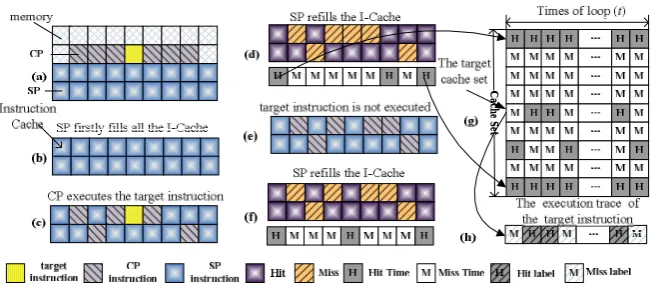
Fig. 1. The trace driven timing attack model based on the whole I-cache
The structure of memory and cache has been simplified as described in Fig.1. The spy process and the cipher process are denoted by SP and CP in short respectively. The SP mostly uses the NOP instructions to fill the whole L1 I-cache (Fig.1 (a)). The attack flow is similar to the flow of Aciicmez’s attack. The difference is that the SP in the new model measures to fill each I-cache set, while Aciicmez’s SP only measures to fill a particular I-cache set. The main attack steps are as follow:
1.The CP is running simultaneously with the SP on the same physical core of a si-multaneous-multithreading (SMT) processor while the spy is executing its loop. The SP startups before the CP and fills the whole cache firstly (Fig.1 (b)), then re-peats to fill each cache set and measure the time for each set.
2.The instructions executed by the CP will alter the I-cache state and cause evictions of spy’s dummy instructions. When the SP measures the time to fill each I-cache set and if some cache sets have been evicted out by the CP since the previous itera-tion of the spy, the measurement result will be higher because the evicted dummy instruction(s) needs to be fetched from a high level memory. Thus, the SP can de-tect the states of which I-cache sets are changed by the CP between consecutive spy iterations (Fig.1 (c-f)).
3.The SP stops after when the CP ends, so it can get the whole execution trace of the instruction of CP (Fig.1 (g)). For the whole execution trace, we can select the spe-cial trace corresponding to the target instructions, according to the character of the sequence of operations, for example there should not be two or more continuous multiplication operations in SWE Exponentiation. Finally, we can get the execu-tion flow (Fig.1 (h)), infer the bits of the exponent and break the RSA key.
3
An Improved Analysis Algorithm of Exponent
3.1 Inferring More Bits from the Sequence of Operations
run-ning with the cipher process in parallel. For RSA realized by the square and multipli-cation algorithm, we can directly give the key value out during a single cipher execu-tion, according to the fact that: If the bit of d is 1, there is one more multiplication operation than the situation that the bit of d is 0. While the OpenSSL implements RSA algorithm with Chinese Remainder Theorem (CRT) to improve the speed of execution [14], the private key d is changed into dp and dq. If the dp and dq are gotten,
we are able to factorize the public modulus. The bits of dp and dq are inferred with the
same approach, so we only focus how to get the bits of dp exponent in p d
m using I-cache timing attack.
The analysis algorithm of Aciicmez’s attack could get some bits of dp based on the
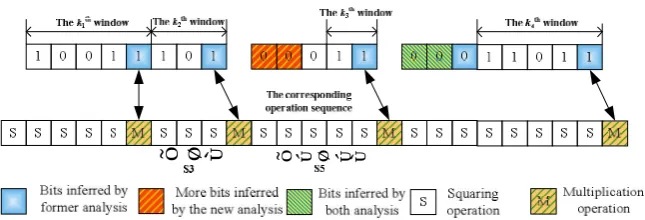
fact that the modular exponentiation is implemented using SWE Exponentiation. From the sequence of multiplications and squarings, they can typically obtain about 200 bits out of each 512-bit exponent [6]: For each multiplication a “1” bit can be inferred, since the multipliers are all odd powers of m, and any time there are more than five squarings without an intervening multiplication, the presence of one or more “0” bits can be inferred, since the multipliers are of degree at most 31. The size of the window for a 512-bit exponent is win_size = 5; the detail analysis process is shown in Fig.2. Compare with D-cache attack, I-cache attack could not get more bits from each exponent using the relationship between the indexes of table and the value of the win-dow. D-cache timing attack on RSA could get 110 more bits based on this fact [5]. However the 200 “scattered” bits of each 512-bit exponent are too limited for us to break RSA in polynomial time for Aciicmez’s attack.
Fig. 2. Analysis the bits of the exponent from the sequence of multiplications and squarings
squarings “S3”, we can evolve the max size of the k2thwindow is 3, so there are two “0” bits after the k2thwindow. Based on this conclusion, we can further deduce that there are most three squarings in the five continuous squarings “S5” for the k3th win-dow, so two “0” bits can be also evolved after the k3thwindow, which can be also inferred by the former analysis algorithm. The combination of the new and former analysis algorithm can get more bits from the sequence of operations. In Fig.2, at least 2 more bits can be inferred among the 22 bits. For a 512-bit exponent, about 50 more bits can be inferred with the new analysis algorithm. The search space of the bits of the key can be further reduced.
3.2 Algorithm with Error Detection
In the practical attack, as the instruction of SP may be evicted from the I-cache by other instructions instead of the target instructions during the CP execution, or the cache timing data may conclude some noises from other processes in the operating system, affecting the precision of timing, so it is possible to make some erroneous decisions when determining the operation sequence. If we had got some erroneous sequence of operations, some erroneous bits of the exponent would be inferred also. The more erroneous decisions occurred, the less correct bits of the exponent would be inferred, and there would be more difficulty in breaking RSA. In this paper, we pro-vide an error detection mechanism that can detect some erroneous decisions to reduce the number of the erroneous bits which are inferred from the sequence of operations.
According to the rule of sliding the window in SWE Exponentiation, we can find some characteristics of the operation sequence: Firstly, there could not be continuous multiplications in one window; secondly, there could be no more than one multiplica-tion among five suqarings. Based on this fact, if the inferred operamultiplica-tion sequence does not accord with these characteristics, we can decide that an erroneous decision has occurred. Such as, if the sequence of operations was got as follow: MSSMSSMS, we can conclude that the second or third multiplication may be an erroneous decision, and then we can increase the sample size to reduce the noise, or enumerate two in-stances for each of these two operations. With the error detection for the sequence of operation, more correct bits can be inferred.
4
Experimental Results and Discussion
4.1 Environment Configuration and Timing collection
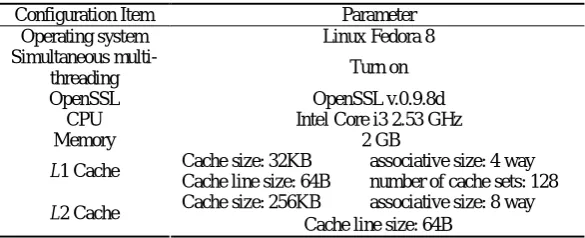
was called to ensure that the SP can run simultaneously with the CP and determine which instructions were executed by the cipher under the Linux operating system. The SP achieves this goal by spying on the cipher execution via observing the I-cache state transitions. We concentrate on Intel Core i3 processor featuring Intel’s Hyper-Threading Technology (HT), and it is a dual-core processor, while the former cache timing attacks were running on a single-core processor, such as Atom and Intel Pen-tium 4 [12, 13]. The detail environment configuration of our attack is shown in Ta-ble.1:
Table 1. Environment configuration of RSA I-cache timing attack Configuration Item Parameter
Operating system Linux Fedora 8 Simultaneous
multi-threading Turn on
OpenSSL OpenSSL v.0.9.8d CPU Intel Core i3 2.53 GHz
Memory 2 GB
Cache size: 32KB associative size: 4 way
L1 Cache
Cache line size: 64B number of cache sets: 128 Cache size: 256KB associative size: 8 way
L2 Cache
Cache line size: 64B
The structure of the L1 I-cache of Core i3 is: 4-way associative 32 KB cache, C =128 cache sets, 4 cache lines in one cache set. We lay out contiguous 64-byte re-gions of code (precisely the size of one cache line) in labels: L = {L0, L1,…, L511}. Denote subsets li = {Lj
∈
l: j mod C = i} in this case, where all regions map to thesame cache set yet critically do not share the same address tag. These subsets natu-rally partition 1
0
c i i
l=
U
=−l . Observe that stepping through a given li pollutes thecorre-sponding the ith cache set and repeating for all i completely pollutes the entire cache. The time for accessing each cache set is the CPU cycle counter, which is accessible via the “RDTSC” instruction that returns the 64-bit cycle count since the CPU initiali-zation [16]. Based on the attack model, the SP measures to fill each I-cache set run-ning simultaneously with the CP. It begins with regions that map to cache set zero: l0 = {L0, L128, L256, L384}, stores the execution time t0, then continues with cache set one: l1 = {L1, L129, L257, L385}, stores the execution time t1 and so on through all 0≤ i <128. When the SP measures to fill the whole I-cache, one timing trace T0 is collected, and then the SP repeats to collect the next trace T1 and so on until the end of the CP exe-cution. In our experiment, according to the consume time for the CP and one loop execution of SP, the SP repeats 2000 times to collect 2000 timing traces.
4.2 Experimental Results and Comparison
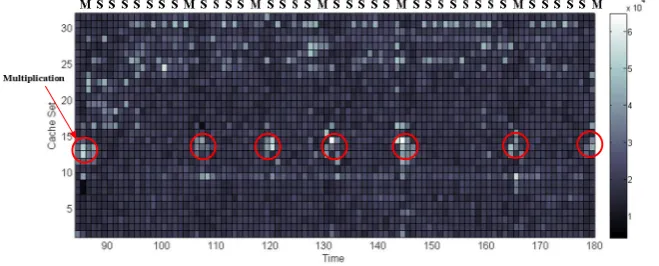
Determine the sequence of operations
from left to right repeating the measurements. To manually analyze such traces and determine what operations are being performed, we look for (dis)similarities between neighboring timing trace. As shown in Fig.3, we can find there are 7 multiplications, with repeated squarings between each multiplication. The sequence of operations as: MSSSSSSSMSSSSMSSSSMSSSSSMSSSSSSSSMSSSSSM can be determined, by S denotes squaring and M denotes multiplication.
Fig. 3. Partial I-cache timing traces in our experiment
The experimental result has shown that even if we could not get the logical ad-dresses of the target instructions, the operation sequence can also be determined by analyzing the I-cache timing data.
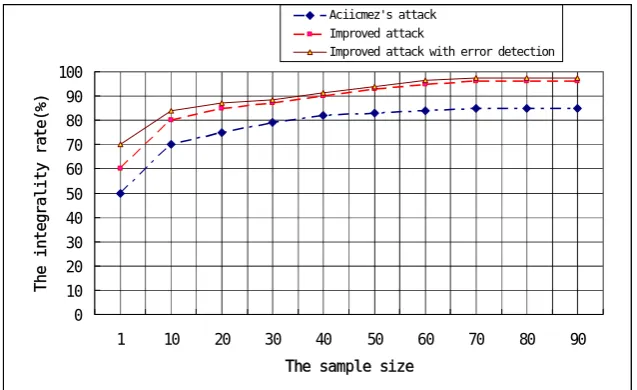
Fig. 4. The relationship between the sample size and the integrality of the sequence of opera-tions
In our experiment, the other processes have been minimized as possible as we can in the operating system, so the noise is minimized. From the results in Fig.4, under the same sample size, the integrality rate of the improved attack is 12~20% than the for-mer. Compared with the improved attack, the additional error detection has a little improvement, but if there is more noise, we are sure that the error detection will play a big role in the attack.
Infer the bits of the exponent
Just the sequence of squarings and multiplications that the SWE algorithm passes through implies a significant amount of information about the exponent input, we analyze the bits of the exponent from the sequence of the operations in Fig.3. The former analysis algorithm of Aciicmez’s could infer the bits as follow: 100XXXX1XXX1XXX1XXXX1000XXXX1XXXX1, by X denotes the unknown bit. Finally it could get total 12 bits. While the proposed algorithm can infer the bits as follow: 100XXXX1XXX10XX100XX1000XXXX1XXXX1, the total 15 bits are got. The experimental results show that: For one random RSA key of OpenSSL, there are 89 multiplications and 511 squarings for the 512-bit dp exponent, and 70 partial
sequences of operations which conclude more than five squarings without an inter-vening multiplication. The former analysis algorithm could infer 90 “1” bits (includ-ing the highest bit of dp) and 122 “0” bits, it can infer the total 212 bits. The improved
analysis algorithm can infer 46 more “0” bits than the former, and finally get the total 258 bits. About 256 bits of dq can be inferred in the same way. Then the RSA can be
broken using the lattice attack method in polynomial time [15].
4.3 Discussion and Future Work
ex-periment and it is hard to put into practice, although Neve in [9] had shown that the theoretical and actual results taken from such a spy process are indeed very close to each other. The advantage is that the SP can accurately spy on the trace of each expo-nentiation step and the noise can be reduced, but it is difficult to realize this attack in practice. The new proposed attack scheme can improve the feasibility of I-cache tim-ing attack on RSA, however in the future research, there are still some works needed to be considered: Firstly, how to reduce the noise effectively is a big problem. We can utilize some statistical tools to deal with the data; Secondly, during analyzing the cache timing data, it needs an automated analysis tool to analyze the vast cache-timing data; and we will try to infer more bits of the exponent to further reduce the search space of the bits of the key.
The combination of vector quantization and hidden Markov model cryptanalysis has been demonstrated that it is a powerful tool for automated analysis of cache-timing data in [13]. In the future work we will also use this automated tool for analyz-ing the I-cache timanalyz-ing data. At the same time, some other cryptographic algorithms, especially the public cryptographic will be considered as the target of I-cache timing analysis.
5
Conclusion
In this paper, we have proposed a new I-cache timing attack model on RSA, by concurrently running a spy process to keep track of the changes in the state of the whole I-cache, while the former only spy on the state of the in the I-cache mapped to the target instruction. An improved analysis algorithm is provided to infer more bits of the exponent from the time traces, and an algorithm with error detection is ad-vanced to detect the erroneous decisions.
We demonstrate the effectiveness by carrying out an I-cache attack on RSA of OpenSSL v0.9.8d employing SWE Exponentiation. The experimental results prove that I-cache cryptanalysis on RSA is realistic, practical and a serious threat for soft-ware systems. The improved analysis algorithm can infer about 50 more bits than the former. With this improvement, about half of the bits of dp (dq) can be got by I-cache
timing attack, so it is possible for I-Cache timing attack to break RSA algorithm in polynomial time using the lattice attack method. And the error detection mechanism can detect some erroneous decisions to reduce the number of the erroneous bits which are inferred from the operation sequence. The dual-core processor is also vulnerable to I-cache timing attack; this result would attract more attention of the processor de-signer to the security of cache against cache attacks.
References
2. Kelsey, J., Schneier, B., Wagner, D., Hall, C.: Side Channel Cryptanalysis of Product Ci-phers. J. Comput. Secur. 8(23), 141–158 (2000).
3. Osvik, D.A., Shamir, A., Tromer, E.: Cache attacks and countermeasures: The case of AES. In: Pointcheval, D. (ed.) CT-RSA 2006. LNCS, vol. 3860, pp. 1–20. Springer, Heidelberg (2006).
4. Bernstein, D.J.: Cache-timing attacks on AES (2004). http://cr.yp.to/papers.html#cachetim ing.
5. Percival, C.: Cache missing for fun and profit (2005), http://www.daemonology.net/papers/ cachemissing.pdf.
6. Aciicmez O, Gueron S, Seifert JP. Micro-Architectural cryptanalysis. IEEE Security and Privacy 5(4), 62−64 (2007).
7. Acıiicmez O and Werner Schindler. A Vulnerability in RSA Implementations Due to In-struction Cache Analysis and Its Demonstration on OpenSSL. In: Malkin T (ed.) CT-RSA 2008. LNCS, vol. 4964, pp. 256–273. Springer, Heidelberg (2008).
8. Aciicmez O, Koc. C. K., Seifert. J.-P. On the power of simple branch prediction analysis. In: Robert D, Pierangela S (eds) ASIACCS 2007, pp. 312-320. ACM Press, New York (2007).
9. M. Neve and J.-P. Seifert. Advances on Access-driven Cache Attacks on AES. In: Biham E (ed) SAC 2006, LNCS, vol. 4356, pp. 147-162. Springer, Heidelberg (2007).
10. Aciicmez O, Seifert J.-P. Cheap Hardware Parallelism Implies Cheap Security. In: 4th Workshop on Fault Diagnosis and Tolerance in Cryptography (FDTC 2007), pp. 80-91. IEEE Press, New York (2007).
11. Aciicmez O, Koc. C. K., Seifert. J.-P. Predicting Secret Keys via Branch Prediction. In: Masayuki A (ed.) CT-RSA 2007, LNCS, vol. 4377, pp. 225-242. Springer, Heidelberg (2007).
12. Aciicmez O, Brumley B. B, Grabher P. New Results on Instruction Cache Attacks. In: Mangard S (ed.) CHES 2010, LNCS, vol. 6225, pp. 110-124. Springer, Heidelberg (2010). 13. Billy B. B, Risto M. H. Cache-Timing Template Attacks. In: Matsui. M (ed.)
ASIACRYPT 2009, LNCS, vol. 5912, pp. 667–684. Springer, Heidelberg (2009).
14. The OpenSSL Project: OpenSSL: The open source toolkit for SSL/TLS, http://www.openssl.org.
15. Coppersmith D. Finding a small root of a bivariate integer equation: factoring with high bits known. In: Maurer U (ed), EUROCRYPT 1996, LNCS, vol. 1070, pp. 178-189. Springer, Heidelberg (1996).