Guide to Analysing Companies Guide to Business Modelling
Guide to Business Planning Guide to Economic Indicators Guide to the European Union Guide to Financial Markets Guide to Management Ideas
Numbers Guide Style Guide
Dictionary of Business Dictionary of Economics International Dictionary of Finance
Brands and Branding Business Ethics Business Strategy China’s Stockmarket Dealing with Financial Risk
Globalisation
Headhunters and How to Use Them Successful Mergers
The City Wall Street
Essential Director Essential Economics
Essential Finance Essential Internet Essential Investment
BUSINESS CONSULTING
A Guide to How it Works and How to Make it Work
Gilbert Toppin
and
Published by Profile Books Ltd
3aExmouth House, Pine Street, London ec1r ojh www.profilebooks.com
Copyright © The Economist Newspaper Ltd 2005
Text copyright © Gilbert Toppin and Fiona Czerniawska 2005
All rights reserved. Without limiting the rights under copyright reserved above, no part of this publication may be reproduced, stored in or introduced into a retrieval
system, or transmitted, in any form or by any means (electronic, mechanical, photocopying, recording or otherwise), without the prior written permission of both
the copyright owner and the publisher of this book.
The greatest care has been taken in compiling this book. However, no responsibility can be accepted by the publishers or compilers
for the accuracy of the information presented.
Where opinion is expressed it is that of the author and does not necessarily coincide with the editorial views of The Economist Newspaper.
Typeset in EcoType by MacGuru Ltd [email protected]
Printed and bound in Great Britain by Creative Print and Design (Wales), Ebbw Vale
A CIP catalogue record for this book is available from the British Library
Acknowledgements vi
How to use this guide vii
Part 1 Business consulting today 1
1 Business consulting at the crossroads 3 2 The new business consulting ecosystem 14
Part 2 The client world 19
3 The client market 21
4 Client organisations 35
5 Projects 48
Part 3 The consulting world 61
6 The consulting industry 63
7 Consulting firms 89
8 Consultants 106
Part 4 The worlds connect 119
9 Seven themes of interaction 121
10 Reputation 124
11 Isolation 135
12 Metamorphosis 152
13 Relationship 161
14 Portfolio 176
15 Career 185
16 Life cycle 195
Part 5 Routes to success 207
17 The successful client 209
18 The successful consulting firm 223
19 The successful business consultant 231
Part 6 A blueprint for the future 239
20 The likely evolution of business consulting 241
Appendices
1 Leading consulting firms 253
2 Notes and references 258
M
any people have helpedin the writing of this book, and theauthors are indebted and grateful to all of them. Some deserve a special mention: Sarah Taylor at the Management Consultancies Associ-ation for allowing us to make use of the detailed research the mcahas
This book has six parts:
1 Business consulting today 2 The client world
3 The consulting world 4 The worlds connect 5 Routes to success
6 A blueprint for the future
Part 1 introduces business consulting and describes a new way of looking at how it works: the business consulting ecosystem.
Parts 2 and 3 focus on what happens within the ecosystem, looking internally at the client market, the consulting industry and other com-ponents. Part 2 describes the client world. It looks at the client market for consulting: What drives the demand for consulting? Why do clients hire consultants? What kinds of consulting projects are there? Part 3 describes the consulting world. It examines the equivalent issues on the supply side: How is the consulting industry’s structure changing? What are the main challenges facing consulting firms? What skills and behaviours are required of today’s consultants?
Part 4 focuses on seven interactions outlined earlier. It explores the nature of these interactions and how they have changed, highlighting the implications for the future. It focuses on the intricate maze of con-nections between client and consultant worlds, brought alive through the themes of reputation, isolation, metamorphosis, relationship, portfo-lio, career and life cycle.
Part 5 translates those implications into practical realities. What are the routes to success? What can clients do to maximise the value they get from consultants? What are the factors that will determine success for consult-ing firms in this more complex, interdependent environment? How can organisations which work closely with this market develop more effec-tive relationships? What are the characteristics of the best consultants?
BUSINESS CONSULTING TODAY
C
hantilly is one of the loveliest chateauxin France. In theglow of a warm day, it is easy to see why it became a favourite playground of the French nobility – and to forget that it was razed to the ground during the French Revolution, its owners fleeing abroad to escape the guillotine.
A tale of two projects
Everyone is a consultant these days, from sales people to beauticians, so what do we mean by “business consulting”? The more traditional “man-agement consulting” is usually associated with one particular high-end style where the consultant’s role is to advise senior managers. But this ignores the large proportion of consulting that is now involved in imple-mentation: systems integration, outsourcing, and so on. These days, most consultants are expected to provide not just advice, but also solu-tions. If that is the case, what is it that distinguishes business consultants from all the other consultants out there? Why consultants, not contrac-tors? The point is that business consultants are supposed to improve businesses: they are not hired to maintain the status quo but to change it. This might be changing a company’s strategy or revoking, even taking over, a process in order to transform it, but it does not include managing an existing process or taking over a function in order to deliver the same levels of service at a lower cost. Consultants should be defined less by what they do (offering advice, implementing systems, outsourcing pro-cesses) and more in terms of the changes they achieve.
For the technical support staff at Sun Microsystems, spread across 46 countries, everything hangs on being able to resolve straightforward problems as quickly as possible and on having a watertight process for dealing with more difficult ones. A good support organisation, like Sun’s, will solve almost all problems quickly. The remaining small pro-portion of problems will, however, absorb 50% of its resources. Things go wrong; no one knows why; finding the cause is a matter of discipline, not luck.
The term “rational troubleshooting” comes from psychological research conducted by Charles Kepner and Ben Tregoe in the mid-1950s and refers to a structured thinking process aimed at helping people solve problems and make decisions more effectively. For many years, the problem-solving concepts of rational troubleshooting were aimed at helping technicians on assembly lines pinpoint problems quickly and accurately. Sun dabbled with the idea in the early 1990s, sending some of its support engineers on training courses, but did not take it particu-larly seriously and by the mid-1990s had pretty much given up on it. But in 1995, the company recruited a considerable number of people from
dec, another technology company, all of whom had been trained in this
training its technical support staff. Steve White, Sun’s global manager for a programme that has trained and supported more than 2,300 tech-nical engineers, explains that “the fundamental problem we had was how to improve the handover of a problem from one engineer to another as it went from expert to expert. We were not thinking about how we think. We were wasting too much time double-checking infor-mation and going through the same thinking process again and again. Case files were being passed over in a mess; data you would expect to be there was not. There was no protocol for saying what information would be needed.”
Kepner-Tregoe trained groups of engineers and managers in trou-bleshooting and how to work coherently on outstanding problems. These people then had three responsibilities: to train their colleagues; to specify explicitly where and when these troubleshooting skills should be used at Sun; and to help solve the most serious problems. “The training aims to make thinking visible,” says Mike Bird, a partner at Kepner-Tregoe who has worked with Sun since 1995. “We took a team of Sun’s top engineers and gave them new skills in diagnosing difficult issues. Classically, people make meaningless statements about what has gone wrong – a server is broken, performance is poor – and support engineers end up working on problems without having done enough to identify the cause. We teach people to be like doctors working on a diagnosis, to ask the right questions and to rule out possible causes before drawing conclusions.”
The secret of the project’s success, however, is that both Sun and Kepner-Tregoe share a common vision of success. As a result, the train-ing programme has been only one of three project pillars. The second was aimed at changing Sun’s work processes to make use of these new skills, and the third set out to identify how to adapt the work environ-ment to help engineers work differently and support this through rigor-ous coaching of Sun engineers by their peers. Following the pilot work there has been a sustained improvement in customer support, and Sun has demonstrated that it can solve the most difficult customer problems on average in half the time it used to take.
we will turn the work down. And we will not sell work for the sake of it: delivering value is more important than quick cash.”
That does not mean it has been smooth sailing throughout; indeed, the relationship is stronger precisely because Sun thought the original training programmes were too geared towards a manufacturing envi-ronment and collaborated with Kepner-Tregoe to come up with some-thing specifically for a support environment. White is just as pleased as Bird that that the programme they have developed together has become one of Kepner-Tregoe’s standard interventions: “If we can sell the con-cept to Sun’s customers, we will be able to collaborate with them more effectively. Mike and I are on the same side – working for Sun.”
A cramped room overlooking Whitehall in London is Richard Granger’s office. As a partner at Deloitte Touche Tomatsu, Granger man-aged the implementation of London’s congestion-charging scheme for motorists; he is now employed by the UK’s National Health Service (nhs) to oversee its £6 billion National Programme for it. It is a
Her-culean task, aimed at bringing together myriad pieces of information on patients into a single, electronic record. “The existing nhs it team is
fully occupied running the current systems,” says Granger, “600 organi-sations, 5,000 clerical systems, 30,000 people across 28,000 locations – all serving a health service that is the world’s second largest employer after the Chinese army. You couldn’t have engineered a bigger challenge if you’d tried. And now we have to overlay a national infrastructure in which information will be available anywhere at the push of a button.” Delivering the systems over a five-year period has already meant a fast procurement cycle, unprecedentedly so in the context of the Euro-pean Union’s Byzantine regulations. “Most large-scaleitsystems need
replacing every ten years. In the public sector, it is typical to spend three years mapping out the project and looking at potential suppliers, between one and two years choosing suppliers and negotiating with them, and between two and three years deploying the technology. You are lucky if you’ve got the first wave of benefits out before your supplier wants to change the platform on which you are operating. The overall business case is pretty poor; your asset is heavily degraded before you have implemented it. We wanted to break out of that approach. We wanted to spend more time on specification (as this is always what gets squeezed most) and less time on procurement. We sent out the request for proposals for the electronic booking system in January 2003, appointed a supplier in October 2003 and had the first live transaction in July 2004.”
multitude of companies involved genuinely accountable. “I use a husky dog-sled racing analogy when I am talking to suppliers,” says Granger. “If one of a pack of huskies is lame, you kill it and feed it to the others. This speeds up the pack in three ways: it is not held back by the lame dog; the other dogs go faster because they are better fed; and the remaining dogs also know what will happen to them if they do not keep up. If a supplier falls behind, we can remove work from them and give it to the supplier who is doing best. It gives the suppliers who fall behind the chance and incentive to catch up, and they can focus more effectively on a diminish-ing portfolio. We want them to realise how much they stand to lose, much as some of the suppliers involved in congestion charging ended up hiring specialist subcontractors at their own expense because it still cost them less than the delay-deduction would have done. You need to have a contestable framework and a degree of contestability to make this work. We had to design our procurement process with this in mind.”
It is, in his own words, a toxic environment in which British cynicism about ambitious projects, hostile media and rivalry between suppliers create difficulties. “I was only 37 when I started this project; a couple of years later I was feeling more like 50. We have a once-in-a-lifetime opportunity to lay the foundations for something which the majority of people in this country see as a cornerstone of what differentiates us as a society: a high-quality public health service. But on a day-to-day basis, it’s like chopping bits off my body – it’s just incredibly painful. I’d like my life back sometime.”
Granger contrasts his desire to make a difference with those of con-sultants more generally. “The consulting industry is lost,” he says. “It needs a new blueprint. It lacks a sense of its role at a societal level and has become very self-serving as a result. Accounting firms profession-alised themselves as a result of trade-sale and capital-market frauds in the 19th century; the consulting industry is immature by comparison, it still needs a roadmap. There are consulting firms out there which pay their consultants 50% more than their basic salary if they sell goods and services. That means there is absolutely no incentive for their consul-tants to turn round to a client and say, ‘I’m not making a difference, I wish to leave’ or ‘this is my advice, I appreciate you may ask me to leave because it is contentious’. They will do everything in their power to keep the meter running – and they’re doing the industry an enormous disser-vice. It is exactly the type of behaviour clients do not want to see.”
unsustainable,” claims Dave Higgins, consulting marketing director for Deloitte in Europe, the Middle East and Africa. “Senior executives in business have grown tired of the over-promising and under-delivering, the do-everything approach, like the famous German Eierlegenvollmilch-sau– ‘egg-laying woolly pig’ – vainly trying to do everything for every-one.” Mark Leiter, who runs Leiter & Company, a consulting firm specialising in the professional services sector, agrees. “Four years ago, people were sitting on the beach. The consulting industry faced a crisis of confidence in terms of whether the consulting proposition made sense. The erosion of many traditional consulting markets, such as corporate strategy, is being masked by a series of management ideas, years of cost cutting and now outsourcing. If you look under the cover today, you’ll see western consulting firms selling more services in the developing world where ideas that have peaked here are still new. That lack of innovation and clear thinking eventually catches up with you. Answering the big question – who are we? – is the biggest challenge facing the consulting industry today.”
If not this way, how?
You can tell a lot about the reputation of an industry by the jokes made about it. People have always made jokes about lawyers and now they make them about consultants. It is not hard to see why: there is no short-age of clients who still harbour bitter memories of the amount of money they spent on a succession of management initiatives – from business process re-engineering and enterprise resource planning, through e-busi-ness to customer relationship management – which yielded little in the way of quantifiable benefits. They are choosier about when and where to use consultants, preferring to hire a small number of experts rather than a cadre of bright, freshly minted graduates.
“We are seeing more clients focused on becoming intelligent clients,” says Paul Hayes, who leadsbt’s technology transformation team, part of
agrees Michael Traem, head of consulting at A.T. Kearney in Europe. “They have built up their own internal consulting teams, often hiring con-sultants who have lost jobs with major consulting firms. They have the capacity to do much of the work themselves that they used to hire con-sultants to do.” Part of this is cyclical: clients have established internal consulting units in the past only to sell them off when the market changes. But it also points to a longer-running trend: “Clients want less in the way of strategic booklets and presentations, and more in the way of concrete results,” says Traem. “They want to get things done.”
Evidence of a change in attitude to the use of outside consultants is provided by the numerous examples of high-profile projects that have run into difficulties or been cancelled part-way through. For example, in the summer of 2004, J.P. Morgan Chase, a financial services company, cancelled an itoutsourcing deal with ibmestimated to be worth $5
bil-lion over seven years and plans to bring back the 4,000 employees and contractors who transferred to ibm. Eighteen months earlier, the
com-pany terminated an existing £1.25 billion outsourcing contract with csc,
Accenture, at&tSolutions and Bell Atlantic in favour of ibm. Both deals
were initially lauded as groundbreaking.
The story is the same everywhere
“The biggest change we’ve seen has been in client behaviour,” says Ken Favaro, the New York-based chief executive of Marakon Associates, a strategy consultancy. “Projects are smaller and more focused on tangible outcomes – a reaction to the experience of the late 1990s when many consulting firms were guilty of making big promises that they failed to meet. As an industry, we’ve gone from enjoying the benefit of the doubt to suffering from the ‘tyranny of doubt’, where we have to all but guar-antee results. Moreover, that so many people have left the consulting industry to join clients’ organisations means we’re seeing a lot of in-sourcing going on in the market for high-end advisory work. That will dissipate as managers realise that fresh thinking is always valuable. People who join clients from consulting firms can be very helpful in the short term, but their intellectual capital is effectively frozen and over time they become compromised by the inherent momentum, habits and politics in any organisation, particularly the largest ones. And when does it ever make sense to in-source when there’s a highly competitive and innovative market, like the consulting industry, to meet one’s needs?”
the actions of a few firms during the late 1990s which promised far more than they could deliver. “Unlike doctors and lawyers, anyone can call themselves a consultant. We have seen – and will continue to see – periodic calls for this to change, for the consulting industry to have some type of qualification or regulatory body. But management science is still too young a discipline to make that possible, let alone effective. The one good thing to have happened since the bubble burst is that it flushed out those people who went into consulting purely for the money. As with medicine and law, the consulting industry now has a higher proportion of people who feel passionate about the work they do, and are not solely interested in the financial return.”
“There has been less money and clients are less willing to spend what they have on consultants,” says Anders Grufman, who runs a specialist consulting company, Grufman Reje, in Sweden. “The market has shrunk and competition is fiercer. Clients are overwhelmed with consultants selling them things and are bothered by all the propositions out there. My company is a small one and we see clients increasingly choosing the consultants they work with on the basis of their specialist knowledge. But I suspect that larger consulting firms are finding things just as diffi-cult. Demand for general strategy consulting seems almost dead, while consulting firms that actually implement concrete results have an advantage.”
In eastern Europe, where capitalism has had less than two decades to find its feet, organisations have become more sophisticated and demanding in their use of consultants. “Clients want tangible results in shorter timescales,” says Mihai Svasta, who runs a consulting company in Romania. “When we established our business in 1991, consulting was regarded as a minority sport; now it is definitely a fashion. Despite that, we still find clients looking for alternative pricing strategies (particularly where they can make consulting fees contingent on success). Perform-ance measurement and quality assurPerform-ance are important, particularly as the supply of consulting services is now growing more quickly than demand for them. Previously, clients tolerated mediocre, even poor performance from consultants.”
com-panies, exist at the whim of their customers. “When the phones stopped ringing in 2001,” recalled one consultant, “I had a nightmare that they might never start again, that clients might just stop using consultants.” As the market picks up and the phones start ringing again, consultants will be tempted to think that things have returned to how they where. That would be a mistake. The number of jobs shed by the consulting industry in recent years may well be equivalent to the number gained during the fattest years of the e-business bubble, but the downturn should not be dismissed as just a normal cyclical adjustment. There are long-term, more deep-rooted sources of dissatisfaction with the way consultants operate that need to be addressed if the reputation of the industry as a whole is to recover.
“Clients continue to be very demanding,” says David Owen, head of Deloitte’s consulting practice in London, “and our responsibility is to respond to this. Clients make substantial investments in the work that we do and have increasingly high expectations in terms of the relevance of the work consultants undertake and the quality of the service deliv-ered. Consulting is a serious business which is addressing serious things.”
The aims of this book
The ultramodern, Richard Rogers-designed Lloyd’s building in London may seem a strange place to start thinking about how the reputation of the consulting industry might be best restored. But for Geoff Dodds, for-merly pwcConsulting’s global brand director and now responsible for
Lloyd’s own brand, there are illuminating parallels between his past and present employers. “The insurance sector has an atrocious reputation,” he says, “not far above tobacco and real-estate agents. What we have had to do is go back to the fundamental reasons why insurance exists – and why Lloyd’s in particular exists. Lloyd’s oils the world economy: we often insure the things that no one else can or will. Without Lloyd’s lots of things would not happen – we would not launch satellites, we would not fly airplanes. The same may be true for the consulting industry – lots of the things corporations do they could not do without consultants. The trouble is consultants do not make the point very well.”
There are several reasons for using consultants, providing they are good at their job and are used thoughtfully:
from being scrutinised and challenged by an objective (and therefore usually external) person. Everyone, whatever their position, can lose sight of the overall wood because they are too busy thinking about individual trees; having someone come in and ask fundamental questions about what they are doing, and why they are doing it, can be enormously valuable.
Consultants offer their clients “economies of knowledge”. Even though they may seem expensive, used intelligently, their clients spend much less time and money either recruiting people with the right skills or training existing staff to carry out a specialist task which may only take a few weeks. Consulting firms, by spreading those costs among their clients, are able to recruit, develop and deploy experts on a short-term basis.
Consultants can provide energy and momentum in projects where clients, often taking a few minutes out of an already busy schedule to sit on a committee, are unable to do so. Consultants can provide the essentials, the roadmap and the resources to help organisations do what they could not do for themselves.
But there can be no doubt that a lot goes wrong. Between the ideal of consulting and the practical reality falls a shadow. Consultants can ride roughshod over the wishes and constraints of the clients they are sup-posed to serve. They can take longer and cost more money than clients expect. That they sometimes deliver less than they promised does not mean they will not try to sell their clients even more.
As Dodds says: “Consulting firms do not do themselves any favours because they are often arrogant. They are reluctant to acknowledge that clients and consultants go up – and down – the greasy pole of learning together. Some days, the clients will be learning from the consultants; some days, it will be the other way round. Together, they can do more than they could independently. What counts is what really happens.”
The past ten years have demonstrated that consulting is no longer simply about a relationship between clients and consultants, but about more complex issues. Clients and consulting firms are far more interde-pendent than they once were. The pressures each side faces are inter-linked, and success comes only from both sides working together and understanding what can be called the “ecosystem” in which they are working.
W
hen you ask clientswhy a particular consulting project hasgone well, the following are typical of the responses you get:
“It is amazing what can be accomplished by a small number of people, when focused on a challenging goal and working together effectively.”
“There was absolutely no demarcation along the lines of ‘I am the client, so you must do it this way’.”
“This was an integrated team, with close relationships developing between the senior consultants and our executive directors. We trusted each other and could discuss issues frankly.”
“We often asked: ‘How would it be if’? Or: ‘How could we get more into this’? This gave both parties an opportunity to go beyond what had been initially planned.”
“We would be hard pressed now to say which elements were generated by the client and which by the consultant. Both trust the other to deliver what they say they will.”
“As true partners with a common goal, trust grew as we both sought the best solutions for mutual success. Issues were raised and resolved in this spirit, and the consultants’ commitment was evidenced by the energy and single-mindedness with which they undertook all challenges.”
Although people habitually talk about the consulting industry in terms of discrete components – the consulting firm, the client, the con-sultant, and so on – the most effective and valuable consulting takes place when clients and consultants work together in teams, sharing skills and expertise and focusing on common goals.
the benchmark for the consulting industry as a whole, dictating the behaviour of firms as well as people.
Two trends are becoming increasingly clear:
Individual clients (especially in the public sector, but increasingly elsewhere) are adopting a more rational approach to consulting and exchanging information with each other.
Consulting firms are beginning to take on the characteristics of a maturing and responsible industry after a period of intense structural change.
Clients, consultants and their respective industries are part of the same internally dependent system. At the simplest level, consultants exist because there is a demand for their services, driven by pressure in the external marketplace, regulation, the emergence of new technology and management ideas. But the relationship is a symbiotic one: consul-tants help to create demand by promoting new technology and by help-ing to disseminate new ideas.
As needs increase in scale and complexity, the classic model of the client–consultant relationship begins to break down: results come from interdependency and diversity; more players become involved; third parties, such as technology vendors and outsourcers, become important.
Six key components interact in a systematic way. On the demand side, there are client markets, individual client organisations and client projects; on the supply side, there is the consulting industry, consulting firms and individual consultants. These components and their interplay form a new system, the business consulting ecosystem (see Figure 2.1 on the next page).
This book explores this system and its components. It focuses on seven important relationships, or interactions, between these compo-nents. This is a system in early formation and turmoil, with great imbal-ances and shifts of power in very short periods. Widespread mergers, radical rethinking of client procurement methods, the increased role of third parties and huge changes in the human resources market for con-sultants demonstrate that much more is at stake than changes to the tra-ditional client–consultant relationship.
These seven “interaction” themes map out the way the business con-sulting ecosystem works:
has a reputation. Many firms choose to believe they are insulated from any problems that may ensue from this. Well-known firms believe their brands will differentiate them; smaller ones think their client relationships and the quality of their work will protect them. In reality, no organisation can entirely escape the way clients view the collective industry.
Isolation.Clients buy consulting in an imperfect market.
Although clients believe they are responsible for their choice and use of consultants, they also think their responsibility is
compromised where they do not have access to sufficiently reliable information. It is a case of buyer beware, but only if you know what to be wary of. Yet clients rarely share views on consulting performance with each other. This seems ironic in an environment in which consulting firms are falling over each other to publish books, articles and papers on every conceivable client issue. Yet quantity of information is of course no guarantee of quality. Little of the “thought leadership” or “industry practice” material offered helps clients make informed choices.
Metamorphosis.Consulting is not a profession: there is no governing body which sets standards and certifies qualified consultants. Qualifications exist, as do trade associations, but participation is entirely voluntary. Would you go to an
unqualified doctor? Would you ask an untrained lawyer for his or her opinion? At the moment, clients rely on the brand of a
The business consulting ecosystem
Isolation
2.1 2.1
Client market The consulting industry
Client organisations Consulting firms
Projects Consultants
Reputation
Relationship
Life cycle Isolation
Portfolio Portfolio
MetamorphosisMetamorphosis
consulting firm to provide them with the confidence that they are buying a high-quality product, but this focus on individual firms, at the expense of the industry as a whole, is unsustainable. Relationship.Clients are accustomed to treating consulting projects as discrete and self-contained. But there are three reasons why this is changing: the remit of central procurement
departments has, for the first time, been extended to cover professional services; clients are increasingly using several suppliers for projects where before they might have used only one; and new governance rules are being established that seek to make consulting firms keep the promises they make of working “in partnership”.
Portfolio.A corollary to complexity is that clients need to manage their consulting projects not in isolation, but as part of a portfolio. They need to balance costly projects against cheaper ones, and difficult ones focused on long-term benefits against simpler ones designed to produce immediate results. A big component of success in using outsiders is getting things lined up internally too.
Career.Consulting used to be a career. However, as a result of the downturn in the early 2000s, many consultants left their firms, some to join clients, others to become freelance or to find non-consulting jobs. In common with many other industries, consulting never really offered a job for life. Nevertheless, good consulting relies on good experienced consultants, so how is this to be reconciled?
Life cycle.When it comes to actual consulting projects, clients invest too much time in the preparatory stages and too little in adapting to changes during the course of a project. Time, budgets and quality standards are typically set from the outset and ignore the way in which projects change during the course of their life: governance, management style and mindset need to be adaptable over time, not set in stone.
just as much to an industry like consulting. Institutions – consulting firms, client procurement departments, and so on – have processes, people, systems and cultures which make them inflexible. But an inter-action is a fulcrum: the point where small changes have disproportional effects, where a little effort can make a big difference.
THE CLIENT WORLD
“Companies engage consultants for three broad reasons – brand, bodies and brains – but often they don’t take the time to understand which of these they need and end
T
here is hardly a big or medium-sizedcorporation in thedevel-oped world that does not make use of consultants in some way. Most consulting firms will also say that between two-thirds and four-fifths of their business is repeat business: that is, additional work under-taken for existing clients.
One reason is certainly to do with money. Consulting firms offer economies of scale: because they work on similar projects for several dif-ferent clients, they can spread the cost of investing in specialist people and skills in a way their clients cannot. A company seeking to reduce costs might therefore hire an outside consulting firm because their wider expe-rience and specialist know-how should help them spot waste the client might miss. That they can be up-and-running as soon as the contract has been signed should mean that the savings are realised more quickly. Sim-ilarly, a client considering launching a new product might hire a consult-ing firm that can reduce its time to market. Either way, the business case for using consultants – at least on paper – will be compelling.
The second reason may well be related to simple wishful thinking. Clients hire consultants to try to achieve a competitive advantage – to do something either so much better or so much more quickly than their rivals that the economic advantage gained is both substantial and sustainable.
The business consulting ecosystem
Isolation
2.1 3.1
Client market The consulting industry
Client organisations Consulting firms
Projects Consultants
Reputation
Relationship
Life cycle Isolation
Portfolio Portfolio
Metamorphosis Metamorphosis
Alexander Pope, an 18th-century poet, rightly advised that: “Hope springs eternal in the human breast/Man never is, but to be blest.” But is it realis-tic to expect that consultants will be better at finding a route to competi-tive advantage than a firm would be as a result of its own efforts and insights?
Ambition, too, plays a role. Managers are as human as the rest of us: if hiring some consultants is good for a manager’s organisation, all well and good; if hiring them is also good for the manager’s career, even better. But, inevitably, there are occasions when clients hire consultants to advance their careers, putting their personal agenda ahead of the col-lective good.
Rich pickings? The economics of consulting demand
One of the myths destroyed in recent years has been the one about con-sultants doing well irrespective of the woes of their clients. Thus, the thinking went, consulting firms were able to supply creative ideas when times were good but could switch to cutting their clients’ costs when times were bad, winning either way.
In fact, research suggests that there is a broad correlation between the state of the economy and demand for consulting. It makes intuitive sense, too. Companies are more likely to consider new initiatives when the economy is buoyant and confidence levels are high; rising stock-markets make it easier to invest. Conversely, when the climate overall is harsh, clients are more likely to defer purchase decisions and the aver-age size of consulting projects (in terms of both duration and fees charged) will shrink.
Regional variety
Consulting is a global business, but its fortunes depend not only on the local economic climate, but also on the structure of the economy in terms of the number of large, medium-sized and small enterprises, levels of inward investment and the level of investment in technology. Over half of all consulting fees are earned in North America and almost one-third in Europe (see Figure 3.2).
international the business environment of a country is: the higher the level of investment, the greater is the flow of management ideas (which boosts demand for consultants) and the number of foreign-owned com-panies that are likely to bring their own consultants with them. Lastly, there is a direct and positive correlation betweenitinvestment across an
economy as a whole and the amount of money spent onit-related
con-sulting.it-related consulting has fuelled much of the growth in
consult-ing in the past decade and it follows that countries which spend the most on itare likely to be the largest markets for consulting.
Some sectors are more equal than others …
The demand for consulting varies among different industry sectors. One reason for this is that levels of it-related investment vary widely from
sector to sector, as does merger and acquisition activity, another impor-tant source of consulting projects in the past.
Financial services has historically been by far the largest market for consulting firms, accounting for one-third of the total in some countries, because of its heavy reliance on and investment in technology, the need to accommodate regulatory changes and the sheer difficulty of finding an edge in a ferociously competitive market. But it is also a market which is peculiarly reliant on the health of the financial markets: falling stock prices between 2001 and 2003 triggered a dramatic fall in both the number and value of consulting projects. Consulting firms specialising in this sector saw their revenues slashed: many went out of business.
Breakdown of consulting fees by region
2004
2.1 3.2
Latin America (2%) Asia/Pacific (7%)
Europe, Middle East and Africa (34%)
North America (57%)
Business is now recovering: the stock markets are more buoyant and regulation is boosting demand.
One of the survivors in consulting in the financial sector is m.a.partners, which was founded in 1996 and is based in New York and London. The year 2002 was a tough one for Jon Moore, the firm’s chief executive: “Clients rationalised their supplier lists; they were much more focused on effective supplier management and reduced the number of relationships that had proliferated during the late-1990s boom.” But 2004 was better: “We have been very busy. Financial insti-tutions have been starved of investment. In order to cut costs they downsized significantly, and now they will need to invest if they are going to respond to opportunities for business growth on a more sus-tainable basis.” Although financial-services clients have started to bring in consulting teams again, rather than rely on independent contractors, Moore, like many others, questions whether there will ever be a return to the large-scale systems integration projects which were the source of most consulting income in the past. “Most systems integration work has gone to India. There is still a lot of tactical work, responding to a short-term need,” he says. “Moreover, the ‘we will do it ourselves attitude’ is still there. Some clients are reluctant to use external people if there is a chance the work can be done in-house.”
Both the telecoms and the energy sectors have become a source of frustration for consultants. The market for consulting in telecoms com-panies has also suffered in recent years, as most mobile comcom-panies remain saddled with Third Generation (3g) debt. Although energy
com-panies have money to spend – as a result of the high price of oil – they are not spending it on consulting.
Overconsulted during the enterprise resource planning (erp) boom of
the mid-1990s, manufacturing has become a consulting backwater. Although some consumer products firms are spending more on consul-tants, there seems little prospect of a broader upturn. Even pharmaceu-ticals companies, historically big spenders on consulting, have cut back and are looking hard at how they buy consulting, buying more selec-tively and trying to reduce dependency on consultants.
When the Management Consultancies Association (mca) published
its annual report on the UK consulting industry in 2003–04, it was the size of the public-sector consulting market that raised the most eye-brows. mcamembers earned £1.3 billion ($2 billion) from public-sector
clients, twice as much as in 2002. This surge in public-sector consulting is mirrored in the United States as well as in the world’s other large con-sulting markets.
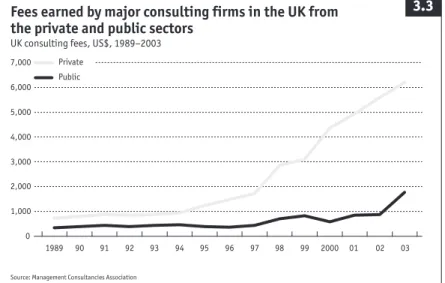
Figure 3.3 shows that between 1989 and 1997 public-sector consulting in the UK remained relatively stable, at around £200m. Interestingly, between 1997 and 2003, when consulting fees from the private sector rose by a factor of three, those from the public sector rose by a factor of four. But even in 2003, when consulting-fee rates were at their lowest ebb, public-sector clients generated only one-fifth of all fees – and that in a year when the private sector was very depressed – still well below his-toric levels. The evidence is therefore that it is not so much that public-sector spending on consultants is spiralling out of control, but that the entire UK economy is using consultants more than ever before. The public sector is not out of line; if anything, it is getting into line.
… as are some services
But what of the different services that make up the consulting market? What do clients actually buy? The picture emerges of an industry
Fees earned by major consulting firms in the UK from the private and public sectors
UK consulting fees, US$, 1989–2003
2.1 3.3
Source: Management Consultancies Association
1989 90 91 92 93 94 95 96 97 98 99 2000 0
1,000 2,000 3,000 4,000 5,000 6,000
7,000 Private Public
increasingly polarised between large-scale “solutions”, which contain outsourcing as well as consulting, and smaller-scale, higher-margin work, which represents a return to the value of traditional “manage-ment consulting”. Squeezed from both sides is it-related consulting,
once the industry’s engine for growth.
Looking more widely, at implementation as well as advisory work, the biggest market of the past few years has been outsourcing and its more recent incarnations: offshoring (outsourcing to a supplier based in a low-cost economy, typically India), business process outsourcing (bpo – outsourcing of business functions other than it) and even
transformational outsourcing (see Chapter 11). It is always a sure sign of an up-and-coming consulting market when no one can agree on the right terminology – the three-letter acronym that will lead the charge into the board room – and these manifestations of outsourcing are no exception. Terms like “right-shoring” and “near-shoring” and “business transformation” are already rolling off people’s tongues. Although it is easy to dismiss such terms as management-speak, they point to an underlying, more significant trend: the shift of consulting away from its traditional model as knowledge arbitrage (taking new management ideas and best practice from client to client) to labour arbitrage (trading client staff for consulting staff and, further, trading consulting staff for offshore outsourcing staff) – in effect, outsourcing and offshoring.
But underneath the marketing hype, it is clear that a significant shift has taken place among clients and consulting firms. For clients, out-sourcing offers a way of restructuring their business, allowing them to concentrate on their core activities rather than a host of peripheral tasks which do not contribute to their competitive edge. Starting with facilities management and the most mundane it tasks, outsourcing is now an
acceptable approach for activities such as financial and human resources administration and customer query handling. For consultants, this is unquestionably a massive opportunity. Market maturity has not yet reached the stage where organisations feel comfortable making their sourcing decisions in isolation. Consultants can help in developing their overall approach and can advise on supplier selection and contract negotiation.
Advisory work (“management consulting”) accounts for only 16% of the global business consulting market (see Figure 3.4), compared with it
next few years, twice the rate of management consulting and pure it
outsourcing. Systems integration is not expected to grow at all.
If you strip out government consulting and outsourcing, the picture for other types of consulting is mixed. Operations management (improving the performance of businesses) remains the bedrock of the more advisory end of consulting. As Figure 3.5 on the next page shows, it accounts for nearly half of all fees earned, with strategy accounting for one-third, human resources (hr) consulting for one-fifth, and it
strategy and planning just over one-twentieth of this market.
Between 2001 and 2003 clients turned away from implementing new, large-scale itsystems in favour of making better use of
their existing technology. As the market recovers that trend may reverse, but many people believe that firms still have plenty of work to do in improving processes around the use of technology before they think about buying new technology. Where
organisations are making small-scale changes, they are staffing the project internally rather than calling in consultants; for larger-scale changes, they are more likely to outsource or offshore the work.
Customer relationship management (crm), the fuel of much
growth in marketing consulting during 2001–02, has had its day.
Current and projected market size ($ billion)
%, 2004–06
2.1 3.4
Source: Kennedy Information Research Group
2004 2005 2006
0 10 20 30 40 50 60 70 80 90 100 Management consulting Systems integration
Manycrmimplementations were predicated on the idea of
cross-selling products or services. This did not happen, and clients rightly blame consulting firms for overstating the potential returns.
hrconsulting continues to battle against perceptions that it is
focused on repetitive, formulaic compensation and benefits consulting. While organisations are increasingly looking to consulting firms to help in “talent management”, leadership issues and organisational redesign, these remain comparatively small parts of the overall market.
It is tempting to predict the death of strategy consulting every time there is an economic downturn, but it never dies. The need among the most senior management of global corporations to have an external, advisory input – a sounding board backed with hefty analysis – never goes away. Fashions and focus may change, but for this type of consulting demand is constant. Much consulting stems from firms’ need to improve the
operational performance of their business, but surprisingly little translates into the archetypal consulting where someone comes into a factory and works out where the bottlenecks are. Most businesses now have such skills in-house. The days when there was a huge divide between clients’ and consultants’ know-how have passed: clients are just as well-equipped when it comes to streamlining processes or improving productivity. But there are two exceptions. First, clients will still seek out consultants who
Management consulting fees split
2004
2.1 3.5
Source: Kennedy Information Research Group
Strategy, $21 billion
IT strategy & planning, $4 billion Operations management, $29 billion
Human resources, $13 billion
31%
6% 20%
43%
20%
have in-depth knowledge of a highly specialised area, perhaps a record of solving a particular problem that is new to the client. Second, much operational improvement consulting has been subsumed into itconsulting and outsourcing. Rather than try to
re-engineer a process, a company may be tempted to change the technology it uses or hand it over to someone who can fix the problem on its behalf.
Financial engineering?
Of course, it is not just the amount of money that managers have avail-able to spend on consultants that drives demand, but also how they account for it.
Consultants like to tell themselves that it is uncertainty and regula-tion or the quality of the services they provide that drive demand for consulting. But they may be underestimating another factor: the pres-sure that organisations have been under to keep their headcount low. For the past 20 years this has been the way in which big corporations have kept a lid on their costs – managers controlled people rather than budgets. Companies employed half as many people doing just as much, and paid them only one-third more in compensation for their additional workload. Asked to do more with less, managers discovered a way round the problem: employing consultants who did not show up on the headcount.
Since the early 1990s, this has been matched by the realisation that outsourcing is a means of instant cost reduction. Increasingly, this approach is being applied to consulting services too: for the largest pro-jects, suppliers may now be expected to finance the work for the first one or two years, until an interim milestone is achieved. Losses made in the early years of a contract are recouped later.
“Why don’t people see how dangerous these kinds of deals are?” asks John Kopeck at Compass Management Consulting, which spe-cialises in benchmarkingitcosts. “I was sitting in a restaurant in New
and the practice of public accounting, will make clients more cautious. “The primary aim of this legislation is to alert investors to creative financial engineering by management and to hold management responsible when it affects the firm’s value. Some outsourced service contracts can look an awful lot like off-balance-sheet financing.”
Sarbanes-Oxley may reduce the demand for project financing, but, with the pressure to deliver to ever-shrinking budgets, it is likely that consulting firms will want to find other ways of helping their clients which do not break the bank. Perhaps the change will be semantic: re-labelling consultants as “contractors”. “People do not see contractors in the same light as consultants, even though they might be doing the same job,” commented one executive. “No one would question the presence of a contractor in the way they would scrutinise a consulting team.” Contractor does not sound as good, especially to the ears of consultants themselves, but needs must when the devil drives.
Very stupid? Fads and bandwagons
Between 2001 and 2004 there was a wide disparity in the fortunes of consulting firms – some grew and others shrank by as much as 50%. To understand these variances, it is helpful to look at the role management ideas play in determining the size and shape of the consulting market.
New management ideas unquestionably boost demand. The major waves of growth in consulting have coincided with surges of interest: in total quality management in the 1980s, in business process re-engineer-ing and then enterprise resource plannre-engineer-ing in the early 1990s, in e-busi-ness and the internet in the late 1990s. Consulting firms have been the medium by which many of these ideas have been spread and have earned substantial fees on the back of them.
When a consulting firm says that it has outperformed the industry because of the brilliance of its management or its unique corporate cul-ture, it is telling only a small part of the story. Consulting firms succeed because they have a service which is disproportionately popular in the markets where they operate: they are in the right place at the right time. The turnover of Index, a consulting firm (later acquired by csc
Com-puter Sciences), grew from $30m in 1989 to $200m in 1997 on the back of business process re-engineering. ibm’s consulting practice was worth
only around $350m in 1994, but the e-business boom took it to over $10 billion by 2001.
take-up of a particular idea. After all, many ideas never make it off the Har-vard Business Reviewstarting blocks. Equally, how do you measure the extent to which an idea adds value? Clearly, ideas make money for con-sulting firms, but do they do so for clients? A 1992 study of the Boston Consulting Group Matrix, which became one of the most widely used management tools of the 1980s, by two professors, J. Scott Armstrong at the Wharton School and Roderick Brodie at the University of Auckland in New Zealand, concluded that the bcg matrix, rather than aiding
profit maximisation, actually interfered with it. “We suspect”, they say, “that decision-makers use the bcgmatrix because it legitimises an
intu-ition that many people have about business decisions … that you should ‘stick to your winners’.”
Reliable data and objective analysis are thin on the ground, so why do companies continue to adopt unproven ideas? Why do managers believe what consultants tell them? This is what John Micklethwait and Adrian Wooldridge, authors of The Witch Doctors: What the Manage-ment Gurus are Saying, Why it Matters and How to Make Sense of It, have to say: “Anxious managers grasp at management literature as a panacea for all their worries. Many firms turn to management theory only when they are desperate. Their minds clouded by panic, they start out with exaggerated expectations, put the theory into practice for a few months, start to despair when it fails to produce results, and then turn to a new theory. Two years and 20 theories later, the business may well be bankrupt.” It is an argument “reformed” consultants have been happy to confirm.
Even where it is possible to correlate performance with the adoption of a particular fad, it is nigh on impossible to prove there is a causal link. That one company performs better than another will be because of a host of factors – its products and services, patterns of demand, location, management, even luck – and a new management tool can only be a part of this.
But interesting research has been carried out. Eric Abrahamson, a professor at New York University, has spent 15 years researching “fads and bandwagons” and is one of the few academics to draw some con-clusions about the impact of management ideas. There is, he argues, a wide disparity in the value obtained: early adopters do best, laggards do worst. Two factors appear to account for the difference:
evolution, it will not be clear how it will work in practice. Pioneering companies have to think harder about the
appropriateness of the idea, but laggards may be more tempted to jump on the bandwagon without giving due consideration to the return on investment.
Early adopters have to customise the idea to suit their own needs. There is no pre-existing manual or methodology for
implementing it, so they inevitably write one which suits their own needs. By contrast, laggards are more likely to think there is a standard methodology they should apply; they become focused on the means and lose sight of the end.
Abrahamson’s research is borne out by consultants themselves. At Bain & Company, Darrell Rigby has been researching management the-ories for more than a decade. He believes the secret to making good use of such tools and techniques does not lie in discovering the one unify-ing theory but in applyunify-ing the right techniques at the right time in the right way. “Management tools have an important role,” he says. “Things go wrong when a guru describes something as a cure-all. Managers should think in terms of a tool chest full of techniques they can apply in different situations. They should not be attracted by big ideas but build up a portfolio of different ones, each appropriate to a different situa-tion.” Managers also underestimate how hard it is to apply management tools. Reading an article in the Harvard Business Reviewis the easy part; the problem is how to make the theory stick. “You can’t transplant tools any more easily than you can transplant an organ from one body to another. The system (the body) that surrounds the tool determines whether the tool (the organ) will work or not. In some cases, managers trigger corporate antibodies which attack the new idea. They shouldn’t just be looking at the ideas other companies are using but questioning whether the conditions that make an idea valuable in one organisation apply to their own.”
David Collins, author of Management Fads and Buzzwordsand a lec-turer at the University of Essex in the UK, argues that managers could not give up looking for panaceas even if they wanted to. Work, he believes, is fundamentally about co-operation, but management is about control: “There is a tension at the heart of management. Managers are not the passive victims of fads. They actively seek them out because they are always hunting for new means of establishing control. The irony is that the harder they try to impose control, the more difficult it becomes, and so they never get to a point where they can stop.”
Very ambitious? Consulting and the wannabe CEO
Of course, there is a personal dimension to all this. Managers use con-sultants because their organisation is facing a particular challenge, because they want to try out something new, or because they want to copy something a competitor is doing. But they will not do any of these things if they think bringing in consultants will damage their career. Indeed, they expect consultants to have a positive effect on their career as well as their business. Hiring consultants may also make them feel important. There is nothing quite like having a team of bright young
mbagraduates hanging off your every word, or expanding your empire
by using an army of consultants to implement your new it system.
Some clients are reluctantly intrigued by consultants. If they have never been one, they want to find out why some consultants are apparently worth more than the people who hire them. They may even be templating consulting as a career and think it is useful to establish con-tact with a potential supplier.
Consultants know this and behave accordingly. They know that, in order to win work, they have to help their clients at a personal level. At its most innocuous, it might mean they simply do the best possible job in the hope that this reflects well on the person who hired them. Equally benignly, it may lead a consultant to take on a coaching role, advising a manager on his or her personal style, helping them prepare for meet-ings, and so on. Rarely – but it certainly happens – the relationship becomes more manipulative. A manager might be quite clear about how he or she is using the input of consultants to score political points; the consulting team might become more focused on helping a particular manager than on the broader interests of the business as a whole.
to pay for them. Consultants will rarely want to make the managers who hire them look bad in front of those they report to, whether it is a more senior manager or the board. Only those with ultimate responsi-bility can make sure that the client–consultant relationship is one that has probity.
Much more of a problem are those people who use consultants from habit. Maybe they have been a consultant and it is easy to tap into their alumni network when they need help. Maybe the use of consultants is so endemic in their organisation that no one really questions the deci-sion. There are some places that use consultants like junkies use heroin: they are the consulting addicts.
The litmus test
So what do clients say about consultants?
The operations manager
Brian Ablett is maintenance manager at an ExxonMobil refinery. “We come across a lot of consultants offering their services,” he says, “but we employ few of them and only where we lack some specific expertise. Wherever possible, we will use our own people. What consulting firms can do is provide additional resources – for example, when we imple-mented sapsoftware worldwide, we had some internal expertise but
we needed to be able to bolster that. We will also use tried-and-trusted consultants on specialist tasks. We use one particular company which carries out industry benchmarking because they are experts at that. But we try to avoid having people hawking their services around.”
ExxonMobil now uses fewer consultants than in the past. Building up internal centres of excellence and encouraging people to network more effectively mean that the company is better able to draw on its own skills, rather than seek those of outsiders. An organisation the size of ExxonMobil will have a huge number of experts to call on. Moreover, internal consultants are already familiar with the business – scale means they can be just as objective as external consultants and they have a
The business consulting ecosystem
Isolation
2.1 4.1
Client market The consulting industry
Client organisations Consulting firms
Projects Consultants
Reputation
Relationship
Life cycle Isolation
Portfolio Portfolio
Metamorphosis Metamorphosis
track record of doing things. “Most consultants have just seen things happen, not made them happen,” says Ablett. “We try very hard to avoid becoming dependent on consultants and it is probably this more than any other factor that puts us off using them.”
A more accessible pool of internal expertise also means that Exxon-Mobil can be clearer about exactly why it is bringing in external consul-tants when it does. “We’ll pick and choose. We also tend to go to specialists: when firms bundle too many services together, they lose focus and the quality of service goes down across the board. No firm can do everything, even though many imply they can. I cannot see why, just because someone has expertise in the refining industry, they should also have process consulting skills.”
Ablett and his colleagues are looking for specific skills and experience so they are more likely to search the market systematically rather than rely on using the same consultants. However, ExxonMobil managers do not start with a clean sheet of paper for each project. “If we have good prior experience with a firm then we will certainly include them along-side the new firms,” says Ablett. In any case, the fluidity of the consult-ing industry means that good contractors join together to form consulting firms, and small consulting firms are taken over by larger ones; it is impossible to have an exclusive list.
So what, apart from specialist knowledge, helps consultants win work at ExxonMobil? Not so much the brand as the ability to work together, according to Ablett: “A firm can have a great reputation, but success comes down to the individual consultants you get.” Nor is global coverage always important, even in an organisation as far-flung as ExxonMobil. So much depends on the skill of the individual consultant that buying locally is often preferable. Where a firm has a niche product, ExxonMobil will go to it rather than expect it to be based around the corner. “Clearly,” says Ablett, “much depends on the project. We are not going to hire two men in a shed to implement sapworldwide, but we’re
more likely to hire an independent consultant to coach senior man-agers.”
inefficien-cies that typically come with intermediaries. But if a consulting firm has expertise that we do not, perhaps because it is not a core part of our business, then manifestly it can add value.”
The strategy director
“Vodafone UK’s use of consultants varies widely, although overall we bring them in less than we did, partly because of expense and partly because we’re aware that we do not always make best use of them,” says Craig Tillotson, the company’s UK strategy director, who spent ten years at McKinsey and then Mercer before moving into industry. “At the UK company level, we employ strategy consultants, especially where an issue is particularly challenging, perhaps because the answer is unclear, perhaps because we need access to some very specific expertise. Else-where, we make widespread use of highly specialised consulting com-panies. Between the two, we hire ‘Big Four’ type firms at a functional level and second-tier players on operational issues. Middle managers do use them to fill resource or knowledge gaps; at this level there is more risk of an overlap between what different consulting teams do.”
Tillotson’s role means that he is generally looking to hire consultants who have experience of the telecoms sector, in-depth expertise of a par-ticular field and “raw talent”. The brand of a parpar-ticular consulting firm is less important than the people. “We want consultants who are gen-uinely committed to the success of our business, people we know and trust.” But that does not mean he would prefer to buy from smaller play-ers: “If we have a particularly difficult problem, then a global firm may be more likely to be able to help, not so much because of its breadth of expertise but because its brand has enabled it to attract the best people.” Indeed, like many others, he is wary of firms that try to offer too many services. “I don’t see the value of buying strategy work from an it
sup-plier. To have the best people in a particular field, a firm has to have a specialist reputation.”
it more difficult to articulate the specific value they bring – the client team members accelerate the learning curve and allow the consultants to get to the heart of a problem more quickly.”
The procurement professional
Alan Gotto, procurement manager for Aviva, an insurance company, and a former consultant, believes that if they are employed intelligently, consultants can bring tremendous benefits to a business. “Having been on both sides of the fence, I’ve a realistic understanding of the pressures both sides are under and how to mitigate these to ensure successful ser-vice delivery,” he says.
One of his main concerns is that consultancy is generally bought and sold badly. “Companies engage consultants for three broad reasons: brand, bodies and brains,” says Gotto, “but often they don’t take the time to understand which of these they need and end up paying for one when they wanted the other. You shouldn’t be using global blue-chip suppliers to work on projects which could be delivered by one-man bands.” At the same time, some consulting firms pay their consultants a commission, based on the new business they bring in, and this encour-ages both the firm and the consultant to focus on one-off sales rather than the long-term investment. “At Aviva,” he says, “we’ve looked at how we can remove these inefficiencies and develop supplier relation-ships for the benefit of both parties.”
Gotto thinks that the purchasing department has a crucial role to play: “As many internal budget holders are only occasional users of consultancy, purchasing can ensure that as a client you remain as joined up as the consultants.” This must be about more than just “policing con-sultancy” and “picking fights over rate cards”. “While consultancy fees are significant, and must be managed, the outputs, such as a future strategic direction of a business, can be far more significant. Purchasing’s role is to bring best value consultancy to the business; enlightened con-sultants recognise this and bring us best value to sell to the business.” A classic case would be where a consulting firm has delivered an out-standing solution for a client in one business unit which it could use again in another if a similar solution is required.
clas-sic procurement process, providing support up to the point where a con-tract is signed, then disappearing – which, of course, is exactly when the consulting sales machine kicks in and it is needed the most to avoid unnecessary dependencies developing. While some consultants may claim to be one-stop-shops, none are market leaders in all areas, so an important part of our role is to capture feedback so that consultant firms can be graded by capability, rather than as a whole.”
Gotto believes that as clients increasingly question the value added by consultants, it is essential for consultants to develop mature, trust-based relationships with their clients. “Often they don’t even seem to trust their own products as they excessively limit their liability,” he argues. “The challenge they must now meet is that if they want to call themselves professionals, and be paid as professionals, they should be prepared to be held responsible as professionals.”
The managing director
Unimills is a Dutch subsidiary of Golden Hope, a Malaysian agricultural products business. Jan van Driel is its managing director: “We hire con-sultants when we do not have the in-house expertise to do something for ourselves. For example, we are in the middle of a project to increase the entrepreneurial skills of our staff, and we have used consultants for this. We have also launched a new energy-saving programme and have hired some consultants to benchmark it.”
If anything, Unimills has seen its use of consultants grow, as it has become clearer about what is and is not core to its business. Cost is a factor in selecting consultants, as are experience and references from other clients. Brand counts for less. “I don’t care about names,” says van Driel. “Big names usually come with big price-tags.” For some types of work, experience in the food industry is preferred – “otherwise we end up teaching the consultant, and paying for it” – but for others, such as organisational redesign, where the issues are usually common across all sectors, it is much less so.