AENSI Journals
Australian Journal of Basic and Applied Sciences
ISSN:1991-8178
Journal home page: www.ajbasweb.com
Corresponding Author: Dr. Mohammed N. AbdulRazaq Alshekhly, Department of Mechanical and Materials Engineering, Faculty of Engineering and Built Environment, Universiti Kebangsaan Malaysia, 43600 Selangor, Malaysia.
Tel: 00601111235992; E-mail: [email protected]
An Overview of Semi-Solid Metal Processing
M.N.Mohammed, M.Z.Omar, M.S.Salleh, K.S.Alhawari, M.A.Abdelgnei
Department of Mechanical and Materials Engineering, Faculty of Engineering and Built Environment, Universiti Kebangsaan Malaysia, 43600 Selangor, Malaysia
A R T I C L E I N F O A B S T R A C T Article history:
Received 15 April 2014
Received in revised form 22 May 2014 Accepted 25 October 2014
Available online 10 November 2014
Keywords:
Thixo-Forming, Rheo-Forming, Semi-Solid Processing.
Background: Semi-solid metal (SSM) processing is widely known as a technology that involves the formation of metal alloys between solidus and liquidus temperatures. For the procedure to operate successfully, the microstructure of the starting material must consist of solid near-globular grains surrounded by a liquid matrix and a wide solidus-to-liquidus transition area. Objective: This overview aims to systematically categorize the most commonly utilized SSM technologies. Results: In general, technologies for SSM processing can be divided in two main categories based on the presence or absence of an intermediate solidification step. Conclusion: This overview clearly shows that several techniques for component forming using semi-solid state processing have been developed for application in various industries worldwide. However, it is still unclear which of these categories in the SSM processing family offers the best method for metal forming.
© 2014 AENSI Publisher All rights reserved. To Cite This Article: M.N.Mohammed, M.Z.Omar, M.S.Salleh, K.S.Alhawari, M.A.Abdelgnei., An Overview of Semi-Solid Metal Processing. Adv. Environ. Biol., 8(19), 369-373, 2014
INTRODUCTION
Semi-solid metal (SSM) processing, also known as thixoforming, is a technology for metal forming that was patented by Spencer during his PhD studies under the supervision of Professor Flemings at the Massachusetts Institute of Technology (MIT) in the early 1970s (Spencer, D.B., 1972; Fan, Z., 2002). Nowadays, the thixoforming process has found application in a number of manufacturing domains due to its ability to deliver the production of high-quality parts at costs that are comparable to or lower than those of conventional forming techniques such as casting or forging. Some examples of these applications are engine suspension mounts and steering knuckles for some automobile brands (Mohammed, M.N., 2013; Salleh, M.S., 2014).
During the last 40 years of research efforts, a lot of different materials have been developed and used with this process. For successful SSM processing, the microstructures should have solid near-globular grains with a wide transition area from solidus to liquidus (Mohammed, M.N., 2013; Mohammed, M.N., 2014). The microstructures impart thixotropic properties in slurries, i.e. they have shear and time-dependent flow properties. A unique property of the flow behaviour in SSM processing is related to the non-Newtonian behaviour of an alloy where, in this case, when the material state is 50% solid and is sheared, the coalescence of the material will break up, its viscosity will fall, and it will flow like a liquid, but if it is allowed to stand for a certain time, globular coalescence will increase the viscosity of the material, which leads to it being able to support its own weight and it can be handled in the same way as if it were solid (Atkinson, H.V., 2005).
As described above, a globular microstructure with an appropriate amount of liquid fraction is required in order for SSM processing or forming to be successful. When shear forces are applied, the near-globular particles move easily past one another, causing a decrease in viscosity and making the material behave like a liquid. In contrast, when shear forces are applied on dendritic microstructures, typically found in conventional castings, the liquid is trapped between the dendritic arms and this prevents them from moving freely, thus increasing the viscosity of the material.
Technologies For Ssm Processing:
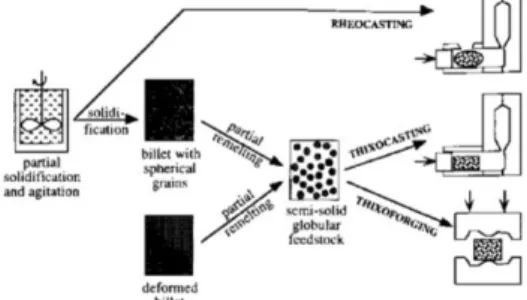
Semi-solid metal processing now covers a whole family of processes. These days whole forming processes can be done by using semi-solid processing techniques without any difficulty. These processing technologies can be grouped into two main categories based on the status of the starting material: rheo-routes and thixo-routes. The rheo-route refers to the preparation of a SSM slurry with spheroidal microstructure from a liquid state, which is injected directly into a die or mould for component shaping without an intermediate (solidification) stage. The thixo-route refers to processes where the molten metal is solidified initially (in an intermediate solidification step) during which time the material in the form of a billet was treated in such a way that when it is heated into the semi-solid state it has a non-dendritic microstructure and is then injected into the die or mould for component forming. There is still a lack of consensus regarding whether rheoforming or thixoforming is the best available method. The differences between rheoforming and thixoforming are illustrated in Figure1. The rheo- and thixo-related terminology is discussed in the following sections.
Fig. 1: Schematic representation of the two main categories of SSM processing.
Rheo-Related Terms:
The term ‘rheocasting’ refers to a process where a molten alloy with a spheroidal microstructure is solidified into a semi-solid state and injected directly into a liquid metal die or mould casting cavity without an intermediate solidification stage. The spheroidal microstructure can be obtained by the liquid route as described in the work of Mohammed et al.(2013) on technologies for the production of non-dendrite feedstock. In general, early rheocasting processes used mechanical stirring to obtain a globular microstructure directly from liquid, but the latest improvements to the technology have employed new processes that promote better properties at the lowest cost, such as the new MIT process, cooling slope technique, and liquidus casting (also known as new rheocasting (NRC)). New rheocasting starts with the application of a low level of superheat to the melt the metal at a uniform temperature near to or just above the liquidus temperature. Next, the molten metal is poured into a holding mould and kept there for a predefined time to be conditioned into slurries of fine, non-dendritic microstructures that can be charged into the inclined sleeve of a vertical squeeze casting machine (De Figueredo, A. and D. Apelian, 2001), as shown in Figure 2.
Fig. 2: Schematic illustration of the stages of new rheocasting (NRC) (De Figueredo, A. and D. Apelian, 2001).
Fig. 3: Schematic illustration of a twin-screw rheomoulding machine (Ji, S., 2002).
Thixo-Related Terms:
The term ‘thixocasting’ usually refers to the process where a molten ingot billet is solidified initially (in an intermediate solidification step) during which time the material was treated in such a way that when it is reheated uniformly to a semi-solid state it will have an equiaxed or globular microstructure. Then a ram or plunger injects and squeezes the thus created semi-solid slurry into a horizontal cold chamber or a closed die by a shot piston, in a manner comparable to high-pressure die-casting. The content of the liquid fraction of the metal prior to forming is relatively high, i.e., more than 50%.
In contrast, the term ‘thixoforging’ describes a process where a semi-solid ingot or billet with a liquid fraction of less than 50% is inserted into the lower half of a horizontal open die and by squeezing the two halves of the die together, the metal fills it completely in one step and formsa near net shape component (Kopp, R., 2001). The procedures of and the differences between rheocasting, thixocasting and thixoforging are illustrated in Figure4.
Fig. 4: Schematic illustration of different routes for semi-solid metal processing (Quaak, C.J., 1996).
The ‘thixomoulding’ process is similar to the rheomoulding process with respect to the mechanism and the procedure, but the main difference can be found in the raw material that is used for feedstock; in thixomoulding the material is in the form of chips of magnesium alloy as opposed to in rheomoulding. The process of thixomoulding is schematically illustrated in Figure 5. In brief, the mechanism of this process consists of feeding the magnesium alloy chips, which are around 2–5 mm in size, by a volumetric metering device into a heated barrel where the material is stirred and partially melted. Then a rotating screw is used to transfer the slurry into one side of the valve to inject it through a nozzle into a die cavity to form the final shape. The main advantages of thixomoulding are that the forming operations can be done in a one-step process which takes place in a clean and safe environment because the handling of liquid metal is completely eliminated and the process can be used for the continuous production of large quantities of components (Pasternak, L., 1992).
Fig. 5: Schematic showing the thixomoulding process (Pasternak, L., 1992).
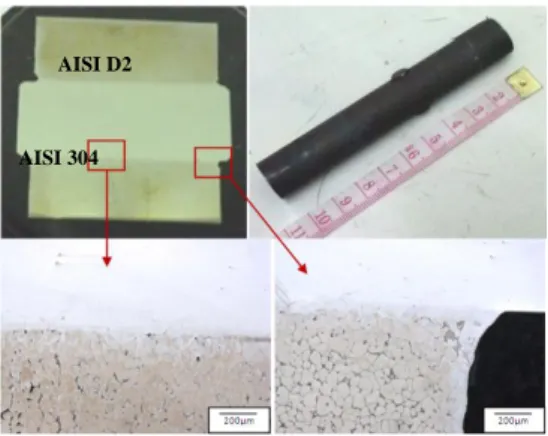
components with multiple materials and minimizing the defects associated with the conventional welding process. In addition, semi-solid joining can be used to join low-melting-point metal with high-melting-point metal (Kiuchi, M., 1998; Mohammed, M.N., 2012). As reported by previous studies, there are three possible methods that can be used to produce thixojoining process: 1) combining forming and bonding in one step (Baadjou, R., 2006) 2) using a thixotropic metal as a filler for the joining materials (Mendez, P.F., 2002), and 3) joining two metals in thixotropic property (Mohammed, M.N., 2013). Since the thixojoining process is not based on conventional methods (adhesive, nails, screws),it is able to produce homogeneous properties with a high-quality surface and avoids the creation of a dendritic microstructure in the join zone as shown in Figure 6.
Fig. 6: Demonstration component for joining two different materials with microstructure at interface (Mohammed, M.N., et al, 2013).
Conclusion:
This overview clearly shows that several techniques for component forming using semi-solid state processing have been developed for application in various industries worldwide. This review of the main routes has categorized these different techniques based on the presence or absence of an intermediate solidification step and the main differences between these technologies have been highlighted. The main difference between thixo-and rheo-based techniques is that the latter category does not have an intermediate solidification stage. However, it is still unclear which of these categories in the SSM processing family offers the best method for metal forming.
ACKNOWLEDGEMENTS
The authors would like to thank Universiti Kebangsaan Malaysia (UKM) and the Ministry of Higher Education of Malaysia for sponsoring this work through the research grant GUP-2012-040.
REFERENCES
Spencer, D.B., R. Mehrabian, M.C. Flemings, 1972. Rheological behavior of Sn-15 Pct Pb in the crystallization range. Metallurgical and Materials Transactions, 3: 1925-1932.
Fan, Z., 2002. Semi-solid Metal Processing. International Materials Reviews, 47:49-85.
Mohammed, M.N., M.Z. Omar, J. Syarif, Z. Sajuri, M.S. Salleh, K.S. Alhawari, 2013. Microstructural evolution during DPRM process of semisolid ledeburitic D2 tool steel. The Scientific World Journal, 828926. doi:10.1155/2013/828926.
Salleh, M.S., M.Z. Omar, J. Syarif, K.S. Alhawari, M.N. Mohammed, 2014. Microstructure and mechanical properties of thixoformed A319 aluminium alloy, Materials and Design, 64: 142-152.
Mohammed, M.N., M.Z. Omar, M.S. Salleh, K.S. Alhawari, P. Kapranos, 2013. Semi-solid metal processing techniques for nondendritic feedstock production,” The Scientific World Journal, doi:10.1155/2013/752175
Mohammed, M.N., M.Z. Omar, J. Syarif, M.S. Salleh, 2014. Morphological Evolution during Partial Re-Melting of AISI D2 Cold-Work Tool Steel, Sains Malaysiana, 43(8): 1213-1219.
Atkinson, H.V., 2005. Modelling the semisolid processing of metallic alloys. Materials Science, 50:341-412.
De Figueredo, A. and D. Apelian, 2001. Science and Technology of Semi-Solid Metal Processing, The North American Die Casting Association NADCA.
Peng, H., W.M. Hsu, 2000. In: Chiarmetta GL, Rosso M, editors. Proc. 6th Int. Conf. Semi Solid Processing of Alloys and Composites, Turin, Italy, September 2000. Italy: Edimet Spa, 313-7.
AISI D2
Ji, S., Z. Fan, G. Liu, X. Fang, S. Song, 2002. Twin-screw rheomoulding of AZ91D Mg-alloy. In Proceedings of the 7-th International Conference Semi-Solid Processing of Alloys and Composites, Tsukuba (pp: 683-688).
Kopp, R., D. Neudenberger, G. Winning, 2001. Different concepts of thixoforging and experiments for rheological data, Journal Of Materials Processing Technology , pp: 48-52.
Quaak, C.J., L. Katgerman, W.H. Kool, 1996. Viscosity evolution of partially solidified aluminum slurries after a shear rate jump. 4th Int. Conf. Semi Solid Processing of Alloys and Composites, Sheffield, UK, 35-9.
Pasternak, L., R. Carnahan, R. Decker, R. Kilbert, 1992. Semi-Solid Production Processing of Magnesium Alloys by Thixomolding[TM]. Proc. 2nd Int.Conf. on Semi-Solid Processing of Alloys and Composites, Cambridge, MA, USA, 159-69.
Kiuchi, M., J. Yanagimoto, S. Sugiyama, 1998. Mashy-state joining, a new process for joining materials together, Proc. 5th Int. Conf. Semi-Solid Processing of Alloys and Composites, Golden, Colorado, USA, 123-130.
Mohammed, M.N., M.Z. Omar, M.S. Salleh, M.A. Zailani, K.S. Alhawari, 2012. Joining Two Metals Via Partial Remelting Method. Journal of Asian Scientific Research, 2: 724-730.
Baadjou, R., H. Shimahara, G. Hirt, 2006. Automated semi-solid forging of steel components by means of thixojoining. Solid State Phenomena, 116–117: 383–386.
Mendez, P.F. C.S. Rice, S.B. Brown, 2002. Joining Using Semisolid Metals, Welding Journal, 181s-187s. Mohammed, M.N., M.Z. Omar, M.S. Salleh, K.S. Alhawari, 2013. Study on thixojoining process using partial remelting method, Advances in Materials Science and Engineering, doi:10.1155/2013/251472.