Corresponding Author: J.O. Petinrin, Centre of Electrical Energy System (CEES), Faculty of Electrical Engineering,
Implementation of Energy Storage in a Future Smart Grid
J.O. Petinrin and M. Shaaban
Centre of Electrical Energy System (CEES), Faculty of Electrical Engineering, Universiti Teknologi,
Malaysia. Johor Bahru, Malaysia.
Abstract: Modernization of power usage and design is demanding for new control and operation strategies of the smart grid. The changes in load control system coupled with the variable and stochastic nature of renewable energy integrated in the smart grid offers a new set of challenges in balancing generation and consumption. The deployment of energy storage system throughout the grid from generation to end-user present an opportunity to transcend the power balance paradigm by storing energy during off-peak and redispatched when needed. It also makes process happen more effectively and improve system performance. This paper addresses commonly used energy storage technologies, their application and benefits. The simulation carried out using OpenDSS software shows the effectiveness of energy storage on intermittent renewable energy and its positive impact on the tasks of voltage control.
Key words:
INTRODUCTION
The inability to store electrical energy has made the utility industry to always operate on the principle of instantaneous supplying demand. There is need to maintain balance between generation and consumption, from generation capital planning to real-time control center operation. Smart grid seamlessly integrates renewable energy (RE) such as solar or wind power which they in turn solve the problem of energy crisis and climate change. However, the stochastic characteristic and the inherent property that exist in the solar and wind power presents difficulties for power system security operation. The deployment of energy storage [ES] system throughout the grid from generation to end-user (Fioravanti 2011) present an opportunity to transcend the power balance paradigm by storing energy during off-peak and redispatched when needed. Energy storage improves network performance in connection with other smart grid control technologies such as demand side integration. The event definitions and varying behavior of the network on both long and short timescale determine the level of contribution of the energy storage system. A greater number of problems could be solved by a higher energy capacity and power rating (1kW - 1GW) ES (Mohod and Aware 2008; Tanabe, Sato et al. 2008; Zhong, Zhang et al. 2008) but there is a balance of cost/benefit analysis (Wade, Taylor et al. 2010).
In addition ES can increase grid reliability and asset utilization (EPRI 2010; Rastler 2010) Energy storage facilities relieve congestion and constrains. They provide easy connection of renewable sources and make islanding possible (Hamidi, Smith et al. 2010), and allows load leveling and peak shaving (Kumar 2011). Energy storage such as battery, thermal, hydrogen, superconducting magnetic energy storage (SMES) devices, and ultra-capacitors play an important role to minimized the impact of sudden load changes and fluctuations in solar and wind generation, as well as to shift energy consumption from peak hours by providing energy balancing, load following, increased supply redundancy and system reliability. The capability of distributed storage to store non-despatchable energy from renewable energy sources can certainly improve system reliability (Shaaban and Majid 2010).
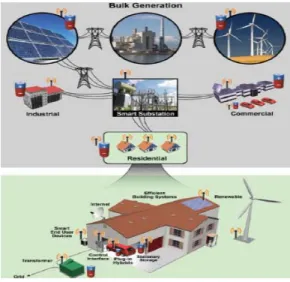
Application of Energy Storage in Smart Grid:
Fig. 1: Application of energy storage and future smart grid.
Without ES, RE penetration would be back up with fossil fuel that run at low efficiencies and release carbon dioxide emission which contradicts the purpose and benefits of RE. ES in conjunction with power electronics that interfaces the ES and the utility gird have a great technical application and enormous impact on future smart grid. this results in many benefits for managing the fluctuations in energy use as well as generation. Some of these benefits are summarized below:
Grid Voltage Stability Enhancement:
ES can maintain the voltages of the generation and load ends within the normal values by providing additional reactive power and injection of real power for a period up to 2 seconds.
Power Grid Reliability:
ES increases power grid reliability by providing uninterrupted power supply.
Power Quality Improvement:
ES reduces harmonic distortions, and eliminates voltage sags and surges through the provision of ride through for momentary outages, and extended protection from longer outages, coupled with advanced power electronics. This improves the power quality.
Renewable Support:
ES facilitates the integration of RE and can improve the net power quality(Noce, Riva et al. 2012). Hybrid ES with Wind and solar PV, makes ES increase the value of the PV and wind generated electricity, thereby balancing energy supply with consumer demands (Choi, Tseng et al. 2008; Styczynski, Lombardi et al. 2009).
Grid Energy Management Improvement:
The ES provides both active and reactive support. It can be used in the energy management applications such as load shifting, peak shaving, load leveling and commodity storage where electricity storage technologies are used in daily cycles for financial benefit (Hamsic, Schmelter et al. 2006).
Grid Frequency Excursion Suppression:
It can provide prompt spinning reserve (or load) for mitigating load-generation imbalance with the ES discharging active power for a duration up to 30minutes which suppresses grid frequency excursion (Rebours and Kirschen 2005).
Grid Angular Stability Enhancement:
ES technology has the capability to keep all components in the system in synchronous with each other and mitigate system collapse by the production and consumption of active power at periods of 1 to 2 seconds.
Customer Energy Management:
Real planning and implementation strategy should be related to the real-time control and operational functionalities of the ES in conjunction with RE so as to get rapid integration process (Mohd, Ortjohann et al. 2008).
Energy Storage Technologies:
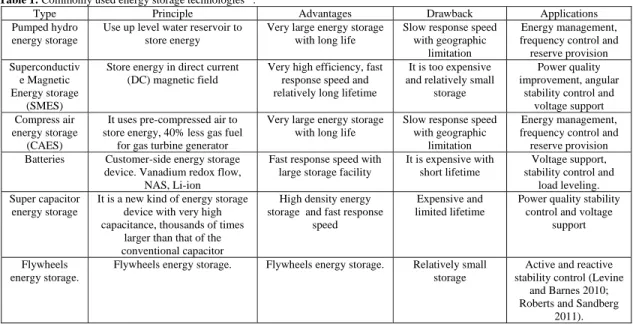
Energy storage technology is a conversion of electrical energy from a power system into a form in which it can be stored until converted back to electrical energy (DTI 2004). There are different types of ES technologies nowadays (Makansi and Abboud 2002; Ibrahim, Ilinca et al. 2008). Table 1 summaries commonly used ES technologies, their principle, advantages, drawback and applications.
Table 1: Commonly used energy storage technologies .
Type Principle Advantages Drawback Applications
Pumped hydro energy storage
Use up level water reservoir to store energy
Very large energy storage with long life
Slow response speed with geographic
limitation
Energy management, frequency control and reserve provision Superconductiv
e Magnetic Energy storage
(SMES)
Store energy in direct current (DC) magnetic field
Very high efficiency, fast response speed and relatively long lifetime
It is too expensive and relatively small
storage
Power quality improvement, angular
stability control and voltage support Compress air
energy storage (CAES)
It uses pre-compressed air to store energy, 40% less gas fuel
for gas turbine generator
Very large energy storage with long life
Slow response speed with geographic
limitation
Energy management, frequency control and reserve provision
Batteries Customer-side energy storage
device. Vanadium redox flow, NAS, Li-ion
Fast response speed with large storage facility
It is expensive with short lifetime
Voltage support, stability control and
load leveling. Super capacitor
energy storage
It is a new kind of energy storage device with very high capacitance, thousands of times
larger than that of the conventional capacitor
High density energy storage and fast response
speed
Expensive and limited lifetime
Power quality stability control and voltage
support
Flywheels energy storage.
Flywheels energy storage. Flywheels energy storage. Relatively small storage
Active and reactive stability control (Levine
and Barnes 2010; Roberts and Sandberg
2011).
Community Energy Storage System (CES):
The development of an intelligent smart grid comes with a challenge of balancing all the variables in connection with dynamic load control powered from an ever increasing penetration of renewable energy resources. The balancing of these variables could be achieved through the installation of energy storage throughout the grid system. It provides significant contributions in overcoming the difficulty of random fluctuation created by RE (Lund and Paatero 2001; Liao, Liu et al. 2010). Design elements from demand response techniques in homes to dynamic loading of transmission and distribution (T&D) networks based on the intermittency of renewable energy (RE) will come to bear in true smart grid design. Community energy storage also known as distributed energy storage system (DESS) provides voltage control, peak load management, reactive support, capacity and ancillary service market, frequency regulation and other smart grid services (Zhou and Qi 2009) and could be controlled in real-time utilizing feeder or substation load signals. During system outages CES could also allow non-faulted subsections of the grid to operate in autonomous mode with proper relaying and protection schemes (Delille, François et al. 2010).
Location of CES throughout the distribution system will store the excess energy with less line losses and redispatched back to the same customers when required. The CES could equally control the local voltage during cloud pass over or voltage sag in solar PV. CES utilizes the power electronics in it to act as instantaneous capacitive VAR compensators to maintain proper voltage and power factor in local area. In addition, CES units could provide peak power in case of abnormal amount of PHEV quick charges.
Test Case/Results:
A sample circuit is taken from a modeled IEEE123 test feeder of an actual 115kV/4.16kV distribution circuit of approximately 10MW of total load distributed among commercial and residential energy consumers. The 123 test feeder consists of a three-phase feeder and a number of one, two and three phase laterals that taps off the mains. The circuit is implemented in OpenDSS, a simulation tool for electric utility distribution system, which can be used as both a stand-alone executable programme and a Com DLL (Dugan 2009) that can be driven from Excel, MATLAB, C++ etc. Off-line tools are utilized to generate intermittent RE (solar PV, wind) and loads curves.
The RE and the load are connected to the IEEE123 test feeder. A 3MW PV with a 3MWh rated capacity and 3MW ES are integrated to Node 450. The power factor of the power generated is unity. Solar radiation was obtained through OpenDSS capability. These profiles were used to later drive the shapes of the power generated. Different load shapes were created with OpenDSS capabilities and each of these shapes were connected to different nodes. The minimum storage capacity hold in reserve of the ES is assumed 25%. The 10MVA interconnection transformer remains the same, and the ES device is controlled to maintain the regulating transformer loading below 10MVA. Immediately the power injected by the PV falls below 1000kW, the ES device starts discharging until the energy level reaches the minimum capacity or the cycle starts again.
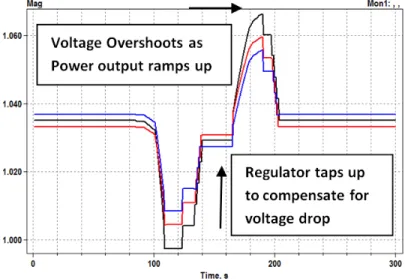
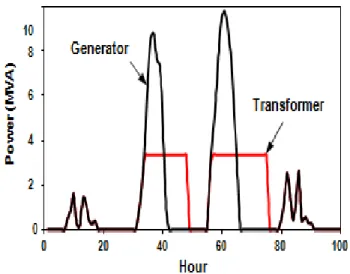
Figs. 2-5 show the simulation results. Fig. 2 shows the solar PV ramp. There was voltage overshoots at 1.05 pu as power output ramps up. The regulator taps up or down to compensate for voltage drop or rise as the case may be. The energy storage system in the test study level the power injection curve as shown in Fig 3 and mitigate transformer overloading as shown in Fig. 4, the power flowing through the interconnection transformer does not increase above 100kW while Fig. 5 shows per phase power injection and energy storage. The study therefore, reveals that ES can be integrated along with RE for load leveling and shifting, voltage regulation and VAR support in power system. A large size of ES system will be required for better leveling of the power produced by renewable energies The non-dispatchable and intermittent power generated by renewable energy most especially wind and solar PV can be dispatchable and non-intermittent (Smith, Sen et al. 2008; Martinez and Martin-Arnedo 2011).
Fig. 3: Solar PV ramp with energy storage.
Fig. 4: Per phase power injection and power flow through the interconnection transformer.
Fig. 5: Per phase power injection and stored energy.
The recent drift towards balancing generation and consumption, reduction of carbon dioxide emission, mitigation of inherent characteristic of renewable energy along with increasing demands of high power quality and reliability, demands for the deployment and implementation of distributed energy storage system in the smart grid. Although, REs are environmentally beneficial but the stochastic and non-dispatchable nature of wind and solar power causes voltage and frequency variation on the grid. Electrical energy storage distributed in the grid will not only be a key enabler for a smart grid with high penetration of RE but provide reliable and quality power supply. The simulations conducted shows that deployment of ES with the RE has a positive impact on the task of voltage control and power flow management of the distribution system. The ES operates to improve network performance. Progressive transition to future intelligent grid will make ES deployed throughout the grid system become an integral part of the smart grid.
REFERENCES
Bjelovuk, G., A. Nourai, et al., 2009. "Community Energy Storage (CES) and the Smart Grid:‘A Game Changer’." AEP Presentation to the Electricity Storage Association.
Choi, S., K. Tseng, et al., 2008. Energy storage systems in distributed generation schemes. Power and Energy Society General Meeting-Conversion and Delivery of Electrical Energy in the 21st Century, 2008 IEEE, IEEE.
Delille, G., B. François, et al., 2010. Dynamic frequency control support: A virtual inertia provided by distributed energy storage to isolated power systems. Innovative Smart Grid Technologies Conference Europe (ISGT Europe), 2010 IEEE PES, IEEE.
DTI, D., 2004. "Status of Electrical Energy Storage Systems." Report DTI (Department of Trade & Industry).
Dugan, R., 2009. "Reference Guide: The Open Distribution System Simulator (OpenDSS)." Electric Power Research Institute, Revision 7.
EPRI, D., 2010. "Electricity Energy Storage Technology Options-A White Paper Primer on Applications, Costs and Benefits."
Fioravanti, R., 2011. “Distributed bulk storage!”: Independent Testing of Complete CES systems. Power and Energy Society General Meeting, 2011 IEEE, IEEE.
Hamidi, V., K. Smith, et al., 2010. Smart grid technology review within the transmission and distribution sector. Innovative Smart Grid Technologies Conference Europe (ISGT Europe), 2010 IEEE PES, IEEE.
Hamsic, N., A. Schmelter, et al., 2006. Stabilising the grid voltage and frequency in isolated power systems using a flywheel energy storage system. The Great Wall World Renewable Energy Forum.
Ibrahim, H., A. Ilinca, et al., 2008. "Energy storage systems—characteristics and comparisons." Renewable and Sustainable Energy Reviews, 12(5): 1221-1250.
Kumar, R., 2011. Assuring voltage stability in the smart grid. Innovative Smart Grid Technologies (ISGT), 2011 IEEE PES, IEEE.
Lasseter, R., A. Akhil, et al., 2007. White paper on integration of distributed energy resources-the CERTS microgrid concept [R/OL].
Levine, J.G. and F.S. Barnes, 2010. "Applications of Energy Storage to Generation and Absorption of Electrical Power." Handbook for High Power and High Energy Storage: 1.
Liao, H., D. Liu, et al., 2010. "A study on compatibility of smart grid based on large scale energy storage system." Automation of Electric Power Systems, 34(2): 15-19.
Lund, P. and J. Paatero, 2001. "Energy storage options for improving wind power quality." imu 1000(2000): 2002.
Makansi, J. and J. Abboud, 2002. "Energy Storage–The Missing Link in the Electricity Value Chain." Energy Storage Council White Paper.
Martinez, J.A. and J. Martin-Arnedo, 2011. Distribution load flow calculations using time driven and probabilistic approaches. Power and Energy Society General Meeting, 2011 IEEE, IEEE.
Mohd, A., E. Ortjohann, et al., 2008. Challenges in integrating distributed energy storage systems into future smart grid. Industrial Electronics, 2008. ISIE 2008. IEEE International Symposium on, IEEE.
Mohod, S.W. and M.V. Aware, 2008. Energy storage to stabilize the weak wind generating grid. Power System Technology and IEEE Power India Conference, 2008. POWERCON 2008. Joint International Conference on, IEEE.
Noce, C., S. Riva, et al., 2012. Electrical energy storage in Smart Grid: Black-start study using a real-time digital simulator. Power Electronics for Distributed Generation Systems (PEDG), 2012 3rd IEEE International Symposium on, IEEE.
Rastler, D., 2010. Electricity Energy Storage Technology Options: A White Paper Primer on Applications, Costs and Benefits, Electric Power Research Institute.
Roberts, B.P. and C. Sandberg, 2011. "The role of energy storage in development of smart grids." Proceedings of the IEEE, 99(6): 1139-1144.
Shaaban, M. and M.S. Majid, 2010. Operational security criterion of a smart grid. Power and Energy (PECon), 2010 IEEE International Conference on, IEEE.
Smith, S.C., P. Sen, et al., 2008. Advancement of energy storage devices and applications in electrical power system. Power and Energy Society General Meeting-Conversion and Delivery of Electrical Energy in the 21st Century, 2008 IEEE, IEEE.
Styczynski, Z., P. Lombardi, et al., 2009. Electric Energy Storage and its tasks in the integration of wide-scale renewable resources. Integration of Wide-Scale Renewable Resources Into the Power Delivery System, 2009 CIGRE/IEEE PES Joint Symposium, IEEE.
Tanabe, T., T. Sato, et al., 2008. Generation Scheduling for wind power generation by storage battery system and meteorological forecast. Power and Energy Society General Meeting-Conversion and Delivery of Electrical Energy in the 21st Century, 2008 IEEE, IEEE.
Wade, N.S., P. Taylor, et al., 2010. "Evaluating the benefits of an electrical energy storage system in a future smart grid." Energy Policy, 38(11): 7180-7188.
Zhong, Y., J. Zhang, et al., 2008. Mathematical model of new bi-directional DC-AC-DC converter for supercapacitor energy storage system in photovoltaic generation. Electric Utility Deregulation and Restructuring and Power Technologies, 2008. DRPT 2008. Third International Conference on, IEEE.