ISSN Online: 2327-5960 ISSN Print: 2327-5952
DOI: 10.4236/jss.2019.73013 Mar. 13, 2019 161 Open Journal of Social Sciences
The Exploration of a Phased Comprehensive
Examination Method in College Physics
Experiments
Xinshun Wang, Benyang Wang, Wenge Qu, Weiyan Jiao, Chengfeng Li, Guanghua Fan,
Yi Liu, Shukun Zhao
School of Science, Harbin Institute of Technology at Weihai, Shandong, Weihai, China
Abstract
Examination method is like a baton, and its reform can greatly improve the teaching effect of college physics experiment course and change the students’ learning styles. Based on the current experimental teaching mode in our school, a new phased comprehensive examination method and the corres-ponding evaluation standard in college physics experiments were discussed in detail. This examination method is very appropriate to the hierarchical phased teaching model and course system. It can guide students to attach importance to experimental process, actively practice, continuous innovation and is beneficial to fully develop the potential of students, cultivate their ac-tive exploration spirit, scientific thinking ability, innovation ability and inno-vation consciousness, which truly achieve quality education.
Keywords
College Physics Experiment Course System, Teaching Model of “2 + 1” In-Class and Extracurricular Integration, Phased Comprehensive
Examination Method, Evaluation Standard, Innovation Ability Cultivation
1. Introduction
“Basic requirements for the teaching of college physics experiments in university of science and technology” [1] clearly points out that the college physics experi-ment is an important practical course in which students are systematically and scientifically trained in experimental techniques and methods, students’ scientif-ic thinking and innovative consciousness have been developed, and their scien-tific experimental ability, literacy, and innovation ability have been improved. How to cite this paper: Wang, X.S., Wang,
B.Y., Qu, W.G., Jiao, W.Y., Li, C.F., Fan, G.H., Liu, Y. and Zhao, S.K. (2019) The Exploration of a Phased Comprehensive Examination Method in College Physics
Experiments. Open Journal of Social
Sciences, 7, 161-170.
https://doi.org/10.4236/jss.2019.73013
DOI: 10.4236/jss.2019.73013 162 Open Journal of Social Sciences Compared with other practical courses, this course plays an irreplaceable role in cultivating students’ rigorous academic attitude, active innovation conscious-ness, theoretical connection practice and comprehensive application ability adapting to the development of science and technology. Therefore, most colleges and universities attach great importance on the teaching quality of physics expe-riment course, and adopt various methods to improve students’ initiative, en-thusiasm and consciousness and stimulate students’ interest in learning [2] [3] [4] [5] [6]. With the continuous advancement of curriculum reform, a hierar-chical, phased university physics experiment teaching model with different goals has been popularized and applied in many colleges and universities [7] [8] [9] [10]. The new curriculum system of college physics experiment (basic physics experiments, comprehensive design experiments, independent innovation expe-riments, research experiments) from basic to frontier, from receiving knowledge to cultivating ability has also been formed. The reform of teaching mode and curriculum system has made some students stand out and their enthusiasm and initiative in learning have been improved obviously. However, in order to bene-fit most students and achieve the goal of “Basic requirements for the teaching of college physics experiments in university of science and technology”, the tradi-tional assessment methods can no longer meet the current teaching system. There is an urgent need for a new assessment system to comply with the new teaching reform. The assessment system must be adapted to the teaching model and curriculum system, otherwise, the effect of teaching reform will be greatly compromised.
DOI: 10.4236/jss.2019.73013 163 Open Journal of Social Sciences
2. The Curriculum System and Teaching Mode of College
Physics Experiment
2.1. College Physics Experiment Course System
The physics experiment course of Harbin institute of technology at Weihai is of-fered to more than 2000 undergraduate students of science and engineering. The experiment is divided into two semesters, one in the first semester of second grade and the other in the second one. At present, there are 23 basic physical experiments, 6 comprehensive physical experiments and 3 designed physical periments (including Do It Yourself experiments) in the University Physics ex-periment Center. In addition, five innovative research exex-perimental courses have been set up independently, including optical combination, holographic optical information processing, laser interferometry technology and application, laser induced breakdown spectroscopy application, and nuclear magnetic resonance technology and application innovative research experiment course. Now, our experimental center has established a multi-level modular experimental teaching course system with the goal of capacity training, from basic experiments to comprehensive experiments to design experiments and innovative research ex-periments.
2.2. Teaching Mode of College Physics Experiment
DOI: 10.4236/jss.2019.73013 164 Open Journal of Social Sciences platform, conduct an experimental research, and write out the research report by themselves.
The three parts of the “2 + 1” teaching model are an indivisible whole. The experiment operation in class is the foundation, the experimental discussion in the class has played a role in summing up and improving the experiment opera-tion in class, which connect the experiment operaopera-tion in class with the extracur-ricular independent expansion experiment, and the extracurextracur-ricular independent expansion experiment reaches the peak, in which students’ interest in learning and innovation consciousness have been stimulated, their field of vision has been broadened, their spirit of exploration has been cultivated, and their prac-tical and innovative ability have been strengthened. The three parts are pro-moted from low to high, so that students will not have a sense of hardship, and it is easy to realize the migration of learning. In the unconsciously, the students’ practical ability and innovative ability have been improved.
3. Phased Comprehensive Examination Method in College
Physics Experiments
3.1. The Total Score Composition of College Physics Experiments
The total score of the college physics experiments consists of three parts: class discussion (10%), experiment in class (80%), and extracurricular expansion ex-periment (10%). This examination method matches our curriculum and teach-ing model very well.
3.2. The Score of Class Discussion
The course discussion is set in the first 20 minutes of each experiment class. The discussion content has been described in the 1.2 (The college physics experiment teaching mode), and will not be repeated here. The score of the course discus-sion are calculated based on the total number of times a student has spoken in one semester. The score of the student who is the most frequent participation in the class is 10 points.
3.3. The Phased Comprehensive Examination of Experiment in
Class
DOI: 10.4236/jss.2019.73013 165 Open Journal of Social Sciences The total score of the experiments in class is 80% of the sum of the score of ten individual experiments in class in one semester. The score of a single riment in class is divided into four parts: experimental preparation (20%), expe-rimental operation (20%), expeexpe-rimental literacy (20%), and expeexpe-rimental report (40%).
1) Experimental preparation:
In order to cultivate students’ ability of independent learning, independent experiment, independent design and independent innovation, we attach great importance to the preparatory process. The experimental preparation assess-ment is divided into three sections, one is the online assessassess-ment under the class, the second is the preview report, and the third is the classroom teacher’s spot check.
a) Online assessment under the class:
Students need to preview the experiment before entering the lab. There are some preview questions for each experiment in our textbook, and the students should understand these preview questions. There is a preparatory laboratory with one or two sets of experimental instruments for each experiment in our college physics experimental center, which are open all day for students to pre-view the instrument. After the prepre-view, students can take the prepre-view test on the Internet. If the test is unqualified, students can’t make an appointment for the lab class online.
b) Preview report:
After students participate in the preview test on the Internet, they also need to write a preview report. If there is no preview report, they cannot go to the lab.
c) Classroom spot check:
Before experiment, teachers check the preview situation of some students. If the students’ check is unqualified, they can’t take the experimental class, and need to preview experiment and participate in the preview test online again.
After students have undergone three preview assessments, they have basically understood the various contents of the experimental project. Some students maybe put forward their own problems, their own ideas and their own goals af-ter the preparation of such a preview. It can be said that the more students pre-pare and the more work they have, the more interested they are in the experi-ment.
2) Experimental operation and literacy:
expe-DOI: 10.4236/jss.2019.73013 166 Open Journal of Social Sciences riment.
3) Experimental report:
Teachers give the score of the experimental report according to the students’ data process, the experimental results, and the discussion of the experimental questions. In the experimental report, if the students have a thorough analysis of the experimental problems, or have their own insights, or have their own unique experience, or have a targeted analysis and discussion of the special phenomena and problems that appear in the experiment, they will be given extra points, which is designed to develop students’ ability to analyze and solve problems.
3.4. The Score of Extracurricular Expansion Experiment
The score of extracurricular expansion experiments is 10 points, and divided in-to three parts: in-topic-selecting report (20%), mid-term examinations (30%), and concluding report (50%).
The students are required to choose one extracurricular expansion experiment in each semester. After four weeks of the beginning of experimental class, stu-dents can investigate the related extracurricular expansion experiment by them-selves based on the four-week classroom discussion. They need to self-prepare the topic, self-design the experimental plan, and write a topic-selecting report. If the topic-selecting report is unqualified, they need to select a topic again and re-write the topic-selecting report. The next work can be carried out until qualified. In the tenth week of the experimental class, students are required to submit a mid-term progress report, including the progress of the experiment, the prob-lems that occurred in the experiment, the difficulties that they encountered, the gains and the thoughts in experiments, and the next plan and so on. The in-structor gives the mid-term score according to the students’ usual experiments and the mid-term progress report. Students who fail to pass the mid-term ex-amination may be dealt with in the following three ways according to the actual situation: 1) after improvement, the extracurricular expansion experiment can be continued; 2) after warning and observation of their improvement, decide whether to continue or stop the extracurricular expansion experiment; 3) stop the extracurricular expansion experiment directly.
At the end of the semester, students are required to submit a concluding re-port and experimental results. The concluding rere-port includes: background of the topic, experimental content and methods, experimental results, experimental analysis and discussion, innovation points, references. Other experimental re-sults include: design, software, models, devices, papers, patents, etc. The in-structor gives the score based on the students’ usual experimental performance, experimental results and concluding report.
4. Evaluation Criteria for Individual Experimental Project
4.1. Evaluation Criteria for Individual Experiment in Class
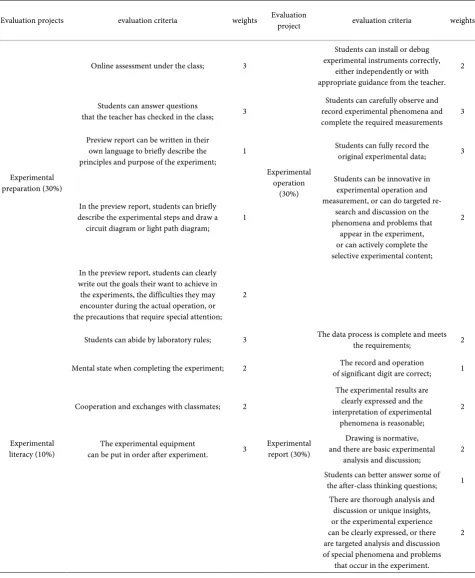
DOI: 10.4236/jss.2019.73013 167 Open Journal of Social Sciences from the assessment of “study performance” to the evaluation of “learning effec-tiveness”, and guide students to shift from “examination results” to “learning process”. The score of college physics experiments is not based on the difference between the actual experimental results and the expected ones, but based on the comprehensive performance of the students’ experimental knowledge, experi-mental ability, experiexperi-mental attitude, etc.. We must encourage innovation and not just be satisfied with completing the experiment. The specific evaluation cri-teria are shown in Table 1. Each evaluation item in the table has different evalu-ation criteria, and each standard requires a certain weight on a 10-point scale.
4.2. Evaluation Criteria for Extracurricular Expansion
Experiments
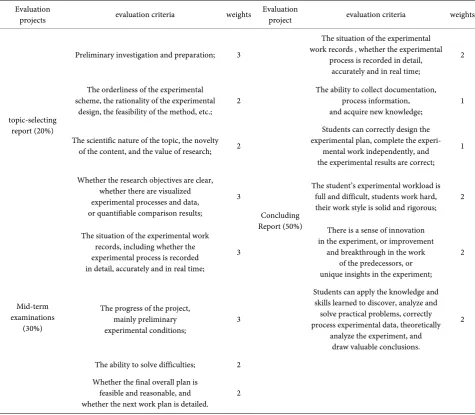
The extracurricular expansion experiment aims to improve students’ ability and quality in self-learning, problem solving, project management, comprehensive innovation, etc., in which students can experience the process of project learning and management, stimulate their interest in scientific and technological innova-tion and scientific research, and improve their innovainnova-tion ability. The experi-ment follows the principle of “interest driven, independent experiexperi-ment, and emphasis on process”. The whole process reflects the characteristics of indepen-dent planning, indepenindepen-dent learning, indepenindepen-dent design and indepenindepen-dent rea-lization. Therefore, the evaluation system should be process-oriented, the im-plementation process and imim-plementation results can be all objectively eva-luated. This evaluation system can guide students to pay attention to the expe-rimental process, initiative practice, and continuous innovation. The specific evaluation criteria are shown in Table 2. Each evaluation item in the table has different evaluation criteria, and each standard requires a certain weight on a 10-point scale.
5. Conclusion
DOI: 10.4236/jss.2019.73013 168 Open Journal of Social Sciences Table 1. Evaluation criteria for classroom experiment projects.
Evaluation projects evaluation criteria weights Evaluation project evaluation criteria weights
Experimental preparation (30%)
Online assessment under the class; 3
Experimental operation
(30%)
Students can install or debug experimental instruments correctly,
either independently or with appropriate guidance from the teacher.
2
Students can answer questions
that the teacher has checked in the class; 3
Students can carefully observe and record experimental phenomena and complete the required measurements 3 Preview report can be written in their
own language to briefly describe the
principles and purpose of the experiment; 1
Students can fully record the
original experimental data; 3
In the preview report, students can briefly describe the experimental steps and draw a
circuit diagram or light path diagram; 1
Students can be innovative in experimental operation and measurement, or can do targeted
re-search and discussion on the phenomena and problems that
appear in the experiment, or can actively complete the selective experimental content;
2
In the preview report, students can clearly write out the goals their want to achieve in the experiments, the difficulties they may encounter during the actual operation, or the precautions that require special attention;
2
Experimental literacy (10%)
Students can abide by laboratory rules; 3
Experimental report (30%)
The data process is complete and meets
the requirements; 2
Mental state when completing the experiment; 2 of significant digit are correct; The record and operation 1
Cooperation and exchanges with classmates; 2
The experimental results are clearly expressed and the interpretation of experimental
phenomena is reasonable;
2
The experimental equipment
can be put in order after experiment. 3
Drawing is normative, and there are basic experimental
analysis and discussion; 2
Students can better answer some of the after-class thinking questions; 1
There are thorough analysis and discussion or unique insights, or the experimental experience can be clearly expressed, or there are targeted analysis and discussion of special phenomena and problems
that occur in the experiment.
2
DOI: 10.4236/jss.2019.73013 169 Open Journal of Social Sciences Table 2. Evaluation criteria for extracurricular expansion experiments.
Evaluation
projects evaluation criteria weights Evaluation project evaluation criteria weights
topic-selecting report (20%)
Preliminary investigation and preparation; 3
Concluding Report (50%)
The situation of the experimental work records , whether the experimental
process is recorded in detail, accurately and in real time;
2
The orderliness of the experimental scheme, the rationality of the experimental
design, the feasibility of the method, etc.; 2
The ability to collect documentation, process information,
and acquire new knowledge; 1
The scientific nature of the topic, the novelty of the content, and the value of research; 2
Students can correctly design the experimental plan, complete the
experi-mental work independently, and the experimental results are correct;
1
Whether the research objectives are clear, whether there are visualized experimental processes and data, or quantifiable comparison results;
3 The student’s experimental workload is full and difficult, students work hard, their work style is solid and rigorous; 2
Mid-term examinations
(30%)
The situation of the experimental work records, including whether the experimental process is recorded in detail, accurately and in real time;
3
There is a sense of innovation in the experiment, or improvement
and breakthrough in the work of the predecessors, or unique insights in the experiment;
2
The progress of the project, mainly preliminary
experimental conditions; 3
Students can apply the knowledge and skills learned to discover, analyze and solve practical problems, correctly process experimental data, theoretically
analyze the experiment, and draw valuable conclusions.
2
The ability to solve difficulties; 2 Whether the final overall plan is
feasible and reasonable, and
whether the next work plan is detailed. 2
Fund Project
Teaching Reform Research Project of Undergraduate Universities in Shandong Province (B2016M020); Harbin Institute of Technology at Weihai Teaching Re-search Project (ITGA 10002016).
Conflicts of Interest
The authors declare no conflicts of interest regarding the publication of this pa-per.
References
Educa-DOI: 10.4236/jss.2019.73013 170 Open Journal of Social Sciences tion Press, Beijing.
[2] Cui, X.R., Cao, A.Y., Li, J., et al. (2016) The Application of Research-Based Teach-ing Model in the Reform of Experimental TeachTeach-ing Method. Experimental Tech-nology and Management, 33, 176-178.
[3] Ma, S.Y., Wang, H., Wu, F.P., et al. (2015) The Practice of Improving the Ability of Autonomous Learning in the Experiment of Autonomy Interest. Experimental Technology and Management, 32, 194-196.
[4] Ding, X.M., Zhang, X.J., Wang, P., et al. (2015) The Application of flipping class-room Teaching Model in College Experimental Teaching. Laboratory Research and Exploration, 34, 207-212.
[5] Geng, H.X. and Jiang, X.L. (2015) Exploration and Practice of Comprehensive Ex-perimental Teaching Reform. Laboratory Research and Exploration, 34, 147-149. [6] Song, J.F., Guo, X.F., Wang, S.Z., et al. (2015) Application of Micro-Course in
Col-lege Physics Experiment Teaching. Physics Experiment, 35, 12-17.
[7] Wei, Y.L. and Yang, L. (2015) Exploration of the layered Teaching Model of College Physics experiment. College Physics Experiment, 28, 126-128.
[8] Wan, W. (2015) Discussion on the Cultivation of Creative Ability in the Hierarchic-al Teaching of Physics experiment. College Physics Experiment, 28, 128-130. [9] Duan, X.S., Zhang, X., Zhang, Z.D. (2015) The Construction and Practice of College
Physics Experiment Teaching System for Students’ Autonomous Learning. Experi-mental Technology and Management, 32, 187-190.
[10] Zhang, Y.H. (2013) Construction of Physical Experiment Teaching System with Outstanding Ability of Practical Innovation. College Physics, No. 12, 43-45. [11] Zhu, H., Wang, W., Suo, Y.J. (2011) Exploration and Practice of Examination
Me-thods of College Physics Experiment Course. Experimental Science and Technolo-gy, 9, 108-111.
[12] Li, L., Li, Y.C. and Zhong, H.J. (2010) The Reform and Practice of Different Exami-nation Methods in Physics Experiment Class—The Positive Effect of Operation Test Is Most Obvious. College Physics, 29, 43-46.
[13] Li, M., Hong, W.N., Qian, L.C., et al. (2011) Practice on the Comprehensive Ex-amination Method of College Physics Experiment. University Physics Experiment, 24, 104-105.
[14] Yuan, A.J. and Ding, X.H. (2009) Evaluation of the Examination Methods of Col-lege Physics Experiments. ColCol-lege Physics Experiment, 22, 117-119.
[15] Wu, X.Q., Yao, X.L., Chen, J.B., et al. (2015) Study on the Examination Method of the Stage of College Physics Experiment. Physics and Engineering, 25, 66-70. [16] Liu, Z.X. and Yang, D. (2012) A Probe into the Reform of the Examination Mode of