AUSTRALIAN JOURNAL OF BASIC AND
APPLIED SCIENCES
ISSN:1991-8178 EISSN: 2309-8414 Journal home page: www.ajbasweb.com
Open Access Journal
Published BY AENSI Publication
© 2016 AENSI Publisher All rights reserved
This work is licensed under the Creative Commons Attribution International License (CC BY). http://creativecommons.org/licenses/by/4.0/
To Cite This Article: K.Uma, D.SynthiyaVinothini, Dr.B. Sathya Bama., Saliency Based Multi-Focus Image Fusion. Aust. J. Basic & Appl. Sci., 10(5): 54-58, 2016
Saliency Based Multi-Focus Image Fusion
1K.Uma, 2D.SynthiyaVinothini, 3Dr.B. Sathya Bama
1Research Scholar, Thiagarajar college of Engineering, Electronics And Communication Engineering, Madurai, India. 2Research Scholar, Thiagarajar college of Engineering, Electronics And Communication Engineering, Madurai, India. 3
Associate Professor, Thiagarajar college of Engineering, Electronics And Communication Engineering, Madurai, India.
Address For Correspondence:
K.Uma, Thiagarajar College Of Engineering, Electronics And Communication Engineering , Madurai 625015. TamilNadu, India. (+91)(9486032344) E-mail: [email protected]
A R T I C L E I N F O A B S T R A C T Article history:
Received 12 January 2016 Accepted 22 February 2016 Available online 1 March 2016
Keywords:
Structural similarity Index Spectral Residual Saliency Saliency map Feature Mutual Information (FMI)
This paper proposes a fusion method for multi-focus images by extracting salient features. The scene which contains objects with different depth of focus cannot display all areas clearly. The focused object in the scene contains more high frequency components than defocused object. It is important to detect salient features that contain high frequency components. Different from the traditional decision map based methods; the proposed algorithm is based on the spectral residual saliency method that fetch out the unique features in frequency domain. The model generates saliency maps that highlight the focused parts of a multi-focus image with a well-defined boundary. First, the saliency map is measured for each and every image, and then their saliency is used to alter their contributions in computing the all-in-focus image and thereby salient features in the sources are well preserved with an average SSIM value of 0.9952 and FMI value of 0.7026. The result shows the efficacy of the algorithm both in quality and computational efficiency in comparison with several recently proposed techniques.
INTRODUCTION
Multi-focus image fusion has been used widely in the field of image analysis task such as target recognition, microscopic imaging, computer vision and medical image processing. The aim of Multi-focus Image fusion is to combine relevant information from two or more images of a scene and as a result has
"all-in-focus" image (Slavica Savić, 2011). When one scene contains objects in different distance, the scene can be
captured on each object one after the other using a camera, creating group of pictures. Then, using image fusion approach, an image with better focus across all areas can be generated. In the utilization of digital camera, optical lenses experience only a narrow depth of focus. As a result of this limitation, it is often not possible to get an image which has all related objects in focus. One feasible solution to overcome this problem is to take several pictures with various focus settings and fused them together into a single frame to get all the details from the less focus area using image fusion method (Zaveri, T. and M. Zaveri, 2010).
Tang. J. (2004) has considered the issue of complexity reduction and implemented two image fusion techniques in DCT domain, namely, DCT + Average and DCT + Contrast in which an 8 × 8 DCT block is defined in JPEG standard. This algorithm is complex in calculating the contrast measure for each coefficient.
focus-level for compressive imaging system. There is no complex calculation for node cameras and thus it is very suitable for visual sensor network application yet it has poor PSNR value. A shortcoming of this method without consistency verification is bit weak on the bounds between focused and unfocussed areas which are worked out in DCT + Variance + CV method. The limitation of using DCT is that its runtime is high because of the block processing. To overcome the above specified issues this paper proposes to extract saliency of focused scene for multi focus image fusion.
Salient objects are those that contain high frequency components and are focused sharply in a multi-focus image. Salient object detection is done as a process of two stages: (1) extraction of salient features (2) segmentation of the salient object’s boundary. Although detection of salient objects in a scene is related to exact image segmentation and object retrieval, interestingly reliable that the estimation of saliency is often feasible at the image-level without any actual scene understanding. This is feasible since often saliency, as widely believed, is bottom-up. Such a hypothesis is favored by an evolutionary incentive to parallel process large volumes of low-level image cues, without requiring any computationally expensive global coupling. Hence, saliency often originates from visual uniqueness, unpredictability, rarity, or surprise, and is often attributed to fluctuation in image characteristics like color, gradient, edges, and boundaries (Nava, R., et al., 2007; Cheng, M.M., et al., 2011; HLi, Shutao and Bin Yang, 2008). Hence this paper proposes a saliency based multi-focus image fusion method which integrates two images in a scene.
Methodology:
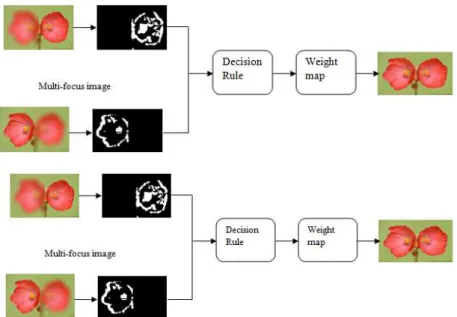
The proposed multi-focus image fusion method comprises of two stages, extraction of salient scene from each input image and then to integrate these salient objects using decision rule to obtain all-in-focus image. The initial stage, highlight the process of saliency extraction from the spectral residual method. Then, multi focus image fusion stage explains the decision rule based fusion method for focused pixels from the source images. A good fusion algorithm (i) must be able to extract complementary features from the input images. (ii) Should be robust and must not introduce artifacts in the fused image.
A. Spectral Residual Saliency Method:
Spectral Residual brings out the unique features of an image in frequency domain. The idea of the spectral residual method is to extract unique features of a source image to form saliency map. These saliency maps can distinctly indicate the focused and defocused parts of an image. To highlight large salient objects, very low frequencies from the original image and to have well defined boundaries, very high frequencies from the original image should be retained (Jiang, Yong, and Minghui Wang, 2014; Itti, Laurent and Christof Koch. 2000; Hong, Richang, et al., 2007; Saha, A., G. Bhatnagar and Q.J. Wu, 2013).
Salient regions are detected in frequency space because a salient region is assumed to contain high frequency components. The input is a gray scale image or RGB and the output is a saliency map, and the salient regions can be extracted by applying threshold. First, FFT is applied to the gray image and the log magnitude and phase of the transformed image are obtained. Log magnitude image is smoothed with a 3x3 filter and the difference between the smoothed log magnitude and the log magnitude images is computed. Inverse FFT of the difference image is smoothed with a Gaussian filter (Cui, Xinyi, Qingshan Liu, and Dimitris Metaxas, 2009; Poyraz Hatipoglu, et al., 2014).
B. Multi focus image fusion:
In multi-focus images, the focused area is more informative with high frequency component (Haghighat, M.B.A., et al., 2011). The main idea behind saliency based multi-focus image fusion technique is to reconstruct a sharper image that contains all objects are in focus by fusing salient objects from a source image with respect to the other source images. This fusion is based on the decision rule.
Algorithm:
Input: Multi-focus images 1& 2(m1&m2) x,y corresponds to the pixel location
1. Extract saliency map using spectral residual method for each source image viz saliencymap1 and
saliencymap2.
2. Calculate the weight map ‘w1’ & ‘w2’ for each saliency map For each output pixel v(x,y)
If (saliencymap1(x,y)=1& saliencymap2(x,y)=0) Then w1(x,y)=1, w2(x,y)=0 else if (saliencymap1(x,y)=0 &saliencymap2(x,y)=0) then
w1(x,y)=1, w2(x,y)=1 else w1(x,y)=1/2, w2(x,y)=1/2 end
3. Multi-focus image fusion method is given by V=(w1*m1)+(w2*m2) Output: All-in-focus image
RESULTS AND DISCUSSIONS
The experimental results for the proposed multi-focus image fusion method are presented in this section, and evaluated by comparing the results with two prominent techniques namely DCT Variance and DCT Variance with consistency verification. Two set of experiments were conducted, one with reference image that is blur will be introduced by simulation and the other is without reference image to verify the effectiveness of the fusion algorithms.
On this accord the ‘clock’ image is taken for experiment without reference image, where two images were available based on one focusing the first clock and the other focusing the second clock. The spectral residual salient features are extracted. The fused image based on saliency and weight map is shown in figure.
Fig. 2: (a) Saliency feature of the highly focused non-reference image (right)
(b) Results of a multi-focus image fusion with respect to reference image (left)
Table I: Performance Comparison Over Existing Methods
Sl.No Methods FMI Computational Time(Sec)
1. DCT var 0.6545 0.266
2 DCTvar+cv 0.6893 0.295
3. Saliency (Proposed) 0.7026 0.1358
FMI (Feature Mutual Information), (Haghighat, M.B.A., et al., 2011) is a non-reference objective image fusion metric based on mutual information which determines the amount of information conducted from the source images to the fused image.
In the second experiment, with respect to reference image ‘the student and the clock’ image is considered. Multi-focus image is synthetically simulated by introducing blur at required scene. A disk shaped blurring filter of size 3 is used for the same. By extracting saliency and applying fusion algorithm, a fused sharp image is formed and the result is shown in the Figure 2. The quality metrics like PSNR, SSIM and correlation coefficient are tabulated in table II and the results shows the efficiency of the proposed algorithm.
Table II: Performance Comparison Over Existing Methods
Sl.No Methods SSIM PSNR Correlation
1. DCTvar 0.9660 29.53 0.9831
2. DCTvar+ cv 0.9662 29.55 0.9833
3. Saliency (Proposed) 0.9952 38.1 0.9977
Conclusions:
In this paper, a saliency based multi-focus fusion technique is proposed. The salient features are extracted by spectral residual method. Experiments have been conducted for evaluating the fusion performance and the results show that the proposed method outperforms existing methods DCT variance and DCT variance with consistency verification with improved SSIM, correlation, PSNR and computational time metrics. FMI index shows that the proposed method works better in conducting information from the source image. These experiments certify the objective results and prove the superiority of our proposed method.
REFERENCES
Cheng, M.M., N.J. Mitra, X. Huang, P.H. Torr and S.M. Hu, 2011. Salient object detection and segmentation. Image, 2(3): 9.
Cui, Xinyi, Qingshan Liu, and Dimitris Metaxas, 2009. Temporal spectral residual: fast motion saliency detection. Proceedings of the 17th ACM international conference on Multimedia. ACM.
Haghighat, M.B.A., A. Aghagolzadeh and H. Seyedarabi, 2011. A non-reference image fusion metric based on mutual information of image features. Computers & Electrical Engineering, 37(5): 744-756.
Haghighat, M.B.A., A. Aghagolzadeh and H. Seyedarabi, 2011. A non-reference image fusion metric based on mutual information of image features. Computers & Electrical Engineering, 37(5): 744-756.
Haghighat, M.B.A., A. Aghagolzadeh and H. Seyedarabi, 2011. Multi-focus image fusion for visual sensor networks in DCT domain. Computers & Electrical Engineering, 37(5): 789-797.
Haghighat, Mohammad and Masoud Amirkabiri Razian, 2014. "Fast-FMI: non-reference image fusion metric." Application of Information and Communication Technologies (AICT), 2014 IEEE 8th International Conference on. IEEE.
HLi, Shutao and Bin Yang, 2008. Multifocus image fusion using region segmentation and spatial frequency. Image and Vision Computing, 26(7): 971-979.
Hong, Richang, et al., 2007. Salience preserving multi-focus image fusion. Multimedia and Expo, 2007 IEEE International Conference on. IEEE.
Itti, Laurent and Christof Koch. 2000. A saliency-based search mechanism for overt and covert shifts of visual attention.Vision research, 40(10): 1489-1506.
Jiang, Yong, and Minghui Wang, 2014. Image fusion with morphological component analysis. Information Fusion, 18: 107-118.
Graphical models and image processing, 57(3): 235-245.
Nava, R., G. Cristóbal and B. Escalante-Ramırez, 2007. Mutual information improves image fusion quality assessments. SPIE News Room, http://spie. org/documents/Newsroom/Imported/0824/0824-2007-08-30.
Poyraz Hatipoglu, Örsan Aytekin, İlkay Ulusoy, Uğur Halici, 2014. saliency analysis for high resolution
satellite images with challenging contents. ICT Innovations 2014 Web Proceedings ISSN 1857-7288.
Saha, A., G. Bhatnagar and Q.J. Wu, 2013. Mutual spectral residual approach for multifocus image fusion. Digital Signal Processing, 23(4): 1121-1135.
Slavica Savić, 2011. Multifocus Image Fusion Based on Empirical Mode Decomposition. Twentieth
International Electro technical and Computer Science Conference.
Tang, J., 2004. A contrast based image fusion technique in the DCT domain. Digital Signal Processing, 14(3): 218-226.
Zaveri, T. and M. Zaveri, 2010. A novel two step region based multifocus image fusion method. Int. J. Comput. Electr. Eng., 2(1): 86-91.