Semantic Security for the McEliece
Cryptosystem without Random Oracles
Ryo Nojima1, Hideki Imai23, Kazukuni Kobara3, and Kirill Morozov3 1 National Institute of Information and Communications Technology (NICT), Japan
2 Department of Electrical, Electronic and Communication Engineering, Chuo University, Japan
3 National Institute of Advanced Industrial Science and Technology (AIST), Japan
[email protected],{h-imai,k-kobara,kirill.morozov}@aist.go.jp
Abstract. In this paper, we formally prove that padding the plaintext with a random bit-string provides the semantic security against chosen plaintext attack (IND-CPA) for the McEliece (and its dual, the Nieder-reiter) cryptosystems under the standard assumptions.
Such padding has recently been used by Suzuki, Imai and Kobara in the context of RFID security. Our proof relies on the technical result by Katz and Shin from Eurocrypt ’05 showing “pseudorandomness” implied by learning parity checks with noise (LPN) problem.
We do not need the random oracles as opposed to the known generic conversions, while they provide stronger protection as compared to our scheme – against (adaptive) chosen ciphertext attack, i.e., IND-CCA(2). In order to show that the padded version of the cryptosystem remains practical, we provide the estimates for suitable key size together with corresponding work required for successful attack.
1
Introduction
The semantic security (a.k.a. indistinguishability) defined by Goldwasser and Micali [14] is the security notion for a public-key cryptosystem (PKC) whose intuitive meaning is that a ciphertext does not leak any useful information about the plaintext but its length. For example, even if an attacker knows that the plaintext is either “0” or “1”, the ciphertext does not help him almost at all. Since this notion appeared, a number of semantically secure public-key encryption schemes have been proposed [9, 1, 8, 24].
At the same time, the problem of enhancing the existing (not semantically secure) cryptosystems with such useful property also arose. Two examples of such schemes are the McEliece [22] and the Niederreiter [23] cryptosystems whose security is ensured under the following two assumptions: a) hardness of the The first author’s work has been done when he was at the University of Tokyo, Japan.
bounded distance decoding of random binary linear codes† or, equivalently, the
learning parity with noise (LPN) and b) indistinguishability of the scrambled generating and parity-check matrices of a Goppa code from random ones.‡ From
the security point of view, these cryptosystems has a one-wayness property. Informally, this means that given a randomly chosen ciphertext, it is hard to completely recover the corresponding plaintext.
Motivation: The main motivation to continue research on the McEliece-style cryptosystems is the following: a) As it was pointed out in the original paper [22], the hardware implementation of the McEliece PKC would be very fast as it only requires matrix operations for encryption/decryption (as long as one can afford storing keys of hundreds of kilobytes in size); b) Not only a public-key encryption but also the other primitives (e.g., signatures [7], identity-based identification and signature schemes [6]) can be built based on the McEliece-style assumptions; c) this PKC is secure against quantum adversaries that makes it a good candidate for the post-quantum world.
Our contribution: Our main observation is that if some fixed part of the plaintext is made random then due to the construction of the cryptosystem it makes the ciphertext pseudorandom from the attacker’s point of view. As easy as it looks, this fact, to the best of the authors’ knowledge, has not been proved or even stated explicitly in the related literature. The paper fills this gap by provid-ing the formal proof of this fact, establishprovid-ing connections to the adjacent areas of cryptography and discussing the future research directions which this result invokes. Additionally, we estimate the time-complexity of breaking this version of the McEliece PKC (which we call therandomized McEliece cryptosystem) and show the suitable size of a public-key for the practical use in this paper.
A bit more formally, letEpk(·) be an encryption algorithm of the McEliece
(or the Niederreiter) cryptosystem whose message space is{0,1}k,m∈ {0,1}k2
a message, and r ∈ {0,1}k1 a random sequence, where k = k1 +k2. Then,
the ciphertext corresponding to m becomes Epk([r|m]), where [A|B] denotes a
concatenation of two vectors (or, in general, matrices)AandB.
In other words, we show that this padding yields an encryption secure un-der chosen plaintext attack (IND-CPA), if the McEliece (or the Nieun-derreiter) cryptosystem is used, under the standard assumptions.
Some details: We note that the aforementioned scheme perhaps appear im-plicitly or exim-plicitly in many previous works. This paper was inspired by the work of Suzuki, Kobara and Imai [30] where it was suggested (without a formal proof) for increasing the security of encryption.
†So far, there exists no polynomial algorithm for this problem. Some evidence for
its hardness is provided by the fact that the general decoding problem is NP-complete [3].
‡This has been believed to be true for a long time and was also utilized for
The technical tool which we use to prove the security of our scheme is the technical lemma by Katz and Shin [15] which established a pseudorandomness of the queries to the oracle in the LPN problem. The key difference from their setting is that we have a scrambled generating (or parity-check) matrix of the Goppa code (which is assumed to be pseudorandom – instead of the oracle which is equivalent to a random matrix). The main technical result of our work, Lemma 4, states that substituting a random matrix by a pseudorandom one pre-serves the pseudorandomness of the output. Then, under the above assumptions the proof of Proposition 1 stating semantic security of the McEliece cryptosystem with randomized plaintext follows as well as the similar result for the Niederreiter cryptosystem.
Related works: Regarding the conversions from one-way cryptosystems to semantically secure ones, one must first mention the straightforward application of Goldreich-Levin (hardcore) predicate theorem [13] or Yao’s XOR lemma which would immediately imply the needed result. The obvious problem is that such conversion is quite inefficient.
The list of more elaborated conversions includes (but is not limited to) [2, 11, 26, 18]. The optimal asymmetric encryption padding (OAEP) by Bellare and Rogaway [2] is the first result of such kind but it dealt with one-way trapdoor permutations (while the cryptosystems we consider are only the trapdoor func-tions) and needed some fixing in the general case [28].
Fujisaki and Okamoto [11] and Pointcheval [26] independently suggested a conversion from any one-way PKC to a PKC semantically secure against cho-sen ciphertext attack (IND-CCA2). Finally, Kobara and Imai [18] precho-sented a more efficient conversion than the above two, tailored specifically for the McEliece cryptosystem and arming the latter with the semantic security against adaptively-chosen ciphertext attack (IND-CCA2). We emphasize that all the proofs of security for all the above mentioned conversions were in the random oracle model, while our result does not need this assumption.
Organization of the rest of the paper: In Section 2, we provide some basic notation and definitions, and describe the original versions of the PKC’s in question. In Section 3, their randomized versions are introduced along with related security definitions and the main result is stated, while its proof is pre-sented in Section 4. In Section 5, the security parameters for the randomized McEliece cryptosystem are estimated. In Section 6, we conclude our work and discuss open questions.
2
Preliminaries
In this paper, we consider a w-error correcting (n, k)-linear binary code and, throughout this paper, we regardk,n, andwas security parameters. Especially, the code we concentrate on is the binary Goppa code and the relationships between these parameters aren= 2mandk≥n−mwfor every positive integer
algorithm efficient if its running time is polynomial. Let s ←$ S denote the operation of selectingsuniformly at random from the setS. IfDis a probability distribution overS thens← Ddenotes the operation of selectingsat random according toD. LetUn denote the uniform distribution over{0,1}n. LetUr,c be
the uniform distribution overr×crandom binary matrices and letEn,w be the
uniform distribution over{0,1}n of Hamming weightw.
A public-key encryption scheme is composed of a triplet of algorithmsΠ = (GenΠ,EncΠ,DecΠ). The key generation algorithm GenΠ is a ppt algorithm
which on input 1k (k ∈ N) outputs a pair of public and secret keys, (pk, sk),
in polynomial time. We assume that the public-key pk defines a message space denoted byM. The encryption algorithmEncΠ is apptalgorithm which, on
in-putpkand a plaintextm∈M, outputs a ciphertextc∈ {0,1}∗. The decryption
algorithm DecΠ is a polynomial-time algorithm which takes sk and c as input
and outputs a message m. We require that for any key pair (pk, sk) obtained fromGenΠ, and any plaintextm∈M,DecΠ(sk,EncΠ(pk, m)) =m.
The semantic security against chosen-plaintext attack (IND-CPA) is one of the most natural practical requirements for a public-key cryptosystem. Its intu-itive meaning is that a ciphertext does not leak any useful information about the plaintext but its length.
Let Π = (GenΠ,EncΠ,DecΠ) be a public-key encryption scheme and let
D= (D1, D2) be apptalgorithm. For everyk∈N, we define
AdvsemD,Π(k) = Pr (pk, sk)←GenΠ(1k), (m0, m1)←D1(pk), D2(y) =b b← {$ 0,1}, y←EncΠ(pk, mb) −12.
Also we define the advantage function of the scheme as follows. For anyt,
AdvsemΠ (k, t) = maxD ©
AdvsemD,Π(k) ª
,
where the maximum is over all A with time-complexity t. We say that Π is semantically secure if the function AdvsemΠ (k, t) is negligible for every polynomial
boundedt and every sufficiently largek.
Let us now describe the original cryptosystems to be considered in this work.
2.1 McEliece Public-Key Cryptosystem
The McEliece cryptosystem [22] consists of a triplet of probabilistic algorithms ME = (GenME,EncME,DecME) andM ={0,1}k.
– Key generation algorithm: Thepptkey generation algorithm GenMEworks as follows:
1. Generate ak×ngenerator matrixG0of a binary Goppa code, where we
assume that there is an efficient error-correction algorithmCorrectwhich can always correct up towerrors.
2. Generate ak×krandom non-singular matrixS. 3. Generate an×nrandom permutation matrixP.
4. SetG=SG0P, and outputpk= (G, w) andsk= (S,G0,P).
– The encryption algorithm: The ppt encryption algorithm EncME takes a plaintextm∈ {0,1}k and the public-keypkas input and outputs ciphertext
c=mG⊕e, wheree← En,w.
– The decryption algorithm: Given ciphertextcand secret-keysk, the polynomial-time decryption algorithmDecME works as follows:
1. ComputecP−1= (mS)G0⊕eP−1, whereP−1denotes the inverse matrix ofP.
2. ComputemS=Correct(cP−1). 3. Outputm= (mS)S−1.
2.2 The Niederreiter Public-Key Cryptosystem
Niederreiter [23] proposed a dual version of the McEliece cryptosystem where the public-key is a scrambled parity-check matrixH, a plaintext is m∈ {0,1}n
of weightw, and the corresponding ciphertextcis of the formc=mH.
The Niederreiter cryptosystem consists of threepptalgorithms NR =(GenNR, EncNR,DecNR) andM =⊂ {0,1}n is a set of strings of weightw.
– Key generation algorithm: Thepptkey generation algorithmGenNR works as follows:
1. Generate a (n−k)×nparity check matrixH00 of a binary Goppa code,
where we assume that there is an efficient error correcting algorithm Correctwhich can correct up towerrors.
2. Generate (n−k)×(n−k) random non-singular matrixS. 3. Generaten×nrandom permutation matrixP.
4. Let H0 = SH00P, let H = H0T and output pk = (H, w) and sk =
(S,H00,P).
– The encryption algorithm: The polynomial-time encryption algorithmEncNR takes a plaintext m ∈ {0,1}n of weight w and pk as input and outputs
ciphertextc=mH.
– The decryption algorithm: Given ciphertextcand secret-keysk, the polynomial-time decryption algorithmDecNR works as follows:
1. ComputeS−1cT =H00(PmT), whereS−1denotes the inverse matrix of S
2. ComputePmT =Correct(S−1cT).
3. OutputmT =P−1(PmT).
3
Randomized Versions and Main Result
3.1 Randomized McEliece CryptosystemIt is easy to see that the original McEliece cryptosystem [22] is not IND-CPA. Suppose that the adversary obtains a ciphertext c, and he knows that c is a
ciphertext of either m0 orm1, then he can verify which one is a corresponding plaintext by simply computing the weight ofm0G⊕c and check it to bew or not. An intuitive way to avoid such the situation is concatenating a random sequencer to a messagem and encrypting [r|m]. Such padding has been often employed in the previous schemes, but so far there has been no formal proof for semantic security which it provides.
Letk1, k2∈Nbe two integers such thatk=k1+k2andk1=bk, whereb <1 is a positive rational number, e.g.,b= 9
10. Here, we denote byk1the length of the random stringrand byk2the length of the messagem. The encryption algorithm EncRMEjust encrypts [r|m] instead ofmitself. The decryption algorithmDecRME is almost the same as DecME. The difference is that it outputs only the lastk2 bits of the decrypted string.
3.2 Randomized Niederreiter Cryptosystem
Similar situation occurs in the Niederreiter cryptosystem as well. In [30], the authors proposed the RFID authentication scheme based on the Niederreiter cryptosystem. Their idea was essentially to use the random padding for enhanc-ing security of the Niederreiter cryptosystem. However, no claim of semantic security for this scheme have been made.
Let n1, and n2 be some integers with n = n1+n2 and n1 = bn for some positive rational number b, e.g., b = 9
10. Here we assume that r ∈ {0,1}n1 is the random sting of weight w1 = d n1w
n1+n2eand m ∈ {0,1}
n2 is the message of
weightw2=b n2w
n1+n2c. The encryption algorithmEncRNR encrypts [r|m] wherer
is randomly chosen. Also the decryption algorithmDecRNRis the same asDecNR except that it outputs only the lastn2 bits of the decrypted plaintext.
3.3 Security of the Original Cryptosystems
In order to prove the security of these schemes, we use the same assumptions as for the original PKC.
Generally, we can categorize the attacks to the McEliece and the Niederreiter cryptosystems into the following two cases:
Structural Attack: Recover the original structure of the secret key from the scrambled generator matrixGor the scrambled parity check matrix H.
Direct Decoding: Decode the plaintextmdirectly frommG⊕eormH. If we employ Goppa codes onF2 from codes onF2m then there is no efficient algorithm which can extract the secret-key from the public key in the McEliece or the Niederreiter cryptosystems as long the weak keys [20] are avoided. Moreover, there is no algorithm which can efficiently distinguish the matrices defined by the public-keys of the those cryptosystems and the same size random matrices. The time complexity of the currently best algorithm [7] is still super-polynomial. Intu-itively this algorithm works as follows: enumerate Goppa polynomials and verify whether each corresponding code and the generator matrixG(or the generator
matrix converted from parity check matrixH) are “permutation equivalent” or not by using thesupport splitting algorithm[27], which results in anw(1 +o
(1))-time algorithm. Actually, in the worst-case, the problem of deciding permutation equivalence can reduce to the graph isomorphism problem [25]. To prove secu-rity of the randomized cryptosystems, we assume that the matrices Gand H
are indistinguishable from the same size random matrices, respectively, for any
pptalgorithm. The formal statements are given in Subsections 3.4 and 3.5. For the excellent review of the security of both PKC’s, we refer the reader to [17].
3.4 Security of the Randomized McEliece Cryptosystem
Definition 1 (Indistinguishability of G).LetDbe a probabilistic algorithm. For every k∈N, we define
AdvindD,G(k) = Pr
£
((G, w), sk)←GenME(1k)|D(G, w) = 1
¤
−Pr [R← Uk,n|D(R, w) = 1].
Also we define the advantage function of the problem as follows. For anyt,
Advind G (k, t) = maxD © Advind D,G(k) ª ,
where the maximum is over all D with time-complexity t. We say G is indis-tinguishable if, for every polynomial bounded t and every sufficiently large k,
Advind
G (k, t)is negligible.
In this paper, we assume thatG is indistinguishable. This assumption was also utilized in [7, 6].
To prove the security, we also need to assume the learning parity with noise (LPN) problem is hard.
Definition 2 (LPN problem). Let r, a be binary vectors of length k and let z = hr, ai, where hr, ai is the dot product of r and a modulo 2. Also we con-sider Bernoulli distribution Bθ with parameter θ ∈ (0,12), and let Qr,θ be the
distribution defined by © a← {0,1}k, ν ← B θ|(a,hr, ai ⊕ν) ª . LetA be a probabilistic algorithm. For every k∈N, we define
AdvonewayA,LPN
θ(k) = Pr
£
r← {0,1}k|AQr,θ =r¤.
We define the advantage function of the problem as follows. For any tandq,
AdvonewayLPN θ (k, t, q) = maxA n AdvonewayA,LPN θ(k) o ,
where the maximum is over all A with time-complexity t and query-complexity q. We say that the LPNθ problem is hard if AdvonewayLPNθ (k, t, q) is negligible for every sufficiently largek and polynomially boundedt, andq.
We assume that the LPNθproblem is hard for someθsatisfyingw=bθ(n+
1)c. In fact, all known algorithms for solving this problem are still super-polynomial time [4]. Especially, for fixedqand small amount of noise, the best ones are the information set decoding attacks due to Leon [19], Stern [29], Canteaut and Chabaud [5], and its time complexity is roughly
µ n k ¶ · µ n−w k ¶−1 , (1)
wherewis the weight of the noise.
With the above two assumptions, we can prove that the randomized McEliece cryptosystem is semantically secure.
Proposition 1. The randomized McEliece cryptosystem is IND-CPA secure if the LPNθ problem is hard and Gis indistinguishable.
The proof is given in Section 4.2
3.5 Security of the Randomized Niederreiter Cryptosystem
Definition 3 (Indistinguishability of H).LetDbe a probabilistic algorithm. For every k∈N, we define
Advind D,H(k) = Pr £ ((H, w), sk)←GenNR(1k)|D(H, w) = 1 ¤ −Pr [R← Un,n−k|D(R, w) = 1].
Also we define the advantage function of the problem as follows. For anyt,
AdvindH (k, t) = maxD ©
AdvindD,H(k)
ª
,
where the maximum is over allD with time-complexityt. We sayHis indistin-guishableifAdvind
H (k, t)is negligible for every polynomially boundedt and every sufficiently large k.
In this paper, we assume thatH is indistinguishable.
We can prove that the randomized Niederreiter cryptosystem has semantic security if the following problem is hard for everypptalgorithm. The problem is similar to the LPN problem but, to the best of the authors’ knowledge, there exists no proof that these two problems are equivalent in terms of the average casetime-complexity.
Definition 4 (Syndrome Decoding Problem). Let D be a probabilistic al-gorithm. For every k∈N, we define
AdvonewayD,SDw(k) = Pr [H← Un,n−k, r← En,w|D((H, w), rH) =r].
Also we define the advantage function of the problem as follows. For anyt,
AdvonewaySDw (k, t) = maxD n
AdvonewayD,SDw(k)
o
where the maximum is over all D with time-complexity t. We say that the syn-drome decoding problem SDw is hard if AdvonewaySDw (k, t) is negligible for every polynomially boundedt and every sufficiently largek.
We assume that the SDw problem is hard. With the above two assumptions we
can prove the following proposition.
Proposition 2. The randomized Niederreiter cryptosystem is IND-CPA secure if the SDw problem is hard and H is indistinguishable.
The proof is given in Section 4.3
4
Security Analysis
4.1 Intermediate LemmaBefore describing the proofs of randomized versions being semantically secure, we characterize these cryptosystems.
We denote a set of random numbers utilized inside EncΠ by R, and we
explicitly denote the randomness used inside the algorithm by EncΠ(pk, m;r),
wherer∈R.
Definition 5. The public-key encryption schemeΠ = (GenΠ,EncΠ,DecΠ)with
a message spaceM and a random spaceRis calledadmissibleif there is a pair of deterministic polynomial-time algorithmsEnc1ΠandEnc2Π satisfying the following
properties:
– Dividability: Enc1Π takes as input a key pk and r ∈ R, and outputs a p(k)
bit-string. Enc2Π takes as input a key pk, and m ∈ M and outputs a p(k)
bit-string. Here pis some polynomial in k. Then for any pk given by Gen, r∈R, andm∈M,Enc1
Π(pk, r)⊕Enc2Π(pk, m) =EncΠ(pk, m;r). – Pseudorandomness: LetD be a probabilistic algorithm. We define
Advind D,Enc1 Π(k) = Pr h r←$ R,(pk, sk)←Gen(1k)|D(pk,Enc1 Π(pk, r)) = 1 i −Pr£s←Up(k),(pk, sk)←Gen(1k)|D(pk, s) = 1 ¤ . Also we define the advantage function of the problem as follows. For anyt,
Advind Enc1 Π(k, t) = maxD n Advind D,Enc1 Π(k) o ,
where the maximum is over allD with time-complexityt. ThenAdvind Enc1
Π(k, t) is negligible for every polynomially boundedt and every sufficiently largek. In the following lemma, we prove that ifΠ is an admissible cryptosystem, then it is an IND-CPA encryption scheme.
Lemma 1. If there exists an algorithmD which runs in time t, and such that
Advsem
D,Π(k, t)≥δ,
then
AdvindEnc1
Π(k, t+t
0)≥δ,
wheret0 is the worst-case time-complexity of computingEnc1
Π.
Proof. We construct a distinguisher D0 from the IND-CPA adversary D. We
show that ifDbreaks the semantic security with non-negligible probability then D0 distinguishes s
1 = Enc1Π(pk, r) and the same length random value s0 with non-negligible probability.
We construct an algorithmD0 as follows:
D0(pk,˜s)
RunD1(pk) to obtain (m0, m1) b← U1
Definec= ˜s⊕Enc2Π(pk, mb)
RunD2(c) to obtainb0
Output 1 ifb0 =b, and 0 otherwise
LetRandbe the event that ˜s(=s0) was chosen from the random distribution, and letRealbe the event that ˜s(=s1) isEnc1Π(pk, r) for some random stringr. We will say thatDsucceeds ifb0=b(and denote this event bySucc) under the
event Real occurs, and we denote this probability as PrD[Succ]. Note that, we
know
Pr [D0= 1|Real]−Pr [D0 = 1|Rand] (2) is upper-bounded byAdvind
Enc1
Π(k, t+t
0).
We claim that Pr [D0= 1|Real] = Pr
D[Succ]. To see this, note that when
Realoccurs we have ˜s=s1=Enc1Π(pk, r). But thens1 is distributed exactly as they would be in a real execution. SinceD0 outputs 1 iffD succeeds, the claim
follows.
To complete the proof, we show Pr [D0 = 1|Rand] = 1
2. Here we know that ˜
s is uniformly distributed in Up(k). Therefore, ˜s⊕Enc2Π(pk, mb) given to D is
uniformly distributed in Up(k) as well. This means that D obtains no infor-mation related to b. Since D0 outputs 1 iff D succeeds, we can conclude that
Pr [D0= 1|Rand] = 1 2.
By combining these results, now we can estimate (2) as follows: Pr [D0 = 1|Real]−Pr [D0 = 1|Rand] = Pr
D[Succ]−1/2
=Advsem
D,Π(k)
≥δ. SinceAdvind
Enc1 Π(k, t+t 0)≥Pr [D0= 1|Real]−Pr [D0= 1|Rand], Advind Enc1 Π(k, t+t 0)≥δ.
Therefore, to prove Propositions 1 and 2, it is sufficient to prove that the random-ized McEliece and the randomrandom-ized Niederreiter cryptosystems are admissible.
4.2 Proof of Proposition 1
Let us recall the form of the randomized McEliece cryptosystem:c= [r|m]G⊕e. LetG1 andG2 bek1×nandk2×nsub-matrices ofG, respectively, such that
GT = [GT
1|GT2]. Then we can rewrite the above equation as follows:
c= [r|m]G⊕e={rG1⊕e} ⊕mG2. (3) If we define the algorithmEnc1RME(pk,[r|r0])) byrG1⊕e, wherer0is the random number utilized for generating the weight w random vector e ∈ {0,1}n, and
define the algorithm Enc2RME(pk, m) by mG2, then the randomized McEliece cryptosystem satisfies dividability. So to prove the IND-CPA security of the randomized McEliece cryptosystem, it is sufficient to prove thatEnc1
RMEsatisfies the pseudorandomness property.
The following lemma, which states that the hardness of the LPN problem implies pseudorandomness of the output, plays an important role to prove the pseudorandomness ofEnc1RME(pk, r).
In the following lemma, we set the length ofaandras k1.
Lemma 2 (Lemma 1 in [15]).If there exists an algorithm which runs in time t, makes queriesqtimes and such that
Pr£r← {0,1}k1|DQr,θ = 1¤−Pr£DUk1+1= 1¤≥δ, then
AdvonewayLPNθ (k1, t0, q0)≥δ/4, wheret0=O(tk1δ−2logk1),q0 =O(qδ−2logk1). This is the key technical lemma which was rigorously proved in [15]. The next corollary easily follows from the above lemma.
Corollary 1. LetO1=Qr,θ andO0=Uk1+1. If there exists an algorithm which
runs in time t, makes queriesq times and such that
¯ ¯ ¯ ¯Pr · r← Uk1, b← U1b=b 0 DOb=b0 ¸ −1 2 ¯ ¯ ¯ ¯≥δ then 2·AdvonewayLPNθ (k1, t0, q0)≥δ, wheret0=O(tk1δ−2logk1),q0 =O(qδ−2logk1).
Informally, the next lemma states that choosing the errors for the LPN prob-lem according to En,w (instead of the Bernoulli distribution with parameterΘ)
preserves pseudorandomness of the output ifw=bθ(n+ 1)c.
LetR1 andR2be ak1×nsub-matrix and a k2×nsub-matrix of a matrix
R, respectively, such thatRT = [RT
Lemma 3. If there exists an algorithmD which runs in time t and such that Pr · r← Uk1,R← Uk,n, e← En,w, D(R, w, sb) =b b← U1, s0← Un, s1←rR1⊕e ¸ −1 2 ≥δ then 2(n+ 1)·AdvonewayLPN θ (k1, t 0, q0)≥δ, (4)
respectively, where q0 =O(nδ0−2logk1),t0 =O((t+n2)k1δ0−2logk1) and δ0 = δ
n+1.
Sketch of Proof. Let’s denote the distinguisher denoted in Corollary 1 by D0.
Then we can construct the distinguisher which tells O1 from O0 using D as follows:
– D0 accesses to the oraclen times. Let (a
i, bi) be a response from the oracle
at timei. If the oracle isO1 then we denote each error vector byνi and so
bi=hai, ri ⊕νi. – D0 setsR
1= [a1|a2|. . .|an], where we regard eachaias a column vector and
thusR1 isk1×nrandom matrix.
– D0 randomly generatesR
2← Uk2,n.
– D0 feedsDwithRT = [RT
1|RT2], w, and [b1|b2|. . .|bn]. – D0 outputs whatD outputs.
Consider the case where the oracle is O1. In this case, each error νi added by
oracle O1 is generated according to Bernoulli distribution, but D0 must feed
D with rG1⊕e, where e = [ν1|ν2|. . .|νn] is a string of weight w. So we must
estimate the probability of the weight ofebeing w. However, this probability is at least 1
n+1 since the weight of w beingbθ(n+ 1)cis the most likely to occur in Bernoulli distribution amongn+ 1 possible weights. This introduces (n+ 1) in the left part of (4), still leaving the advantage negligible. ut To prove the proposition, we need to replace the random matrixRwith the (pseudorandom) public-key matrix G. The next lemma states that exchanging a truly random matrix with a pseudorandom matrix G preserves the pseudo-randomness of the output s1 = rG1⊕e. That is, the randomized McEliece cryptosystem is an admissible cryptosystem.
Lemma 4. If there exists an algorithmD which runs in time t and such that Pr£r← Uk1,(G, w)←GenME(1 k), e← E n,w|D((G, w), rG1⊕e) = 1 ¤ −Pr£s0← Un,(G, w)←GenME(1k)|D((G, w), s0) = 1 ¤ ≥δ, then
4(n+ 1)·AdvonewayLPNθ (k1, t1, q1) + 2·AdvindG (k, t2)≥δ.
q1=O(nδ0−2logk1),t1=O((t+n2)k1δ0−2logk1),t2=O(t+n2)andδ0= δ n+1.
Proof. We will say that the algorithm D succeeds iff it outputs 1 when given input was of the formrG1⊕e. We denote this event bySucc. We construct an adversary D0 which distinguishes the random matrix Rfrom the matrix G as
follows. D0(M, w)
DivideMintoM1andM2such thatMT = [MT1|MT2],M1isk1×nsub-matrix andM2 isk2×nsub-matrix. b← U1 Ifb= 1 e← En,w,r← Uk1, runD((M, w), rM1⊕e) to obtainb0 Else s0← Un, runD((M, w), s0) to obtainb0 Endif
Ifb=b0 then output 1, and otherwise 0
LetRandbe the event that the matrixMwas chosen randomly from uniform distribution Uk,n, and let Real be the event that the matrix was generated by
GenME. Note that we want to estimate the amount of Pr [b=b0|Real]−Pr [b=b0|Rand].
We first claim that Pr [b=b0 |Real] = Pr
D[Succ]. To see this, note that when
Realoccurs we haveM=G. But thenGis distributed exactly as this would be in a real execution, and sinceD0 outputs 1 iffD succeeds, the claim follows.
Next, we estimate the amount of Pr [b=b0 |Rand]. From the construction of
D0, we can rewrite this by
Pr [b=b0|Rand] = Pr · M← Uk,n, b← U1, e← En,w, r← Uk1, b=b0 s0← Un, s1←rM1⊕e, b0←D((M, w), sb) ¸ . But this is already evaluated in Lemma 3. So we know that
2(n+ 1)·AdvonewayLPN
θ (k1, t1, q1)≥Pr [b=b
0|Rand]−1
2, whereq1=O(nδ0−2logk1),t1=O((t+n2)k1δ0−2logk1) andδ0 =n+1δ .
By combining these observations, we obtain Pr [b=b0|Real]−Pr [b=b0|Rand] ≥Pr D[Succ]− 1 2−2(n+ 1)·Adv oneway LPNθ (k1, t1, q1) and
AdvindG (k, t2)≥Pr [b=b0 |Real]−Pr [b=b0|Rand], wheret2=O(t+n2). So
Advind
G (k, t2) + 2(n+ 1)·AdvLPNonewayθ (k1, t1, q1)≥PrD[Succ]− 1 2
and thus
2·Advind
G (k, t2) + 4(n+ 1)·AdvonewayLPNθ (k1, t1, q1)≥δ.
This concludes the proof. ut
Remember the form of the randomized McEliece cryptosystem, that is c= [r|m]G⊕e={rG1⊕e} ⊕mG2.
In the above lemma, we proved thatEnc1RME(pk, r) =rG1⊕eis pseudorandom for every ppt algorithm. Thus, the randomized McEliece cryptosystem is the admissible cryptosystem. By Lemma 1 and Lemma 4, we can conclude with the following: If there exists an IND-CPA adversaryD which runs in timet, then
2·Advind
G (k, t2) + 4(n+ 1)·AdvonewayLPNθ (k1, t1, q1)≥Adv sem
D,RME(k, t), where q1 = O(nδ0−2logk1), t1 =O((t+n2)k1δ0−2logk1), t2 = O(t+n2) and δ0 = δ
n+1. Therefore, ifGis indistinguishable and the LPN problem is hard then the randomized McEliece cryptosystem is IND-CPA secure.
4.3 Proof of Proposition 2
In the above proof, Lemma 2 played an important role. There is a similar result in [10] which is useful for proving the semantic security of the randomized Niederre-iter cryptosystem. The result stated in [10] is that, for a randomly chosen vector r∈ {0,1}n1 of weightw1 andn1×(n−k) binary random matrixR,rRis
pseu-dorandom. So we can prove its semantic security with the similar strategy. That is, recall the form of the randomized Niederreiter cryptosystem: c = [r|m]H, whereris the random vector of weightw1. LetH1 andH2be n1×(n−k) and n2×(n−k) sub-matrices ofH, respectively, such thatHT = [HT
1|HT2]. Similar to the randomized McEliece cryptosystem, we can rewrite the above equation as follows:
c= [r|m]H={rH1} ⊕mH2.
The randomized Niederreiter cryptosystem has dividable property in nature, and thus the rest of the proof is to prove its pseudorandomness of Enc1
RNR(pk, r0) = rH1, wherer0 is the random string for generating a random stringr∈ {0,1}n1 of weightw1. To prove pseudorandom property we utilize the result of [10]§. Theorem 1 ([10, 12]). If there exists an algorithm which runs in timet, and such that
Pr [r← En1,w1,R1← Un1,n−k|D((R1, w1), rR1) = 1]
−Pr [s← Un−k,R1← Un1,n−k|D((R1, w1), s) = 1]≥δ,
thenAdvonewaySDw
1 (n1, t
0)≥ δ3
64n1, wheret
0=O(n2(t+n2)/δ2).
§It utilized the Goldreich-Levin (hardcore) predicate theorem[13, 12] to prove the
pseudorandomness but the authors did not estimate the reduction cost. To estimate the reduction cost, we simply combine Proposition 2.5.3 in [12] and Theorem 1 in [10].
LetR1be then1×(n−k) binary matrix, letR2 be then2×(n−k) binary matrix, and let RT = [RT
1|RT2]. The following corollary can be easily deduced from the above theorem.
Corollary 2. If there exists an algorithm which runs in time t, and such that Pr [r← En1,w1,R← Un,n−k |D((R, w1), rR1) = 1]
−Pr [s← Un−k,R← Un,n−k|D((R, w1), s) = 1]≥δ,
thenAdvonewaySD
w1 (n1, t
0)≥ δ3
64n1, wheret
0=O(n2(t+n2)/δ2).
We follow the same strategy as with Proposition 1: We replace the random matrixRwith the (pseudorandom) public-key matrixHand showEnc1RNR(pk, r0) = rH1is pseudorandom, wherer0is used to produce a random stringr∈ {0,1}n1of weightw1. The proof of the following lemma is very similar to that of Lemma 4, so we only provide its sketch.
Lemma 5. If there exists an algorithmD which runs in time t and such that Pr£r← En1,w1,(H, w)←GenNR(1 k)|D((H, w), rH 1) = 1 ¤ −Pr£s← Un−k,(H, w)←GenNR(1k)|D((H, w), s) = 1 ¤ ≥δ, then 8· 3 q n1·AdvonewaySDw 1 (n1, t 0) + 2·Advind H (k, O(t+n2))≥δ, wheret0=O(n2(t+ 2n2)/δ2).
Sketch of Proof. We will say that the algorithmDsucceeds iff it outputs 1 when given input was of the formrH1. We denote this event by Succ. We construct an adversary D0 which distinguishes the random matrix Rfrom the matrixH
as follows. D0(M, w)
DivideM into M1 andM2 such thatMT = [MT1|MT2], M1 is an1×(n−k) sub-matrix andM2 is an2×(n−k) sub-matrix.
b← U1 Ifb= 1
r← En1,w1, set s1=rM1 and runD((M, w), s1) to obtainb
0
Else
s0← Un−k, and runD((M, w), s0) to obtainb0
Endif
Ifb=b0 then output 1, and otherwise 0
LetRandbe the event that the matrixMwas chosen randomly from uniform distributionUn,n−k, and letRealbe the event that the matrix was generated by
GenRNR. Note that, from the assumption that H and Rare indistinguishable, we know
is upper-bounded byAdvind
H (k, O(t+n2)).
We are going to estimate the amount of Pr [b=b0 |Real] and Pr [b=b0 |Rand].
However, by the same reason with Lemma 4, Pr [b=b0 |Real] = Pr
D[Succ] and 3 q 64n1·AdvonewaySD w1 (n1, t 0)≥Pr [b=b0|Rand]−1 2,
where t0 = O(n2(t+ 2n2)/δ2). Combining all these observations together, we have Pr D[Succ]− 1 2 ≤ 3 q 64n1·AdvonewaySDw 1 (n1, t 0) +Advind H (k, O(t+n2)) δ≤8· 3 q n1·AdvonewaySD w1 (n1, t 0) + 2·Advind H (k, O(t+n2)). u t The above lemma states that Enc1RNR(pk, r0) = rH
1, where r0 is a random value for generatingr, is pseudorandom and thus we can say that the random-ized Niederreiter cryptosystem is the admissible cryptosystem. By combining Lemma 1 and Lemma 5 we can say
8· 3 q n1·AdvonewaySD w1 (n1, t 0) + 2·Advind H (k, O(t+n2))≥AdvsemRNR(k, t), wheret0=O(n2(t+n2)/δ2). Thus we can conclude that the randomized Nieder-reiter cryptosystem is IND-CPA cryptosystem ifHis indistinguishable and syn-drome decoding problem is hard.
5
Estimation of the Security Parameters
In all the cryptosystems, if the adversary has some partial information on the plaintext, the time complexity of recovering the entire plaintext is reduced. Par-ticularly, let us consider the original McEliece cryptosystem. Let m= [ml|mr]
forml∈ {0,1}k1 andmr∈ {0,1}k2 and letmrbe the partial information which
the adversary knows in advance. Since
c=mG⊕e=mlG1⊕mrG2⊕e, he can computemrG2 and
c0 =mlG1⊕mrG2⊕e⊕mrG2=mlG1⊕e.
Thus, the time-complexity of recovering the entiremwill be reduced to that of decrypting onlyc0, hereby changing from 1 to the following:
µ n k1+ 1 ¶ · µ n−w k1+ 1 ¶−1 . (5)
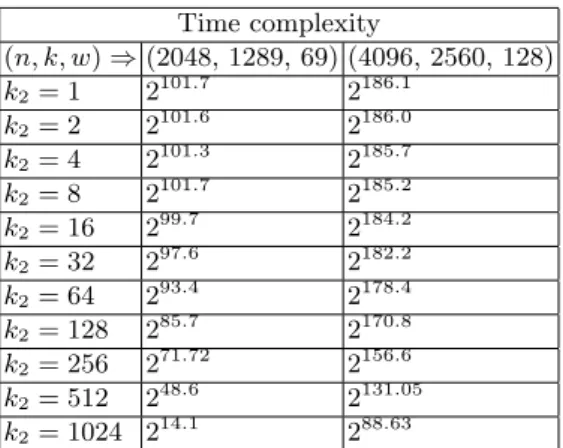
In this paper, we consider the semantically secure variant of the McEliece cryptosystem. In our scenario, the adversary knows that ciphertext is the en-cryption of eitherm0orm1. Thus, we need to consider that the adversary knows the partial information of the given ciphertext and this situation is very similar to the above attack. That is, if the adversary can recoverr, then he can distin-guish the encryptions of m0 and m1. We present the estimated lower-bound of the size of the public-key in terms of this attack in Table 5. This time complexity is estimated according to (5). Time complexity (n, k, w)⇒(2048, 1289, 69) (4096, 2560, 128) k2= 1 2101.7 2186.1 k2= 2 2101.6 2186.0 k2= 4 2101.3 2185.7 k2= 8 2101.7 2185.2 k2= 16 299.7 2184.2 k2= 32 297.6 2182.2 k2= 64 293.4 2178.4 k2= 128 285.7 2170.8 k2= 256 271.72 2156.6 k2= 512 248.6 2131.05 k2= 1024 214.1 288.63
Table 1.Time Complexity for the “low weight codeword” Attack
6
Concluding Remarks
We formally show that random padding of the plaintext makes the McEliece and Niederreiter cryptosystems IND-CPA secure. It is worth noting that both these results do not allow tight reductions. Improving them, or, in other words, providing tightness for [15] and [10] is an open problem.
Another interesting open question, in the light of [16], is whether the security of the randomized versions of the McEliece and the Niederreiter cryptosystems is equivalent or not.
Finally, one might want to extend our result in order to achieve IND-CCA2 secure version of the McEliece as well as the Niederreiter cryptosystems without employing random oracles.
References
1. M. Bellare, P. Rogaway, “Random Oracles are Practical: a Paradigm for Designing Efficient Protocols,” Proc. CCS, pp.62–73, 1993.
2. M. Bellare, P. Rogaway, “Optimal Asymmetric Encryption - How to Encrypt with RSA,” Proc. EUROCRYPT ’94, LNCS 950, pp. 92–111, 1995.
3. E.R. Berlekamp, R.J. McEliece, H.C.A van Tilborg, “On the Inherent Intractability of Certain Coding Problems,” IEEE Trans. Inf. Theory, vol. 24, pp.384–386, 1978. 4. A. Blum A. Kalai, H. Wasserman, “Noise-Tolerant Learning, the Parity Problem,
and the Statistical Query Model, J. of ACM 50(4): pp. 506–519, 2003.
5. A. Canteaut, F. Chabaud “A new algorithm for finding minimum-weight words in a linear code: application to primitive narrow-sense BCH codes of length 511,” IEEE Trans. Inf. Theory, vol. 44(1), pp.367–378, 1998.
6. P.-L. Cayrel, P. Gaborit and M. Girault, “Identity Based Identification and Signa-ture Schemes Using Correcting Codes” Proc. WCC ’07, pp. 69–78.
7. N. Courtois, M. Finiasz, N. Sendrier, “How to Achieve a McEliece-Based Digital Signature Scheme,” Proc. Asiacrypt ’01, LNCS 2248, pp.157–174, 2001.
8. R. Cramer, V. Shoup, “A Practical Public Key Cryptosystem Provably Secure against Adaptive Chosen Ciphertext Attack,” Proc. Crypto ’98, LNCS 1462, pp.13– 25, 1998.
9. T. El Gamal, “A Public Key Cryptosystem and a Signature Scheme Based on Dis-crete Logarithms,” IEEE Trans. Inf. Theory, IT-31(4), pp.469–472, 1985.
10. J-B. Fischer, J. Stern, “An Efficient Pseudo-Random Generator Provably as Secure as Syndrome Decoding,” Proc. Eurocrypt ’96, LNCS 1070, pp.245–255, 1996. 11. E. Fujisaki and T. Okamoto, “Secure Integration of Asymmetric and Symmetric
Encryption Schemes”, Proc. Crypto ’99, LNCS 1666, pp. 537–554, 1999.
12. O. Goldreich, “Foundation of Cryptography, Basic Tools,” Cambridge University Press, 2001.
13. O. Goldreich, L.A. Levin, “A Hard-Core Predicate for all One-Way Functions,” Proc. STOC ’89, pp.25–32, 1989.
14. S. Goldwasser, S. Micali, “Probabilistic Encryption,” J. Comp. Syst. Sci. 28:270– 299, 1984.
15. J. Katz, J.S. Shin, “Parallel and Concurrent Security of the HB and HB+ Proto-cols,” Cryptology ePrint Archive: Rep.No. 461, 2005.
16. Y.X. Li, R.H. Deng, X.M. Wang, “The Equivalence of McEliece’s and Niederreiter’s Public-Key Cryptosystems,” IEEE Trans. Inf. Theory, 40, pp.271–273, 1994. 17. G. Kabatiansky, E. Krouk and S. Semenov, “Error Correcting Codes and Security
for Data Networks,” Wiley, 2005.
18. K. Kobara, H. Imai, “Semantically Secure McEliece PublicKey Cryptosystems -Conversions for McEliece PKC -,” Proc. PKC ’01, LNCS 1992, pp.19–35, 2001. 19. J.S. Leon, “A probabilistic algorithm for computing minimum weights of large
error-correcting codes” IEEE Trans. on Inf. Theory, volume 34(5), pp. 1354–1359, 2001.
20. P. Loidreau and N. Sendrier, “Weak keys in the McEliece public-key cryptosystem”, IEEE Trans. on Inf. Theory, vol. 47 (3), pp. 1207 – 1211, 2001.
21. R.J. McEliece, “The Theory of Information and Coding (Vol. 3 of The Encyclopedia of Mathematics and Its Applications.), Reading, Mass., Addison-Wesley, 1977. 22. R.J. McEliece, “A Public-Key Cryptosystem Based on Algebraic Coding Theory,”
Deep Space Network Progress Rep., 1978.
23. H. Niederreiter, “Knapsack-type Cryptosystems and Algebraic Coding Theory,” Prob. of Control and Inf. Theory, vol. 15(2), pp.159–166, 1986.
24. P. Paillier, “Public-Key Cryptosystem Based on Discrete Logarithm Residues,” Proc. Eurocrypt ’99, LNCS 1592, pp.223–238, 1999
25. E. Petrank, R.M. Roth, “Is Code Equivalence Easy to Decide?,” IEEE Trans. Inf. Theory, Vol.43, pp.1602–1604, 1997.
26. D. Pointcheval, “Chosen-Ciphertext Security for any One-Way Cryptosystem”, Proc. PKC ’00, LNCS 1751, pp. 129–146, 2000.
27. N. Sendrier, “Finding the Permutation Between Equivalent Linear Codes: The Support Splitting Algorithm,” IEEE Trans. Inf. Theory, 46(4), pp.1193–1203, 2000. 28. V. Shoup, “OAEP reconsidered,” CRYPTO ’01, LNCS 2139, pp. 239–259, 2001. 29. J. Stern, “A Method for Finding Codewords of Small Weight”, Proc. Coding
The-ory and Applications, LNCS 388, pp. 106–113, Springer, 1989.
30. M. Suzuki, K. Kobara, H. Imai, “Privacy Enhanced and Light Weight RFID System without Tag Synchronization and Exhaustive Search,” IEEE SMC, Taipei, 2006.