C
C
B
B
W
W
I
I
Z
Z
A
A
R
R
D
D
A
A
L
L
E
E
R
R
T
T
S
S
Y
Y
S
S
T
T
E
E
M
M
A. DESCRIPTION
The CB Wizard alert system is an unmanned CB radio transmitter designed to automatically broadcast work zone safety messages prior to motorists entering the work zone. The messages can be pre-recorded or recorded on site, and can be transmitted every 30, 60, or 90 seconds. To avoid interfering with other CB users, the device monitors CB transmissions on the selected frequency and when it detects a lull, a safety message is broadcast.
B. OBJECTIVE
• The CB Wizard is primarily used to alert long-haul truckers of hazards, work zones, and/or unusual traffic conditions.
C. LITERATURE REVIEW SUMMARY
C.1. ADVANTAGES
• The CB Wizard alert system is an effective communication tool for disseminating up-to-the-minute work-zone related information to trucks drivers as they approach the work zone. • The CB Wizard allows drivers to receive advance warning before static signing or Portable
• The response from truck drivers is positive about using their CB radios to receive work zone information and they consider the advanced warning messages transmitted by the CB Wizard useful.
• Truck operators are typically tuned to a CB radio frequency and thus no further driver action is required to listen to the advance warning.
• CB Wizard is a non-hazardous, portable, low-cost, and easy-to-deploy and use work zone safety tool.
• The system is installed, operated, and removed without traffic disruption.
• Unlike traditional Highway Advisory Radio (HAR), the use of CB frequencies does not require a Federal Communications Commission (FCC) permit.
C.2. DISADVANTAGES
• A study from Texas reported slightly higher truck average speeds at the start of the work zone when CB Wizard was used versus when it was not used.
• CB Wizard messages that are transmitted too frequently may become obtrusive and/or annoying.
C.3. OTHER RELEVANT ISSUES & FINDINGS
• CB Wizard Systems range in price from $4,000 for handheld units to $7,000 for trailer mounted units.
• Truck drivers rely heavily on CB radios as a source of information about highway work zones.
D. DEPLOYMENT GUIDELINES
• CB Wizard should be placed 1 or 2 miles upstream from the beginning of the work zone transition area. In case of mobile operations, it should be placed in one of the vehicles in that operation.
• The CB Wizard alert system should be used in work zones where high truck traffic volumes (above 10 percent) are anticipated.
• CB Wizard should preferably be used in rural work zone projects where minimal local commercial traffic is anticipated (local commercial traffic relies on other communication options, e.g., mobile phones).
• The CB Wizard alert system may be used to warn approaching motorists about both stationary long-term or short-term work zones and mobile operations.
• CB Wizard should be used to disseminate long messages that cannot be easily conveyed by static signing or PCMS.
• CB Wizard may be used to warn approaching motorists about upcoming work zone lane closures and to increase awareness of reduced work zone speed limits.
• For long-term projects a trailer-mounted solar-assisted unit should be used. Since the CB Wizard will be typically set up on the roadside, adequate steps should be taken to ensure reliable supply of energy throughout the deployment period, as well as to secure the device from theft or vandalism.
• The topography and roadway geometry of the work zone area should be considered during set-up of the CB Wizard, as it will affect its transmission range. If possible, the CB Wizard should be placed at the crest of a vertical work zone curve.
• CB Wizard messages should be recorded away from the roadway to minimize background noise as much as possible.
• Preferably, female voices should be used due to their higher frequencies.
• CB Wizard messages should start with a brief user identification statement, for example, “This is a Maryland State Highway Administration road work alert”, followed by a clear and concise message containing all pertinent information, and a closing statement such as “thank you”, “please use caution”, etc. The message’s content greatly impacts the effectiveness of the system.
• Message length can vary, but messages may typically last 7 to 10 seconds. The maximum length of a pre-recorded message is 18 seconds.
• Motorists should hear the message twice prior entering the work zone area.
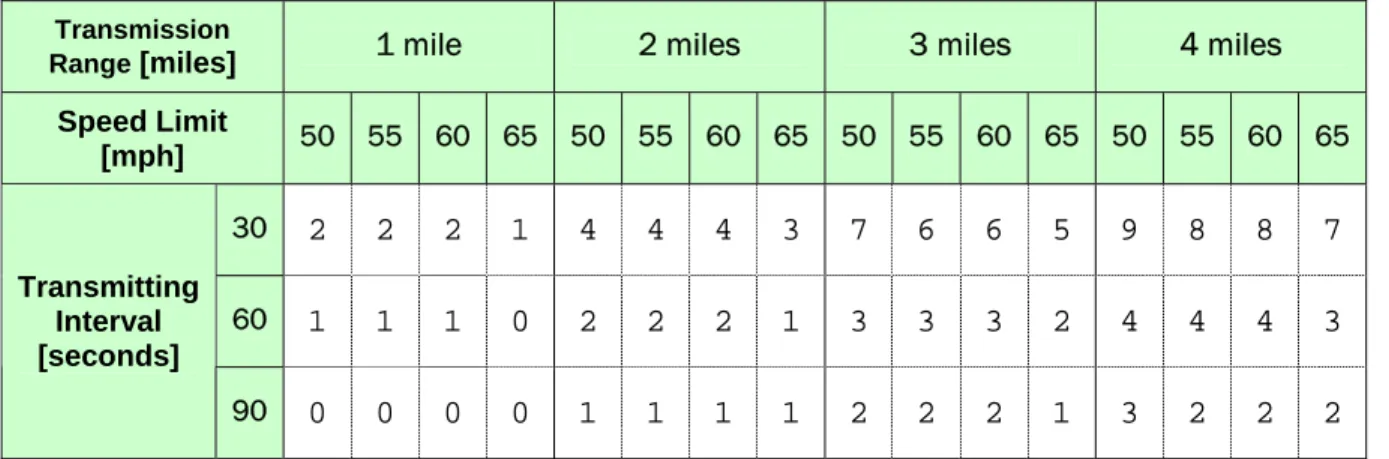
• The time interval at which the messages are to be transmitted (e.g., 30, 60, or 90 seconds) shall be dictated by prevailing work zone conditions (i.e., its effect on the transmission range), the speed limit, and the number of times the messages need to be heard (refer to Table 1 in the next page for reference values). As a general rule, the longer the interval the farther away from the work zone the device must be set.
Table 1. Number of Times a CB Wizard Message can be Heard by an Approaching Motorist before Entering the Work Zone Transition Area (*)
Transmission
Range [miles] 1 mile 2 miles 3 miles 4 miles
Speed Limit [mph] 50 55 60 65 50 55 60 65 50 55 60 65 50 55 60 65 30 2 2 2 1 4 4 4 3 7 6 6 5 9 8 8 7 60 1 1 1 0 2 2 2 1 3 3 3 2 4 4 4 3 Transmitting Interval [seconds] 90 0 0 0 0 1 1 1 1 2 2 2 1 3 2 2 2 (*)
Reference values calculated assuming the wizard is placed slightly upstream of the work zone transition area. Example: If prevailing work zone conditions allow a transmission range of 3 miles, and the work zone speed limit is 50-mph, messages should be played every 90 seconds (motorists should hear the message twice prior to entering the work zone area).
Disclaimer
The information provided in this section of the Maryland State Highway Administration’s Work Zone Safety Tool Box is only to provide guidance. The Work Zone Safety Tool Box supplements current practices and standards provided in the current edition of the following documents:
1) The Manual on Uniform Traffic Control Devices (MUTCD)
2) The Maryland Supplement to the Manual on Uniform Traffic Control Devices 3) Maryland State Highway Administration Standard Sign Book
4) Maryland State Highway Administration Book of Standards for Highway and Incidental Structures 5) Maryland Department of Transportation State Highway Administration Standard Specifications for
Construction and Materials
E. BIBLIOGRAPHY
1. G.L. Ullman, P.A. Barricklow, R. Arredondo, E.R. Rose, M.D. Fontaine (2002). Traffic Management and Enforcement Tools to Improve Work Zone Safety. Research Report 2137-3. Texas Transportation Institute,
4. Kamyab, A., Maze, T., Gent, S., and Poole, C. (2000). Mid-West States Smart Work Zone Deployment Initiative, Technology Evaluations - Year One. Wizard CB Alert System - Iowa Results. Mid-America Transportation Center, University of Nebraska-Lincoln, Lincoln, NE.
5. Federal Highway Administration (2000). Work Zone Operations Best Practices Guidebook. Publication No. FHWA-OP-00-010. Washington, D.C.
6. Griffith, A. and McGregor, L. (2002). Assessing Public Inconvenience in Highway Work Zones. Publication No. FHWA-OR-RD-02-20. Oregon Department of Transportation, Salem, OR
1 2 3 4 5 6 7 8
Arizona No - - - Michael Manthey (602) 255-8888
California No - - - Linda M. Simpson (916) 654-6072
Connecticut No - - - Terri L. Thompson (860) 594-2667
Delaware No - - - Michael S. Hitchens (302) 326-4494
Idaho No - - - Lance Z. Johnson (208) 334-8557
Illinois No - - - James Schoenherr (217) 782-3450
Kansas No - - - George Stelzmiller (701) 328-2556
Kentucky No - - - Jeffery Wolfe (502) 564-3020
Michigan Yes Very Effective - Rural Stationary Construction - No - Jeffery K. Grossklaus (517) 322-5769
Nevada No - - - Mark Mindrum (775) 888-7555
New York No - - - Charles Riedel (518) 457-2185
Ohio No - - - Mack Braxton (614) 752-8829
Rhode Island No - - - Frank Corrao (401) 222-2694
Tennessee No - - - David C. Donoho (615) 741-2414
Vermont No - - - John Perkins (802) 828-2603
Virginia Yes Very Effective - Rural All of the Above - No
Their Bristol district has been using the CB Wizard for a few years, and reported positive comments from truckers by monitoring CB conversations. They have since purchased three additional units for use statewide.
David B. Rush (804) 371-6672
Wisconsin No - - - - - - - Thomas N. Notbohm (608) 266-0982
Wyoming No - - - Mike Gostovich (307) 777-4492
8. Do you have any other comments/suggestions about the use of CB Wizard Alert System in work zones?
States Responded Answers to Questions Contact Phone
6. Has your agency written a report, conducted research or field-trials on the use of CB Wizard Alert System in work zones? (Yes/No) 7. Does your agency have an established policy /guidelines on the use of CB Wizard in work zones? If yes, please describe it.
2. What was/is the perceived effectiveness of the CB Wizard Alert System? (Extremely effective/ Very effective/Somewhat effective/Not very effective/Not at all effective) 3. Please mention any problem/disadvantage associated with the use of the CB Wizard Alert System in work zones.
4. In what type of environment has the CB Wizard been used? (Urban/Rural/Both)