(NG9-1-1)
prepared for
State of Maine Emergency Services
Communication Bureau
TABLE OF CONTENTS
1. INTRODUCTION ... 1
1.1 PROJECT PURPOSE ... 1
1.2 METHODOLOGY ... 1
2. CURRENT ENVIRONMENT ... 3
2.1 CURRENT MSAG AND GISMAINTENANCE ... 3
2.2 WIRELINE,WIRELESS AND VOIP ... 3
2.2.1 Wireline Service ... 4
2.2.2 Wireless Service ... 4
2.2.3 VoIP Service ... 6
2.3 PUBLIC SAFETY ANSWERING POINTS AND DISPATCH-ONLY SITES ... 7
2.4 CALL HANDLING PROCEDURES ... 9
3. CONCEPTUAL SYSTEM DESIGN ... 12
3.1 NG9-1-1SYSTEM OVERVIEW ... 12
3.1.1 Call Origination ... 13
3.1.2 Call Delivery and Routing ... 18
3.1.3 Answering Points ... 25
3.1.4 Dispatch Function ... 27
3.2 MAINE NG9-1-1CONCEPTUAL SYSTEM DESIGN ... 29
3.2.1 Call Origination ... 31
3.2.2 Call Delivery and Routing ... 32
3.2.3 Public Safety Answering Points ... 34
3.2.4 Dispatch Function ... 34
4. MIGRATION PLAN ... 36
4.1 MIGRATION PLAN STAGES ... 37
4.1.1 Stage I - Preparation ... 37
4.1.2 Stage II – Next Generation 9-1-1 Pilot Demonstration ... 38
4.1.3 Stage III ESInet Construction ... 38
4.1.4 Stage IV - Migration ... 39
4.2 TECHNICAL REQUIREMENTS ... 39
4.2.1 Call Origination ... 40
4.2.2 Call Delivery and Routing ... 41
4.2.3 Public Safety Answering Points ... 49
4.2.4 Dispatch Function ... 50 4.3 SECURITY... 51 4.4 RISKS ... 51 4.5 SYSTEM CONSIDERATIONS ... 52 4.5.1 State ... 52 4.5.2 PSAPs ... 57 APPENDIX A – GLOSSARY ... 60
APPENDIX B – RISK MATRIX ... 65 REFERENCES ... 69
1.
INTRODUCTION
L.R. Kimball respectfully submits this Next Generation 9-1-1 (NG9-1-1) Plan to the State of Maine (State) Emergency Services Communication Bureau (ESCB).
The ESCB is proactively looking at the future of 9-1-1 in Maine. The current contract for enhanced 9-1-1 (E9-1-1) services with Fairpoint Communications is ending. The equipment provided under that contract is nearing end of life and will require a technology refresh. This combination makes this the perfect situation for planning the next evolutionary step for 9-1-1 in Maine: NG9-1-1.
NG9-1-1 is a system-of-systems that makes use of many different services and components to receive 9-1-1 calls and data from call origination providers, and then route the calls to the proper PSAPs. NG9-1-1 systems use open standards and protocols to allow interoperability between systems and equipment.
1.1
Project Purpose
The intent of this document was to prepare a high-level migration plan for the deployment of NG9-1-1 services in a statewide system for Maine. This document is intended to aid in the delivery of ubiquitous service throughout the state. The State has successfully managed the migration to new technologies in the past, and will continue to do so into the future. The major aspect of that success has been the ESCB‘s planning and monitoring of the 9-1-1 system as new technologies have been introduced.
This document will provide an initial, high-level road map the ESCB may use moving forward. Once the selection of the NG9-1-1 service provider is completed, a detailed NG9-1-1 master plan should be developed to include detailed governance, operations and management policies and procedures.
1.2
Methodology
L.R. Kimball created this document using the following methods:
Standards – L.R. Kimball is an active participant in several standards development organizations (SDOs) and tracks progress of NG9-1-1 standards. This knowledge is used to identify options that would be appropriate for Maine.
Data Gathering – Data gathered from previous projects with the State and meetings with the
ESCB staff and stakeholders. This information allowed the recommendations in the document to reflect the needs of the ESCB and stakeholders.
Industry Experience – L.R. Kimball used the experience of working with the SDOs, Internet Protocol (IP) network and system implementations, and NG9-1-1 planning and development to provide the ESCB with this migration plan.
Assumptions – The following assumptions were made during the completion of this plan:
NG9-1-1 and customer premise equipment (CPE) procurements will be in a single procurement
The final system will be open standards-based
The basic NG9-1-1 functions are described, regardless of the location and number of public safety answering points (PSAPs)
2.
CURRENT ENVIRONMENT
In March 2008, FairPoint Communications, Inc. (FairPoint) acquired the assets and service areas from Verizon New England (Verizon). FairPoint is now both a local exchange carrier (LEC)and the E9-1-1 service provider for the state. E9-1-1 services include automatic location identification (ALI)
functionality and database management, CPE, 24/7 support and maintenance of all components and training for PSAP staff.
In Maine, 9-1-1 calls originate from three sources: wireline, wireless, or Voice over Internet Protocol (VoIP). In each case, calls route through the FairPoint Communications 9-1-1 system to the appropriate PSAP. Verizon originally designed and maintained the network for wireline (landline) E9-1-1 calls. The system was adapted in 2003 for wireless calls, with VoIP capability added in 2007.
FairPoint‘s dedicated time division multiplexing (TDM) network with analog centralized automatic message accounting (CAMA) trunks deliver 9-1-1 calls to the appropriate PSAP. FairPoint has two redundant E9-1-1 tandem offices in the state. Both tandems connect to each of the 26 PSAPs. FairPoint contracted with Intrado for call routing and call data delivery database management. Intrado uses a multi-protocol label switching (MPLS) network, which provides diverse routing from the two tandems to their two redundant database centers. Four Intrado switches provide redundant paths by using two different networks for each pair of switches.
2.1
Current MSAG and GIS Maintenance
The ESCB contracts with the Maine Office of GIS (MEGIS) to maintain both the Intrado master street address guide (MSAG) and the mapped data. This office frequently compares the tabular MSAG and the GIS road network to improve the synchronization of valid address data. MEGIS maintains the road network with address ranges based on update information from the approximately 500 organized towns in Maine and also from the 16 counties who have responsibility for the unorganized areas of Maine. MEGIS maintains polygon datasets for PSAP jurisdictions for wireline, wireless, and VoIP as well as emergency service zone (ESZ) boundaries. Additionally, emergency responder points are maintained in an informal manner. Other mapped data provided to the PSAPs are town and county boundaries, aerial photography, trails (snowmobile, ATV, hiking, and non-911 private roads), hydrants, lifeflight landing sites, common place names, boat landings, camp sites, and water bodies.
2.2
Wireline, Wireless and VoIP
In 2009, the PSAPs in Maine received 647,6911 E9-1-1 calls.
1
Call count was obtained from individual PSAPs. Municipal and county wireless call counts include many calls received and counted at the four DPS PSAPs and transferred to the municipal and county PSAPs.
9-1-1 Call Type # of 9-1-1 Calls % of Total Landline 257,913 40 % Wireless 369,778 57 % VoIP ~20,000 3 % Totals 647,691 100 %
2.2.1
Wireline Service
Wireline phones connect to the LEC‘s central office (CO), which provides connectivity to the public switched telephone network (PSTN). When a 9-1-1 call is placed, the CO automatically sends the call to one of the two 9-1-1 tandems. 9-1-1 calls made in southern Maine use the southern tandem as their primary tandem, and the northern tandem as their secondary, and vice versa for northern Maine.
Competitive local exchange carriers (CLEC) and incumbent local exchange carriers (ILEC) connect to the 9-1-1 tandems via CAMA or signaling system 72 (SS7) trunking.
When a wireline 9-1-1 call reaches the tandem or selective router, the telephone number, also called automatic number identification (ANI), directs the call to the appropriate PSAP. The PSAP receives the call (voice) and the ANI on their CPE. Upon receipt of the call, the CPE automatically queries the ALI database, maintained by Intrado, for the name and location associated with the ANI. The ALI screen displays the ANI callback number, company identification (ID), class of service, customer‘s name and address and emergency responders for that location.
Based on the location displayed on the ALI screen, MapStar automatically plots the address of the caller. According to the ESCB, approximately 1,071,000 wireline records, provided by FairPoint, the CLECs, and other ILECs, are in the ALI database. Carriers validate customer addresses with Intrado in order to activate phone service to new customers. After the address is validated, the customer name and address is added to the ALI database.
2.2.2
Wireless Service
Wireless or cell phones use radio technology for communications. Wireless service providers (WSP) have developed a network of radio towers to provide their customers with mobile communications. When a wireless call is initiated, the cell phone locks onto an open radio channel on a nearby cell tower antenna. The radio channel connects to the carrier‘s mobile switching center (MSC), which sends the call, via SS7 trunking, to one of the two 9-1-1 tandems. As a wireless user moves across a geographical area, the network hands the live call to the next available cell site antenna. As long as the WSP has radio coverage in an area, a wireless call can take place. Some rural areas of Maine have little or no cellular service, which limits wireless usage.
2
An out-of-band signaling system used to provide basic routing information, call set-up and other call termination functions. Signaling is removed from the voice channel itself and put on a separate data network. - NENA Master Glossary of 9-1-1 Terminology, p.88.
As with wireline, wireless calls from southern Maine use the southern tandem as primary and the northern tandem as the secondary, and vice versa.
Five WSPs operate in Maine: AT&T, Sprint/Nextel, T-Mobile, US Cellular and Verizon Wireless (includes Rural Cellular). Each carrier is wireless Phase II deployed, providing caller location to the PSAPs. WSPs‘ systems include MSCs, service control points (SCPs), and mobile positioning centers (MPCs).
To deliver wireless 9-1-1 calls to the correct PSAP, wireline routing technology must be used. A wireless routing database record is created for each sector of every cell tower for all WSPs.
The E9-1-1 service provider assigns a range of routing numbers, or emergency service routing keys (ESRKs) to each WSP, who in turn assigns a unique ESRK range to each PSAP in Maine. Within the wireless routing database, ESRKs identify the primary PSAP for each wireless call.
When a wireless 9-1-1 call reaches the tandem or selective router, the ESRK or pseudo ANI (pANI) routes the call to the appropriate PSAP. The PSAP receives the call (voice) and the pANI on its CPE. Upon receipt of the call, the CPE automatically queries Intrado‘s ALI database for the information needed or for steering data to athird-party database.
The MSC sends the cell tower sector and address information, the ESRK (pANI), the caller‘s telephone number and the cell tower latitude and longitude coordinates to the WSP‘s SCP. The SCP queries a third-party MPC for the caller‘s location. The MPC provider receives the location from either their equipment attached to the WSP‘s wireless network or from the cell phone‘s global positioning system (GPS) technology. The location information received is in the form of latitude and longitude coordinates and will replace the cell tower‘s latitude and longitude in the ALI record.
The WSP‘s system provides Intrado with ESRK/pANI, WSP ID, class of service, cell site address, and latitude and longitude of the cell site or caller‘s location and callback number.
The location of the caller, which is based on the MPC, may not be available until after the call has been answered by the PSAP. The key to identifying if a wireless call is providing the caller‘s location is the class of service designation in the ALI screen. If the class of service is WPH1 (Phase 1), the latitude and longitude represent the cell tower address; if the class of service is WPH2 (Phase 2), the latitude and longitude represent the approximate location of the caller. A manual re-bid of the ALI database during the call may be required.
MapStar automatically plots the latitude and longitude coordinates provided.
The legacy 9-1-1 system can only provide a limited amount of data to the PSAP CPE. The customer name and home address associated with the wireless number are not delivered with a wireless call.
2.2.3
VoIP Service
VoIP is the routing of voice conversations over the Internet or through any other IP-based network. Devices can be used anywhere as VoIP phone service utilizes the Internet for connectivity.
In May 2005, Federal Communications Commission (FCC) Order 05-1163 was adopted. This rule
required providers of interconnected VoIP services to supply 9-1-1 emergency calling capabilities to their customers as a mandatory feature of the service by November 28, 2005. "Interconnected" VoIP services allow a user to receive and make calls by connecting to the traditional telephone network.
Under FCC rules, interconnected VoIP providers must deliver all 9-1-1 calls to the local emergency call center; deliver the customer‘s callback number and ―registered location‖ information, where the
emergency call center is capable of receiving it; and inform their customers of the capabilities and limitations of their VoIP 9-1-1 service.
VoIP service providers (VSP) are allowed to satisfy this rule through a CLEC, third-party partners (VoIP E9-1-1 database providers), or any other providers that have an E9-1-1 solution.
Only VoIP subscribers with static addresses can make emergency calls using the existing 9-1-1 network. In some areas of Maine, cable companies provide VSPs with connectivity by using CLECs to deliver 9-1-1 calls to the PSAP through the wireline system. A VSP that uses dynamic routing must connect to the 9-1-1 tandems through a VoIP (third-party) database provider. In order to route these calls, VoIP database providers obtain a range of numbers called emergency service query keys (ESQK) from the LEC. VSP database providers assign specific ranges of ESQK to each PSAP. After a VoIP subscriber provides the address where the device is located, the VoIP database provider will verify the address by comparing it to postal, geographic information system (GIS), and the MSAG databases. After the address is confirmed, the appropriate ESQK range is assigned to the customer‘s ALI record. These ESQK (pANI) are used to route the call to the proper PSAP. At the time a 9-1-1 call is made, the VoIP switching center assigns a specific ESQK (pANI) from the assigned range to the call.
In Maine, most VoIP providers using VoIP database providers also plot the subscriber‘s address using a mapping solution. The resulting latitude and longitude coordinates are added to the customer‘s record maintained by third- party database providers.
Upon receipt of the call, the CPE automatically queries Intrado‘s ALI database for additional data. The VSP supplies Intrado with ESQK/pANI, VoIP service or database provider‘s company ID, class of service, customer name and address, latitude and longitude, and callback number.
MapStar automatically plots the caller‘s location using the longitude and latitude provided by the VSP. VoIP 9-1-1 service is dependent upon customer-provided addresses and address changes. If the subscriber moves or is mobile, he or she can use his or her VoIP phone if Internet access is available. If he or she
3
fails to change his or her address, a 9-1-1 call will be delivered to the PSAP designated by the last address registered with the VoIP provider. Address changes also delay 9-1-1 service because the VSP must verify and accept the new address through their database provider before a 9-1-1 call can be delivered to the correct PSAP.
2.3
Public Safety Answering Points and Dispatch-Only Sites
Of the 26 PSAPs statewide, 13 are county government-based, four are operated by the Department of Public Safety (DPS), and nine are operated by municipalities. PSAP annual call counts range from 5,100 to 157,431. The four PSAPs operated by DPS receive most of the wireless calls in the state. When necessary, wireless 9-1-1 calls are transferred to county and municipal PSAPs.
The ESCB provides the PSAPs with an interconnected statewide system, which includes the equipment and services listed below.
9-1-1 Trunking
Each PSAP has 9-1-1 trunking to FairPoint‘s two tandem offices, with two trunks for each 9-1-1 position. For example, if a PSAP has two 9-1-1 positions, then it has four trunks. The trunks are split evenly between the two tandem offices. In the above case, two trunks are from each office. All PSAP trunking is configured the same. Twenty PSAPs have between four and eight 9-1-1 trunks, while the remaining six have either 12 or 16 trunks.
CPE
CPE for all PSAPs is provided by Plant/CML. CPE delivers the 9-1-1 call and the corresponding call data to the call taker. Twenty of the smaller PSAPs, with two to five answering positions, have Vesta Pallas equipment. Six PSAPs, with 8 to 16 answering positions, have Vesta Meridian with automatic call distribution (ACD).
ALI Links
Each PSAP has ALI links back to each 9-1-1 tandem office. These links provide each PSAP with redundant access to the ALI database. During a 9-1-1 call only a limited amount of data (ANI or pANI) can be delivered with voice to the PSAP. For a wireline call, it is the customer‘s phone number. CPE uses the ANI (pANI) to query the ALI database for the location of the caller via the ALI links.
Mapping
The Orion MapStar system is provided by Plant/CML. MapStar automatically plots the location of the caller based on the ALI information received on the CPE at the PSAP. Mapping data is regularly updated by the Maine Office of GIS and pushed to the PSAPs over the managed services network.
Call Record Management System
Plant/CML MagIC is a call record management system provided at each PSAP. This system makes a record of each incoming and outgoing call through the CPE at the PSAP. MagIC
provides ESCB and PSAP staff with a variety of reports and query ability based on call data, such as PSAP and individual activity and performance levels.
Managed Services
The statewide network is a frame relay network that uses a T-1 connection as a conduit to each PSAP. The network hosts Maine‘s National Crime Information Center (NCIC) network and the 9-1-1 managed services network. The 9-1-1 managed services network, supported by Plant/CML Monitoring and Response service for FairPoint, is used for system updates, monitoring, disaster recovery and mapping updates by the Maine Office of GIS. Access is gained through a firewall at two diverse entry points.
The FairPoint Emergency Response Center (FERC) and Network Operations Center (NOC) are located in Manchester, New Hampshire. The FERC takes trouble calls from the PSAPs,
dispatches emergency service technicians, and also monitors uninterruptible power supply (UPS) alarms at each PSAP. The NOC is responsible for FairPoint‘s telecommunications network in Maine, New Hampshire and Vermont.
Should a 9-1-1 call need to be transferred between PSAPs, the transfer occurs within the 9-1-1 system. The voice and routing number (ANI or pANI) are transferred and the corresponding call data delivered via Intrado‘s ALI database. This allows the receiving PSAP to update location information for wireless calls.
Currently, there is category 5 (Cat-5) cabling at the PSAPs. End office-to-PSAP (last mile) connection is via copper. Interoffice connections are via fiber. The Central Maine Regional Communications Center (CMRCC) has fiber for the last mile.
There is no IP connectivity available at the PSAPs at this time. FairPoint is proposing two network projects: broadband for home use and a core IP transport network for 9-1-1 across all three states. According to FairPoint, the target date for completion is 2011.
In addition to the 26 PSAPs, there are 47 dispatch-only sites, according to ESCB records. Thirty-three of these sites are municipal police departments or Sheriffs‘ Offices. These agencies are on the same NCIC network that also provides managed services to the 26 PSAPs
The dispatch-only sites are not connected to the 9-1-1 system, and have no CPE or ALI links. A 9-1-1 call transferred to one of these sites arrives via the PSTN. The dispatch center receives voice and, if the center subscribes to caller ID services, caller ID. The location and nature of the emergency must be delivered verbally by the PSAP or caller.
During the 2005-2007 PSAP consolidation efforts, the number of PSAPs was reduced from 48 to 26. Originally, 18 of the 22 closed PSAPs opted to continue dispatch services for their agencies. Currently, 13 of the 18 are still dispatching.
In an effort to provide ALI data to the dispatch centers that no longer have CPE, the ESCB offered a one-time grant that provided the dispatch site with an interface between their designated PSAP‘s computer aided dispatch (CAD) system and the dispatch site‘s CAD system. If the PSAP‘s CAD was not
compatible with the dispatch site CAD, the ESCB paid to install the dispatch CAD at the PSAP. Incoming calls that need to be transferred to a dispatch center require a manual data download to the correct CAD by the call taker. Nine PSAPs and 14 dispatch-only locations received the CAD interface grant. During the 2010 Optimum PSAP Reconfiguration study, there were several complaints from dispatch focus groups regarding the speed and reliability of the CAD interface.
2.4
Call Handling Procedures
Wireline and VoIP 9-1-1 calls are handled in the same manner. However, the level of service varies from area to area due to various PSAP and dispatch configurations. The configurations and key service points are as follows:
Full service PSAP (Call taking and dispatch) No transfers
No delays
Caller‘s location plots to map software
Call data and callback number readily available
PSAP-to-PSAP transfers
Call transfer and call data delivery arrive at the receiving PSAP simultaneously Minimal delay
Re-interview streamlined because of available call data Caller‘s location plots to map software
PSAP–to-Dispatch-only with CAD interface
Dispatch receives call data and location information at the time of data transfer Minimal delay
Re-interview streamlined because of available call data
If the call is terminated or lost, dispatch will have the callback number available, if needed If dispatch center has mapping software and it is interfaced with CAD, caller‘s location will
plot to the map
PSAP-to-Dispatch with no CAD interface
PSAP needs to provide callback number and location information verbally Re-interview of the caller required
Manual CAD data entry required, to include nature and location of the emergency and callback information for the caller
If the call is terminated or lost, dispatch may have to call the PSAP for a callback number if it is not noted during the initial call transfer
Repeating information during an emergency is frustrating for the caller. The name, location, and callback number are all automatically delivered in an E9-1-1 PSAP.
Wireless 9-1-1 calls create additional transfers in the emergency communications system. The four DPS PSAPs receive the majority of the wireless calls. Lincoln County, Lewiston/Auburn 9-1-1 and Portland Police Department also receive a significant number of wireless calls. The PSAPs in Franklin, Knox, Somerset, Cumberland, and Waldo Counties and Scarborough Police Department receive wireless calls directly from US Cellular only. Sanford receives calls directly from US Cellular and Verizon Wireless. By definition, wireless callers are mobile. The coverage quality varies by location, carrier, device, and battery strength. If the connection is weak or severed before an accurate location is given by the caller or the WSP location system, the PSAP will have to reconnect with the caller, if possible.
Wireless call handling varies greatly in the current environment. The various processes are as follows:
Full service PSAP (Call taking and dispatch) No transfers
No delays
Caller‘s location plots to map software Call data and callback readily available
PSAP-to-PSAP transfers
The call transfer and call data delivery arrive at the secondary PSAP at virtually the same time
Minimum delay
Re-interview streamlined because of available call data
ALI data updates for mobile caller available to secondary PSAP Caller‘s location plots to map software
PSAP-to-Dispatch with CAD interface
Dispatch receives call data and location information at the time of data transfer Minimal delay
Re-interview streamlined because of available call data
If PSAP exits the call, dispatch center will not be able to get any location updates electronically. Verbal updates from the caller are needed
If the call is terminated or lost, dispatch will have the callback number available, if needed If dispatch center has mapping software and it is interfaced with CAD, the caller‘s location at
the time of data transfer will plot to the map
PSAP-to-Dispatch with no CAD interface
Re-interview of the caller required
Manual CAD data entry required, to include nature and location of the emergency and callback information for the caller
If caller is coherent, reliable and familiar with their location, data from the PSAP may not be needed
If PSAP exits the call, no confirmation of location information is available
If the call is terminated or lost, dispatch may need to call the PSAP for a callback number, if it is not noted during the initial call transfer
A major advantage of E9-1-1 is the ability to verify caller-provided information with the ALI data, which is a reliable independent source.
3.
CONCEPTUAL SYSTEM DESIGN
NG9-1-1 is a system-of-systems composed of one or more IP networks, protocols, applications,
databases, servers, and user devices and makes use of many different networks, services, and components. These networks, services, and components are explained to assist in understanding the conceptual system design.
3.1
NG9-1-1 System Overview
The Maine ESCB NG9-1-1 system should be developed using open standards that will allow for
interoperability with call origination systems, PSAPs, and other NG9-1-1 systems. These open standards are being developed by several SDOs. Two primary SDOs with respect to open NG9-1-1 standards are the National Emergency Number Association (NENA) and the Internet Engineering Task Force (IETF). Additionally, the National Information Exchange Model (NIEM), a partnership of the Department of Justice (DOJ) and the Department of Homeland Security (DHS), defines standard XML formats to enable critical information sharing among jurisdictions. NG9-1-1 CAD and dispatch systems are expected to be NIEM-compliant.
To facilitate interoperability, the Maine NG9-1-1 system will be based on the NENA NG9-1-1 standards that are commonly referred to as i3. These standards are built on standards from other organizations such as the IETF.
This section will describe the networks, services, and components of the NG9-1-1 system following the typical call flow.
One of the components of the NG9-1-1 system is an ―emergency services IP network,‖ or ESInet, or simply, ―the system‖. An ESInet is based on a private, secure, and highly resilient IP network that is used to carry the call and call information. Aside from special precautions that are taken to ensure this IP network‘s security, reliability, and its ability to handle ―real-time‖ traffic, the IP network is otherwise unremarkable. It is otherwise much like any other typical enterprise, regional, or state-level IP network. A second major component of the NG9-1-1 system is the various applications and devices that are needed for NG9-1-1 to operate effectively. These services or software-implemented functions provide for the delivery of ―next generation‖ calls and data to PSAPs. In an NG system, a call is any request for emergency assistance, be it a voice, text, picture, automated data, or video call. Emergency calls can originate from a variety of sources, including wireline and wireless telephones. Applications and devices of NG9-1-1 will permit the system to be changed and modified in the future. Applications can be added to perform specific functions with limited impact to the systems as new technology is introduced. The IP-based services that route, setup, disconnect, and otherwise control emergency calls through the ESInet IP network will be discussed later. However, these services all speak a common language, both to each other and to the call originating and call terminating equipment. This common language permits
standardized and interoperable communication between and among NG9-1-1 systems and between and among system elements connected to the ESInet.
In addition to the IP and IP network-related protocols, the language of the NG9-1-1 services includes three IETF protocols: Session Initiation Protocol (SIP), Real-time Transport Protocol (RTP), and the Location-to-Service Translation (LoST) protocol. It also includes the Presence Information Data Format – Location Object (PIDF-LO), which is an XML-based data format. By definition, an IP-based 9-1-1 system that does not utilize these standard protocols and formats is not an NG9-1-1 system.
3.1.1
Call Origination
Calls into the system will originate from both traditional and non-traditional sources. The ESCB must establish policies and requirements for interconnection to the system for the purpose of receiving calls from these sources. Points of interconnection (POIs) must be provided, through the ESCB‘s contracted network operator, to which communications service providers can establish connections in order to deliver emergency traffic to the system.
3.1.1.1
Direct IP Interconnection
Some service providers may be able or may choose to provide 9-1-1 calls by direct connection to the IP network, using the standard IP and NG9-1-1 formats and protocols. Direct interconnection between IP networks will also be the interconnection mode between the State NG9-1-1 system and other NG9-1-1 systems.
The ESCB must establish security and technical requirements policies appropriate to direct IP
interconnection. The interconnecting service providers or networks may also have security policies of their own pertaining to this type of interconnection.
The ESCB and/or the interconnecting entity may require the use of some type of firewall, security
appliance, or session border controller to adequately protect both the public safety IP network and the call originating network from accidental damage or malicious attack. These devices or functions may also be of assistance resolving differences in IP addressing schemes or dial plans between the two parties. The required interconnection device(s) are in the interest of both the ESCB and the interconnecting party. A particular interconnection device will almost certainly be owned, operated, and located on the side of the demarcation point by the party that requires the use of the device or function.
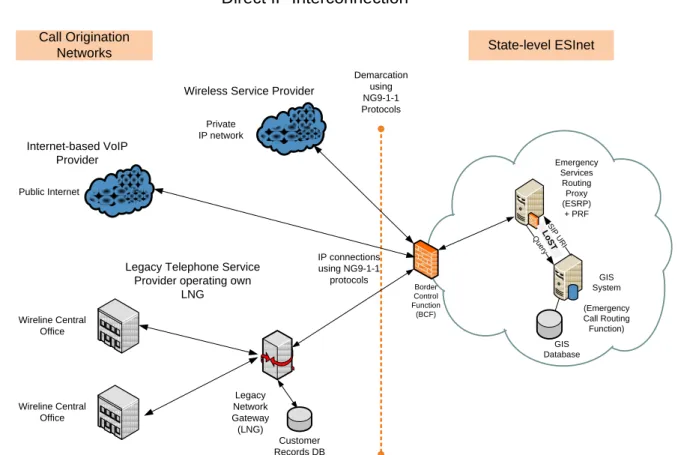
The following drawing illustrates direct IP interconnection between several possible types of call origination networks and the ESInet.
Wireless Service Provider Private IP network Legacy Network Gateway (LNG) Emergency Services Routing Proxy (ESRP) + PRF GIS System (Emergency Call Routing Function) Lo S T GIS Database Call Origination
Networks State-level ESInet
IP connections using NG9-1-1 protocols Customer Records DB Wireline Central Office Wireline Central Office S IP UR I Q uery Demarcation using NG9-1-1 Protocols Direct IP Interconnection Border Control Function (BCF) Internet-based VoIP Provider Public Internet
Legacy Telephone Service Provider operating own
LNG
Figure 1 – Direct IP Interconnection
3.1.1.2
Legacy Networks
In order to connect calls from traditional PSTN 9-1-1 trunks to the NG9-1-1 system, a device called a legacy network gateway (LNG) is used. The LNG is itself composed of two principle elements: the gateway device and the ALI-to-PIDF-LO conversion software.
The LNG device connects directly to the traditional trunks and to the IP network. The gateway device converts the legacy call signaling and media from the traditional trunk into the standard SIP and RTP protocols used in NG9-1-1.
The LNG also contains a software element that receives the SIP message from the LNG gateway device. This software performs a traditional ALI query using the ANI arriving with the call and contained within the SIP message. The software encodes the ALI response into the PIDF-LO and then encapsulates this information into a SIP message, thereby implementing SIP location conveyance. At this point, the incoming call appears to be a fully standard NG9-1-1 protocol call. The LNG then forwards the NG9-1-1 call to the ESInet‘s NG9-1-1 services for further call processing.
The functions do not have to be performed in a single device. The implementation of the LNG may physically and geographically separate the IP conversion element from the LNG ALI-to-PIDF-LO conversion element. The ALI-to-PIDF-LO software may run as a process on a server somewhere on the network. These elements would then use the IP network itself to communicate with each other.
Since the software element of the LNG performs an ALI query, each instance of this element must have connection(s) to the appropriate legacy ALI databases.
Some LNG implementations may be able to consolidate such queries back through the IP network to concentration points, thereby avoiding the need for multiple ALI connections to any specific ALI database beyond those required to achieve high reliability.
Of course, the LNG must implement defaults in case it does not obtain a timely ALI response for some reason. The default is typically a default ―location,‖ ideally selected by the incoming trunk. This allows a call without location data to be default-routed similarly as in a legacy network.
3.1.1.3
Legacy Network Interconnection Options
Consideration must be given to the location of POIs between the traditional 9-1-1 network and the LNG device elements. Location refers not only to the geographic location of a POI, but also at what point in the call handling process the handoff from the legacy network to the LNG occurs.
3.1.1.3.1
Interconnecting with Legacy 9-1-1 Tandems
The LNG can connect to trunks originating from the existing 9-1-1 tandems/selective routers. This arrangement leaves the legacy wireline and wireless 9-1-1 network largely in place, and available to use as a fallback and/or as a fail-over network. This approach is relatively simple to implement and will require the fewest number of interconnections at a minimum number of locations.
By connecting the LNG device to the outgoing (PSAP) side of an existing 9-1-1 tandem, the other telephone companies and wireless carriers connected to the input side of that same 9-1-1 tandem do not have to do anything. The legacy 9-1-1 tandem can consolidate all the trunks from the individual
exchanges and carriers into smaller number of ―shared‖ trunks. This choice of POI reduces the number of LNG device ports and perhaps the number of LNG devices required.
In this interconnection arrangement, the ESInet appears to the incumbent LECs to be simply a large ―consolidated‖ PSAP. Therefore, incumbent LECs will have less controversy with this arrangement than with other interconnection arrangements.
Transfers among and between PSAPs that remain connected to the 9-1-1 tandem are not impacted. A downside of connecting LNGs to a legacy 9-1-1 tandem is that there is little or no cost savings realized from the operation of the traditional 9-1-1 network. The traditional 9-1-1 network continues to operate pretty much unchanged. Allowing WSPs and other non-LEC carriers to connect to an LNG also provides little incentive for these operators to move to a direct ESInet interconnection.
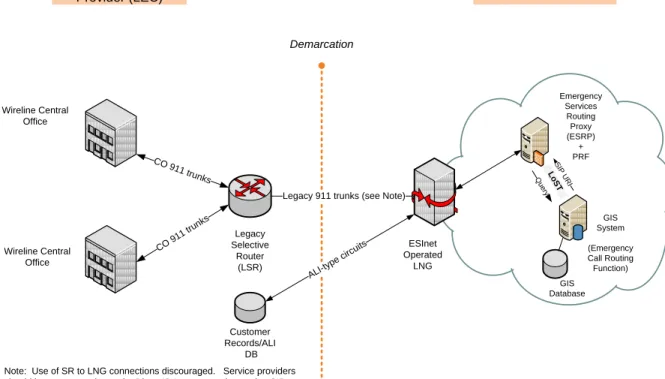
Because of the speed, simplicity, and safety of this type of interconnection arrangement, it may be considered for the purpose of getting the ESInet rapidly into production status, but this type of interconnection arrangement should be viewed as temporary. The following drawing shows interconnection of the ESInet with a legacy selective router using an LNG:
Emergency Services Routing Proxy (ESRP) + PRF GIS System (Emergency Call Routing Function) L oS T GIS Database ESInet Operated LNG Legacy Service
Provider (LEC) State ESInet
ALI-ty pe ci rcuits Customer Records/ALI DB Wireline Central Office Wireline Central Office CO 911 tru nks S IP UR I Q ue ry
Legacy Selective Router Interconnection
Legacy 911 trunks (see Note)
Legacy Selective
Router (LSR)
Demarcation
Note: Use of SR to LNG connections discouraged. Service providers should be encouraged to make Direct IP Interconnections using SIP location conveyance.
CO 91 1 trunk
s
Figure 2 – Legacy Selective Router Interconnection
3.1.1.3.2
Interconnecting via Legacy Exchange Trunks
An alternate interconnection strategy is to connect individual telephone exchanges or host CO switches directly to an LNG element, ahead of and bypassing the traditional 9-1-1 tandem.
This type of legacy 9-1-1 trunk connection approach saves the costs associated with using the 9-1-1 tandem for emergency traffic originating from such LNG-connected exchanges or host switches.
Depending on geographic LNG device location(s), such direct connections may or may not reduce trunk costs overall. The cost of bringing the legacy trunks to the LNG device site should be compared to the cost of connecting the LNG device(s) to the public safety IP network from the LNG device site.
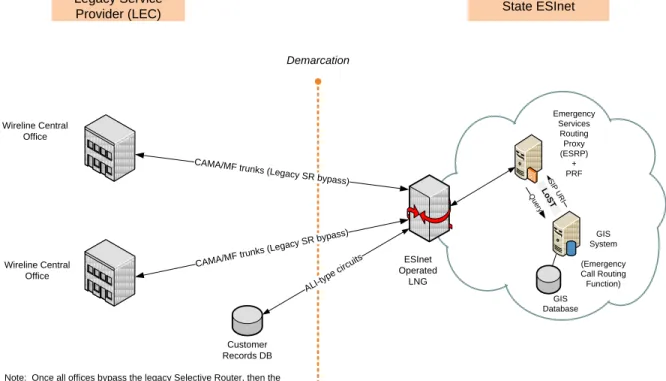
The following drawing depicts legacy exchanges bypassing the selective router. This is possible because the location-based routing function of the ESInet will provide the routing function previously provided by the selective router.
Legacy Service
Provider (LEC) State ESInet
ALI-ty pe ci rcuits Customer Records DB Wireline Central Office Wireline Central Office
Selective Router Bypass using LNG
Demarcation
CAMA/MF trunk
s (Legacy SR bypass)
Note: Once all offices bypass the legacy Selective Router, then the legacy SR can be eliminated. Service providers should be encouraged to make Direct IP Interconnections using SIP location conveyance, e.g. operate their own LNGs as required.
Emergency Services Routing Proxy (ESRP) + PRF GIS System (Emergency Call Routing Function) L oS T GIS Database ESInet Operated LNG S IP UR I Qu ery CAMA/MF trunks
(Legacy SR byp ass)
Figure 3 – Selective Router Bypass
Generally speaking, it will be less expensive to locate the LNG device element close to the source of the traditional trunks, perhaps even co-locating them in the originating CO if possible, in order to reduce the distance required for the traditional trunk circuits. As an alternative to co-location, the LNG device might be located at the geographically nearest site that is connected to the public safety IP network.
The greater the number of legacy 9-1-1 trunks that originate from the host, the greater the cost advantage of getting the LNG device geographically close to the host office. However, the actual location of the LNG device element is largely an economic consideration, and other considerations, such as LEC cooperation and accessibility to the gateway element by the LNG operator may also guide this design choice.
If the legacy network uses CAMA/multi-frequency (MF) trunks between the exchange/host switch and the 9-1-1 tandem, bypassing the 9-1-1 tandem will also improve call setup time, as one less ANI spill is
required. ANI signaling on CAMA/MF type trunks normally requires about three to four seconds per ANI spill with current equipment.
Direct legacy connections may increase the total cost of the LNG itself, as more LNG ports will be required to terminate the many directly-connected exchanges. In this scenario, the legacy 9-1-1 tandem is no longer consolidating trunks for the ESInet.
Ultimately, if the traditional 9-1-1 tandem is to be fully eliminated, all carriers (including wireless carriers) that are presently connected to that tandem will need to make new interconnections to the ESInet. Accomplishing these new interconnections for many companies requires a significant investment of time, effort, and resources. Allowing WSPs and other non-LEC carriers to remain connected through the legacy 9-1-1 tandem also provides little incentive for these operators to move to a direct ESInet interconnection.
The willingness of upstream companies to bypass the legacy 9-1-1 tandem will be driven in part by the business relationship and costs between the upstream carrier and the 9-1-1 tandem operator. If the legacy connection involves considerable cost to the upstream carrier, then those carriers may be incented to move quickly to a direct interconnection to the ESInet. If, however, the existing connection is at low cost to the originating carrier, and the companies enjoy a pleasant working relationship, then convincing an upstream carrier to move from the legacy tandem to the ESInet may be problematic, short of a statutory requirement to do so, or other outside influence or pressure.
Total elimination of the legacy 9-1-1 tandem typically results in a network that is more robust and resilient, as the tandem itself (and the tandem site) are centralized points in the network, and become significant points-of-failure. If the LNG device elements are deployed at multiple sites, redundantly and diversely, then the resulting overall network will be more distributed, and therefore more resilient and survivable, than the legacy network.
3.1.2
Call Delivery and Routing
The NG9-1-1 services provide the call delivery and routing functions in the ESInet. These services are basically application-layer computer programs (software) that run on servers attached to the public safety IP network. Due to the high-availability requirements of public safety, these programs are normally duplicated, triplicated, or more, on servers located at geographically separated locations.
The system must be designed to provide automatic fail-over to other instances of the program in the event of a failure of a particular process, server, or node on the network. Several different schemes can be used to obtain availability among multiple program instances. Regardless of how it is achieved, high-availability is a requirement for all critical NG9-1-1 services.
The principle protocol used by NG9-1-1 services is SIP. SIP provides all call signaling and control functions in the ESInet, including the transportation of location, status, call type, or other relevant data. SIP negotiates and accomplishes the media stream setup between the endpoints in the IP network. SIP itself does not encompass the media stream.
The media streams set up by SIP use RTP. RTP is a stream of IP data packets that carry actual voice, video, or text messages. These messages are coded using a standard coding scheme that is compatible with both endpoints of the conversation.
Using SIP, the endpoints negotiate with each other to find and select a mutually compatible encoding scheme, according to the preferences of the endpoints. For example, a PSAP may be able to
accommodate both voice connections, and prefer video to voice. If a call origination point contacts this PSAP, and the origination is capable of a compatible video encoding, then a video call will be set up. But if the origination point is capable of voice only or uses an incompatible video encoding, then a voice-only call is set up. This negotiation happens automatically. The endpoints use SIP to communicate with each other to perform this negotiation.
When a new encoding scheme is invented, no changes are required to the SIP protocol to utilize the new encoding scheme. A unique identifier is assigned to the new coding scheme, and then SIP can set up a connection between any two endpoints that both implement the new scheme. This separation of media from signaling is one of features of NG9-1-1 that makes the system flexible and adaptable to new communications technologies as they emerge in the future.
PIDF-LO is an XML-based data format that provides a standard way of transmitting location information over an IP network. The PIDF-LO can accommodate both ―civic‖ (street address) locations and ―geo‖ (geographical coordinate) locations such as latitude and longitude. The PIDF-LO accommodates civic addresses from countries from around the globe, as well as U.S. addresses. It is fully compatible with NENA-2 ALI data, and may include optional fields, such as the NENA ID and contact information that is used to identify the ALI database provider. Like all XML documents, the PIDF-LO can be extended without disrupting existing application software.
In NG9-1-1 call setup, the PIDF-LO is encapsulated into the SIP protocol messages, providing what is called SIP location conveyance. SIP location conveyance attaches location information (in the legacy 9-1-1 system, the ALI data) to the SIP messages that set up an NG9-1-1 call. In NG9-1-1, there is no ALI network separate from the voice network. All NG9-1-1 communications requirements are provided by the single public safety IP network infrastructure.
SIP location conveyance is a principle characteristic of NG9-1-1 services.
NG9-1-1 services use the LoST protocol to communicate with GIS. The GIS system is given, via LoST, both a requested type of service and a location. The GIS system responds, via LoST, with a list of one or more providers of the requested type of service appropriate to the given location.
The ESInet uses the LoST protocol to identify a PSAP appropriate to the caller‘s location. This requires a GIS database containing the jurisdictional boundaries of the PSAPs. The jurisdictional boundaries in the GIS should not have empty geographical ―gaps‖ between jurisdictions, so that the system is always able to return at least one PSAP name for any location. In the NG9-1-1 system, the PSAP name that is returned is the SIP universal resource identifier (URI) of the PSAP, that is, the PSAP‘s emergency
―telephone‖ number as expressed in SIP. In this way, the GIS, using the LoST protocol, provides a means of routing emergency calls based on the location of the caller.
It is worth noting that uses of the LoST protocol are not unique to emergency services. LoST could also be used to obtain contact, location, Web site addresses, or other data for nearby gas stations, hospitals, libraries, hotels, pizza parlors, or any other such ―service types‖ for a given location, if such information is contained within the GIS database. The LoST protocol also uses the PIDF-LO data format to convey location data.
None of the IETF protocols listed are unique to public safety. SIP and RTP are already widely used on the public Internet as well as on private IP networks. The PIDF and PIDF-LO formats are being used today for determining the ―presence‖ or status of persons or objects remotely located across IP networks, and their locations.
Only the LoST protocol was originally invented to satisfy the need for location-based call routing in the public safety network. However, the inventors of LoST have realized that LoST has broad applicability. There is a hope and expectation that LoST will also become widely used outside of public safety in the near future. If such uses of LoST become common, then public safety should benefit from the enhanced features and reduced cost of GIS software that implements LoST as these GIS systems are developed for markets other than just for public safety.
Just as the public safety IP network is built from commercial off-the-shelf (COTS) components and parts, the NG9-1-1 services use standard protocols and data formats, promoting standardized and interoperable systems and services.
3.1.2.1
ESInet
The IP network is constructed using readily available COTS parts and telecommunications services, which helps control its cost. However, the security, real-time, and reliability requirements of the public safety IP network make it somewhat more expensive than its generic cousins. Public safety IP networks are typically about twice as expensive as a generic IP network of similar size and capabilities.
The high-availability requirements of public safety also require that the IP network be continuously monitored for the proper operation of all of its components. Little benefit is achieved if a highly-reliable and redundant network is implemented only to have the failure of a redundant component go unnoticed. Provided the redundancy works correctly, a single failure should have little or no noticeable operational impact. However, the reliability of the network would be compromised as a result of the failure. Therefore, monitoring is required to detect failures, and to promptly restore fully redundant operation. This level of monitoring incurs a cost that goes beyond the cost of monitoring a more generic IP network. The public safety IP network provides the infrastructure to carry NG emergency traffic, including
traditional 9-1-1 telephone calls, from call origination points to PSAPs. Given care and due consideration for the special requirements of public safety, the IP network component of the ESInet can also be used for other public safety-related applications. Examples of such uses are NCIC terminal connections; radio
system interconnections, state-wide emergency management uses, and GIS update distributions. These uses may result in a reduction of the ―per-use‖ cost of the IP network component of the ESInet. The cost of the IP network may be shared across each use.
3.1.2.2
Border Control Function
A border control function (BCF) provides for security and call control for calls entering the ESInet from external IP networks.
BCF will consist of several components. It will include carrier-grade IP routers to accept connections from other IP networks. The routers (and/or additional equipment) will provide firewall functions and other security for protection. A back-to-back user agent (B2BUA), a function available on some IP routers, allows for isolation of IP address space and routing between the connecting network and the Maine ESInet. This occurs by terminating SIP calls from the originating network on one side of the B2BUA, and then re-originating the SIP call on the Maine ESInet on the other side of the B2BUA. The B2BUA may also terminate and re-initiate the RTP streams. The B2BUA interconnects the two sides via internal signaling and media paths that do not pass IP traffic. Then only explicitly allowed IP
communications between the two networks can occur, in compliance with the NENA IP-Security (IP-SEC) recommendations.
As BCF must be a high-availability function, it will be replicated among multiple routers or devices distributed across the IP network. The economic balance between the number of BCF devices that are implemented and the amount of backhauling of connections must be determined after specific solutions have been proposed.
3.1.2.3
Emergency Call Routing Function
A SIP call controller, called a SIP proxy, provides some functions similar to a legacy telephone switch. In the legacy wireline telephone world, the telephone instrument itself is designed to be a comparatively simple device, and all of the intelligence of the telephone system is in the CO switch. This design was driven by the economics of providing large numbers of cheap telephone instruments to subscribers while using only a few expensive switches.
In the IP-networking world, typified by the public Internet itself, modern technology has made the ―intelligence‖ of the computer chip very inexpensive compared to cost of the wires and fiber that
comprise the network. The edge devices of the IP network, which are always some type of computer, are very ―smart,‖ while the core IP network, which simply routes and delivers IP packets from point to point, is comparatively simple.
This fundamental decentralization of intelligence and complexity in IP networks compared to legacy telephone networks underlies the current revolution in communications systems and methods. The design of the SIP protocol also reflects this fundamental change. The endpoints of a SIP communications system are called user agents (UA). UAs are roughly analogous to the telephone instrument. But UAs are computer programs that are very intelligent. SIP UAs are present in SIP
present in gateway devices, in routers, in ―soft‖ (software) phones running on computers, in Internet-capable mobile phone applications and much more.
In the end, a SIP UA ―talks‖ to another SIP UA: telephone-to-telephone, gateway-to-telephone, softphone-to-telephone, or in any other combination.
It is possible for SIP UAs to ―talk‖ directly to other SIP UAs over an IP network with no intervening SIP proxy, if they know or are programmed with each other‘s IP address. However, UAs must be able to locate other UAs in some systematic way. Part of the purpose of the SIP proxy is to assist call-originating UAs in locating the desired or appropriate destination UA.
In the legacy telephone network, telephones are connected to other telephones by the telephone switch. The dialed digits define the target of the connection, and the telephone switch and network set up a path from the call originating telephone to the destination telephone. SIP proxies provide a similar function in the IP network.
Rather than telephone numbers, individual SIP UAs are identified by SIP URIs. SIP URIs can be name-based, as in: sip:[email protected]. SIP UAs are often set up with numbers in the URIs in order to ease interoperability with the PSTN and for the familiarity of the users, for example:
sip:[email protected].
UAs can move around, disconnecting from the network here, and then reconnecting to the same or different network over there, even while the SIP URI for the UA remains unchanged. By using a UA registration process, SIP proxies may maintain a list of which SIP UAs are online, or registered, at any given moment, and record the IP address where each registered UA can be reached.
SIP proxies play a role similar to domain name service (DNS) in the public Internet. SIP proxies act as a ―directory service‖ or clearing house for SIP UAs. The SIP proxy uses registration lists and dial plans to locate other UAs on behalf of a UA, or to forward requests to other SIP proxies, in order to reach a final destination.
SIP proxies can also perform other services, such as call forwarding, busy, ring-no-answer, or
disconnected destination calls to other UAs according to some predefined rule(s). SIP proxies can also perform call detail recording of calls traversing the proxy.
For NG9-1-1 services, a SIP proxy is needed that has a 9-1-1 specific feature. The key feature a NG9-1-1 SIP proxy must implement is special call handling if the called number is sip:911 or
urn:service:sos.
NG9-1-1 calls include the location information encapsulated in the SIP call setup message in the PIDF-LO. The 9-1-1 SIP proxy will then use the PIDF-LO to make a query to a GIS server, using the LoST protocol. The GIS server returns a reply containing the SIP URI of the PSAP that has jurisdiction at the caller‘s location. The proxy then forwards the call to the proper PSAP‘s URI, either directly or through
another proxy, complete with the location data still encapsulated. In this way, the NG9-1-1 SIP proxy, together with the GIS server, performs location-based 9-1-1 routing.
A 9-1-1 SIP proxy must implement standard call forwarding functions, such as busy, ring-no-answer, or destination no-response. The 9-1-1 SIP proxy must also implement some sort of default scheme, in the event the GIS server does not respond to its LoST query in a timely fashion, or it receives a call to 911 that is missing or has faulty location information.
In NENA terminology, a SIP proxy exhibiting the required 9-1-1 features is called an emergency services routing proxy, or ESRP. The basic call forwarding functions, such as busy and ring-no-answer are part of the policy routing function (PRF) and are usually a sub-function within the ESRP itself.
3.1.2.4
Policy Routing Function
NG9-1-1 envisions the possibility of a much more sophisticated PRF system that routes calls based on other information in the SIP call setup messages, and/or based on information external to the call, such as information obtained from the IP network monitoring system.
For example, in the SIP message there is an optional ―Language‖ parameter (called a ―header‖ in SIP) that some SIP telephones will set according to the choice of language for the telephone‘s menus. So, if the telephone user has selected Spanish menus rather than English menus on the telephone, the SIP header will say: Language: Spanish. A sophisticated PRF could use this information to route the call to Spanish-speaking call takers, rather than to any call taker.
3.1.2.5
Public Safety Geographic Information Systems
The second foundational NG9-1-1 service is a GIS system that can respond to LoST queries. In order to accomplish this, the GIS system must include a GIS database with a map layer that defines the
geographical jurisdictional boundaries of each PSAP. The boundaries should be without gaps in the geographical area, and probably without overlaps in PSAP jurisdictions.
One or more SIP URIs is associated with each PSAP service area. The GIS server looks up the location contained in the PIDF-LO, which is part of the LoST query, and returns the associated SIP URI to the SIP proxy or other requestor. The SIP proxy can then use the URI as the SIP dial string and so direct the call from the originating UA to the correct PSAP or PSAP UA, based on the caller‘s location.
The LoST query includes a service request type. For 9-1-1, the service request type is designated as ―emergency‖, and the GIS system associates the emergency service request type with the map layer containing the PSAP jurisdictional boundaries. But it is possible to implement other service types. For example, police refers to a GIS layer that shows the boundaries of the police agencies, and fire the boundaries for fire department coverage areas. In this way, the PSAP can use the NG9-1-1 GIS system to determine the appropriate responder for the caller‘s location, and/or to effect ―selective transfer,‖ as in one-button police, one button fire, or one button ambulance call transfers based on the caller‘s location. In general, the GIS system can support additional GIS ―layers‖ that provide additional information valuable to call takers, dispatchers, and emergency responders. For example, layers depicting the service
boundaries of electric utility companies, railroad dispatch centers, and locations/contact information for special service providers, such as wrecker services, crane services, and bulldozer services, may be very useful to public safety operators and responders. This information, appropriate to a caller‘s location, can then be readily accessed by the PSAPs and other entities connected to the public safety IP network via the LoST protocol.
Clearly, NG9-1-1 is map-centric. The major administrative NG9-1-1 task is the maintenance of the GIS database. This task largely replaces the MSAG and ALI maintenance tasks of the legacy 9-1-1 systems. Modern GIS implementations should considerably ease some of the maintenance tasks of the legacy MSAG and ALI systems. For one example: the MSAG is a table-driven list of civic address ranges and associated emergency service numbers, or ESNs. To move the jurisdictional boundary, say, of an ambulance service requires identifying all the effected address ranges, and updating dozens, even hundreds, of records in the MSAG, followed by a reprocessing of many ALI records dependent on those MSAG entries. Performing the same task on a GIS system with a graphical user interface (GUI) requires accessing the appropriate GIS layer, then doing a drag and drop of the ambulance service boundary on the map, then saving the updated boundary.
The GIS system must be able to reliably convert civil (street) addresses to coordinate (latitude/longitude) locations, in order to correctly plot or map the location of the caller. The process is called geocoding. The NG9-1-1 GIS system must be tested against the traditional ALI database to verify high accuracy geocoding of the addresses in the ALI records. The ability to geocode a street addresse is the key to NG9-1-1 call routing.
3.1.2.6
Location Verification Function
Geocoding is critical to the successful location and routing of wireline and fixed communication services, such as VoIP (e.g. Vonage-like services), that specify location with civic addresses. However, geocoding can fail if the civic address does not actually exist, such as a non-existent street name.
Geocoding does not apply and is not required for wireless and mobile communications devices and/or networks that determine location dynamically and report location using geographic coordinates. The accuracy of the reported geographic location may be an issue; however, these locations are determined outside of the ESInet. The role of the ESInet is simply to communicate the reported location to the PSAP and to the call taker. It is always possible to plot a reported latitude/longitude on a map and to route the call accordingly, even if the latitude/longitude is not an accurate location for the caller, and so the call is routed to the wrong PSAP. In any event, no geocoding is required, so the geocoding process cannot fail. In the legacy 9-1-1 world, the MSAG provided pre-validation of civic telephone service addresses, permitting many errors to be corrected before a 9-1-1 call is actually placed. The location verification function (LVF) provides a similar and equivalent validation function in the NG9-1-1 network.
The LVF also uses the LoST protocol and queries the GIS system. Rather than requesting the URI(s) of the service type, the query is for location validation. The validation function returns a message indicating if the specified civic address can be successfully geocoded. The return message indicates which elements
in the civic address matched elements in the GIS database, which elements in the civic address failed to match the GIS system, and, in some cases, which elements were not verified, probably due to the failure to match other elements. For example, it makes no sense to validate the house number if the street name does not match anything in the database.
It is expected that service providers, end users, PSAPs, and any other interested parties will use the LVF to verify civic addresses, hopefully at the time a communications device is initially configured, installed, or powered up. For example, if an independent telephone company chooses to implement their own LNG using their own customer records for the LNG‘s ALI database, then that company could use the LVF to verify the validity of the civic addresses in their customer database at any time, but especially when a new address is added to the database, as when a customer orders service. Another example would be a
customer of a VoIP service that self-provisions their own phone. The provisioning process could include a check of the civic address, perhaps even geocoding the address and plotting it on a map for the customer to verify that the location is indeed correct.
The LVF may, in fact, be built on the same GIS that responds to production LoST queries for routing purposes. However, due to security and high-availability, it is likely that at least one LVF will operate on a copy of the GIS database as a separate instance. This LVF may also be provisioned and available outside the private public safety IP network, such as at a www.Maine.gov Web site, so that it is readily accessible by the general public. Such an outside instance would not also be connected to the public safety IP network due to security considerations. Inside LVF queries may simply use the NG9-1-1 GIS / LoST system.
Since the LVF is not normally invoked at the time a 9-1-1 call is placed, the LVF may not be implemented with high-availability, as with foundational NG9-1-1 services. Never-the-less,
implementing and using the services of an LVF is important to the reliable routing and operation of civic addresses in the ESInet.
3.1.3
Answering Points
The NG9-1-1 PSAP of the future, which no longer has to operate in the legacy 9-1-1 world, can use a SIP-based COTS telephone system, rather than a purpose-built 9-1-1emergency telephone system (ETS), as is common today.
Any SIP-based telephone system that fully complies with SIP standards and that satisfies the high-availability requirements of a PSAP is potentially suitable for PSAP use. This is because any standards-based SIP telephone system will pass the PIDF-LO location data (or a location URI) through the telephone system to the answering UA. The rules of SIP insure this, even if the telephone system is unaware of the purpose or content of the PIDF-LO, or of any other attachment to a SIP message. The SIP standards and high-availability requirements may also be found in many enterprise and
institutional telephone systems. Examples of these include agencies that manage the marine patrol, coast guard, forest rangers, and game wardens. Many SIP telephone systems potentially suitable for the PSAP
are available today, and this number is sure to grow. The use of COTS equipment and systems has the potential to expand the vendor base and the support base for the NG9-1-1 PSAP telephone system. The 9-1-1 specific aspect of the NG9-1-1 telephone system is in the SIP UA that runs at each emergency answering position. In addition to performing the standard and typical telephone functions, these SIP UAs must also be able to handle the SIP messages that implement SIP location conveyance.
The NG9-1-1 SIP UA, or associated call taker software, must provide these functions:
Display the location data to the call taker
Deliver the location data to typical public safety applications, such as CAD or mapping systems
Query a NG9-1-1 GIS system via the LoST protocol to retrieve emergency service provider (police, fire, ambulance) information appropriate to the caller‘s location
Provide ―selective transfer‖ of a call to the appropriate responding agency
Provide instant recall recording (IRR)
Provide call logging / call detail recording (CDR)
Perform other traditional and NG9-1-1 tasks
It is noteworthy that in NG9-1-1 all of these functions, many of which are performed by the legacy ETS and/or the ANI/ALI controller, may now be performed by the answering position software running on a typical desktop or notebook computer. The answering position computer is connected to the SIP telephone system using only an IP network connection.
This simple method of interconnecting the answering position also opens opportunities to easily and inexpensively implement backup PSAPs at alternate sites, or to implement ―virtual‖ PSAPs, where the call takers are geographically dispersed.
In some instances the answering position software may report data to a centralized server over the local PSAP‘s IP network. For example, the NG9-1-1 answering position software may send CDR data to a centralized PSAP logging system. As another example, the NG9-1-1 answering position software may send the location data to a CAD server that is connected to the local network. These communications will themselves occur over the answering position‘s IP connection.
The answering positions can use COTS hardware, with the possible exception of small audio boxes needed to interconnect the answering position with legacy radio consoles, headsets, or similar such interfaces. All the NG9-1-1 specific functions are embedded in the software.
The actual selection of a PSAP‘s SIP telephone system will be guided by many factors. A prime
consideration will be the support and interoperability requirements imposed by the vendor of the NG9-1-1 answering position software.
Some vendors may see value in supplying a product that interoperates with ―generic‖ SIP telephone systems. The ability to use generic telephone systems should both broaden the appeal of the product and