R E S E A R C H
Open Access
Adaptive coding and modulation using
imperfect CSI in cognitive BIC-OFDM systems
Jeroen Van Hecke
1*, Paolo Del Fiorentino
2, Riccardo Andreotti
2, Vincenzo Lottici
2, Filippo Giannetti
2,
Luc Vandendorpe
3and Marc Moeneclaey
1Abstract
This work investigates adaptive coding and modulation (ACM) algorithms under the realistic assumption that the available channel state information (CSI) at the transmitter is imperfect due to estimation errors and/or feedback delays. First, we introduce an optimal performance metric for the secondary user (SU) bit-interleaved coded orthogonal frequency division multiplexing (BIC-OFDM) system, called the expected goodput (EGP). By using an accurate modeling approximation, we succeed in deriving a tractable and very accurate approximation for the EGP. This approximate EGP (AEGP) is then used for the derivation of several ACM algorithms which optimize the code rate and bit and energy allocation under a constraint on the interference caused to the PU network. In the numerical results, we show that the AEGP is far more accurate than previous attempts to model the GP in the presence of imperfect CSI. Further, we verify that, in spite of the imperfect nature of the available CSI, the derived ACM algorithms significantly increase the goodput of the SU network, compared to a non-adaptive selection of the transmission parameters.
Keywords: Effective SNR mapping (ESM), Orthogonal frequency division multiplexing (OFDM), Adaptive coding and modulation (ACM), Imperfect channel state information, Goodput
1 Introduction
To meet the demand of high data rates and the increas-ing amount of traffic, the current and next generation of wireless networks need spectrally efficient solutions such as multicarrier orthogonal frequency division mul-tiplexing (OFDM) transmission, efficient channel coding techniques in the form of bit interleaved coded modu-lation (BICM) [1], and adaptive coding and modumodu-lation (ACM) [2]. To further increase the spectral efficiency, the idea of cognitive radio (CR) [3, 4] has been proposed. This technique allows unlicensed or secondary users (SUs) to transmit over sections of spectrum owned by licensed or primary users (PUs), on the condition that the former do not harm the quality of service (QoS) of the latter.
If channel state information (CSI) is available at the transmitter, ACM can significantly improve the perfor-mance of the network by adapting the transmission parameters, such as energy and bit allocation per subcar-rier, constellation size, and code rate, to the actual state
*Correspondence: [email protected]
1Ghent University, Department of Telecommunications and Information
Processing, 9000 Ghent, Belgium
Full list of author information is available at the end of the article
of the channel. However, in a wireless environment, the CSI at the transmitter, obtained from channel estimates fed back by the receiver, will beimperfect, due to chan-nel estimation errors at the receiver and, in the case of a time-varying channel, the feedback delay on the return channel from the receiver to the transmitter. In [5], the authors show for a single user OFDM system that, even with CSI imperfections at the transmitter, the through-put of the system can be significantly increased by using adaptive modulation. The adaptation algorithms take the CSI imperfections into account, and their performance was shown to improve by having multiple estimates avail-able at the transmitter. This means that, when multiple estimates are available, the network can tolerate larger channel estimation errors or longer delays, while still achieving an acceptable performance level. In [6], this scenario was extended to a multi-user OFDMA-system where the subcarriers are allocated to the user with the best signal-to-noise ratio (SNR) conditions and the num-ber of bits per subcarrier are optimized by maximizing the average throughput. However, the results in [5, 6] were obtained for an uncoded OFDM system; this consider-ably simplifies the optimization problem (OP) because the
probability of a bit error on a subcarrier only depends on the SNR of the considered subcarrier, but the results are of limited use in a practical scenario where channel coding is used.
In recent years, there have been several works [7–12] that studied resource allocation in cognitive underlay net-works with imperfect CSI. However, these net-works used a more theoretic performance metric like the capacity met-ric or SNR and did not consider the difficult problem of implementing ACM in a practical coded multi-carrier transmission system. Because the bits are coded and the channel is frequency-selective, the throughput of the net-work depends upon a complicated function of the SNRs of all the subcarriers which are used for the transmis-sion. A technique which allows to simplify the analytical expression for the performance metric is effective SNR mapping (ESM) [13]. This technique transforms the vec-tor of subcarrier SNRs, which affect the codeword, into a scalar SNR. This effective SNR is the operating point at which an equivalent coded system, which uses the same modulation and coding scheme, operating over an additive white Gaussian noise (AWGN) channel, has the same performance as the system under consideration. A very promising mapping function, called the cumulant-generating function-based ESM (κESM), was introduced in [14]. This mapping function combines the simplicity of exponential ESM (EESM) with the accuracy of mutual information ESM (MIESM) [15]. Another advantage is that this mapping function can be used to optimize the coding rate together with the energy and bit allocation per subcarrier.
In [16], EESM has been applied to ACM in a multi-carrier system with feedback delays. The bit allocation per subcarrier and the code rate are selected such that the throughput gets maximized under a certain block error rate constraint. However, because the transmitter is unaware of the fact that the available CSI is delayed, the transmitter sometimes over- or underestimates the actual channel conditions which results in a loss of spectral effi-ciency. In [17], the throughput of a BIC-OFDM system is optimized under a target packet error rate (PER) con-straint, where a packet can consist of multiple OFDM symbols. Also here, the considered adaptation algorithm at the transmitter does not account for CSI imperfections, which leads to a violation of the PER constraint when only delayed CSI is available.
Rationale and contributions. This paper deals with an ACM scheme for the SU link of a cognitive system based on a BIC-OFDM signaling with imperfect CSI at the SU transmitter, due to estimation errors or feedback delays. The performance metric we consider is the goodput (GP), which is similar to the throughput but considers only the number of information bits which are correctly received. The key idea behind the proposed method relies on
optimizing the long-term average GP of the SU link, aver-aged over the realizations of both the actual channel and the available CSI at the SU transmitter, under the con-straints of the total transmitted energy and the level of interference on the PU receivers. This can be achieved by optimizing the expected GP (EGP) metric.1This optimal metric is the expected GP conditioned on the available CSI at the SU transmitter. In view of these features, our proposed scheme turns out to be more competitive, when compared to the current literature, as outlined in the sequel.
1. Instead of resorting to the often used information-theoretical capacity metric, a more practically relevant metric, i.e., the GP, is optimized, which gives the advantage of allowing the optimization of realistic modulation and coding formats.
2. Unlike the ad hoc approaches used in our previous work [19, 20], we now start from the optimal expression for the EGP. By using the statistical approximation for the effective SNR, which we introduced in [21], we now derive an analytical, tractable approximation for the EGP, which we call the approximate EGP (AEGP). In the numerical results, we show that the AEGP is a far more accurate approximation of the EGP, compared to the metrics used in [19, 20]. To the authors’ knowledge, these works are the first ones which propose to use a practical metric, which takes care of the imperfect CSI, for the optimization of the transmission parameters.
3. In this work, we successfully combine the practical assumption of imperfect CSI with the accurate model of the effective SNR, which results in the AEGP metric. This AEGP metric, which takes care of the imperfect CSI, is proposed as the objective function of an OP to search for the optimal combination of the ACM parameters under the above mentioned transmit energy and interference constraints. By using the AEGP, packet errors or a loss in spectral efficiency by over- or underestimating the actual channel conditions are largely avoided. This differs from the approach taken in [16, 17], where the transmitter is unaware that its CSI is imperfect and only the impact of the imperfect CSI on the performance is investigated.
4. We derive several ACM solutions which optimize the code rate together with uniform or non-uniform bit allocation and uniform or non-uniform energy allocation. The performance of these algorithms is investigated for different types of CSI at the SU transmitter.
algorithms allow significant gains compared to non-adaptive ACM schemes. Further, depending on the quality level of the CSI, the resulting GP
performance can be very close to that obtainable in scenarios where perfect CSI is employed.
Organization. In Section 2, we describe the cogni-tive BIC-OFDM system. In Section 3, we introduce the EGP metric and discuss the statistical approximation of
the κESM. The ACM algorithms which select the code
rate and the energy and bit allocations per subcarrier are derived in Section 4. The accuracy of the EGP metric and the performance of the ACM algorithms are validated in Section 5. The conclusions are presented in Section 6.
Notations. Expectation operator is E[·], [·]Tis the trans-pose operator, [·]His the Hermitian transpose operator,
x ∼ CN(0,) refers to a circular symmetric zero-mean Gaussian complex random vector with covariance matrix
, and the matrix I denotes the identity matrix. The
ith column of the identity matrix is denoted byei. The notation(X)i,j refers to the element on theith row and jth column of the matrix X, while (x)i denotes the ith component of the vectorx.
2 Cognitive BIC-OFDM system model
We consider a SU network, which consists of a point-to-point OFDM link, that occupies the same bandwidth as a PU network containingNPUPU receivers. Messages are transmitted by means of a packet-oriented BIC-OFDM communication system consisting ofNsubcarriers within
a bandwidth B[14]. Each packet contains Np
informa-tion bits andNCRC bits for the cyclic redundancy check (CRC), which leads to a total of Nu = Np+NCRC bits per packet. TheseNubits are first encoded by a convolu-tional encoder. Several convoluconvolu-tional codes are available at the transmitter; these are punctured versions of a rate 1/2 code, designated by their rater ∈ Dr. In the follow-ing step, theseNu/rcoded bits are randomly interleaved
and Gray-mapped to Ns unit-energy quadrature
ampli-tude modulation (QAM) symbols. In the last step, we
make use of OFDM, with N available subcarriers per
OFDM symbol, to transmit theNsQAM symbols over a
frequency-selective fading channel, which is assumed to be time-invariant for the whole packet transmission dura-tion. The duration of an OFDM symbol will be denoted byTs. The SU receiver first performs a fast Fourier
trans-form (FFT) on the received OFDM symbol; thekth OFDM
subcarrier, withk ∈ {1,. . .,N}is observed at the corre-sponding FFT output as
zk=
EkHkxk+wk, (1)
whereEkis the transmit energy on thekth subcarrier,Hkis the corresponding channel coefficient,xkis the constella-tion symbol transmitted on subcarrierkcontainingmk ∈
Dm coded bits and E[|xk|2]= 1, andwk ∈ CN
0,σ2 w
is the additive noise contribution. The transmit energies are constrained by
N
k=1
Ek≤Emax (2)
where Emax is the maximal transmit energy per OFDM
symbol. Next, the SU receiver first performs soft demap-ping, and finally de-interleaves and decodes the packet; the CRC allows to verify whether the packet has been correctly decoded.
The received SNR associated with thekth subcarrier at the FFT output is defined as
γk= Ek|Hk|2
σ2 w
. (3)
Let us arrange the received SNRs into a vector =
[γ1,. . .,γN] for further use. We define the
trans-mission mode (TM) φ={ m,r} ∈ DmN × Dr, with
m=[m1,. . .,mN]T. As not all N available subcarriers will necessarily be used for the transmission, we make a distinction between the set {1,. . .,N} of available sub-carriers, and the setN ⊆{1,. . .,N}of active subcarriers. When thekth subcarrier is not active (i.e., k ∈/ N), we haveEk=0 andmk=0.
Because of noise and/or feedback delays, the CSI avail-able at the transmitter will often be imperfect. To make the description of our proposed approach quite general, we will denote the CSI, which is available at the transmitter about the actual channel realization H=[H1,. . .,HN]T,
by the vectorCSI. We make the assumption thatHand
CSIare jointly zero-mean circular symmetric Gaussian. It then follows that H conditioned on CSIis Gaussian, with expectation μH|CSI = EH[H|CSI] and covariance matrix CH|CSI = EH[HHH|CSI]−μH|CSIμHH|CSI; note thatμH|CSIis the minimum mean-squared error (MMSE)
estimate ofHbased onCSI. Some examples ofCSIand
the associated statistics are given in the Appendix section. The signals transmitted in the SU network cause inter-ference at the PU receivers, which should be constrained in order not to affect the PU QoS. Denoting by G(q)k
the channel gain from the SU transmitter to theqth PU receiver, experienced by the kth subcarrier, the interfer-ence constraints can be expressed ask∈NEk|G(q)k |2 ≤
Iqforq∈Q={ 1,. . .,NPU}.
PU receiver has switched to a transmission mode. As only
CSIPUand not the exact channel gainsG(q)k are available at the SU transmitter, it can happen that the interfer-ence constraint at the PU receivers is violated. Therefore, alternative formulations of the interference constraints are needed that can be satisfied by the SU transmitter. A first possibility is to satisfy the interference constraints only on average, conditioned on the availableCSI(q)PU. In this case, the interference constraint is replaced by
EG(q)
where we have assumed that the distribution ofG(q) con-ditioned on CSI(q)PUis Gaussian with meanμ(q)G|CSI
PU and
covariance matrixC(q)G|CSIPU.
A second possibility is to define the interference con-straint by means of uncertainty sets [23, 24]. By defining the uncertainty setSk(q)as follows
Sk(q)=Gˆ(q)k :Gˆ(q)k =μ(q)G|CSI
the interference constraint is formulated as
k∈N
Ek| ˆG(q)k |2≤Iq, ∀q∈Q,∀ ˆG(q)k ∈Sk(q) (7)
where the complex scalarαdefines the size of the uncer-tainty interval, which directly influences the minimum probability that the interference is below the interference thresholdIq. The set of constraints in (7) can be reduced to a single constraint per PU receiver, by only considering the value ofGˆk(q)inSk(q)which leads to the most restrictive constraint. Denoting this value byG∗k(q), (7) is equivalent to
k∈N
Ek|G∗k(q)|2≤Iq, ∀q∈Q. (8)
A third possibility, used in [12, 25, 26], is to neglect the statistical variation ofG(q)k for givenCSI(q)PU, and to use the following interference constraint
We note that these interference constraints can be linked to the concept of interference probability as defined in [12]. The interference probability (IP) for the qth PU receiver reads as
In the case that the dynamically allocated energy vector
E=[E1,. . .,EN]T leads to an intolerable IP, one can sub-stituteIqin the corresponding interference constraint by κqIq. The scaling factorκqis chosen such that IPqreaches an acceptable value, after finding a new dynamic alloca-tion of the vectorEwhich satisfies the new constraint.
Finally, it is clear that the constraints (5), (8), and (9) all have the same mathematical form. This means that our proposed algorithms are compatible with all these con-straints. For the remainder of the paper however, we will consider the average interference constraint (5).
3 Goodput performance metric
The goodput (GP), being defined as the ratio of the num-ber of correctly received information bits (associated with correctly decoded packets) and the actual transmission time, has a very clear practical interpretation. Normaliz-ing the GP by dividNormaliz-ing by the actual bandwidthN/Ts, the
GP corresponding to a given TM φ = {m,r} and SNR
vectoris expressed as
GP= Npr is a function of the actual channel realizationHbecause of (3). As a performance measure of the SU network, we consider the long-term average of the goodput (11) over many channel realizations.
If perfect CSI were available at the transmitter (i.e., the transmitter knows the realizations of its channels to the SU receiver and PU receivers), the optimal way of selecting the transmission modeφand the energy allocation vector
Eas a function of these realizations is to maximize (11) under the constraints on the SU transmit energy and the interference at the PU receivers, for the given realizations
Hand{G(q),q ∈ Q}. This selection obviously maximizes the long-term average goodput of the system, given by GPavg =EH,{G(q),q∈Q}[GP].
However, when only imperfect CSI is available, the transmission parameters(φ,E)must be selected as func-tions ofCSIandCSIPU, rather thanHand{G(q),q∈ Q}.
Taking into account that for given φ and E, GP from
p(H,CSI,CSIPU) = p(H|CSI)p(CSI)p(CSIPU), the long-term average goodput can be written as
GPavg=EH,CSI,CSIPU[ GP]
It follows from (12) that GPavgbecomes maximum when for given(CSI,CSIPU)the transmission parameters(φ,E) maximize the expression between brackets in the second line of (12), under the constraints (2) and (4). This is equiv-alent to maximizing the expected goodput (EGP) metric, given by
which is the conditional expectation of GP for givenCSI
and represents the optimal performance metric in terms
of GPavg when only imperfect CSI is available at the
transmitter.
The evaluation of PER(φ,)is not an easy task. In [14], an accurate link performance evaluation model, referred
to asκESM, has been proposed for the BIC-OFDM
sys-tem. This model provides a closed-form expression for the effective SNRγ. The effective SNRγ has the important property that the PER of the considered BIC-OFDM sys-tem where the SNRs and transmission mode of the subcar-riers are given byandφ, respectively, is approximately equal to PERESM(r,γ ), which denotes the PER of an equiv-alent BPSK system (i.e., using the same convolutional code with rater) which operates over an AWGN channel with SNR equal toγ. The effective SNR is calculated as [14]
γ= − βlog(Y), (14)
whereβis a scaling coefficient which is optimized across all possible TMs [27].Yis expressed as
Y= 1
wheredk,mindenotes the minimum Euclidean distance of the constellation used on thekth subcarrier, andαk,nis a known constant which depends on the chosen constella-tion.
The EGP from (13) can now be approximated by replacing PER(φ,) by PERESM(r,γ ), with γ given by
(14). The reference curves PERESM(r,γ ) can be stored
in a lookup table for each code rate r from the set
Dr. In order to compute the conditional expectation
EH
PERESM(r,−βlog(Y))|CSI
, we need the distribution
of Y conditioned on CSI. In [21], it was proposed to
approximateYconditioned onCSIby a random variable
Zwhich follows a beta distribution with shaping parame-tersaandb, i.e.,pZ(z) ∝ za−1(1−z)b−1for 0 ≤ z ≤ 1.
The value of these shaping parameters is given bya =
e(e−e2−v)
v andb = (1−e)(e− e2−v)
v , wheree = EH[Y|CSI]
andv=VarH[Y|CSI]. For more details, we refer to [21], where closed-form expressions where derived foreandv. Note that the distribution ofZ depends on the selected bit allocation through the variablesαk,n, mk anddk,min. Using this approximating beta distribution, we obtain the approximate EGP (AEGP) given by
AEGP= Npr
The expectation w.r.t.Zin (17) can be approximated by means of numerical integration.
4 Goodput optimization
In this section, we consider different algorithms the trans-mitter can employ to optimize the code rater, the energy allocation Ek and the bit allocationmk (∀k ∈ N) such that the AEGP from (17) is maximized, while satisfying the transmit energy constraint (2) and the interference con-straints (4) at the PU receivers. These algorithms assume that only imperfect CSI is available at the transmitter.
4.1 Uniform energy and bit allocation
In this first subsection, we make the restriction that the bit and energy allocation is uniform and that allN available subcarriers are actually used, i.e.,N = {1,. . .,N}. For the bit and energy allocation, this means that
mk =m, Ek =E, ∀k∈N, (18)
wherem ∈ Dm. Considering the constraints (2) and (4), the optimal uniform energy per subcarrier is given by
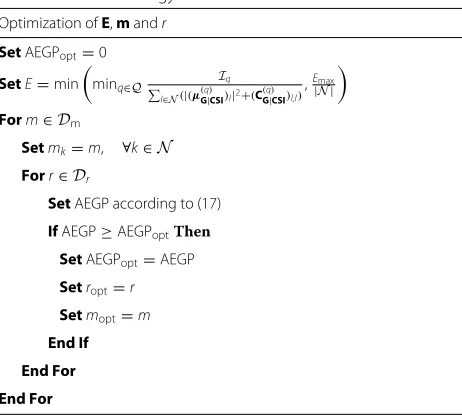
E=min
Table 1Uniform energy and bit allocation
SetAEGP according to (17)
IfAEGP≥AEGPoptThen
4.2 Optimized energy and uniform bit allocation
In this subsection, we will adapt the previous algorithm such that the transmitter optimizes the energy per sub-carrier, while the bit allocation remains uniform. As explained further, we will allow some of the subcarriers to be inactive, i.e.,N ⊆ {1, 2,. . .,N}. We first have a closer
where we have explicitly shown the dependence on the energy allocation vectorE. Because the PER is a convo-luted function of the individual subcarrier energies, an exact optimization of this metric will be very hard to obtain. Therefore, we suggest a more computationally effi-cient method, by optimizing the following simplification of the EGP
where the average is now taken inside the logarithm. As PERESM(r,γ )decreases with increasingγ, the maximiza-tion of (21) w.r.t. E is equivalent to the minimization of EH[Y(E)|CSI]. The latter function can be obtained
So the optimized energy allocation that maximizes the simplified EGP in (21) is found by solving the following OP
According to [28], an OP is convex when both the con-straints and the objective function are convex. From (24), it is clear that the constraints are convex, as they are lin-ear in the components ofE. Further, the convexity of the objective function follows from the fact that the second derivative ofgk,n(Ek)with respect toEkcan be shown to be non-negative; hence, each term of the objective function is convex, so that the entire objective function is convex as well. Therefore, the OP of (24) can be efficiently solved by using optimization tools such as CVX [29].
For the optimization of the EGP, we slightly adapt the algorithm outlined in Table 1. We start by considering all available subcarriers as active, i.e., N = {1,. . .,N}. For every possible TMφ= {m,r}the algorithm computes the approximation (17) of the EGP, using as energy allocation the solution of OP (24). Because the energy allocation now depends on the parameterm, it must now become part of the outer loop of the algorithm. For a given value ofm, it might happen that for somekthe optimized value ofEk equals 0. In this case, the corresponding subcarriers are removed from the active setN by puttingmk = 0, which also removes the large terms withEk = 0 (i.e.,γk = 0) from (15) for the considered bit allocation. Finally, the algorithm selects the TM and the corresponding energy allocation yielding the largest value of the AEGP (17).
4.3 Uniform energy and greedy bit allocation
In this subsection we consider a uniform energy alloca-tion according to (19) and an optimized bit allocaalloca-tion per subcarrier.
We first consider the simplified expression for the EGP (21):
where now the dependence on the bit and energy
allocation vectors m and E is explicitly shown.
(25) only depends on the bit allocation through the quantity k∈NEH[k(mk,Ek)|CSI] and the sum
k∈Nmk=M (m). Because the PER is a decreasing func-tion of the effective SNR γ, the maximal value of the simplified EGP, for a fixed value ofM(m), will be achieved for the bit allocation m and energy allocation E which minimizes
arg min E,m
k∈N
EH[k(mk,Ek)|CSI]
=arg min
E,m
k∈N
√ 2mk
2
n=1
gk,n(mk,Ek). (26)
wheregk,n(mk,Ek) is given by (23), and the dependence on mk is shown explicitly. However, this represents a mixed integer programming problem, which is computa-tionally very hard. In order to obtain a computacomputa-tionally efficient solution, we base our algorithm on the iterative suboptimal greedy algorithm described in [30].
In the current iteration, we modify the bit allo-cation from the previous iteration by adding 2 bits (because we restrict our attention to square QAM con-stellations, representing an even number of bits) to the subcarrier which leads to the smallest increase of
k∈NEH[k(mk,Ek)|CSI]. For the resulting bit and
energy allocation, we determine the code rate r which
leads to the highest AEGP (17). The iterative algorithm is initialized with mk = 0 for all available subcarriers (yieldingM(m) = 0) and continues until allN available subcarriers havemmax bits (yieldingM(m) = mmaxN), wheremmax is the largest allowed number of bits in the constellation. At that point, we select the code raterand the energy and bit allocation which correspond to the value ofM(m)for which the AEGP (17) is maximal.
Now, we outline how the increase of k∈NEH[k
(mk,Ek)|CSI] is evaluated. Let us denote bymthe value of the bit allocation vector and by N the set of active subcarriers, both referring to the previous iteration. We now introduce the quantityδ(mk+2)
k (m)which is defined
as the increase of (26) when the bit allocation on subcar-rierkincreases frommktomk+2. If subcarrierkwas not active in the previous iteration (i.e.,mk = 0), the set of active subcarriers increases fromN(previous iteration) to
N ∪ {k}(current iteration), yielding the increase
δ(2)k (m)=EH
k(2,Ek(m+2ek))
+
l∈N
(l(ml,El(m+2ek))−l(ml,El(m)))|CSI
,
(27)
whereE(m)andE(m+2ek)denote the uniform energy allocations from (19) corresponding to the bit allocations
mandm+2ek, respectively, related to the previous and the current iteration; because the corresponding set of active subcarriers has changed, E(m) and E(m+ 2ek) are different, which makes in (27) the summation overl
nonzero. If subcarrierkwas already active in the previous iteration (i.e.,mk >0), we obtain
δmk+2
k (m)=EH[k(mk+2,Ek(m+2ek))
−k(mk,Ek(m))|CSI] . (28)
As in this case, the set of active subcarriers equals N for both the previous and the current iteration, the uni-form energy allocation from (19) satisfiesE(m+2ek) =
E(m). In the current iteration, the incrementsδkmk+2(m)
are computed for all k ∈ {1,. . .,N}; then, the subcar-rierkwhich yields the lowestδkmk+2(m)(k ∈ {1,. . .,N}) is selected, and the bit allocation for this subcarrier and
M(m)are both increased by 2, compared to the previous iteration.
4.4 Suboptimal joint energy and bit allocation
The greedy bit allocation algorithm introduced in the pre-vious subsection requires the reevaluation of the values of δmk+2
k (m)(∀k∈ {1,. . .,N}) each time the setN of active subcarriers is modified. The complexity would increase even further if we combined each step of the greedy bit allocation algorithm with the optimized energy allocation introduced in Section 4.2, which requires solving a convex optimization algorithm instead of a simple evaluation of Eq. (19).
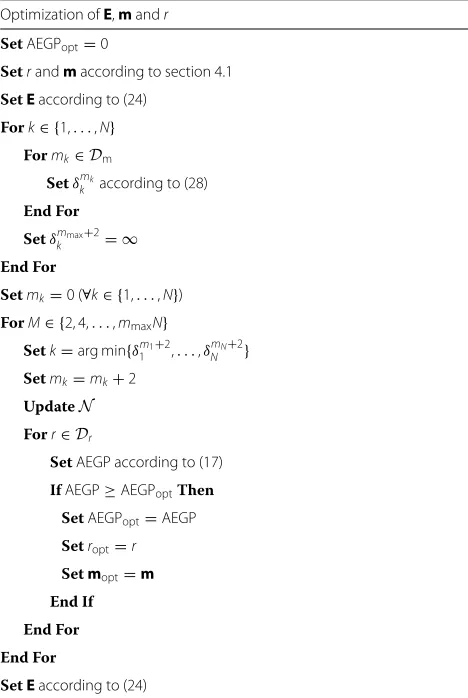
To circumvent this complexity, we present a faster, less computationally intensive algorithm. We initialize the algorithm with the optimal uniform energy and bit allocation from Section 4.1. Then, as a first step we calcu-late for this specific uniform bit allocation the optimized energy allocation vector resulting from OP (24), forN =
{1,. . .,N}. In the second step, we optimize the bit allo-cation and code rate according to the greedy algorithm outlined in 4.3. Because during this step the energy allo-cation vector E is kept to its value resulting from the previous step, we can drop the dependency ofδkmk+2on
Table 2Suboptimal joint energy and bit allocation
Optimization ofE,mandr
SetAEGPopt=0
Setrandmaccording to section 4.1
SetEaccording to (24)
Fork∈ {1,. . .,N}
Formk∈Dm
Setδmk
k according to (28)
End For
Setδmmax+2 k = ∞
End For
Setmk=0 (∀k∈ {1,. . .,N})
ForM∈ {2, 4,. . .,mmaxN}
Setk=arg min{δm1+2 1 ,. . .,δ
mN+2
N }
Setmk=mk+2
UpdateN
Forr∈Dr
SetAEGP according to (17)
IfAEGP≥AEGPoptThen
SetAEGPopt=AEGP
Setropt=r
Setmopt=m
End If
End For
End For
SetEaccording to (24)
5 Numerical results
We consider a communication system characterized by the parameters from Table 3, which uses orthogonal frequency-division multiple access (OFDMA) to support several users. Here, we concentrate on the performance of a user to which 48 data subcarriers are allocated, which is equal to one subchannel in the FUSC permutation mode of WiMax [31]. These subcarriers are considered to be evenly spaced across the available bandwidth. The channel impulse responses behave according to the ITU vehicular A model [32], with time variations according to Jakes’ model [33]. We consider a single PU receiver (so we can drop the indexq) and the channels between the different nodes are characterized by Tr(E[hhH])= 1 and Tr(E[ggH]) = 10−3 , where h and g denote the channel impulse responses corresponding to the chan-nel frequency responsesHandG, respectively; this yields E[|Hk|2]= 1 and E[|Gk|2]= 10−3 for k ∈ {1,. . .,N}. In this section, we will consider three types of CSI, i.e., estimated CSI, delayed CSI, and estimated and delayed CSI (see the Appendix section); we always assume that for bothCSI andCSIPU, the same type of CSI is
avail-Table 3System parameters
Data subcarriers (N) 48
Sampling rate (1/T) 5.6 MHz
FFT size (Ncar) 512
Length of cyclic prefix (ν) 64
Convolutional code (133, 171)8
Code rates (Dr) 1/2, 2/3, 3/4, 5/6
Constellation sizes (Dm) 2, 4, 6 bits
Information bits (Np) 1024
CRC (NCRC) 32
able at the transmitter. We note however that this is not a requirement for the proper functioning of our proposed algorithms.
The SNR is defined as
SNR=Emax
Nσ2 w
. (29)
As a performance indicator for the different resource allocation schemes, we will display (12), which denotes the average of the actual GP w.r.t. the joint probability density function of H, CSI, and CSIPU. This averaging involves the generation of realizations ofCSIandCSIPU, from which the corresponding(m,E,r)are computed. For each such realization of(m,E,r), we generate realizations ofHaccording to the conditional distributionp(H|CSI). For each such realization of H, we transmit and decode one packet using the transmission parameters (m,E,r)
and verify whether a decoding error has occurred; averag-ing the indicator of a decodaverag-ing error over the realizations ofHyields EH[ PER(φ,)|CSI] corresponding to the con-sidered realization of(m,E,r).
5.1 Accuracy of AEGP
In this subsection, we investigate how accurately the AEGP metric (17) approximates the EGP from (13). As a reference, we compare the accuracy with the predicted GP (PGP) introduced in [20] and the IC-κESM introduced in [19]. The PGP is obtained by neglecting the uncertainty on
Hgiven the actual CSI, and is calculated by substitutingH
byμH|CSIin the expression (15) and using this determinis-tic value ofYto replace the random variableZin (17). The IC-κESM is an approximation that only applies to delayed CSI. For this reason, we will compare the accuracy of these three metrics for the scenario where the transmitter only has delayed CSI available (see the “Delayed CSI” section in the Appendix). The following simulation parameters are used: SNR=10 dB,Iq/σw2=0 dB, and the value offdτdis equal to 0.05.
code rate are obtained as described in Section 4.1. Then, for each realization ofCSI,CSIPU, and the correspond-ing(m,E,r), we compute (i) the AEGP from (17); (ii) the PGP; (iii) the IC-κESM; (iv) the EGP from (13), where the average conditioned onCSIis replaced by an arith-metical average over 1000 realizations of H, generated according to the conditional distributionp(H|CSI) (see the Appendix section), and for each realization ofH, it is verified whether the received packet is correctly decoded; and (v) the differencesAEGP = |AEGP−EGP|,PGP = |PGP−EGP|, andIC-κESM = |IC-κESM−EGP|. Table 4 shows the average, the standard deviation, and the root mean-squared (rms) value ofAEGP, PGP, and IC-κESM, resulting from the simulations; these numbers should be compared to the average of EGP over the CSI, which equals 1.42 bits/s/Hz. From Table 4, we observe that the AEGP is a very accurate estimate of the EGP,
outperform-ing both the PGP and the IC-κESM by about one order
of magnitude in terms of rms value. This result validates
the accuracy of both the κESM and our approximation
of Y by a beta-distributed random variable. The high
accuracy of the AEGP metric makes it a very attractive objective function for the optimization of the SU trans-mission parameters. Further, we also note that being able to accurately describe the expected performance of a link will also have further benefits for more high level algo-rithms such as scheduling as the probability, of correctly allocating a user to a channel that satisfies its demands, will be increased.
5.2 Uniform energy and bit allocation
The performance of the uniform energy and bit allocation algorithm described in Section 4.1 is investigated. As a ref-erence, we will also show the performance in the case of perfect CSI and also for non-adaptive transmission.
In the case of perfect CSI, the optimal uniform energy allocation is given by
E=min
min q∈Q
Iq
l∈N|G(q)l |2 ,Emax
|N|
. (30)
Using this uniform energy allocation, the GP metric (11) is computed for each possible TM {m,r} but with PER(φ,) replaced by PERESM(r,γ ). The TM which corresponds to the largest GP is then considered optimal.
Table 4Accuracy of the AEGP, PGP and IC-κESM metric (SNR=10 dB,Iq/σw2=0 dB andfdτd=0.05)
AEGP PGP IC-κESM
E[] 1.87×10⁻² 5.48×10⁻¹ 5.57×10⁻¹
√
Var[] 2.07×10⁻² 2.45×10⁻¹ 1.95×10⁻¹
E[2] 2.79×10⁻² 6.00×10⁻¹ 5.90×10⁻¹
In the case of non-adaptive transmission, the transmit-ter has no CSI available. This is equivalent to the case where the pdf of the channel gains conditioned on the CSI reduces to the unconditional pdf of the channel gains. Hence, the uniform energy allocation is obtained as
E=min ⎛ ⎝min
q∈Q
Iq EG(q)l∈N|G(q)l |2
,Emax
|N| ⎞
⎠. (31)
For the above energy allocation, the transmitter selects, for the current value of SNR (29), the TM {m,r} which leads to the highest value of EH[ GP], with GP given by (11) .
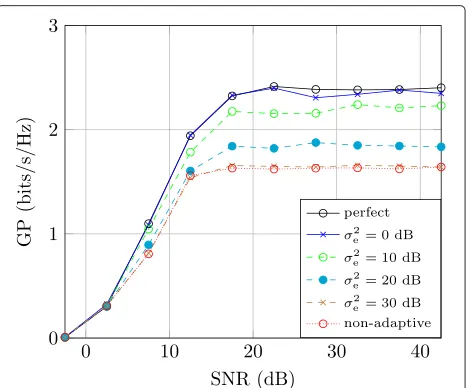
Now, we will apply the algorithm described in Section 4.1. As a first example, we assume that the trans-mitter only has estimated CSI available (see the “Esti-mated CSI” section in the Appendix). The variance of the estimation error related to the PU and SU channels is equal to σe2 = 0, 10, 20, and 30 dB. For the interfer-ence threshold, we considerIq/σw2=0 dB. The results are shown in Fig. 1. We observe that the performance of the SU network clearly depends on the variance of the esti-mation errorσe2. Forσe2 =30 dB, there is almost no gain by exploiting CSI compared to a non-adaptive transmis-sion algorithm, because the CSI is unreliable. However, when the value ofσ2
e decreases, we consistently see a clear gain in performance by exploiting the CSI. Whenσ2
e =0
dB, we notice there is a negligible difference between the algorithm using estimated CSI or perfect CSI. Further, we also note that there is almost no gain compared to non-adaptive transmission for small SNR.
In the following example, the transmitter only has access to delayed CSI (see the “Delayed CSI” section in the Appendix). The performance of the SU network is shown
Fig. 1GP using estimated CSI (σ2
in Fig. 2 for a value of fdτd equal to 0.01, 0.05, 0.1, and 0.2. It is clear from Fig. 2 that whenfdτd is equal to 0.2, there is almost no gain in performance compared to the non-adaptive transmission algorithm because the channel variations are too fast. However, for lower values offdτd, the GP of the SU network increases considerably. When
fdτd =0.01, the GP almost equals the performance of the algorithm which uses perfect CSI.
In Fig. 3, we show the difference in performance between optimizing the AEGP, the PGP (as in [20]), and the IC-κESM (as in [19]). We show the performance for
fdτd equal to 0.05 and 0.2. For fdτd = 0.05, we can see a small performance benefit by optimizing the AEGP
compared to the less accurate PGP and IC-κESM. When
fdτd = 0.2, we notice that the performance improvement we get by using the AEGP or IC-κESM becomes signifi-cantly larger compared to using the PGP. In this case, the performance achieved by using the PGP drops even below the performance we would get by using the non-adaptive approach. This demonstrates that the PGP approximation is unable to accurately describe the expected goodput and is thus not suited as an objective function for the OPs, especially in the case of fast channel variations. While optimizing the IC-κESM is shown to achieve a similar per-formance as the optimization of the AEGP, the IC-κESM is far less general than the proposed AEGP as it can only be used in the scenario with delayed CSI described in the “Delayed CSI” section in the Appendix.
In the last example, we combine the delayed CSI with the estimated CSI (see the “Estimated and delayed CSI”
section in the Appendix). We choose fdτd = 0.2 and
σ2
e =0 dB. We investigate the performance for a different number (P) of available, delayed channel estimates, with corresponding delaysτd, 2τd,. . .,Pτd. The performances
Fig. 2GP using delayed CSI (fdτd=0.01, 0.05, 0.1, and 0.2)
Fig. 3Comparison between AEGP, PGP, and IC-κESM using delayed CSI (fdτd=0.05 and 0.2)
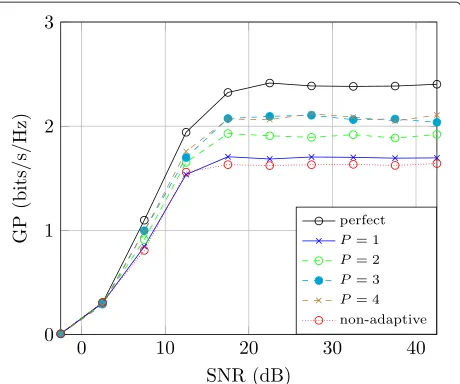
are shown in Fig. 4 forP=1, 2, 3, and 4. We observe that the performance of the SU network can be significantly improved when the CSI consists of multiple delayed chan-nel estimates. In this example, the GP increases by about
20 % when going from P = 1 toP = 4 for high SNRs.
We note that it is not possible to reach the performance of an algorithm with perfect CSI, by increasing the number of estimates. As is clear from Fig. 4, there is no noticeable performance gain by going fromP=3 toP=4.
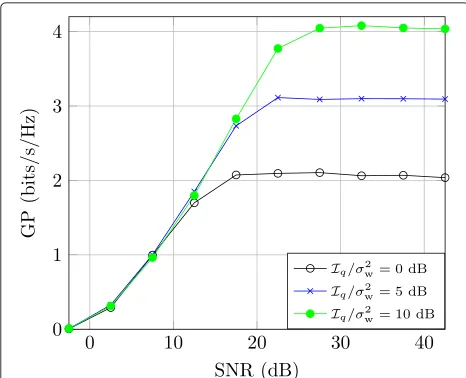
In Fig. 5, we investigate the impact of the interfer-ence threshold. We show the performance of the uni-form bit and energy allocation algorithm whenIq/σw2 = 0, 5 and 10 dB. The resulting goodput is shown for the following simulation variables: fdτd = 0.2, σe2 = 0 dB
Fig. 4GP using estimated and delayed CSI (σ2
Fig. 5GP for different interference thresholds. (σ2
e =0 dB,fdτd=0.2, P=3,Iq/σw2=0, 5 and 10 dB)
andP = 3. We observe that the value of the interference threshold has a huge impact on the performance of the SU network. A too conservative value of the interference threshold will severely limit the achievable goodput of the SU network.
5.3 Optimized energy and uniform bit allocation
In this subsection, the optimized energy (OE) allocation from (24) and the uniform energy (UE) allocation are compared in terms of goodput. The following simulation parameters are chosen:σ2
e = 0 dB,fdτd = 0.2,P = 3, andIq/σw2 = 0 dB. Figure 6 shows the goodput result-ing from the uniform energy and bit allocation described
Fig. 6GP achieved by optimal and uniform energy allocation (σe2=0 dB,fdτd=0.2,P=3,Iq/σw2=0 dB)
in Section 4.1, along with the goodput corresponding to the OE allocation for the same uniform bit (UB) allo-cation. We notice that for high SNR the OE allocation improves the goodput by about 8 % compared to UE allocation.
5.4 Greedy bit allocation
Now, we investigate the performance of the SU network in the case where the SU transmitter optimizes the bit allocation per subcarrier. The simulation parameters are chosen as follows: σe2 = 0 dB, fdτd = 0.2, P = 3,
and Iq/σw2 = 0 dB. We compare the performance of
uniform bit and energy allocation (UB+UE), with our algo-rithm introduced in Section 4.3 which combines greedy bit allocation with uniform energy allocation (GB+UE). Further, we also consider the performance of the subopti-mal algorithm introduced in Section 4.4 which combines the greedy bit allocation and optimized energy allocation (GB+OE). From Fig. 7, we notice that there is a con-siderable increase in GP when we apply GB instead of UB allocation. At low SNR, the transmitter is now capa-ble of deactivating subcarriers with poor instantaneous channel gains, which considerably decreases the PER and improves GP. At higher SNR the transmitter can now bet-ter utilize the full capacity at each subcarrier by allocating a larger number of bits to a subcarrier with favorable channel gains. An even larger gain at higher SNR can be obtained by combining the GB with the OE allocation. In Fig. 7, we notice that the gain compared to uniform bit and energy allocation (UB+UE) amounts to 10 % for greedy bit and uniform energy allocation (GB+UE) and becomes nearly 20 % for greedy bit and optimized energy allocation (GB+OE). This additional gain is achieved by giving the
transmitter the freedom of reallocating the energy over the subcarriers, which improves the performance in sev-eral ways: it can happen for example that subcarriers with less favorable channel gains now receive more energy, or that subcarriers causing strong interference at the PU are switched off to allow for a higher total transmit energy. We do notice however that at lower SNRs the GB+OE algorithm performs slightly worse than the GB+UE algo-rithm. This is a consequence of our suboptimal approach outlined in Section 4.4. However, the performance loss at low SNR is very small, and an optimal joint bit and energy allocation algorithm would require a much higher complexity.
5.5 Computational complexity
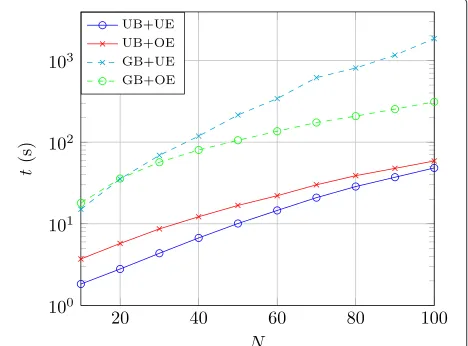
To illustrate their complexity, we will compare the aver-age computation times of the different resource allocation algorithms described in Section 4. The SNR is fixed at
20 dB and the simulation parameters are σe2 = 0 dB,
fdτd = 0.2, P = 3 and Iq/σw2 = 0 dB. In Fig. 8, the computation time of the algorithms is shown as a func-tion of the number of subcarriersN. We notice a slight increase in computation time for the optimized energy allocation (UB+OE) compared to the uniform energy allo-cation (UB+UE). However, a more significant increase in computation time occurs when implementing the greedy bit allocation. The greedy bit with uniform energy allo-cation (GB+UE) described in Section 4.3 clearly becomes unfeasible when the number of subcarriers becomes too high. Compared to GB+UE, the complexity is signifi-cantly reduced when using the suboptimal joint energy and bit allocation (GB+OE) described in Section 4.4, whose computation time increases much more slowly withN.
Fig. 8Comparison of the simulation time of the different bit and energy allocation algorithms (SNR=20 dB,σ2
e =0 dB,fdτd=0.2, P=3,Iq/σw2=0 dB)
6 Conclusions
In this paper, we have considered adaptive coding and modulation in a cognitive BIC-OFDM system, under the realistic assumption that only imperfect CSI is available. In order to tackle this problem, we introduced an opti-mum performance metric called the expected goodput (EGP), which is the expectation of the goodput, condi-tioned on the imperfect CSI.
A major advantage of this metric is that it allows the transmitter to account for the imperfections of the CSI by selecting its transmission parameters such that the best average goodput is achieved. To make the optimization of the code rate, bit and energy allocation tractable, we proposed a very accurate approximation of this perfor-mance metric, referred to as approximate EGP (AEGP). The numerical results clearly show that the ACM algo-rithms based on the AEGP have at least the same per-formance as the non-adaptive algorithms and, in most cases, clearly outperform them. Finally, we also show that, depending upon the quality of the available CSI, the pro-posed algorithms can come very close to the performance of algorithms with perfect CSI.
Endnotes
1This EGP metric is different from the expected
effective goodput metric proposed in [18]. The metric introduced in [18] takes into account the expected trans-mission time, which can vary because of the possibilities of retransmissions. It has however nothing to do with imperfect CSI which is the focus of the present paper.
2Note that if we have a number of pathsL< ν+1, only
Ldiagonal elements ofRhare strictly greater than 0.
Appendix
Examples of different types of CSI at the transmitter In the following, the impulse response of a generic chan-nel between the SU transmitter and any receiver of the PU or SU network will be denoted byh(m,t), where the delay variable is represented by the discrete time index
m associated with a sampling rate 1/T, and the time variability of the channel is indicated by a continuous
time index t. Without any loss of generality, we can
represents the zeroth-order Bessel function of the first kind, andfddenotes the Doppler spread.
Introducing the Fourier matrixF∈CNcar×(ν+1)as
Fk,l=e −j2π(k−1)(l−1)/Ncar, k=1,. . .,Ncar;l=1,. . .,ν+1, (32)
the time-varying frequency response of the channel can then be written asH(t)=Fh(t)which has the covariance matrixRH=FRhFH. Thekth component ofH(t)denotes the channel gain which affects thekth subcarrier at time instantt.
In the following subsections, we consider a few possible examples of the type of CSI available at the transmitter. Each case leads to different expressions for the parameters μH|CSIandCH|CSI, which completely describe the random variableH(t)conditioned on the availableCSIas follows
H(t)=μH|CSI(t)+n(t), (33)
where n(t) ∼ CN(0,CH|CSI). The probability density function p(H(t)|CSI) is then given by CN(μH|CSI(t),
CH|CSI). If onlyNof theNcarsubcarriers are available at the transmitter, as is the case in the numerical section, we can define a smallerμH|CSIandCH|CSIwhich only contain the elements corresponding to the available subcarriers.
Estimated CSI
In this subsection we determine the quantitiesμH|CSIand
CH|CSIin the case of channel estimation errors. The trans-mitter only has access to an estimated frequency response
˜
H(t), which means that CSI = ˜H(t). The estimated frequency responseH˜(t)is decomposed as
˜
H(t)=H(t)+ ˜e(t), (34)
wheree˜(t)andH(t)are statistically independent,e˜(t) ∼
CN(0,σ2INcar). In Section 5, we will use the value
of the normalized estimation error variance σe2 =
σ2/TrEhhH. It can be shown that
Note that in the case of perfect estimation (i.e.,σ2=0) we obtain perfect CSI, as (34), (35) and (36) reduce toH˜(t)= H(t),μH|CSI=H(t)andCH|CSI=0.
Delayed CSI
Now we assume that the CSIis outdated, because of a
delay in the feedback to the transmitter. At time instancet, the delayed CSI available at the transmitter is denoted by
H(t−τd), whereτddenotes the delay. In this case, it can
In this section we assume that the CSI available at the transmitter is both delayed and estimated. We also con-sider the possibility that the transmitter has access to multiple delayed estimates. WithPdenoting the number of available estimates, the CSI which is available at the transmitter is given by product, it can be shown that
μH|CSI=XY−1CSI, (42)
and
CH|CSI=RH−XY−1XH. (43)
Acknowledgements
J. Van Hecke is supported by a Ph. D. fellowship of the Research Foundation Flanders (FWO).
This work was supported by the European Commission in the framework of the FP7 Network of Excellence in Wireless COMmunications NEWCOM# (Grant agreement no. 318306), and the Interuniversity Attraction Poles Programme initiated by the Belgian Science Policy Office.
Competing interests
The authors declare that they have no competing interests.
Author details
1Ghent University, Department of Telecommunications and Information Processing, 9000 Ghent, Belgium.2University of Pisa, Department of Information Engineering, I-56122 Pisa, Italy.3Université Catholique de Louvain, Institute of Information and Communication Technologies, Electronics and Applied Mathematics (ICTEAM), 1348 Louvain-la-Neuve, Belgium.
Received: 23 March 2016 Accepted: 20 September 2016
References
1. G Caire, G Taricco, E Biglieri, Bit-interleaved coded modulation. Inf. Theory IEEE Trans.44(3), 927–946 (1998). doi:10.1109/18.669123
2. AJ Goldsmith, S-G Chua, Variable-rate variable-power MQAM for fading channels. Commun. IEEE Trans.45(10), 1218–1230 (1997).
doi:10.1109/26.634685
3. S Haykin, Cognitive radio: brain-empowered wireless communications. Selected Areas Commun. IEEE J.23(2), 201–220 (2005).
4. A Goldsmith, SA Jafar, I Maric, S Srinivasa, Breaking spectrum gridlock with cognitive radios: an information theoretic perspective. Proc. IEEE.97(5), 894–914 (2009). doi:10.1109/JPROC.2009.2015717
5. S Ye, RS Blum, LJ Cimini, Adaptive OFDM systems with imperfect channel state information. Wireless Commun. IEEE Trans.5(11), 3255–3265 (2006). doi:10.1109/TWC.2006.05004
6. A Kuhne, A Klein, Throughput analysis of multi-user OFDMA-systems using imperfect CQI feedback and diversity techniques. Selected Areas Commun. IEEE J.26(8), 1440–1450 (2008). doi:10.1109/JSAC.2008.081010 7. N Mokari, S Parsaeefard, P Azmi, H Saeedi, E Hossain, Robust ergodic
uplink resource allocation in underlay OFDMA cognitive radio networks. IEEE Trans. Mobile Comput.15(2), 419–431 (2016).
doi:10.1109/TMC.2015.2413782
8. D Tian, J Zhou, Z Sheng, VCM Leung, Robust energy-efficient MIMO transmission for cognitive vehicular networks. IEEE Trans. Veh. Technol.
65(6), 3845–3859 (2016). doi:10.1109/TVT.2016.2567062 9. W Jaafar, T Ohtsuki, W Ajib, D Haccoun, Impact of the CSI on the
performance of cognitive relay networks with partial relay selection. IEEE Trans. Veh. Technol.65(2), 673–684 (2016). doi:10.1109/TVT.2015.2402193 10. S Mallick, R Devarajan, RA Loodaricheh, VK Bhargava, Robust resource
optimization for cooperative cognitive radio networks with imperfect CSI. IEEE Trans. Wireless Commun.14(2), 907–920 (2015).
doi:10.1109/TWC.2014.2362135
11. S Singh, PD Teal, PA Dmochowski, AJ Coulson, Robust cognitive radio cooperative beamforming. IEEE Trans. Wireless Commun.13(11), 6370–6381 (2014). doi:10.1109/TWC.2014.2331074
12. H Huang, Z Li, J Si, L Guan, Underlay cognitive relay networks with imperfect channel state information and multiple primary receivers. IET Commun.9(4), 460–467 (2015). doi:10.1049/iet-com.2014.0429 13. S Nanda, KM Rege, Frame error rates for convolutional codes on fading
channels and the concept of effective Eb/N0. Veh. Technol. IEEE Trans.
47(4), 1245–1250 (1998). doi:10.1109/25.728513
14. I Stupia, V Lottici, F Giannetti, L Vandendorpe, Link resource adaptation for multiantenna bit-interleaved coded multicarrier systems. Signal Process. IEEE Trans.60(7), 3644–3656 (2012). doi:10.1109/TSP.2012.2192110 15. E Tuomaala, H Wang, inMobile Technology, Applications and Systems, 2005
2nd International Conference On. Effective SINR approach of link to system mapping in OFDM/multi-carrier mobile network (IEEE, New Jersey, 2005), pp. 5–5. doi:10.1109/MTAS.2005.243791
16. J Francis, NB Mehta, Characterizing the impact of feedback delays on wideband rate adaptation. Wireless Commun. IEEE Trans.14(2), 960–971 (2015). doi:10.1109/TWC.2014.2363083
17. TL Jensen, S Kant, J Wehinger, BH Fleury, Fast link adaptation for MIMO OFDM. Veh. Technol. IEEE Trans.59(8), 3766–3778 (2010).
doi:10.1109/TVT.2010.2053727
18. D Qiao, S Choi, KG Shin, Goodput analysis and link adaptation for IEEE 802.11a wireless LANs. IEEE Trans. Mobile Comput.1(4), 278–292 (2002). doi:10.1109/TMC.2002.1175541
19. PD Fiorentino, R Andreotti, V Lottici, F Giannetti, JV Hecke, M Moeneclaey, inEuropean Wireless 2014; 20th European Wireless Conference; Proceedings Of. Link resource adaptation for BIC-OFDM systems with outdated channel state information (VDE VERLAG, Berlin, 2014), pp. 1–6 20. J Van Hecke, P Del Fiorentino, R Andreotti, V Lottici, F Giannetti,
L Vandendorpe, M Moeneclaey, inCommunications (ICC), 2015 IEEE International Conference On. Goodput-maximizing resource allocation in cognitive radio BIC-OFDM systems with DF relay selection (IEEE, New Jersey, 2015), pp. 1404–1409. doi:10.1109/ICC.2015.7248520 21. J Van Hecke, P Del Fiorentino, R Andreotti, V Lottici, F Giannetti,
L Vandendorpe, M Moeneclaey, inCommunications and Vehicular Technology in the Benelux (SCVT), 2015 IEEE 22st Symposium On. Accurate modeling of the predicted kesm-based link performance metric for BIC-OFDM systems (IEEE, New Jersey, 2015)
22. A Ghasemi, ES Sousa, Fundamental limits of spectrum-sharing in fading environments. Wireless Commun. IEEE Trans.6(2), 649–658 (2007). doi:10.1109/TWC.2007.05447
23. UL Wijewardhana, M Codreanu, M Latva-aho, A Ephremides, A robust beamformer design for underlay cognitive radio networks using worst case optimization. EURASIP J. Wireless Commun. Netw.2014(1), 1–16 (2014). doi:10.1186/1687-1499-2014-37
24. E Björnson, E Jorswieck,Optimal Resource Allocation in Coordinated Multi-Cell Systems, vol. 9. (Foundations and Trends in Communications and Information Theory, Boston, 2013)
25. X Zhang, J Xing, Z Yan, Y Gao, W Wang, Outage performance study of cognitive relay networks with imperfect channel knowledge. IEEE Commun. Lett.17(1), 27–30 (2013).
doi:10.1109/LCOMM.2012.112812.121371
26. K Ho-Van, PC Sofotasios, S Freear, Underlay cooperative cognitive networks with imperfect nakagami-m fading channel information and strict transmit power constraint: Interference statistics and outage probability analysis. J. Commun. Netw.16(1), 10–17 (2014). doi:10.1109/JCN.2014.000004
27. I Stupia, F Giannetti, V Lottici, R Andreotti, L Vandendorpe, AN D’Andrea, inFuture Network and Mobile Summit, 2010. A greedy algorithm for goodput-oriented AMC in turbo-coded OFDM (International information management corporation (IIMC), Dublin, 2010), pp. 1–8
28. S Boyd, L Vandenberghe,Convex optimization. (Cambridge University Press, Cambridge, UK, 2004)
29. M Grant, S Boyd, CVX: Matlab Software for Disciplined Convex Programming, version 2.1 (2014). http://cvxr.com/cvx
30. I Stupia, F Giannetti, V Lottici, L Vandendorpe, inWireless Conference (EW), 2010 European. A greedy algorithm for goodput-based adaptive modulation and coding in BIC-OFDM systems (IEEE, New Jersey, 2010), pp. 608–615. doi:10.1109/EW.2010.5483466
31. PL Nuaymi,WiMAX: Technology for Broadband Wireless Access. (John Wiley & Sons, New York, 2007). https://books.google.co.uk/books?id= Kvf5bdM9QlYC
32. ETSI, Selection procedures for the choice of radio transmission technologies of the UMTS (UMTS 30.03 version 3.1.0). Technical report, UMTS. http://www.etsi.org/
33. WC Jakes,Microwave Mobile Communications. (John Wiley & Sons, New York, 1974)
Submit your manuscript to a
journal and benefi t from:
7Convenient online submission
7Rigorous peer review
7Immediate publication on acceptance
7Open access: articles freely available online
7High visibility within the fi eld
7Retaining the copyright to your article