April 2015
Abstract ... 2
Background Information ... 2
Calaveras Public Utility District ... 2
Water Rights ... 2
Water Supply ... 2
Project Information ... 3
Project Description ... 3
Project Location ... 3
Project Sponsor ... 4
Scope of Work ... 4
Task 1. Data Collection and Pipeline Evaluation ... 4
Task 2. Transmission Main Feasibility Study ... 5
Task 3. Implementation Planning ... 5
Task 4. Environmental and Permitting ... 6
Task 5. Design and Construction ... 6
Budget ... 7
8b-2
Abstract
The Rehabilitation of Transmission Main Project will conduct a study to determine the benefits of replacing all or a portion of the transmission main that conveys treated water from the Jeff Davis Water Treatment Plant (WTP) to Mokelumne Hill, Paloma, and San Andreas. The study will include assessment of areas that are reaching life expectancy, areas of water loss, and recommendations for rehabilitation. Upon completion of the study, the project includes replacing or lining the recommended portions of the current transmission main. Costs for this project are estimated to be $5.2 million, with $200,000 for the study and $5 million for implementation.
Background Information
Calaveras Public Utility District
Calaveras Public Utility District (CPUD) supplies treated water to Mokelumne Hill, San Andreas, Paloma, Glencoe, and other outlying areas in the Upper Mokelumne Watershed. The boundary covers approximately 21,543 acres. CPUD obtains its water from the South Fork of the Mokelumne River at a diversion dam and pump station located near the confluence of the Licking and South Forks of the Mokelumne River. Water is then pumped to the Jeff Davis Reservoir and gravity fed to a treatment plant (Calaveras County, 2008).
The CPUD service area population is approximately 5,000 people, and water use is approximately 1,120 AFY (RMC, 2015).
Water Rights
CPUD has various water diversion and storage rights on the Mokelumne River system and the Calaveras River. Treated water is delivered from the Mokelumne River system and a small amount of agricultural water is delivered from the Calaveras River. On May 8, 1940, an agreement was made with the East Bay Municipal Utility District (EBMUD) which entitles CPUD to a diversion of 12.5 cubic feet per second (cfs) from the South, Middle and Licking Forks of the Mokelumne River. CPUD’s maximum entitlement, including direct diversion and diversion from storage is 10,950 AFY (Calaveras County, 2008).
Water Supply
The primary water supply to CPUD is from the South Fork of the Mokelumne River. Water is pumped from the river at a small diversion dam up through a pump station (3,300 gallon per minute capacity) and transported via a three-mile pipeline (9.l7 million gallons per day capacity) to the Jeff Davis Reservoir. From there, it enters the treatment plant and then flows through transmission mains to storage tanks located in Rail Road Flat, Mokelumne Hill,
8b-3
Paloma, and San Andreas. From there, the water is delivered into the distribution system (Calaveras County LAFCO, 2013).
The estimated safe yield of CPUD’s current water supply is 4,370 AFY. This includes a safe yield of 1,370 AFY from Schaads Reservoir on the Middle Fork of the Mokelumne River. CPUD has the right to store and release 1,800 AFY from Schaads. Another 3,000 AFY of safe yield is from the South Fork of the Mokelumne River when used in conjunction with CPUD’s Jeff Davis Reservoir. CPUD has a right to store 2,300 AF of water in Jeff Davis Reservoir. CPUD also has a right to store 400 AF from the Calaveras River watershed at its Redhawk Reservoir. This water is not connected to CPUD’s treated water system and is only used to supply immediate downstream agricultural users (Calaveras County LAFCO 2003b). CPUD has not supplied those agricultural users since approximately 2002, and is not actively operating the Redhawk Reservoir (Calaveras County LAFCO, 2013).
Project Information
Project Description
This concept will conduct a study to determine the benefits of replacing all or a portion of the transmission main that conveys treated water from the Jeff Davis Water Treatment Plant (WTP) to Mokelumne Hill, Paloma, and San Andreas. The study will include assessment of areas that are reaching life expectancy, areas of water loss, and recommendations for rehabilitation. Upon completion of the study, the project would include replacing or lining recommended portions of the current transmission main. The transmission main was installed in the 1970s and has had one large repair since that time. Replacing or lining the transmission main will increase the life expectancy, and likely improve efficiencies and reduce water loss.
CPUD has approximately 23 miles of distribution pipeline. The transmission system consists of 18 miles of mains constructed primarily of cement, mortar-lined and –coated steel pipe ranging from 16 to 27 inches in diameter. The main transmission line from the Jeff Davis WTP to the communities of Mokelumne Hill and San Andreas is 18-inch concrete lined steel pipe. Distribution feeder lines serving the two communities and outlying areas are comprised of 4-inch to 12-4-inch steel or plastic pipe (Calaveras County LAFCO, 2013).
Project Location
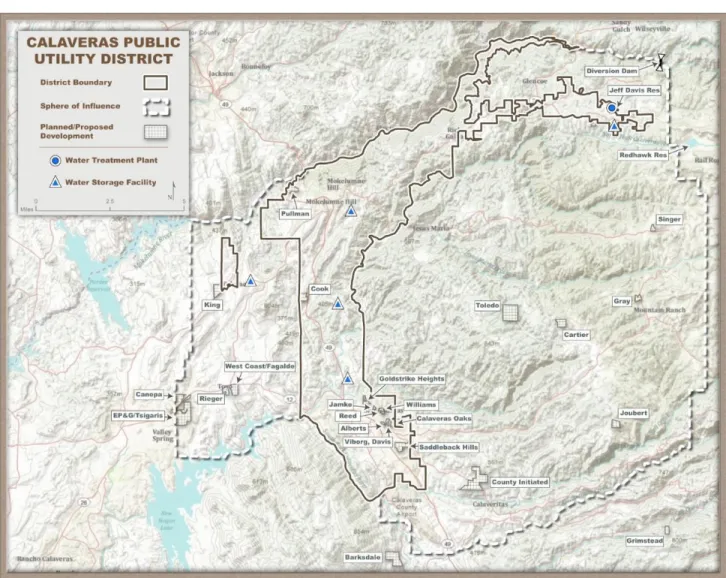
The transmission main is located within the CPUD district from the Jeff Davis WTP to the Mokelumne hill, Paloma, and San Andreas areas. Figure 1shows the CPUD boundary and Jeff Davis Reservoir.
8b-4 Figure 1: CPUD Boundary and Jeff Davis Reservoir
Source: Calaveras County LAFCO, 2013
Project Sponsor
CPUD is the lead sponsor of the concept. Currently, a co-sponsor for this Concept has not been identified.
Scope of Work
Task 1. Data Collection and Pipeline Evaluation
Because the transmission pipeline is reaching the end of its expected useful life, there is an increased risk of pipeline breaks, which threatens supply reliability. Existing mapping,
8b-5
design drawings, engineering reports and other data related to the transmission will be gathered and reviewed. A field investigation will be conducted to evaluate the effectiveness of the current transmission main and location of potential minor leaks and water losses.
Task 2. Transmission Main Feasibility Study
The Transmission Main Feasibility Study will be conducted to determine if all or a portion of the transmission main should be replaced. The study will include an assessment of areas that are reaching the end of their useful life, areas of water loss, and recommendations for rehabilitation.
Subtask 2.1 Conduct Assessment
A condition assessment of the current state of the transmission main will be performed in order to identify areas of leaks / water loss, pressure issues, and significant corrosion.
Subtask 2.2 Develop and Evaluate Improvement Options
A preliminary evaluation of improvement options will be conducted to identify and evaluate recommendations for rehabilitation of all or a portion of the current transmission main. This task will involve determining the value of the benefit provided by each of the proposed alternatives for rehabilitation in terms of risk reduction. A cost/benefit and risk analysis will be prepared for each rehabilitation alternative recommendation. This analysis will also include the anticipated efficiency and savings achieved by each alternatives. The benefits will then be compared against the costs of each alternative to determine which alternative is more feasible. Preliminary recommendations will be developed based on this analysis. A detailed opinion of probable construction cost will be provided for each alternative to identify budget level cost for rehabilitation a portion or all of the transmission main.
The recommended rehabilitation project will be identified, which will include all or a portion of the transmission main, depending upon the results of the risk and cost analyses.
Subtask 2.3 Recommended Project Delivery Method
Traditional bid-build and alternative project delivery approaches such as design-build, contractor-led design-design-build, and engineer-led design-build will be evaluated. Each project delivery option will have various implications on the degree of decision-making and risk allocated to CPUD. A recommendation will be made as to the most cost- and schedule-efficient delivery approach for project implementation.
Task 3. Implementation Planning
8b-6
Implementation schedule (including permitting, design, and construction) and proposed phasing of the project based on cost-effectiveness, estimated benefits, and implementation constraints
Outreach strategies for moving the project forward through the design and construction phase
Operational plans will be developed for the rehabilitation of the transmission main, including strategies for optimizing performance and minimizing costs.
Task 4. Environmental and Permitting
Subtask 4.1 EnvironmentalAn environmental analysis will be performed to help determine any potential fatal flaws or major mitigation requirements that might be associated with replacing a portion or all of the transmission main. This analysis will include identification of potential environmental impacts and mitigation measures needed for compliance with CEQA and NEPA, as appropriate, and preparation of required CEQA/NEPA documentation.
Subtask 4.2 Permitting
This task includes identification and preparation of all permits necessary for implementation of the project. Strategies to address the project’s regulatory requirements, institutional issues, and challenges, particularly the approach to regulatory compliance will be assessed. The Stormwater Pollution Prevention Plan (SWPPP) required for construction will be prepared.
Task 5. Design and Construction
Subtask 5.1 DesignDesign plans will be created which will show proposed locations of the transmission main replacement. Progress drawings, specifications, a construction sequencing plan, and a construction cost estimate will be submitted throughout this task until the final design plans are complete. Design milestones will depend upon the delivery method selected. Assistance with the procurement of qualified contractors will be provided in order to perform the rehabilitation.
Subtask 5.2 Engineering Services during Construction
This task will vary depending upon the delivery approach selected. All of the facilities that will require demolition during construction will be identified. Proper project management is necessary to keep the project on schedule. This task will include typical services needed for implementation of the updated transmission main including pre-construction meetings, review of contractors’ submittals, inspections and monitoring of permit compliance, system
8b-7
performance testing, and preparation of record drawings after completion of the project construction.
Subtask 5.3 Construction
This task includes mobilization, demolition of existing facilities, site preparation, and construction of all new facilities, demobilization, performance testing, and startup. Depending on the level of funding, construction can be implemented in phases.
Budget
Based on costs submitted for the 2015 MAC IRWMP Update, the budget for this project is estimated to be $1.03 million. Costs associated with the project are broken down as follows:
Planning: $30,000
Implementation: $1,000,000
o These costs represent the immediate goal of treating critical sections. The cost for rehabilitation of the entire distribution system is much greater in magnitude and will be approached in a phase manner.
Total Project Cost: $1,030,000
References
Calaveras County LAFCO. 2003b. Service Review Study: Public Agency Water Purveyors. December 2003.
Calaveras County, 2008. General Plan Baseline Report. January 2008.
Calaveras County LAFCO, 2013. Calaveras Public Utility District Sphere of Influence Update. December 2013.
RMC, 2015. MokeWISE Program Final Memorandum Water Availability Analysis. January 2015.