Accelerating embedded
software development
via agile techniques
The nine strategies that
lead to successful embedded
software development
Technology Institute June 2013
3
PwC
Introduction
The accelerating rate of technological change for electronic products requires rapid market
responsiveness to maintain a competitive edge. Hardware-centric product industries have
increasingly turned to the flexibility and adaptability of software to enable critical features
and functionality that differentiate their products. As a result, embedded software use is
growing to the point that it is becoming omnipresent across multiple industries.
The growing importance of software as a differentiator, combined with increasing product
complexity, and more frequent release cycles are increasing the cost of embedded software
development. Many companies that rely on embedded software are exploring agile software
development to cut costs while improving quality and time to market. The challenge for them is
that agile software development methodologies differ from traditional hardware product
development models, which are typically linear and more rigid in nature. Instead, agile practitioners
use a highly adaptive and iterative development cycle based on a collaborative team approach.
Although agile has proved beneficial in mainstream software development scenarios, implementing
an agile software development framework within the embedded software environment poses a
number of unique challenges. After analyzing leading practices of agile software development
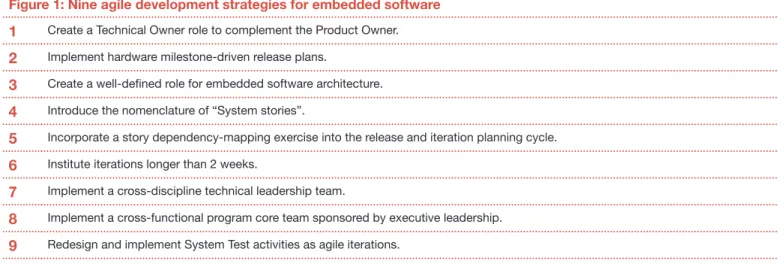
leaders, PwC has developed an end-to-end structured approach with nine key strategies to help
hardware companies successfully adapt agile practices for their embedded software development.
(Figure 1) PwC’s nine strategies, along with key processes and planning activities, can help
companies that rely on embedded software reap the value of agile software development.
This article is for product development executives, managers, and others in the many industries
that incorporate embedded software.It includes a maturity model that can help organizations
identify whether they are leaders, laggards or in the mainstream of embedded software
development, as well as guidance about how to improve.
Figure 1: Nine agile development strategies for embedded software
1 Create a Technical Owner role to complement the Product Owner. 2 Implement hardware milestone-driven release plans.
3 Create a well-defined role for embedded software architecture. 4 Introduce the nomenclature of “System stories”.
5 Incorporate a story dependency-mapping exercise into the release and iteration planning cycle. 6 Institute iterations longer than 2 weeks.
7 Implement a cross-discipline technical leadership team.
8 Implement a cross-functional program core team sponsored by executive leadership. 9 Redesign and implement System Test activities as agile iterations.
The growth of embedded software
From pacemakers to smart phones to set-top boxes to complex network routers, technology products that use software in an embedded environment are extensive and
varied. Embedded software use is a fast growing area, with applications varying by industry application, form factor, and footprint. That growth should continue, as the electronics industry faces an ever-accelerating demand for new chipsets that are faster, smaller, and cheaper and can handle an ever-wider variety of applications.
For example, products such as a smartphone are based
on multiple hardware chipsets (such as for baseband and
application) requiring numerous external suppliers. These
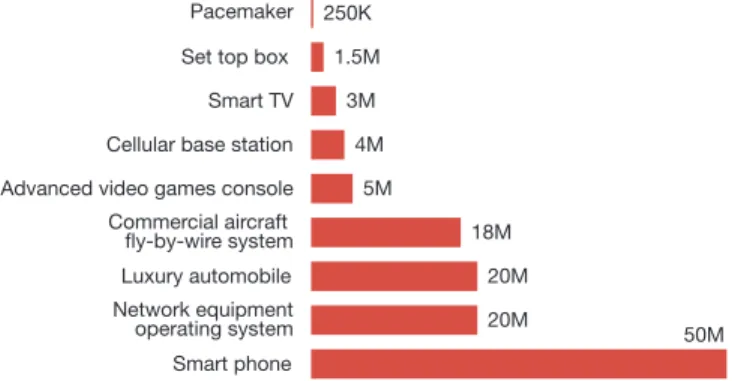
devices can contain up to 50 million lines of embedded software code. (Figure 2)
Developing these complex products requires OEMs to
establish broad ecosystems which have grown more
complex, with more participants catering to multiple layers
of the application stack. At the same time, those ecosystems
must work quickly, as OEMs and ODMs accelerate product
development to quickly generate new product features and enhancements, while maintaining product quality.
Thus, expenditure on software development is becoming a significant portion (often>50% of R&D resource costs) of the overall development expense for embedded product
companies, according to PwC estimates.
Given such market pressures and the growing prominence of software, embedded product development organizations are increasingly interested in harnessing the power of agile software development to improve time-to-market, productivity, and quality while maintaining lower costs. However, while agile software development holds great promise, doing so within the typical embedded software environment poses a number of challenges not found in typical application software development.
Background and benefits of agile
Software development has traditionally followed waterfall-style development techniques made popular by manufacturing and construction industries in the 1970s. The waterfall method breaks down software development into discrete steps: requirements, design, coding, and testing, with each step occurring in sequence
with no overlap. This linear sequence makes it difficult for
development teams to adapt to changing requirements and market needs; moreover, mistakes made in an earlier step
are costly to fix in latter steps. Waterfall development also
tends to create natural silos, due to the functional nature of the discrete steps, with “throw-over-the-wall” behavior common between product managers, architects, developers and testers.
Figure 2: Lines of code* in device Pacemaker
Set top box Smart TV
and many, many more... * These are high level estimates for product category
Cellular base station Advanced video games console Commercial aircraft fly-by-wire system Luxury automobile Network equipment operating system Smart phone
250K 1.5M
3M 4M
5M
18M 20M 20M
5
PwC Agile principles transform traditional software development capabilities to deliver value “Agile” refers to a set of adaptive software development methodologies that share common characteristics: working software, responsiveness to change and collaborative processes.
Agile methodologies are completely different— they are adaptive and iterative. Key characteristics of agile development are as follows:
• Intentional blending of define-build-test cycles and
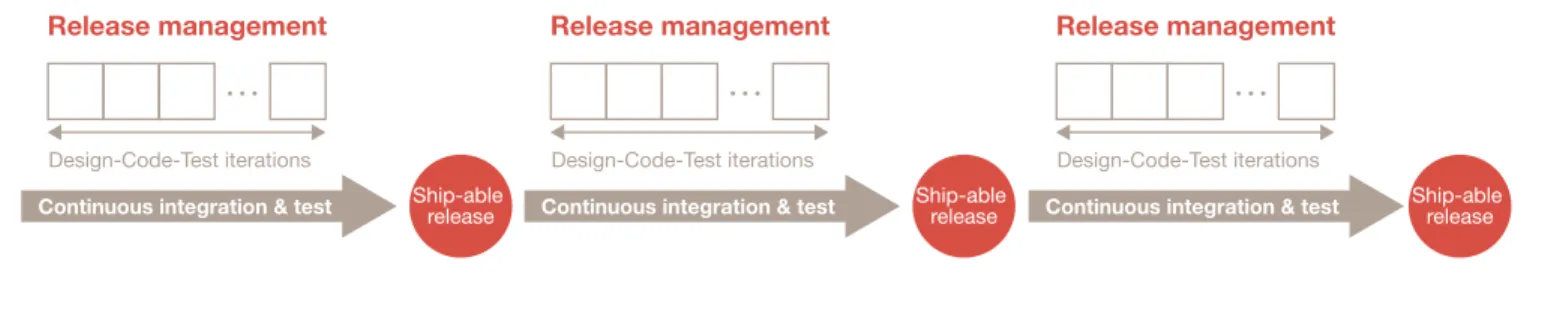
continuous integration of software (Figure 3)
• Frequent releases of fully tested features, ready for use by the customer
• Highly collaborative work teams comprising both business people and developers
• Reliance on face-to-face communication as the
dominant form of interaction • High value placed on simplicity
Agile also offers additional benefits for effective software
development, such as early customer engagement, early test engagement, focused engineering, enhanced collaboration and empowerment, early program risk visibility, and consistency. The aggregate quantitative
impact of these benefits appears across a number of vital
industry performance metrics (Figure 4)
Figure 4: Agile development impact on key benchmarks
Measure
Quality improvement1,6 Productivity improvement1,2,3,5,6, Time to market improvement1-6 Cost reduction 1,5
1. Source: David Rico analysis of 69 scholarly studies, 2008. What is the ROI of Agile VS. Traditional Methods? http://davidfrico.com/rico08b.pdf 2. Source: Rally/QSMA: benchmarking 29 agile projects against 7,500 waterfall projects, 2009 http://www.rallydev.com/sites/default/files/How_explain_the_ financial_impact_of_agile.pdf
3. Source: Thomke, S., & Reinertsen, D. (1998). Harvard Business School Survey— Agile product development: Managing development flexibility in uncertain environments. 1998
4. Source: Fichman, R. G., & Moses, S. A. (1999). Boston College— An incremental process for software implementation. A case study of 28 software projects, 1999
5. Source: Reifer, D. J. (2003). The business case for agile methods/extreme programming (XP). Proceedings of the Seventh Annual PSM Users Group conference, Keystone, Colorado, USA, 1-30.
6. Source: A Business Case for Software Process Improvement (2007 Update), Measuring Return on Investment from Software Engineering and Management; A DACS State-of-the-Art Report
Benchmark
50% 31%
97% 14%
91% 18%
29% 7% Release management
Design-Code-Test iterations
Continuous integration & test Ship-able release
Release management
Design-Code-Test iterations
Continuous integration & test Ship-able release
Release management
Design-Code-Test iterations
Continuous integration & test Ship-able release
Clearing roadblocks to embedded software agile implementation
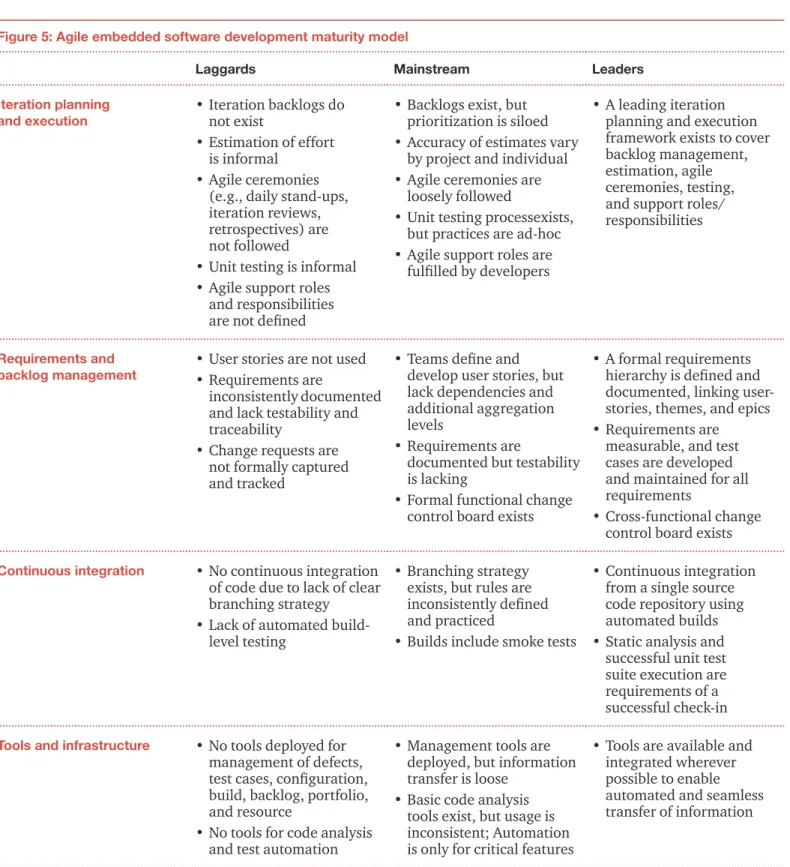
PwC has analyzed the leading practices of agile leaders, as well as challenges facing laggards, and created a set of recommendations and strategies to enable agile development of embedded software. Collectively the characterizations of leaders, laggards and mainstream implementation of agile development highlight relative levels of maturity, so the table below can also be considered a maturity model. (Figure 5)
Developers of embedded software should embrace a transformative approach that encompasses the entire product development cycle and provides a holistic solution for end-to-end agile development. Therefore, these recommendations and strategies affect both agile methods and agile team structures and behaviors.
Figure 5: Agile embedded software development maturity model
Laggards Mainstream Leaders
Iteration planning
and execution • Iteration backlogs do not exist
• Estimation of effort
is informal
• Agile ceremonies (e.g., daily stand-ups, iteration reviews, retrospectives) are not followed
• Unit testing is informal • Agile support roles
and responsibilities
are not defined
• Backlogs exist, but
prioritization is siloed • Accuracy of estimates vary
by project and individual • Agile ceremonies are
loosely followed
• Unit testing processexists,
but practices are ad-hoc • Agile support roles are
fulfilled by developers
• A leading iteration
planning and execution framework exists to cover
backlog management, estimation, agile ceremonies, testing, and support roles/ responsibilities
Requirements and
backlog management • User stories are not used• Requirements are inconsistently documented and lack testability and traceability
• Change requests are not formally captured
and tracked
• Teams define and
develop user stories, but lack dependencies and additional aggregation levels
• Requirements are
documented but testability is lacking
• Formal functional change
control board exists
• A formal requirements
hierarchy is defined and
documented, linking user-stories, themes, and epics • Requirements are
measurable, and test cases are developed and maintained for all requirements
• Cross-functional change
control board exists
Continuous integration • No continuous integration of code due to lack of clear branching strategy
• Lack of automated build-level testing
• Branching strategy
exists, but rules are inconsistently defined
and practiced
• Builds include smoke tests
• Continuous integration from a single source code repository using automated builds • Static analysis and
successful unit test
suite execution are
requirements of a successful check-in Tools and infrastructure • No tools deployed for
management of defects,
test cases, configuration,
build, backlog, portfolio, and resource
• No tools for code analysis and test automation
• Management tools are deployed, but information transfer is loose
• Basic code analysis
tools exist, but usage is
inconsistent; Automation is only for critical features
• Tools are available and integrated wherever possible to enable automated and seamless transfer of information
7
PwC
Laggards Mainstream Leaders
Tools and infrastructure • No tools deployed for management of defects,
test cases, configuration,
build, backlog, portfolio, and resource
• No tools for code analysis and test automation
• Management tools are deployed, but information transfer is loose
• Basic code analysis
tools exist, but usage is
inconsistent; Automation is only for critical features
• Tools are available and integrated wherever possible to enable automated and seamless transfer of information
Release roadmap planning • Value proposition and business case for the roadmap is not consistently developed • Roadmap planning
process is ad-hoc; Release
strategy is non-standard
• Value proposition of the roadmap for a targeted
duration is defined and
documented. A qualitative business case for the release is developed and documented • Roadmap planning
and release cadence
are defined, but not
consistently followed
• Value proposition of
roadmap is defined and
documented. Business case includes quantitative
cost-benefit analysis
• Release roadmap planning
and cadence is thoroughly followed with documented governance and roles/ responsibilities for all release types
Release management • Release methodology is
not distinguished from development methods • Release scope/criteria/
planning is loosely defined
• Release methodology is defined and guides
preparation of code for release and distribution • Release scope/criteria/
planning adopted, but ignored under pressure
• Release governance
linked to cross-functional product and release lifecycle process • Release scope/criteria/
planning prioritized, rationalized and consistently applied Architecture and design • Architecture and design
are largely by-products of coding. Interfaces
are not formally defined nor managed
• Component-based system architectures coordinate the interaction and design of components. A System Architect role is formally
defined but inconsistently fulfilled across programs
and change control is
inconsistently executed
• Cross-product
coordination exists for
architecture development and management. System architect from a central architecture group has formal responsibility to support the design lead for each program and ensure cross-product alignment. Interfaces have clear and testable contract
Global R&D planning
and orchestration • No formal mechanisms around talent acquisition, skill development, retention, site strategy, offshoring, and teaming
• Semi-formal mechanisms
exist with non-uniform execution around
talent acquisition, skill development, retention, site strategy, offshoring, and teaming
• Formal mechanisms, metrics, and uniform
execution for talent
acquisition, skill
development, retention, site strategy, offshoring, and teaming
Portfolio management • No formal decision processes in place • No clear roles and
responsibilities defined
• Decisions are focused on resource allocation rather than portfolio balance and
strategic fit
• Roles are not clearly defined but a true attempt
is made at cross-functional portfolio management
• Decision process is fully cross-functional with active involvement of business management at regular cadence • Roles and responsibilities
are clearly defined with specific responsibilities
for individual parties throughout the portfolio review cycle
Successful adoption of agile practices requires a careful adaptation of methods and patterns that are aligned with business objectives and organizational maturity, and supported by a continuous focus on organizational change management that addresses barriers and resistance to change. Using such an approach, PwC has helped clients transform their embedded software development practices to become more agile.(Figure 6)
Nine vital strategies
Once a structured transformative plan is in place, PwC recommends the following nine strategies to resolve the challenges
of supporting embedded software development via agile techniques.
Challenge Strategy
Challenge 1: Nature of the product is deeply technical and challenging for Product Owners. The Agile Product Owner,
typically from the product management discipline, brings in the customer perspective to build out prioritized work content for the agile teams. However, the
complex nature of embedded products makes it difficult for the typical Product Owner to effectively guide agile teams.
PwC Strategy 1: Create a Technical Owner role to complement the Product Owner. The Technical Owner will bring deeper technical expertise to the following responsibilities:
• Collaborate with Product Owner for overall backlog prioritization based on technical dependencies and complexity
• Support the team’s effort to simplify or reconfigure user stories so they can fit within an agile iteration cycle while maintaining key
technical considerations
• Collaborate with other Technical Owners on identification of
technical dependencies
• Collaborate with the Product Owner for acceptable technical exceptions to “Done” criteria for a given iteration
• Enable key technical decisions within the team to achieve iteration plan Figure 6: A structured approach to agile development transformations
Overall transformation approach
PwC-Client engagement approach Work with Executive Leadership to define business objectives and articulate the case for change
Form cross-functional working group of thought leaders and champions to adapt practices and capability changes
Selectively pilot new processes and capabilities.Refine designs based on pilot feedback and deploy enterprise-wide
Top-down Build from middle Drive bottom-up change
Task 1
Baseline and plan
Baseline current hardware and software development practices and identify key organizational challenges
Define overall transformation plan
Task 2
Design
Develop details of agile practices in collaboration with a cross functional design team using PwC’s agile framework
Task 3
Pilot and refine
Pilot agile practices and refine design based on results
Task 4
Scale and sustain
Institutionalize agile and develop plans for wide roll out
9
PwC
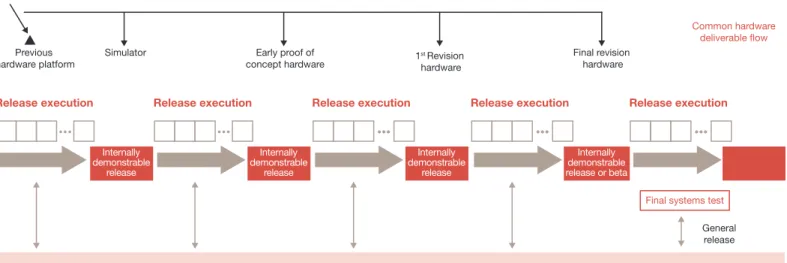
Figure 7: Typical hardware development process
Release execution
Internally demonstrable
release
Internally demonstrable
release
Internally demonstrable
release
Internally demonstrable release or beta
Release execution Release execution Release execution Release execution
Simulator Previous
hardware platform
Early proof of
concept hardware 1
st Revision
hardware
Final revision hardware
Common hardware deliverable flow
Final systems test
General release
Hardware development
Higher level integration—other hardware platforms and software layers applications
Challenge 2: Hardware development follows waterfall techniques, while software is agile. With hardware
development typically following traditional waterfall style development, development organizations struggle to determine the right organization and process approach to adopt agile. (Figure 7)
PwC Strategy 2: Implement hardware milestone-driven release plans.
Define software releases that are aligned to particular hardware
development milestones, such as simulator readiness, or the availability of early proof of concept hardware. Another useful method is to organize the teams and categorize code into dependent and hardware-independent tracks.
Challenge 3: Products are highly complex to architect. Traditional agile development emphasizes light up-front design and limited importance for the role of an architect, in favor of rapid Design-Code-Test iterations. However, developing embedded software for these products is complicated because of multiple chipsets from multiple suppliers, the multi-layered nature of software, and stringent performance, scalability and availability requirements. There is a need for upfront system architecture with
expertise and decision-making capabilities
to properly weigh hardware vs. software trade-offs as well as platform vs. application type architecture decisions.
PwC Strategy 3: Create a well-defined role for embedded software architecture by defining a mechanism for upfront end-to-end system
architecture, system engineering decisions, hardware/software and
application/platform partitioning. Define the role of an architect that
incorporates the following core activities as well as development support:
Core architecture activities:
• Requirements analysis for right choice of architecture
(hardware vs. software, platform vs. application)
• End-to-end architecture description across hardware-software and platform-application
• Documentation of key elements of architecture (e.g., system level APIs)
• System level performance and scalability analysis
Development support activities:
• Participation in epic and user story (requirements) definition
• Prioritization and resolution of architectural issues across teams
Challenge 4: Work is more system-focused than end-user focused. In
traditional agile development, work content
is defined in the form of user stories,
written in the “As a user…..” format. Most embedded software, especially products aimed at enterprises, lack the concept of
an end-user, making it difficult to write
user-focused stories. Also, early stages of embedded systems development involve low-level platform type work requiring “systems” thinking.
PwC Strategy 4: Introduce the nomenclature of “System stories”. Encourage stories to be written as “As a system, it will …” or “The system should…” from the point of view of the system under development. This
easily replaces the traditional “As a user…” syntax that traditional agile
developers are used to.
Challenge 5: Functional
interdependencies need upfront
identification. Agile teams for embedded software development have both intra-and
inter-team work dependencies. For example,
an application team can start work on its stories only after the lower-level platform team builds the foundation. Also, software teams have dependencies on hardware to enable functionality.
PwC Strategy 5: Incorporate a story dependency-mapping exercise into the release and iteration planning cycle. Once hardware-based intra- and inter-team dependencies have been identified, they should be documented
for a given story in the Agile Lifecycle Management (ALM) tool. Inter-connected stories, including dummy stories for hardware dependency, should be linked, and a communications process should be set up to identify dependencies between teams and prioritize implementation.
Challenge 6: Embedded agile teams often struggle to deliver meaningful work within typical 2 week agile iterations.
Longer iteration lengths are typically required to offset the:
• High technical complexity inherent in
embedded products and the ease with which the product design can be changed and tested
• Tightly coupled nature of hardware and software product architectures, and the challenges this poses for build and test automating
• Longer test and debug times necessary to isolate and triage between hardware vs. software issues.
PwC Strategy 6: Institute iterations longer than 2 weeks to accommodate
the complexities and constraints of embedded development. At the same
time, work towards the decoupling of the product architecture to improve
the ability to more easily change, build, and test specific architectural
11
PwC
Support Team Description
Scrum of Scrums
(SMs) • • Maintain a coordinated agile team schedule for planning and execution Resolve cross scrum-team roadblock issues impacting execution: Tactical items such as builds, equipment, short-term debug support, and specific defects requiring resolution Product Owners (POs) • Overall program priority setting related to product requirements and customer interactions
• Joint responsibility with TOs and Architects to define content (Release and Iteration Planning)
• Joint responsibility for prioritization of content across scrum teams
Technical Owners (TOs) • Functional and detailed design planning, content integration, and cross-team issue resolution
• Joint responsibility with POs and Architects to define content (Release and Iteration Planning)
• Joint responsibility for prioritization of content across scrum teams
Test Council (TLs) • Program level system test strategy, planning and coordination
• Definition of cross-scrum team test user stories
Architect Council • System and program level architecture definition, planning and issue resolution
• Joint responsibility with POs and TOs to define content (Release and Iteration Planning) Challenge 7: Multiple agile teams need to
be coordinated effectively. Support roles
such as Scrum Master and Product Owner
focus on one agile team. However, embedded product organizations have multiple agile teams. (Figure 8)
PwC Strategy 7: Implement a cross-discipline technical leadership team that manages across multiple agile teams, consisting of Scrum
Masters, Product and Technical Owners, and Test and Architect
Council members.
Agile
team Agile team
Agile team
Figure 8: Adaptation—Cross-discipline leadership teams (an example)
Scrum of scrums Product owners Technical owners Test council Architect council
SM PO TO TL Arch
SM PO TO TL Arch
SM PO TO TL Arch
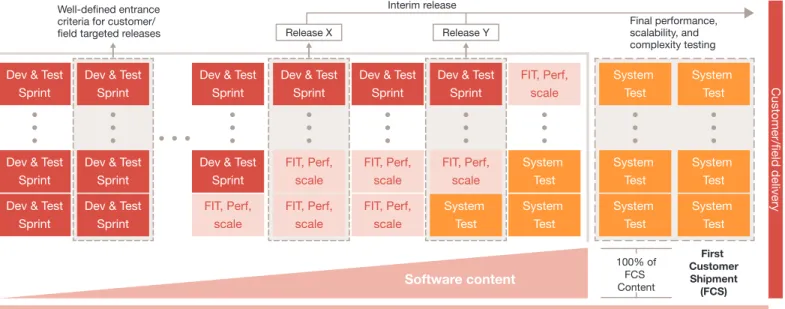
Figure 9: Adaptation—Illustrative agile iterations of system testing
System test activities designed as agile iterations with small teams of testers executing functional, performance, scalability and other system-level testing
Dev & Test Sprint
Dev & Test Sprint Dev & Test
Sprint
Dev & Test Sprint
Dev & Test Sprint FIT, Perf,
scale
Dev & Test Sprint
FIT, Perf, scale FIT, Perf,
scale Dev & Test
Sprint
Dev & Test Sprint Dev & Test
Sprint
Dev & Test Sprint
FIT, Perf, scale FIT, Perf,
scale
Dev & Test Sprint
FIT, Perf, scale System
Test
FIT, Perf, scale
System Test System
Test
System Test
System Test System
Test
System Test
System Test System
Test
Release X Release Y
Customer/field delivery
Final performance, scalability, and complexity testing Well-defined entrance
criteria for customer/ field targeted releases
Continuous integration and regression testing Software content
First Customer Shipment (FCS) 100% of
FCS Content Interim release
FIT=Feature Integration Test
Challenge 8: Strong, balanced governance structure needed for overall execution and market delivery. Given its cross-functional nature, agile implementation directly challenges traditional functional governance structures such as testing and program management. However,
the complex nature of embedded software
development requires effective governance
to oversee overall execution and delivery.
PwC Strategy 8: Implement a cross-functional program core team
sponsored by executive leadership and responsible for the execution
and delivery of the product development team. The program core team provides two-way communication and direction to both agile teams and other program teams.
Challenge 9: Most embedded environments require the concept of System Test. An additional layer of testing, known as System Test, typically follows the development cycle in embedded software development environments.
In addition to black box functional testing in
a customer-like infrastructure environment, System Test focuses on performance, availability
and scalability verification of the embedded product. With agile delivering frequent, working
increments of the product, the role of System Test needs to be integrated into the agile framework.
PwC Strategy 9: Redesign and implement System Test activities as agile iterations, with small teams of testers executing functional,
13
PwC These strategies are designed to help address commonly
found challenges in embedded software development. However, some embedded software development teams may also need to consider additional strategies.
For example, many embedded products, especially consumer electronics, use over-the-air (OTA) upgrades
after the product is released to enable new enhancements
and critical defect fixes. In such cases, product organizations
often establish dedicated small feature, or sustenance, agile teams to handle the post-release product backlog. Moreover, many embedded product developers do not entirely build their software in-house, so the agile development process needs to be further adapted.
Organizations that buy and integrate code from
third-party software vendors or communities that follow their own development/release processes, or simply outsource some software development to third-party companies, may confront development environments that may not necessarily follow agile techniques.
In these cases, the sourcing process needs to be adapted to facilitate agility. Upfront service-level agreements with suppliers on software release content, scope, and cadence,
need to be established. Once the agreements are in place,
a milestone-based hybrid approach, similar to the one used to adapt to waterfall-style hardware development, can be adopted. Another option, particularly useful in offshore staff-augmentation scenarios, is to get the supplier to move towards agile style development.
Agile embedded software development case study
Looking to facilitate early customer adoption by providing
incremental functionality for its next-generation platform at periodic intervals leading to the final release date, a
networking equipment manufacturer asked PwC to help support the transition from waterfall to agile software
development practices. With the goal of institutionalizing
agile practices and accelerating time to customer adoption, PwC helped the client implement a structured agile transformation framework that allowed the company
to implement a three-phase transition:
Phase I: Mobilize and Construct. The team created a
baseline map of the existing environment and product architecture. They then defined the methodology, team
structures, tools, practices, and metrics necessary for an agile-based operating model, and an implementation plan that encompassed pilot and ramp-up phases.
Phase II: Operationalize. The client gradually instituted the agile program by launching the pilot program for four agile teams and developing a plan to scale-up for the remaining 9 teams. It streamlined the move to the new operating model by utilizing PwC organizational training and coaching to implement incremental change management and secure buy-in from all levels of organization.
Phase III: Sustain. Achieved steady-state program
performance targets and removed external supports.
Program is positioned to deliver to market at desired pace. Conclusion
The benefits of agile software development are real,
especially for companies looking to accelerate the product development cycle, a common refrain in many industries
that use embedded software. With careful adaptation of
agile design and development practices, software teams can overcome the inherent constraints of embedded software development and successfully accelerate new
© 2013 PricewaterhouseCoopers LLP, a Delaware limited liability partnership. All rights reserved. PwC refers to the US member firm, and may sometimes refer to the PwC network. Each member firm is a separate legal entity. Please see www.pwc.com/structure for further details.
This content is for general information purposes only, and should not be used as a substitute for consultation with professional advisors. PwC can help
For more information about how PwC can help your organization improve its embedded software development processes by adopting agile techniques, please contact one of our practice leaders.
Aritomo Shinozaki
Principal, Product Innovation
& Development
Advisory Services 408 817 5870
Walter Sun
Principal, Product Innovation
& Development
Advisory Services 408 817 5949
[email protected] Let’s talk
Please reach out to any of our technology leaders to discuss this or other
challenges. We’re here to help. Tom Archer
US Technology Industry Leader 408 817 3836
Kayvan Shahabi
US Technology Advisory Leader 408 817 5724
Cory Starr
US Technology Assurance Leader 408 817 1215
Diane Baylor
US Technology Tax Leader
408 817 5005
[email protected] Acknowledgements
The following PwC professionals contributed their experience, knowledge and expertise to produce this paper.
Bill Noel
Director, Product Innovation
& Development
Advisory Services 617 530 7184
Shankar Subramaniam
Manager, Product Innovation
& Development
Advisory Services 312 298 5217
[email protected] About PwC’s Technology Institute
The Technology Institute is PwC’s global research network that studies the business of technology and the technology
of business with the purpose of creating thought leadership that offers both fact-based analysis and experience-based
perspectives. Technology Institute insights and viewpoints originate from active collaboration between our professionals
across the globe and their first-hand experiences working in and with the technology industry. For more information
please contact Tom Archer, Technology Industry Leader.
About PwC’s Product Innovation and Development Practice
PwC’s Product Innovation and Development advisory services help clients develop new innovative businesses, products and
services to achieve market-leading revenue and profitability growth. We also help our clients build lasting internal capabilities, ranging from Innovation Incubators to global R&D centres to PLM systems, that enable sustained, consistent results.