Evidence-Based Nursing Research Vol. 2 No. 3 July 2020
Article number 11 page 1 of 12
Effect of Training Exercise Program on Functional Outcomes for
Patients with Hand Burns
Rawia A. Ibrahim1, Eman S. M. Omran2 1Medical-Surgical Nursing, Faculty of Nursing, Benha University, Egypt. e-mail: [email protected]
2Medical-Surgical Nursing, Faculty of Nursing, Benha University, Egypt. e-mail: [email protected]
Received April 27, 2020, accepted May 15, 2020.
ABSTRACT
Context: The outcome of hand burns can significantly impact daily function and overall health-related quality of life. A crucial issue in hand burns is proper management of hands treatment and care for maximizing the normal function of the burned hand.
Aim: To evaluate the effect of training exercise program on functional outcomes for patients with hand burns.
Methods: A quasi-experimental design(study/control group) was utilized to achieve the aim of this study. This study conducted at the burn unit at Benha Teaching Hospital. A purposive sample of 60 conscious adult patients who suffered from hand burns. They were divided equally into the study and control group, 30 patients in each. Two tools were used. The structured interview questionnaire to assess patients' knowledge regarding burn injury. Functional outcome scale involving: Jebson-Taylor hand function test (JTHFT) and observational checklist for assessing the hand’s range of motion.
Results: Showed that there was highly statistically significant improvement in patients’ knowledge score among the study group compared to control group, as well as there was an improvement in the function of hand and range of motion in the study group rather than in control group with highly statistically significant differences between both groups.
Conclusions: Implementing a designed training exercise program for patients with hand burns effectively improved knowledge, a function of the hand, and range of motion among the study group than in the control group. The study recommended that post-burn programs should be initiated by a multidisciplinary team and continued after discharge to provide support, education, prevention of complications, and motivation for burn patients.
Keywords:Hand burns, functional outcomes, training exercise program
1. Introduction
Burn injuries are a widespread health problem, one of the most devastating injuries and the fourth frequent most type of trauma following traffic accidents, falls, and interpersonal violence, causing death and disability worldwide (Lee et al., 2014). Burns have always been considered one of the most destructive injuries, causing deaths and significant economic and psychological impacts and long-term somatic sequelae (Bazargani et al.,2011).
Burn injury is one of the most critical injuries around the world. An estimated 265,000 deaths every year are caused by burns globally. Fire-related burns alone caused over 300,000 deaths per year, with more deaths from scalds, electricity, chemical burns, and other burns. About 95% of the injured are in countries with low or average incomes (Cheng et al.,2018).
The hand is considered one of the most common areas of the body that is vulnerable to burns (Schneider et al., 2012). Burned hand impairment is a potential and essential factor in chronic disabilities because it causes complications such as deformation and functional disorders such as the difficulty of normal hand movement, which will adversely affect the life quality of the patients (Dodd et al., 2013).
2Corresponding author: Rawia Ali Ibrahim
Although hand burns affect less than 5% of the total body surface area, they are ranked as severe trauma and requiring extensive treatment in a specialized burn center. Hand burns do not often play significant roles in mortality. However, they can cause crippling deformities and disabilities, which may affect the patient’s ability to perform daily living activities and fine tasks. Subsequently, they may lead to significant functional restrictions and impairments in physical and psychological health, and overall quality of life (Omar et al., 2012).
A crucial issue in hand burns is proper management of hands treatment and care for maximizing the normal function of the burned hand. On this basis, rehabilitation of hands is an essential principle in the effective care of patients (Lin et al., 2013).
2. Significance of the study
According to the World Health Organization (WHO), currently, 90% of burns occur in moderate- and low-income countries due to a lack of facilities and failings in managing this event (Aghazadeh et al., 2018). In Egypt, it is difficult to get precise burn injury statistics due to the lack of an accurate national reporting system. Benha Teaching Hospital documented the admitted number of burned patients in the years 2018 was about 180 patients acquiring inpatient care at the burn unit (Statistical Department of Benha Teaching Hospital, 2018).
Article number 11 page 2 of 12 Acute burns of the hands are complex and may impact
on various aspects of a person's life. Rehabilitation and restoration of hand function are critical for the patient's independence and reintegration into society. Physiotherapy rehabilitation is an integral component of burn care to maintain the range of motion, prevent contracture development, maximize function, and promote psychological well-being and social integration (Dunpath et al., 2016
).
The most crucial point in physical therapy for a burned patient is to have a proper training exercise program that is easy to understand. Although education to patients has a positive effect on clinical improvement, trends, and complications caused by burning, this study has been conducted to study the effect of training exercise programs on functional outcomes for patients with hand burns.
3. Aim of the study
This study aimed to evaluate the effect of training exercise program on functional outcomes for patients with hand burns through:
- Assessing patients ' knowledge regarding burn.
- Assess the function of the hand and range of motion of the burned hands.
- Design and implement a training exercise program for patients with hand burns among the study group.
- Evaluate the effect of training exercise program on functional outcomes for studied patients.
3.1. Research hypotheses
H1: The knowledge score of the study group burned patients will be higher than the knowledge score of the control group after implementing the training exercise program.
H2: Hand function for the study group burned patients will be improved than the control group after implementing the training exercise program.
H3: Hand range of motion for the study group burned patients will be improved compared to the control group after implementing the training exercise program.
3.2. Operational definitions
Functional outcomes are the level of functional capabilities of the hand, which detected through the mean score of the Jebson-Taylor Hand Function test and hand range of motion.
4. Subjects and Methods
4.1. Research design
A quasi-experimental research design (study/control group) utilized to reach the aim of this study. Quasi-experimental research involves manipulating an independent variable without the random assignment of participants to conditions or orders of conditions and can be constructed with single or multiple groups and may involve pretest and post-test or post-test-only measurement (Mateo and Foreman,2014). The quasi-experimental design includes a wide range of nonrandomized or partially
randomized pre-post intervention studies (Handley et al., 2018)
4.2. Research Setting
This study was conducted at the burn unit at Benha Teaching Hospital. It includes four rooms for inpatients with 20 beds. Beds are full most of the time. There is also one room for dressing.Burn unit provide burn care services for burned patient free of charge.
4.3. Subjects
A purposive sample of patients who suffered from hand burns was admitted to the burn unit at Benha Teaching Hospital based on the inclusion criteria. The inclusion criteria were as follows: Adult male and female patients, their age ranged between 20 to 60 years old, who suffered from recent second or third-degree hand burns (post 72 hours of injury) with a total body surface area (BSA) of 15-45%, hemodynamically stable, able to communicate and cooperate with the researcher.
The exclusion criteria included a history of any chronic disease such as diabetes and rheumatoid arthritis due to the probability of having a motor and sensory neuropathy, psychological problems and mental disabilities, deformation, and motor disorders of hands and fingers.
The sample size was estimated using the Epi info (7) statistical program based on the previous year's statistical report of admission to the burn unit at Benha teaching Hospital from the statistical department in 2018 at 90% confidence level and acceptable margin of error 5%. The total sample size was 108. Sixty patients consented to participate in the study. Forty was excluded from the study because they did not meet inclusion criteria, five patients transferred to another hospital, and three refused to participate. The final sample size was sixty patients who met the inclusion criteria and agreed to participate. They were divided randomly into two equal groups (study and control), and each group was containing 30 patients.
The participants assigned to the study and the control group by using simple randomization as follows: Each participant assigned a number, the numbers of the participants were written on slips of paper, placed in a container, mixed well, and then drawn out one at a time until assigning the sample required. The researcher drew the number out of the container. The study group received a designed training exercise program, and the control group received routine hospital care.
4.4. Tools of data collection
Data collected through the utilization of the following tools:
4.4.1. A Structured Interview Questionnaire
The researchers constructed it after reviewing relevant literature. It wrote in the simple Arabic language. It used to assess patients' knowledge regarding burn and included three parts:
Evidence-Based Nursing Research Vol. 2 No. 3 July 2020
Article number 11 page 3 of 12
Part one is concerned with assessing patients' socio-demographic data such as age, gender, educational level, occupation, marital status, and residence.
Part two assessed the burn-related data. The researcher designed this tool to collect data related to how burn occurs, type of burn, burn degree, total body surface area affected (TBSA%), burned hand, and length of hospitalization.
Part three encompassed the patient's knowledge assessment. It was adapted from Radwan et al. (2011); Elsherbini et al. (2018). It developed in Arabic form in order to prevent misunderstanding. It included 20 MCQs about burn distributed as; definition (1 question), cause of burn (1 question), types (4 questions), signs and symptoms (1question), degree of burn (4 questions), the complication of burn (3 questions), first aids of burn (4 questions), precautions (1 question) and common defaults in dealing with burn (1 question). This tool is distributed twice (before training exercise program implementation and at discharge).
Scoring system
Knowledge obtained from patients was scored and calculated. Each question ranged from 0-1 grade. Whereas the correct answer scored 1 grade and scored zero for an incorrect answer. The total score level for the questionnaire sheet was 20 grades (equal 100%).
- The patients' knowledge ≥ 60% considered satisfactory knowledge.
- The patients' knowledge < 60% considered unsatisfactory knowledge.
4.4.2. Functional outcome scales
4.4.2.1. Jebson-Taylor hand function test (JTHFT)
It was adopted from Jebson et al. (1969). It used to assess the function of the burned hand. The JTHFT is an objective and standardized test designed to evaluate the hand's functional capabilities, with 7 test items representing various hand activities. The reliability of the tool was fallen between 0.7 and 0.95 in different studies (Li-Tsang et al., 2004; Cox et al., 2006). The test items include writing a short sentence, turning over 3X5-in cards, picking up small objects and placing them in a container, stacking checkers, simulated eating, moving large empty cans, and moving large, heavy cans. The time to complete each subtest is measured in seconds, with a longer time to completion, indicating more significant impairment in hand function. Table (1) is the standard reference mean.
4.4.2.2. Observational checklist for Hands’ range of motion
It was adapted from Ardebili et al. (2014). It used to assess the motor function of the hand. The original tool consisted of three items related to hand’s range of motion (ability to bend the wrist, ability to rotate the wrist, ability to bend fingers). The researcher added another two items (ability to adduct and abduct fingers and rotate the thumb circularly).
Scoring system
For each movement,a good range of motion was given (2) grade, fair range of motion was given (1) grade, and poor range of motion was given (0) grade.
4.5. Procedures
Permission granted from the Dean of Faculty of Nursing, Benha University, hospital directors, and head of the burn unit at Benha Teaching Hospital. The researcher obtained approval for data collection. The study's objectives and nature explained, so it becamepossible to carry out the study with minimum resistance.
Tools’ validity tested through a jury of five experts from the medical-surgical nursing department, faculty of nursing, Benha University. The modification was carried out according to the panel's judgment on the clarity of sentences, appropriateness, and completeness of the content. The percentage of consensus among experts
regarding structured interviewing questionnaire was 97%, and functional outcome scale was 98%. The reliability of the proposed tools was tested by Cronbach's alpha test (0.958) for a structured interview questionnaire and (0.844) for the ROM checklist.
A pilot study carried out on 10% of the studied subjects (6 patients), who excluded from the primary study sample. The pilot study was conducted to ensure clarity, the applicability of the study tools, also the time needed for each tool to be filled in, and the feasibility of the study process.
All ethical issues were taken into consideration during all phases of the study. The ethical research consideration in this study included the research approval that was obtained Table (1):Jebson-Taylor hand function test (JTHFT) reference standards.
Women Men
Hand’s function Dominant
hand Non-dominant
hand Dominant
hand Non-dominant
hand
11.7±2.1
30.2±8.6
12.2±3.5 32.3±11.8
Writing a short sentence
4.3±1.4 4.8±1.1
4.5±0.9 4.5±0.9
Turning over 3X5-in cards
5.5±0.8 6.0±1.0
5.9± 1.0
6.2± 0.9 Picking up small objects and placing them in a container
6.7±1.1
`8.0±1.6 6.4±0.9
7.9±1.3
Stacking checkers
3.3±0.6 3.8±0.7
3.3±0.7 3.8±0.6
Simulated eating
3.1±0.5 3.3±0.6
3.0±0.4 3.2±0.6
Moving large empty cans
3.2±0.5 3.3±0.5
3.0±0.5 3.1±0.4
Moving large heavy can
Article number 11 page 4 of 12 before training exercise program implementation, the
objectives and aim of the study were explained to all participants, and they informed that they could withdraw from the study at any time. Additional oral consent was taken from the patients who participated in the study. The researcher maintained the anonymity and confidentiality of the subjects.
The preparatory phase included reviewing the available literature and different studies related to the research problem and theoretical knowledge of its various aspects of the study, using textbooks, evidence-based articles, internet periodicals, and journals in order to collect data of this study.
A designed training exercise program was developed by researchers based on patients' needs assessment, literature review, researchers' experience, and opinions of experts. The researchers designed a booklet. It was written in the Arabic language with illustrations, involving theoretical and practical parts.
The theoretical part included information about the definition of burn, causes, types, signs and symptoms, degree of burn, complications of burn, first aids, precautions, common defaults in dealing with a burn, and benefits of early exercise after-burn. The practical part contained many exercises for burned hand (13 exercises for fingers and wrist). Field of work: The process of data collection extended over nine months from the beginning of April 2019 to the end of December 2019. The researchers visited the burn unit three days weekly (morning and afternoon) to collect the data by using previous tools. The researchers assessed the patients' knowledge about burn by using part three of the structured interview questionnaire. The average time needed for the completion of a questionnaire was between 20-30 minutes.
Implementation phase: The training exercise program was implemented for patients with a burn. Patients were recruited equally to either the control group or study group. This training program was conducted for the study group through 4 sessions (two theoretical and two practical). The duration of each session ranged from 45-60 minutes.
The first session was carried out during the assessment phase, which involved (definition of burn, causes, types, degree of burn, signs, and symptoms of different types of burn). This session took 45 minutes. The second session involved (an early and late complication of burn, first aids of burn, precautions to avoid another burn and common defaults in dealing with burn). This session took 45 minutes.
While the third and fourth sessions were involved (demonstration to study group regarding hand exercises post-burn), arrangements for the practical training were made with the physician and nurse specialist regarding time and number of exercises and the performance of a range of motion for hand. Training exercise program validity was tested through a jury of five experts from the Medical-Surgical Nursing Department, Faculty of Nursing, Benha University, and two physicians from the burn unit at Benha teaching hospital. The designed training exercise program was implemented for the study group individually.
The designed training program comprising thirteen exercises included a range of motion exercises for finger and wrist, grip strength exercises for hand, and finger coordination exercises. It is recommended to do the prescribed exercises regularly throughout the day, and every day, for an hour but at least 4 to 5 sessions daily.
These exercises were divided into two practice sessions. The first practical session included a range of motion exercises for hand and wrist (seven exercises). The second practical session included grip strength exercises for hand and finger coordination exercises (six exercises). Each exercise was done for one minute, and the patient asked to repeat it ten times. The researcher demonstrated exercise for patients. Then the patients instructed to perform the exercise. This session took 60 minutes. The training sessions took place three times a week until discharge.
Each session was started with a summary of the previous one and the presentation of the new session's objectives, using the simple Arabic language. Also, the session ended with a content summary and feedback from the patient to ensure that they got the maximum benefit. The teaching methods were composed of lectures, group discussions, role-playing exercises, and real-life demonstrations. Visual aids included colored printed booklet (handout), Microsoft PowerPoint presentation, illustrated pictures, and videos.
The control group received routine hospital care, which included a range of motion exercises for hand. These exercises were done for thirty minutes while dressing at the dressing room under the nurse's supervision.
Evaluation phase: The effect of the designed training exercise program on patient knowledge, hand function, and range of motion was evaluated by comparing the level of study and control group knowledge using the tool (I) and part 3 at discharge. Also, hand function and range of motion have been evaluated after two weeks post-program implementation and at discharge by the researchers through measuring the outcomes by the functional outcome scales.
4.6. Limitation of the study
- Generalization of the results was constricted because the sample was small and selected from one geographical area in Egypt.
- One limitation of the study is that we took only two measurements until the patient discharged. To better quantify the changes in the function of hand after burn, more measurements are recommended during the 6th month or one-year follow-up.
4.7. Data analysis
The collected data were organized, coded, computerized, tabulated, and analyzed using the statistical package for social science (SPSS), version (20). Data analysis was accomplished using the number, percentage distribution, chi-square test, mean, standard deviation, and correlation coefficient; a Paired t-test was used to test the significance of some variables. A significant level value considered when p<0.05, p<0.001.
Evidence-Based Nursing Research Vol. 2 No. 3 July 2020
Article number 11 page 5 of 12
5. Results
Table 2 demonstrates the comparison between study and control groups regarding their demographic characteristics. It shows that 60% of the study group and 76.6% of the control group were at a young age between 20-<30 years. Regarding gender 66.7%, and 63.3% of both study and control groups respectively were males. Regarding education 66.6% for study and 73.3% for control were graduated from secondary school, and 50% of the study group were skilled manual worker, and 63.4% and 60% of the study and control group were married respectively, and 93.3%, 86.7% of study and control group lived in rural areas, with a non-significant difference between both groups at the beginning of the study.
Table 3 illustrates the comparison of the study and control groups regarding their burn-related data. This table reveals that 93.3% of the study group and 90% of the control group their burn occurred due to accidents. Thermal burn represented the highest cause among study and control group (80% and 86.6%), respectively. 66.7% of the study group and 90% of the control group had a second-degree burn, 40% of the study, and 46.7% of the control group had 15% to less than 25 of total body surface area burn. Most of the study and control group had burned in both hands (96.7% and 93.4%), respectively. Concerning the duration of hospitalization, the mean scores were 23.73±5.83 and 24.06±5.65 days for the study and control group, respectively. With a non-significant difference between both groups
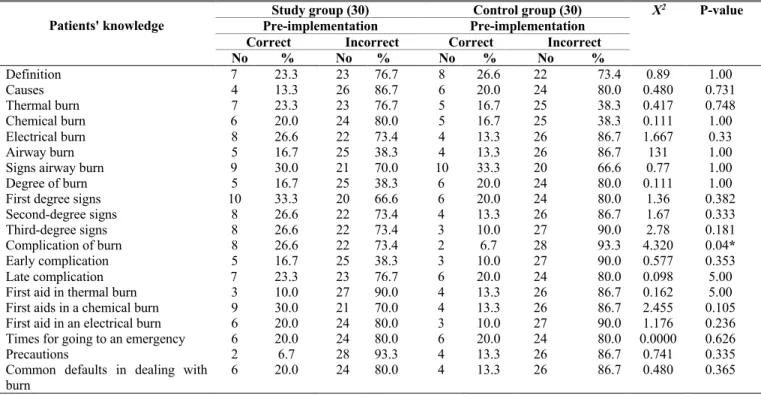
Table 4 shows the comparison of study and control groups regarding their knowledge about burn pre-program implementation. It was noted that 33.3% of the study group had correctanswers related to the first degree of the burn, while 33.3% of the control group had correct answers related to signs of airways burn. Also, 26.6% of the study group had correct answers about the electrical burn, the second, third-degree signs of burn, and complication of burn. On the other hand, 26.6% of the control group had correct answers related to the definition of burn with no statistically significant differences between the study and control group in all items (P>0.05) except complication of burn. There were statistically significant differences (P≤0.05).
Table 5 demonstrates a comparison of the study and control group regarding their knowledge about burn post-program implementation (at discharge). This table reveals that 100% of the study group had correctanswers related to the definition of burn, causes, and time for going to an emergency. In comparison, 53.3% of the control group had correct answers related to knowledge about third-degree signs and early complications. Also, there were highly statistically significant differences between the study and control group in all knowledge elements (P= 0.000).
Figure 1 illustrates that the minority of study and control group had a satisfactory level of knowledge pre-implementation (13.3% and 6.7%), respectively. While post-implementation, most of the study group had a
satisfactory level of knowledge (83.3%), but 86.7% of the control group had unsatisfactory knowledge.
Table 6 shows a comparison of hand function for both the control and study group two weeks post-intervention for the dominant and non-dominant hand. An increase in time indicates decreasing hand function. This table reveals that the control group took more time to complete each function than the study group in both non-dominant and dominant hands. Also, there were highly statistically significant differences between the study and control group regarding all hands’ functions (dominant and non- dominant) (P≤0.05, P=0.000).
Table 7 shows a comparison of hand function for both the study and control group at discharge. This table reveals that the control group took more time to complete each function than the study group in both the non-dominant and dominant hand. Also, there were highly statistically significant differences between the study and control group (P=0.000) regarding all hands’ functions.
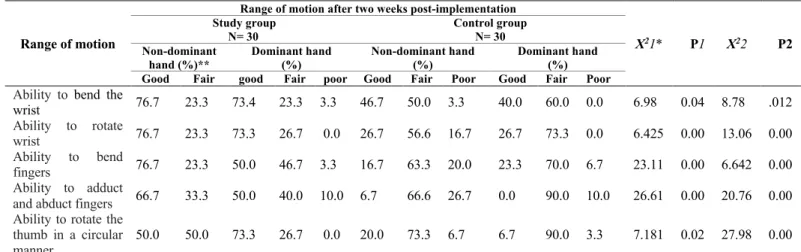
Table 8 reveals a comparison of hand range of motion for both the control and study group two weeks post-intervention. It shows that 76.7% of the study group had a good range of motion for non-dominant hand related to the ability to bend the wrist, rotate the wrist, and bend fingers. Also, 73.4% and 73.3% of them had a good range of motion for the dominant hand related to the ability to bend the wrist, rotate the wrist, and rotate the thumb circularly, respectively. On the other hand, 46.7% and 40% of the control group had a good range of motion for non-dominant and dominant hand related to the ability to bend the wrist. Also, there were highly statistically significant differences between the study and control group in both hands related to all range of motion for both hands (P≤0.05, P<0.001).
Table 9 reveals a comparison of hand range of motion for both the control and study group at discharge. It shows that most of the study group had a good range of motion related to the ability to bend wrist and ability to rotate wrist (80%) in non-dominant hand and 76.7% of them had a good range of motion related to the ability to rotate thumb circularly in the dominant hand. On the other hand, 50% and 26.7% of the control group had a good range of motion related to the ability to bend the wrist and ability to rotate wrist in non-dominant hand respectively, and 16.7% of them had a good range of motion related to the ability to rotate thumb circularly in the dominant hand. Also, there were highly statistically significant differences between study and control group in both hands related to all of the range of motion in both hands (p<0.05 and p<0.001)
Table 10 reveals the correlation between hand function and range of motion two weeks post-implementation and at discharge for both study and control group. This table documents a statistically significant positive correlation between hand function and range of motion two weeks post-implementation in both study and control groups. Also, there was a statistically significant positive correlation between hand function and range of motion at discharge (p≤0.05) for both study and control groups.
Article number 11 page 6 of 12 Table (2): Comparison between the study and control groups regarding their demographic characteristics.
Demographic characteristics Study group N= 30 Control group N= 30 X2 P-value
No % No %
Age
2.572 0.463
20-<30 years 18 60.0 23 76.7
30-<40years 7 23.4 4 13.3
40-<50years 4 13.3 3 10.0
50-<60years 1 3.3 0 0.0
Gender
0.073 0.787
Male 20 66.7 19 63.3
Female 10 33.3 11 36.7
Education level
0.495 0.920
Cannot read and write 2 6.7 2 6.7
Read and write 6 20.0 4 13.3
Secondary 20 66.6 22 73.3
University 2 6.7 2 6.7
Occupation
2.661 0.616
Do not work 2 6.7 2 6.7
Craft 15 50.0 17 56.6
Employee 5 16.7 2 6.7
Student 1 3.3 0 0.0
Housewife 7 23.3 9 30.0
Marital status
1.209 0.546
Single 10 33.3 12 40.0
Married 19 63.4 18 60.0
Divorced 0 0.0 0 0.0
Widow 1 3.3 0 0.0
Residence
0.741 0.389
Rural 28 93.3 26 86.7
Urban 2 6.7 4 13.3
Table (3): Comparison of the study and control groups regarding their burn-related data.
Burn related data Study group N= 30 Control group N= 30 X2 P-value
No % No %
How burn occur
0.218 0.640
Accident 28 93.3 27 90.0
Suicide 2 6.7 3 10.0
Type of burn
2.080 0.556
Thermal 24 80.0 26 86.6
Scalds 4 13.4 2 6.7
Electricity 1 3.3 0 0.0
Chemical 1 3.3 2 6.7
Degree of burn
7.976 0.083
Second degree 20 66.7 27 90.0
Third-degree 2 6.7 1 3.3
Mixed 8 26.6 2 6.7
TBS
0.554 0.758
15-<25% 12 40.0 14 46.7
25-<35% 12 40.0 12 40.0
35-45% 6 20.0 4 13.3
Burned hand
1.018 0.601
Right hand 1 3.3 1 3.3
Left hand 0 0.0 1 3.3
Both hand 29 96.7 28 93.4
Dominant hand
2.069 0.150
Right hand 28 93.3 30 100.0
Left hand 2 6.7 0 0.0
Hospitalization stay (in days)
t=0.224 0.822
Mean ±SD 23.73±5.83 24.06±5.65
Evidence-Based Nursing Research Vol. 2 No. 3 July 2020
Article number 11 page 7 of 12
Table (4): Comparison of study and control group regarding their knowledge about burn pre-program implementation.
P-value X2
Control group (30) Study group (30)
Patients' knowledge Pre-implementation Pre-implementation
Incorrect Correct Incorrect Correct % No % No % No % No 1.00 0.89 73.4 22 26.6 8 76.7 23 23.3 7 Definition 0.731 0.480 80.0 24 20.0 6 86.7 26 13.3 4 Causes 0.748 0.417 38.3 25 16.7 5 76.7 23 23.3 7 Thermal burn 1.00 0.111 38.3 25 16.7 5 80.0 24 20.0 6 Chemical burn 0.33 1.667 86.7 26 13.3 4 73.4 22 26.6 8 Electrical burn 1.00 131 86.7 26 13.3 4 38.3 25 16.7 5 Airway burn 1.00 0.77 66.6 20 33.3 10 70.0 21 30.0 9 Signs airway burn
1.00 0.111 80.0 24 20.0 6 38.3 25 16.7 5 Degree of burn
0.382 1.36 80.0 24 20.0 6 66.6 20 33.3 10 First degree signs
0.333 1.67 86.7 26 13.3 4 73.4 22 26.6 8 Second-degree signs 0.181 2.78 90.0 27 10.0 3 73.4 22 26.6 8 Third-degree signs 0.04* 4.320 93.3 28 6.7 2 73.4 22 26.6 8 Complication of burn
0.353 0.577 90.0 27 10.0 3 38.3 25 16.7 5 Early complication 5.00 0.098 80.0 24 20.0 6 76.7 23 23.3 7 Late complication 5.00 0.162 86.7 26 13.3 4 90.0 27 10.0 3 First aid in thermal burn
0.105 2.455 86.7 26 13.3 4 70.0 21 30.0 9 First aids in a chemical burn
0.236 1.176 90.0 27 10.0 3 80.0 24 20.0 6 First aid in an electrical burn
0.626 0.0000 80.0 24 20.0 6 80.0 24 20.0 6 Times for going to an emergency
0.335 0.741 86.7 26 13.3 4 93.3 28 6.7 2 Precautions 0.365 0.480 86.7 26 13.3 4 80.0 24 20.0 6 Common defaults in dealing with burn
Table (5): Comparison of study and control group regarding their knowledge about burn post-program implementation (at discharge).
P-value X2
Control group(30) Study group(30)
Patients' knowledge Post-implementation Post-implementation
Incorrect Correct Incorrect Correct % No % No % No % No 0.000 27.80 63.4 19 36.6 11 0.0 0 100.0 30 Definition 0.000 40.00 80.0 24 20.0 6 0.0 0 100.0 30 Causes 0.000 19.20 60.0 18 40.0 12 6.7 2 93.3 28 Thermal burn 0.000 20.31 56.6 17 43.4 13 3.3 1 96.6 29 Chemical burn 0.000 19.200 60.0 18 40.0 12 6.7 2 93.3 28 Electrical burn 0.000 23.25 70.0 20 30.0 10 6.7 2 93.3 28 Airway burn 0.000 20.31 56.6 17 43.4 13 3.3 1 96.6 29 Signs airway burn
0.000 24.754 73.4 22 26.6 8 10.0 3 90.0 27 Degree of burn
0.000 19.200 60.0 18 40.0 12 6.7 2 93.3 28 First degree signs
0.000 18.37 63.4 19 36.6 11 10.0 3 90.0 27 Second degree signs
0.005 7.937 46.7 14 53.3 16 13.3 4 86.6 26 Third degree signs
0.002 9.320 50.0 15 50.0 15 13.3 4 86.6 26 Complication of burn
0.000 12.27 46.7 14 53.3 16 6.7 2 93.3 28 Early complication 0.000 13.017 53.3 16 46.7 14 10.0 3 90.0 27 Late complication 0.000 13.017 53.3 16 46.7 14 10.0 3 90.0 27 First aid in thermal burn
0.000 19.200 60.0 18 40.0 12 6.7 2 93.3 28 First aids in chemical burn
0.000 20.317 56.6 17 43.4 13 3.3 1 96.6 29 First aid in electrical burn
0.000 25.714 60.0 18 40.0 12 0.0 0 100.0 30 Times for going to emergency
0.000 26.44 70.0 20 30.0 10 3.3 1 96.6 29 Precautions 0.000 24.300 63.4 19 36.3 11 3.3 1 96.6 29 Common defaults in dealing with burn
Article number 11 page 8 of 12 Figure (1): Percentage distribution of the study and control group according to their total knowledge score levels pre
and post-implementation.
Table (6): Comparison of hand function between study and control groups two weeks post-implementation for the dominant and non-dominant hand.
P2 T2 P1 T1* Hand function two weeks post-implementation
(Time in seconds)
Hands’ functions Study group N= 30 Control group N= 30
Dominant hand Non-dominant
hand Dominant
hand Non-dominant
hand
0.00 8.03 0.00 7.11
20.20±3.57
42.43±3.62 14.56±1.40
35.93±3.44 Writing a short sentence
0.00 7.78 0.00 6.68
9.66±2.12
11.50±2.49 6.10±1.34
7.30±2.38 Turning over 3X5-in cards
0.00 10.65 0.00
8.57
10.90±1.95
12.87±1.54 6.65±1.07
8.77±2.11 Picking up small objects and
placing them in a container
0.00 8.65 0.00 4.55
9.26±2.25
10.80±2.28 5.36±0.99
7.50±3.25 Stacking checkers
0.00 6.56 0.005 2.89
12.23±2.71
13.06±2.32 8.73±1.08
11.40±2.14 Simulated eating
0.00 12.20 0.00
6.43
9.50±1.85
9.300±2.28 4.76±1.04
5.90±1.79 Moving large empty cans
0.00 8.29 0.04 2.11
9.06±1.43
9.53±2.96 5.86±1.54
8.13±2.96 Moving large heavy can
*T 1(P 1): Relationship between non-dominant hand function for the study and control group, T 2(P 2): Relationship between dominant hand function for the study and control group
Table (7): Comparison of hand function for both the control and study group at discharge for dominant and non- dominant hand.
P2 T2 P1
T1* Hand function two weeks post-implementation
(Time in seconds)
Hands’ functions Study group N= 30 Control group N= 30
Dominant hand Non-dominant
hand Dominant
hand Non-dominant
hand
0.00 11.14 0.00
14.69
19.43±3.08
41.86±3.38
12.83±1.01 32.53±0.81
Writing a short sentence
0.00 10.82 0.00
11.57
8.90±1.58 11.01±2.33
5.53±0.62 5.45±1.20
Turning over 3X5-in cards
0.00 13.67 0.00
15.70
10.53±1.87 11.60±1.60
5.66±0.54 7.01± 0.58
Picking up small objects and placing them in a container
0.00 10.506 0.00
8.30
8.63±2.04 9.93±2.25
4.56±0.56 5.83±1.48
Stacking checkers
0.00 5.01 0.01
2.55
10.10±2.55 9.03±1.49
7.66±0.75 8.26±0.69
Simulated eating
0.00 5.87 0.00
5.04
7.20±2.68 7.37±2.68
4.26±0.52 4.80±0.76
Moving large empty cans
0.00 15.62 0.00
12.80
8.40±0.93 9.36±1.95
4.83±0.83 4.56±0.62
Moving large heavy can
*T 1(P 1): Relationship between non-dominant hand function for the study and control group, T 2(P 2): Relationship between dominant hand function for the study and control group.
0.00% 20.00% 40.00% 60.00% 80.00% 100.00%
Study Control
Study Control
n=30 pre implementation
post implementation
83.30%
13.30% 13.30%
6.70% 16.78%
86.70% 86.70%
93.30%
satisfactory knowledge >60% unsatisfactory knowledge<60%
Evidence-Based Nursing Research Vol. 2 No. 3 July 2020
Article number 11 page 9 of 12
Table (8): Comparison of hand range of motion for both the control and study groups two weeks after implementation.
*X21(P1): Relation between non-dominant hand function for the study and control group, X22(P2) Relation between dominant hand function for the study and
control group. **no poor level in the range of motion of the non-dominant hand in the study group.
Table (9): Comparison of hand range of motion for both the control and study group at discharge.
*X21(P1): Relation between non-dominant hand function for the study and control group, X22(P2) Relation between dominant hand function for the study
and control group. **no poor level in the range of motion of the non-dominant hand in the study group.
Table (10): Correlation between hand function and range of motion two weeks post-implementation and discharge for both study and control groups.
Range of motion
Hand function
2 weeks post-implementation At discharge
r-test p –value r-test p -value
Study group 0.340 0.008 0.275 0.033
Control group 0.227 0.082 0.255 0.049
6. Discussion
Although the hands comprise a relatively small amount of the total body surface area, they are frequently involved in burn injuries and can contribute to significant functional impairment and decreased quality of life (Payne et al., 2018). Therefore, the present study aimed to evaluate the effect of training exercise program on functional outcomes for patients with hand burns.
Regarding socio-demographic characteristics of the study and control group, the result of the current study showed that nearly two-thirds of the study group and three
fourth of the control group were at the young age group in between 20<30 years. This result may be explained by the fact that adults are generally active and therefore exposed to hazardous situations at work and home. These results agreed with Elsherbini et al. (2018), who studied "Effect of the burn rehabilitation program on improving quality of life (QoL) for hand burns patients: A randomized controlled study" and found that most of patient in study and control group in young age between 20 and 30 years. Also, this finding was in the same line with Mohamed et al. (2014), who studied "The effect of an educational program for burned patients on their quality of life at Benha Teaching
P2 X22
P1 X21*
Range of motion after two weeks post-implementation
Range of motion
Control group N= 30 Study group N= 30 Dominant hand (%) Non-dominant hand (%) Dominant hand (%) Non-dominant hand (%)** Poor Fair Good Poor Fair Good poor Fair good Fair Good .012 8.78 0.04 6.98 0.0 60.0 40.0 3.3 50.0 46.7 3.3 23.3 73.4 23.3 76.7 Ability to bend the wrist 0.00 13.06 0.00 6.425 0.0 73.3 26.7 16.7 56.6 26.7 0.0 26.7 73.3 23.3 76.7 Ability to rotate wrist 0.00 6.642 0.00 23.11 6.7 70.0 23.3 20.0 63.3 16.7 3.3 46.7 50.0 23.3 76.7 Ability to bend fingers 0.00 20.76 0.00 26.61 10.0 90.0 0.0 26.7 66.6 6.7 10.0 40.0 50.0 33.3 66.7 Ability to adduct and abduct fingers
0.00 27.98 0.02 7.181 3.3 90.0 6.7 6.7 73.3 20.0 0.0 26.7 73.3 50.0 50.0 Ability to rotate the thumb in a circular manner
P2 X22
P1 X21*
Range of motion after two weeks post-implementation
Range of motion
Control group N= 30 Study group N= 30 Dominant hand (%) Non-dominant hand (%) Dominant hand (%) Non-dominant hand (%)** Poor Fair Good Poor Fair Good poor Fair good Fair Good .012 8.78 0.01 5.93 0.0 60.0 40.0 0.0 50.0 50.0 3.3 23.3 73.4 20.0 80.0 Ability to bend the wrist 0.00 9.64 0.00 17.53 0.0 66.7 33.3 6.7 66.6 26.7 0.0 26.7 73.3 20.0 80.0 Ability to rotate wrist 0.28 2.52 0.00 19.96 6.7 60.0 33.3 10.0 70.0 20.0 3.3 43.3 53.4 23.3 76.7 Ability to bend fingers 0.00 16.85 0.00 25.22 10.0 86.7 3.3 20.0 73.3 6.7 3.3 46.7 50.0 33.3 66.7 Ability to adduct and abduct fingers
0.00 21.98 0.00 17.67 3.3 80.0 16.7 6.7 73.3 20.0 0.0 23.3 76.7 26.7 73.3 Ability to rotate the thumb in a circular manner
Article number 11 page 10 of 12 Hospital” and reported that more than two-thirds of the
studied group aged between (18 -< 30) years.
Regarding gender, the present study revealed that nearly two-thirds of patients were males in both groups. This result may be attributed to the fact that males are more exposed to occupational hazards. These results agreed with Elsherbini et al. (2018), who stated that more than half of the study group and two-thirds of the control group were males. However, these results disagree with Abd Elalem et al. (2018), who studied "The effect of self-care nursing intervention model on self-esteem and quality of life among burn patients" and found that more than half of patients were females. It also disagreed with Ardebili et al. (2017), who studied "Effect of multimedia self-care education on quality of life in burn patients" and reported that more than half of the studied patients were females.
Regards education, occupation, and residence, two-thirds of the study group and nearly three fourth of control were graduated from secondary school, and half of the study group were skilled manual workers, and most of the study and control group lived in rural areas. This finding could be due to the Egyptian culture of rural areas; they use fire as a source for seeking warmth, especially during cold nights and in cooking. Therefore, they are exposed to accidental burn injuries. This finding was in the same line with Elsherbini et al. (2018); Mohamed et al. (2014), who found in their studies most of the patients lived in rural areas. This finding is also accepted by Abbass (2009) in his study about “Effect of Api-Tulle dressing versus the conventional dressing technique on the healing of moderate burns," and Fathy (2010) in his study about " Assessment of burned patients’ needs in Benha Teaching Hospital" who reported that the highest percent of burn victims were living in the rural area.
Concerning marital status, nearly two-thirds of patients in both groups were married. This finding may indicate that marriage problems may lead to burning injury either by suicide ideas or loss of concentration when contacting dangerous items or domestic violence due to increasing workload. This finding was in the same line with Elsherbini et al. (2018), who found that two-thirds of the study group were married. Also, following Abd Elalem et al. (2018), who reported that half of the study subjects were married. Nevertheless, these results disagree with Ardebili et al. (2017); Mohamed (2014) found that more than half of the studied subjects were singles.
Regarding burn-related data, the results of the current study reveal that the majority of the study and control group burn occurred due to accident, thermal burn represented the highest cause among study and control group followed by scald (boiled water). That is, most of the patients were affected by thermal. This finding may be due to unsupervised and careless handling of gas pipes without safety features and malfunctioning kerosene pressure stoves during cooking. Petrol (kerosene), which is also stored at home increases the risk of fires.
This result was congruent with Omar and Hassan (2011) in their study about "Evaluation of hand function after early excision and skin grafting of burns versus
delayed skin grafting: A randomized clinical trials." The study reported that the most common cause of burns was flame, with a frequency of about 72.5%, in the same line with Hashemi et al. (2014) in a study about "Effect of Orem self-care program on the life quality of burn patients referred to Ghotb-al-Din-e-Shirazi Burn Center, Shiraz, Iran: A randomized controlled trial," who found that more than three fourth of the subjects had a thermal burn.
Regards the degree of burn, two-thirds of the study group and most of the control group had a second-degree burn, and less than half of the study and control group had fifteen percent to less than twenty-five percent of total body surface area burned. This finding could be due to a delay in transferring the patient immediately after burn injury to the burn center. These results are matched with Abd Elalem et al. (2018), who reported that more than half of patients had burn injury from ten percent to than twenty-five percent of TBSA. Also, following Omar and Hassan (2011), who stated that patients in both groups had burn injury covering twenty-four and twenty-six percent of TBSA. This result is incongruent with Mohamed et al. (2014), who reported more than two-thirds of patients with a second-degree burn.
The current study findings revealed that most of the study and the control group had burned in both hands. This finding might be referred to as the nature of handling things and doing work, which is usually done by both hands. This result agreed with Hashemi et al. (2014), who reported that the burn's primary site was in hand with the highest percent. This finding also matched with Mohamed et al. (2014), who clarified that face and hands are the most common locations of burns.
Concerning the length of hospitalization, the mean scores were 23.73±5.83 and 24.06±5.65 days for the study and control group, respectively. These results agreed with Omar and Hassan (2011), who found that the mean length of hospitalization in both groups was 16 ±2.5 and 24±3.4 days. Also in the same line with Mohamed et al. (2014), who reported that patients who had burned in face, hands and upper arm and leg stayed more than three weeks in the hospital and this could be explained as those sites are the most common and serious sites of burn injury because of their dominant functions in the activity of daily living.
Regarding knowledge of patients related to burn, the present study revealed an improvement in the study group's level of knowledge after program intervention compared with the control group with highly statistically significant differences between them. This finding might be due to the positive effect of theoretical sessions in the designed training exercise program. These results agreed with Elsherbini et al. (2018). They reported a definite improvement in the level of knowledge of the study group after applying the burn rehabilitation sessions compared with the control group with a statistically significant difference between them.
Also, these results were supported by Radwan et al. (2011). They studied "Effect of a rehabilitation program on the knowledge, physical and psychosocial functions of patients with burns." They reported that their study group exhibited a significant improvement in the scores of
Evidence-Based Nursing Research Vol. 2 No. 3 July 2020
Article number 11 page 11 of 12
knowledge compared to the control group after applying for the rehabilitation program. In the same line, Abd Elalem et al. (2018) showed that the patient's knowledge about burn and self-care improved post-intervention rather than pre-intervention with a high statistical significance difference. These findings are supporting the first research hypothesis.
Regarding the effect of exercises program on functional outcomes (hand function and range of motion of burned hand), the present study's results reveal an improvement in function and range of motion of the hand in the study group compared to the control group two weeks post-intervention and at discharge. Highly statistically significant differences were revealed between the study and control group, which indicates the success of the training exercise program in improving hand function of burned patients. From the research point of view, this result ensuring that exercise is one of the most critical measures for managing deformation and improving the motor function of the skin after hand burn.
These results were supported by Ardebili et al. (2014) in their study about "Effect of educational program based on exercise therapy on burned hand function” and stated that execution of hands exercise program was effective in improving the function of hands. Also, this results in the same line with Paratz et al. (2012) in their study entitled "Intensive exercise after thermal injury improves physical, functional, and psychological outcomes," which showed that physiotherapy educational program in patients with hand burn promoted the physical and functional improvement and had a positive effect on psychological consequences of these patients.
Also following Schneider et al. (2012), who studied "Efficacy of inpatient burn rehabilitation: A prospective pilot study examining a range of motion, hand function, and balance," and reported that execution of rehabilitation programs particularly physiotherapy education in patients with hand burn had a positive and considerable effect on the range of motion of hands and normal function of the hand.
The study also matched with Li et al. (2017), who studied "The effect of a rehabilitation nursing intervention model on improving patients' comprehensive health status with hand burns." It stated that the rehabilitation intervention model had significant effects on the improvement of patients' physical function. Also, these results were supported by Mohamed et al. (2014), who found that educational program has a positive effect on improving patient hand functions and increasing ability of the patient to do isometric exercises and consistent with Elsherbini et al. (2018). They reported that there was a definite improvement in the mean score of hand function in the study group after implementing a rehabilitation program than the control group.
In the same line, Sabapathy et al. (2010) studied "Management of post-burn hand deformities," and Colaianni and Provident (2010), who studied "The benefits of and challenges to the use of occupation in hand therapy.” They emphasized the importance of teaching burns' patients through a planned educational program, which considered an effective method used to prevent the unforeseen burn
deformities in the patient care process. Moreover, education to the patient has a positive effect on the clinical outcomes and complications caused by burn. These findings are supporting the second and third research hypotheses.
The results of the current study documented that there was a statistically significant positive correlation between hand function and range of motion two weeks post-implementation and at discharge for both study and control group which indicates the necessity of performing an early range of motion and hand exercise post-burn that in turn leading to positive hand function and decrease disabilities. These results agreed with Perera et al. (2015) in their study about "Effects of burn on the mobility of upper limb/s, functions of hand/s and activities of daily living" and found a significant positive correlation between active range of motion and hand function in performing selected activities of daily living
.
7. Conclusion
Based on the findings of the current study, it can be concluded that: Implementing a designed training exercise program for patients with the burned hand was effective in improving knowledge, the function of the hand, and range of motion among the study group than in the control group.
8. Recommendation
Based on the results of the current study, the following recommendations are suggested:
- Post-burn programs should be initiated by a multidisciplinary team and continued after discharge to provide support, education, prevention of complications, and burn patients' motivation.
- Written, colored simple booklets about burn and isometric exercises should be provided and be available for all patients in the burn unit.
- Apply other researches using more instruments to assess the function of burned hand such as Michigan hand outcome questionnaire and total active motion of joint. - Replication of the current study on a larger probability
sample is recommended to achieve generalizability and broader utilization of the designed program.
9. Acknowledgment
The researchers would like to extend their great appreciation to all nurses, nurse specialists, and physicians in the burn department at Benha Teaching Hospital and the patients involved in the study for their cooperation in this study's fulfillment.
10. References
Abbass, H. (2009). Effect of Api-Tulle dressing versus the conventional dressing technique on the healing of moderate burns. Unpublished Master Thesis, Faculty of Nursing, Alexandria University. Pp. 43.
Abd El Alem, S., Shehata, O., & Shattla, S. (2018). The effect of care nursing intervention model on self-esteem and quality of life among burn patients. Clinical Nursing Studies,6(2), 79-90.
Article number 11 page 12 of 12 Aghazadeh, A., Lotfi, M., Ghahramanian, A., & Ahadi, F.
(2018). Lethal area 50 in patients with burn injuries in North West, Iran. J Caring Sci. 7(1), 53.
Ardebili, F., Ghezelje, T., Bozorgnejad, M., Ghorbani, H., & Manafi, F. (2017). Effect of multimedia self-care education on quality of life in burn patients. World J Plast Surg, 6(3), 292-297.
Ardebili, F., Manzari., Z., & Bozorgnejad, M. (2014). Effect of educational program based on exercise therapy on burned hand function, World J Plast Surg, 3(1), 39-46. Bazargani, H., Maghsoudi, H., Ranjbar, F., & Abdollahi, H. (2011). Stress disorder and PTSD after burns injuries: A prospective study of predictors of PTSD at Sina Burn Center, Iran. Neuropsychiatr Dis Treat, (7), 425–9.
Cheng, W., Wang, S., Shen, C., Zhao, D., Li, D., & Shang, Y. (2018). Epidemiology of hospitalized burn patients in China: A systematic review. Burns Open, 2(1), 8-16.
Colaianni, D., & Provident, I. (2010). The benefits of and challenges to the use of occupation in hand therapy. Occup Ther Health Care, 24(2), 130–146.
Cox, J., Spaulding, S., & Kramer, J. (2006). A comparison of two assessments of hand function. J Hand Ther, 4, 443-4.
Dodd, A. R., Nelson-Mooney, K., Greenhalgh, D. G., Beckett, L. A., Li, Y., & Palmieri, T. L. (2013). The Effect of hand burns on quality of life in children. Burns, 39, 16-23.
Dunpath, T., Chetty, V., & Reyden, D. (2016). Acute burns of the hands: Physiotherapy perspective. African Health Science, 16(1), 266–275.
Elsherbini, O., El Fahar, M., & Weheida, S. (2018). Effect of burn rehabilitation program on improving quality of life (QoL) for hand burns patients: a randomized controlled study. Eur J Plast Surg, 41, 451–458.
Fathy, R. (2010). Assessment of burned patients’ needs in Benha Teaching Hospital, Unpublished Master Thesis, Faculty of Nursing, Benha University. Pp. 95.
Handley, M., Lyles, C., McCulloch, C., & Cattamanchi, A. (2018). Selecting and Improving Quasi-Experimental Designs in Effectiveness and Implementation Research, Annu Rev Public Health,39, 5-25.
Hashemi, F., Dolatabad, F., & Yektatalab, S. (2014). Effect of Orem self-care program on the life quality of burn patients referred to Ghotb-al-Din-e-Shirazi Burn Center, Shiraz, Iran: A Randomized controlled trial. Int J Community Based Nurs Midwifery, 2(1), 46-48.
Jebsen, R. H., Taylor, N., Trieschmann, R. B., Trotter, M. H., & Howard, L. A. (1969). An objective and standardized test of hand function. Arch Phys Med Rehabil, 50, 311–9.
Lee, K. C., Joory, K., & Moiemen, N. S. (2014). History of burns: the past, present, and the future. Burns Trauma, 2(4), 169–180.
Li, L., Xu, J., Xu, L., Huang, Z., Pan, Q., Zhang, X., & Chen, Z. (2017). The effect of a rehabilitation nursing intervention model on improving the comprehensive health status of patients with hand burns, burns, (43), 877-885. Lin, S. Y., Chang, J.K., Chen, P.C., & Mao, H. F. (2013). Hand function measures for burn patients: A literature review. Burns, 39(1), 16–23.
Li-Tsang, C., Chan, S., Chan, S., & Soo, A. (2004). The Hong Kong Chinese Version of the Jebsen hand function test: Inter-rater and test-retest reliabilities. Hong Kong J Occup Ther, 1, 12-20.
Mateo, M., & Foreman, M. (2014).Research for advanced practice nurses: From evidence to practice, 2nd ed, Springer publishing company, NewYork. Pp. 137.
Mohammed, R. Allaa-Eldin, S., Zaghlol, A., & Ragheb, M. (2014). The Effect of an educational program for burned patients on their quality of life at Benha Teaching Hospital. Doctoral thesis, medical-surgical nursing, faculty of nursing, Benha university. Pp. 105-120.
Omar, M. T., Hegazy, F. A., & Mokashi, S. P. (2012). Influences of purposeful activity versus rote exercise on improving pain and hand function in the pediatric burn. Burns, 38(2), 261–268.
Omar, M., & Hassan, A. (2011). Evaluation of hand function after early excision and skin grafting of burns versus delayed skin grafting: A randomized clinical trial, burns, (37), 707-713.
Paratz, J., Stockton, K., Plaza, A., Muller, M., & Boots, R. (2012). Intensive exercise after thermal injury improves physical, functional, and psychological outcomes. J Trauma Acute Care Surg,73, 186-94.
Payne, M., Quiroga, L., Cooney, M., & Caffrey, A. (2018). Use of vascular clips to approximate skin grafts on the burned hand, Burns Open, 2(3), 126-129.
Perera, M., Nanayakkarawasam, P., & Katulanda, P. (2015). Effects of burn on the mobility of upper limb/s, functions of hand /s & activities of daily living, Int J Physiother Res, 3(1), 832-838.
Radwan, M., Samir, S., Aty, O., & Attia, S. (2011). Effect of a rehabilitation program on the knowledge, physical, and psychosocial functions of patients with burns. J Am Sci 7, 427-434.
Sabapathy, S. R., Bajantri, B., & Bharathi, R. R. (2010). Management of post-burn hand deformities. Indian J Plast Surg, 43(Suppl), S72–S79.
Schneider, J., Qu, H., Lowry, J., Walker, J., Vitale, E., & Zona, M. (2012). Efficacy of inpatient burn rehabilitation:
A prospective pilot study
examining the range of motion, hand function, and balance. Burns, 38(2), 164-171.
Statistical Department of Benha Teaching Hospital (2018). Benha teaching hospital, El Kalyoubeya, Egypt.