MJCCA9 – 662 ISSN 1857-5552 e-ISSN 1857-5625
Received: November 7, 2014 UDC: 548.7
Accepted: December 10, 2014 Original scientific paper
SQUEEZE
FOR TREATING SEVERELY DISORDERED SOLVENT MOLECULES
IN THE REFINEMENT OF THE OTHERWISE ORDERED CRYSTAL STRUCTURES
OF [Cd(C
12H
10N
4)(C
15H
9O
2)
2(CH
3OH)]·0.5H
2O·CH
3OH
AND [Cd(C
12H
10N
4)
1.5(C
15H
9O
2)
2]·CH
3OH
Seik Weng Ng
Department of Chemistry, University of Malaya, 50603 Kuala Lumpur, Malaysia Chemistry Department, King Abdulaziz University, Jeddah, Saudi Arabia
In the refinement of the crystal structure of [Cd(C12H10N4)(C15H9O2)2(CH3OH)]·0.5H2O·CH3OH, the lattice water molecule was not located by difference Fourier synthesis but was instead deduced by us-ing SQUEEZE owing to severe disorder of the water molecule in the otherwise ordered crystal structure. Similarly deduced were the two symmetry-independent methanol molecules in [Cd(C12H10N4)1.5(C15H9O2)2]·CH3OH. The first coordination polymer adopts a chain motif and the second a layer motif; for both, the N-heterocycle functions as a bridge to connect adjacent metal atoms. The sol-vent molecules are presumed to reside in voids, which are themselves connected into channels. The crys-tallographic program Crystal Explorer was used in the illustration of the channels. Crystal data C44H37N4O6.5Cd: FW = 838.18, monoclinic, P21/n, a = 16.7871(4) Å, b = 26.5431(5) Å, c = 18.7034(5) Å, = 111.915(3), V = 7731.7(3) Å3. Crystal data for C49H38N6O5.5Cd: FW = 911.25, monoclinic, P21/c, a = 11.0586(3) Å, b = 23.5007(6) Å, c = 17.3454(5) Å, = 105.626(3), V = 4341.2(2) Å3.
Keywords: solvent molecules; voids;SQUEEZE; Crystal Explorer
SQUEEZE ЗА ТРЕТИРАЊЕ НА ИЗРАЗИТО НЕСРЕДЕНИТЕ МОЛЕКУЛИ
НА РАСТВОРУВАЧОТ ПРИ УТОЧНУВАЊЕ НА ИНАКУ СРЕДЕНИТЕ КРИСТАЛНИ СТРУКТУРИ НА [Cd(C12H10N4)(C15H9O2)2(CH3OH)]·0.5H2O·CH3OH И
[Cd(C12H10N4)1.5(C15H9O2)2]·CH3OH
Позицијата на молекулата на вода при уточнувањето на кристалната структура на [Cd(C12H10N4)(C15H9O2)2(CH3OH)]·0.5H2O·CH3OH не е лоцирана со диферентната Фуриеова синтеза, туку е определена со помош на SQUEEZE, поради изразената несреденост на молекулата
на вода во инаку средената кристална структура. На сличен начин се дефинирани и позициите на двете симетриски независни молекули на метанол во [Cd(C12H10N4)1.5(C15H9O2)2]·CH3OH. Првиот координационен полимер гради синџирест мотив, а вториот слоевит мотив, при што за обата N -хетеропрстенот игра улога на мост кој ги поврзува соседните метални атоми. Молекулите на растворувачите се сместени во празнините, формирајќи преку меѓусебно поврзување посебни канали. За илустрирање на каналите е користена кристалографската програма Crystal Explorer.
Кристалографски податоци за C44H37N4O6.5Cd: FW = 838.18, моноклиничен, P21/n, a = 16.7871(4) Å, b = 26.5431(5) Å, c = 18.7034(5) Å, = 111.915(3), V = 7731.7(3) Å3. Кристалографски податоци за C49H38N6O5.5Cd: FW = 911.25, моноклиничен, P21/c, a = 11.0586(3) Å, b = 23.5007(6) Å, c = 17.3454(5) Å, = 105.626(3), V = 4341.2(2) Å3.
Клучни зборови: молекули на растворувачот; SQUEEZE; Crystal Explorer
1. INTRODUCTION
In some crystal structure analyses of small molecules, residual peaks in the difference Fourier map that will not yield to refinement are usually suspected to be solvent molecules if the peaks are positioned away from the otherwise ordered part of the structure. If no other chemical analyses can be performed on the compounds for a variety of rea-sons, then an educated guess of the nature and number of the solvent molecules can be made with the SQUEEZE procedure of the PLATON suite un-der such circumstances. This calculates the contri-bution of disordered solvent molecules, assumed to exist in voids, in the refinement of the ordered part of the crystal structure by extracting information on the electron density from a correctly-phased model of the ordered part [1, 2]. According to
PLATON, voids are those spaces in a crystal struc-ture that can accommodate a sphere of 1.2 Å radi-us, but the voids themselves should not overlap with the Van der Waals spheres of the ordered at-oms. After the application of the SQUEEZE proce-dure, no additional parameters in the subsequent refinement should be necessary if the voids have no more residual electron density. A recent report presented cases of using the procedure on a range of crystal structures [3].
In this study, cadmium nitrate, anthracene-9-carboxylic acid and a 4,4´-bipyridine-like N -he-terocycle when reacted in methanol medium yield-ed two types of prismatic crystals, one being light yellow and the other being dark yellow. It was im-practical to separate the two manually owing to the small quantity of crystals synthesized; consequent-ly, no further chemical measurements could be performed on the mixture. Other compounds were not found in the medium.
4-[(1E)-[(E )-2-(Pyridine-4-ylmethylidene)hy-drazine1-1-ylidene]methyl]pyridine itself exists as a flat, centrosymmetric molecule [4, 5] whose two aromatic donor sites are each capable of binding to a metal center to generate a chain motif, as exem-plified by the cadmium nitrate adduct [6]. The pre-sent study was initiated to explore other adducts of cadmium bis(anthracene-9-carboxylate) as the compound forms adducts with other N-heterocyclic ligands: for example, the 2,2´-bipyridine and 1,10-phenanthroline adducts are both water-bridged di-mers. The 4,4´-bipyridine adduct adopts a ribbon structure; two carboxylate-chelated cadmium at-oms are each bridged through two other carbox-ylate anion to a central cadmium atom, and the three-metal entity is linked to adjacent three-metal entities to generate a ribbon [7]; the adducts exhibit luminescence. The crystal structures of two
cadmi-um bis(anthracene-9-carboxylate) adducts of the Schiff base ligand (I and II) are reported here to-gether along with a description of how the solvent molecules are identified by the use of SQUEEZE.
I
II
2. SYNTHESIS
4-[(1E)-[(E)-2-(Pyridine-4-ylmethylidene) hy-drazine-1-1-ylidene]methyl]pyridine was synthe-sized from the condensation pyridine-4-carbox-aldehyde with hydrazine [4, 5]. The Schiff base (0.001 mol), cadmium nitrate (0.001 mol) and an-thracene-9-carboxylic acid (0.002 mmol) were loaded into a convection tube along with several drops of triethylamine; the tube was filled with methanol kept at 333 K. Crystals were collected from the side arm after several days; one type has a light yellow and the other a dark yellow color. Alt-hough the two types of crystals could be distin-guished when viewed under a microscope, their manual separation was not carried out; it was not practical to scale up the synthesis either.
3. CRYSTALLOGRAPHY:
DATA COLLECTION AND REFINEMENT
Diffraction measurements on light yellow [Cd(C12H10N4)(C15H9O2)2(CH3OH)]·0.5H2O·CH3OH
radiation up to 2max of 55. A sphere of reflections
was measured; the 89,570 reflections averaged to 17,891, with 14,199 satisfying the I >2(I) cutoff. A numerical absorption correction based on the Gaussian integration of a multi-faceted crystal [9] was applied. In the initial stages of refinement with
SHELXL-2013[10], the residual index did not fall below 0.047 and the difference Fourier map had two peaks (2.98 and 4.46 eÅ–3) larger than 1 eÅ–3. The weighting scheme [–1 = 2 + (0.0520P)2 + 25.1399P] had an unusually large second parame-ter. These peaks could not be treated by assuming a disordered water molecule.
The SQUEEZE program in the most recent version of crystallographic checking program,
PLATON[11], was used to read the *.cif and *.fcf
that were generated by SHELXL-2013. The run generated several files, with *_sq.ins and *_sq.hkl
being used for further refinement. (Information on the solvent-accessible volume and the estimated number of electrons in the voids is given as a *_sq.sqf.) The *_sq.sqf file showed that there are four 39 Å3
voids (in general positions), with each void holding an approximately 7-electron species. (The program assumes a triclinic primitive cell in the calculation of the voids for all crystal struc-tures). The 7-electron species was assumed to be a water molecule on the basis of the volume of the void since a water molecule has an approximately 40 Å3
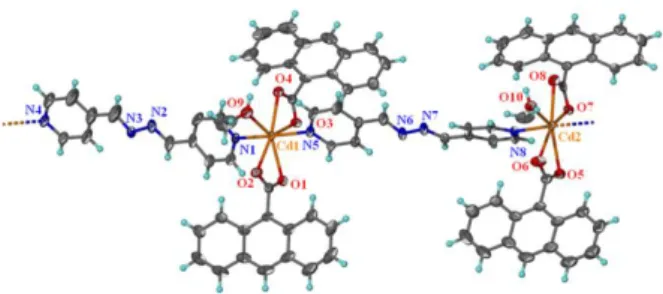
volume. Subsequent refinements proceeded to a final residual of 0.039; the final difference map was featureless; furthermore, the weighting scheme [-1 = 2 + (0.0353P)2 + 12.1175P] was much improved. Some minor disorder in the – C=N–N=CH– segment of the bridging ligand was treated by the use of distance restraints. Figure 1 depicts a portion of the chain motif. (CCDC depo-sition No.1001480)
A sphere of reflections was also collected on [Cd(C12H10N4)1.5(C15H9O2)2]
.
CH3OH (II). The 45,445
reflections averaged to 10,043, with 8,862 satisfying the I >2(I) cutoff. A numerical correction for ab-sorption was applied. In the initial stages of refine-ment, the residual index did not fall below 0.067 and the difference Fourier map had five peaks that were not near any atom, with the largest being 4.80
eÅ–3 [–1 = 2 + (0.1191P)2 + 21.6051P]. The *_sq.sqf file showed that there are two 294 Å3 voids (on Wyckoff 2d special positions), with a 37-electron species in each void. The 37-37-electron unit is assumed to consist of two methanol molecules. Subsequent refinements on proceeded to a final residual of 0.036; the final difference map was fea-tureless and the weighting scheme [–1 = 2 + (0.0423P)2 + 3.9095P] was similarly much
im-proved. Figure 2 depicts a portion of the layer mo-tif; the layer motif is represented as an OLEX [12] plot in Figure 3 (CCDC deposition No. 1001481).
4. RESULTS AND DISCUSSION
Cadmium bis(anthracene-9-carboxylate) forms two different adducts with the Schiff base, 4-[(E )-[(E)-2-pyridin-4-methylidene)hydrazin-1-ylidene] methylpyridine, in the same synthesis. The formula unit of (I), features two metal atoms; each is O,O
´-chelated by the carboxylate anion and is also coor-dinated by a methanol molecule. The Schiff base links adjacent metal atoms to form a linear chain. The geometry of the metal atoms is a trans -pentagonal bipyramid in which the nitrogen atoms occupy axial sites (Fig. 1).
Fig. 1. 70% probability ORTEP plot of a portion of (I) without lattice solvent molecules
Water molecules (predicted by SQUEEZE) and lattice methanol molecules connect adjacent chains to generate a hydrogen-bonded 3D network structure. In (II), the metal atom is similarly O,O
´-chelated by the carboxylate ion; however, the met-al atom is coordinated to two different Schiff-base ligands so that the N-heterocycles link adjacent metal atoms to generate a layer (Fig. 2); the honey-comb network has the common honeyhoney-comb topol-ogy (Fig. 3).
Fig. 3. OLEX representation of the layer structure of (II)
The methanol solvent molecules (predicted by SQUEEZE) are presumed to occupy the space between adjacent layers, and these connect the lay-ers to generate a hydrogen-bonded 3D network. The two adduct are expected to exhibit light-emitting properties since some cadmium dicarboxylates are known to exhibit such behavior [6, 7, 13].
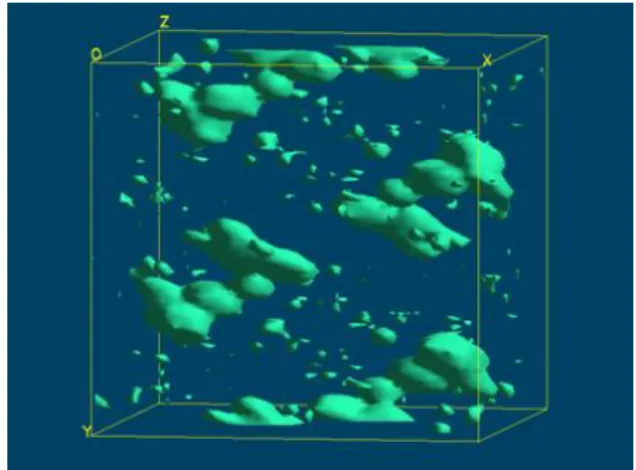
In (II), the voids are each presumed to hold two methanol molecules; however, instead of re-garding these lattice occupants as being severely-disordered solvent molecules, the electron density in the voids is better thought of in terms of chan-nels of inter-connected electron density. The main voids as well as the smaller ones (before the appli-cation of SQUEEZE) are shown as a single unit-cell isosurface plot [14] (Fig. 4); the plot, which is essentially an Fobs–Fcalc plot, shows that the regions
of electron density are not localized but are instead spread over the unit cell. A somewhat simpler de-piction of the electron density map can be made with ShelXle [15]. The coordination polymer (II) adopts an undulating layer motif, and adjacent honeycomb-like layers are stacked over each other (Fig. 5).
Fig. 4. Isosurface showing electron density of (II) (before SQUEEZE)
Fig. 5. Stacking of undulating honeycombs of (II)
The analysis of voids (that are presumably filled by the solvent molecules) is best performed with CrystalExplorer [16]; in addition to the analysis of voids [17], the program can also be used to investigate Hirshfeld surfaces [18]. In (II), the methanol solvent molecules insert themselves between the layers, which adopt a wave-like conformation. According to the depiction by
CrystalExplorer, the solvent molecules are better regarded as molecules that are organized into channels (Fig. 6).
Fig. 6. Voids of (II) depicted as channels
The presence of rigid ligands in coordination polymers gives rise to rigid chain, layer and 3D motifs, and if the ligands themselves are large, then the resulting structures can accommodate larger solvent molecules. The coordination polymer, [Zn2(C12H12N2)(C8H4O4)2] (C12H12N2 is
2,2´,4,4´-bipyridine) is reported to crystallize with solvent molecules as [Zn2(C12H12N2)(C8H4O4)2
.
DMF.2H2O];
the nature and number of solvent molecules were assumed from a SQUEEZE run on the room-temperature measurements [19]. A low-tempera-ture study established the formulation as [Zn2(C12H12N2)(C8H4O4)2.DMF]; i.e., the 3D
then used in the structure-factor calculations.
SQUEEZE was used in an extreme case of a cadmium carboxylate having a huge carboxylate group: the uncoordinated anion could not be located in the difference Fourier map; the formulation was supported by other chemical analyses [20].
Acknowledgements.I thank the University of Malaya for sup-porting this study (UM.C/625/1/HIR/247).
REFERENCES
[1] A. L. Spek, Structure validation in chemical crystallo-graphy, Acta Cryst., D65, 148–155 (2009).
[2] P. van der Sluis, A. L. Spek, BYPASS: an effective method for the refinement of crystal structures containing disor-dered solvent regions, Acta Cryst., A46, 194–201 (1990). [3] S. W. Ng, Guessing unknown and disordered solvent
molecules with SQUEEZE in the structure validation program PLATON, J. Chem. Soc. Pakistan, 36, 996-1002 (2014).
[4] S. S. S. Raj, H.-K. Fun, J. Zhang, R.-G. Xiong, X.-Z. You, Pyridine-4-carbaldehyde azine, Acta Cryst., C56, e274–e275 (2000).
[5] D. M. Ciurtin, Y.-B. Dong, M. D. Smith, T. Barclay, H.-C. zur Loye, Two versatile, N,N´-bipyridine-type ligands
for preparing organic-inorganic coordination polymers: new cobalt- and nickel-containing framework materials,
Inorg. Chem., 40, 2825–2834 (2001).
[6] G. Zhang, G. Yang, J. S. Ma, Anion control of the self-assembly of one-dimensional molecular ladders vs three-dimensional cross-like arrays based on a bidentate Schiff base ligand, Cryst. Growth Des., 6, 1897–1902 (2006). [7] C.-S. Liu, J.-J. Wang, Z. Chang, L.-F. Yan, Cadmium(II)
complexes with a bulky anthracene‐based carboxylate lig-and: syntheses, crystal structures, and luminescent proper-ties, Z. Anorg. Allg. Chem., 636, 1115–1123 (2009).
[8] Agilent Technologies, Santa Clara, CA, USA. CrysA-lisPRO (2014).
[9] R. C. Clark, J. S. Reid, The analytical calculation of absorption in multifaceted crystals, Acta Cryst., A51, 887–897 (1995).
[10] G. M. Sheldrick, A short history of SHELX, Acta Cryst., A64, 112–122 (2008).
[11] A. L. Spek, PLATON/SQUEEZE in the context of twin-ning and SHELXL2013, Utrecht University, The Neth-erlands, (2013).
[12] O. V. Dolomanov, A. J. Blake, N. R. Champness, M. Shröder, OLEX: new software for visualization and analysis of extended crystal structures, J. Appl. Cryst., 36, 1283–1284 (2003).
[13] C.-S. Liu, X.-S. Shi, J.-R. Li, J.-J. Wang, X.-H. Bu, Cd(II) coordination architectures with mixed ligands of 3-(2-pyridyl)pyrazole and pendant carboxylate ligands bearing different aromatic skeletons: syntheses, crystal structures, and emission properties, Cryst. Growth Des., 6, 656–663 (2006).
[14] L. J. Farrugia, WINGX and ORTEP for Windows: An update, J. Appl. Cryst., 45, 849–852 (2012).
[15] C. B. Hübschle, G. M. Sheldrick, B. Dittrich, ShelXle: A Qt graphical user interface for SHELXL, J. Appl. Cryst., 44, 1281–1284 (2011).
[16] S. K. Wolff, K. D. Grimwood, J. J., McKinnon, M. J. Turner, D. Jayatilaka, M. A. Spackman, CrystalExplorer
(Version 3.1), University of Western Australia (2012). [17] M. J. Turner, J. J. McKinnon, D. Jayatilaka, M. A.
Spack-man, Visualisation and characterisation of voids in crystal-line materials, CrystEngComm, 13, 1804–1813 (2011). [18] M. A. Spackman, D. Jayatilaka, Hirshfeld surface
analy-sis, CrystEngComm, 11, 19–32 (2009).
[19] D. Ma, Y. Li, Z. Li, Tuning the moisture stability of metal–organic frameworks by incorporating hydropho-bic functional groups at different positions of ligands,
Chem. Commun., 47, 7377–7379 (2011).