476
THE IMPACT OF COW NUTRITION IN THE DRY PERIOD WITH RED
AND FODDER BEETS ON COLOSTRUM QUALITY AND IMMUNE
STATUS OF CALVES
GUȚĂ-FLOREA MARINEL*, GĂVAN CONSTANTIN**, COLĂ FLORICA*** *Phd student Horticultural Faculty Craiova **Agricultural Research and Development Station Șimnic-Craiova ***Agronomic Faculty Craiova
keywords : dry period, colostrums quality, immunoglobulins.
ABSTRACT
The aim of this study was to evaluate the effect of adding red and fodder beets in the diet of cow, in the dry period, on colostrum quality and immune status of calves. Twelve Holstein Friesian cows were dried at 56 days before the expected date of calving and were randomized assigured to two groups (1 oud 2). Three diets were formulated: diet 1 with a mix (50:50) of red and fodder beets (10% of dry matter of diet) for group 1, diet 2, without beets, for group 2, both beginning at 56 days before parturition until 21 days before parturition and diet 3 beginning 21 days before parturition until 21 day post parturition for both group 1 as groups 2. Samples of colostrums were collected within 2 hours after parturition and 1ts % Brix, proteinand and fat content were measured. Blood samples of calves were collected at three days of age, and % Brix was determined using a digital refractometer. The % Brix is well correlated with immunoglobulin G (Ig G) concentrations in colostrums and blood. Trataments had no significant effect on protein and fat content of colostrums. Ig G content was higher in colostrums from cows in group 1, than in group 2 (61,9 ± 4,8 g/l v. 54,32 ± 27,5) and in the blood serum of calves (11,69 ± 1,15 mg/ml v. 9,36 ± 3,53). Red and fodder beets can be a good feed sources for improvement of colostrums quality of cows or immune status of their calves.
INTRODUCTION
The roots of red beet are a good source of minerals and vitamins. The folic acid plays an important role in cardiovascular diseases, cancer, the frequency of the malfunctions that are specific for the neural tube in case of children. The red beet is full of pigments, especially betalains. The visible red pigment has two groups of pigments that are soluble in water: betacyanins of red to purple color and betaxanthins of yellow color.
In the plant, the accumulation of the pigments takes place when the tissues are affected, offering them the defense role.
The enormous interest in the current research of the red beet, due to the nutritional and pharmaceutical components, transforms the red beet into an excellent vegetal product, that is easily to be cultivated and processed.
Starting with the aspects that have been described above, it has been ordered to include the red beet together with the fodder beet in the feeding process of the milk cows. The objective of the researches aims at the effects of the root vegetables upon the quantity and the quality of the cow milk. In this study, there are presented the partial results concerning the effect of including some root vegetables in the alimentation of the cows, starting with the period of their dry cycle.
477
In the production process for the milk, the importance of a high-quality colostrum for the new born calves, in terms of high content of immunoglobulins (Ig) has been recognized, a long time ago, (Stott and his collaborators, 1979). At their birth, the calves suffer from agammaglobulinemia and their survival entirely depends on the transfer of the passive immunity from their mothers. In order to have resistant calves, there is necessary an adequate colostrum quality. The current recommendations are suggesting to analyze the quality of the collected colostrum, the content of protein and fat, but especially the content of immunoglobulins G. Measured by refractometry, the colostrum with Brix % over 22 has a content of over 50 g of immunoglobulins G per liter, colostrum that is necessary for an adequate absorption at the level of the calf’s digestive system. The studies that have been realized prove a large variety for the content of immunoglobulins G, between the cows or between the effectives. In many studies, there have been analyzed the factors associated to a low-quality colostrum and there have been established some correlations with the level of the produced colostrum, the time from the parturition date to the first milking, the parity, the season, the number of germs and somatic cells, the duration of the period for the cows’ dry cycle, the race and especially the nutrition in the period of the cows’ dry cycle.
The clarification of some mechanisms that take place between the composition of the food portions during the cows’ dry cycle and the quality of the colostrum creates the possibility for the producers of milk cows to improve the production of colostrum and milk.
The objective of this study is that of describing the quality of the colostrum in case of the milk cows, at the beginning of the second milking, if there is used a complementary food of red beet and fodder beet and by investigating the influence factors.
MATERIALS AND METHODS
Experimental design and feeding plan
The experimentations took place within the Research and Development Biological Base for the milk cows from S.C.D.A. Şimnic-Craiova.
Depending on the probable parturition date, a number of 12 pregnant cows, after their first milking (and the resulted calves) have been randomly allocated in two feeding groups (the first and the second group) starting with the 56th day and until the 21st day before the
parturition. In this period the fetus’ weight gain and the increase of the volume for the associated liquids, usually restrict the stomach capacity. Moreover, there is a decrease of the appetite during their dry cycle. These facts suggest that the necessary of energy is smaller and there are no foddering problems in this stage.
As a rule, the Holstein Friesian cows have an average consumption, during the period of dry cycle, of a quantity of dry substance (DS) which is equivalent with 2 % from their body weight. For the cows that have been taken for study this fact means 600 kg x 2 % = 12 kg of DS for every day.
The main aim for foddering the cows during their dry cycle is that of maintaining their body condition through an adequate consumption of energy. As a general rule, the Holstein Friesian cows need a percentage of 15 % from their body weight, plus 10 MJ of metabolized energy (ME) for every day. In this case 600 x 15 % + 10 = 100 MJ of ME per day.
478
The necessary of protein in the period of cows’ dry cycle is smaller than the necessary from the milking period. A content of 13-14 % (130-140 g/kg) in DS for the portion is generally adequate during the entire period of dry cycle.
A content under 12 % of the protein from the fodder portion determines a reduction of the quality for the colostrum milk and for the production of milk at the beginning of milking period.
As far as the necessary of mineral salts and vitamins is concerned, it is more important to maintain a correct equilibrium than to assure some absolute levels. As a rule, the imbalance, determines difficulties in the parturition moment due to the lack of muscle tone, the retention of the fetal covers due to the decease of the uterine contractions and the milk fever with its consequences, the reduction of the fodder consumption and the movement of the abomasum. The main minerals are, first of all, correlated with the addition of calcium that becomes critical from the point of view of the sudden increase of the necessary in the parturition moment at of the relative impossibility of the body reserves. The selenium and the vitamin E are also important because of their role in completely maintaining the functionality and the cellular defense system after the parturition, when the cows manifest a suppression of their immunity system.
Starting from these aspects, there have been elaborated the portions 1 and 2 according to the table no. 1.
Table 1 The fodders (% from DS) and the nutritive value of the experimental portions
Fodder Experimental portions
1 2 3
Meslin hay (oat+pea) Maize silo Concentrated mixture Mixture of root vegetables
Lucerne hay
Vitamins and minerals premix
TOTAL
40.0 40.0 8.7 10.0
- 1.3
100.0
40.0 40.0 8.7
- 10.0
1.3
100.0
- 50.0 25.3
- 20.0
4.7
100.0
The concentration of the nutrients (1 kg DS)
Crude protein (%)
Neutral detergent fiber (NDF%) Acid detergent fiber (ADF%)
Calcium (%) Phosphor (%)
13.6 53.5 34.0 7.3 3.5
13.5 53.5 34.6 7.3 3.5
16.5 35.0 20.1 7.6 4.0
Milk net energy (Mcal) 1.1 1.1 1.4
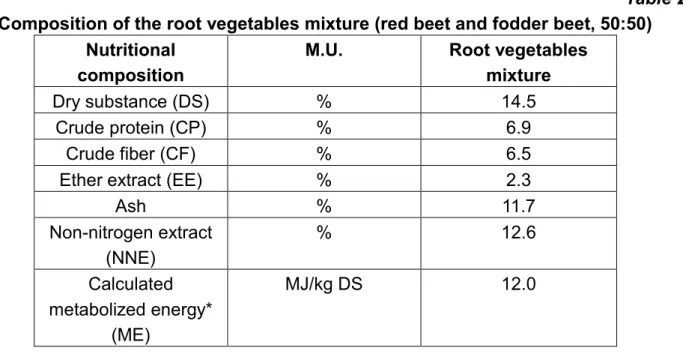
In the 1st portion, there has been introduced a mixture of equal parts de red beet and
479
Table 2 Composition of the root vegetables mixture (red beet and fodder beet, 50:50)
Nutritional composition
M.U. Root vegetables
mixture
Dry substance (DS) % 14.5
Crude protein (CP) % 6.9
Crude fiber (CF) % 6.5
Ether extract (EE) % 2.3
Ash % 11.7
Non-nitrogen extract (NNE)
% 12.6
Calculated metabolized energy*
(ME)
MJ/kg DS 12.0
*ME (MJ/kg) = 0.012 CP + 0.031 EE+0.005 CF + 0.014 NNE (according to MAFF 1975)
Starting with the 21st day before the parturition date and until the 21st day of the
milking period, both groups of animals have received the 3rd portion (table no. 1). The portion
contains adequate nutrients for a cow of 600 kg and 28 liters of milk per day.
The body condition has been appreciated at 56 days before the parturition date and weekly until the parturition date and at 21 days from the milking date. In the period of 56-21 days before their parturition date, the animals have been kept free in two stalls, and in the period of 21 days before the parturition and until the parturition moment, in two compartments in their maternity period, in a connected system, with a daily exit to the paddock. Every day, the feeding ingredients have been measured in a group and individually, during the maternity period. The calves have been separated from their mothers after a maximal period of 2 hours since their birth moment and then they have been placed in individual stalls. The 1st group was made up of 6 cows, 3 female calves and 3 male calves,
and the 2nd group was made up of 6 cows, 4 female calves and 2 male calves.
The new born male calves have been weighted after their birth moment (day =) and after 21 days of life (the final day of the experiment).
During the first 3 days, the male calves have received colostrum and transition milk in a quantity of 10 % from their body weight. Since the 4th day until the 21st day, the male
calves have received milk (2x3 liters) at 7:00 o’clock and at 16:00 o clock and a starter concentrated mixture, whenever they wanted. All the animals have had access to water.
TAKING TESTS AND THEIR ANALYSIS
Colostrum
There have been taken colostrum tests (0,5 1) from every cow at a maximal period of 2 hours since the parturition moment (the first milking), at 6 hours after the parturition moment (the second milking), at 12 hours after the parturition moment (the third milking) and at 24 hours after the parturition moment (the fourth milking) in the period: March-April 2017. The total quantity of colostrum from every milking has been weighted with the KERN EOE balance.
480
temperature of 40°C. The bottles with colostrum tests have been well mixed (by an up and down reversing moment, realized for 10 times, in order to assure a good distribution of the components). The quality of the colostrum in this report is expressed in % Brix or protein content, because both measurements are correlated with the volume of immunoglobulins G (Fllenov and Stott, 1980, Bielman et al. 2010, Quigley and others 2013).
Moreover, the colostrum tests have been analyzed for their content of protein and grease with the ultrasonic equipment EKOMILK -MILK Analyzers.
Data organization
The data have been arranged in two separate subsets, colostrum and milk data and data concerning the nutrients.
The data about the colostrum and the milk refer to the quantity of colostrum for every animal and its composition.
The data about nutrients refer to the fodder portions that have been used and the quality and the quantity of the ingredients for the included fodder.
Statistic analyses
The descriptive statistics have been used to compare the % Brix values between the animals and between the portions. The have been calculated the averages, the standard deviations, the variation coefficients and the variation field. The concentration of the colostrum in immunoglobulin G has been done according to the following relation: a Brix value of 22 % of the colostrum is equivalent with a concentration Ig G de 50 g/ liter.
The blood serum
The blood tests from the new born calves have been taken in the 3rd day of life, in
test tubes with a coagulant and then they have been kept at the ambient temperature for the serum’s expression. The tests have been analyzed in the same day, with the same refractometer, in order to get % Brix values from the serum of every calf.
The descriptive statistics has been used to compare the Brix % values and the content of Ig G from the calves’ blood.
RESULTS AND DISCUSSIONS
Colostrum quantity
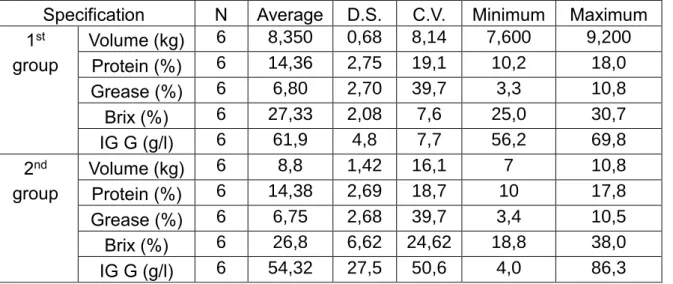
At the first milking, the quantity of the resulted colostrum was of about 8.350 ± 0.680 kg, the standard deviation at the 1st group of cows and of 8.800 ± 1.420 kg, the standard
deviation at the 2nd group of cows (table no. 3). The variability coefficient being of 8.14 %
at the 1st group and of 16.1 % at the 2nd group (table no. 3). We can remark the fact that the
Holstein cows, with high milk productions, produce a quantity of colostrum which is bigger than the quantity that can be consumed by a new born calf. Statistically, between the two averages there is no significant difference. However, we can observe the significant differences concerning the variability coefficient of the production of colostrum between the two lots (8.14 % at the 1st group and 16.1 at the 2nd group). Probably, the 1st recipe, where
there has been introduced the mixture of root vegetables, has not determined a large variation of the quantity of colostrum.
Colostrum quality
The quality of the colostrum is given by the protein and grease percentage of the collected colostrum and by the content of immunoglobulins.
The protein percentage of the colostrum for the 1st group of cows was of about 14.36
± 2.75 %, standard deviation and of 14.38 ± 2.69 % standard deviation at the 2nd group of
cows (table no. 3). The difference between the two averages is not statistically significant. The variability of this character was of 19.1 % for the 1st group of cows and of 18.7 % for the
481
The grease percentage from the cows’ colostrum, for the 1st group was of about 6.80
± 2.70 %, standard deviation and of 6.75 ± 2.68 %, standard deviation for the 2nd group of
cows. The difference between the two averages is not statistically significant. The variability coefficient for the colostrum grease percentage was of about 39.7 % for both groups of cows.
Table 3 Descriptive statistics for the data concerning the colostrum quality and quantity
The colostrum tests have a Brix percentage of about 27.33 ± 2.08 % and of 26.8 ±
6.62 % for the 2nd group of cows. This fact means that the limit value (minimal value) of 50
g/1, which is the equivalent of a Brix value of 22 % has been generally realized, by both cow groups. However, in the case of the 2nd group of cows, a percentage of 16.6 % of the tests
have not accomplished this criterion.
The results of this study indicate a large variability for the Brix percentage, at the 2nd
group (from 18.8 % to 38.0 %) compared with the 1st group from 25 % to 30.7 %. The time
interval between the parturition moment and the collection of the colostrum influences the production of colostrum and the concentration of Ig G. A bigger interval determines an increase of the production of colostrum and a decrease of the concentration of Ig G (Connely and others 2013).
In the previous studies (Găvan C. and V. Motorga, 20091 and Găvan C. and V.
Motorga, 20092) there has been identified a percentage of 16 % of the cows (with milking
from 1 to more than 4) that have had a colostrum quantity, collected with the occasion of the first milking, under 50 g of Ig G per colostrum liter for the whole lot from SCDA Şimnic. Faber and his collaborators, 2005 have reported a percentage of 15 % of the cows with an inferior colostrum, and Gulliksen and his collaborators 2008 have found a percentage of 57.8 %
from the 1250 colostrum tests, with lesser than 50 g of Ig G/1 of colostrum.
Hastetlr and his collaborators, 2003, have found big concentrations of Ig G in the initial fraction of the first collected colostrum, compared with the last fraction. This fact can be taken into consideration for establishing a strategy concerning the management of the colostrum collection in the case of the new born calves. A smaller volume of colostrum but with a big quantity of Ig G can be offered for the new born calves.
Specification N Average D.S. C.V. Minimum Maximum 1st
group
Volume (kg) 6 8,350 0,68 8,14 7,600 9,200
Protein (%) 6 14,36 2,75 19,1 10,2 18,0
Grease (%) 6 6,80 2,70 39,7 3,3 10,8
Brix (%) 6 27,33 2,08 7,6 25,0 30,7
IG G (g/l) 6 61,9 4,8 7,7 56,2 69,8
2nd
group
Volume (kg) 6 8,8 1,42 16,1 7 10,8
Protein (%) 6 14,38 2,69 18,7 10 17,8
Grease (%) 6 6,75 2,68 39,7 3,4 10,5
Brix (%) 6 26,8 6,62 24,62 18,8 38,0
482
Table 4 Descriptive statistics for the data concerning the content of Ig G from the blood
serum in case of the new born calves
Specification MU n Averag e
± DS CV Minimum Maximum
1st group
Brix Ig G
% mg/ml
6 6
9.1 11.69
0.89 1.15
9.8 9.80
8.3 10.64
10.5 13.46 2nd group
Brix Ig G
% mg/ml
6 6
7.3 9.36
2.75 3.53
37.6 37.71
3.7 4.74
10.40 13.33 The Brix % value was of about 9.1 ± 0.89 % DS for the 1st group of cows, compared
with 7.3 ± 2.75 % D.S. for the 2nd group. The variability coefficient of the Brix % values was
of 9.8 in the 1st group and of 37.6 % in the 2nd group. The minimal limit for the content of Ig
G from the blood serum of the calves should be of 10 mg/ml or 10 g/1.
The content of Ig G from the blood serum was of about 11.69 ± 1.15 g/1 for the 1st
group of calves and of 9.36 ± 3.53 g/1 for the 2nd group of new born calves.
In the 1st group, all the new born calves have had over the minimal limit of 10 g/1 Ig
G in the blood serum. In the 2nd group of calves a percentage of 33.33 % have had under
the minimal limit of 10 g/1 of blood serum. The calves with values of the Ig G from the blood serum under 10 g/1 are calves with an inadequate transfer of the passive immunity from the mother to the fetus.
The inadequate transfer of the passive immunity is associated with the increase of the morbidity and mortality of the calves, with the reduction of the increase rate concerning the weigh and the body development and by reducing the production of milk in case of the female cows, at their first parturition.
CONCLUSIONS
The researches based on the optimal foddering of the cows in their period of dry cycle reveal new knowledge about the necessary of nutrients.
The quality of the colostrum measured with the refractometer (% Brix) is different both between the animals and also between the two experimental lots.
In this study thecomplementarity with soluble sugars, mineral salts, vitamins and pigments from the roots of the red beet and of the fodder beet could be used as a marker in the prediction of the colostrum quality in case of the cows that are in their period of dry cycle. However, their biological role should be elucidated.
483
BIBLIOGRAPHY
1. Bielman V., J. Gillan, N.R. Perkins, A.L. Skidmore, S. Godden, K.E. Leslie, 2010. An evaluation of Brix refractometry instruments for measuremant of colostrum quality in dairy cattle. J. Dairy Sci 93:3713-3721.
2. Conneelly M., D.P. Berry, R. Saiers, J.P. Murphy, I. Loreny, M.L. Doherty, E. Kennedy, 2013. Factors associated with the concentration of immunoglobulin G in the colostrum of dairy cows. Animal 7 (11) 1824-1832. 3. Faber S.N., N.E. Faber, T.C.Mc. Canly, R.L. Ax,2005. Effects of colostrum ingestion on
lactational performance. The Professional Animal Scientist 21: 420-425. 4. Fleenor W.A. and G.H. Stott,1980. Hydrometer Test for estimation of Immunoglobulin
Concentration in Bovine Colostrum. Journal of Dairy Science 63:973-977. 5. Găvan C., V. Motorga, 20091. Effects of colostrum supplementation on health and
growing performance in Holstein calves. Book of abstracts of the 8th International Symposium of Animal Biology and Nutrition pg. 20.
6. Găvan C., V. Motorga, 20092. Effects of abnormal parturition on colostrum components in Holstein dairy Cows. Book of abstracts of the 8th International Symposium of Animal Biology and Nutrition pg. 20.
7. Gulliksen S.M., K.I. Lie, L. Salverod and O. Osteras,2008. Risk factors associated with colostrum quality in Norvegian dairy cows. J. Dairy Sci. 91:704-712.
8. Kehoe S.I., B.M. Jayarao, A.J. Heinricks, 2007. A Suvvey of Bovine Colostrum Composition and Colostrum Management Practices on Pensylvania Dairy Ferm. J. Dairy Sci. 90:4108-4116.
9. MAFF (Ministry of Agriculture, Fisheriesand Food), 1975. Energy Allowances and Feeding Systems for Ruminants. Technical Bulletin 33 HMSO – London. 10. Quigley J.D., A. Lago, C. Chapman, P. Erickson, J. Polo,2013. Evaluation of the Brix
refractometer to estimate immunoglobulin G concentration in bovine colostrum. Journal of Dairy Science 96:1148-1155.