Encounted Malware Using Spyware In Delay Tolerant Network
B.Estheramma1, G. Dayanandam2, Dr. T. V. Rao31Department of CSE, QISCET, Ongole, Andhra Pradesh, INDIA
2Department of CSE, Research Scholar, ANUCET, Guntur, Andhra Pradesh, INDIA 3Department of CSE, PVPSIT, Vijayawada, Andhra Pradesh, INDIA
Email:[email protected];[email protected]
3[email protected] ABSTRACT:
Delay Tolerant Network (DTN) have some kind of system attributes because of which discovering a pernicious and narrow minded conduct in the system is incredible test in DTN. So framework with iTrust, a probabilistic mischief identification plan for secure DTN steering towards proficient trust foundation is proposed here. The essential sign of iTrust is introducing an intermittently existing Trusted Authority (TA) to judge the hubs to conduct in light of the gathered directing confirmations and probabilistic assessment. It additionally gives verification in secure way to all the clients in correspondence system. Proposed framework will distinguish every one of the sorts of assault happened in the system and recognize the malevolent client in system. Trouble making of hub speaks to a genuine danger against directing in deferral tolerant system. In this paper primarily center to enhance the bundle misfortune amid the transmission of parcel one hub to another, furthermore it manages childish and pernicious hub. This paper presents an intermittently accessible trusted power. TA judges any hub in the system by gathering the history proof from upstream and downstream hub. TA could rebuff and remunerate the hub in light of its practices. Every hub must pay the store before it joins intothe systems, and the store will be paid after, then the hub leave if there is no mischievousactivitiesof hub. This paper additionally concentrates on security between the hubs in DTN. We presented a mystery key which is created and utilized to share the information. The mystery key is consequently changed when the hub joins a system and leaves a system in light of quick randomized calculation. So we can expand the level of security in postponed tolerant system.
Keywords: Delay Tolerant Networks (DTN), Network Security, Trust Management.
I. Introduction:
Delay tolerant system is a way to deal with PC system building design that looks to address the specialized issues in heterogeneous system. It may need nonstop system integration. Illustrations of these systems are those working in portable or arranged systems in space, or amazing physical situations. In
Fig. System Architecture
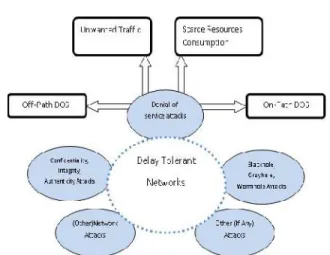
Egotistical hubs minimize their commitments to the system group and expand their own additions by putting scheming hubs into the system group (to snatch data). Noxious hubs assault fitting system operations and don't consider their own additions. DTNs security conventions must be more insusceptible and intense to handle these sorts of hubs. Additionally the qualities of DTNs and attributes of portable specially appointed systems are far off which makes these security conventions ineligible for DTNs. DTN-particular security arrangements are needed. In this manner, generally security framework is not suitable. Messages in DTNs are called as packs. They cross through Delay Tolerant Network pack operators who share in group interchanges to shape the DTN as store-and-forward overlay system. Make trouble imply that to act seriously or shamefully. In the adhoc system that absolutely rely on the one another hub for trade of data. Get out of hand in system that hub does not perform its undertaking in a legitimate manner. In PC systems an assault is any endeavor to annihilate, uncover, adjust, impair, take or increase unapproved access to or make unapproved utilization of a benefit. This paper primarily concentrates on dark opening assault, blackhole assault and wormhole assault these assaults are hurtful assaults against the DTN system. Dark gap is a hub that can change from carrying on effectively to act like a dark opening and it is actually an aggressor and it will go about as a typical hub, dark openings is an assault in the system where approaching or active movement is quietly disposed of (or "dropped") without illuminating the source that the information did not achieve its planned beneficiary. Worm gap assault is a system that mine data to another system i.e., itwill get the information from one system duplicate system to another through passage. DTNs system are experienced the ill effects of absence of contemporaneous, end-to-end way High variety in system conditions, difficulty to foresee versatility, examples like Long Input Delay.
As of late, there are truly a couple of proposition for mischievous activities discovery in DTN, the vast majority of which are in view of sending history confirmation (e.g., multi-layered credit, three-bounce input transmission, or experience ticket), which are exorbitant in term of transmission overhead and check cost. The fundamental thought of TA is to judge the hub, taking into account the gathered directing proof. Before joining or leaving the hub the contact to TA about the way before sending the bundle to each other hub.
II. Related Work
III. System Model
In the present work we consider the DTN environment without any centralized trusted authority (TA). Nodes are able to use multi hops communication. Node exchanges the information on encounters with another node.
Selfish Behavior and Model
The selfish behavior of the node is defined as the unwillingness of node in participation of its resources on others requirement, this is generally done to maintain its limited resources such as power. Since DTNs required participation of all nodes in packet relaying this could cause severe degradation of the performance. They considered selfish nodes acts for its own interests, so to save energy it just drop the packet but it may decide to forward a message with a certain probability. Two kind of selfishness: 1. Individual Selfishness: Here node forwards only those packets which are generated by it and drop packets from other node. 2. Social Selfishness: Here nodes are willing to forward packets for other nodes with whom they have social connect but not others and such willingness varies with the strength. Strategies [13] for prevention of selfishness are as follows: 1. Barter Based 2. Credit Based 3. Reputation Based. Barter Based is pair wise Tit-For-Tat strategy. The procedure is that two encounter nodes exchange the equal value of messages. A message in which the nodes are interested is called primary message and other are secondary messages, hence it degrades the performance of nodes drastically. Credit Based strategy are cooperative to forward the messages, the idea is to get certain amount of credit as a reward that it can later explore for its own profit. Credit Based are generally of two types: Message Purse Model and Message Trade Model. In Message Purse Model source node pay credits to the intermediate nodes which are involve in forward the messages to the destination. In Message Trade Model the sender of the message pay credits to receivers in each hop-by-hop transmission until the message reach the destination, which finally pays credits for the message forwarding. Reputation Based strategy based upon cooperative experiences and observation of its past activities. If the reputation value of a node is less, it reflects that the node is selfish according to other nodes, otherwise Cooperative nature to the nodes. Each intermediate node receives a reputation value after pass a message to other nodes. The reputation value is a proof about the cooperative nature of the intermediate node. Reputation Based are generally of two types: Detection Based Model and Without Detection Based Model. In Detection Based every node detects the behaviour of the receiver which receives the message from him, in order to monitor the selfishness and
encourage them to be cooperative in nature. In reputation the node is punished if it is not cooperate in nature. Reputation is also used in Social Selfishness Aware Routing (SSAR), the performance of the node is not affected by the not well-behaved nodes. First check the willingness of receiving node if it is ready then the message with higher delivery probability in the network is transferred. When a node behave as a selfish then forward the messages only to its community while a malicious node aims to break all the protocols of basic DTN routing functionality. A malicious node drops the packets and also performs the trust related attacks: 1. Self-promoting attacks: To attract other packets in the network its increase own importance by providing good credits or recommendations for itself. 2. Bad-monitoring attacks: It decreases the probability of packet routing through good nodes by providing bad recommendations and its ruin the reputation of well-behaved nodes. 3. Ballot stuffing: It increase the probability of packet transfer through malicious node by proving good recommendations to the bad nodes, it increase the reputation of not well-behaved nodes. A malicious node attacker performs random attacks to evade detection. We introduce a new random attack probability to reflect random attack behavior. When random attack probability is equal to 1, the malicious attacker is a reckless attacker, when random attack probability is less than 1 it is a random attacker. The node trust value is directly accessed by the trust evaluation and indirect trust value by recommendations.
IV. Proposed Scheme
In this section we are introducing a secret key and a fast randomized algorithm. We know that a DTNs have unique features of intermittent connectivity, which makes routing absolutely distant from other kind of wireless networks. Since an end to end connection is hard to arrangement, store-carry and forward is used to transfer the packet to the destination.
Advantages are Improved security.Less time consumption. No loss of data packet.Improved efficiency. Reduce the detection overheadadequately.Will reduce transportation overhead incurred by misbehavior detection and detect the malicious nodes effectively.
1. Secret Key
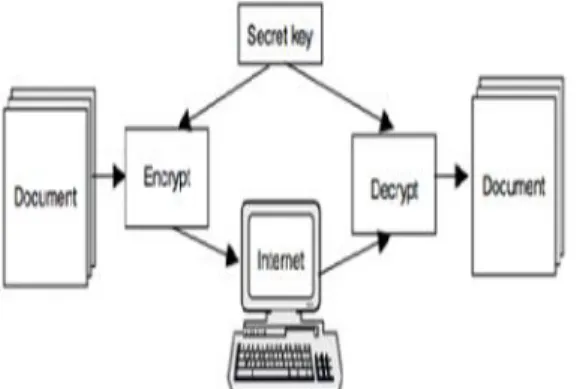
employs algorithms in which the key that is used to encrypt the original plaintext message can be calculated from the key that is used to decrypt the cipher text message and inversely. It has been used primarily to provide confidentiality. In secret key cryptography (also called symmetric key cryptography), only single key is used to perform both the encryption and decryption functions. The encrypted message can be freely sent from one location to another through an insecure intermediate, such as the Internet or a dial link. As the name signified, secret key cryptography relies on both parties keeping the key secret. If this key is negotiated, the security offered by the encryption process is eliminated.
Fig: secret key
Secret key cryptography has powerful limitations that can make it impractical as a stand-alone solution for securing electronic transactions, especially among large communities of users that may have no pre-established relationships. The most important limitation is that some means must be devised to securely distribute and key management manage the keys that are at the heart of the system.
Transmitting Over an Insecure Channel
It is generally impossible to avoid eavesdropping when transmitting information. For instance, a telephone conversation can be tapped, a letter can be interrupted, and a message transmitted on a LAN can be received by unauthorized stations. If you and I agree on a shared secret key then by using secret key cryptography we can send messages to one another on a medium that can be tapped, without worrying about hearers. All we need to do is for the sender to encrypt the messages and the receiver to decrypt them using the shared secret. An hearers will only see unintelligible data. This is the classic use of cryptography.
Secure Storage on Insecure Media
If any information i want to preserve but which i want to assure no one else can look at then i have to be able to store the media where i was sure that no one can get it. Between expert thieves and court orders, there are very few places that are actually
secure, and none of these are hard. If i invent a key and encrypt the information using the key, I can store it in any location and it is safe so long as I can remember the key. Of course, forgetting the key makes the data fully lost, so this must be used with great care.
Authentication
The term strong verification means that someone can prove knowledge of a secret without revealing it. Strong authentication is possible with cryptography. Strong authentication is particularly effective whentwo computers are trying to communicate over an insecure network.
2. A Fast Randomized Algorithm
This is an algorithm which gives excellent results when detect and verify on both source location as well as destination location networks and is much faster typically thousands of times faster than localized algorithms. It randomly provide a key for each node in network It gives a new randomized algorithm for achieving consensus among asynchronous processes that communicate by monitoring for every node in the entire network based on node key. An algorithm that employs a degree of randomnessas part of its logic, the algorithm consistently uses uniform random bits as an auxiliary input to guide its behavior in the hope of obtaining good performance in the "average case" over all possible choices of random bits. Properly, the algorithm's performance will be a random variable determined by the random bits, thus either the executing time or the output (or both) are random variables. One has to analyze between algorithms that use the random input to reduce the expected running time or memory usage but always terminate with a correct result in a bounded amount of time and probabilistic algorithms. A fast randomized algorithms are approximated using a pseudorandom number generator in place of a true source of random bits. Such a performance may deviate from the expected theoretical behavior. A fast Randomized algorithms are particularly useful when faced with a malicious "adversary" or attacker who deliberately tries to feed a bad input to the algorithm.
Advantages of Algorithm
It provide high securityEasily identify the attacker Less time consuming process Avoid packet loss Quick data transmission
3. Trusted Authority
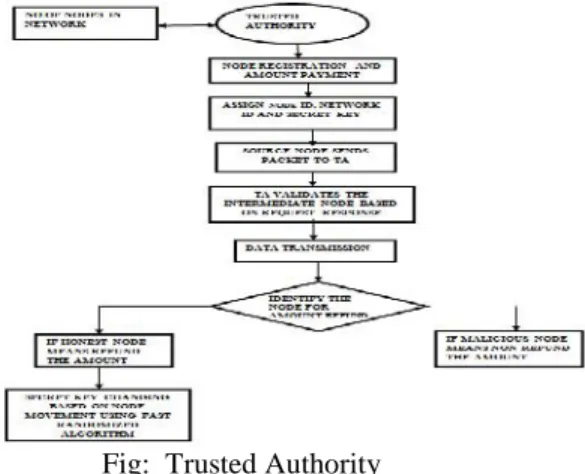
after the node leaves if there is no misbehavior activity of the node. The basic misbehavior detection scheme to prevent malicious users from providing fake delegation/forwarding/ contact evidences should check the authenticity of each evidence by verifying the corresponding signatures which introduce a high transportation and signature verification overhead.
Fig: Trusted Authority
V. Mitigating Routing Misbehavior in Disruption Tolerant Networks
In disruption tolerant networks (DTNs), selfish or malicious nodes could fall received packets. Such routing misbehavior decreases the packet delivery ratio and wastes system resources such as power and bandwidth. Although methods have been suggested to mitigate routing misbehavior in mobile ad hoc networks, they were unsuitable to DTNs because of the intermittent connectivity between nodes. To address the problem, in this paper we proposed a distributed scheme to detect packet dropping in DTNs [8]. In this scheme, a node is required to keep a few signed contact records of its earlier contacts, based on which the next contacted node can detect if the node has released any packet. Since misbehaving nodes may misrepresent their contact records to escape being detected, a small percentage of each contact record is circulated to a certain number of witness nodes, which can gather suitable contact records and detect the misbehaving nodes. We also suggest a system to mitigate routing misbehavior by limiting the number of packets forwarded to the misbehaving nodes.
VI. Key Changing based on Node Movement
In this module, source node wants to move one network means, its private key also changed by network based on fast randomized algorithm. Same time once node move to another network means, existing network completely change the each node private key for security purpose. Suppose this source node hacks its previous network data means, it user their previous private key. But this private key changed so it did not access previous network data.
VII. Routing in Socially Selfish Delay-Tolerant Networks
Existing routing algorithms for Delay Tolerant Networks (DTNs) undertake that nodes are ready to forward packets for others. But node could misbehave selfishly by ignoring or dropping packets. In this paper, author proposes a Social Selfishness Aware Routing (SSAR) algorithm [3] to allow user selfishness and offer improved routing performance in an effective way. To choice a forwarding node,
SSAR studies both user’s willingness to forward and their contact chance, affecting in a well forwarding system than purely contact-based methods. Trace-driven simulations show that SSAR permits users to keep selfishness and accomplishes improved routing performance with low transmission cost.
VIII. Conclusion
In this paper, we propose a probabilistic misbehavior detection scheme, which could reduce the transmission overhead. It will reduce the high verification cost incurred by routing evidence auditing. We introduce a probabilistic misbehavior scheme which allows the trusted authority to launch the misbehavior detection at a certain probability. Our simulation results confirm that trust model will increase the detection performance and detect the malicious nodes effectively. Our future work will focus on the extension of trust to other kinds of network. The proposed system follows the same malicious node detection scheme and security mechanisms performed in the existing network. In order to make the DTN more reliable and efficient, the proposed system forms clusters among the nodes in the network. This work will reduce the energy consumption by the nodes and it will reduce the traffic and save the detection time in the network as it performs the detection scheme and security mechanisms on the clusters in the network
References
[1] Wei Peng, Student Member, IEEE, Feng Li,
Member, IEEE, Xukai Zou, Member, IEEE, and Jie Wu, Fellow, IEEE Transactions on parallel and distributed systems, vol. 25, NO. 1, January 2014. [2] Haojin Zhu, Suguo Du, ZhaoyuGao, Mianxiong
Dong, and Zhenfu Cao, “A Probabilistic Misbehavior
Detection Scheme toward Efficient Trust Establishment in Delay-Tolerant Networks”, IEEE
transactions on parallel and distributedsystems,vol.25,no.1,january2014.
[3] Q. Li, S. Zhu, and G. Cao,“Routing in Socially Selfish DelayTolerant Networks,” Proc. IEEE INFOCOM ’10, 2010.
[4] H. Zhu, X. Lin, R. Lu, Y. Fan, and X. Shen,
IEEE Trans. Vehicular Technology, vol. 58, no. 8,pp. 828-836, 2009.
[5] Q. Li and G. Cao, “Mitigating Routing Misbehavior in Disruption Tolerant Networks,” IEEE
Trans. Information Forensics and Security,vol. 7, no. 2, pp. 664-675, Apr. 2012.
[6] R. Lu, X. Lin, H. Zhu, and X. Shen, “Pi: A
Practical Incentive Protocol for Delay Tolerant
Networks,” IEEE Trans. Wireless Comm., vol. 9, no.
4, pp. 1483-1493, Apr. 2010.
[7] E. Ayday, H. Lee, and F. Fekri, “Trust
Management and Adversary
DetectionforDelayTolerantNetworks,”Proc.MilitaryC
omm.Conf.( Milcom’10), 2010.
[8] B.B. Chen and M.C. Chan, “Mobicent: A Credit -BasedIncentive System for Disruption-Tolerant
Network,” Proc. IEEEINFOCOM’10,2010.
[9] A. Lindgren and A. Doria, “Probabilistic Routing Protocol for Intermittently Connected Networks,”
draft-lindgren-dtnrgprophet-03, 2007.
[10] W. Gao and G. Cao, “User-Centric Data
DisseminationinDisruptionTolerant Networks,” Proc. IEEE INFOCOM ’11, 2011.
[11] T. Hossmann, T. Spyropoulos, and F. Legendre,
“Know the Neighbor: Towards Optimal Mapping of
Contacts to Social Graphs for DTN Routing,” Proc. IEEE INFOCOM ’10, 2010.
[12] O. Younis, M. Krunz, and S. Ramasubramanian,
“Node
ClusteringinWirelessSensorNetworks:RecentDevelop
mentsandDeploymentChallenges,”IEEENetwork,
vol.20,no.3,pp.20-25,May/June2006.
[13] S. Bandyopadhyay and E. Coyle, “An Energy
Efficient Hierarchical Clustering Algorithm for
Wireless Sensor Networks,” Proc.IEEE INFOCOM,
vol. 3, pp. 1713-1723, Mar.2003.
[14] Vahdat, Amin; Becker, David (2000), "Epidemic routing for partially connected ad hoc networks", Technical Report CS-2000- 06, Duke University. [15] Harminder Singh Bindra, AmritLalSangal,”
Considerations and Open Issues in Delay Tolerant
Network’S (DTNs) Security”, Department of
Computer Science and Engineering, NIT Jalandhar, Punjab, India, June 2, 2010.
Acknoledgment